instrument cluster AUDI A4 2015 Owner's Manual
[x] Cancel search | Manufacturer: AUDI, Model Year: 2015, Model line: A4, Model: AUDI A4 2015Pages: 304, PDF Size: 74.86 MB
Page 108 of 304
106 Audi adap tive cruise control and br aking guard
Setting the distance
Applies to vehicles: wit h Aud i adapt ive cru ise co ntrol
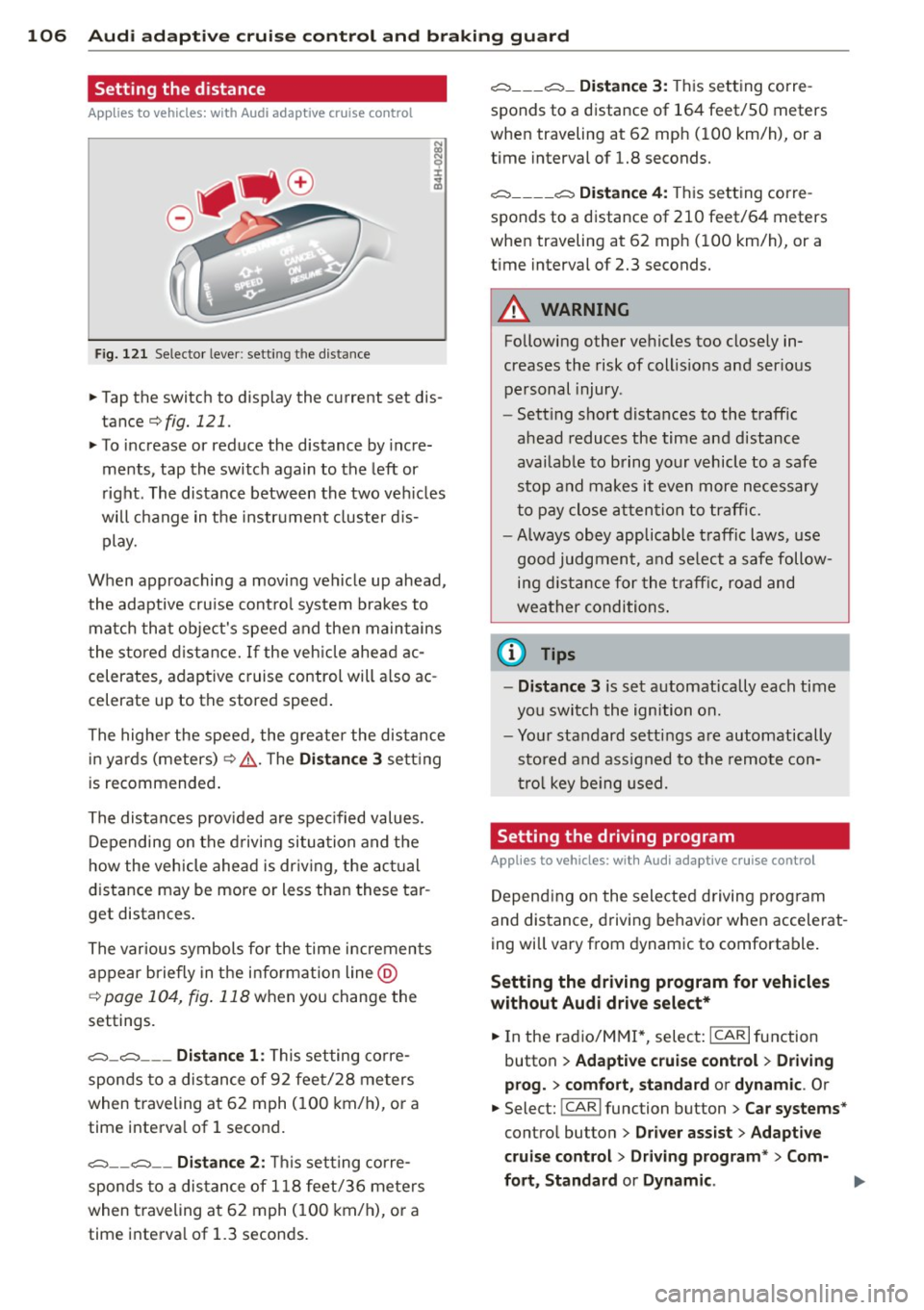
F ig. 121 Selector lever: setting the distance
~ Tap the switch to display the current set dis
tance
¢fig. 121.
~ To increase or reduce the distance by incre
ments, tap the switch again to the left or
right. The distance between the two veh icles
will change in the instrument cluster d is
play.
When approaching a moving vehicle up ahead,
the adaptive cru ise cont rol system brakes to
matc h that object's speed and then maintains
the stored d istance. If the vehicle ahead ac
celerates, adaptive cruise control will also ac
celerate up to the stored speed.
The highe r the speed, the greater the distance
in yards (meters)¢ ,&.. T he
Di st a nc e 3 setting
is recommended .
The distances p rov ided are specified values.
Depending on the driving situation and the
how the vehicle ahead is dr iving, the actual
distance may be more or less than these tar
get distances .
The various symbols fo r the time increments
appear briefly in the information line @
c;, page 104, fig. 118 when you change the
settings.
c::::::,_c::::::, ___ Dist ance 1: This setting corre-
sponds to a distance of 92 feet/28 meters
when traveling at 62 mph (100 km/h), or a
time interva l of 1 second.
c::::::, __ c::::::, __ Dista nce 2 : This setting corre
sponds to a distance of 118 feet/36 meters
when traveling at 62 mph (100 km/h), or a
time interva l of 1.3 seconds .
c::::::, ___ c::::::, _ Dista nce 3 : This setting corre-
sponds to a distance of 164 feet/SO meters
when traveling at 62 mph (100 km/h), or a
time interval of 1.8 seconds.
c::::::, ____ c::::::, Dista nce 4 : This setting corre-
sponds to a distance of 210 feet/64 meters
when traveling at 62 mph (100 km/h), or a
t ime interval of 2.3 seconds.
A WARNING
Following other vehicles too closely in
creases the risk of collis ions and ser ious
personal injury .
- Sett ing short distances to the traffic
ahead reduces the time and distance
availab le to bring your vehicle to a safe
stop and makes it even more necessary
to pay close attention to traffic.
-
- Always obey applicable t raffic laws, use
good judgment, and select a safe follow
ing d istance for the t raff ic, road and
weather conditions .
0) Tips
-Distan ce 3 is set automatically each time
you switch the ignition on.
- Your standard settings are automatically
stored and ass igned to the remote con
tro l key be ing used.
Setting the driving program
Applies to veh icles: w ith Audi ada ptive c ruise control
Depending on the selected driving program
and distance, driving behavior when accelerat
ing will vary from dynamic to comfortable .
Setting the dri ving program for vehicles
without Aud i d riv e se le ct*
~ In the radio/MM!*, select: ICARlfunction
button
> Ad apti ve cr uise cont rol > D rivi ng
p rog.
> c omfort, sta nd ard or dyn amic . Or
~ Select: !CAR I function button > Car systems *
control button > Driver assi st > A dapt ive
c ruis e control > Dr iving p rogram *
> Com-
f o rt , Standard
or D ynamic . ll-
Page 109 of 304
M N
~ co
rl I.O
"' rl
"' rl
Audi adaptive cruise control and braking guard 107
Setting the driving mode for vehicles with
Audi drive select*
Refer to <=> page 116.
(D Tips
Your settings are automatically stored and
assigned to the remote control key being
used.
Request for driver intervention
Applies to vehicles: with Audi adaptive cruise control
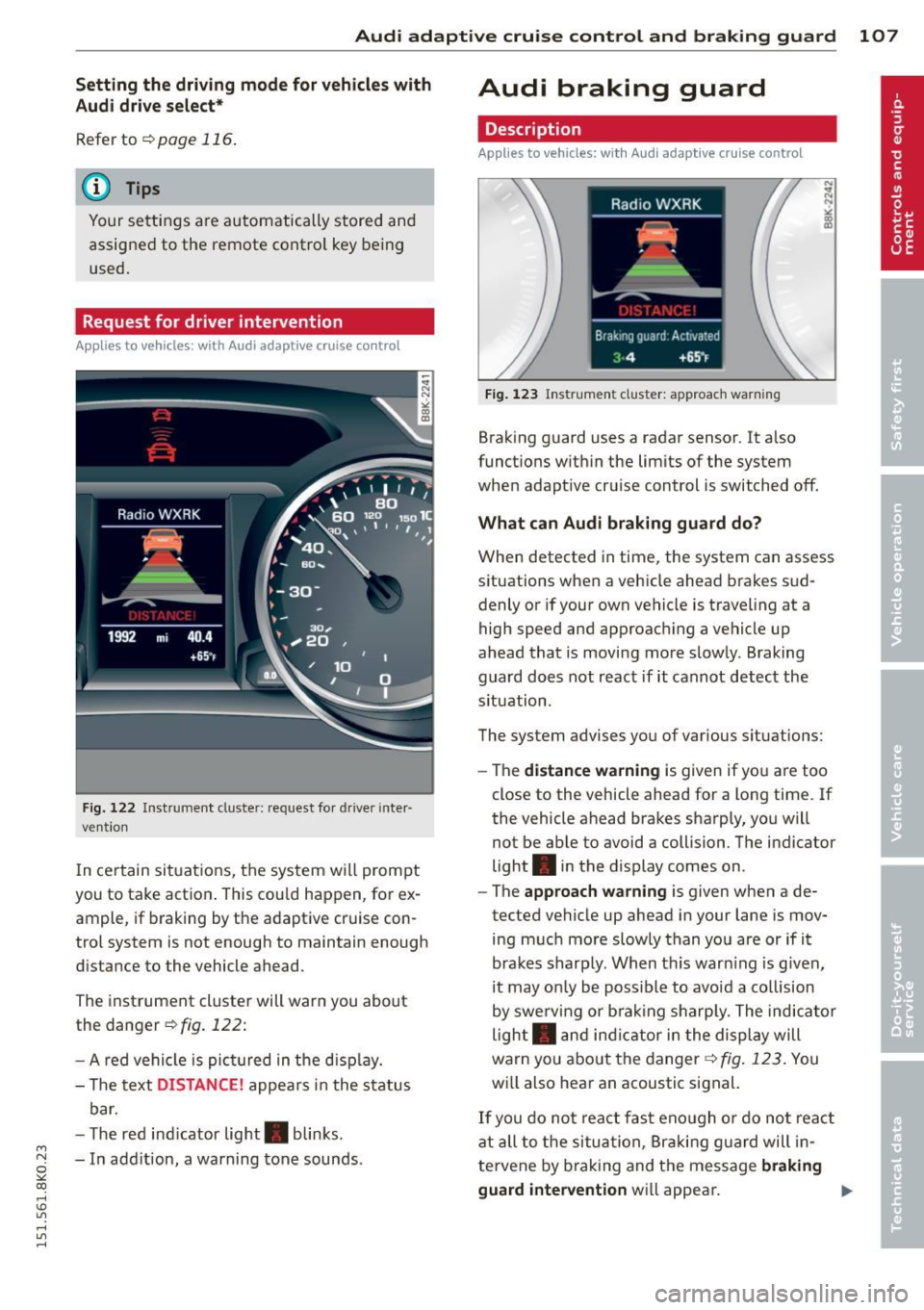
Fig. 122 Inst rumen t cl us ter: reques t for drive r inte r·
vention
I n ce rtain situat ions, the system will prompt
you to take action . This cou ld happen, for ex
ample, if braking by the adaptive cruise con
trol system is not enough to maintain enough
distance to the vehicle ahead.
The instrument cluster will warn you about
the danger<=>
fig. 122:
- A red vehicle is pict ured in the disp lay.
- The text
DISTANCE! appears in the status
bar.
- T he red ind icator light . blinks.
- In add ition, a warning tone sounds.
Audi braking guard
Description
Applies to vehicles: with Audi adaptive cruise control
Fig. 123 Instr ument cluster: approach warning
Braking guard uses a radar sensor. It also
functions within the limits of the system
when adapt ive cruise control is switched off.
What can Audi braking guard do?
When detected in time, the system can assess
situations when a vehicle ahead brakes sud
denly or if your own vehicle is traveling at a
high speed and approaching a vehicle up
ahead that is moving more slowly. Braking
guard does not react if it cannot detect the
s ituation.
The system advises you of various situations:
- The
distance warning is given if you are too
close to the vehicle ahead for a long time. If
the vehicle ahead brakes sharply, you will
not be able to avoid a collision . The indicator
light . in the display comes on .
- The
approach warning is given when a de
tected vehicle up ahead in your lane is mov
ing much more slowly than you are or if it
brakes sharply. When thi s war ning is given,
it may on ly be possible to avoid a co llision
by swerving or brak ing sharp ly. The indicator
light . and indicator in the display will
warn you about the danger
r=.> fig. 123. You
wi ll also hear an acoustic signal.
If you do not react fast enough or do not react
at all to the situation, Braking guard will in
te rvene by brak ing and the message
braking
guard intervention
wi ll appear. ~
Page 138 of 304
136 Safety belts
Safety belts
General notes
Always wear safety belts!
Wearing safety belts correctly saves lives!
This chapter explains why safety be lts are nec
essary, how they work and how to adjust and
wear them correctly .
.. Read a ll the information that fo llows and
heed all of the instructions and WARNINGS.
A WARNING
Not wearing safety belts or wearing them
improperly increases the risk of ser ious
personal in jury and death .
- Safety belts are the sing le most effective
means avai lab le to reduce the risk of se
r ious injury and dea th in a utomob ile acci
dents. For your protection and that of
yo ur passenge rs, always co rrectly wear
safety belts when the vehicle is moving.
- Pregnant women, injured, or physically
im paired perso ns m ust also use safety
belts. Lik e all veh icle occup ants, they are
more like ly to be ser iously injured if they
do not wea r safety be lts . The best way to
protect a fetus is to protect the mother -
throughout the entire pregnancy.
Number of seats
Your Audi has a total of five seating positions: two in the front and three in the rear. Each
seating position has a safety belt.
A WARNING
Not wea ring safety belts or weari ng them
improp erly increases the risk of ser ious
pe rsonal i njury and deat h.
- Never st rap more than one pe rson, in
cl uding small ch ild ren, into any belt.
It is
e speci ally dange rous to pla ce a safety
belt over a child s itting on yo ur lap.
- N ever le t mo re people ride in the ve hicl e
than there are s afe ty be lts avail able. -
Be s ure everyone riding in the vehicle is
properly restrained w ith a separate safe
ty belt or child restra int.
Safety belt warning light
Your vehicle hos o warning system for the
driver and (on USA models only) front seat
passenger to remind you about the impor
tance of buckling-up .
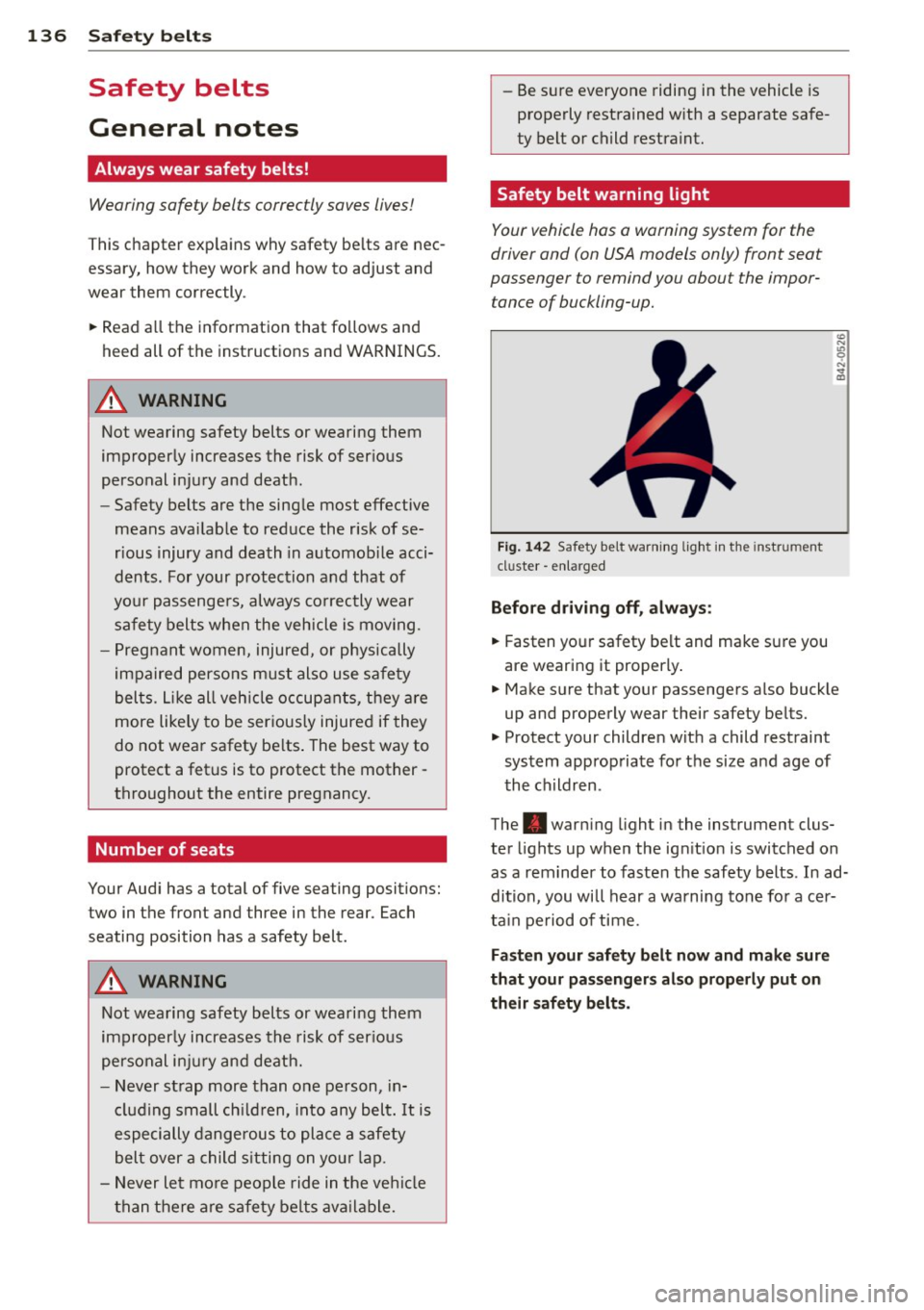
F ig. 142 Safety belt warni ng lig ht in the instrument
cluster -en larged
Before driv ing off, always :
.. Fasten yo ur safety belt and make sure you
are wearing it properly .
.. Make sure that your passengers also buck le
up and properly wear their safety be lts.
.. Protect your children wit h a child restraint
system approp riate fo r the size and age of
t he children.
The . war ning light i n the instrument clus
ter lights up when the ig nition is switched on
as a rem inder to fasten the safety belts. In ad
dition, you will hear a warning tone fo r a cer
ta in pe riod of time.
Fasten your safety belt now and make sure
that your pa ssenger s also prope rly put on
their safety belts.
Page 148 of 304
146 Airbag system
Even though your vehicle is equipped with an
Advanced Airbag System, make certain that
all chi ldren, especially those 12 years and
younger, a lways ride in the back seat properly
restrained for their age and size. The airbag
on the passenger side makes the front seat a potentially dangerous place for a ch ild to ride.
The front seat is not the safest place for a
child in a forward-facing child safety seat. It
can be a very dangerous place for an infant or
a child in a rearward-facing seat.
The Advanced Airbag System in your veh icle
has been certified to comply with the Requ ire
ments of United States Federal Motor Vehicle
Safety Standard 208 as applicable at the time
your vehicle was manufactured.
The Standard requires the front a irbag on the
passenger side to be turned off ("sup
pressed") if a child up to about one year of
age restrained in one of the rear-facing or for
ward -facing infant restraints listed in Federal
Motor Vehicle Safety Standard 208 with which
the Advanced Airbag System in your vehicle
was certified has been installed on the front passenger seat . For a listing of the child re
strai nts that we re used to certify compliance
with the US Safety Standard
r=v page 167.
The PASSENGER AIR BAG OFF light in the in
strument panel te lls you when the front Ad
vanced A irbag on the passenger side has been
turned off by the e lectronic control unit.
Each t ime you turn on the ignition, the
PAS
SENGER AIR BAG OFF
light will come on for a
few seconds and:
- will stay on if the front passenger seat is not
occupied,
- will stay on if there is a small child or child restraint on the front passenger seat,
- wi ll go off if the front passenger seat is oc
cupied by an adult as registered by the
weight-sensing mat
r=v page 154, Monitor
ing the Advanced Airbag System .
The PASSENGER AIR BAG OFF light comes on
when the control un it detects a total weight
on the front passenger seat that requires the
front airbag to be turned off.
If the total weight on the front passenge r
seat is more than that of a typica l 1 year -old
chi ld but less than the weight of a small
adult, the front airbag on the passenger side
can deploy (the
PASSENGER AIR BAG OFF
light does not come on). If the PASSENGER
AIR BAG OFF
light does not come on, the
front airbag on the passenger side has not
been turned off by the electronic con trol unit
and can deploy if the control unit senses an
impact that meets the cond itions stored in its
memory .
For example, the airbag may deploy if:
-a small ch ild that is heav ier than a typical 1
year-old ch ild is on the front passenger seat
( re gard less of whether the child is in one of
the child safety seats listed
r=v page 167), or
- a child who has outgrown ch ild restraints is
on the front passenger seat.
If the front passenger airbag is turned off, the
PASSENGER AIR BAG OFF light comes on in
the instrument cluster and stays on.
The front airbag on the passenger s ide may
not deploy (the PASSENGER AIR BAG OFF
light does not illum inate and stay lit) even if a
small adult or teenager, or a passenger who is
not sitt ing upright with their back against a
non-reclined backrest with their feet on the
vehicle floor in front of the seat is on the front
passenger seat
r=v page 12 7, Proper seating
position for the driver.
If the front passenger airbag deploys, the
Federal Standard requires the airbag to meet
the "low risk" deployment criteria to reduce
the risk of injury t hroug h interaction with the
airbag. "Low risk" deployment occurs in those
crashes that take place at lower dece lerat ions
as defined in the electronic control unit
r=v page 155, PASSENGER AIR BAG OFF light .
Always remember, a child safety seat or infant
carr ier installed on the front seat may be
struck and knocked out of posit ion by the rap
idly inflat ing passenger's airbag in a frontal
collision . The air bag could greatly reduce the
effectiveness of the ch ild restraint and even
seriously injure the child during inflation .
Page 153 of 304
"' N
0 ::.,: co ,...., \!) ..,.,
,...., ..,., ,....,
th e forward-facing child res traint. The
backrest must be adjusted to an upr ight
posit ion.
- Make sure that the
PASSENGER AI R BA G
OFF
light comes on and stays on all the
t ime whenever the ignition is switched
on.
Advanced Airbag System components
The front passenger seat in your vehicle has a
l ot of very important parts of the Advanced
Airbag System in it. These parts include the
weight-sens ing ma t, sensors, wiring, brack
ets, and more. The function of the system in
the front passenger seat is checked by the
e lectronic control unit when the ignition is on .
The control unit monitors the Advanced Air bag System and turns the airbag indicator
light on when a malfunction in the system
components is detected. The function of the
airbag ind icator light is described in greater
deta il below. Because the front passenger
seat contains impo rtant parts of the Ad
vanced A irbag System, you m ust take care to
p revent it from being damaged. Damage to
the seat may prevent the Advanced Airbag for
the front passenger seat from doing its job in
a crash.
The front Advanc ed Airbag Syst em
con sis ts o f th e following :
-Crash sensors in the front of the vehicle that
measure vehicle acceleration/deceleration
to provide information to the Advanced Air
bag System about the severity of the crash.
-An electronic control unit, with integrated
crash sensors for front and side impacts .
The contro l unit "decides" whether to fire
the front airbags based on the information
r eceived from the c rash sensors. The control
unit a lso "dec ides" whet her the safety be lt
pretensione rs should be activated.
- An Advanced Airbag with gas generator and
control valve for the driver inside the steer
i ng wheel hub.
A irbag system 15 1
- An Advanced Ai rbag with gas gene rator and
contro l valve inside the instrument pane l for
the front passenger .
- A weight-sensing mat under the upholstery
padding of the front passenger seat cushion
that measures the total weight on the seat.
The informat ion reg istered is sent continu
ously to the electronic control unit to regu
late deployment of the front Advanced Air
bag on the passenger side.
- An airbag monitoring system and ind icator
light in the i nstr ument cluster ~
page 154 .
-A sensor in each front seat registers the dis
tance betwee n the respective seat and the
steer ing whee l or inst rument panel. The i n
formation register ed is sent cont inuous ly to
the ele ct ron ic cont ro l uni t to regulate de
ployment o f the front Advanced A irbags .
- The
PASSENGER AIR BAG OFF light comes
on and stays on in the center o f th e instr u
ment panel
~page 155, fig. 156 and tells
you when the front Advanced Airbag on the
passenger side has been turned off .
- A sensor below the safety be lt latch for the
front seat passenger to meas ure t he tension
on the safety be lt . T he tension o n the safety
be lt and the weight registered by the
weight-sensing mat help the control unit
"decide" whether the front airbag for the
front passenge r seat should be turned off or
not~
page 145, Child restraints on the
front seat -some important things to
know.
- A sensor in the safety belt latch fo r the driv
er and fo r the front sea t passe nger that
senses w hethe r that s afety belt is latched or
no t and transmi ts this information to the
electronic control unit.
A WARNING
Damage to the front passenger seat can
p revent the front airbag from work ing
properly.
- Improper repair or disassembly of the
front passenge r and dr iver seat will pre
vent the Advanced Airbag System from
functioning p roperly .
-
•
•
Page 158 of 304
156 Airbag system
make certain that the PASSENGER AIR BAG
OFF
light stays on continuous ly whenever the
ignition is on. If the
PASSENGER AIR BAG
OFF
light does not appear and not stay on all
the time, stop as soon as it is safe to do so
and
- reactivate the system by turning the ignition
off and then turning it on again;
- remove and reinstall the child restraint.
Make sure that the child restraint is properly
installed and that the safety belt for the
front passenger seat has been correctly
routed around the child restraint as descri
bed in the child restraint manufacturer's in
structions;
- make sure that the convertible locking re
tractor on the safety belt for the front pas
senger seat has been act ivated and that the
safety belt has been pulled tight. The belt
must not be loose or have loops of slack so
that the sensor below the safety be lt latch
on the seat can do its job
c::> page 175 .
-make su re that things that may increase the
weight of the child and child safety seat are
not being transported on the front passen
ger seat;
- make sure that the safety belt tension sen
sor is not blocked. Shake the safety belt
latch on the front passenger seat back and
forth;
- If a strap or tether is being used to tie the child safety seat to the front passenger
seat, make sure that it is not so tight that it
causes the we ight-sensing mat to measure
more weight than is actua lly on the seat.
If the PASSENGER AIR BAG OFF light still
does not come on
and does not stay on con
tinuously (when the ignition is switched on),
- take the chi ld restraint off the front passen-
ger seat and install it properly at one of the
rear seat positions . Have the a irbag system
inspected by your authorized Audi dealer
immediately .
- move the ch ild to a rear seat pos it io n and
make sure that the child is properly restrain
ed in a child restraint that is appropriate for
it s size and age. The
PASSENGER AIR BAG OFF light
should
NOT come on when the ignition is on and an
adult is s itting in a proper seating position on
the front passenger seat. If the
PASSENGER
AIR BAG OFF
light comes on and stays on or
flashes for about 5 seconds wh ile driving, un
der these cir cumstances, make sure that:
- the adult on the front passenger seat is properly seated on the center of the seat
cushion with his or her back up aga inst the
backrest and the backrest is not recl ined
c::> page 12 7, Proper occupant seating posi
tions,
- the adult is not taking weight off the seat by
holding on to the passenger assist handle
above the front passenger door or support
ing their weight on the armrest,
- t he safety belt is being properly worn and
t hat there is not a lot of s lack in the safety
be lt webb ing,
- accesso ry seat covers or cushions or other
t hings that may cause an incorrect reading
or impression on the weight-sensing mat
under the upho lstery of the seat have been
removed from the front passenger seat,
- a safety belt extender has not been left in
the safety belt latch for the front passenger
seat.
In addition to the
PASSENGER AIR BAG OFF
light in the center of the instrument panel,
t h e message
PASSENGER AIR BAG OFF or
PASSENGER AIR BAG ON wi ll briefly appear
in the instrument cluster disp lay. This is to in
form the dr iver of the current front passenger
airbag status.
Important safety instructions on
monitoring the Advanced Airbag System
A WARNING
An a irbag system that is not functioning
properly cannot provide supplemental pro
tection in a frontal c rash.
- If the airbag ind icator light
c::> page 20
comes when the veh icle is being used,
have the system inspected immediately
by your authorized Audi dealer .
It is
-
Page 187 of 304
@ Tips
Your vehicle may be equipped with Audi
connect. Your use of certain Aud i connect
features req uires wireless serv ices that are
provided by a third party wireless telecom
municat ions provider. For details regard
ing how information obtained through
Aud i connect is collected, processed,
transmitted, used, and shared, please see
your contra ct w ith the wire less telecom
municat ions provider and the "About A udi
connect" tab in your vehicle's MMI*:
!MENU ! button> Audi connect > About
Audi con nect .
Electronic Stabilization
Control (ESC)
Description
ESC helps to improve road holding and vehicle
dynamics to help reduce the probability of
skidd ing and loss of veh icle control. It works
only when the eng ine is running. ESC detects
certain difficult driv ing situations, including
when the vehicle is beginning to spin (yaw) out of cont ro l and he lps you to get the vehicle
back under control by select ively b rak ing the
wheels, and/or red ucing engine powe r and
p roviding steering assistance to help hold the
ve hicle on the driver's intended course . The in
dicator light
DJ in the instrument cluster
blinks when ESC is taking action to help you
control the vehicle.
ESC has limitations.
It is important to remem
ber that ESC cannot overcome the laws of
phys ics. It will not a lways be able to help out
under all conditions you may come up against.
For example, ESC may not always be able to
h elp you master situat ions where there is a
sudden change in the coefficient of fr iction of
the road surface. When there is a sect io n of
d ry road that is s udden ly cove red with water,
slush o r snow, ESC canno t perform the same
way it would on the dry su rface.
If the vehicle
hydroplanes (rides on a c ush ion of wate r in
stead of the road surface), ESC wi ll not be
ab le to he lp you steer the veh icle because con-
Int ellig ent technolog y 185
tact with the pavement has been interrupted
and the vehicle cannot be braked or steered .
D uring fast corner ing, particular ly on wind ing
roads, ESC cannot always deal as effectively
with difficult dr iv ing s ituations than at lower
speeds. When towing a trailer, ESC is not able
to help you regain control as it would if you
were not tow ing a trailer.
Always adjust your speed and driving style to road, traffic and weather conditions . ESC can
not override the vehicle's physical lim its, in
crease the availab le tract ion, or keep a veh icle
o n the road if road departu re is a result of
driver ina ttent io n. Instead , ESC imp roves the
poss ibility of keep ing t he vehicle under con
trol and on the road during extreme maneu
vers by using the driver's steering i nputs to
help keep the vehicle go ing in the intended di
rect ion. If you are traveling at a speed that
causes you to run off the road before ESC can
provide any assistance, you may not experi
ence the benefits of ESC.
ESC is switched on all the time. In certain sit
uat ions when you need less traction, you can
switch off ASR by pressing the butto n
[ill
~ page 187, fig. 174 or~ page 187,
fig. 175. Be sure to sw itch ASR on aga in when
you no lo nger need less traction.
The following systems are integrated in the
ESC:
Anti-lock bra king sy stem (ABS )
ABS prevents the whee ls from locking up
when brak ing. T he vehicle can st ill be steered
even dur ing hard braking. App ly steady pres
su re to the brake peda l. Do not pump the ped
al. A pulsing in the brake pedal ind icates that
the system is helping you to brake the veh icle .
Brake assi st system
The brake ass ist system can decrease braking
distance. It increases brak ing power when the
drive r presses the brake peda l quickly in emer
gency s ituations. You must press and hold the
brake pedal unti l the s ituation is over. In
vehicles wi th adap tive c rui se control*, the
brake assis t system is more sensitive if the
•
•
Page 216 of 304

214 Checking and filling
Engine compartment
Engine compartment
These are the most important items that you can check.
Fig. 182 Typical layout for containers and eng ine o il filler cap
(D Eng ine o il filler cap ("1::::r.) . . . . . 216
@ Jump start point(+) under a cov-
er .. .. .... ... ....... .... ..
224, 275
@ Bra ke fluid reservo ir (0)) . . . . . 221
@ Coolant expansion tank (-L) . . . 219
® Jump start point(-) with hex
head sc rew ..... .......... ..
224, 275
® W indshield/headlight* washer
. (" ') container o ....... . ... .. . 225
The pos ition o f the engine o il fi lling hole
¢ fig . 182 (item @) can differ depending on
the eng ine design.
A WARNING
Before yo u check anything in the engine
compartment, always read and heed all
WARNINGS
¢ .&. in Working in the engine
compartment on page 212.
-
Engine oil
· Engine oil specifications
The engine oil used must conform to exact
specifications.
The service interval disp lay in the instrument
cluster of your vehicle will inform you when it
is time for a n oil change . We recommend that
you have your oil changed by an authorized
Audi Se rv ice Adv isor.
If you have to top off the o il between o il
changes, use the Audi o il quality standard
specified in the tab le.
Audi oil quality standard
Gasoline
VW 502 00 or
engine vw 504 00
Page 218 of 304
216 Checking and filling
-If you have the impression your engine
consumes excessive amounts of oi l, we
recommend that you consult an author
ized Audi dealer to have the cause of
your concern properly diagnosed. Keep in
mind that the accurate measurement of
oil consumption requires great care and
may take some time . An authorized Audi
dealer has instructions about how to
measure oil consumpt ion accurately.
Checking the engine oil level
Fig. 183 MMI D isp lay : Oil leve l ind icator
Read oil level
.,. Park your vehicle so that it is horizonta lly
level.
.,. Shut the engine off when it is at operat ing
temperature .
.,. Switch only the ignition back on.
• Wait approx . two minutes.
• Se lect : Fu nct ion button
I _C_A_R_I > Oil level. Or
.,. Select : Function button
ICARI > Car sys-
tems* control button > Servicing & checks >
Oil level.
.,. Read the oil Level in the MMI* Display
c:> fig. 183. Add engine oi l if the bar of the
oil level indicator is near "min"
c:> page 216
Depend ing on the way the vehicle is driven
and the operating conditions, oil consumpt ion
can be up to a 1/2 quart per 600 mi les (0.5
li
ter per 1,000 km) . Consumption may be high
er within the first 3,000 miles (5 ,000 km).
(D Tips
The oil Level indicator in the MMI* Display
is only an information display . If the oil
Level is too Low, a minimum oil warning ap -pears in
the instrument cluster. Add oil
c:> page 216. If the hood has been opened,
the current oil level is shown in the instru
ment cluster the next t ime the ignition is
switched on.
'e:;1: Adding engine oil
Fig. 184 Engin e compar tmen t: Cover on th e oil filler
neck
.,. Before you check anything in the engine
compartment,
always read and heed all
WARNINGS c:> .&. in Working in the engine
compartment on page 212 .
.,. Shut the engine off .
.,. Unscrew the cap
't'::71 to the engine oi l filling
hole
¢ fig. 184, c:>page 214, fig. 182 .
.,. Carefully top off with 0 .5 quarts (0 .5 liters)
of the appropriate oil
c:> page 214 .
• Check the oil level again after two minutes
r::;, page 216, Checking the engine ail level .
.,. Top off the oil aga in , if necessary .
.,. Screw the cap back on the filling hole .
_& WARNING
-While topping off, the oil must not come
i n contact with hot engine parts -fire
hazard!
- The oil filler cap must be properly se
cured to prevent oil from being sprayed
on the hot engine and exhaust system
when the engine is running -fire hazard!
- If your skin has come in contact with the
engine o il, you must subsequently
cleanse it thoroughly.
(D Note
- Check the oil level using the radio or
MMI*. If the message Please reduce oil
Page 260 of 304
258 Tires and wheels
Accordingly, when the low tire pressure tell
tale illuminates, you should stop and check
your tires as soon as possible, and inf late
them to the proper pressure. Driving on a sig nificantly under-inflated tire causes the tire to
overheat and can lead to tire failure. Under-in
flation also reduces fuel efficiency and tire
tread life, and may affect the vehicle's han
dling and stopp ing ability.
Please note that the TPMS is not a subst itute
for proper tire maintenance, and it is the driv
er's responsib ility to ma inta in correct tire
pressu re, even if under- inflation has not
reached the level to trigger illumination of the
TPMS low tire pressure telltale.
Your veh icle has also been equ ipped with a
TPMS malfunction indicator to indicate when
the system is not operating properly. The
TPMS malfunction indicator is combined with
the low tire pressure telltale . When the sys
tem detects a malfunction, the te lltale will
f lash for approximately one minute and then
remain cont inuous ly illuminated. This se
quence will continue upon subsequent vehicle
start-ups as long as the ma lfunction ex ists .
When the malfunct ion indicator is illuminat
ed, the system may not be able to detect or
signal low t ire pressure as intended. TPMS
malfunctions may occur for a variety of rea
sons, includ ing the installat ion of replace
ment or a lternate tires or whee ls on the veh i
cle that prevent the TPMS from functioning
p rop erly. Always check the TPM S malf unct ion
tellta le after replacing one o r more t ires or
wheels on your vehicle to ensure that the re p lacement or a lternate tires and wheels allow
the TPMS to continue to function properly. Tire pressure indicator appears
App lies to vehicles : wi th tire p ress ure mo nito rin g system
The tire pressure indicator in the instrument
cluster informs you if the tire pressure is too
low or if there is a system malfunction .
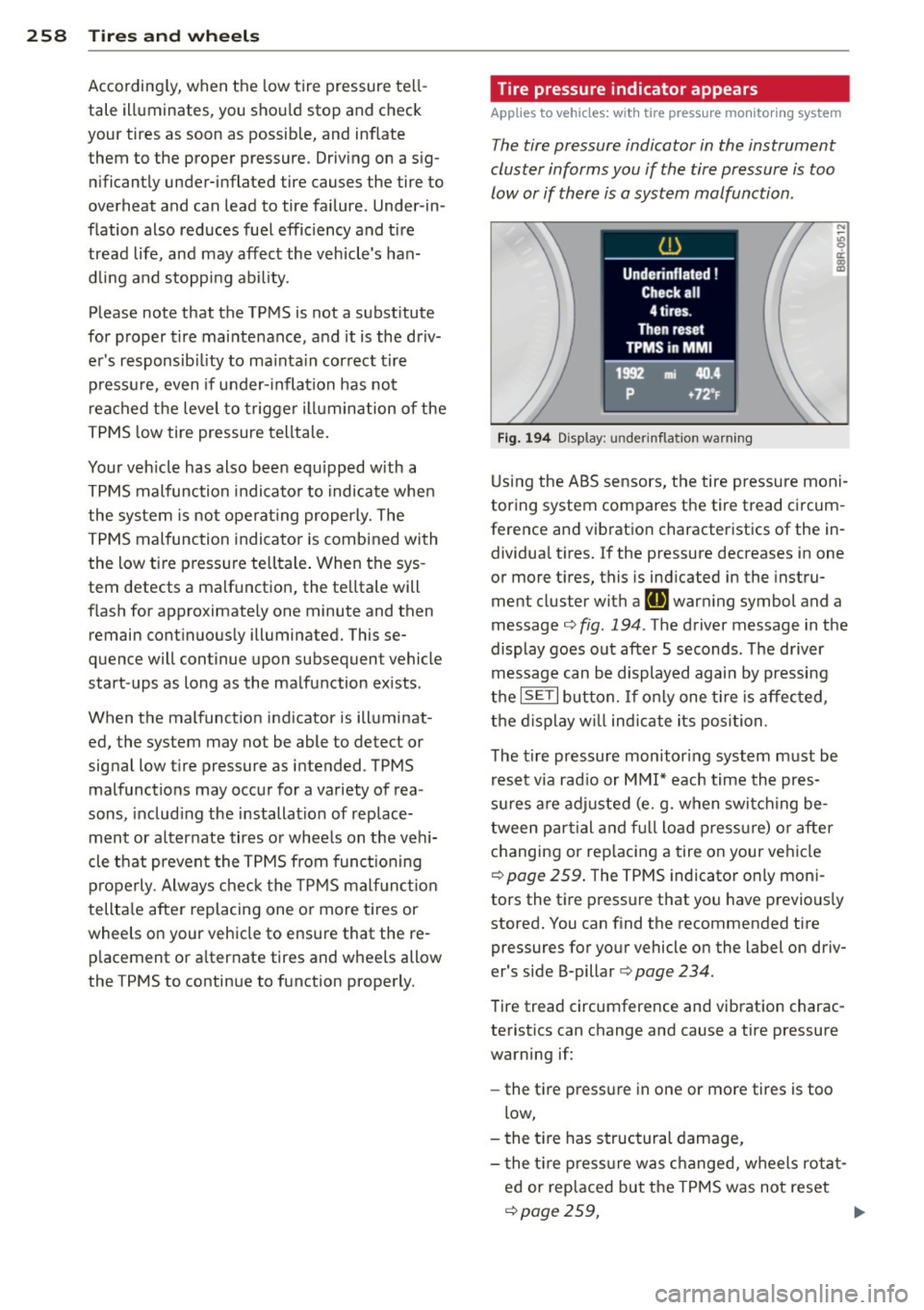
Fig. 194 Display: u nde rinfla tion warning
Using the ABS sensors, the tire pressure moni
toring system compares the tire tread circum
ference and vibration characteristics of the in
dividua l tires.
If the pressure decreases in one
or more t ires, this is indicated in the instru
ment cluster with a
RI] war ning symbol and a
message¢
fig . 194 . The driver message in the
display goes out afte r 5 seconds . The driver
message can be displayed again by pressing
the
ISETI button. If o nly one tire is affec ted,
the display will ind icate its position.
The tire pressure monitoring system must be
reset via rad io or MMI* each time the pres
sures are adjusted (e.g. when switching be
tween partial and full load pressure) or after
changing or replacing a tire on your ve hicle
¢
page 259. The TPMS indicator only moni
tors the tire pressure that you have previous ly
stored. You can find the recommended tire
pressures for your vehicle on the label on driv
er's side 8-pillar ¢
page 234.
Tire tread circumference and vibration charac
teristics can change and cause a tire pressure
warning if:
- the tire pressure in one or more tires is too
low,
- the tir e has structural damage,
- the tir e pressure was changed, wheels rotat-
ed or rep laced but the TPMS was not reset
¢page 259, ..,_