ESP AUDI A4 2015 Manual PDF
[x] Cancel search | Manufacturer: AUDI, Model Year: 2015, Model line: A4, Model: AUDI A4 2015Pages: 304, PDF Size: 74.86 MB
Page 207 of 304
"" N
0 ::.,: co ,...., \!) 1.1'1 ,...., 1.1'1 ,....,
Vehicle care and cleaning 205
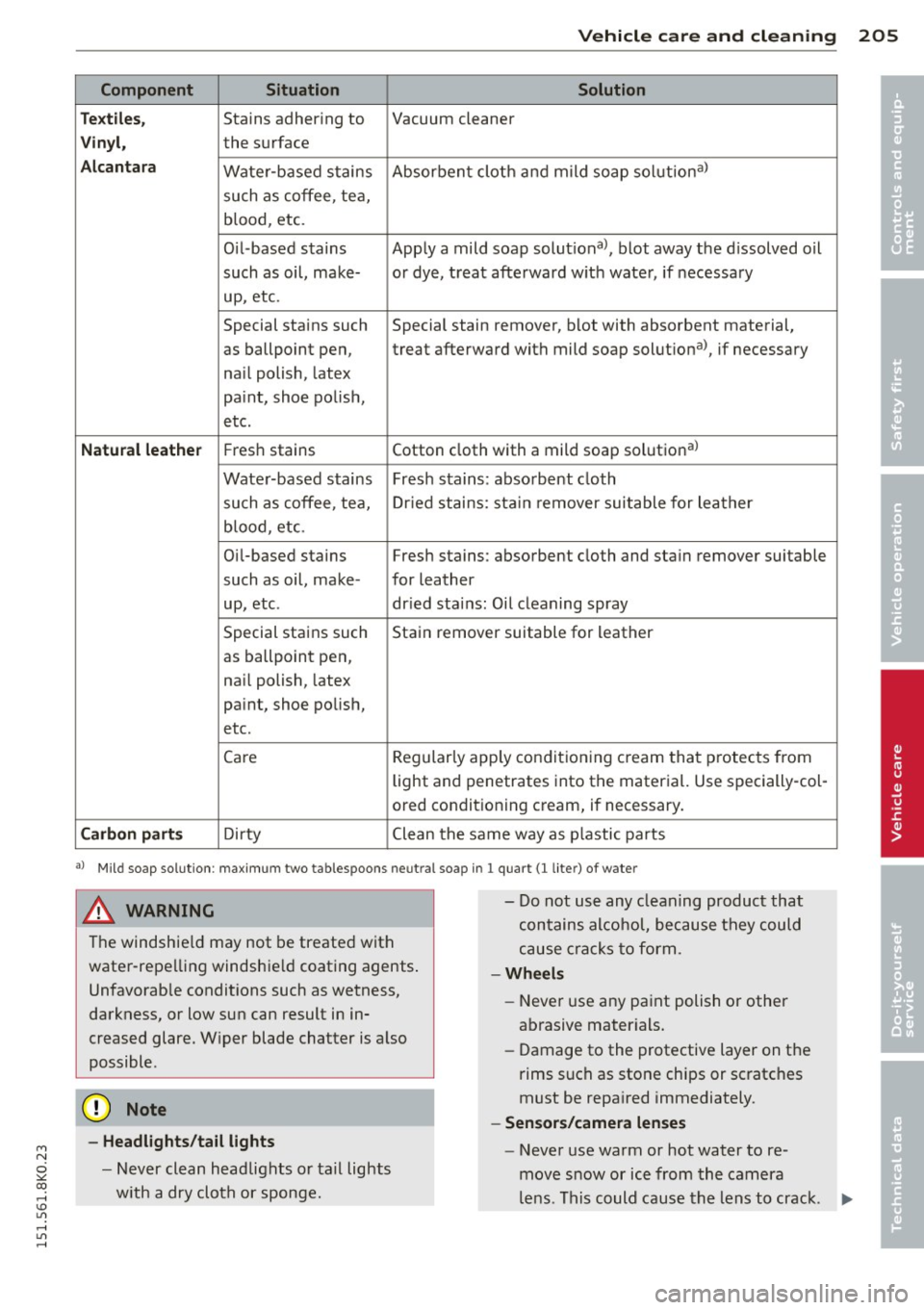
Component Situation Solution
Te xtile s,
Stains adhering to Vacuum cleaner
Vinyl, the surface
Alcantara Water-based stains Absorbent cloth and mild soap solutiona>
such as coffee, tea, blood, etc.
Oil-based stains Apply a mild soap solutiona>, blot away the d issolved oil
such as oil, make- or dye, treat afterward w ith water, if necessary
up, etc.
Special stains such Special stain remover, blot with absorbent material,
as ballpoint pen, treat afterward with mild soap solutiona>, if necessary
na il polish, latex
pa int, shoe polish,
etc.
Natural leather Fr es h stains Cotton cloth with a mild soap solutiona)
Water-based stains Fresh sta ins: absorbent cloth
such as coffee, tea, Dr ied stains: sta in remover suitable for leather
blood, etc.
Oil-based stains Fresh sta ins: absorbent cloth and stain remover suitable
such as oil, make- for leather
up, etc . dried sta ins: Oil cleaning spray
Special stains such Stain remover suitable for leather
as ballpo int pen,
na il polish, latex
pa int, shoe polish,
etc .
Care Regularly
apply conditioning cream that protects from
light and penetrates into the material. Use specially-col-
ored conditioning cream, if necessary.
Carbon parts Dirty Clean the same way as plastic parts
al Mild soap solution: maximum two tablespoons neut ral soap in 1 quart (I liter) of water
& WARNING
The windshie ld may not be treated with
water-repelling windshie ld coating agents .
Unfavorab le conditions such as wetness,
darkness, or low sun can result in in
creased glare. W iper blade chatter is also
possible.
- Headlights/tail lights
- Never clean headlights or tail lights
w ith a dry cloth or sponge. -
Do not use any cleaning product that
contains alcohol, because they could
cause cracks to form .
-Wheels
-Never use any paint polish or other
abrasive mater ials.
- Damage to the protective layer on the
rims such as stone chips or scratches
must be repaired immediately.
- Sensors/camera lenses
- Never use warm or hot water to re-
move snow or ice from the camera
len s. This could cause the lens to crack .
IJII>
•
•
Page 210 of 304
208 Fuel supply and filling your fuel tank
Seasonally adjusted gasoline
Many gasoline grades are blended to perform
especially well for winter or summer driving. During seasonal change-over, we suggest that
you fill up at busy gas stations where the sea
sonal adjustment is more likely to be made in
time.
CD Note
- Fuels containing a high percentage of
ethanol such as ESO and E85 may only be used in vehicles with flexible fuel en
gines. Using high ethanol fuel in vehicles not equipped with flexible fuel engines
can cause severe engine damage.
- Methanol fuels which do not meet these
requirements may cause corrosion and
damage to plastic and rubber compo
nents in the fuel system.
- Do not use fuels that fail to meet the
specified criteria in this chapter .
- If you are unable to determine whether
or not a particular fuel blend meets the
specifications, ask your service station or
its fuel supplier .
- Do not use fuel for which the contents
cannot be identified.
- Fuel system damage and performance
problems resulting from the use of fuels
different from those specified are not
the responsibility of Audi and are not
covered under the New Vehicle or the
Emission Control System Warranties.
- If you experience a loss of fuel economy
or driveability and performance prob
lems due to the use of one of these fuel
blends, we recommend that you switch
to unblended fuel.
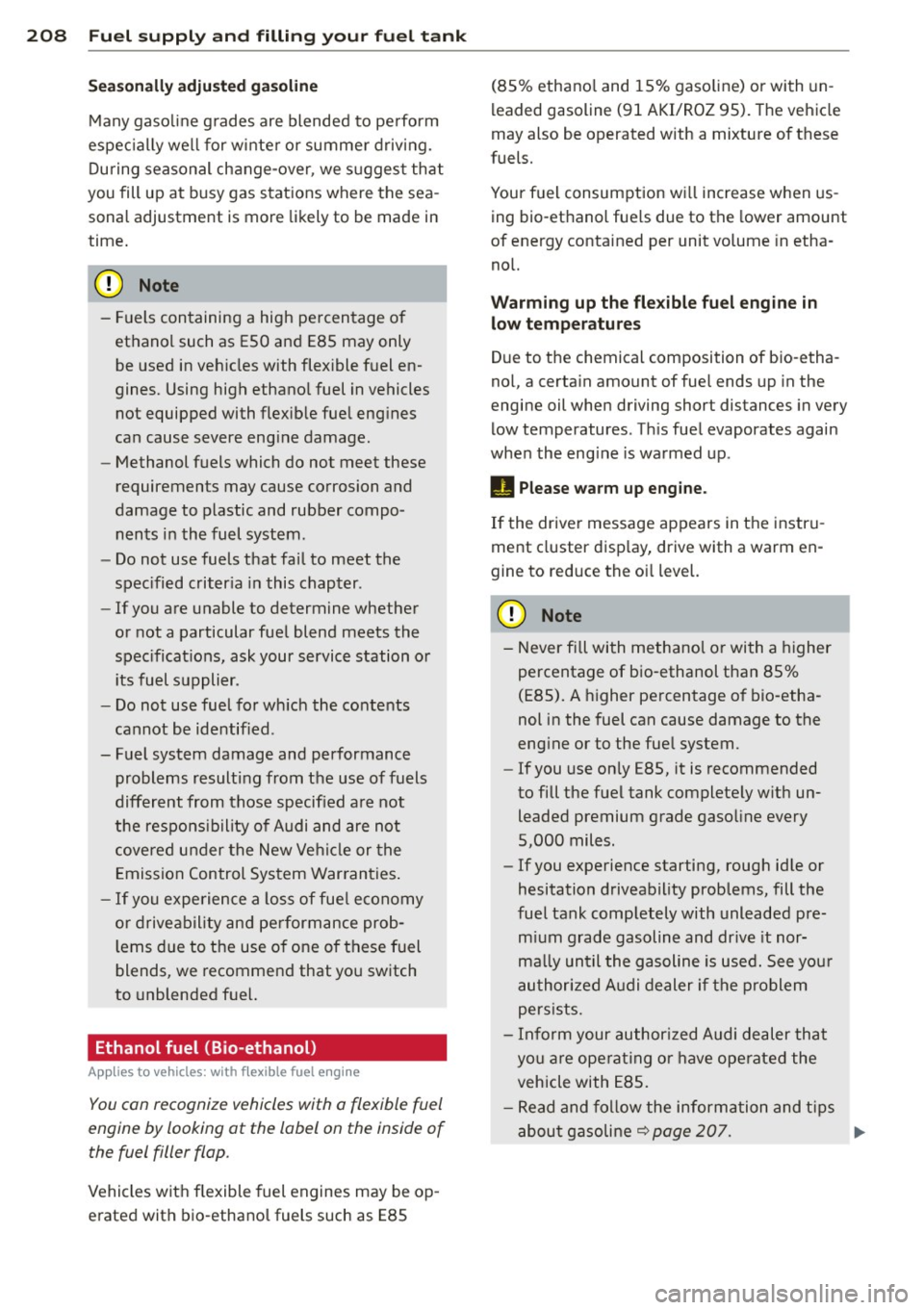
Ethanol fuel (Bio -ethanol)
App lies to vehicles: with flexible fuel e ngi ne
You con recognize vehicles with a flexible fuel
engine by looking at the label on the inside of the fuel filler flap.
Vehicles with flexible fuel engines may be op
erated with bio-ethanol fuels such as E85 (8S% ethanol and
15% gasoline) or with un
leaded gasoline (91 AKI/ROZ 95). The vehicle
may also be operated with a mixture of these
fuels.
Your fuel consumption will increase when us
ing bio-ethanol fuels due to the lower amount
of energy contained per unit volume in etha
nol.
Warming up the flexible fuel engine in low temperatures
Due to the chemical composition of bio-etha
nol, a certain amount of fuel ends up in the
engine oil when driving short distances in very
low temperatures . This fuel evaporates again
when the engine is warmed up.
II Please warm up engine.
If the driver message appears in the instru
ment cluster display, drive with a warm en
gine to reduce the oil level.
CD Note
- Never fill with methanol or with a higher
percentage of bio-ethanol than 85%
(E85). A higher percentage of bio-etha
nol in the fuel can cause damage to the
engine or to the fuel system .
-If you use only E85, it is recommended
to fill the fuel tank completely with un
leaded premium grade gasoline every
5,000 miles .
- If you experience starting, rough idle or
hesitation driveability problems, fill the
fuel tank completely with unleaded pre mium grade gasoline and drive it nor
mally until the gasoline is used. See your
authorized Audi dealer if the problem
persists.
- Inform your authorized Audi dealer that
you are operating or have operated the
vehicle with E85.
- Read and follow the information and tips
about gasoline
c::> page 207. .,.
Page 212 of 304
210 Fuel supply and filling your fuel tank
Refuelling
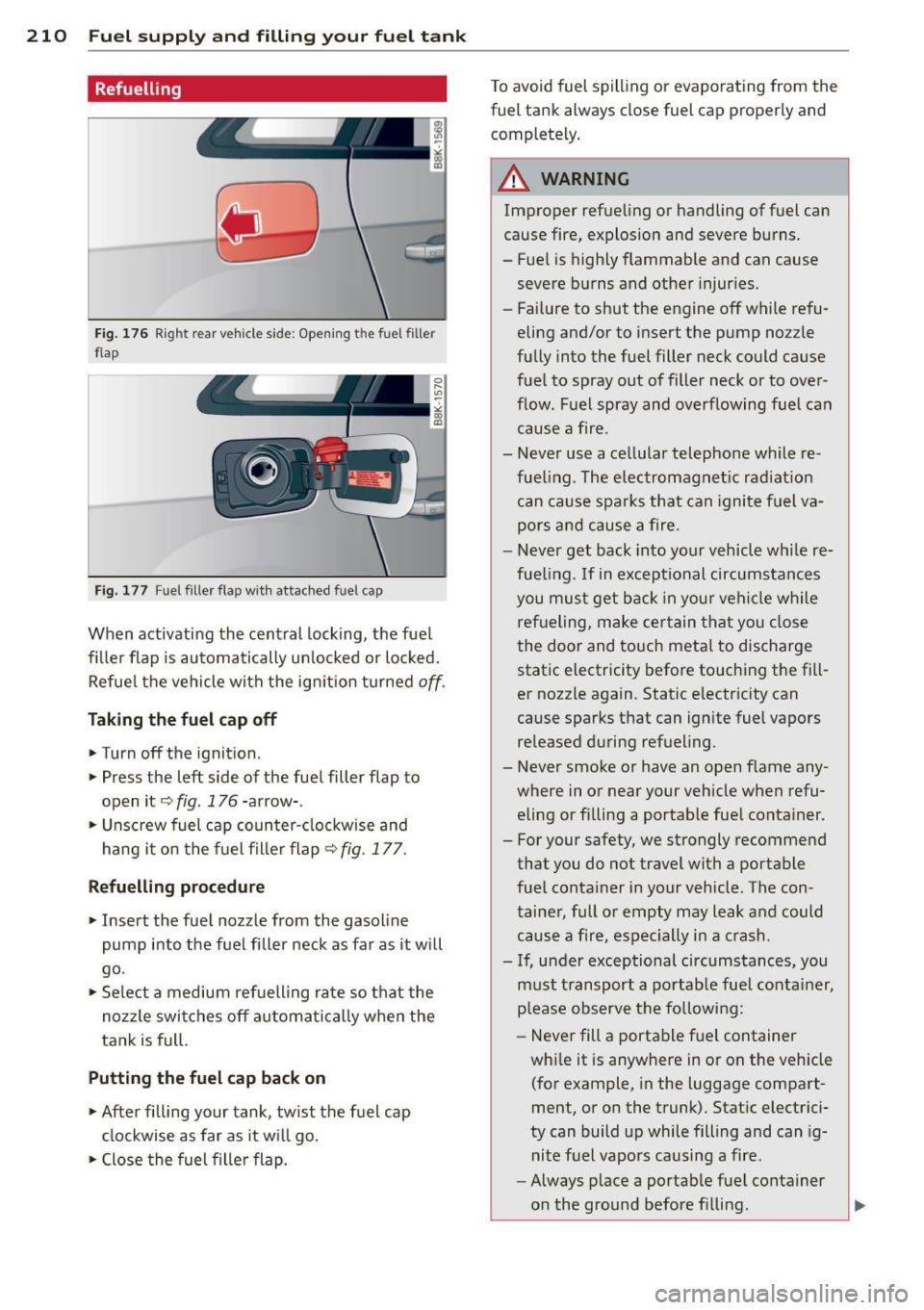
Fig. 176 Right rear vehicle side: Open ing t he fuel filler
flap
F ig. 177 Fu el filler flap with attached fuel cap
When activating the central lock ing, the fuel
fi ller flap is automatically un locked or loc ked.
Refuel the vehicle with the ig nition turned
off.
Taking the fuel cap off
~Turnoff the ignition .
~ Press the left side of the fuel filler flap to
open it
c::> fig. 176 -arrow- .
~ Unscrew fuel cap counter-clockwise and
hang it on the fuel filler flap
~ fig. 177.
Refuelling procedure
~ Insert the fuel nozzle from the gasoline
pump into the fuel filler neck as far as it will
go.
~ Select a medium refuelling rate so that the
nozzle switches off a utomatica lly when the
tank is full.
Putting the fuel cap back on
~ After filling your tank, tw ist the fuel cap
clockwise as far as it will go.
~ Close the fuel filler flap. T
o avoid fuel spilling or evaporating from the
fuel tank always close fuel cap properly and
completely .
A WARNING
-Im proper refueling or handling of fuel can
cause fire, explosion and severe burns.
- Fuel is highly flammable and can cause
severe burns and other injuries.
- Failure to shut the engine off while refu
eling and/or to insert the pump nozzle
fully into the fuel filler neck could cause
fuel to spray out of filler neck or to over
flow. Fuel spray and overflowing fuel can cause a fire .
- Never use a cellular telephone while re
fueling. The electromagnet ic rad iat ion
can cause sparks that can ignite fuel va
pors and cause a fire.
- Never get back into your vehicle whi le re
fue ling.
If in exceptional circumstances
you must get back in your vehi cle while
refueling, make ce rtain that you close
the door and touch metal to discharge
static electricity before touching the fill
er nozzle again. Static electricity can
cause sparks that can ignite fuel vapors released during refueling.
- Never smoke or have an open flame any
where in or near your vehicle when refu
eling or filling a portable fuel conta iner.
- For your safety, we strongly recommend
that you do not travel with a portable
fuel conta iner in your vehicle . The con
tainer, full or empty may leak and could
cause a fire, especially in a crash.
- If, u nder exceptional cir cumstances, you
must transport a portable fuel conta iner,
p lease observe the following:
- Never fill a portable fuel container
whi le it is anywhere in or on the vehicle
(for example, in the luggage compart
ment, or on the trunk). Static electrici
ty can build up while filling and can ig
nite fuel vapors causing a fire .
- Always place a portable fue l conta iner
on the ground before filling.
Page 214 of 304
212 Checking and filling
Checking and filling
Engine hood
Releasing and opening the engine hood
The engine hood is released from inside the
vehicle .
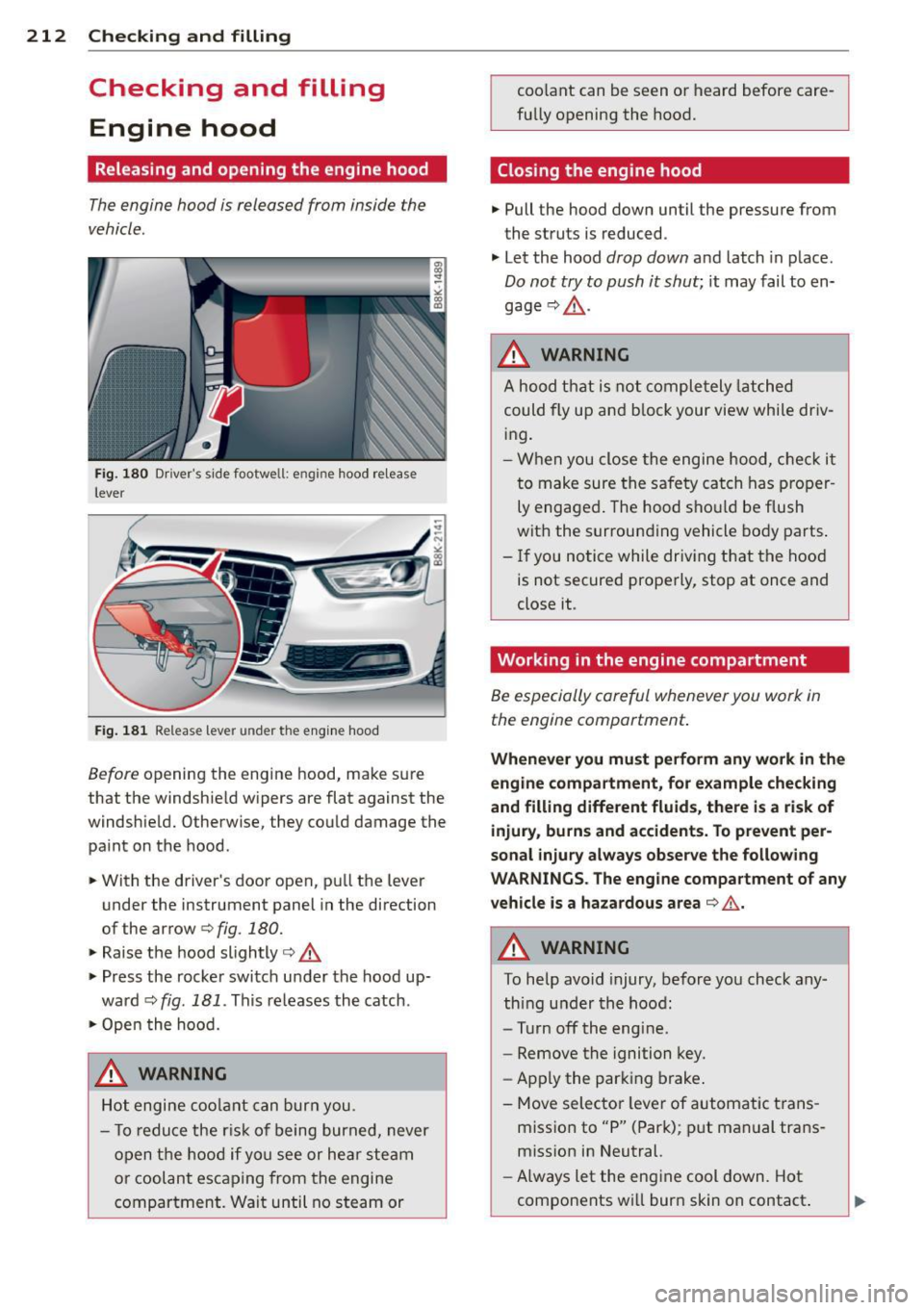
Fig. 180 Driver's side footwe ll: e ngin e hood release
lever
... -- - -=-
Fig. 181 Release lever u nde r the engine hood
Before opening the engine hood, make sure
that the windshield wipers are flat against the
windshield. Otherwise, they could damage the
pa int on the hood.
... With the driver's door open, pull the lever
under the instrument panel in the direction
of the arrow
c> fig . 180.
... Raise the hood slightly c> .&,
... Press the rocker switch under the hood up
ward
c> fig . 181 . This releases the catch.
... Open the hood.
A WARNING
Hot engine coo lant can burn you.
- T o reduce the risk of being burned, never
open the hood if you see or hear steam
or coolant escaping from the engine
compartment. Wait until no steam or coo
lant can be seen or heard before care
fully opening the hood.
Closing the engine hood
... Pull the hood down until the pressure from
the struts is reduced .
... Let the hood
drop down and latch in place.
Do not try to push it shut; it may fail to en
gage
c> .&, .
A WARNING
-
A hood that is not completely latched
could fly up and b lock your view while driv
ing.
- When you close the engine hood, check it
to make sure the safety catch has proper
ly engaged . The hood shou ld be flush
with the surrounding vehicle body parts.
-If you notice while driving that the hood
is not secured properly, stop at once and
close it.
Working in the engine compartment
Be especially careful whenever you work in
the engine compartment.
Whenever you must perform any work in the
engine compartment, for example checking
and filling different fluids , there is a risk of
injury , burns and accidents. To prevent per
sonal injury always observe the following
WARNINGS. The engine compartment of any
vehicle is a hazardous area
c> ,&..
A WARNING
-To help avoid injury, before you check any-
thing under the hood:
- Turn off the engine.
- Remove the ignition key.
- Apply the parking brake.
- Move selector lever of automatic trans-
mission to "P" (Park); put manual trans
mission in Neutral.
- Always let the engine cool down. Hot
components will burn skin on contact .
Page 220 of 304
218 Check ing and filling
Engine cooling system
Coolant
The engine coolant performs two functions: it
keeps the engine from overheating and it pro
tects the engine from freezing in the winter .
The cooling system is sealed and generally re
quires little attention.
The cooling system has been filled at the fac
tory with a permanent coolant which does not need to be changed. The coolant consists of a
mixture of specially conditioned water and the
manufacturer's glycol-basedcoolant addi-
tive G13 antifreeze with ant icorrosion addi
tives (50% for USA models; 60% for Canadian models) . This mixture both assures the neces
sary frost protection and protects metal com
ponents in the engine's cooling system from
corrosion and scaling.
It a lso raises the boil
ing point of the coo lant.
Do not reduce the concentration of the coo l
ant in the summer by adding plain water .
The
pr opor tion of coolant add itiv e m ust be at
l eas t 50% but not more than 60%
to main
tain antifree ze protection and cooling efficien
cy. If the coolant frost protection is too low,
the coolant could freeze and damage the veh i
cle heating and eng ine cooling system .
For year-round driving, antifree ze is added at
the factory for temperatures down to:
- -31°F(-35°C)USA
- - 40 ° F ( - 40 °C) Canada.
I f you must add coo lant, use a m ixture of wa
ter and coolant addit ive. M ixing the coolant
addit ive with dist illed water is recommended.
_& WARNING
Before you check anything in the engine
compartment, always read and heed all
WARNINGS
~ &. in Working in the engine
compartment on page 212.
(D Note
- Before winter sets in, have the coolant
checked to see if the coolant additive in
-
your vehicle is sufficient to meet the climate conditions . This is especia lly impor
tant if you live in a reg ion where the win
ter is extreme ly cold. If necessary, in
crease the proportion of coolant additive
to 60% .
- When adding coolant additive to your
cooling system, remember :
- We recommend us ing on ly coolant ad
d itive G12 ++ or G13 for your vehicle.
This coolant addit ive is availab le at a u
thorized Audi dealers. Other types of
antifreeze can significantly reduce cor rosion protection. The resulting corro
sion can cause a loss of coolant and se
rious engine damage .
- Do not add any type of radiator leak seal
ant to your vehicle's engine coolant.
Add ing radiator repa ir flu id may adverse
ly affect the function and performance of
your cooling system and could resu lt in
damage not covered by your New Veh icle
Limited Warranty.
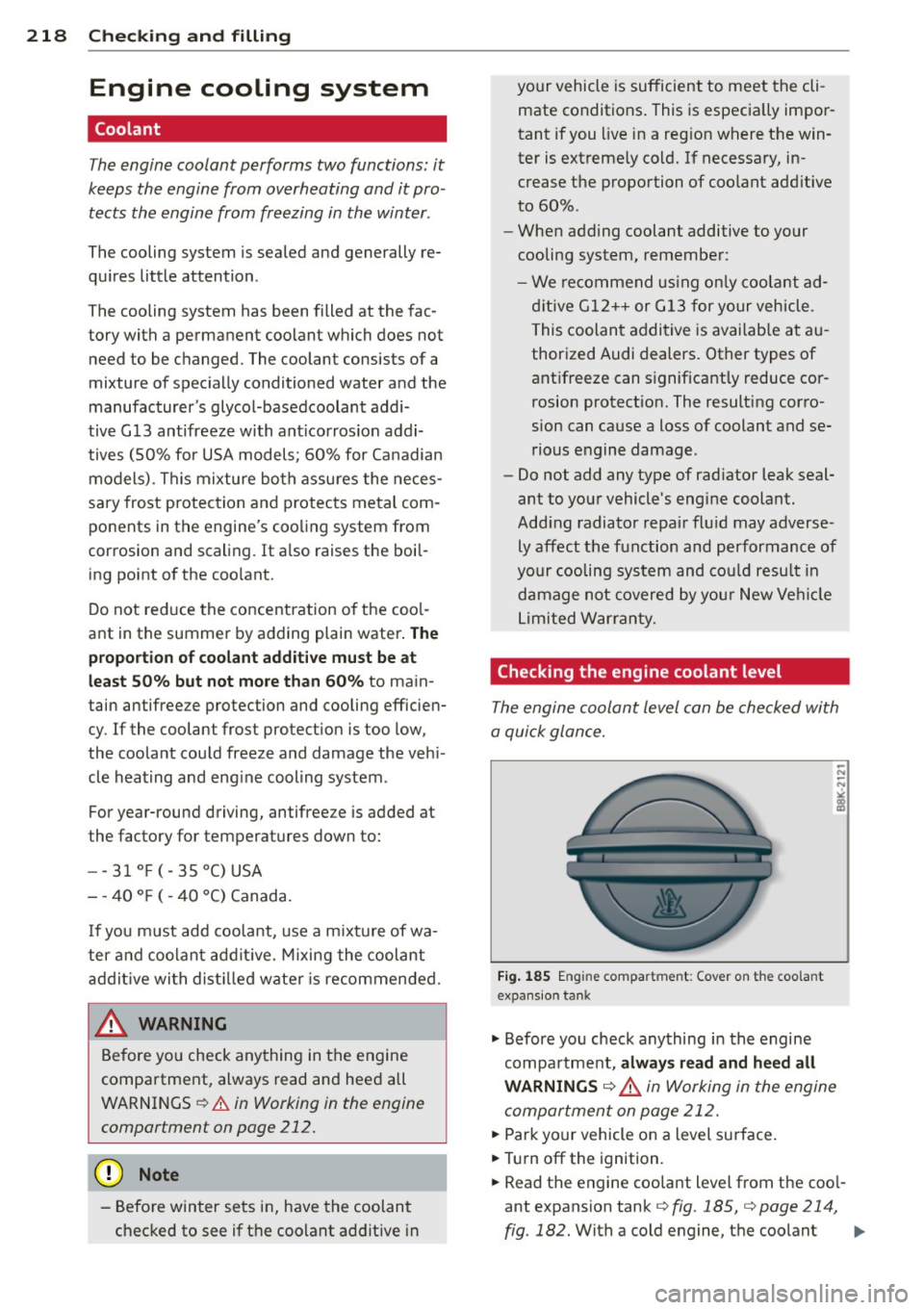
Checking the engine coolant level
The engine coolant level can be checked with
a quick glance.
F ig . 1 85 Engine compar tmen t: Cover on the coo la n t
expans io n t ank
.,. Before you check anything in the engine
compa rtment,
alwa ys read and h eed all
W ARNING S ~ ,& in Working in the engine
compartment on page 212.
.,. Park your vehicle on a level surface .
.,. Turn off the ignition.
.,. Read the engine coolant level from the coo l
ant expansion tank
c:> fig . 185, c:> page 214,
fig . 182.
With a cold engine, the coolant Iii>-
Page 224 of 304
222 Check ing and filling
@ For the sake of the environment
Becau se of the pr oblem of proper disposa l
of brake flu id as we ll as the special tools
requ ired and the necessary expert ise, we
recommend that you have the brake fluid
changed by your author ized Audi dealer.
Battery
General information
Unde r normal operating conditions, the bat
tery in your Audi does not need any mainte
nance. With
high outside temperatures or
long daily dr ives we recommend that you have
the electro lyte level checked by an authorized
Aud i dea ler o r qualified workshop . The elec
trolyte leve l sho uld a lso be checked each t ime
the battery is charged ¢
page 224.
Have the battery checked when you take your
ve hicle in for service . Yo u are well adv ised to
replace a bat tery that is older tha n 5 yea rs .
W ith certa in types of a irbag deployment, t he
battery is d isconnected from the vehicle elec
tr ica l system fo r safety reasons ¢
& in Re
pair, core and disposal of the airbags on
page 157.
Disconnecting the battery terminals
Some veh icle functions (power w indow regu
lato rs, for example) are lost if the battery ter
m inals a re discon nected. These functions have
to be re lea rned after the batte ry terminals a re
connec ted agai n. T o prevent this, the battery
should o nly be d isconnec ted from the vehicle
e lec trica l syste m when absolu tely necess ary
for repairs.
Vehicles not driven for long periods
I f yo u do not drive you r vehicle over a pe riod
of severa l days or weeks, elec trical co m po
nen ts are gr adually cu t back o r swi tched off .
T his reduces energy consumption and main
tains sta rting capab ility over a lon ger period
¢ page 191.
Some o f the conven ien ce f unct ions m ay no t
ope rate, su ch as the in ter ior lights o r the power seat adjus
tment. The convenience
funct ions wi ll be available again when yo u
tu rn on the ignition and sta rt t he engine.
Winter operation
Du ring the w inte r mon ths , b att ery capac ity
tends to dec rease as temperatures drop . This
is beca use more power is a lso consumed w hile
starting, and the headlights, rear win dow de
f ogger, etc., are used more often.
Avoid unnecessa ry powe r consumpt ion, pa r
ticu lar ly in ci ty traffic o r when traveling only
sho rt distances . Let yo ur autho rized A udi
dealer check the capacity of the vehicle bat
tery before w inter sets in ¢
page 224. A well
charged battery will not on ly prevent starting
problems when the weather is cold, but will
also last longer .
@ Tips
If your vehicle is left standing for seve ral
weeks at extremely low temperatures, the
vehicle battery s hou ld be removed and
s tored w her e it w ill not freeze. This will
preve nt i t fr om be ing d amaged and having
t o be repla ced .
Working on the battery
Be especially careful when working on or near
the battery.
The battery is located in the luggage compar t
ment under the floor . Befo re you che ck any
t hi ng in the luggage co mpartment,
read and
heed all WARNINGS
¢ .&, .
Always heed the safety warnings , when work
i ng on the veh icle ba tte ry or the vehicle e le c
t ric al sys tem to p reven t inju ry.
The following WARNINGS are very
important when working on the battery:
Always heed the following WARNING SYM ·
BOLS and safety precautions when working
on the battery .
®
Always wear eye protection .
Page 227 of 304
"" N
0 ::.,: co ,...., \!) 1.1'1 ,...., 1.1'1 ,....,
-To r educe the danger of explosion, never
connect or disconnect charger cables
while the charger is operating.
- Fast charg ing a battery is dangerous and
should only be attempted by a compe
tent technician w ith the proper equip
ment .
- Battery acid that may spill during charg
ing should be washed
off with a solution
of warm water and baking soda to neu
t ralize the acid .
Never use a fast charger as a booster to
start the engine . This will seriously dam
age sensitive elect ronic components, such
as control units, relays, radio, etc. , as we ll
as t he battery charger.
Battery replacement
The new battery must have the same specifi
cations and dimensions as the original equip
ment battery.
Intell igent energy management in your veh i
cle is respons ible for d istr ibuting the e lectr i
cal energy throughout you r vehicle
¢ page 191. T he inte lligen t en ergy ma nage
men t system w ill keep the engine b attery
charged be tter then vehicles w ithout this sys
tem . To make sure t he additional e lectrica l e n
ergy is available once again after you have
changed t he battery, we recommend that you
install ba tteries of the same type and man u
facture only (the same as t hose installed at
the t ime your vehicle was delivered) . Specifi
cations a re listed on the battery hous ing . You r
author ized Audi dealer must code the bat tery
in the energy management system to enable
you to use the energy management functions
correctly after rep lac ing the battery .
I f it is not poss ible to use a battery of this
type, the new bat tery mus t have the s ame ca
pacity, vo ltage ( 12-volts), ampe rage, con
struction and pl ug sea ling.
Checkin g and fillin g 225
When installing the battery, make su re the ig
nition and a ll electrical consume rs a re turned
off.
Q) Note
M ake sure the ven tilat ion hose on the side
of the batte ry is connecte d, otherwise
fumes o r batte ry acid can leak out .
@ For the sake of the environment
Because o f the p rob lem of proper disposal
of a battery, we recommen d your author
i zed A udi dealer change the battery for
you. Batteries contain sulfur ic acid and
l ead and must always be disposed of prop
erly in comp liance with a ll environmental
r egula tions . Dispos ing of vehicle batter ies
i mprope rly is v ery dange rous to th e envi
r o nmen t.
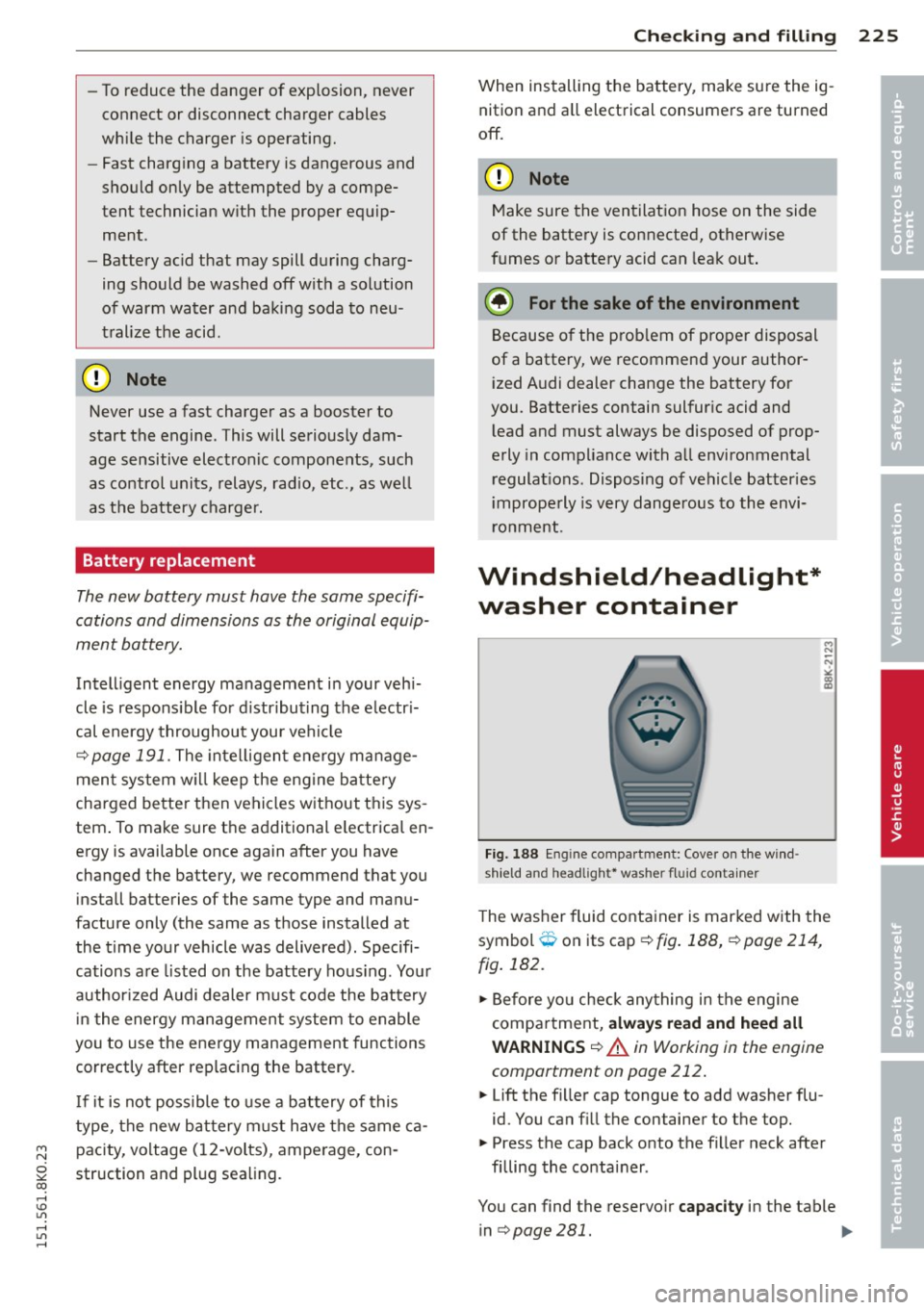
Windshield/headlight*
washer container
Fi g. 18 8 Eng in e co mpartm en t: Cove r o n th e w ind
s h iel d a nd headlig ht• was her fluid conta in er
T he was her fluid conta iner is mar ked w ith the
symbol
O on its cap ¢ fig . 188, ¢page 214,
fig . 182.
.. Before yo u check any thing in t he engine
compa rtment,
alwa ys re ad and heed all
WARNINGS ¢ & in Working in the engine
compartment on page 212 .
.. Lift the fi ller cap tongue to add washer flu
id. You can f ill the container to t he top.
.. Press the cap back o nto the fi lle r neck after
filling the co nta iner .
You can find the reservo ir
capacity in the table
in ¢
page 281. 111>
•
•
Page 230 of 304
228 Tires an d whee ls
and make of tire and the tread
pattern.
Hidden damage
Damage to tires and rims is of
ten not readily visible. If you
notice unusua l vibration or the
vehicle pulls to one side, this may indicate that one of the
t ires has been damaged . The
tires must be checked immedi
ately by an authorized Audi
dealer or qualified workshop .
Unidirectional tires
A unidirectional tire can be
identified by arrows on the
sidewall, that point in the direc
tion the tire is designed to ro
tate. You must follow the speci
fied direction of rotation. This is
necessary so that these tires
can develop their optimum
characteristics regarding grip,
road noise, wear and hydro
planing resistance. For more in
formation
c:> page 267 .
&_ WAR NIN G
New tires or tires that are
old, worn or damaged cannot provide maximum control
and braking ability. -
New tires tend to be slip
pery and must also be bro
ken-in. To reduce the risk of losing control, a collision
and serious personal inju
ries, drive with special care
for the first 350 miles (560 km).
-Driving with worn or dam
aged tires can lead to loss of
control, sudden tire failure,
including a blowout and
sudden deflation, crashes
and serious personal inju
ries. Have worn or damaged
tires replaced immediately.
- Tires age even if they are
not being used and can fail
suddenly, especially at high
speeds . Tires that are more
than 6 years old can only be
used in an emergency and
then with special care and at low speed.
-Never mount used tires on
your vehicle if you are not sure of their "previous histo
ry." Old used tires may have
been damaged even though
the damage cannot be seen
that can lead to sudden tire
failure and loss of vehic le
control.
...
Page 231 of 304
-If you notice unusual vibration or if the vehicle pulls to one side when driving, al
ways stop as soon as it is safe to do so and check the
wheels and tires for dam age.
(D Note
-Please note that summer and winter tires are de
signed for the conditions
that are typical in those sea
sons. Audi recommends using winter tires during the
winter months. Low tem peratures significantly de
crease the elasticity of
summer tires, which affects
traction and braking ability.
Tires and wheels 229
If summer tires are used in
very cold temperatures, cracks can form on the tread bars, resulting in perma
nent tire damage that can
cause loud driving noise and unbalanced tires. Audi is not
responsible for this type of
damage.
-Burnished, polished or chromed rims must not be used in winter road condi
tions. The surface of the
rims does not have suffi
cient corrosion protection
for this and could be perma
nently damaged by road salt
or similar substances.
•
•
'
Glossary of tire and loading terminology
Accessory weight
means the combined weight (in
excess of those standard items
which may be replaced) of auto matic transmission, power
steering, power brakes, power
windows, power seats, radio, and heater, to the extent that
these items are available as fac
tory-installed equipment (whether installed or not).
Aspect ratio
means the ratio of the height to
the width of the tire in percent. Numbers of 55 or lower indi
cate a low sidewall for im proved steering response and
better overall handling on dry
pavement.
Page 232 of 304
230 Tires a nd whee ls
Bead Extra load tire
means the part of the tire that means a tire design to operate
is made of steel wires, wrapped at higher loads and at higher
or reinforced by p ly cords and inflation pressures than the
that is shaped to fit the rim . corresponding standard tire .
Bead separation Extra load tires may be identi-
fied as "XL", "xl", " EXTRA
means a breakdown of the bond LOAD", or "RF" on the sidewall.
between components in the
bead .
Gross A xle Weight Rating
(" GAWR ")
Cord
means the load-carrying capaci-
means the strands forming the ty of a single axle system,
p lies in the tire .
measured at the tire-ground in-
Cold tire inflation pressure terfaces.
means the tire pressure recom-
Gross Vehicle Weight Rating
mended by the vehicle manu-( "GVWR ")
facturer for a t ire of a designat-
means the maximum total
ed size that has not been driven loaded weight of the vehicle.
for more than a couple of miles
Groove
(kilometers) at low speeds in
the three hour period before means the space between two
the tire pressure is measured or adjacent tread ribs.
adjusted.
Load rating (code )
Curb weight
means the max imum load that
means the weight of a motor a tire
is rated to carry for a giv-
vehicle with standard equip -en inflation pressure
. You may
ment including the maximum not find th
is information on all
capacity of fuel, oil, and cool- tires because it is not required
ant, air condit ioning and addi- by law.
...
tional weight of optional equip-
ment.