light AUDI A4 2016 Owners Manual
[x] Cancel search | Manufacturer: AUDI, Model Year: 2016, Model line: A4, Model: AUDI A4 2016Pages: 278, PDF Size: 70.26 MB
Page 177 of 278
..... N
0 ::..:: co .....
If you leave the child restraint with the tether
strap firmly installed for several days, this
could leave a mark on the upholstery on the
seat cushion and backrest in the area where
the tether strap was installed . The upholstery
would also be permanently stretched around
the tether strap . This applies especially to
leather seats .
Using tether straps on rearward-facing
child restraints
Currently, few rearward -facing child restraint
systems come with a tether. P lease read and
heed the child rest raint system manufacturer's
instruc tions care fully to de termine how to prop
erly install the tether.
A WARNING
A child in a rearward-facing child safety seat installed on the front passenge r seat w ill be
ser ious ly injured and can be killed if the front
airbag infla tes · even w ith an Advanced A irbag
System.
- T he inflating a irbag wi ll hit the child safety
seat or infant carrier with great force and
will smash the chi ld safety seat and chi ld
against the backrest, center armrest, or
door .
- A tight tether or other strap on a rearward
facing child restra int attached to the front
passenger seat can put too much pressure
on the weight-mat in the seat and register a heavier weight in the Advanced Airbag Sys
tem . The heav ier weight registered can
make the system wo rk as though an adult
we re o n the seat a nd deploy the Advanced
Airbag when it must be supp ressed caus ing
serious o r even fatal in jury to the c hild.
- If you must install a rearward fac ing ch ild
sa fety seat on the front passenger seat be
cause of exceptiona l circumstances and the
PASSENGER AIR BAG OFF light does not
come on and stay on, immediate ly install
the rearward-facing child safety seat in a rear seat ing pos ition and have the airbag
Ch ild safety
system inspected by your authorized Audi
dealer .
Additional information
Sources of information about child
restraints and their use
There are a number of sources o f additional in
formation about child restraint se lection, instal
lation and use :
N HT SA advises tha t the best ch ild safety seat is
the one that fits your child and fits in your vehi
cle, and that you wi ll us e correct ly and consis
tent ly.
T ry before you buy!
U.S National H igh way Traffic Safety Administra
tion
T el. : 1-888 -327-4236 ( TTY: 1-800 -424-9153)
www.nhtsa .gov
Nati onal SAFE KIDS Campaign
Tel. : (202) 66 2-0600
www .safekids.org
Saf ety BeltSaf e U.S .A
T el. : (800) 745-SAFE (English)
T el. : (800) 747-SANO (Spanish)
www .carseat.org
Tran sport C anada Information Centr e
Tel. : 1-800-333-0371 o r ca ll 1-613-998-86 16 if
you are in the Ottawa area
http://www.tc.gc.ca/ eng/ roadsafety/men u. htm
Audi Cu stom er Re lations
T el. : (800) 822-2834
175
Page 179 of 278
..... N
0 ::..:: co .....
wireless telecommunications provider and the
"About Aud i connect" tab in your vehicle's
MMI*:
IMENU I button> Audi connect > About
Audi conn ect.
Electronic Stabilization
Control (ESC)
Description
ESC helps to improve road ho ld ing and vehicle
dynamics to help reduce the probability of skid
d ing and loss of veh icle control. It works only
when the engine is runn ing . E SC detects certain
d ifficult dr iving sit uat ions, including when t he
ve hicl e is begin ning to spin (yaw) out of co ntro l
a nd helps you to ge t the veh icle back under con
tro l by se lective ly bra king the wheels, and/or re
d ucing engine powe r and provid ing steering as
sistance to help hold the vehicle on the dr iver's
intended course. The indicator light
GJ in the in
strument cluster blinks when ESC is taking action
to help you co ntro l the vehicle.
ESC has limitations. It is important to remember
that ESC cannot overcome the laws of physics. It
will not a lways be able to help out under all con
d itions you may come up aga inst. For example,
ESC may not always be able to help you master
situations where there is a sudde n change in the
coeff icient of friction of the road surface. When
there is a section of dry road that is sudde nly cov
e red with wate r, slush o r snow, ESC cannot pe r
form the same way i t wo uld on the dry s urface . If
the vehicle hydrop lanes (rides on a cushion of wa
ter i nstead of t he road su rface), ESC wi ll not be
ab le to he lp you steer the ve hicle because contact
with the pavement has been interrupted and the
ve hicle cannot be b raked or steered. Dur ing fast
cornering, pa rticula rly on w inding roads, ESC
cannot always deal as effect ively w it h difficult
d riving si tuations tha n at lowe r speeds. When
tow ing a t raile r, ESC is no t able to help you re
g ai n con trol as it would if you we re not towing a
tra iler .
A lways adjust yo ur speed and driving sty le to
road, traffic and weathe r co nd itions. ESC canno t
override the vehicle's physical lim its, increase the
Intellig ent Technology
available t ract ion, or keep a vehicle on the road if
road depart ure is a resu lt of driver inattention .
Instead, ESC improves the possib ility o f keeping
the vehicle under contro l and on the road d uring
extreme maneuvers by us ing the driver's steer ing
i nputs to help keep the veh icle go ing in the in
tended direction.
If you are traveling at a speed
that causes you to run off the road before ESC
c an p rovide any assistan ce, you may not exper i
en ce the benefi ts of ESC.
ESC is swi tched o n all the time . In certa in s itua
t ions when you need less tract ion, you can sw itch
off AS R by press ing the button
11) c:> page 178,
fig. 173 o r c:> page 178, fig . 174. Be s ure to
swi tch ASR on again w hen you no longe r need
l ess trac tion.
T he following systems are integ ra ted in the ESC:
Anti-lock brak ing system (ABS)
ABS prevents the wheels from locking up w hen
braking. The vehicle can still be steered even d ur
i ng hard braking. Apply steady p ressure to the
brake pedal. Do not pump the peda l. A p uls ing in
t h e br ake peda l indicates that the system is help
i ng yo u to b rake the vehi cle.
Brake assist system
T he brake assist system can decrease braking dis
tance . It increases b raking powe r when the dr iver
presses the b rake peda l quickly in emergency sit
u at io ns. You mus t press and ho ld the br ake pedal
u nt il t he s ituat ion is ove r. In vehicles wi th adap
tive cru ise control *, the brake assist system is
more sensitive if the distance detected to the ve
hicle ahead is too sma ll.
Anti-slip regulation (ASR )
ASR reduces engine powe r whe n the dr ive whee ls
begi n to spin and adapts the fo rce to the road
co ndit ions . Thi s makes it easier to start, acce ler
ate and d rive up hills .
Electronic differential lock (EDL)
T he ED L brakes wheels t hat are spi nning and
transfe rs the dr ive power to the o ther dr ive
whee l or wheels if the vehicle is equ ip p ed with
all -wheel drive*. This function is not ava ilab le at
higher speeds. .,.
177
Page 181 of 278
..... N
0 ::..:: co .....
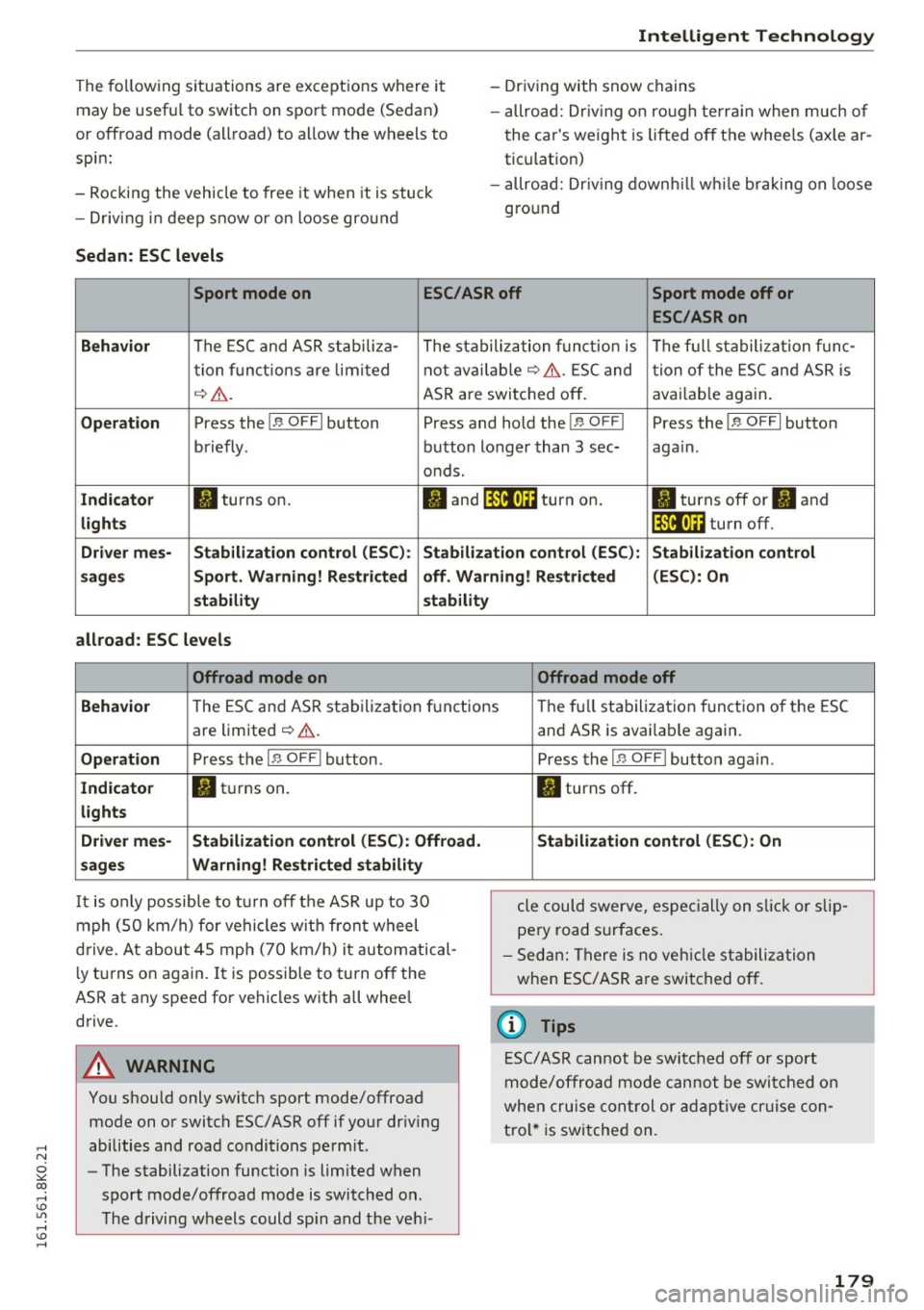
may be useful to switch on sport mode (Sedan)
or offroad mode (allroad) to allow the wheels to
spin:
- Rocking the vehicle to free it when it is stuck
- Driving i n deep snow or on loose gro und
Sedan : ESC levels
Intellig ent Technology
- Driving with snow chains
- allroad: Dr iv ing o n ro ugh te rra in when much of
the car's weight is lifted off the whee ls (axle ar
tic ulation)
- allroad: Dr iv ing down hill while brak ing on loose
gro und
Sport mode on ESC/ASR off Sport mode off or
ESC/ASRon
Behavi or
The ESC and ASR stabili za- The stabilization funct io n is The f ull stabilization f unc -
t ion f unct ions are lim ited not avai lab le
~ &. . ESC and tion of the ESC and ASR is
~ &. . ASR are switched off . avai
lab le aga in.
Op eration Press the!.$ OFFI button Press and hold the!.$ OFFI Press the!.$ OFFI button
briefly . button longer than 3 sec- aga in .
o nds.
Ind icato r II turns on. fl and It'll•)~~ turn on. II turns off or II and
lights It'll•)~~ turn off.
D river me s-Stabilization contr ol (ES C): Stabilization cont rol (ESC ): S tabilization control
s age s Sport. Warning! Re stricted off. W arning! Restricted (ESC
): On
s tability stabilit y
all road: ESC levels
Offroad mode on Offroad mode off
Behavio r
The ESC and ASR stabilization f unctions The fu ll stabiliza tion f unction of the ESC
are limited
¢ & .
Operation Press the I.$ OFF I button .
In d icato r fl turns on .
light s
Driv er me s- Stabi lization control (E SC): Offro ad .
sage s Warning! Re stri cted stabili ty
It is only possible to turn off the ASR up to 30
mph (50 km/h) for vehicles w it h front wheel
drive. At about 45 mph (70 km/h) it automatical
l y turns on again. It is possible to turn off the
ASR at any speed for vehicles with all whee l
drive.
A WARNING
You should only switch sport mode/offroad mode on or switch ESC/ ASR off if your dr iv ing
abilities and road conditions perm it .
- The stabilization function is limited when
sport mode/offroad mode is switched on .
The driving wheels could sp in and the veh i-
-
and ASR is avai lable again.
Press the I.$ OF FI button aga in .
II turns off.
Stabilizat ion control (ESC ): On
cle could swerve, espe cially on s lick o r slip
pery road surfaces.
- Sed an: There is no veh icle stabili zation
when ESC/ASR are switched off .
(D Tips
ESC/ASR cannot be switched off or sport
mode/offroad mode cannot be swi tched on
when cru ise cont rol or adapt ive cr uise con
tro l* is switched on.
179
Page 182 of 278
Intelligent Technology
Braking
What affects braking efficiency?
New brake pads
During the firs t 25 0 miles (400 km), new b rake
pads do not possess their full braking effect , they
have to be "broken i n" first ¢& . You can com
pensate for this slight ly reduced braking power
by push ing harder on the brake pedal. Avoid
heavy braking loads during the break-in period .
Operating conditions and driving habits
The brakes on today's automobiles a re still sub
ject to wear, depend ing largely on ope rating con
ditions and driving habits¢& . On vehicles that
are either dr iven most ly in stop-and-go city traf
f ic or are driven hard, the brake pads should be
checked by you r authorized Aud i dea ler more of
ten than spec ified in the
Warranty & Mainte
nance booklet .
Failu re to have your brake pads
i n spected c an resu lt in reduced bra ke pe rform
ance.
O n steep slopes, you sho uld use the braking ef
fect of the eng ine . This way, you prevent unnec
es sary wear on t he b rake system. If yo u m ust use
your b rake s, d o not hold the brakes down cont in
uously. Pum p th e b rakes at intervals.
Operating noise
Noises may occur when brak ing depend ing on the
speed, b raking force and outs ide cond it ions such
as tempe ra tu re and humidi ty.
Effect of water and road salt
In certain s ituations, for example after driving
through water, in heavy ra in, afte r ove rnig ht con
densat ion or after washing your car, the b raking
effect can be reduced by mo isture or ice on the
b rake rotors and b rake pads . T he brakes must be
d ried first w ith a few careful b rake a pplica tions.
At highe r speeds and with t he windsh ield wipers
tur ned on, the br ake pads press aga inst the brake
rotors for a sho rt amoun t of time. This occur s at
regular intervals w it h out t he dr iver noticing and
p rov ides for better bra ke response time under
wet conditions.
180
The effectiveness of the brakes can be reduced
when the vehicle is driven on a salt-covered road
and t he b rakes are not used . Likewise, yo u clean
off accum ulated salt coating from brake discs
and pads with a few caut ious app lications of the
brake ¢& .
Corrosi on
There may be a tendency fo r dirt to build up on
the b rake pads and corrosion to form on the discs
i f the car is not driven regu larly or only for short
trips with little use of the brakes .
If the bra kes are not used frequent ly, or if corro
s ion has formed on the discs, it is advisable to
clean off the pads and discs by braking firmly a
few times from a moderately high speed ¢ &.
Faults in th e brake system
If you shou ld notice a sudden increase in brake
pedal travel , then one of t he two brake circu its
may have failed¢& .
Low brake fluid level
Malfu nctions can occu r in the brake system if the
br ake fluid level is too low . The brake fluid leve l
is mo nitored electronica lly .
Brake booster
The bra ke booster i ncreases the press ure t hat
yo u ge nera te with the brake ped al.
It works only
whe n the eng ine is ru nning .¢ &
Brake lining wear status
Brake lining wea r may be c hecked by visua l in
spection o f the condition of the brake pads
t hr ough t he openings in t he wheel. If necessary,
t h e wheel m ay be removed fo r thi s inspe ction
¢ page 240, Replacing wheel s.
_& WARNING
- New brake pads don't have the be st sto p
ping power and m ust be " broken-in" du ring
the initial 250 miles (400 kilometers). You
can compensate for this by p ressing the
brake pedal more firmly. This also app lies
later w hen new pads are installed.
Page 183 of 278
..... N
0 ::..:: co .....
the p urpose of clean ing the brake system
only if road conditions permit. Other road
users must not be put at risk - you may
cause an accident!
- Before descend ing a steep grade, reduce
speed and shift transm iss io n into a lower
gear or lowe r d riv ing range. Do not ride the
bra kes or hold the pedal down too long or
t oo often. This could ca use the bra kes to get
hot an d diminish brak ing efficiency.
- Do not "r ide t he b rakes" by resting your foot
on the pe dal when yo u do not inten d to
br ak e. This may cause the br akes to over
heat, p remat ure wea r and increased stop
ping distance.
- Under certa in climatic and operating condi
tions such as passing thro ugh water, driving
in heavy ra in or after washing the vehicle,
the effectiveness of the brakes can be re
duced. In w inte r, ice can acc umulate on the
brake pads, linings, discs and drums. Care
fully apply brakes for a test. Brakes will dry and ice coatings w ill be cleaned off after a
few careful b rake applica tions.
- Driv ing for an ex tended period of time on
salt-covered roads witho ut using your
bra kes can also affe ct bra king efficie ncy .
C le an off a ccumula ted s alt co ating from
bra ke discs and pads with a few caref ul
bra ke app lications.
- If you dam age the fro nt sp oiler, or if yo u in
st all a diff erent spoi le r, be sure the ai r flow
to the front brakes is not obstr ucte d. Othe r
wise the bra ke system could overheat reduc
ing the e ffectiveness of the entire b rake sys
tem.
- Failure of one brake circuit will impair the
brak ing capability resulting in an increased
stopp ing distance. Avoid driving the vehicle
and have it towed to the nearest authorized
Audi dealer or qualif ied workshop.
- Never let the veh icle roll to a stop w ith the
engi ne shut off .
-If the brake booster is not working, the
bra ke pedal m ust be pressed conside rably
harder to make up for the lac k of booster
assista nee .
Intellig ent Technology
Electro-mechanical
power assist, dynamic
steering
The ele ctro-mechanical power a ssist helps the
driver when steering .
P ower s teer ing adapts electronically based on
t h e veh icle spee d.
Indicator lights and messages
• Steering defective! Do not drive vehicle!
If this indicator light turns on and stays on and
t hi s message appears, the power steering may
have failed.
Do
not continue driving. See your author ized
Audi dealer or a qualified repair facility for assis
tance.
' :r, y Dynamic steering: System fault! You can
continue d riving
If the indic ator l igh t turns on and the message
appe ars, the steering may be more diffic ult to
move o r more sensitive than usu a l. T he steering
whee l may a lso be at an angle w hen d riving
straight .
Drive slowly to you r autho rized Audi dea le r or
qualified wo rks hop to have the malfunction cor
rected .
,T u Dynamic steering: initializing
If this drive r message appea rs and t he indicator
li ght is flashing on t he instrument pane l, dynam
ic s teer ing* is being re ini tialized. After s tarting
t h e engine, t he steer ing w heel w ill move sligh tly.
Re- ini tializa tion might be necessary if the s teer
ing wheel was moved hard to the left a nd right
whi le the vehicle was not moving . The display
goes out as soon as initialization is comp lete.
A WARNING ~
Have the dynam ic steeri ng* system malfunc -
tion repaired as soon as poss ible by an au
thor ized Audi dealer or qualified workshop -
r isk of acc ident!
181
Page 184 of 278
Intelligent Technology
(D Tips
- If the . or
,~ n ind icator light only stays on
fo r a short time, you may continue driving.
- The dynamic steering* stability systems are
not available in the event of a system mal
funct ion.
- Fo r additional information on dynamic
steering*, refer to¢
page 111 .
Driving with your
quattro
Applies to veh icles: w ith all-wheel drive
With all-wheel drive, all four wheels are driven.
General information
With all-whee l drive, power is distributed to all
four wheels . This happens automatically depend
ing on your dr iv ing style and the road condit ions
at the time . See also ¢
page 177 .
A center differentia l distrib utes the driv ing power
variably to the front and rear axle. It works to gether with selective wheel torque control, which
activates when driving through curves
¢
page 178 . With the sport differentia l*, power
d istr ibut io n to the rear wheels is variable and can
be adj usted w ith d rive select¢
page 111.
The all -wheel drive concept is designed for high
engine power . Your veh icle is exceptionally pow
erful and has excellent driving characterist ics
both under normal dr iv ing condit io ns and on
snow and ice. Always read and fo llow safety pre
cautions ¢
A.
Winter tires
When d rivi ng in the winter, your vehicle with all
wheel drive has an advantage, eve n with regular
tires. In winter road conditions it may be adv isa
b le to mount w inte r ti res (or all-season tires) fo r
improved driveability and braking: these tires
must be mounted on all four wheels . See a lso
¢ page 232, Winter tires.
Tire chains
Where ti re chains are mandatory on certain
roads, this norma lly also applies to vehicles w ith
all -whee l drive ¢
page 233, Snow chains .
182
Replacing wheels /tires
Vehicles with all-wheel d rive must a lways have
tires of the same size. Also avoid t ires with differ
ent tread depths. For detai ls see page
¢ page 224, New tires or wheels .
Off-Road driving?
You r A udi does not have eno ugh ground clear
an ce to be used as an off-road vehicle.
It is there
fore best to avoid ro ugh tracks and uneven ter
rain as much as possib le. Also refer to
¢ page 185.
A WARNING
A lways adjust your dr iving to road and traffic
conditions . Do not let the extra safety afford
ed by all-whee l drive tempt you into taking
extra risks .
- Although the all-wheel drive is very effec
tive, always remember that braking capacity
is limited by ti re tract ion. You s hou ld there
fore not drive at excessive speeds on icy or
slippe ry road s urfaces.
- On wet road surfaces, be careful not to dr ive
too fast because the front wheels could be
gi n to slide on top of the water (aquaplan
ing) . If th is should occur, you will have no
warning from a s udden increase in engine
speed as with a front-wheel drive vehicle.
Always drive at speeds which are suited to
the road conditions -risk of crash .
Energy management
Starting ability is optimized
Energy management controls the distribution of
electrical energy and thus optimizes the availa
bility of electrical energy for starting the engine .
If a vehicle with a conventional energy system is
not driven for a long period of time, the batte ry is
discharged by id ling current consumers (e.g . im
mobilizer). In ce rtain circumstances it can resu lt
i n the re being insufficient energy avai lab le to
start the engine .
Intelligent energy management in yo ur vehicle
hand les t he d istribution of elect rical energy. .,.
Page 185 of 278

..... N
0 ::..:: co .....
of the battery is extended.
Basically, energy management consists of
bat
t e ry di agno sis, idl ing curr ent mana gement
and
dy namic en ergy management .
Battery diagnosis
Battery diagnosis continuous ly determines the
state of the batte ry . Sensors dete rm ine battery
voltage, batte ry current and battery tempera
ture . This determ ines the current state of charge
and the power of the battery.
Idling current management
Idling current management reduces energy con
sumpt io n while the veh icle is stand ing . With the
i gn it ion sw itched off, it controls the energy sup
p ly to the various ele ctrical components . Data
from battery diagnosis is considered.
D epending on the battery's state of charge, ind i
vid ual consume rs a re gradually turned off to p re
vent excessive discharge of the battery and thus
maintain starting capability.
Dynam ic energy management
While the vehicle is being driven, dynamic energy
management dist ributes the ene rgy generated
accord ing to the needs of the individual compo
nents . It regulates cons umption, so that mo re
e lectrica l energy is not being used than is being
generated and ensures an optimal state of
charge for the battery.
@ Tips
- But even energy management cannot neg
ate the limits of physics. Consider that the power and life of a battery are limited.
- If starting ability is threatened, the indica
tor light
(•j appears 9 page 16.
What you should know
The highest priority is given to maintaining start
ing capability.
The ba tte ry is severely taxed in short -d istance
driving, in city traffic and d uring the co ld time of
year. Abundant electrical energy is requ ired, but
Intellig ent Technology
on ly a little is generated . It is a lso critical if the
engine is not running and electrical components
are turned on. In this instance energy is being
consumed but none is being generated.
It is in precisely these situations that you will no
tice energy management actively regulating the distribution of energy .
Vehicle stands for an extended period
If you do no t drive your vehicle ove r a period of
severa l days o r weeks, electrical components are
gradually cut back or switched off. This reduces
energy consumption and maintains starting ca
pability over a longer period. Some of the con
venience functions may not operate, such as the interior lights or the power seat adjustment. The
convenience functions will be ava ilable aga in
when you switch on the ignition and start the en
gine.
With the engine turned off
If you listen to the rad io, for example, with the
engine turned off or use other MMI funct ions,
the battery is being d ischarged .
If starting capab ility is jeopardized due to energy
consumption, a message appears in the MMI dis
play . The message ind icates that the system will
be switched off automat ica lly in a moment . If
you w ish to continue using the funct ions, you
have to sta rt the eng ine.
With the engine running
Although e lectr ical energy is generated when the
vehicle is being driven, the battery can become
discharged. This happens mostly when little en
ergy is being generated and a great dea l con
s u med and the batte ry's state of charge is not
optimal.
T o bring the energy balance back into equilibr i-
um, consumers w hich require espec ia lly large
amounts of ene rgy are tempo rar ily cut back o r
swi tched off . Hea ting systems in particular re-
quire a great de al of energy. If yo u no tice, fo r ex
amp le, that the heated seats * or the heated rear
window are not heating, they have been tempo
rarily cut bac k or switched off. These systems will .,..
183
Page 186 of 278

Intelligent Technology
be ava ilab le aga in as soon as the energy balance
has been restored.
You will a lso not ice tha t engine idle speed has
been inc reased slightly. This is normal and not a
cause for concern. By increasing eng ine idle
speed the additiona l energy required is generat
ed and the battery is cha rged .
184
Page 189 of 278
..... N
0 ::..:: co .....
tion, maintenance and storage . Pay attention to
addit ional information concerning the battery .
Refer to
c::;, poge 212.
Economical and environ
mentally-friendly driving
General
Your personal style of driving will determine the
economy of your vehicle, as well as exhaust and
noise levels.
F ue l economy, environmenta l impact, and we ar
on your engine, brakes and tires la rgely depend
on three factors :
- you r persona l dr iving sty le
- operating conditions
- technical lim itations
If you anticipate what you need to do next and
drive economically, you can eas ily cut your fue l
consumption by
10-15 percen t. This section will
g ive you some tips on how you can help the envi
ronment and yo ur pocketbook .
(!) Tips
The consumpt ion estimates as published by
ENVIRONMENTAL PROTECTION AGENCY (EPA) and Transport Canada may not cor re
spond to your actual consumption on the
road, which will va ry depending upon vehicle
load and speed, road and wea ther condi tions,
t rip length, etc.
Drive smoothly and keep a lookout ahead
Vehicles use the most fuel when they are acceler
ating.
" Avoid unnecessary accelerating a nd braking .
Veh icles use the most fuel when they are acceler
ating . If you anticipate what is going to happen
next , you will need to brake less and, thus, accel
e rate less . let the vehicle coast wheneve r possi
b le -fo r example when yo u see that the next traf
fic light is red .
Driving and the envir onment
Avoid full throttle
Driving at moderate speeds saves fuel and im
proves your mileage .
"Try and keep well below your car 's maximum
speed.
Acce lerating gently reduces fuel consumption,
engine wear, and does not disturb the environ
ment.
Fuel consumption, exhaust emissions and engine
noise increase disproport ionately at high speeds.
If you drive at approximately three quarters of
top speed, fuel consumption will be reduced by
one half. Never drive faster than the posted
speed limit and weather cond itions permit .
Reducing unnecessary idling
Even when your car is jus t idling it burns up fuel.
" Shut the eng ine off when you are not driving
the vehicle.
" Do not warm up the vehicle by lett ing the en-
gine run at idle.
It makes sense to shut off the engine in traffic
jams, when waiting for trains to pass at railroad cross ings, or at traff ic lights that have long waits
on red . Turning the engine off for just
30 -40 sec
onds saves more f uel than is burned starting the
. . engine again.
It takes a long time for the eng ine to warm up
fully when it is running at idle . However, wear
and noxious emissions are especially h igh when
the engine is warming up . So yo u should dr ive
away as soon as you start the eng ine and avoid
runn ing at high rpms w hile the engine is st ill
warming up .
(D Note
Do not leave eng ine idling unattended after
s tart ing. If wa rning lights sho uld come on to
i ndicate improper operation, they would go
unheeded . Extended idling also prod uces
heat, which could resu lt in overheating or
other damage to the vehicle or other proper
ty.
187
Page 191 of 278
..... N
0 ::..:: co ,....,
lights and the license plate .
- Perform a brake test (especially after dr iving
t h rough water) .
& WARNING
-Be espec ially aware and attentive when driv
ing under difficult conditions. Damages to
the vehicle and injuries may occur when
dr iv ing at an excessive ly high speed or w ith
incorrect dr iving maneuvers.
- Always adjust your speed and handling to
the roads, terrain, traffic and weather con
ditions. Drive especially slow if offroad wit h
low v is ibility.
- Please note that the wheels can spin and
the vehicle can break away when the ESC
Off road Mode is switched off, especia lly
w he n t he roa d is slippery.
- Driv ing stabi lity is reduced in the ESC Off
road mode.
@) For the sake of the environment
Avoid harming the environme nt and take na
ture into conside ra tion .
(D Tips
Only drive where it is allowed and always stay
on t he p rovided roads and paths.
Driver messages
App lies to vehicles: allroad
There is only one right way to drive in difficult
conditions: slowly and with caution!
When driving offroad, observe the fo llowing:
.. Never dr ive the veh icle in te rrai n which is not
s ui tab le for the vehicle, o r which exceeds your
driving skills. Never ta ke any unnecessary risks!
.. Drive slowly and ca utiously!
.. Pay attention to the
ground clearance of yo ur
vehicle! This may vary depending on the load and compos it io n of the ground and the environ
me nt. The driver is therefore responsible for
deciding whether a vehicle can handle a specif ic
s itu atio n.
Driving and the envir onment
.. Activate the ESC-Offroad-Mode ¢ page 178 as
needed .
Difficult terrain
Never dr ive in areas t hat are not fam ilia r to you
and dr ive slow ly when off road and be prepare d
and expect the unexpected (e .g. potho les, bould
ers, t ree stumps, etc.)
T o p reve nt the vehicle from bottom ing and avoid
damage to t he un derbody, you shou ld dr ive
straight ac ross seve re bumps in the ground w ith
on ly one side of the vehicle so tha t on ly two of
your whee ls cross the bumps .
Dr ive quickly th ro ugh sandy o r m ars hy off road
sections and do not stop, if at all possible .
Driving through water on roads
Read the informa tion on ¢ page 185.
189