capacity AUDI A4 2016 User Guide
[x] Cancel search | Manufacturer: AUDI, Model Year: 2016, Model line: A4, Model: AUDI A4 2016Pages: 278, PDF Size: 70.26 MB
Page 225 of 278
Uniform Tire Quality Grading
is a tire information system devel
oped by the United States Nation
al Highway Traffic Safety Admin
istration (NHTSA) that is designed
to help buyers make relat ive com
parisons among tires . The UTQG
is not a safety rating and not a
guarantee that a tire will last for
a prescribed number of mi les
(kilometers) or perform in acer
tain way. It simply gives t ire buy
e rs add itional informa tion to
combine with other considera
tions, such as p rice, brand loya lty
and dealer recommendations . Un
der UTQG, tires are graded by t he
tire manufacturers in th ree areas:
treadwear, traction, and tempera
ture res istance. The UTQG infor
mation on the tires, molded into
the s idewalls .
U.S. DOT Tire Identification
Number (TIN)
This is the tire's "serial number".
It beg ins with the le tters "DO T"
and indicates that the tire meets
all federal standards . T he nex t
two numbers or letters indicate
the plant where it was manufac
tured , and the last fo ur numbers
represent the week and yea r of
manufacture. For examp le,
Wheels
DOT ... 2215 ...
means that the tire was produced
in the 22nd week o f 2015. The
other numbers are marketing co des that may or may not be used
by the t ire manufact urer. This in
formation is used to contact con sumers if a tire defec t req uires a
reca ll.
Vehicle capacity weight
means the rated cargo and lug
gage load plus 150 lbs . (68 k ilo
grams) t imes the vehicle's desig
na ted seating capacity.
Vehicle maximum load on the
tire
means that load on an ind iv idual
tire tha t is determined by dist rib
ut ing to eac h ax le its share of the
maximum loaded vehic le weight
and dividing by two.
Vehicle normal load on the tire
means that load on a n individual
tire that is determined by dist rib
uting to each ax le its share of the
curb weight , accessory weight ,
and normal occupant weigh t (dis
tributed in accordance wit h
¢ page 228) and dividing by two . .,,.
223
Page 233 of 278
increase the risk of the loss of
vehicle control.
- The brakes on a vehicle that
has been overloaded may not
be able to stop the vehicle
within a safe distance.
-Tires on a vehicle that has
been overloaded can fail sud
denly, including a blowout and
sudden deflation, causing loss
of control and a crash.
-Always make sure that the to
tal load being transported -
including the weight of a trail
er hitch and the tongue
weight of a loaded trailer -
does not make the vehicle
heavier than the vehicle's
Gross Vehicle Weight Rating.
Determining correct load
limit
Use the example below to calcu
late the total weight of the pas
sengers and luggage or other
things that you plan to transport so that you can make sure that
your vehicle will not be overload
ed.
Wheels
Steps for Determining Correct Load Limit
1. Locate the statement "THE
COMBINED WEIGHT OF OCCU
PANTS AND CARGO SHOULD
NEVER EXCEED XXX KG OR XXX
LBS"on your vehicle's placard
(tire inflation pressure label)
~ page 227, fig. 190.
2.
Determine the combined
weight of the driver and pas
sengers that will be riding in
your vehicle.
3. Subtract the combined weight of the driver and passengers
from
" XXX " kilograms or "XXX "
pounds shown on the sticker
¢page 227, fig. 190.
4. The resulting figure equals the
available amount of cargo and
luggage load capacity. For ex
ample, if the
" XXX " amount
equals
1400 lbs. and there will
be five
150 lbs. passengers in
your vehicle, the amount of
available cargo and luggage load capacity is
650 lbs.
(1400-750 (5 X 150) = 650
lbs.)
5. Determine the combined weight of luggage and cargo being loaded on the vehicle.
231
Page 252 of 278
Emergency situations
Emergency situations
General
This chapter is intended for trained emergency crews and working personnel who have the nec
essary tools and equipment to perform these
operations.
Starting by pushing or
towing
CD Note
Vehicles with an automatic transmission
cannot be started by pushing or towing.
Starting with jumper
cables
If necessary, the engine con be started by con
necting it to the battery of another vehicle.
If the engine should fail to start because of a dis
charged or weak battery, the battery can be con
nected to the battery of
another vehicle, using a
pair of jumper cables to start the engine.
Jumper cables
Use only jumper cables of sufficiently largecross
section
to carry the starter current safely. Refer
to the manufacturer's specifications.
Use only jumper cables with
insulated terminal
clamps which are distinctly marked :
plus(+) cable in most cases colored red
minus(-) cable
in most cases colored black.
A WARNING
Batteries contain electricity, acid, and gas.
Any of these can cause very serious or fatal in
jury. Follow the instructions below for
safe
handling of your vehicle's battery.
-Always shield your eyes and avoid leaning
over the battery whenever possible.
-A discharged battery can freeze at tempera
tures just below 32 °F (0 °C). Before con
necting a jumper cable, you must thaw the
250
frozen battery completely, otherwise it could explode.
- Do not allow battery acid to contact eyes or
skin. Flush any contacted area with water immediately.
- Improper use of a booster battery to start a
vehicle may cause an explosion.
- Vehicle batteries generate explosive gases.
Keep sparks, flame and lighted cigarettes
away from batteries.
- Do not try to jump start any vehicle with a
low acid level in the battery.
- The voltage of the booster battery must also
have a 12-Volt rating. The capacity (Ah) of
the booster battery should not be lower
than that of the discharged battery. Use of
batteries of different voltage or substantial
ly different "Ah" rating may cause an explo
sion and personal injury.
- Never charge a frozen battery. Gas trapped in the ice may cause an explosion.
- Never charge or use a battery that has been
frozen . The battery
case may have be weak
ened .
- Use of batteries of different voltage or sub
stantially different capacity (Ah) rating may
cause an explosion and injury. The capacity
(Ah) of the booster battery should not be
lower than that of the discharged battery.
- Before you check anything in the engine
compartment, always read and heed all
WARNINGS
~page 203.
CD Note
-Applying a higher voltage booster battery
will cause expensive damage to sensitive
electronic components, such as control
units, relays, radio, etc.
- There must be no electrical contact between
the vehicles as otherwise current could al
ready start to flow as soon as the positive
(+) terminals are connected.
@ Tips
The discharged battery must be properly con-
nected to the vehicle's electrical system. .,..
Page 256 of 278
Emergency situations
Raising the vehicle
Lifting with workshop hoist and with floor
jack
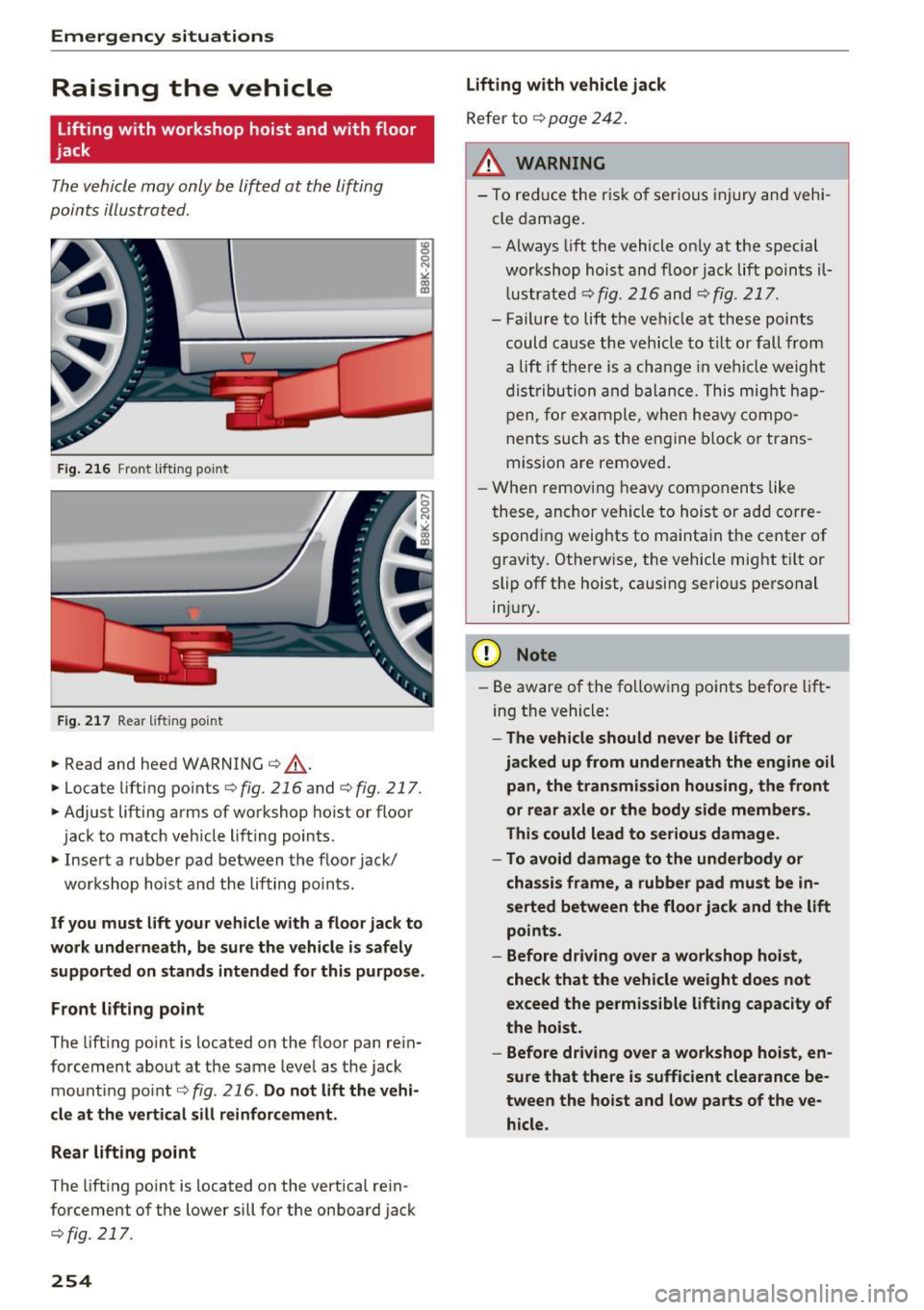
Th e vehicle may only b e lift ed at the lifting
poin ts illust rated.
F ig .. 216 F ro nt lift ing po int
F ig. 217 Rea r lifti ng po int
.,. Read and heed WARNING ¢ A-
.,. Locate lifti ng po ints ¢ fig. 216 and ¢ fig. 217 .
.,. Adjust lifting arms of wo rkshop hoist or floor
jack to match veh icle lifting points .
.,. In se rt a rubb er pad between t he floor jack/
wor kshop hoist a nd the lif ting poin ts .
If you must lift your vehicle with a floor jack to
work underneath, be sure the vehicle is safely
supported on stands intended for this purpose .
Front lifting point
The lift ing po int is located on the floo r pan re in
forcement about at the same leve l as the jack
mo unt ing point ¢
fig. 216 . Do not lift the vehi
cle at the vertical sill rei nforcement.
Rear lifting point
The lift ing po int is located on the vertica l re in
for cement of the lower sill fo r the on board jack
¢fig. 217.
254
Lifting with vehicle jack
Refer to ~ page 242.
A WARNING
-To re duce the r is k of serious injury and vehi
cle dama ge .
- Always lift the vehicle o nly at the special
workshop hois t an d floor jack lift points il
l ustrat ed
~ fig. 216 and ~ fig . 217.
- Failur e to lift the v ehicle at these points
could ca use the veh icle to tilt or fall from
a lift if the re is a cha ng e i n ve hicle weigh t
dis tribu tion and ba lan ce . T his mig ht hap
p en, for exa mple, whe n he avy co mpo
n en ts such as the engine block o r tr an s
mission are removed.
- W hen re m ov in g h eavy co mponen ts like
these, an cho r veh icle to hoist or ad d co rre
spond ing weights to ma inta in the ce nter of
gravity . Othe rw ise, the vehicle mi ght t ilt o r
slip off t he hoist, causing serious pe rsonal
in jur y.
(D Note
- Be aware of the fo llowing po ints befo re lift
ing the vehicle:
- The vehicle should never be lifted or
jacked up from underneath the engine oil pan, the transmission housing, the front
or rear axle or the body side members .
This could lead to serious damage .
- To avoid damage to the underbody or
chassis frame, a rubber pad must be in
serted between the floor jack and the lift
points.
- Before driving over a workshop hoist,
check that the vehicle weight does not
exceed the permissible lifting capacity of
the hoist.
- Before driving over a workshop hoist , en
sure that there is sufficient clearance be
tween the hoist and low parts of the ve
h icle.
Page 258 of 278
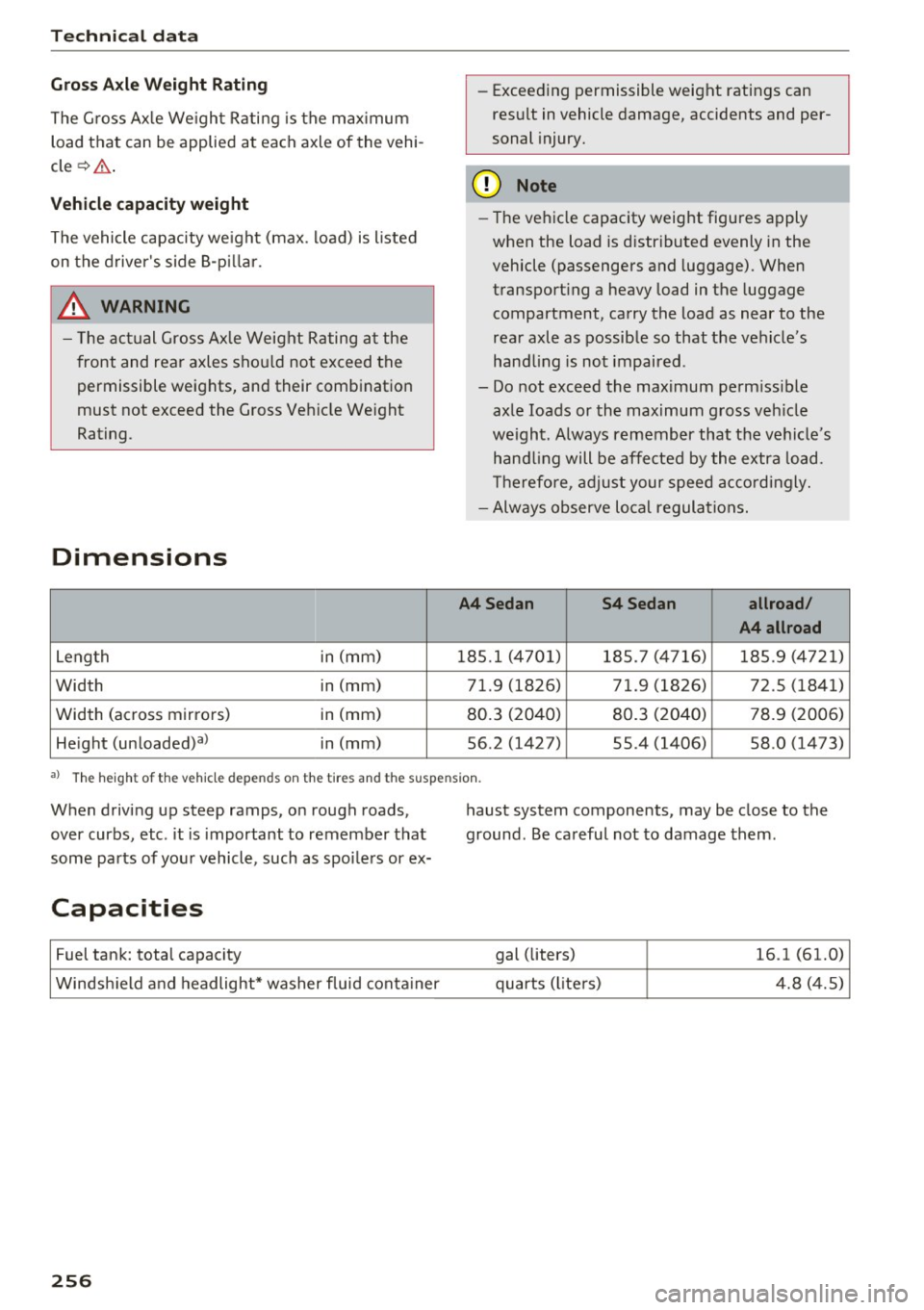
Tech nical data
Gross Axle Weight Rating
The G ross Ax le We ight Rating is the max imum
load that can be applied at each axle of the vehi
cle ¢& .
Vehicle capacity weight
The vehicle capacity we ight (max. load) is l isted
on the d river's side 8-p illar.
_& WARNING
- T he ac tual Gross Axle Weight Rating a t the
front and rear axles sho uld not exceed the
permissible weights, and their combination
must not exceed the Gross Veh icle Weight
Rating.
Dimensions
Leng th in
(mm)
Width in
(mm)
Width (across mirrors) in (mm)
He ight (unloaded)al in (mm) -
Exceed ing permissible weight ratings can
result in vehicle damage, accidents and per
sonal injury.
(D Note
- The vehicle capacity weight figures apply
when the load is d istr ibuted evenly in the
vehicle (passengers and luggage). When
t ransporting a heavy load in the luggage
compartment, carry the load as near to the
rea r axle as possib le so that the vehicle's
hand ling is not impaired .
- Do not exceed the max imum perm iss ible
axle loads or the maximum g ross veh icle
we ight. Always remember that the ve hicle's
han dling will be affe cted by the extra load.
T herefore, a djust your speed acco rd ingly.
- Always observe lo cal regulations.
A4Sedan S4Sedan
allroad/
A4 allroad
1 85.1 (4 70 1) 185. 7 (4716) 18 5.9 (4721)
71.9 (1826) 71.9 (1826) 72.5 (1841)
80.3 (20 40) 80.3 (20 40) 78.9 (2006)
56.2 (1427) 55.4 (1406) 58.0 (1473)
a) The height of th e veh icle depends on t he tir es and the suspens ion.
When driving up steep ramps, on rough roads,
over curbs, etc . it is important to remember that
some parts of you r vehicle, such as spoi lers or ex-
Capacities
Fuel tank: tota l capacity
Windsh ie ld a nd headlight* washer fluid conta iner
256
haust system components, may be close to the
ground. Be careful not to damage them .
gal (liters)
16.1 (61.0)
quarts (l ite rs) 4.8 ( 4.5)
Page 268 of 278
Index
Engine hood Closing . . . . . . . . . . . . . . . . . . . . . . . . . . . .
203
How to release the hood . . . . . . . . . . . . . . 203
Engine oil . . . . . . . . . . . . . . . . . . . . . . . . . . . 205
Adding .. .. .. ............... .... ... 207
Additives . . . . . . . . . . . . . . . . . . . . . . . . . . . 207
Changing . . . . . . . . . . . . . . . . . . . . . . . . . . 208
Check oil level . . . . . . . . . . . . . . . . . . . . . . 207
Consumption . . . . . . . . . . . . . . . . . . . . . . . 207
Indicator light .. .................. 17, 20
Oil consumption . . . . . . . . . . . . . . . . . . . . . 206
Pressure malfunction . . . . . . . . . . . . . . . . . 17
Sensor defective . . . . . . . . . . . . . . . . . . . . . . 20
Specification and viscosity . . . . . . . . . . . . . 205
Engine speed limitation . . . . . . . . . . . . . . . . . 20
Environment
Catalytic converter . . . . . . . . . . . . . . . . . . .
186
Disposing of your vehicle battery . . . . . . . 215
Driving at high speeds . . . . . . . . . . . . . . . . 187
Fuel. .... .. .. .. ............. .... .. . 200
Leaks under your vehicle . . . . . . . . . . . . . . 203
Letting the vehicle stand and warm up . . . 187
Proper disposal of drained brake fluid . . . 212
Proper disposal of drained engine coolant 210
Proper disposal of drained engine o il 207, 208
Recycling used engine oil . . . . . . . . . . . . . 207
Roof rack . . . . . . . . . . . . . . . . . . . . . . . . . . . 68
Unleaded fuel . . . . . . . . . . . . . . . . . . . . . . . 198
What should I do with an old battery? 215
E PC
refer to Electronic power control . . . . . . . . 20
Ethyl alcohol (Fuel) . . . . . . . . . . . . . . . . . . . . 199
Event Data Recorder (EDR) . . . . . . . . . . . . . 176
Expansion tank
Exterior lighting
Exterior mirrors 209
48
Adjusting . . . . . . . . . . . . . . . . . . . . . . . . . . . 51
D ' . 1mming ... .. .. ................ ..... 52
Heating . . . . . . . . . . . . . . . . . . . . . . . . . . . . . 51
F
Fan
Radiator
211
Fastening
Booster seats . . . . . . . . . . . . . . . . . . . . . . .
166
Convertible chi ld safety seats . . . . . . . . . . 164
Infant seats . . . . . . . . . . . . . . . . . . . . . . . . 163
266
Fastening eyes
refer to Tie-downs . . . . . . . . . . . . . . . . . . . . 72
flexib le fue l . . . . . . . . . . . . . . . . . . . . . . . . . . 199
Floor . . . . . . . . . . . . . . . . . . . . . . . . . . . . . . . . 75
Floor mats . . . . . . . . . . . . . . . . . . . . . . . . . . . 126
Fog lights/rear fog light(s) . . . . . . . . . . . . . . 48
Fold ing the rear seats . . . . . . . . . . . . . . . . . . . 69
Foot pedals . . . . . . . . . . . . . . . . . . . . . . . . . . 125
For the sake of the environment
Environmentally -friendly driving . . . . . . .
187
Gasoline fumes and the environment . . . . 200
Letting the engine warm up . . . . . . . . . 80, 83
Refueling . . . . . . . . . . . . . . . . . . . . . . . . . . 200
Sav ing fuel by early upshifting . . . . . . . . . . 11
Front airbags
Description . . . . . . . . . . . . . . . . . . . . . . . . .
142
How they work . . . . . . . . . . . . . . . . . . . . . . 146
Frontal collisions and the laws of physics . . 131
Front passenger 's door emergency locking . . 36
Front seats
Adjusting . . . . . . . . . . . . . . . . . . . . . . . . . .
123
Child restraints in the front seat . . . . . . . . 139
Fuel
Additives .. ... ... ... ...... ....... ...
198
Blended gasoline 198
Consumption . . . . . . . . . . . . . . . . . . . . . . . . 24
Fuel gauge . . . . . . . . . . . . . . . . . . . . . . . . . . 12
Gasoline add it ives . . . . . . . . . . . . . . . . . . . 200
Low fue l level symbol . . . . . . . . . . . . . . . . . 20
Octane rating . . . . . . . . . . . . . . . . . . . . . . . 198
Recommendation ... ................. 198
Refuelling . . . . . . . . . . . . . . . . . . . . . . . . . . 200
Reserve . . . . . . . . . . . . . . . . . . . . . . . . . . . . . 12
Saving fuel . . . . . . . . . . . . . . . . . . . . . . . . . 187
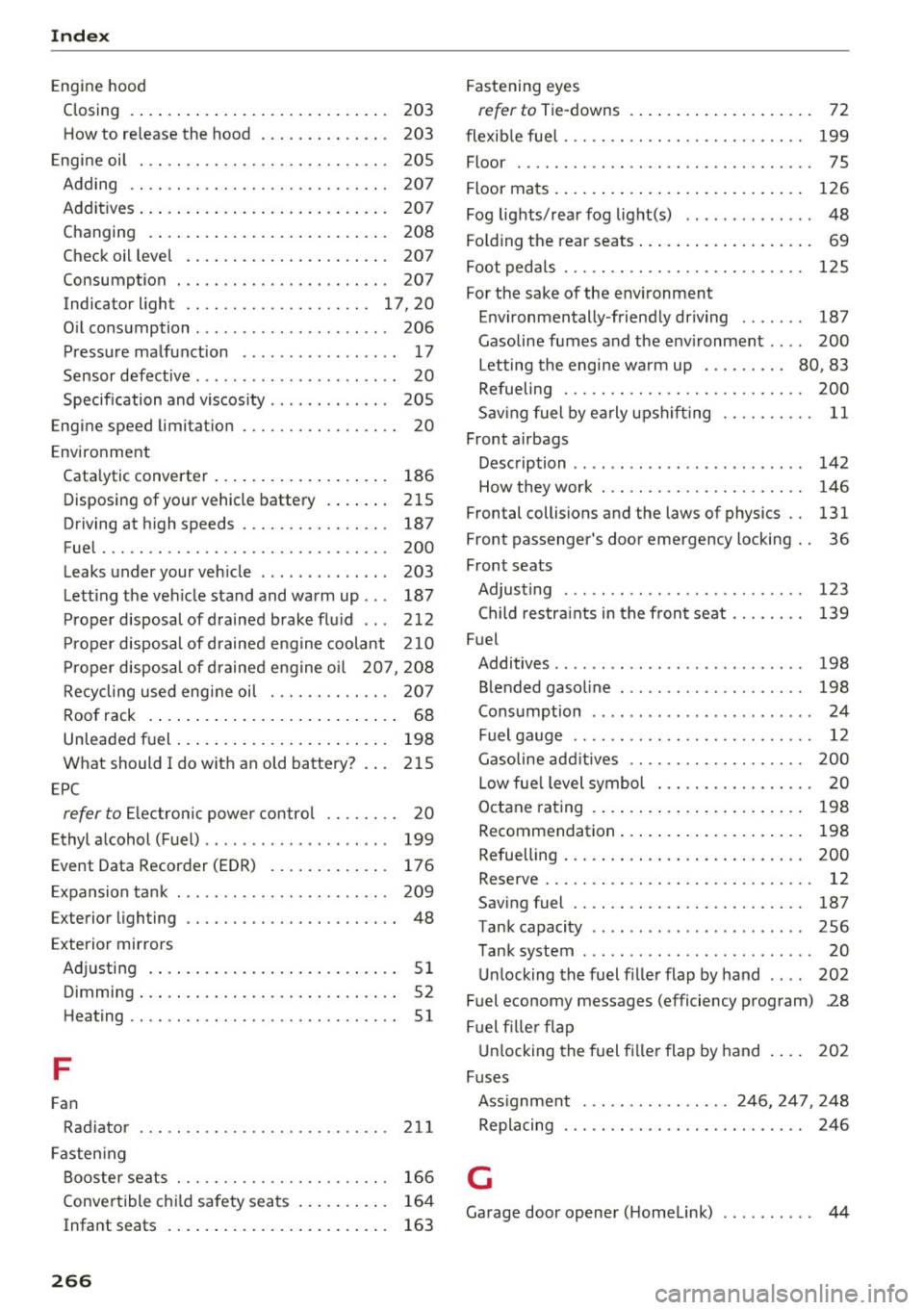
Tank capacity . . . . . . . . . . . . . . . . . . . . . . . 256
Tank system . . . . . . . . . . . . . . . . . . . . . . . . . 20
Unlocking the fuel filler flap by hand . . . . 202
Fuel economy messages (efficiency program) 28
Fuel filler flap
Unlocking the fuel filler flap by hand . . . .
202
Fuses
A . ss 1gnment . .. .. .. .. .. ..... 246, 247, 248
Replacing . . . . . . . . . . . . . . . . . . . . . . . . . . 246
G
Garage door opener (HomeLink) . . . . . . . . . . 44
Page 273 of 278
..... N
0 ::..:: co .....
Improperly worn . . . . . . . . . . . . . . . . . . . . 136
Not wo rn . . . . . . . . . . . . . . . . . . . . . . . . . . 13 1
Safety belt position . . . . . . . . . . . . . . . . . . 134
Safety instructions . . . . . . . . . . . . . . . . . . . 132
Secur ing ch ild safety seats . . . . . . . . . . . . 167
Special co nsiderations for pregnant wom-
e n . . . . . . . . . . . . . . . . . . . . . . . . . . . . . . . . 135
Unfaste ning . . . . . . . . . . . . . . . . . . . . . . . . 135
Wa rni ng/i ndi cator lig ht . . . . . . . . . . . . . . 130
Warning light . . . . . . . . . . . . . . . . . . . . . . . . 1 6
Worn properly . . . . . . . . . . . . . . . . . . . . . . 132
Safety belt warn ing light . . . . . . . . . . . . . . . 130
Safety compliance st icker . . . . . . . . . . . . . . 255
S afety equipmen t . . . . . . . . . . . . . . . . . . . . . 121
Safety features for occupant restraint and p rotection . . . . . . . . . . . . . . . . . . . . . . . . . . . 121
Safety guide lines
Seats . . . . . . . . . . . . . . . . . . . . . . . . . . . . . . . 59
Safety ins truc tions
E ngine compartment . . . . . . . . . . . . . . . . . 203
for side curtain ai rbags . . . . . . . . . . . . . . . 157
for using chi ld safety seats . . . . . . . . . . . . 161
for using safety bel ts . . . . . . . . . . . . . . . . . 132
Mon itoring the Advanced Airbag System 150
Seat adjustment Head restraints . . . . . . . . . . . . . . . . . . . . . 124
S eat belts
refer to Safety belts . . . . . . . . . . . . . . . . . . 130
Seat heating . . . . . . . . . . . . . . . . . . . . . . . . . . 78
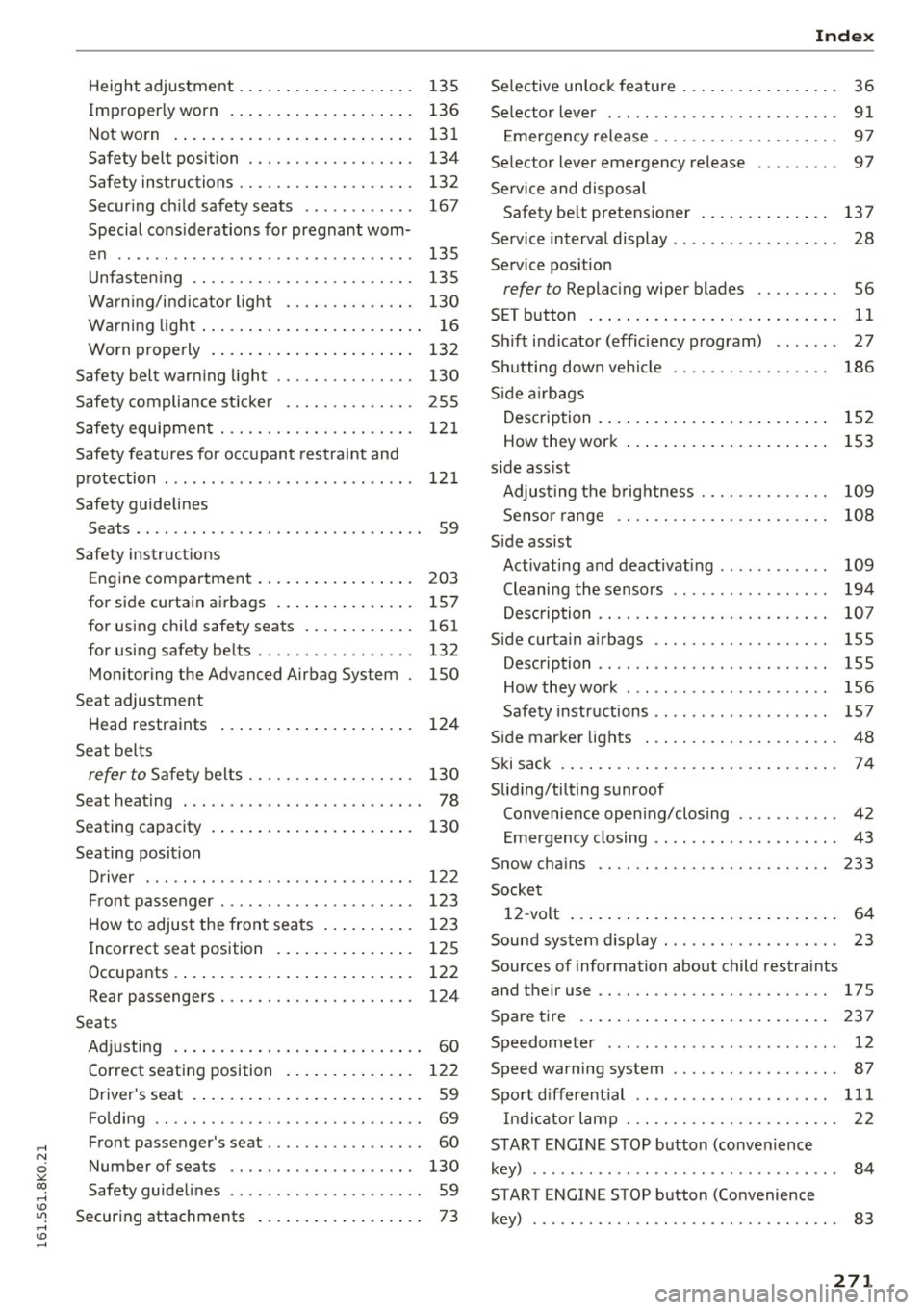
Seating capacity . . . . . . . . . . . . . . . . . . . . . . 130
Seating position Driver . . . . . . . . . . . . . . . . . . . . . . . . . . . . . 122
Fr on t pa ssenger . . . . . . . . . . . . . . . . . . . . . 123
H ow to adjust the front seats . . . . . . . . . . 123
Inco rrect seat position . . . . . . . . . . . . . . . 125
Occupants. . . . . . . . . . . . . . . . . . . . . . . . . . 122
Rear passengers . . . . . . . . . . . . . . . . . . . . . 124
Seats Ad justing . . . . . . . . . . . . . . . . . . . . . . . . . . . 60
Correct seating position . . . . . . . . . . . . . . 122
Driver's seat . . . . . . . . . . . . . . . . . . . . . . . . . 59
Folding . . . . . . . . . . . . . . . . . . . . . . . . . . . . . 69
F ront passenger's seat . . . . . . . . . . . . . . . . . 60
Number of seats . . . . . . . . . . . . . . . . . . . . 130
Safety guideli nes . . . . . . . . . . . . . . . . . . . . . 59
Secur ing attachments . . . . . . . . . . . . . . . . . . 73
Index
Selective unlock feature . . . . . . . . . . . . . . . . . 36
Se lector lever . . . . . . . . . . . . . . . . . . . . . . . . . 91
E mergency release . . . . . . . . . . . . . . . . . . . . 97
Se lector lever emergency release . . . . . . . . . 97
Service and disposal Safety be lt pretens ioner . . . . . . . . . . . . . . 13 7
Se rvice interva l display . . . . . . . . . . . . . . . . . . 28
Se rvice pos ition
refer to Replac ing wiper blades . . . . . . . . . 56
S ET button . . . . . . . . . . . . . . . . . . . . . . . . . . . 11
S hi ft i ndicator (efficiency program) . . . . . . . 27
Sh utting down vehicle . . . . . . . . . . . . . . . . . 186
S ide airbags
Desc ription . . . . . . . . . . . . . . . . . . . . . . . . . 152
How they work . . . . . . . . . . . . . . . . . . . . . . 153
s ide ass ist
Adjus ting the b rightness . . . . . . . . . . . . . . 109
S enso r range . . . . . . . . . . . . . . . . . . . . . . . 108
S ide ass ist
Activat ing and deactivat ing . . . . . . . . . . . . 109
Cleaning the senso rs . . . . . . . . . . . . . . . . . 194
Des cription . . . . . . . . . . . . . . . . . . . . . . . . . 10 7
S ide curta in a irbags . . . . . . . . . . . . . . . . . . . 155
Description . . . . . . . . . . . . . . . . . . . . . . . . . 155
How they work . . . . . . . . . . . . . . . . . . . . . . 156
Safety instructions .. ................. 157
S ide marker lights . . . . . . . . . . . . . . . . . . . . . 48
Ski sac k . . . . . . . . . . . . . . . . . . . . . . . . . . . . . . 74
Slid ing/tilting sunroof
Convenience open ing/clos ing . . . . . . . . . . . 42
E mergency closing . . . . . . . . . . . . . . . . . . . . 43
Snow cha ins . . . . . . . . . . . . . . . . . . . . . . . . . 233
Socke t
12 -volt . . . . . . . . . . . . . . . . . . . . . . . . . . . . . 64
Sound system display . . . . . . . . . . . . . . . . . . . 23
Sources of information abo ut child restra ints
and their use .... .. .. ............... .. 175
Spare t ire . . . . . . . . . . . . . . . . . . . . . . . . . . . 23 7
Speedometer . . . . . . . . . . . . . . . . . . . . . . . . . 12
Speed warning system . . . . . . . . . . . . . . . . . . 87
Spo rt d ifferent ial . . . . . . . . . . . . . . . . . . . . . 111
In dicator lamp . . . . . . . . . . . . . . . . . . . . . . . 22
STAR T EN GINE S TOP button (conve nience
key) . . . . . . . . . . . . . . . . . . . . . . . . . . . . . . . . . 84
S TAR T E NGINE STOP button (Convenience
key) . . . . . . . . . . . . . . . . . . . . . . . . . . . . . . . . . 83
271