low fuel AUDI A4 2016 User Guide
[x] Cancel search | Manufacturer: AUDI, Model Year: 2016, Model line: A4, Model: AUDI A4 2016Pages: 278, PDF Size: 70.26 MB
Page 69 of 278
,....,
N
0
""' CX) ,....,
I.Cl U"I ,....,
I.Cl ,....,
-The coat hooks must only be used for light
weight clothing . Do not leave any heavy or
sharp edged objects in the pockets which
may interfere with the side curtain airbag
deployment and can cause personal injury in
a crash .
- Do not use coat hangers for hanging cloth ing on the coat hooks as this can interfere
with proper deployment of the side curtain
airbags in an accident.
- Do not hang heavy objects on the coat
hooks, as they could cause personal injury in
a sudden stop.
-Always keep the compartment above the
rearview mirror closed while driving to re
duce the risk of injury in the event of sudden
braking maneuvers or a collision.
0 Note
Objects located on the rear shelf that rub
against the rear window could damage the
heating wires for the rear window defogger.
(j) Tips
-A vent slot is located between the shelf and
the rear window. Do not block the vent with
any items you may place on the rear window
shelf.
- Do not p lace bulky items on the rear window
shelf as they could restrict or block the driv
er's vision in the rear view mirror.
Roof rack
Description and mounting locations
Additional cargo can be carried with a roof lug
gage rack .
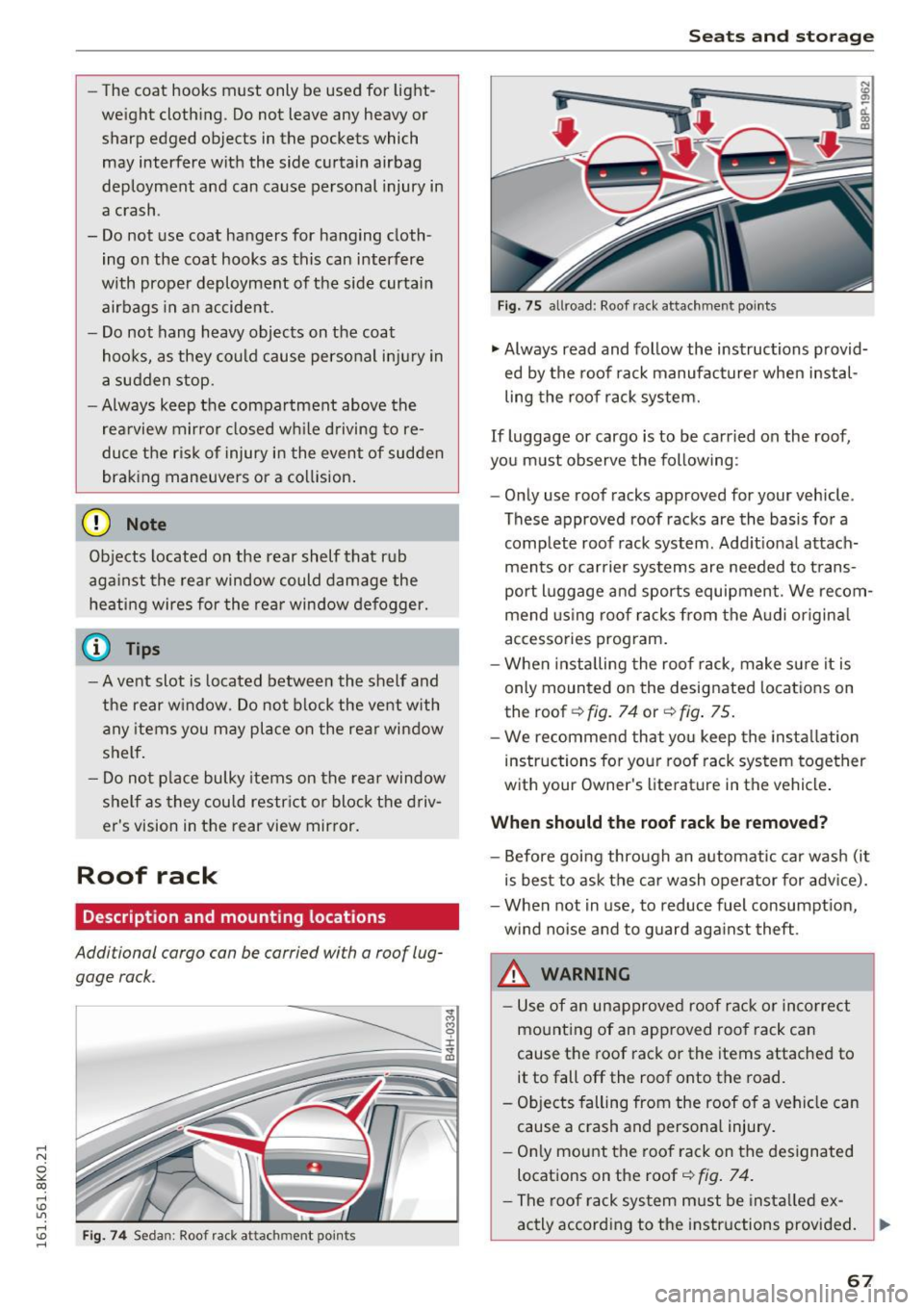
Fig. 74 Sedan: Roof rack a ttac hm en t poin ts
Seats and storage
Fig. 75 allroad : Roof rack attachme nt points
"'Always read and follow the instructions provid
ed by the roof rack manufacturer when instal
ling the roof rack system.
If luggage or cargo is to be carried on the roof,
you must observe the following :
- Only use roof racks approved for your vehicle .
These approved roof racks are the basis for a
complete roof rack system . Add it ional attach
ments or carrier systems are needed to trans
port luggage and sports equipment. We recom
mend using roof racks from the Audi original
accessories program.
- When insta lling the roof rack, make sure it is
only mounted on the designated locations on
the roof
r::!> fig. 74 or r::!> fig. 75.
- We recommend that you keep the installation
instructions for your roof rack system together
with your Owner's literature in the vehicle .
When should the roof rack be removed?
-Before going through an automatic car wash (it
is best to ask the car wash operator for advice).
- When not in use, to reduce fuel consumption,
wind noise and to guard against theft .
_&. WARNING
- Use of an unapproved roof rack or incorrect
mounting of an approved roof rack can
cause the roof rack or the items attached to
it to fall off the roof onto the road.
- Objects falling from the roof of a vehicle can
cause a crash and personal injury.
- Only mount the roof rack on the designated
locations on the roof
r::!> fig. 7 4.
- The roof rack system must be install ed ex-
actly according to the instructions provided. ..,.
67
Page 70 of 278
Seat s and sto rage
-When driving with a roo f rack system,
changes to the center of gravity and wind
resistance can change the vehicle handling
and lead to a collision . A lways adapt your
dr iv ing and your speed to the current condi·
t ions .
{U) Note
- Your vehicle warranty does not cover any
damages to the vehicle caused by using roof
racks or mounting structures not approved
by Aud i for your vehicle . The same applies to
damage resulting from incorrect roof rack i nst allation .
- Always check the roof rack mount ings and
hardware befo re each trip and dur ing a tr ip
to make s ure everyt hing is securely tight
ened.
If necessary, ret ighten the mo unt ings
and check the entire system from time to
time.
- After mounting a roo f rack system, or when
you transport objects on the roof of your ve
hicle, the height of the veh icle is naturally
i nc reased. Be careful when driving under
l ow bridges or in parking garages for exam
ple . This could cause damage to the load
and even the vehicle itself.
- Make sure that the open rear lid and the
su nroof do not come into contact with ob·
j ects on the roof .
Loading the roof rack
Always distribute loads evenly. Make sure any
thing on the roof rack is securely tied down .
"'Always distribute the loads on the roof rack
evenly .
"' Always attach items to the roof rack securely
before you dr ive off .
The max imum perm issible roo f weight is
2 00 lb
( 90 kg ).
The roof weight is the total of the
weight of the roof rack, the attachme nts and the
cargo you are carrying . You must also not exceed
the maximum load weight fo r the roof rack yo u
a re using.
68
When using a roof rack system wh ich has a lower
l oad carrying capacity, you must not use up the
total max imum permissib le load carry ing capac i
ty specified above. Instead, you should load the
roof rack sys tem only to the maximum capacity
specified by the manufacturer of the roof rack
system.
A WARNING
Weak, damaged or improper straps used to
secure items to the roof rack can fail du ring
hard brak ing or in a collision and cause seri
ous persona l injury .
- Ma ke sure the roof rack is i nstalled exactly
as spe cified above
~ page 67 .
-Always use suitable mo unt ing straps fo r se·
cur ing items to the roof ra ck to help preven t
items from sh ifting or flying forward .
- Items on the roof rack must a lways be se·
cure ly mounte d.
- The use of a roof rack can negative ly affect
the way a vehicle handles . Cargo that is
large, heavy, b ulk y, long or flat w ill have a
greater negative influence on the vehicle's
aerodynamics, center of grav ity and overa ll
handling . Always drive slowly, avoid sudden
braking and maneuvers when transporting
cargo on the roof of your vehicle .
- Never exceed the maximum permissib le
load carry ing capacity of the roof of your ve
hicle, the perm iss ible axle weights and the
perm iss ible total we ight of your vehicle
~ page 255, Weights.
(D Note
Make sure that the opened rear lid does not
come in contact with the cargo on the roof .
@ For the sake of the environment
As a result of the increased wind resistance
created by a roof rack, your vehicle is using
fuel unnecessarily . So remove the roof rack
after using it .
-
Page 78 of 278
Warm and cold
Warm and cold
Climate control system
Description
The climate control system warms, cools and
adds humidity to the air in the veh icle inter ior. It
is the most effective when the windows and sun
roof are closed. If there is a build-up of heat in
side the vehicle, ventilation can help to speed up
the cooling process.
I n all heating mode functions except
defrost, the
b lower only switches to a higher speed once the
engine coolant has reached a certain tempera
ture .
Condensat ion from the cooling system can drip
and form a puddle of water under the veh icle.
This is normal and does not mean there is a leak.
P ollutant filt er
The pol lutant filte r removes pollutants such as
dust and pollen from the a ir.
The air pollutants filter must be changed at the intervals specif ied in your Warranty
& Mainte
nance booklet, so that the a ir cond it ione r can
properly work.
If you drive your vehicle in an area with high air pollut ion, the filter may need to be changed
more frequently than specified i n your Aud i War
ranty
& Maintenance booklet. If in doubt, ask
your author ized Audi Service Advisor for advice.
Ke y cod ed setting s
The climate control settings are automatically
stored and assigned to the remote control key
that is in use .
.8, WARNING
Reduced visib ility is dangerous and can ca use
accidents.
- For safe dr iv ing it is very impo rtan t that all
windows be free of ice, snow and condensa
t ion .
76
- Complete ly familiarize yourself with the
proper use and function of the heating and
ventilation system and espec ially how to de
fog and defrost the wi ndows .
- Never use the windshield wiper/washer sys
tem in freezing weather until you have
warmed the windshield first, using the heat ing and vent ilation system. The washer solu
tion may freeze on the windshield and re
duce visibi lity.
(D Note
- If you suspect that the air conditioner has
been damaged, sw itch the system off to
avoid further damage and have it inspected
by a q ualified dealership.
- Repa irs to the Aud i air cond itioner requ ire
special techn ica l know ledge and spec ial
tools. Contact an a uthorized Audi dealer fo r
assistance.
@ For the sake of the environment
By reduc ing the amo unt of fuel you use, you
also reduce the amount of pollutants emitted
into the a ir.
(D Tips
- Keep t he a ir intake slots (in front of the
windshield) free from ice, snow and debr is
in orde r to maintain the prope r funct ion of
the climate control system .
- The energy management sys tem may sw itch
the seat heating* o r rea r window defroster
off temporarily. These systems are available
again as soon as the energy balance has
been restored.
- Air escapes through vents under the rear
window. When placing items of clothing on
the luggage compartment cover, ensure
that the openings are not covered.
Page 92 of 278
Automatic transmission
Automatic transmission Manual transmission
Gearshift lever
A pp lies to veh icles: w ith manu al transmiss ion
The clutch pedal must be depressed all the way
before you can start the engine .
The manual transmission in your Audi is equip
ped with an
interlock-feature.
• Depress the clutch pedal a ll the way.
• Start the engine w it h the gearshift lever in Neu
tral and the clutch pedal depressed.
(D Note
Always depress the clutc h pedal fu lly when
chang ing gears. Do not ho ld the vehicle on a
hill with the clutch pedal partially depressed.
This may cause premature clutch wear or
damage.
@ Tips
- Resting your hand o n the gearshift leve r
k nob while driving will cause premature
wear in the transmiss io n.
- The back-up lights go on when you shift into
Reverse w ith the ignition o n.
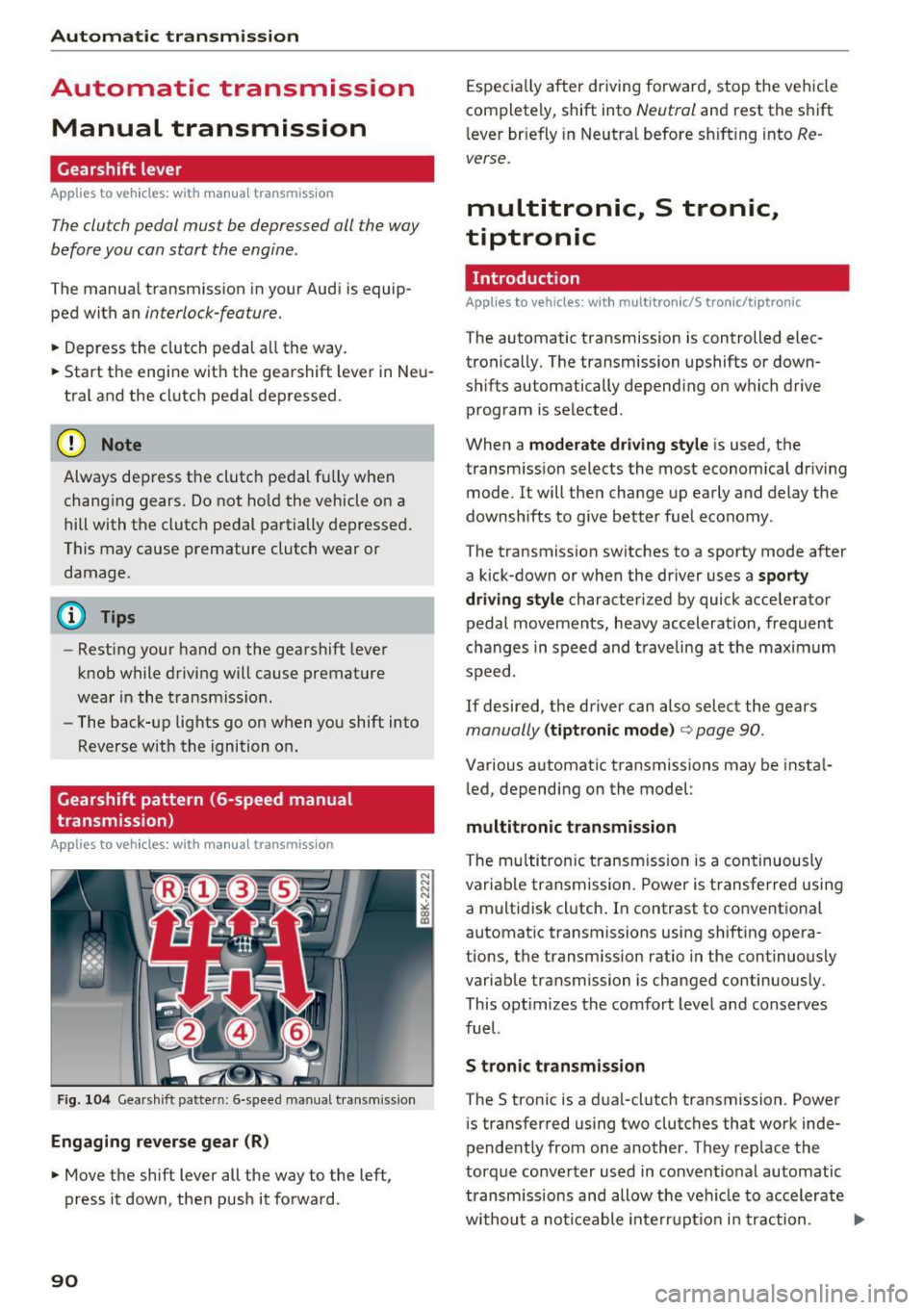
Gearshift pattern (6-speed manual
transmission)
Ap plies to veh icles: w ith man ual transmiss ion
F ig . 104 Gears h ift pattern: 6-speed manual transm iss io n
Engaging reverse gear (R)
• Move the shift lever all the way to the left,
press it down, the n push it forward.
90
Espec ia lly after driving forward, stop the vehicle
completely, shift into
Neutral and rest the shift
l ever br iefly in Neutra l before s hift ing into
Re
verse.
multitronic, S tronic,
tiptronic
Introduction
Applies to vehicles : wi th mult itro nic/S tro nic/ tip tronic
The automatic transmission is controlled elec
tronically. The transmission upshifts or down
shifts automatically depend ing o n which drive
program is se lected .
When a
moderate driving style is used, the
transm ission selects the most economica l driv ing
mode . It will the n change up early and delay the
downshifts to give better fuel economy .
The transmission switches to a sporty mode after
a kick-down or when the driver uses a
sporty
dri ving style
characterized by quick accelerator
pedal movements, heavy acceleration, frequent
c hanges in speed and traveling at the maxim um
speed.
If desired, the driver can also select the gears
manually (tiptronic mode ) ¢ page 90.
Various automatic transmissions may be insta l
l ed, depending on the model :
multitronic transmission
The mu ltitron ic t ransm iss ion is a continuously
variable transmission. Power is transferred using
a multidisk cl utch . In contrast to conventional
automat ic transmissions using shifting opera
tions, the transmission ratio in the continuously
variable transmission is changed continuously.
This opt imizes the comfort leve l and conserves
fuel.
S tronic t ran smission
The S tronic is a d ua l-clutch transmission. Power
i s transferred using two clutches that work inde
pendently from one another . They rep lace the
torque converter used in convent io nal automatic
transm issions and allow the vehicle to accelerate
withou t a noticeable inte rru pt io n in traction. ..,.
Page 187 of 278
..... N
0 ::..:: co .....
environment
Breaking in
New engine
The engine needs to be run-in during the first
1,000 miles (1,500 km).
For the first 600 miles (1 ,000 kilometer s):
"' Do not use full throttle .
"' Do not drive at engine speeds that are more
than
2/3 of the max imum permitted RPM .
From 600 to 1,000 miles (1 ,000 to 1 ,500
kilometers):
"' Speeds can gradually be increased to the maxi
mum pe rm issib le road or engine speed .
During and after break-in pe riod
"' Do not rev the engine up to high speeds when it
is cold. This applies whether the transmission is
in N (Neutral) or in gear .
After the break-in period
"'Do not exceed maximum engine speed under
any c ircumstances.
"'U pshift into the next higher gear
before reach
ing the red area at the end of the tachometer
sca le
c=>page 10.
During the first few hours of driving, the eng ine's
internal friction is higher than later when all the
mov ing parts have been broken in . How well this
b reak-in process is done depends to a considera
b le exte nt on the way the veh icle is d rive n during
t he first 1,000 miles (1,500 kilometers).
(D Note
Extremely high eng ine speeds a re au toma ti
cally reduced. However, these rpm limits are
programme d for a n engine well run-in, not a
new engine.
@) For the sake of the environment
D o not dr ive with u nnecessari ly high eng in e
spee ds -ups hifting ea rly saves fuel, reduces
noise and pro tec ts the envi ronme nt.
Driving and the envir onment
New tires
If your vehicle is runn ing on new tires, d rive very
car efu lly fo r the firs t 35 0 miles (500 kilometers)
a ft er fit ting.
New tires tend to be slippe ry and must a lso
be "bro ken-in". Be sure to remembe r th is dur
i ng the fi rst 350 m iles (500 kilometers).
Brake gent ly. Avoid following closely behind
other vehicles or other s ituations that m ight
r equire sudden, hard b raking.
Avoid damaging the
vehicle
When yo u are dr iv ing o n poor roa ds, or over
cur bs, stee p ramps, e tc., ma ke cert ain that low
ly ing parts s uch a s spo ile rs a nd exh aust sy stem
parts do no t bottom o ut and get dama ged.
T his is espec ially true for ve hicles with low-s lung
c h ass is (sports c hass is) * and fully loaded
vehicles.
Driving through water on
roads
Note t he following to avoi d ve hicle damage w hen
driv ing through water, for examp le on flooded
roads:
- The water must not be any hig her t han the bot
tom of the vehicle body.
- Do not dr ive faste r than walk ing speed.
A WARNING
= -
Afte r driv ing th ro ugh water, m ud, slush, etc .,
the brakes may be slow to take effect beca use
of wet brake rotors and pa ds. Dry the brakes
f irst by braking carefully to restore the full
b raking effect.
(D Note
Ve hicle compone nts such as the engine,
transmission, suspension o r electrica l system
can be severely damaged by driving throug h
water.
185
Page 189 of 278
..... N
0 ::..:: co .....
tion, maintenance and storage . Pay attention to
addit ional information concerning the battery .
Refer to
c::;, poge 212.
Economical and environ
mentally-friendly driving
General
Your personal style of driving will determine the
economy of your vehicle, as well as exhaust and
noise levels.
F ue l economy, environmenta l impact, and we ar
on your engine, brakes and tires la rgely depend
on three factors :
- you r persona l dr iving sty le
- operating conditions
- technical lim itations
If you anticipate what you need to do next and
drive economically, you can eas ily cut your fue l
consumption by
10-15 percen t. This section will
g ive you some tips on how you can help the envi
ronment and yo ur pocketbook .
(!) Tips
The consumpt ion estimates as published by
ENVIRONMENTAL PROTECTION AGENCY (EPA) and Transport Canada may not cor re
spond to your actual consumption on the
road, which will va ry depending upon vehicle
load and speed, road and wea ther condi tions,
t rip length, etc.
Drive smoothly and keep a lookout ahead
Vehicles use the most fuel when they are acceler
ating.
" Avoid unnecessary accelerating a nd braking .
Veh icles use the most fuel when they are acceler
ating . If you anticipate what is going to happen
next , you will need to brake less and, thus, accel
e rate less . let the vehicle coast wheneve r possi
b le -fo r example when yo u see that the next traf
fic light is red .
Driving and the envir onment
Avoid full throttle
Driving at moderate speeds saves fuel and im
proves your mileage .
"Try and keep well below your car 's maximum
speed.
Acce lerating gently reduces fuel consumption,
engine wear, and does not disturb the environ
ment.
Fuel consumption, exhaust emissions and engine
noise increase disproport ionately at high speeds.
If you drive at approximately three quarters of
top speed, fuel consumption will be reduced by
one half. Never drive faster than the posted
speed limit and weather cond itions permit .
Reducing unnecessary idling
Even when your car is jus t idling it burns up fuel.
" Shut the eng ine off when you are not driving
the vehicle.
" Do not warm up the vehicle by lett ing the en-
gine run at idle.
It makes sense to shut off the engine in traffic
jams, when waiting for trains to pass at railroad cross ings, or at traff ic lights that have long waits
on red . Turning the engine off for just
30 -40 sec
onds saves more f uel than is burned starting the
. . engine again.
It takes a long time for the eng ine to warm up
fully when it is running at idle . However, wear
and noxious emissions are especially h igh when
the engine is warming up . So yo u should dr ive
away as soon as you start the eng ine and avoid
runn ing at high rpms w hile the engine is st ill
warming up .
(D Note
Do not leave eng ine idling unattended after
s tart ing. If wa rning lights sho uld come on to
i ndicate improper operation, they would go
unheeded . Extended idling also prod uces
heat, which could resu lt in overheating or
other damage to the vehicle or other proper
ty.
187
Page 190 of 278
Driving and th e en vironm ent
Regular maintenance
A badly tuned engine unnecessarily wastes a lot of fuel.
.,. Have your vehicle serviced at regular intervals.
By having your vehicle regu larly serviced by an
author ized Audi dealer he lps to ensure that it
runs properly and econom ically . The condition of
your veh icle not only affects its safety and ability
to hold its value, it also affects
fu el consump
tion .
C he ck your oil e ach t ime you fill you r ta nk .
The amount of oil used is re lated to engine load
and speed.
It is normal for the oil consumpt ion of a new en
g ine to reach its lowest val ue afte r a certa in mile
age has been driven .
You must d rive you r vehicle about 3 ,000 miles
(5,000 k ilome ters) before you can p roperly as
sess o il cons umption .
This a lso applies to fuel consumption and engine
outpu t.
(D Note
- Have your vehicle maintained properly and
in accordance with the service recommenda
tions in you r Warranty
& Maintenance book
l et . La ck of p roper main tenance as well as
i mproper use of the vehicle will impa ir the
f u nct ion of the emission control system and
could lead to damage.
- Do not al ter or remove any component of
the Emission Control System unless ap proved by the manufacturer.
- Do not a lter or remove any device, such as
heat shie lds, switches, ignition wires,
valves, which are designed to protect your
vehicle's Emission Control System and other i mportant vehicle components.
188
· Fewer short trips
Fuel consumption will always be relatively high
on short trips .
.,. Try to avoid driving short distances with a cold
eng ine .
T he eng ine and catalytic converter have to reac h
their opt imal
operating temper atu re to reduce
fuel consumpt ion and noxious emiss ions effec
tively .
Just after start ing, a cold engine in a mid-size car
on ly achieves a fuel economy of 6-8 miles per
gallon (30-40 l/100 km) . After about a half a
mile, fuel economy climbs to 12 mpg (20 l/100
km) . After about
2 .5 m iles (4 km), the engine is
at its proper operating temperatu re and fuel
economy has reached a no rma l level. So you can
see that you should avoid sho rt tr ips wheneve r
possible .
The
out sid e temperatur e is also cr it ica l in th is re
gard. Your car cons umes more fue l in the winter
than in the summer.
allroad: Driving offroad
General information .
App lies to vehicles : allroad
When dr iving offroad, the functions for the elec
tronic stabilization co ntrol (ESC) are expanded .
The ESC-Offroad-Mode ca n be activated in d riving
s ituations in which a wheel loc k or a d iffe rential
l ock f unct ion is needed ~
page 178. In addit ion,
you r A udi p rovides cont in uo us all whee l dr ive.
You r Audi i s how ever, not an offroad vehicl e.
Nev er dri ve the vehicl e in t errain whi ch i s not
suitable for the vehicl e, or whi ch exce ed s your
driving skills . Nev er take any unnece ssary ri sk s!
Afte r driving offro ad
- After driving offroad, remove branches and
other deb ris from the rad iator g rille , under
body, and wheels. Look especially fo r objects
(s tones) that have been caught in the tire
t read.
- Clean the body and the ve hicle unde rbody and
inspect the ve hicl e for possible damages.
IJI>
Page 197 of 278
..... N
0 ::..:: co .....
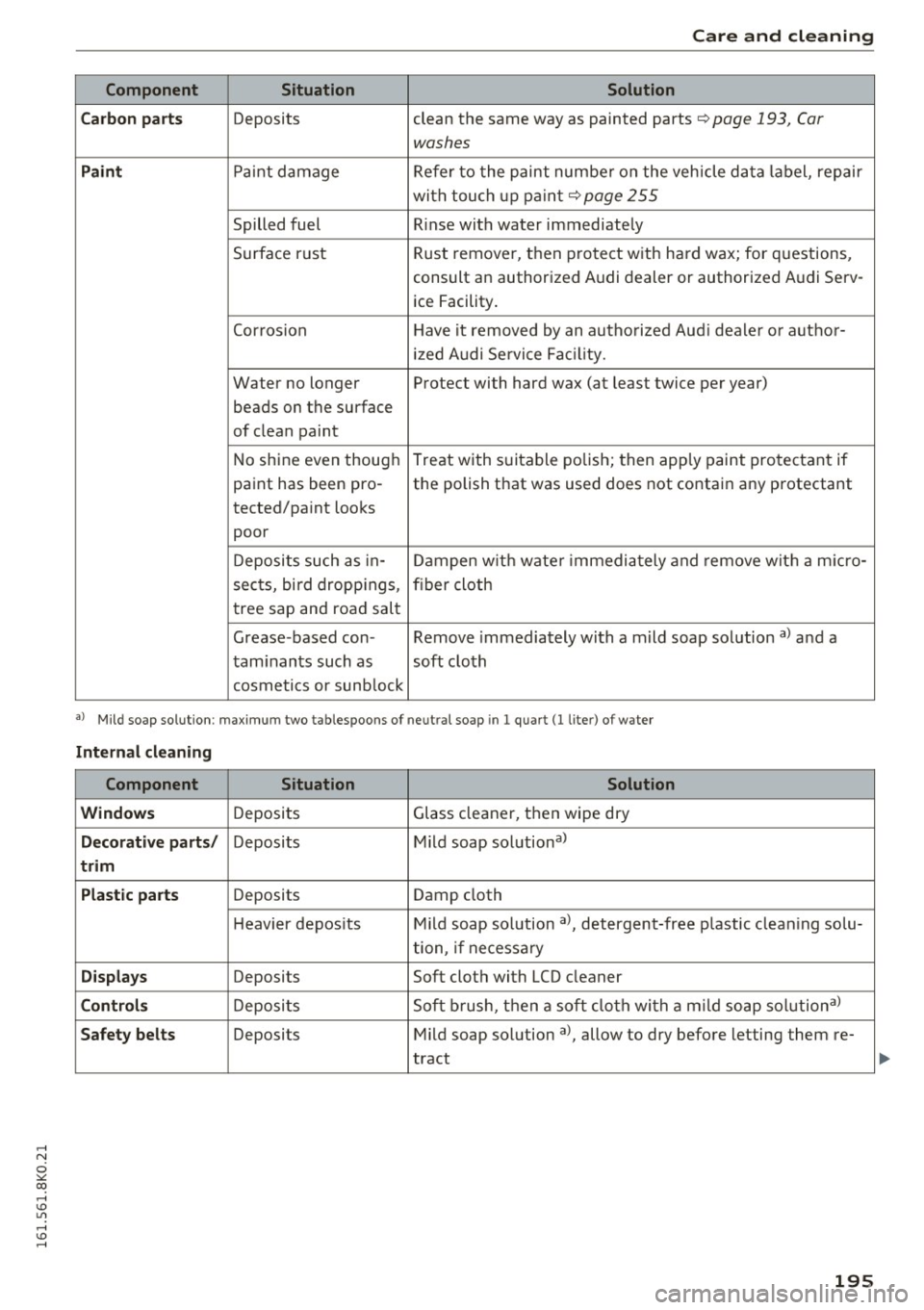
Component Situation Solution
Carbon parts
Deposits clean the same way as
painted parts~ page 193, Car
washes
Paint Paint damage Refer to the paint number on the vehicle data label, repair
with touch up paint~
page 255
Spilled fuel Rin se with water immediately
Surface rust Rust remover,
then protect with hard wax; for questions,
consult an authorized Audi dealer or authorized Audi Serv- ice Facility.
Corrosion Have it removed by an authorized Aud i dealer or author-
ized Audi Se rvice Facility.
Water no longer Protect with hard wax (at least twice per year)
beads on the surface
of clean paint
No shine even though Treat with suitable
polish; then apply paint protectant if
paint has been pro- the polish that was used does not contain any protectant
tected/paint looks
poor
Deposits such as in-Dampen with wate r immediately and remove wit h a m icro-
sects, bird droppings, fiber cloth
tree sap and road salt
Grease-based con-Remove immediately with a mild soap solution a) and a
taminants such as soft cloth
cosmetics or sunb lock
•> Mild soap solution: maximum two tab lespoons of neutral soap in 1 quar t (1 liter) of wa ter
Internal cleaning
Component Situation Solution
Windows
Deposits Glass
cleaner, then wipe dry
Decorative parts / Deposits Mild soap solutiona>
trim
Plastic parts
Deposits Damp doth
Heavier deposits Mild soap solution a), detergent-free plastic cleaning solu-
tion, if ne cessary
Displays Deposits Soft cloth with LCD cleaner
Controls Deposits Soft brush,
then a soft cloth with a mild soap solutiona)
Safety belts Deposits Mild soap solution a>, allow to dry before letting them re-
tract
195
Page 200 of 278
Fuel and Refueling
Fuel and Refueling
Fuel
Fuel supply
Using the right fuel helps keep the environment
clean and prevents engine damage.
Fuel recommendation
The fuel recommended for your vehicle is unlead
ed premium
grade gasoline. Audi recommends
using TOP TIER Detergent Gasoline with a mini
mum octane rating of 91 AKI (95 RON). For more
information on TOP TIER Detergent Gasoline,
p lease go to the official website
(www.toptiergas.com).
The recommended gasoline octane rating for
your engine can also be found on a label located
on the ins ide of the fuel filler flap . This rating
may be specified as AKI or RON.
Your vehicle may also be operated using unlead
ed regular gasoline with a minimum octane rat
ing of 87 AKl/91 RON . However, using 87 AKI/91
RON octane fuel w ill slightly reduce engine per
formance.
Use unleaded gasoline only. Unleaded gasoline
is available throughout the USA, Canada, and in
most European countries . We recommend that
you do not take your vehicle to areas or countries
where un leaded gaso line may not be available.
For more information on refueling your vehicle,
see
c::> page 200.
Octane rating
Octane rating indicates a gasoline's ability to re
sist engine damaging "knock" caused by prema
ture ignit ion and detonation . Therefore, buy ing
the correct grade of gasoline is very important to
he lp prevent poss ible engine damage and a loss
of engine performance.
Gasoline most commonly used in the United
States and Canada has the following octane rat
i n gs that can usually be found on the filler pump:
- Premium Grade: 91 - 96 AKI
- Regular Grade: 87 -90 AKI
198
Explanation of the abbreviations:
AKI= Anti Knock Index= (R+M)/2 = (RON +MON)/
2
RON = Research Octane Number
MON = M otor Octane Number.
CJ) Note
- Do not use any fue l with octane ratings low
er than 87 AKI or 91 RON otherwise expen
sive engine damage will occur.
- Do
not use leaded gasoline. The use of lead
ed gasoline will severely damage your vehi
cle's catalytic converter and its ability to
control exhaust emissions.
Blended gasoline
Use of gasoline containing alcohol or MTBE
(methyl tertiary butyl ether)
You may use unleaded gasoline blended with al
cohol or MTBE (commonly referred to as oxygen
ates) if the blended mixt ure meets the following
criteria:
Blend of gasoline methanol (wood alcohol or
methyl alcohol)
- Anti-knock index must be 87 AKI or higher.
- Blend must contain no more than 3% metha-
nol.
- Blend must contain more than 2% co-solvents.
Blend of gasoline and ethanol (grain alcohol or
ethyl alcohol)
-Anti-knoc k index must be 87 AK I or higher.
- Blend must not contain more than 15% etha-
nol.
- Vehicles with flexib le fue l eng ine: blend must
not contain more than 85% ethanol.
Blend of gasoline and MTBE
-Anti-knock index must be 87 AKI or higher.
- Blend must contain not more than 15% MTBE.
Seasonally adjusted gasoline
Many gasoline grades are blended to perform es
pecially well for winter or summer dr iv ing . Dur-
i ng seasonal change-ove r, we suggest that you .,.
Page 201 of 278
..... N
0 ::..:: co .....
adjustm ent is mor e likely to be made in time .
(D Note
-Fu els con taining a high pe rcentage of etha
no l such as ESQ and EBS may only be used in
vehicles with flexible fuel engines. Using high ethanol f uel in veh icles not equ ipped
with flexib le fue l engines can cause severe
engine damage.
- Methanol fuels which do not meet these re quirements may cause corros ion and dam
age to plast ic and rubber components in the
fuel system.
- Do not use fuels that fail to meet the spec i
fied c riter ia in this chapter .
- If you are unable to determine whether or
not a particular fuel blend meets the spec i
fications, ask your service station o r its fuel
supplier .
- Do not use fue l for wh ich the contents can
not be identif ied .
- Fuel system damage and performance prob
lems result ing from the use of fuels differ
ent from those specif ied a re not the respon
s ibility of Audi and are not covered under
t h e New Veh icle o r the Emiss io n Control
Syste m Wa rra nt ies.
- If yo u experience a loss of fue l economy o r
driveability an d pe rform ance pr oble m s du e
to t he use of one of these fuel blends we
,
recommend that you switch to unb lended
fuel.
Ethanol fuel (Bio-ethanol)
Applies to vehicles: with flex ible fuel engine
You can recognize vehicles wi th a flexible fuel
engine by looking at the lab el on the inside of
the fuel filler flap.
Ve hicl es w ith flex ible f uel engines may be oper
ated w ith b io -e thanol fuels such as EBS (85%
ethano l and 15% gasoline) or with un leaded gas
oline (91 AKI/ROZ 95) . The ve hicle may a lso b e
operated with a mixtu re of these fuels.
Fuel and R efueling
Your fuel consumpt ion w ill increase when using
bio-ethano l fue ls due to th e lower amount of en
ergy conta ined per un it vol ume in ethanol.
Warming up the flexible fuel engine in low
temperature s
Due to the chemica l composition of b io -ethanol ,
a certa in amount of fue l ends up in the engine o il
when driving short distances in very low temper
atures . This fuel evaporates again when the en
gine is warmed up.
II Please warm up engine .
If the drive r message appears in the instr ume nt
cluster disp lay, drive with a warm engine to re
duce the oil leve l.
(D Note
- N ever fill wi th metha no l o r with a higher
percentage of b io -ethanol than 85% (E85).
A highe r percentage of bio-ethanol in the
fuel can cause damage to the engine or to the fuel system.
- If you use on ly E85, it is recommende d to
fill the fue l tank complete ly w ith unleaded
premium g rade gasoline every 5,000 mi les.
- If you expe rience starting, rough id le or hes
itat ion d riveab ility prob lems, f ill the fuel
tank complete ly w ith unleaded p remium
grade gaso line and drive it norma lly until
t he gaso line is used. See your author ized
Audi dea ler if the problem persists.
- Inform your author ized Audi dealer that you
are ope rating o r have operate d the vehicle
w ith EBS.
- Read and follow the i nfo rmat ion and tips
abou t gasoli ne
<=:> page 198.
(D Tips
It may take longer to start the engine when
the outs ide temperat ure is very cold . If possi
ble, use w inte rize d fue l if tempe ratures are
below free zing .
199