low fuel AUDI A4 2016 Owner's Manual
[x] Cancel search | Manufacturer: AUDI, Model Year: 2016, Model line: A4, Model: AUDI A4 2016Pages: 278, PDF Size: 70.26 MB
Page 202 of 278
Fuel and Refueling
Gasoline additives
A major concern among many auto manufactur
ers is carbon deposit build-up ca used by the type
of gasoline you use.
Although gasoline grades d iffer from one manu
facturer to another, they have certain things in
common. All gasoline grades contain substances
that can cause deposits to collect on v ital engine
parts, such as fuel injectors and intake valves. Al
though most gasoline brands include additives to
keep engine and fuel systems clean, they are not
equally effective.
Audi recommends using TOP TIER Detergent Gas
oline. For more information on TOP TIER Deter
gent Gasoline, please go to the official website (www.toptiergas.com).
After an extended period of using inadequate
fue ls, built-up carbon depos its can rob your en
g ine of peak performance.
CD Note
- Damage or malfunction due to poor fuel
quality is not covered by the Audi New Vehi
cle Limited Warranty .
- Do not add aftermarket fuel additive prod
ucts to yo ur fuel tank.
Refueling
Fuel filler neck
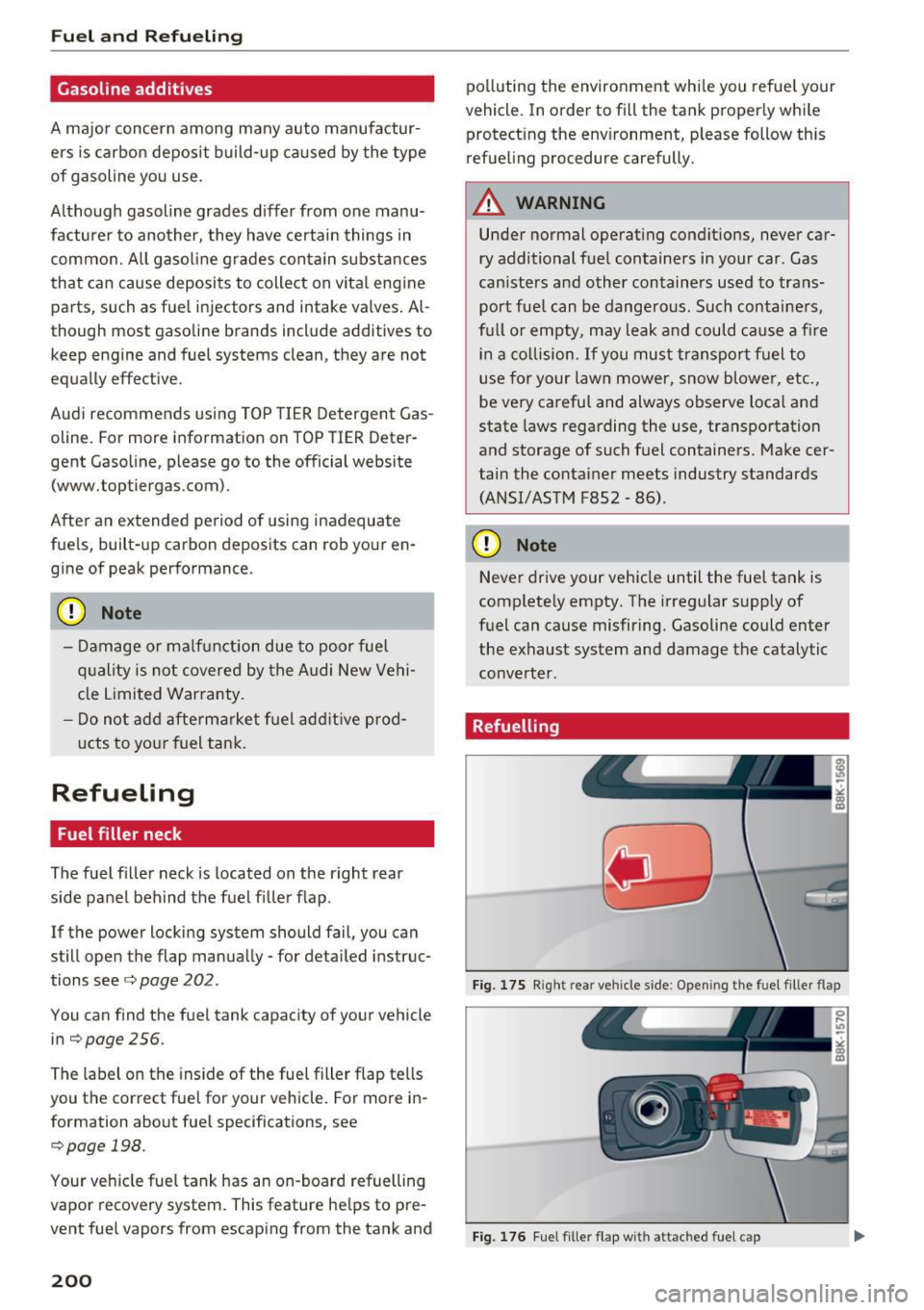
The fuel filler neck is located on the right rear
side panel behind the fuel f iller flap .
If the power locking system should fail, you can
still open the flap manually -for detailed instruc
tions see
c> page 202.
You can find the fuel tank capacity of your vehicle
in
c> page 256 .
The label on the inside of the fuel filler flap tells
you the correct fue l for your vehicle. For more in
formation about fuel specifications, see
<=>page 198.
Your vehicle fuel tank has an on-board refuelling
vapor recovery system. This feature he lps to pre
vent fuel vapors from escaping from the tank and
200
polluting the environment whi le you refuel your
vehicle. In order to fill the tank proper ly while
protecting the env ironment, please follow th is
refueling procedure carefully.
A WARNING
Under normal operating conditions, never car
ry additional fuel containers in your car. Gas
can isters and other containers used to trans
port fue l can be dangerous. Such containers,
full or empty, may leak and could cause a fire
in a col lision.
If you must transport fuel to
use for your lawn mower, snow blower, etc.,
be very careful and always observe local and
state laws regarding the use, transportation
and storage of such fuel containers. Make cer
tain the container meets industry standards (ANSI/ASTM F852 -86).
CD Note
Never drive your vehicle until the fuel tank is
complete ly empty. The irregular supply of
fuel can cause misfiring. Gasoline could enter the exhaust system and damage the catalytic
converte r.
Refuelling
Fig. 175 R ight rea r vehicle side: Open ing the fuel filler flap
Fig. 176 Fuel filler flap w ith attac hed fuel cap
Page 203 of 278
..... N
0 ::..:: co .....
er flap is automatically unlocked or locked. Re
fue l the vehicle with the ignit ion turned
off.
T a king the fuel cap off
.,. Turn off the ignition.
.,. Press the left side of the fue l filler flap to open
it
c:> fig . 175 -arrow -.
.,. Unscrew fue l cap counter -clockwise and hang it
on the fue l filler flap
c:> fig. 176.
Refuelling proc edure
.,. Inse rt the fue l nozzle from the gasoline pump
into the fuel filler neck as far as it will go .
.,. Se lect a medium refuelling rate so that the
nozzle switches off automatically when the
tank is full.
Putting the fuel cap back on
.,. After filling your tank, tw ist the f uel cap clock-
wise as far as it wi ll go .
.,. Close the fuel filler flap.
To avoid fuel spill ing o r evaporating from the f uel
tank always close fuel cap proper ly and com
pletely.
A WARNING
Improper refueling or handling of fuel can
cause fire, explosion and severe b urns.
-
- Fuel is highly flammable and can cause se
vere burns and other injur ies .
- Failure to shut the engine off wh ile refuel
ing and/or to insert the pump nozz le fully
into the fuel filler neck could ca use fue l to
spray out of filler neck or to ove rflow. Fuel
spray and overflowing fue l can cause a fire.
- Never use a cellular telephone wh ile refuel
ing. The electromagnetic radiation can
cause spa rks that can ignite f uel vapors and
cause a fire.
- Never get back into your vehicle while refu
eling. If in except ional circumstances you
must get back in your vehicle while refuel
ing, make certain that you close the door
and touch meta l to discha rge static ele ctric
ity befo re touching the filler noz zle ag ain.
Fuel and R efueling
Stat ic elect ricity can cause sparks that can
ignite fue l vapors released during refueling.
- Never smo ke or have an open flame any
where in or near your vehicle when ref ueling
or filling a portable fuel container .
- For your safety, we strongly recommend
that you do not trave l with a po rtable fuel
container in your veh icle. The container, fu ll
or empty may leak and co uld cause a fire,
especially in a crash.
- If, under except ional circumstances, you
m ust transport a portable fuel container,
p lease observe the following:
- Never fill a portab le fue l conta iner while it
is anywhere in or on the vehicle (for exam
ple, in the l uggage compa rtment, o r on
the trunk). Static electricity can build up
while filling and can ignite fuel vapors caus ing a f ire .
-Always place a portab le fue l conta iner on
the ground before fi lling .
-A lways keep the f iller nozzle comp lete ly
inside the portable container before and
during f il li ng.
- If filling a portable conta iner made of
metal, the filler nozz le must always be in
contact with the container . This will he lp
prevent stat ic elec trici ty from discharging
and ca use a fire.
- Never spill fue l inside the vehicle o r lug
gage compartment. F uel vapors a re highly
flammable.
- Always observe loca l and state/prov incial
laws rega rding the use, storage a nd trans
po rtation of fuel contai ners.
- Make ce rtain the f uel con tainer mee ts i n
dust ry standards (A NSI/ AS TM F852 -86).
(D Note
If any fuel has sp illed onto the car, it should
be removed immed iately to p revent damage
to the pa int.
@) For the sake of the environment
As soon as the correctly operated nozzle
switches off automatically for the first time,
201
Page 204 of 278
Fuel and Refueling
the tank is full . Do not try to add more fuel
because fuel may spill out. In addition, the
expansion space in the fuel tank will be filled -
causing the fuel to overflow when it becomes
warm and pollute the environment.
(D Tips
- Running your engine while refuelling may
cause vapors to escape or even cause fuel to
sp ill out of the tank. This would then shut
off the fuel nozzle before the tank is full.
- Do not refuel your vehicle with the ignition
turned on. The fuel gauge may otherwise
not indicate the correct fuel level after refu
elling .
- The fuel filler flap of your vehicle is not
l ocked when you lock the veh icle from the
inside .
Unlocking the fuel filler flap by hand
You can open the fuel filler flap by hand if the
power locking system should fail.
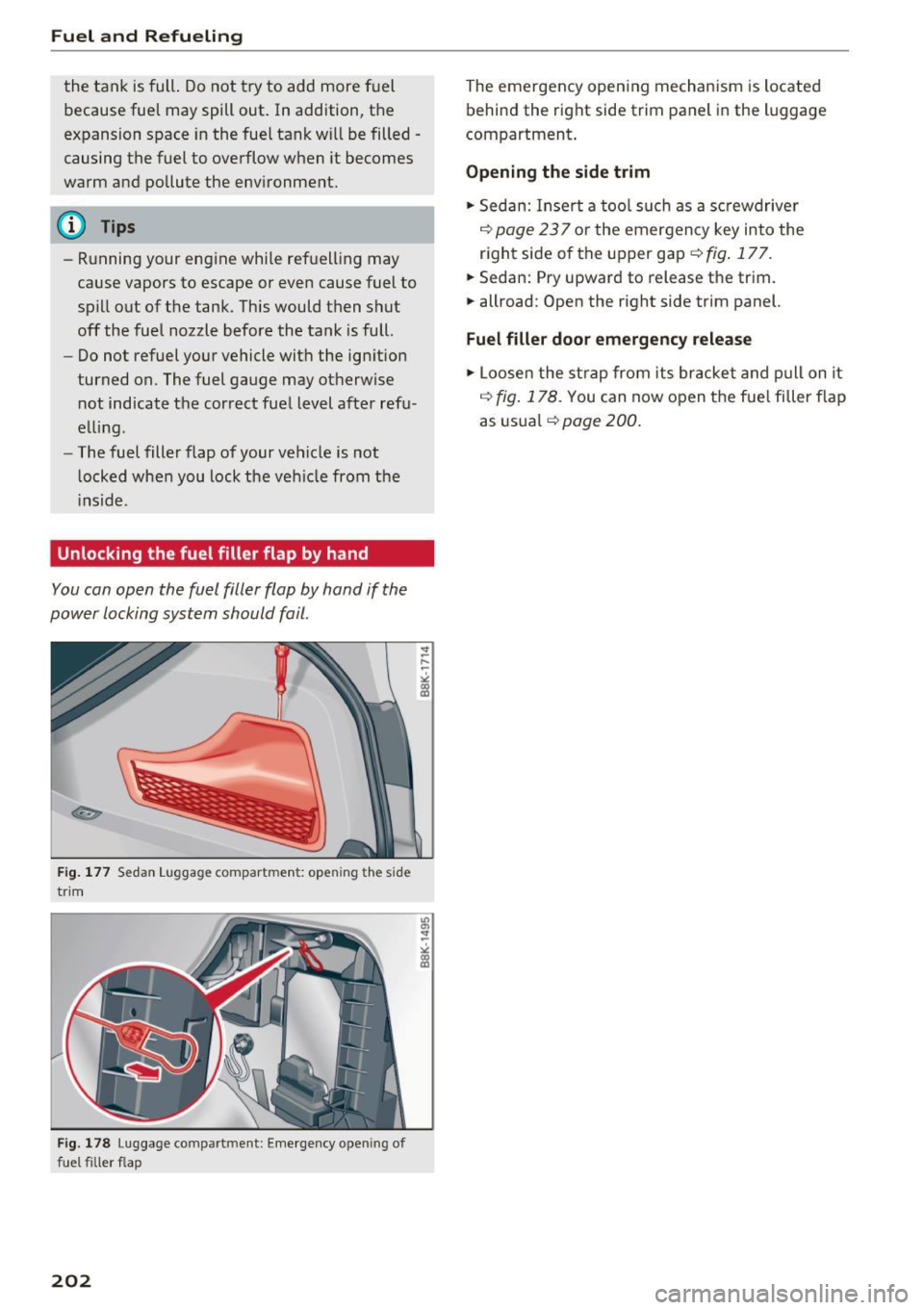
F ig. 177 Sedan Luggage compartmen t: open ing th e s ide
trim
Fig. 178 L uggage compartment: Emergency opening of
fuel filler fla p
202
The emergency opening mechanism is located
beh ind the right side trim panel in the luggage
compartment .
Opening the side trim
.. Sedan: Insert a tool such as a screwdriver
¢
page 237 or the emergency key into the
right side of the upper gap¢
fig. 177 .
.. Sedan: Pry upward to release the trim.
.. allroad: Open the right side trim panel.
Fuel filler door emergency release
.. Loosen the strap from its bracket and pull on it
¢
fig. 178. You can now open the fue l filler f lap
as usual ¢
page 200 .
Page 208 of 278
Check ing and F illing
Using the proper engine oil is impo rtant for the
functionality and service life of the engine. Your engine was facto ry-filled with a h igh-quality oi l
which can usually be used throughout the entire
year.
@) Note
Your Limited New Vehicle War ranty does not
cover damage or malfunctions due to failure
to follow recommended maintenance and use
requirements as set forth in the Audi Owner's
Manual and Warran ty
& Maintenance booklet.
- Use only a high quality eng ine oil t hat ex-
p ressly complies with the Audi oil qua lity
standard specified for your vehicle's engine .
Using a ny o ther oil can cause serious engine
d am age.
- D o not mix any lubricants o r other addit ives
i nto the engine oil. Doing so ca n cause en
g ine damage.
(D Tips
I f you need to add oil and there is none availa
ble t hat meets the Audi o il quality standard
your eng ine requi res , you m ay ad d a tot al of
no more than 0.5 qu art /li ter o f a h igh-quality
"synthe tic"oil that meets t he following speci
fications.
- Vehicles w it h gasoline eng ine: AC EA A3 o r
API SM with a viscosity grade of SAE 0W-30,
SAE SW -30 or SAE SW-40.
- Fo r more information about en gine o il that
has been approve d for your ve hicle, please
contact eithe r you r a uthorized Aud i dea ler
or A udi C ustome r Relat ions at
1 (800) 822-2834 or visit our web site at
www .audiusa .com or www.aud icanada .ca .
Engine oil consumption
The engine in your vehicle depends on an ade
quate amoun t of oil to lubricate and cool all of
its moving parts .
In order to provide effective lubr ication and coo l
ing of in ternal engine components, all internal
combustion eng ines consume a certain amou nt
of oil. Oil co nsumption varies from engine to en
g ine and may change significant ly over the life of
206
th e engine. Typically, engines w ith a specified
break-in period (see
r=:> poge 185) consume more
o il dur ing the b reak-in per iod than they consume
after oil consumption has stabili zed .
U nder normal cond itions, the rate of oil con
sumption depends on the q ua lity and viscosity of
the oil, the RPM (revo lutions per m inute) at
which the engine is operated, the ambient tem perature and road condit ions. Further factors are
the amo unt of o il di lution from water condensa
t ion or fuel residue a nd the oxidation level of the
o il. As any engine is subject to wea r as mileage
builds up, the o il cons umption may increase ove r
t i me unt il repla ce m ent of wo rn components m ay
be come necessary .
With a ll these va riab les coming into p lay, no
sta ndard rate of o il cons umption can be estab
li sh ed or spec ified . T he re is no alte rn ative to reg
ul ar and frequen t checking of the oi l level, see
Note .
If the yellow engine oi l leve l wa rning symbo l Ill
in the instrument clus ter lights up , you sho uld
c h eck t he o il level as soon as possible
r=:> page 207 . Top off the oi l at your ea rliest con
venience
r=:> poge 207.
A WARNING
Before you check anyth ing in the engine com
partment, always read and heed all WARN
INGS
r=:> .&. in Working in the engine compart
ment on page 203 .
@ Note
Driving wit h an insuffic ient oil level is like ly to
cause severe damage to the eng ine.
(D Tips
- The oil pressure warning display. is not
an indicator of the oil level. Do not rely on
it . Instead, check the oil level in your en
gine at regular intervals, preferably each
time you refuel, and always before going
on a long trip .
-If you have the impress io n your e ngine con
sumes excessive amou nts of oil, we recom-
mend th at yo u consult an authori zed A udi .,.
Page 219 of 278
Wheels
Wheels and Tires
General information
.,.Check your tires regularly for
damage (punctures, cuts, cracks
and bulges). Remove foreign ob
jects from the tire tread.
.,. If driving over curbs or similar
obstacles, drive slowly and ap
proach the curb at an angle.
.,.Have faulty tires or rims re
placed immediately.
"'Protect your tires from oil,
grease and fuel.
.,.M ark tires before removing
them so that the same running
direction can be maintained if
they are reinstalled.
"'Lay tires flat when storing and
store them in a cool, dry location
with as little exposure to light as
possible.
(D Note
-Please note that summer and
winter tires are designed for
the conditions that are typical in those seasons. Audi recom
mends using winter tires dur
ing the winter months. Low
temperatures significantly de crease the elasticity of summ
er tires, which affects traction
Wheels
and braking ability. If summer
tires are used in very cold
temperatures, cracks can form
on the tread bars, resulting in
permanent tire damage that
can cause loud driving noise
and unbalanced tires.
-Burnished, polished or
chromed rims must not be
used in winter driving condi
tions. The surface of the rims
does not have sufficient corro
sion protection for this and
could be permanently dam aged by road salt or similar
substances.
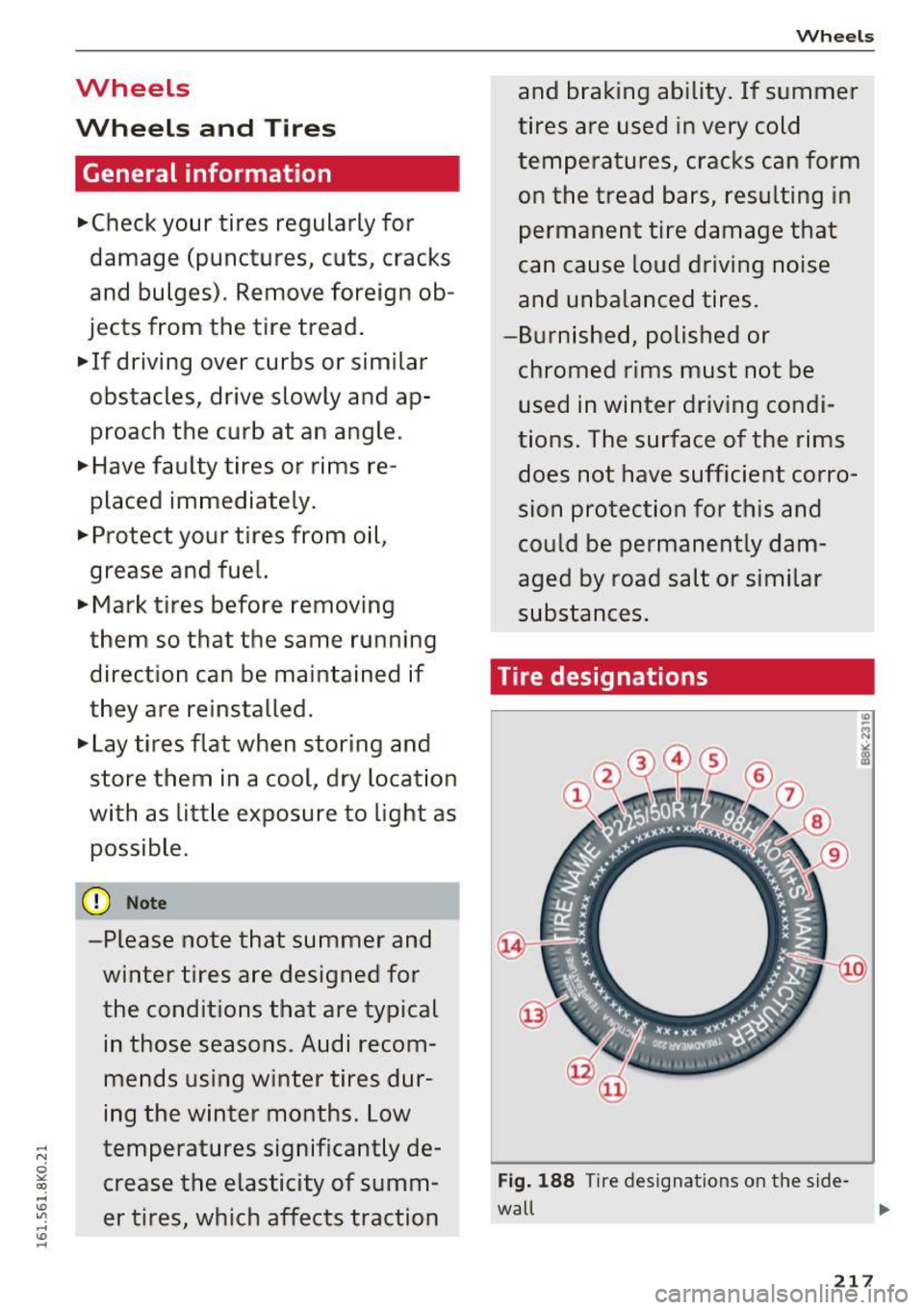
Tire designations
Fig. 188 T ir e designations on the side -
wall Ill>
217
Page 222 of 278
Wheels
Bead
means the part of the tire that is
made of steel wires, wrapped or
reinforced by ply cords and that is
shaped to fit the rim .
Bead separation
means a breakdown of the bond
between components in the bead.
Cord
means the strands forming the
plies in the tire.
Cold tire inflation pressure
means the tire pressure recom
mended by the vehic le manufac
turer for a tire of a des ignated
size that has not been driven for more than a couple of miles (kilo
meters) at low speeds in the
three hour period before the tire pressure is measured or adj usted.
Curb weight
means the weight of a motor ve
hicle w ith standard equipment in
cluding the maximum capacity of
fuel, oil, and coolant, air condi
tioning and additiona l weight of
op tional equipment.
E x tra load tire
means a tire des igned to operate
at higher loads and at h igher in -
220
flation pressures than t he corre
spond ing standa rd tire. Extra load
tires may be identified as "XL",
"xl" , "EXTRA LOAD" , or "RF" on
the sidewall.
Gross A xle Weight Rating
("GAWR ")
means the load-carrying capacity
of a single axle system , measured
at the ti re-gro und interfaces.
Gross Vehicle Weight Rating
("GVWR")
means the max imum total loaded
weight of the vehicle .
Groove
means the space between two ad
jacent tread ribs .
Load rating (code)
means the maximum load tha t a
tire is rated to carry for a given in
flation pressure. You may not find
this informat ion on all ti res be
cause it is not required by law .
Maximum load rating
means the load rating for a tire at
the maximum permissible infla
tion p ressure for that ti re .
Maximum loaded vehicle
weight
means the sum of:
Page 230 of 278
Wheels
the risk of an accident. Read and follow the important safe
ty precautions in ¢ page 229,
Tires and vehicle load limits.
-The tire must flex more if the
tire pressure is too low or if
the vehicle speed or load are
too high. This heats the tire up
too much. This increases the
risk of an accident because it
can cause the tire to burst and
result in loss of vehicle con
trol.
-Incorrect tire pressure in
creases tire wear and has a
negative effect on driving and
Tire pressure table
Please note that the informat ion
contained in the following table
was correct at the time of print
ing, and the information is sub
ject to change. If there are differ
ences between this information
and the tire pressures specified
on the label on the driver's side 8- pillar, always follow the specifica
tion on the 8-pillar label
¢ page 227, fig.190.
228
braking behavior, which in
creases the risk of an accident.
(D Note
Replace lost valve caps to re
duce the risk of damage to the
tire valves.
@ For the sake of the environment
Tire pressure that is too low in
creases fuel consumption.
(D Tips
Audi recommends using the
tire pressure specified for a normal load
¢ page 228 or for
a full load when the vehicle is
partially loaded .
Make sure that the tire designa
tion on your tire matches the des ignation on the tire pressure label
and the tire pressure table.
The following table lists recom
mended tire pressures in cold
tires according to the load and the size of the tires installed.
Page 232 of 278
Wheels
loss of vehicle control, but can al
so damage important parts of the
vehicle and can lead to sudden tire failure, including a blowout
and sudden deflation that can
cause the vehicle to crash.
Your safety and that of your pas
sengers also depends on making
sure that load limits are not ex
ceeded. Vehicle load includes ev
erybody and everything in and on
the vehicle. These load limits are
technically referred to as the vehi
cle's
Gross Vehicle Weight Rat
ing
("GVWR ") .
The "GVWR" includes the weight
of the basic vehicle, all factory in
stalled accessories, a full tank of
fuel, oil, coolant and other fluids plus maximum load. The maxi
mum load includes the number of
passengers that the vehicle is in
tended to carry ("seating capaci
ty") with an assumed weight of 150 lbs. (68 kg) for each passen
ger at a designated seating posi
tion and the total weight of any
luggage in the vehicle. If you tow
a trailer, the weight of the trailer
hitch and the tongue weight of
the loaded trailer must be includ
ed as part of the vehicle load.
230
The Gross Axle Weight Rating
("GAWR") is the maximum load
that can be applied at each of the
vehicle's two axles.
The fact that there is an upper
limit to your vehicle's Gross Vehi
cle Weight Rating means that the
total weight of whatever is being
carried in the vehicle (including
the weight of a trailer hitch and
the tongue weight of the loaded
trailer) is limited. The more pas
sengers in the vehicle or passen
gers who are heavier than the
standard weights assumed mean
that less weight can be carried as
luggage.
The Gross Vehicle Weight Rating and the Gross Axle Weight Rating
are listed on the safety compli
ance sticker label located on the
driver's side B-pillar
¢ page 22 7,
fig. 190.
! WARNING
Overloading a vehicle can cause
loss of vehicle control, a crash
or other accident, serious per
sonal injury, and even death.
-Carrying more weight than your vehicle was designed to carry will prevent the vehicle
from handling properly and
Page 234 of 278
Wheels
Th at w eight ma y not safel y ex
ce ed th e av a il a bl e c argo and
lugga ge loa d capa city c alcul at
ed in St ep 4.
6 . If yo ur vehicle will b e to wing a
tr aile r, lo ad fr om your tr ailer
w ill b e tran sferred to your ve
h ic le . Con sult thi s manual to
dete rmin e how this re du ce s
the a vailable carg o and lug
g age load capa cit y o f your vehi
cle .
.,.Ch eck th e tire s idewall
(¢pag e 217 J fig . 188) to deter
min e the d esign ated load r ating
for a specifi c tire .
Wheel bolts and rims
Wheel bolts
W heel bol ts must be clean and loosen/t ighten
eas ily.
Rims
R ims with a bolted rim r ing * or w it h bolted whee l
covers * consist of mu ltiple pieces . These compo
nents were bolted together using specia l bolts
a nd a special procedu re. You must not repair o r
d isassemble th em¢ ,&..
_& WARNING
Whee l bolts tha t are t ightened o r repa ire d in
correctly can become loose and resul t in loss
of vehicle control, which increases the risk of
an acc ident. For the correct t ightening specif i
cat ion, refer to¢
page 241, After changing a
wheel.
- Always keep the wheel bolts and the
threads in the whee l hub clean and free of
grease.
- Only use wheel bolts that fit the rim.
232
- Always have damaged rims repaired by an
author ized Audi dealer or authorized Audi
Serv ice Facility. Neve r repa ir or disassemb le
r ims you rself, because this increases the risk
of an accident.
Winter tires
Win ter tires significantly improve the vehicle's
handling when dr iv ing in winter conditions. Be
ca use of their const ru ct ion (w idth, compou nd,
t read pat te rn), summer t ires provide less t rac
tion on ice and snow .
.,. Use winter tires on all four wheels.
.,. Onl y use winter tires that a re approved fo r yo ur
veh icle.
.,. Please note that t he maximum permit ted
speed may be lower with winter tires¢.&_ . An
authorized A udi dealer or authorized Audi
Serv
ice Facility can inform you about the maximum
permitted speed for your tires .
.,. Check the tire pressure after insta lling wheels
¢ page 227.
The effectiveness of winter tires is reduced great
l y when the tread is worn down to a depth of
0 .157 in (4 mm). The characteristics of winter
tires also decrease g reatly as the tire ages, re
gard less of the rema ining t read .
_& WARNING
-
-Never d rive fas ter than the max imum pe r
m itted speed for your tires. This could c ause
the t ires to hea t up too m uch. T his increases
the risk of an accident because it can cause the t ire to burst.
- Always ada pt your driving to the road and
traffic conditions. Drive carefu lly and reduce
your speed on icy or slippery roads. Even
winter t ires can lose tract ion on black ice.
@ For the sake of the environment
Reinsta ll summer tires a t the appropriate
time, beca use they provide better handling
when roads are free o f snow and ice. Summer
tires cause less road no ise, tire wear and fuel
consumpt ion.
Page 237 of 278
..... N
0 ::..:: co .....
The temperature grade for this tire is established for a tire that is properly inflated and
not overloaded. Excess ive speed, underinfla
tion, or excessive loading, either separately or
in combination, can cause heat buildup and
possible tire failure.
& WARNING
-
-
Temperature grades apply to tires that are properly inflated and not over or underinflat
ed.
Tire pressure monitoring system
U) General notes
App lies to vehicles: with tire pressure mo nitoring system
Each tire, including the spare (if provided),
should be checked monthly when cold and inflat
ed to the inflation pressure recommended by the
ve hicle manufact urer on the vehicle placa rd o r
tire inflat ion press ure label.
(If your vehicle has
tires of a different size than the size indicated on
the vehicle placard or tire inflation pressure la
be l, you should determine the proper tire infla
tion pressure for those tires).
As an added safety feature, your vehicle has been
eq uipped with a tire pressu re monitoring system
(TPMS) that illuminates a low tire pressure te ll
tale when one or more of your t ires is significant
ly under- inflated. Accordingly, when the low tire
pressure tellta le illuminates, you should stop and
check your tires as soon as possible, and inflate
them to the proper press ure. Driving on a s ignifi
cantly under-inflated tire causes the tire to ove r
h eat and can lead to t ire failure. Unde r-inflation
a lso reduces fuel e fficiency and tire tread life,
and may a ffec t the vehicle's handling and stop
p ing ability .
P lease note that the TPMS is not a substit ute for
p roper tire main tenance, and i t is the drive r's re
sponsib ility to ma intain correct tire pressure,
even if under-inflation has not reached the level
to trigger illumination of the TPMS low tire pres
sure telltale .
Wh eel s
Your vehicle has also been equipped with a TPMS
malfunction indicator to indicate when the sys
tem is not ope rating properly. The TPMS ma l
funct ion indicator is combined with the low t ire
pressure telltale. When the system detects a
malfunction, the telltale will flash for app roxi
mately one m inute and t hen rema in continuously
illuminated. This seque nce w ill cont inue upon
s u bsequent vehicle star t-ups as long as the mal
funct ion exists.
When the malfunction indicator is illum inated,
the system may not be able to detect o r signal
l ow tire p ressure as intended. TPMS malfunct ions
may occur fo r a v arie ty of reaso ns, including the
insta llation of replacement or al ternate tires or
whee ls on the vehicle that p revent the TPMS
from functioning proper ly . Always check the
TPMS ma lfunction te lltale after replacing one or
more tires or wheels on yo ur vehicle to ensure
that the rep lacement or a lternate tires and
wheels allow the TPMS to continue to function prope rly.
' If the Tire Pressure Monitoring System
indicator appears
Applies to vehicles: wi th t ire pressure monitoring system
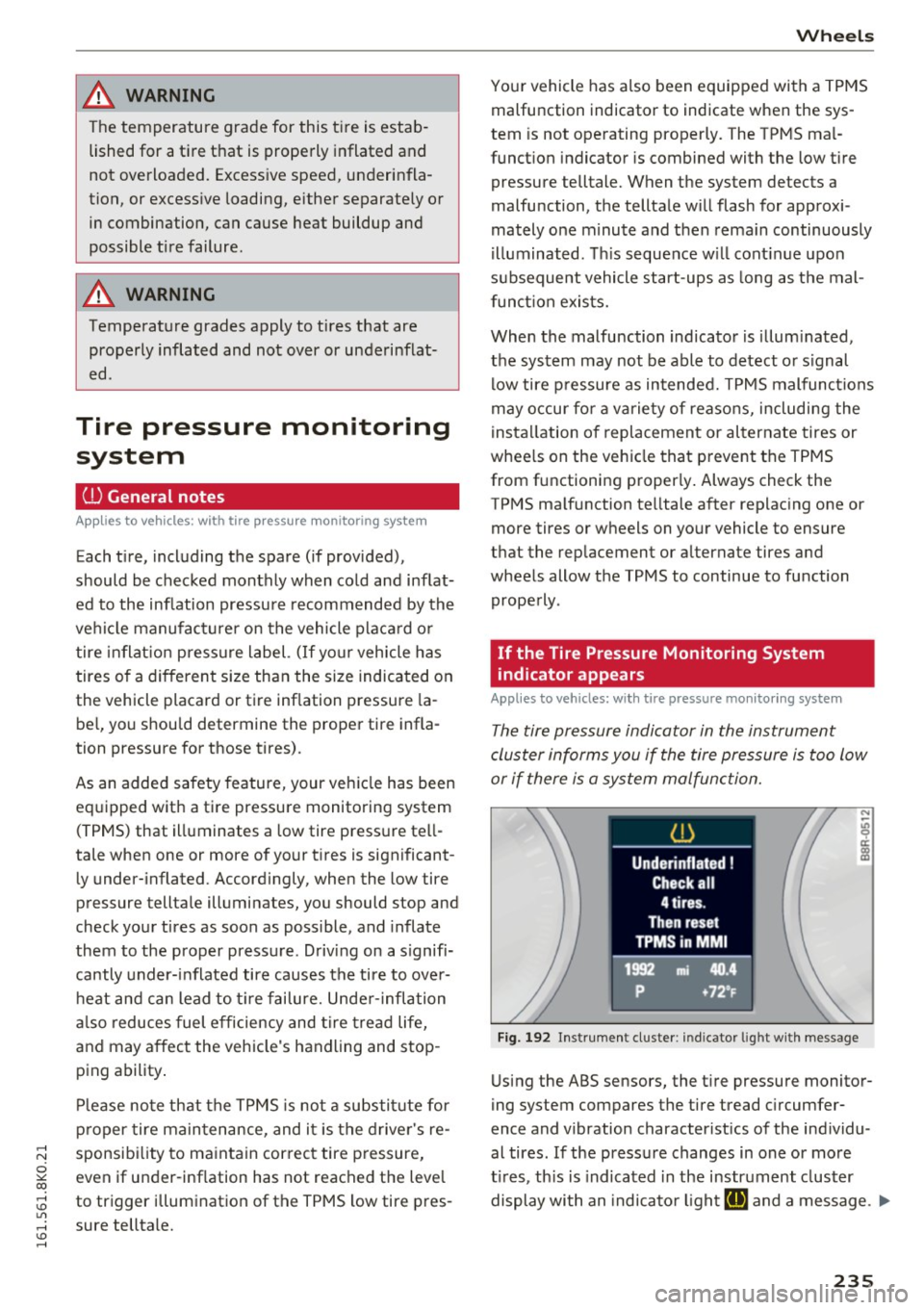
The tire pressure indicator in the instrument
cluster informs you if the tire pressure is too low
or if there is a system malfunction.
Fi g. 192 Instrument cluster: indicator light with message
Using the ABS sensors, the tire pressure monito r
ing system compares the tire tread c ircumfer-
ence and v ibration characterist ics of the ind ividu-
al tires. If the press ure changes in one or mo re
t ir es, th is is indicated in the instrument clust er
display with an indicato r light
RI] and a message . .,.
235