weight AUDI A4 2016 Owner's Manual
[x] Cancel search | Manufacturer: AUDI, Model Year: 2016, Model line: A4, Model: AUDI A4 2016Pages: 278, PDF Size: 70.26 MB
Page 156 of 278
Airbag syste m
passenger. In order to he lp provide this add ition
al protection, the side airbag must inflate within
a fraction of a second at very high speed and w ith
great force. The supplemental side airbag could injure you if your seating position is not proper or
upright or if items are located in the area where
the supplemental side airbag expands . This ap
plies especially to children
q page 158, Child
safety.
Supplemental side ai rbags inf late be
tween the occ upan t and the door pane l on the
side of the vehicle that is struck in certa in side
collision
q fig . 157.
Although they are not a sof t pillow, they ca n
"c ushion" the impact and in t his way they can
he lp to reduce the risk of injury to the upper part
of the body .
A fine dust may deve lop when the airbag deploys.
This is normal and does not mean there is a fire
in the vehicle.
Important safety instructions on the side
airbag system
Airbags ore only supplemental restraints . Always
properly wear safety belts and ride in a proper
seating position.
There is a lot that yo u and your passengers must
know and act accord ingly to help the safety be lts
and airbags do the ir job to provide supplemental
protection.
A WARNING
An inflating side airbag can cause serious or
fatal injury. Improperly wearing safety belts
and improper seating positions increase the
r isk of se rious personal injury and death
w henever a vehicle is being used.
- In order to reduce the risk of injury when
the supplemental s ide airbag inflates:
- Always sit in an upright position and never
lean aga inst the area where the s upple-
mental side airbag is located.
- Never let a chi ld or anyone else rest their
head against the side trim panel in the
area where the supp lemental s ide airbag
inflates.
154 -
Always make sure that safety belts are
worn correctly,
- Do not let anyone sitting in the front seat
put their hand or any other parts of their
body out of the window.
- Always make sure that the side airbag can
inflate w ithout interference.
- Never install seat covers or replacement
upholstery ove r the front seatbacks that
have not been specifica lly approved by
A udi.
- Never use addi tional seat cush ions that
cover the areas where the side airbags de
ploy .
- Damage to the orig inal se at cove rs or to
the seam in the area of the s ide airbag
module must a lways be repaired immedi
ate ly by an authorized Audi dealer.
- Objects be tween you and the airbag can in
crease the r is k of injury in an acc ident by in
terfering with the way the airbag unfolds or by being p ushed into you as the airbag in
flates.
- Never place or attach accessor ies or other
obje cts (s uch as cupholders, telephone
bracke ts, or even l arge, bulk y objec ts) on
the doors, over or near the area marked
"AIRBAG" on the seat backrests .
- Such objec ts and accessories can be come
dange rous projecti les and cause injury
when the supplemental side airbag de ploys.
- Never carry any objects or pets in the de
ployment space between them and the
airbags or allow children or other passen
gers to trave l in this position.
- Always use the b uilt-in coat hooks only fo r
lightweight clothing. Never leave any heavy
or sharp-edged objects in the pockets that
may inte rfere with s ide a irbag deployment
a nd can cause personal injury in an accident .
- Always prevent the side airbags from being
damaged by heavy objects knocking against
or hitting the sides of the seatbacks.
- The a irbag system can only be triggered
once . If the airbag has been triggered, the
system must be replaced by an autho rized
Aud i dea le rship.
~
Page 159 of 278
..... N
0 ::..:: co .....
curtain airbag system
Airbags are only supplemental restraints. Always
properly wear safety belts and ride in a proper
seating position.
There is a lot that you and your passengers must
know and do to help the safety belts and airbags
do their job to provide supplemental protection.
_& WARNING
-
Improperly wearing safety belts and improper
seating positions increase the risk of serious
personal injury and death whenever a vehicle
is being used.
- Never let occupants place any parts of their
bodies in the area from which the side cur
tain airbags inflate.
- Always make sure that the side curtain air
bags can inflate without interference. Un
suitable accessories fitted inside the expan
sion range of a head airbag can dangerously
interfere with its function. A deploying head
airbag develops enough force to catapult
any piece of add-on component out of its
path of inflation and into the passenger
compartment. An occupant hit by such a
projectile can suffer serious injury or death
¢ page 260, Technical Modifications.
- Do not swivel the sun visors to the side if
you have any objects clipped onto them (for
example pens). If the airbag should deploy,
you could be injured by these objects.
- Use the built-in coat hooks only for light
weight clothing. Never leave any heavy or
sharp-edged objects in the pockets that may
interfere with airbag deployment and can
cause personal injury in an accident.
- Never use hangers to hang clothing from the hooks.
- Only use factory-installed sun shades or, in
the case of shades installed after the vehicle
leaves the factory, only Audi roll-up
sunscreens may be used
¢ page 260, Addi
tional accessories and parts replacement.
- Always sit in proper seating position and
wear safety belts while traveling so that the
Airbag system
side curtain airbags can help provide protec
tion.
- The airbag system can only be triggered
once. If the airbag has been triggered, the
system must be replaced by an authorized
Audi dealer or qualified workshop.
-Always have work involving the side curtain
airbag system, removal and installation of
the airbag components, or other repairs performed by an authorized Audi dealer or
qualified workshop. Otherwise the airbag
system may not work correctly.
- Never attempt to modify any components of
the airbag system in any way.
157
Page 160 of 278
Child safety
Child safety
Important information
Introduction
The rear seat is generally the safest place in a
collision .
The physical principles of what happens when
your vehicle is in a crash apply also to children
¢ page 131, What happens to occupants not
wearing safety belts? .
But unlike adults their
muscles and bones are not fu lly deve loped . In
many respects ch ildren are at greater risk of ser i
ous injury in crashes than adults.
Because children's bodies are not fu lly devel
oped, they requ ire restraint systems especially
des igned for their size, we ight, and body struc
ture. Many countries and all states of the United
S tates and p rovinces of Canada have laws requir
ing the use of approved child restraint systems
for infants and small children.
I n a frontal crash at a speed of 20-35 mph
(30-56 km/h) the forces acting on a 13-pound
(6 kg) infant will be more than 20 times the
weight of the child. This means the weight of th e
child would suddenly be more than 260 pounds
(120 kg) . Under these conditions, only an appro
priate child restraint properly used can reduce
the risk of serious injury. Child restraints must be
used properly to be effective . Used improperly,
they can increase the risk of serious injury in an
accident.
Consult the child safety seat manufacturer's in
structions to be sure the seat is right for your
child's size¢
page 161, Important safety in
structions for using child safety seats.
Please be
sure to read and heed all of the important infor
mation and WARN INGS about ch ild safety, Ad
vanced Airbags, and the installation of child re
straints in this chapter.
There is a lot you need to know about the Ad
vanced Airbags in you r vehicle and how they work
when infants and children in child restraints are
on the front passenger seat . Because of the large
amount of important information, we cannot re
peat it all here. We urge you to read the detailed
158
information in this owner 's manual about airbags
and the Advanced Airbag System in your vehicle
and the very important information about trans
porting children on the front passenger seat.
Please be sure to heed the WARNINGS - they are
extremely important for your safety and the safe
ty of your passengers, especially infants and small chi ldren .
&_ WARNING
-Accident statistics have shown that children
are generally safer in the rear seat area than
in the front seating position. Always restrain
any child age 12 and under in the rear.
- All vehicle occupants and especially children
m ust be restrained properly whenever riding
in a vehicle. An unrestrained or improperly
restrained child cou ld be injured by striking
the interior or by being ejected from the ve hicle during a sudden maneuver or impact.
An unrestrained or improperly restrained
child is also at greater r isk of injury or death
through contact w ith an inflating airbag .
- A suitable ch ild restraint properly installed
and used at one of the rear seating positions
provides the highest degree of protect ion
for infants and small children in most acci
dent sit uat ions.
&_ WARNING
Children on the front seat of any car even with
Advanced Airbags can be ser iously injured or
even killed when an airbag inflates. A child in
a rearward-facing child safety seat installed
on the front passenger seat will be seriously
injured and can be killed if the front airbag in
flates.
- The inflating airbag will hit the ch ild safety
seat or infant carrier with great force and
w ill smash the child safety seat and child
aga inst the backrest, center armrest or
door.
-Always install rearward-facing child safety
seats on the rear seat.
- If you must install a rearward facing child
safety seat on the front passenger seat in
Page 161 of 278
..... N
0 :,,:: co .....
GER AIR BAG OFF
light does not come on
and stay on, immediately insta ll the rear
ward-facing child safety seat in a rear seat
ing posit ion and have the airbag system in
spected immediately by your authorized
Audi dealer.
A WARNING
If, in except ional circumstances, you must in
stall a forward-facing chi ld restraint on the
front passenger's seat :
- Always make sure the forward-fac ing seat
has been designed and certified by its man
ufacturer for use on a front seat with a pas
senger front and s ide airbag .
- Always follow the manufac turer 's instruc
tions provided with the chi ld safety seat or
carrier.
- Always move the passenger seat into its
rearmost position in the seat's fore and aft
adjustment range, as far away from the air
bag as possib le before installing the child
restra int. The backrest must be adjusted to
an upr ight position.
-Always make sure that the
PA SSENGER AIR
B AG OFF
light comes on and stays on all the
t ime whenever the ignition is switched on.
Always replace ch ild restraints that were in
stalled in a vehicle dur ing a crash. Damage to
a child restraint that is not visib le could cause
it to fail in another collision situation.
Advanced front airbag system and children
Your veh icle is equipped with a front "Advanced
A irbag System" i n compliance w ith United States
F edera l Moto r Vehicle Safety Standard ( FMVSS)
208, as well as Canada Motor Ve hicle Safety
Standard (CMVSS) 208 as applicable at the time
your vehicle was manufactured .
The Advanced Airbag system in your ve hicle has
been ce rtified to meet the " low-risk" requ ire
ments for 3 -and 6-yea r old children on the pas
senger side and sma ll adults on the driver side .
Child safety
The low risk deployment criteria a re intended to
reduce the risk of injury through interaction with
the a irbag that can occur, for example, by be ing
too close to the steering wheel and instrument panel when the airbag inflates. In addition, the
system has been certified to comply with the "suppression" requirements of the Safety Stand·
ard, to turn off the front airbag for infants up to
12 months who are restrained on the front pas
senger seat in ch ild rest raints that are listed in
the Standard.
Even though your veh icle is equipped with an Ad·
vanced Airbag system, all ch ild ren, especially
those 12 yea rs and you nger, sho uld a lways ride
in the back seat proper ly restrained for their age
and size . The airbag on the passenger side makes
the front seat a potentially dangerous p lace for a
child to ride. The front seat is not the safest place
for a ch ild in a forward-fac ing ch ild safety seat. It
can be a very dangerous place for an infant or a
larger ch ild in a rearward-facing seat .
' Advanced Airbags and the weight-sensing
mat in the front seat
The Advanced A irbag System in you r vehicle de
tects the presence of an infant or chi ld in a chi ld
restraint on the front passenger seat using the
weight -sensing mat in the seat cushion and the
sensor below the safety belt latch on the front
passenger seat that measures the tens ion on the
safety belt.
The weight-sensing mat measures total weight of the child and the chi ld safety seat and a child
blanket on the front passenger seat . The weight
on the front passenger seat is related to the de
s ign of the child restra int and its "footprint", the
s ize and shape of the bottom of the ch ild re-
straint as it sits on the seat. The weight of a ch ild
restra int and its "footprint" va ry for different
k inds of child restra ints and for the different
models of the same kind o f chi ld rest raint of -
fered by chi ld restraint manufacturers.
T he we igh t ranges for the indiv id ual types,
makes and mode ls of ch ild restraints that the
NH TSA has specified in the Safety Standard to
gether with the weight ranges of typical infants .,.
159
Page 162 of 278
Child safet y
and typical 1 year -old child have been sto red in
the co ntrol unit of the Advanced Airbag System.
When a chi ld restra int is being used on the front
passenger seat with a typical 1 year-old child, the
Advanced Airbag System compares the we ight
measured by the we ight sensing mat with the in
formation stored in the electronic control unit.
The electronic control un it also registers the ten
sion on the front passenger safety belt. The ten
sion on the safety belt for the fro nt passenger
seat will be d ifferent for an adult w ho is p roperly
using the safety belt as compared to the tension
on the belt w hen it is used to attach a ch ild re
s tra int to the sea t. The senso r below the la tch for
t he safety belt for the front sea t passenger
measures the tension on the belt. The inp ut from
this senso r is then used with the weight to "de
cide", whether there is a child restra int w ith a
typical 1 year-old child on the front passenge r
seat and whether or not the a irbag must be
turned off.
Child restraints and Advanced Airbags
Regard less of the child restra int tha t you use,
make su re that it h as been cert ified to meet Safe
ty Standa rds and has been certified by its manu
facture r for use wi th an a irba g. A lways be sure
t hat the chi ld restrain t is properly insta lled at
one of the rear seating positions . If in exception
al c ircumstances yo u m ust use it on the front
passenger seat, carefully read all of the informa
tion on child safety and Advanced Airbags and heed a ll of the app licab le WARNINGS . Make cer
tain tha t the child res tra int is correc tly recog
n iz ed by the we ight-sens ing mat inside the front
passenger seat, that t he fron t passe nger a irbag
is t urned off and tha t the airbag st atus is always
corre ct ly sign aled by the
PASSENGER AIR BAG
OFF li ght .
M any types and mo dels of child res traints have
been available ove r the ye ars, new mode ls are in
troduce d regularly inco rpora ting new and im
p roved designs and o lder mode ls are taken o ut of
product ion . Chi ld restraints a re not standardized .
Ch ild restraints of the same type typ ica lly have
d ifferent weights and s izes and d ifferent 'foot
prints,' the size a nd shape of the bottom of t he
160
ch ild restraint t hat sits on the seat, when they
a re installed on a vehicle seat . These differences
make it virtua lly impossib le to certify comp liance
with the requirements for advanced a irbags w ith
each and every child restra int that has ever been
sold in the past or wi ll be sold over the course of
t h e usefu l life of your vehicle .
For t his reason, the United States National High
way Traffic Safety Admin istrat ion has published a
li st of specific type, makes and mode ls of ch ild
res tra ints tha t must be used to certify compli
ance of the Advanced Airbag System in your ve hi
cl e w ith the s uppression requirements of Federa l
Mot or Ve hicl e Safety St and a rd 208. These child
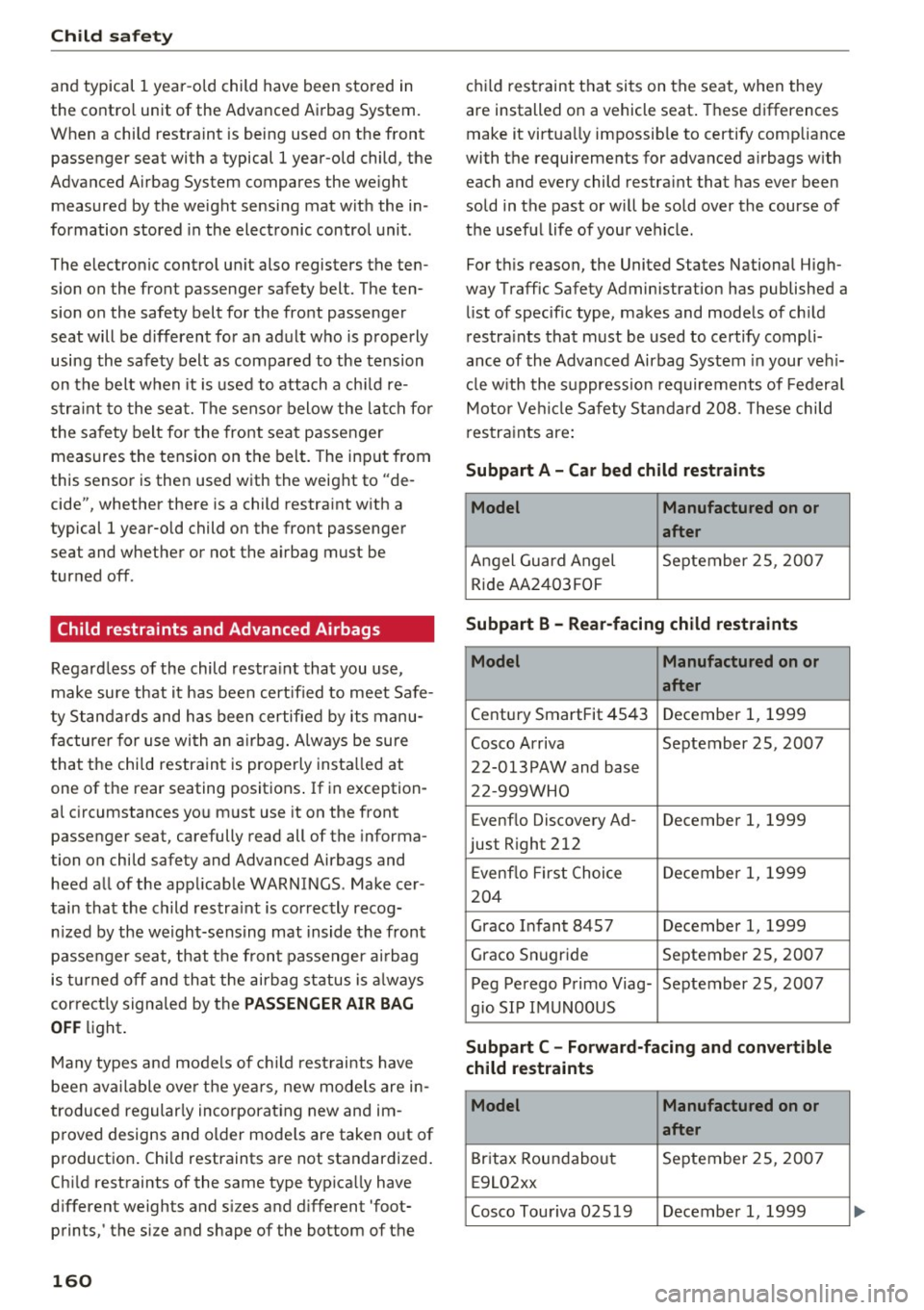
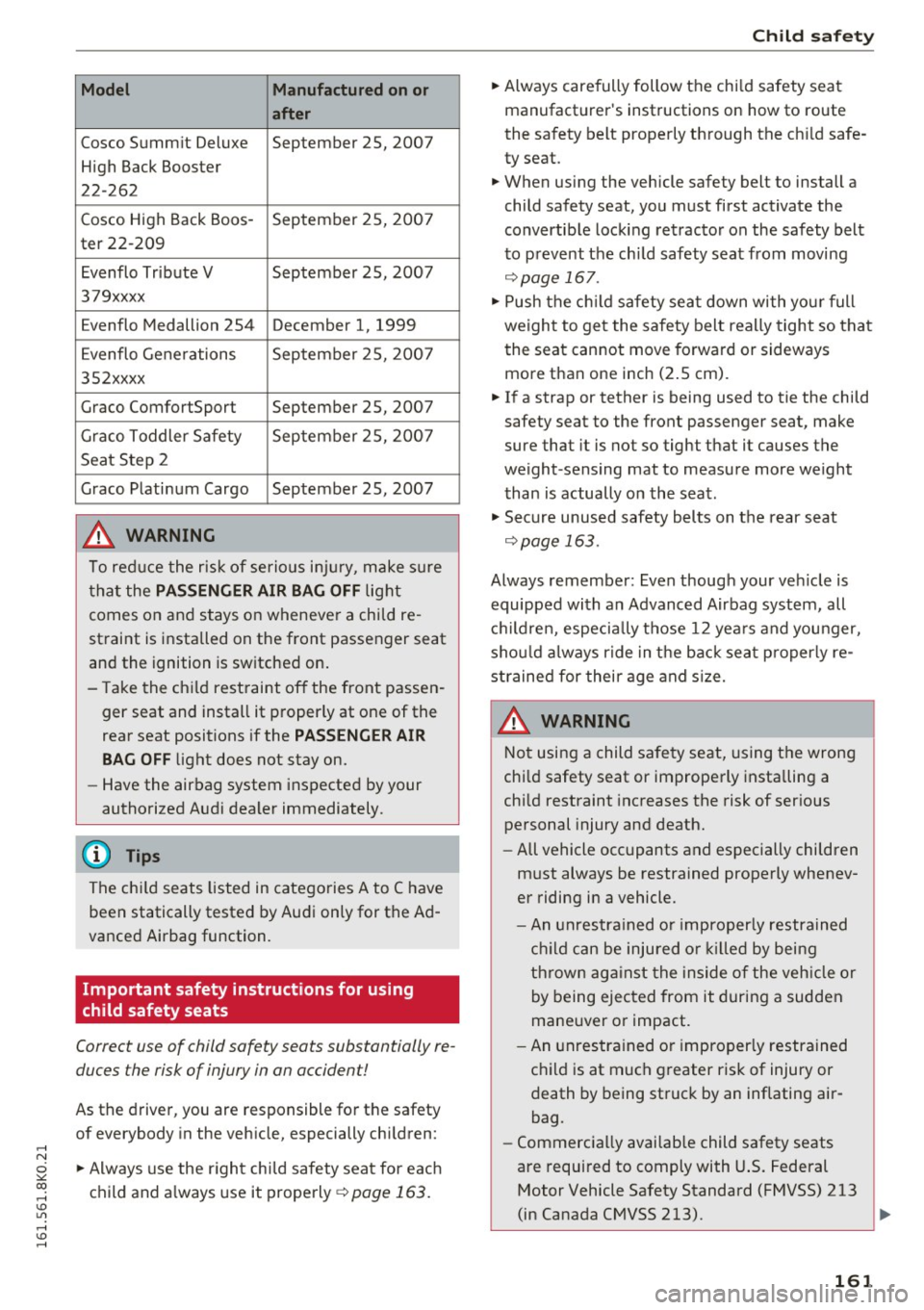
r es tra ints are :
Subpart A- Car bed child restraints
Model Manufactured on or
after
A ngel Guard Angel Se pte mber 2 5, 20 07
Ride AA 2403F OF
Subpart B - Rear-facing child restraints
Model Manufactured on or
after
Century SmartFit 4543 December 1, 1999
Cosco Arriva September 25, 2007
22-013PAW and base 22- 999WHO
Evenflo Discove ry Ad- December 1, 1999
just R ight 212
E ven flo Firs t Choi ce December
1, 1 999
2 04
Grace I nfant 8457 December 1, 1999
Grace Sn ugride September 25, 2007
Peg Perego Primo Viag- September 25, 2007
g io SIP I MUNOOUS
Subpart C -Forward-facing and convertible
child restraints
Model Manufactured on or
after
Br itax Roundabo ut September 25, 2007
E9L02xx
Cosco Tou riva 0 2519 December 1, 1999
...
Page 163 of 278
..... N
0 ::..:: co .....
after
Cosco Summit Deluxe September 25, 2007
High Back Booster
22-262
Cosco High Back Boos -
September 25, 200 7
ter 22-209
Evenflo Tr ibute V September 25, 2007
379xxxx
Evenflo Medallion 254 December 1, 1999
Evenflo Generations September 25, 2007
352xxxx
Graco ComfortSport September 25, 2007
Graco Toddler Safety September 25, 2007
Seat Step 2
Graco Platinum Cargo September 25, 2007
.&, WARNING
To reduce the risk of serious inju ry, make sure
that the
PA SSEN GER AIR BAG OFF light
comes on and stays on whenever a child re
straint is installed on the front passenger seat
and the ignition is switched on.
- Take the child restraint off the front passen
ger seat and install it properly at one of the
rear seat positions if the
P A SSEN GER AIR
BAG OFF
light does not stay on.
- Have the airbag system inspected by your
authorized Audi dealer immediately.
(D Tips
The chi ld seats listed in categories A to C have
been statically tested by Audi only for the Ad
vanced Airbag function.
Important safety instructions for using
child safety seats
Correct use of child safety seats substantially re
duces the risk of injury in an accident!
As the driver, you are responsible for the safety
of everybody in the veh icle, especially children:
.,. Always use the right chi ld safety seat for each
child and a lways use it properly
q page 163 .
Child safety
.,. Always carefully follow the chi ld safety seat
manufacturer's instructions on how to route
the safety belt properly through the ch ild safe
ty seat.
.,. When using the vehicle safety belt to install a
child safety seat, you must first activate the
convertible locking retractor on the safety belt
to prevent the chi ld safety seat from moving
q page 167.
.,. Push the ch ild safety sea t down with yo ur full
weight to get the safety belt really tight so that the seat cannot move forward or sideways
more than one inch (2.5 cm).
.,. If a strap or tether is being used to tie the child
safety seat to the front passenger seat, make
sure that it is not so tight that it causes the
weight -sensing mat to measure more weight
than is actually on the seat .
.,. Secure unused safety belts on the rear seat
q page 163.
Always remember: Even though your veh icle is
equipped with an Advanced Airbag system, all
c hi ldren, especia lly t hose 12 yea rs and younger,
sho uld a lways ride in th e back seat p roper ly re·
strained for their age and s ize.
A WARNING
=
Not using a child safety seat, using the wrong
chi ld safety seat or improperly insta lling a
chi ld restraint increases the risk of serious
personal injury and death.
- All vehicle occupants and especially children
must always be restrained properly whenev
er riding in a vehicle.
- An unrestra ined o r improperly restrained
c hi ld can be injured o r killed by being
thrown aga inst the inside of the veh icle or
by being ejected from it during a sudden
maneuver or impact.
- An unrestra ined or improperly restrained
child is at much greater risk of injury or
death by being struck by an inflating air bag.
- Commercially availab le child safety seats
are requi red to comply with U .S. Federal
Motor Vehicle Safety Standard (FMVSS) 213
(in Canada CMVSS 213). ..,_
16 1
Page 165 of 278
,....,
N
0
""' CX) ,....,
I.Cl U"I ,....,
I.Cl ,....,
-Take the child restraint off the front passen
ger seat and install it properly at one of the
rear seat positions if the
PASSENGER AIR
BAG OFF
light does not stay on.
- Have the airbag system inspected by your
authorized Audi dealer immediately.
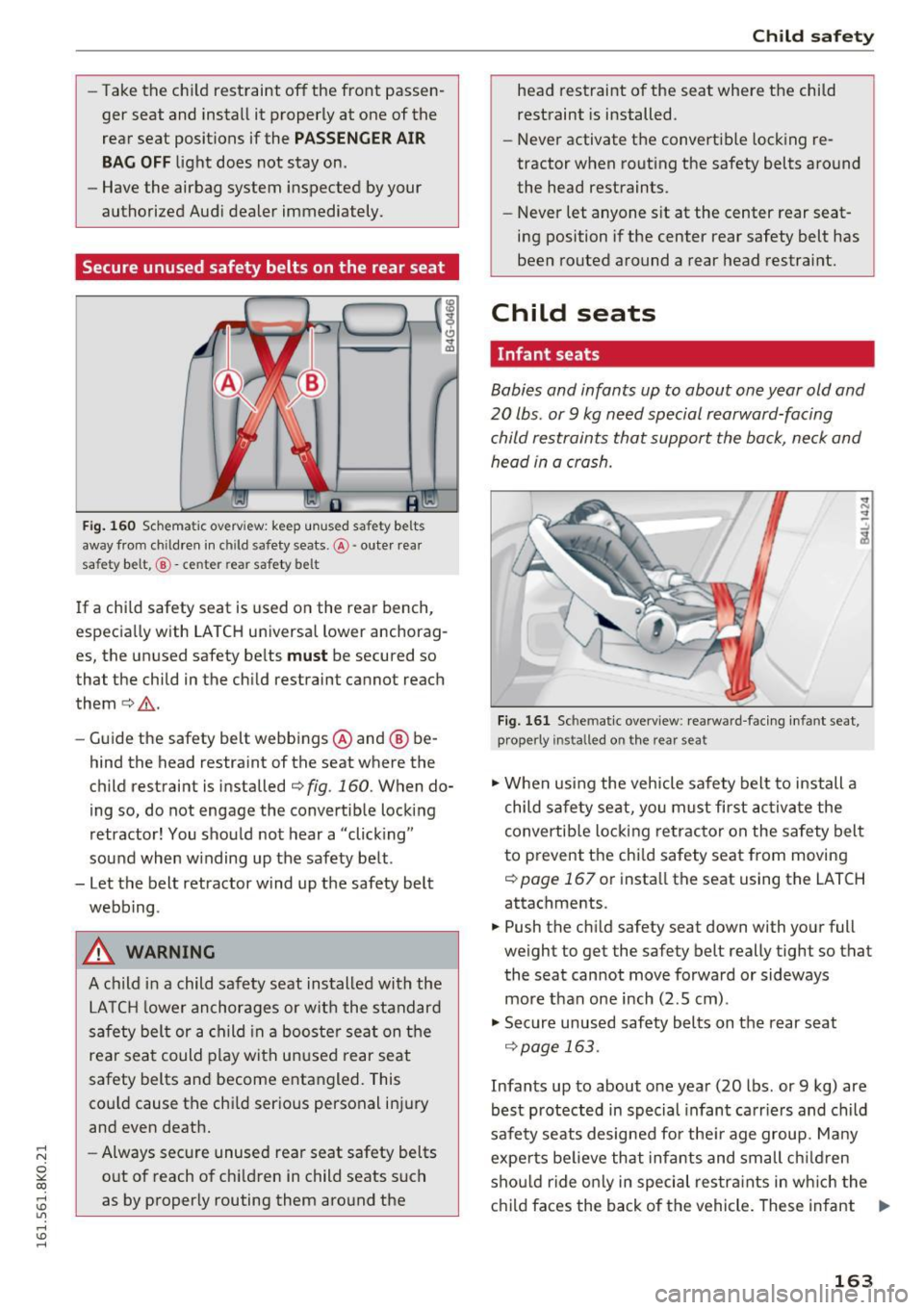
Secure unused safety belts on the rear seat
Fig . 160 Schemat ic overv iew: keep unused s-afety belts
away from children in chil d safety seats.@· oute r rear
sa fety belt,
@ -center rear safety bel t
If a chi ld safety seat is used on the rear bench,
especia lly with LA TCH universal lower anchorag
es, the unused safety belts
must be secured so
that the child in the child restraint cannot reach
them
c::> ,& .
-Gui de the safety belt webbings @ and @ be
hind the head restra int of the seat where the
child restraint is installed
c::>fig. 160. When do
ing so, do not engage the convertible locking
retractor! You should not hear a "click ing"
sound when w inding up the safety belt .
- Let the belt retractor wind up the safety belt
webbing .
A WARNING
A child in a child safety seat installed with the
LATCH lower anchorages or with the standard
safety belt or a child in a booste r seat on the
rear seat could play with unused rear seat
safety belts and become entangled. This
cou ld cause the chi ld serious personal injury
and even death.
- Always secure unused rear seat safety belts
out of reach of children in child seats such
as by proper ly routing them aro und the
Child safety
head restraint of the seat where the child
restraint is installed .
- Never activate the convertible locking re
tractor when routing the safety belts around
the head restraints.
- Never let anyone sit at the center rear seat
ing position if the center rear safety belt has
been routed around a rear head restraint.
Child seats
Infant seats
Babies and infants up to about one year old and
20 lbs. or
9 kg need special rearward-facing
child restraints that support the back, neck and
head in a crash.
Fig. 161 Sc hem atic overv iew: rearward -fac ing infa nt seat ,
proper ly i nsta lled o n the rear seat
., When using the vehicle safety belt to install a
child safety seat, you must first activate the
convertib le locking retractor on the safety belt
to prevent the chi ld safety seat from moving
c::> poge 167 or install the seat using the LATCH
attachments .
.. Push the child safety seat down with your full
weight to get the safety belt really tight so that
the seat cannot move forward or sideways
more than one inch (2 .5 cm) .
., Sec ure unused safety belts on the rear seat
c::> page 163.
Infants up to about one year (20 lbs . or 9 kg) are
best protected in special infant carriers and child
safety seats designed for the ir age group. Many
expe rts be lieve that infants and small children
shou ld ride only in special res tra ints in wh ich the
child faces the back of the vehicle. These infant ..,.
163
Page 167 of 278
..... N
0 ::..:: co .....
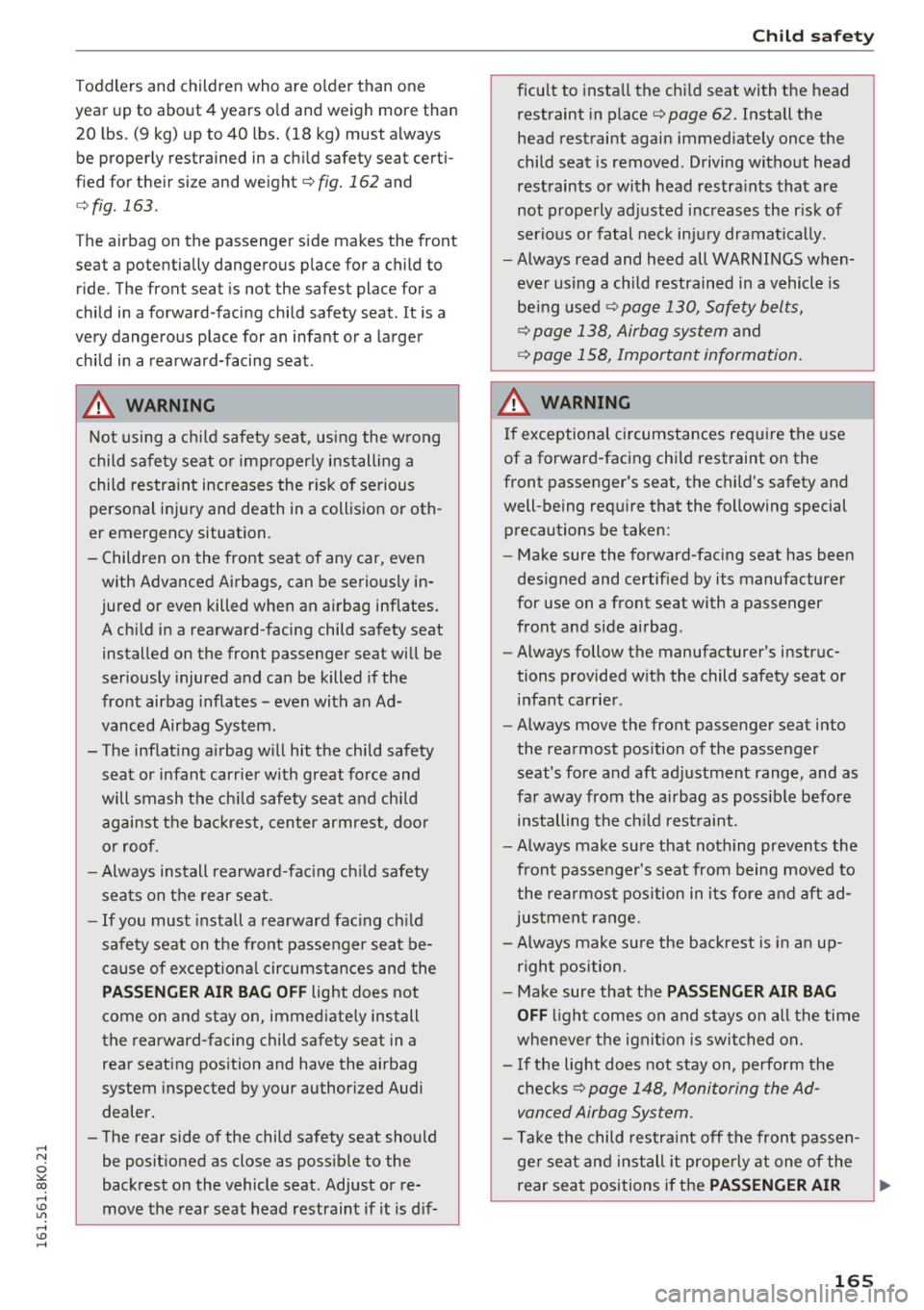
year up to about 4 years old and weigh more than
20 lbs. (9 kg) up to 40 lbs. (18 kg) must always
be properly restrained in a child safety seat certi
fied for their size and weight¢
fig. 162 and
¢ fig. 163.
The airbag on the passenger side makes the front
seat a potentially dangerous p lace for a child to
ride. The front seat is not the safest place for a
child in a forward-facing child safety seat .
It is a
very dangerous place for an infa nt or a larger
child in a rearward-facing seat.
A WARNING
Not using a ch ild safety seat, using the w rong
child safety seat or improperly installing a
child restraint increases the risk of serious
personal injury and death in a collision or oth
er emergency situation.
- Children on the front seat of any car, even with Advanced Airbags, can be seriously in
jured or even killed when an airbag inf lates.
A ch ild in a rearward-facing child safety seat
installed on the front passenger seat will be
seriously injured and can be killed if the
front airbag inflates -even with an Ad
vanced Airbag System.
- The inflating a irbag w ill hit the child safety
seat or infant carrier with great force and
will smash the ch ild safety seat and chi ld
against the bac krest, center armrest, doo r
or roof.
- Always install rearward-fac ing ch ild safety
seats on the rear seat.
- If you must install a rearward fac ing ch ild
safety seat on the front passenger seat be
c ause of exceptiona l circumstances and the
PASSENGER AIR BAG OFF light does not
come on and stay on, immediate ly install
the rearward-facing child safety seat in a
rear seating pos ition and have the airbag
system inspected by your authorized Audi
dealer.
- The rear side of the child safety seat should
be pos it ioned as close as poss ible to the
backrest on the vehicle seat. Adjust or re
move the rear seat head restraint if it is d if-
Ch ild safety
ficult to insta ll the chi ld seat with the head
restraint in place¢
page 62. Install the
head restraint again immediate ly once the
child seat is removed. Driving without head
restraints or with head restra ints that are
not properly adjusted increases the r is k of
serio us or fatal neck inju ry dramatically.
- Always read and heed all WARNINGS when
eve r using a child restrained in a vehicle is
be ing used
r::!;> page 130, Safety belts,
r::!;> page 138, Airbag system and
r::!;> page 158, Important information .
A WARNING
= -
If exceptional circumstances requ ire the use
of a forward-facing chi ld restraint on the
front passenger's seat, the child's safety and
well-being requ ire that the following special
precautions be taken:
- Make sure the forward-fac ing seat has been
des igned and certified by its manufacturer
for use on a front seat with a passenger
front and side airbag.
-Always follow the manufacturer's instruc
tions provided with the child safety seat or
infant carrie r.
- Always move the front passenger seat into
the rearmost pos ition of the passenger
seat's fore and aft adjustment range , and as
fa r away from the airbag as possib le befo re
installing the ch ild rest raint.
- Always make sure that nothing prevents the
front passenger's seat from being moved to
the rea rmost pos ition in its fore and aft ad
justment range.
- Always make sure the backrest is in an up
right position.
- Make sure that t he
PASSENGER AIR BAG
OFF
li ght comes on and stays on all the time
wheneve r the ignit ion is swit ched on.
- If the light does not stay on, perfo rm the
checks
r::!;> page 148, Monitoring the Ad
vanced Airbag System.
- Take the child restra int off the front passen
ge r seat and install it prope rly at one of the
rear seat positions if the
PASSENGER AIR ...,
165
Page 168 of 278
Child safety
BAG OFF light does not stay on whenever
the ignition is switched on.
Booster seats and safety belts
Properly used booster seats can help protect
children weighing between about 40 lbs. and 80
lbs. (18 kg and 36 kg) who ore less than 4 ft .
9
in. (57 inches/1.45 meters) tall.
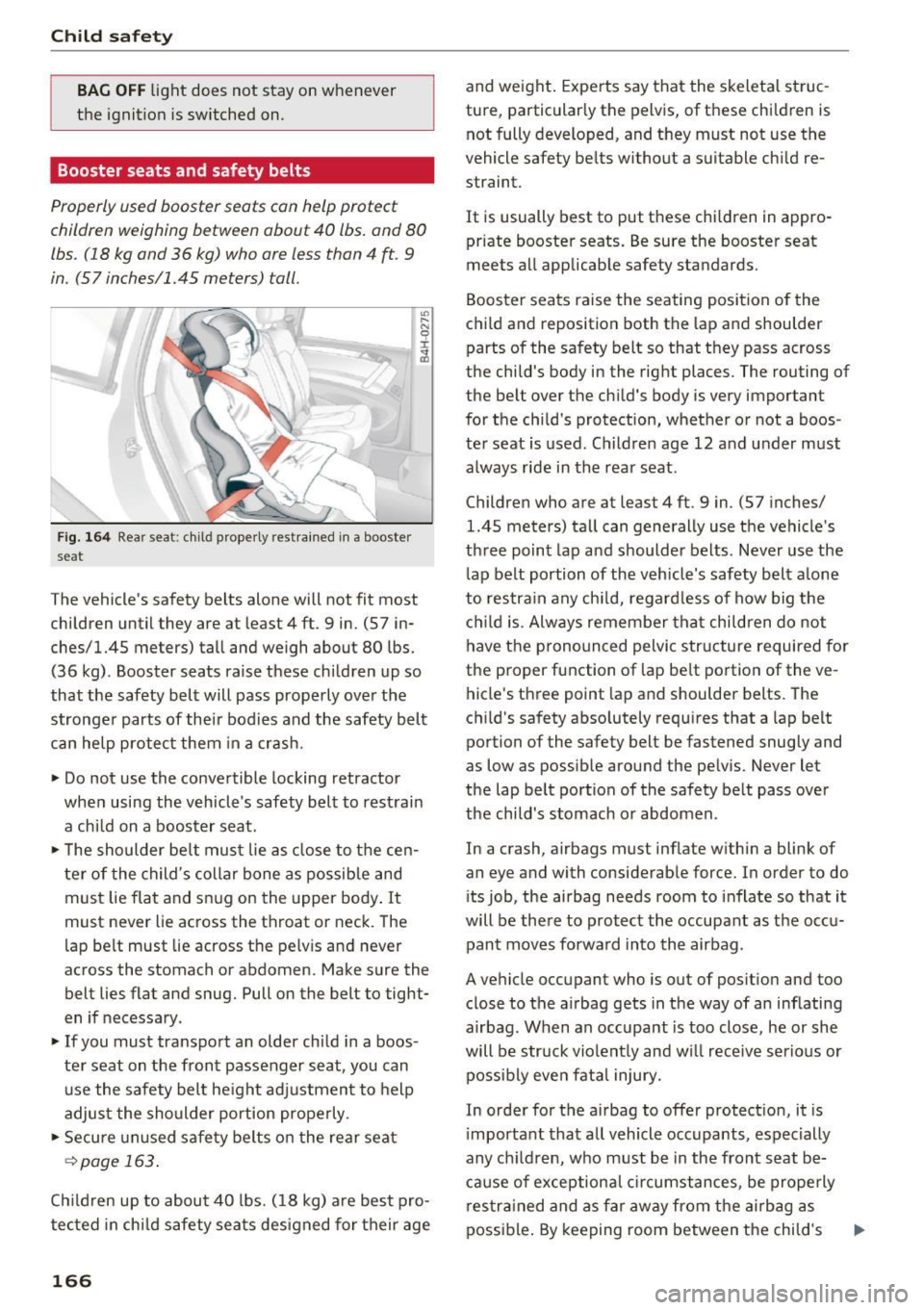
Fig. 164 Rear seat: child properly restra ined in a booster
seat
The vehicle's safety belts alone will not fit most
children until they are at least 4
ft. 9 in. (57 in
ches/1.45 meters) tall and weigh about 80 lbs.
(36 kg). Booster seats raise these children up so
that the safety belt will pass properly over the
stronger parts of their bodies and the safety belt
can help protec t them in a crash.
• Do not use the convertible locking retractor
when using the vehicle's safety belt to restrain
a child on a booster seat.
• The shoulder be lt must lie as close to the cen
ter of the child's collar bone as possible and
must lie flat and snug on the upper body. It
must never lie across the throat or neck. The
lap belt must lie across the pelvis and never
across the stomach or abdomen. Make sure the
belt lies flat and snug. Pull on the belt to tight
en if necessary .
• If you must transport an older child in a boos
ter seat on the front passenger seat, you can use the safety belt he ight adjustmen t to help
adjust the sho ulder portion properly .
• Secu re unu sed safety belts on the rear seat
~page 163.
Children up to about 40 lbs. ( 18 kg) are best pro
tected in ch ild safety seats designed for their age
166
and weight. Experts say that the skeletal struc
ture, particularly the pelvis, of these children is
not fully developed, and they must not use the
vehicle safety be lts without a suitable child re
straint.
It is usually best to put these children in appro
priate booster seats. Be sure the booster seat
meets all applicable safety standards.
Booster seats raise the seating position of the
child and reposition both the lap and shoulder
parts of the safety belt so that they pass across
the chi ld's body in the right places. The routing of
the belt over the child's body is very important
for the child's protection, whether or not a boos
ter seat is used. C hil dre n age 12 and u nder must
always ride in the rear seat.
Children who are at least 4 ft. 9 in. (57 inches/
1.45 meters) tall can generally use the vehicle's
three point lap and shoulder belts. Never use the
l ap belt portion of the vehicle's safety belt a lone
to restrain any child, regard less of how big the
child is . Always remember that children do not
have the pronounced pelvic structure required for
the proper function of lap be lt portion of the ve
hicle's three point lap and shoulder belts. The
ch ild's safety absolutely requires that a lap belt
portion of the safety belt be fastened snugly and
as low as possible around the pelvis. Never let
the lap belt portion of the safety be lt pass over
the chi ld's stomach or abdomen.
In
a crash, airbags must inflate w ithin a blink of
an eye and with considerable force. In order to do its job, the airbag needs room to inflate so that it
will be there to protect the occupant as the occu
pant moves forwa rd into the airbag.
A vehicle occupant who is out of pos it ion and too
close to the airbag gets in the way of an inflating
airbag. When an occupant is too close, he or she
will be struck vio lent ly and will receive serious or
possibly even fatal injury.
In order for the airbag to offer protect ion, it is
i mporta nt that all vehicle occupants, especially
any ch ildren, who must be in the fron t seat be
cause of exceptional circumstances, be properly
restrained and as far away from the airbag as
possible. By keeping room between the child's ..,_
Page 169 of 278
..... N
0 ::..:: co .....
ment, the airbag can inflate completely and pro
vide supp lemental protect ion in certain frontal
collisions.
_&. WARNING
Not using a booster seat, using the booster
seat improperly, incorrectly installing a boos
ter seat or using the vehicle safety belt im properly increases the risk of serious personal
injury and death in a collision or other emer
gency situat ion. To help red uce the risk of se
rious personal injury and/or death:
- T he shoulder be lt must lie as close to the
center of the child's collar bone as possible
and must lie f lat and snug on the upper
body. It must never lie across the throat or
neck. The lap belt must lie across the pelvis
and never across the stomach or abdomen.
Make sure the belt lies flat and snug. Pull on
the belt to tighten if necessary.
- Failure to properly route safety belts over a
child's body will cause severe injuries in an
accident or other emergency situation
¢page 130.
-The rear side of the child safety seat should
be pos itioned as close as poss ible to the
backrest on the vehicle seat. Adjust or re
move the rear seat head restraint if it is d if
ficult to install the child seat with the head restra int in place
¢page 62. Install the
head restraint again immediately once the
child seat is removed. Driving without head
restraints or with head restraints that are
not properly adjusted increases the risk of
serious or fatal neck injury dramatically.
- Children on the front seat of any car, even
with Advanced Airbags, can be seriously in
jured or even killed when an airbag inflates.
- Never let a child stand or kneel on any seat.
- Never let a child ride in the cargo area of
your vehicle.
- Always remember that a child leaning for
ward, sitting sideways or out of position in
any way during an accident can be struck by
a deploying airbag. This will result in serious personal injury or death .
Ch ild safety
-If you must insta ll a rearward facing child
safety seat on the front passenger seat be
cause of exceptional circumstances the
P AS ·
S ENGER AIR BA G OFF
light must come on
and stay on, whenever the ignit ion is switch
ed on .
- If you must install a booster seat on the front passenger seat because of exceptional circumstances the
PASS ENGE R AIR BAG
OFF
li ght must come on and stay on, when
eve r the ignit io n is switched on.
- Take the child restra int off the front passen
ge r seat and install it prope rly at one of the
rear seat positions if the
PAS SENGER A IR
BAG O FF
light does not stay on whenever
the ignition is switched on .
- Always read and heed all WARNINGS when
ever using a child restrained in a vehicle is
being used¢
page 130, Safety belts,
¢ page 138, Airbag system and
¢ page 158, Important information.
Securing child seats
Securing a child safety seat using a safety
belt
Safety belts for the rear seats and the front pas
senger's seat can be locked with the convertible
locking retractor to properly secure child safety
seats.
T he safety belts emergency lock ing retractors for
the rear seats safety be lts and for the front pas
senger's seat safety be lt have a convertible lock
ing retractor for child restraints . The safety be lt
must be locked so that be lt webbing cannot un
reel. The retractor can be activated to lock the
safety belt and prevent the safety belt webbing
from loosening up dur ing normal driving . A ch ild
safety seat can only be properly installed when
the safety belt is locked so that the ch ild and
ch ild safety seat will stay in place.
Always remember : Even though your vehicle is
equipped with an Advanced Airbag system, all
ch ildren, especially those 12 years and younger,
shou ld a lways r ide in the back seat properly re-
strained for thei r age and weight.
II>-
167