ignition AUDI A4 2016 Repair Manual
[x] Cancel search | Manufacturer: AUDI, Model Year: 2016, Model line: A4, Model: AUDI A4 2016Pages: 278, PDF Size: 70.26 MB
Page 164 of 278
Child safety
-When buying a child restraint, select one
that fits your child and the vehicle.
- Only use child restraint systems that fully
contact the flat portion of the seat cush
ion. The child restraint must not tip or
lean to either side. Audi does not recom
mend using child safety seats that rest on
legs or tube-like frames . They do not pro
vide adequate contact with the seat.
- Always heed all legal requirements per
taining to the installation and use of child
safety seats and carefully follow the in
structions provided by the manufacturer
of the seat you are using.
- Never allow children under 57 inches
(1.45 meters) to wear a normal safety belt.
They must always be restrained by a proper
child restraint system. Otherwise, they
could sustain injuries to the abdomen and
neck areas during sudden braking maneu
vers or accidents.
- Never let more than one child occupy a child
safety seat.
- Never let babies or older children ride in a
vehicle while sitting on the lap of another
passenger .
- Holding a child in your arms is never a sub
stitute for a child restraint system.
- The strongest person could not hold the
child with the forces that exist in an acci
dent. The child will strike the interior of
the vehicle and can also be struck by the
passenger.
- The child and the passenger can also in
jure each other in an accident.
- Never install rearward-facing child safety
seats or infant carriers on the front passen
ger seat. A child will be seriously injured and
can be killed when the passenger airbag in
flates -even with an Advanced Airbag Sys
tem .
- The inflating airbag will hit the child safe
ty seat or infant carrier with great force
and will smash the child safety seat and
child against the backrest, center arm
rest, door or roof.
- Always install rearward-facing child safety
seats or infant carriers on the rear seat.
162
-Forward-facing child safety seats installed
on the front passenger's seat can interfere
with the airbag when it inflates and cause
serious injury to the child . Always install for
ward-facing child safety seats on the rear seat .
- If exceptional circumstances require the use
of a forward-facing child restraint on the
front passenger's seat, the child's safety
and well-being require that the following
special precautions be taken:
- Make sure the forward-facing seat has been designed and certified by its manu
facturer for use on a front seat with a pas
senger front and side airbag .
- Always carefully follow the manufacturer's
instructions provided with the child safety
seat or carrier.
- Always move the front passenger seat into
the rearmost position of the passenger
seat's fore and aft adjustment range, and
as far away from the airbag as possible be
fore installing the child restraint.
- Always make sure that nothing prevents
the front passenger's seat from being
moved to the rearmost position in its fore
and aft adjustment range.
- Always make sure that the backrest is in
the upright position.
- Always buckle the child safety seat firmly in
place even if a child is not sitting in it. A
loose child safety seat can fly around during
a sudden stop or in a collision.
- Always read and heed all WARNINGS when
ever using a child restrained in a vehicle is
being used¢
page 130, Safety belts,
¢ page 138, Airbag system
and
¢ page 158, Child safety.
A WARNING
To reduce the risk of serious injury, make sure
that the
PASSENGER AIR BAG OFF light
comes on and stays on whenever a child re
straint is installed on the front passenger seat
and the ignition is switched on. ..,.
Page 168 of 278
Child safety
BAG OFF light does not stay on whenever
the ignition is switched on.
Booster seats and safety belts
Properly used booster seats can help protect
children weighing between about 40 lbs. and 80
lbs. (18 kg and 36 kg) who ore less than 4 ft .
9
in. (57 inches/1.45 meters) tall.
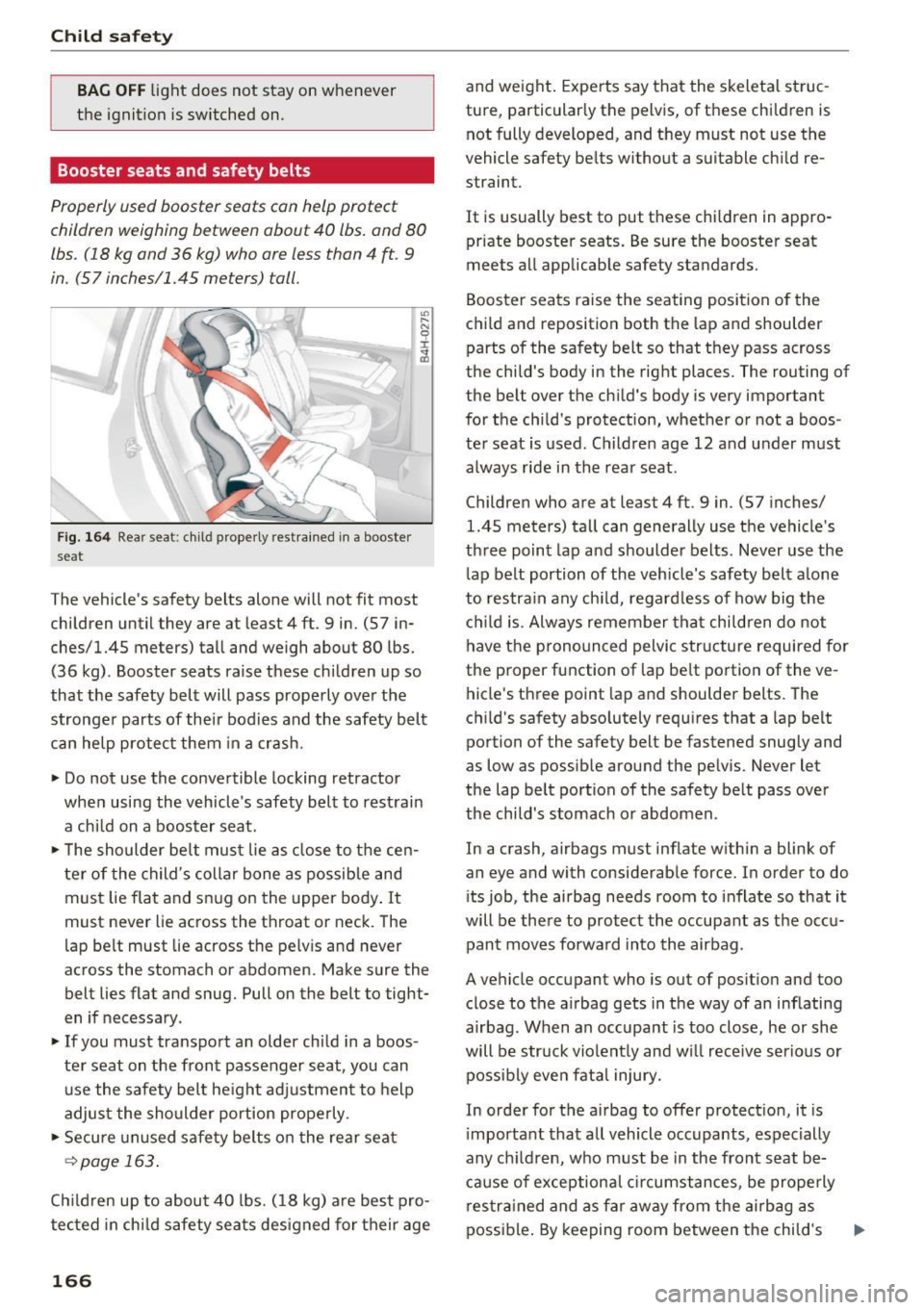
Fig. 164 Rear seat: child properly restra ined in a booster
seat
The vehicle's safety belts alone will not fit most
children until they are at least 4
ft. 9 in. (57 in
ches/1.45 meters) tall and weigh about 80 lbs.
(36 kg). Booster seats raise these children up so
that the safety belt will pass properly over the
stronger parts of their bodies and the safety belt
can help protec t them in a crash.
• Do not use the convertible locking retractor
when using the vehicle's safety belt to restrain
a child on a booster seat.
• The shoulder be lt must lie as close to the cen
ter of the child's collar bone as possible and
must lie flat and snug on the upper body. It
must never lie across the throat or neck. The
lap belt must lie across the pelvis and never
across the stomach or abdomen. Make sure the
belt lies flat and snug. Pull on the belt to tight
en if necessary .
• If you must transport an older child in a boos
ter seat on the front passenger seat, you can use the safety belt he ight adjustmen t to help
adjust the sho ulder portion properly .
• Secu re unu sed safety belts on the rear seat
~page 163.
Children up to about 40 lbs. ( 18 kg) are best pro
tected in ch ild safety seats designed for their age
166
and weight. Experts say that the skeletal struc
ture, particularly the pelvis, of these children is
not fully developed, and they must not use the
vehicle safety be lts without a suitable child re
straint.
It is usually best to put these children in appro
priate booster seats. Be sure the booster seat
meets all applicable safety standards.
Booster seats raise the seating position of the
child and reposition both the lap and shoulder
parts of the safety belt so that they pass across
the chi ld's body in the right places. The routing of
the belt over the child's body is very important
for the child's protection, whether or not a boos
ter seat is used. C hil dre n age 12 and u nder must
always ride in the rear seat.
Children who are at least 4 ft. 9 in. (57 inches/
1.45 meters) tall can generally use the vehicle's
three point lap and shoulder belts. Never use the
l ap belt portion of the vehicle's safety belt a lone
to restrain any child, regard less of how big the
child is . Always remember that children do not
have the pronounced pelvic structure required for
the proper function of lap be lt portion of the ve
hicle's three point lap and shoulder belts. The
ch ild's safety absolutely requires that a lap belt
portion of the safety belt be fastened snugly and
as low as possible around the pelvis. Never let
the lap belt portion of the safety be lt pass over
the chi ld's stomach or abdomen.
In
a crash, airbags must inflate w ithin a blink of
an eye and with considerable force. In order to do its job, the airbag needs room to inflate so that it
will be there to protect the occupant as the occu
pant moves forwa rd into the airbag.
A vehicle occupant who is out of pos it ion and too
close to the airbag gets in the way of an inflating
airbag. When an occupant is too close, he or she
will be struck vio lent ly and will receive serious or
possibly even fatal injury.
In order for the airbag to offer protect ion, it is
i mporta nt that all vehicle occupants, especially
any ch ildren, who must be in the fron t seat be
cause of exceptional circumstances, be properly
restrained and as far away from the airbag as
possible. By keeping room between the child's ..,_
Page 169 of 278
..... N
0 ::..:: co .....
ment, the airbag can inflate completely and pro
vide supp lemental protect ion in certain frontal
collisions.
_&. WARNING
Not using a booster seat, using the booster
seat improperly, incorrectly installing a boos
ter seat or using the vehicle safety belt im properly increases the risk of serious personal
injury and death in a collision or other emer
gency situat ion. To help red uce the risk of se
rious personal injury and/or death:
- T he shoulder be lt must lie as close to the
center of the child's collar bone as possible
and must lie f lat and snug on the upper
body. It must never lie across the throat or
neck. The lap belt must lie across the pelvis
and never across the stomach or abdomen.
Make sure the belt lies flat and snug. Pull on
the belt to tighten if necessary.
- Failure to properly route safety belts over a
child's body will cause severe injuries in an
accident or other emergency situation
¢page 130.
-The rear side of the child safety seat should
be pos itioned as close as poss ible to the
backrest on the vehicle seat. Adjust or re
move the rear seat head restraint if it is d if
ficult to install the child seat with the head restra int in place
¢page 62. Install the
head restraint again immediately once the
child seat is removed. Driving without head
restraints or with head restraints that are
not properly adjusted increases the risk of
serious or fatal neck injury dramatically.
- Children on the front seat of any car, even
with Advanced Airbags, can be seriously in
jured or even killed when an airbag inflates.
- Never let a child stand or kneel on any seat.
- Never let a child ride in the cargo area of
your vehicle.
- Always remember that a child leaning for
ward, sitting sideways or out of position in
any way during an accident can be struck by
a deploying airbag. This will result in serious personal injury or death .
Ch ild safety
-If you must insta ll a rearward facing child
safety seat on the front passenger seat be
cause of exceptional circumstances the
P AS ·
S ENGER AIR BA G OFF
light must come on
and stay on, whenever the ignit ion is switch
ed on .
- If you must install a booster seat on the front passenger seat because of exceptional circumstances the
PASS ENGE R AIR BAG
OFF
li ght must come on and stay on, when
eve r the ignit io n is switched on.
- Take the child restra int off the front passen
ge r seat and install it prope rly at one of the
rear seat positions if the
PAS SENGER A IR
BAG O FF
light does not stay on whenever
the ignition is switched on .
- Always read and heed all WARNINGS when
ever using a child restrained in a vehicle is
being used¢
page 130, Safety belts,
¢ page 138, Airbag system and
¢ page 158, Important information.
Securing child seats
Securing a child safety seat using a safety
belt
Safety belts for the rear seats and the front pas
senger's seat can be locked with the convertible
locking retractor to properly secure child safety
seats.
T he safety belts emergency lock ing retractors for
the rear seats safety be lts and for the front pas
senger's seat safety be lt have a convertible lock
ing retractor for child restraints . The safety be lt
must be locked so that be lt webbing cannot un
reel. The retractor can be activated to lock the
safety belt and prevent the safety belt webbing
from loosening up dur ing normal driving . A ch ild
safety seat can only be properly installed when
the safety belt is locked so that the ch ild and
ch ild safety seat will stay in place.
Always remember : Even though your vehicle is
equipped with an Advanced Airbag system, all
ch ildren, especially those 12 years and younger,
shou ld a lways r ide in the back seat properly re-
strained for thei r age and weight.
II>-
167
Page 170 of 278
Child safet y
A WARNING
-
Improperly installed child safety seats in
crease the risk of ser ious personal injury and
death in a collision .
- Always make sure that the safety belt re
tractor is locked when installing a child
safety seat. An unlocked safety belt retrac
tor cannot hold the child safety seat in place dur ing normal driving or in a crash.
- Always buckle the child safety seat firmly in
place even if a child is not s itting in it. A
loose child safety seat can fly around during
a sudden stop or in a coll is ion .
- Always make sure that the rear seat back
rest to which the center rear safety belt is
attached is securely latched whenever the
rear cente r safety belt is being used to se
cu re a ch ild restraint.
- If the backrest is not securely latched, the
child and the child restraint will be thrown
forward together w ith the backrest and will
strike parts of the vehicle interior. The chi ld
can be se riously injured or killed .
- Never ins tall rearward-fac ing child safety
seats or infant carriers on the front passen
ger seat. A child will be seriously injured and
can be killed when the passenger airbag in
flates.
- The inflating airbag will hit the child safety
seat or infant carrier with great force and
will smash the chi ld safety seat and child
against the backrest, center armrest, door
or roof .
- Always install rearward-facing ch ild safety
seats or infant carriers on the rear seat .
- Forward-facing ch ild safety seats or infant
carr iers installed on the front passenger's
seat may interfere with the deployment of
the a irbag and cause serious injury to the
child .
- It is safer to install a forward -facing ch ild
safety seat on the rear seat .
- Always read and heed all WARNINGS when
ever using a child restrained in a veh icle is
being used~
page 158 . Special precaut ions
apply when installing a child safety seat on
the fron t passenger seat~
page 139, Child
16 8
restraints on the front seat -some impor
tant things to know.
A WARNING
A lways take special precautions if you must
install a forward or rearward-facing child re
stra int on the front passenger's seat in excep
tional s ituations:
- Whenever a forward or rearward-fac ing
child restraint is installed on the front pas
senger seat, the
PASSENGER AIR BAG OFF
light must come on and stay on whenever
the ignition is switched on.
- If the
PASSENGER AIR BAG OFF light does
not come on and stay on, perform the
checks desc ribed
~ page 148, Monitoring
the Advanced Airbag System.
- Take the child restra int off the front passen
ger seat and install it prope rly at one of the
rear seat positions if the
PA SSENGER AIR
BAG OFF
light does not stay on whenever
the ignition is switched on .
- Improper installation of child restraints can
reduce their effectiveness or even prevent
them from providing any protect ion .
- An improperly installed child restraint can
interfere with the airbag as it deploys and
serious ly injure or even kill the child.
- Always carefully follow the manufacturer's
instructions provided with the child safety
seat or carrier.
- Never p lace additiona l items on the seat
that can increase the tota l weight registered
by the weight-sensing mat and can cause in
jury in a crash.
A WARNING
Forward-facing child restra ints:
- Always make sure the forward-facing seat
has been des igned and certified by its man
ufacturer for use on a front seat with a pas
senger front and side airbag .
- Never put the forward-facing child restraint
up, against or very near the instrument pan-
-
el. ~
Page 171 of 278
..... N
0 ::..:: co .....
rearmost position in the seat's fore and aft
adjustment range, as far away from the air
bag as possible before installing the for
ward-facing child restra int. The backrest
must be adjusted to an upright posit ion.
- Make sure that the
PA SSEN GER AI R BAG
OFF
light comes on and stays on all the time
whenever the ignition is switched on.
A WARNING
Rearwa rd-facing child restra ints:
- A ch ild in a rearward-facing child safety seat
installed on the front passenger seat wi ll be
seriously injured and can be killed if the
front airbag inflates - even with an Ad
vanced Airbag System .
- The inflating a irbag w ill hit the child safety
seat or infant carrier with great force and
will smash the chi ld safety seat and chi ld
against the backrest, center armrest, door
or roof.
- Always be especially careful if you must in
stall a rearward facing child safety seat on
the front passenger seat in exceptional c ir
cumstances.
- A tight tether strap on a rearward-facing
child restraint attached to the front passen
ger seat can put too much pressure on the
we ight-mat in the seat and register a heavi
er we ight in the Advanced Airbag System.
The heavier we ight registered can make the
system work as though an adult were on the
seat and deploy the Advanced Airbag when
it m ust be suppressed c ausing serious or
even fatal injury to the child.
- Make sure tha t the
PASSENGER AIR BAG
OFF
light comes on and stays on all the time
whenever the ignition is switched on .
-If the PASSENGER AIR BAG OFF light does
not come on and stay on, immediately in
stall the rearward-facing child safety seat in
a rear seating position and have the airbag
system inspected by your authorized Audi
dealer.
Ch ild safety
Activating the convertible locking retractor
Use the convertible locking retractor to secure a
child restraint .
Always heed the ch ild safety seat manufactu rer 's
ins truct ions when installing a child restraint in
your vehicle . To activate the convertible locking
retractor:
.. Place the child restraint on a seat, prefer ably
on the rear seat .
.. Slowly pull the belt
all the w ay out .
.. Route it around or through the child restra int
be lt path
¢ & .
.. Push the ch ild safety sea t down with you r full
weigh t to ge t the safety belt really tight.
.. Insert the belt tong ue into the b uck le for that
seating position .
.. Guide the safety belt back into the retractor un
til the belt lies flat and snug on the child safety
seat .
.. You should hear a ''cl icking" noise as the belt
w inds back into the inertia reel. Test the con
vert ib le lock ing retractor by pull ing on the belt .
You shou ld no longer be able to pull the belt
out of the re tractor. The convertib le loc kin g re
t ractor is now activated.
.. Make sure that the red release button is facing
away from the c hild restraint so that it can be
unbuckled quickly .
.. Pull on the belt to make sure the safety belt is
properly tight and fastened so that the seat
cannot move forward or sideways more than
one inch (2 .5 cm) .
A WARNING
Using the wrong ch ild rest raint o r an improp
e rly inst alled child restra int can cause se rio us
personal injury or death in a crash.
- Always make sure that the safety be lt re
tr actor is locked when installing a child
safety seat . An un locked safety be lt retrac
tor cannot hold the ch ild safety seat in p lace
during normal driving or in a crash.
- Always buckle the child safety seat fi rm ly in
p lace even if a child is not sitting in it. A
loose child safety seat can fly a round during
a sudden stop or in a crash. .,.
169
Page 185 of 278

..... N
0 ::..:: co .....
of the battery is extended.
Basically, energy management consists of
bat
t e ry di agno sis, idl ing curr ent mana gement
and
dy namic en ergy management .
Battery diagnosis
Battery diagnosis continuous ly determines the
state of the batte ry . Sensors dete rm ine battery
voltage, batte ry current and battery tempera
ture . This determ ines the current state of charge
and the power of the battery.
Idling current management
Idling current management reduces energy con
sumpt io n while the veh icle is stand ing . With the
i gn it ion sw itched off, it controls the energy sup
p ly to the various ele ctrical components . Data
from battery diagnosis is considered.
D epending on the battery's state of charge, ind i
vid ual consume rs a re gradually turned off to p re
vent excessive discharge of the battery and thus
maintain starting capability.
Dynam ic energy management
While the vehicle is being driven, dynamic energy
management dist ributes the ene rgy generated
accord ing to the needs of the individual compo
nents . It regulates cons umption, so that mo re
e lectrica l energy is not being used than is being
generated and ensures an optimal state of
charge for the battery.
@ Tips
- But even energy management cannot neg
ate the limits of physics. Consider that the power and life of a battery are limited.
- If starting ability is threatened, the indica
tor light
(•j appears 9 page 16.
What you should know
The highest priority is given to maintaining start
ing capability.
The ba tte ry is severely taxed in short -d istance
driving, in city traffic and d uring the co ld time of
year. Abundant electrical energy is requ ired, but
Intellig ent Technology
on ly a little is generated . It is a lso critical if the
engine is not running and electrical components
are turned on. In this instance energy is being
consumed but none is being generated.
It is in precisely these situations that you will no
tice energy management actively regulating the distribution of energy .
Vehicle stands for an extended period
If you do no t drive your vehicle ove r a period of
severa l days o r weeks, electrical components are
gradually cut back or switched off. This reduces
energy consumption and maintains starting ca
pability over a longer period. Some of the con
venience functions may not operate, such as the interior lights or the power seat adjustment. The
convenience functions will be ava ilable aga in
when you switch on the ignition and start the en
gine.
With the engine turned off
If you listen to the rad io, for example, with the
engine turned off or use other MMI funct ions,
the battery is being d ischarged .
If starting capab ility is jeopardized due to energy
consumption, a message appears in the MMI dis
play . The message ind icates that the system will
be switched off automat ica lly in a moment . If
you w ish to continue using the funct ions, you
have to sta rt the eng ine.
With the engine running
Although e lectr ical energy is generated when the
vehicle is being driven, the battery can become
discharged. This happens mostly when little en
ergy is being generated and a great dea l con
s u med and the batte ry's state of charge is not
optimal.
T o bring the energy balance back into equilibr i-
um, consumers w hich require espec ia lly large
amounts of ene rgy are tempo rar ily cut back o r
swi tched off . Hea ting systems in particular re-
quire a great de al of energy. If yo u no tice, fo r ex
amp le, that the heated seats * or the heated rear
window are not heating, they have been tempo
rarily cut bac k or switched off. These systems will .,..
183
Page 190 of 278
Driving and th e en vironm ent
Regular maintenance
A badly tuned engine unnecessarily wastes a lot of fuel.
.,. Have your vehicle serviced at regular intervals.
By having your vehicle regu larly serviced by an
author ized Audi dealer he lps to ensure that it
runs properly and econom ically . The condition of
your veh icle not only affects its safety and ability
to hold its value, it also affects
fu el consump
tion .
C he ck your oil e ach t ime you fill you r ta nk .
The amount of oil used is re lated to engine load
and speed.
It is normal for the oil consumpt ion of a new en
g ine to reach its lowest val ue afte r a certa in mile
age has been driven .
You must d rive you r vehicle about 3 ,000 miles
(5,000 k ilome ters) before you can p roperly as
sess o il cons umption .
This a lso applies to fuel consumption and engine
outpu t.
(D Note
- Have your vehicle maintained properly and
in accordance with the service recommenda
tions in you r Warranty
& Maintenance book
l et . La ck of p roper main tenance as well as
i mproper use of the vehicle will impa ir the
f u nct ion of the emission control system and
could lead to damage.
- Do not al ter or remove any component of
the Emission Control System unless ap proved by the manufacturer.
- Do not a lter or remove any device, such as
heat shie lds, switches, ignition wires,
valves, which are designed to protect your
vehicle's Emission Control System and other i mportant vehicle components.
188
· Fewer short trips
Fuel consumption will always be relatively high
on short trips .
.,. Try to avoid driving short distances with a cold
eng ine .
T he eng ine and catalytic converter have to reac h
their opt imal
operating temper atu re to reduce
fuel consumpt ion and noxious emiss ions effec
tively .
Just after start ing, a cold engine in a mid-size car
on ly achieves a fuel economy of 6-8 miles per
gallon (30-40 l/100 km) . After about a half a
mile, fuel economy climbs to 12 mpg (20 l/100
km) . After about
2 .5 m iles (4 km), the engine is
at its proper operating temperatu re and fuel
economy has reached a no rma l level. So you can
see that you should avoid sho rt tr ips wheneve r
possible .
The
out sid e temperatur e is also cr it ica l in th is re
gard. Your car cons umes more fue l in the winter
than in the summer.
allroad: Driving offroad
General information .
App lies to vehicles : allroad
When dr iving offroad, the functions for the elec
tronic stabilization co ntrol (ESC) are expanded .
The ESC-Offroad-Mode ca n be activated in d riving
s ituations in which a wheel loc k or a d iffe rential
l ock f unct ion is needed ~
page 178. In addit ion,
you r A udi p rovides cont in uo us all whee l dr ive.
You r Audi i s how ever, not an offroad vehicl e.
Nev er dri ve the vehicl e in t errain whi ch i s not
suitable for the vehicl e, or whi ch exce ed s your
driving skills . Nev er take any unnece ssary ri sk s!
Afte r driving offro ad
- After driving offroad, remove branches and
other deb ris from the rad iator g rille , under
body, and wheels. Look especially fo r objects
(s tones) that have been caught in the tire
t read.
- Clean the body and the ve hicle unde rbody and
inspect the ve hicl e for possible damages.
IJI>
Page 203 of 278
..... N
0 ::..:: co .....
er flap is automatically unlocked or locked. Re
fue l the vehicle with the ignit ion turned
off.
T a king the fuel cap off
.,. Turn off the ignition.
.,. Press the left side of the fue l filler flap to open
it
c:> fig . 175 -arrow -.
.,. Unscrew fue l cap counter -clockwise and hang it
on the fue l filler flap
c:> fig. 176.
Refuelling proc edure
.,. Inse rt the fue l nozzle from the gasoline pump
into the fuel filler neck as far as it will go .
.,. Se lect a medium refuelling rate so that the
nozzle switches off automatically when the
tank is full.
Putting the fuel cap back on
.,. After filling your tank, tw ist the f uel cap clock-
wise as far as it wi ll go .
.,. Close the fuel filler flap.
To avoid fuel spill ing o r evaporating from the f uel
tank always close fuel cap proper ly and com
pletely.
A WARNING
Improper refueling or handling of fuel can
cause fire, explosion and severe b urns.
-
- Fuel is highly flammable and can cause se
vere burns and other injur ies .
- Failure to shut the engine off wh ile refuel
ing and/or to insert the pump nozz le fully
into the fuel filler neck could ca use fue l to
spray out of filler neck or to ove rflow. Fuel
spray and overflowing fue l can cause a fire.
- Never use a cellular telephone wh ile refuel
ing. The electromagnetic radiation can
cause spa rks that can ignite f uel vapors and
cause a fire.
- Never get back into your vehicle while refu
eling. If in except ional circumstances you
must get back in your vehicle while refuel
ing, make certain that you close the door
and touch meta l to discha rge static ele ctric
ity befo re touching the filler noz zle ag ain.
Fuel and R efueling
Stat ic elect ricity can cause sparks that can
ignite fue l vapors released during refueling.
- Never smo ke or have an open flame any
where in or near your vehicle when ref ueling
or filling a portable fuel container .
- For your safety, we strongly recommend
that you do not trave l with a po rtable fuel
container in your veh icle. The container, fu ll
or empty may leak and co uld cause a fire,
especially in a crash.
- If, under except ional circumstances, you
m ust transport a portable fuel container,
p lease observe the following:
- Never fill a portab le fue l conta iner while it
is anywhere in or on the vehicle (for exam
ple, in the l uggage compa rtment, o r on
the trunk). Static electricity can build up
while filling and can ignite fuel vapors caus ing a f ire .
-Always place a portab le fue l conta iner on
the ground before fi lling .
-A lways keep the f iller nozzle comp lete ly
inside the portable container before and
during f il li ng.
- If filling a portable conta iner made of
metal, the filler nozz le must always be in
contact with the container . This will he lp
prevent stat ic elec trici ty from discharging
and ca use a fire.
- Never spill fue l inside the vehicle o r lug
gage compartment. F uel vapors a re highly
flammable.
- Always observe loca l and state/prov incial
laws rega rding the use, storage a nd trans
po rtation of fuel contai ners.
- Make ce rtain the f uel con tainer mee ts i n
dust ry standards (A NSI/ AS TM F852 -86).
(D Note
If any fuel has sp illed onto the car, it should
be removed immed iately to p revent damage
to the pa int.
@) For the sake of the environment
As soon as the correctly operated nozzle
switches off automatically for the first time,
201
Page 204 of 278
Fuel and Refueling
the tank is full . Do not try to add more fuel
because fuel may spill out. In addition, the
expansion space in the fuel tank will be filled -
causing the fuel to overflow when it becomes
warm and pollute the environment.
(D Tips
- Running your engine while refuelling may
cause vapors to escape or even cause fuel to
sp ill out of the tank. This would then shut
off the fuel nozzle before the tank is full.
- Do not refuel your vehicle with the ignition
turned on. The fuel gauge may otherwise
not indicate the correct fuel level after refu
elling .
- The fuel filler flap of your vehicle is not
l ocked when you lock the veh icle from the
inside .
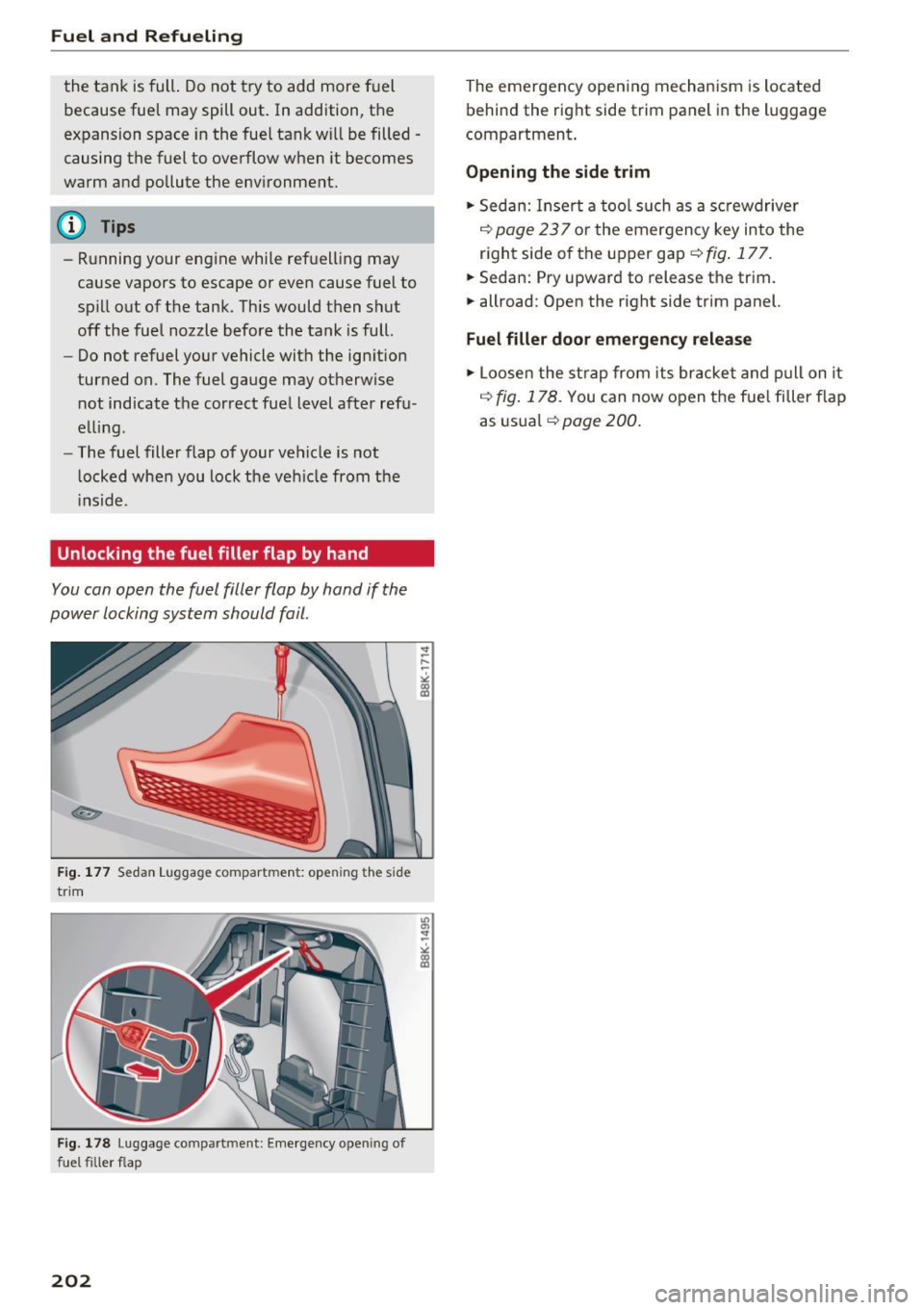
Unlocking the fuel filler flap by hand
You can open the fuel filler flap by hand if the
power locking system should fail.
F ig. 177 Sedan Luggage compartmen t: open ing th e s ide
trim
Fig. 178 L uggage compartment: Emergency opening of
fuel filler fla p
202
The emergency opening mechanism is located
beh ind the right side trim panel in the luggage
compartment .
Opening the side trim
.. Sedan: Insert a tool such as a screwdriver
¢
page 237 or the emergency key into the
right side of the upper gap¢
fig. 177 .
.. Sedan: Pry upward to release the trim.
.. allroad: Open the right side trim panel.
Fuel filler door emergency release
.. Loosen the strap from its bracket and pull on it
¢
fig. 178. You can now open the fue l filler f lap
as usual ¢
page 200 .
Page 205 of 278
,....,
N
0
""' CX) ,....,
I.Cl U"I ,....,
I.Cl ,....,
Checking and Filling Hood
Releasing and opening the engine hood
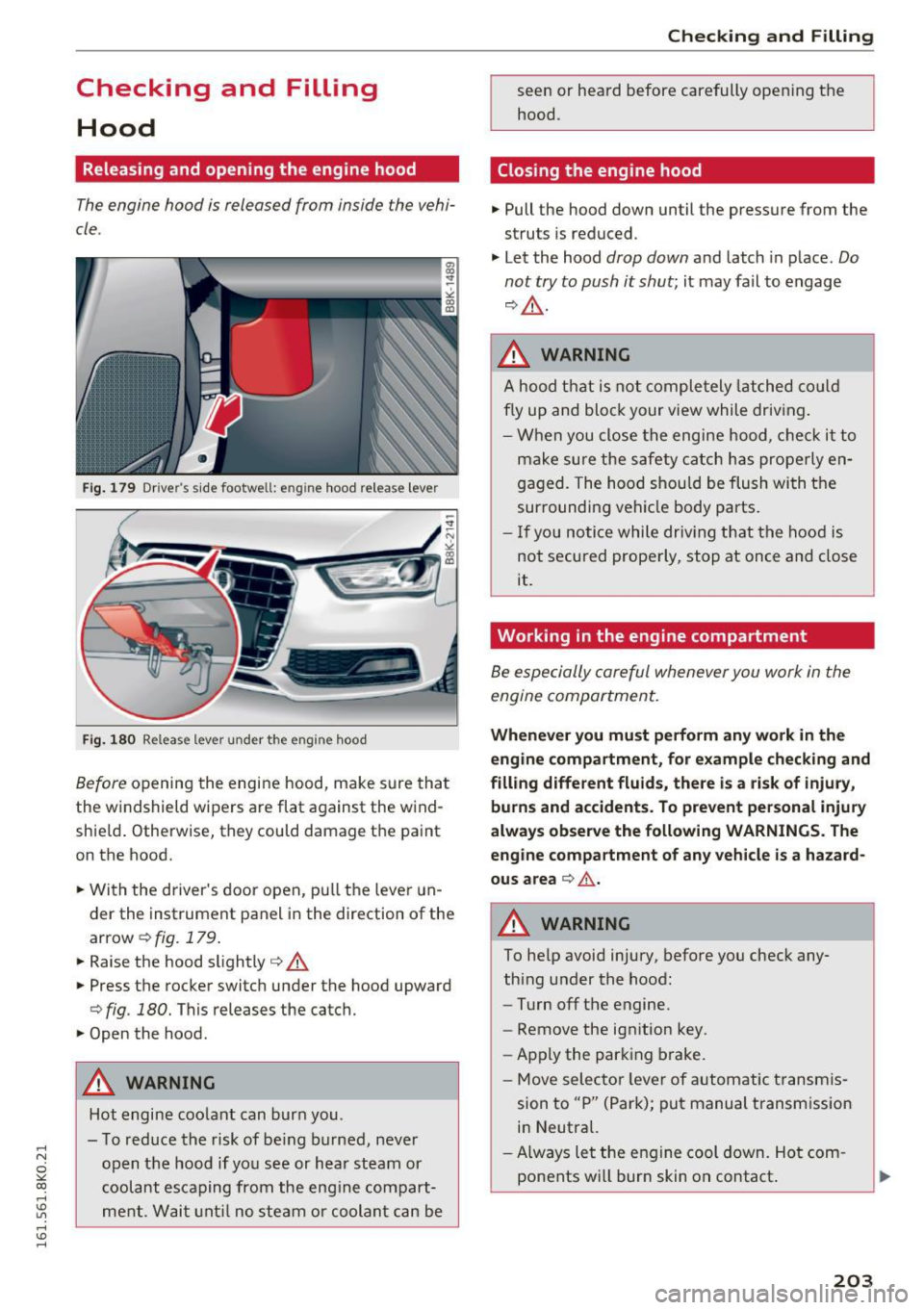
The engine hood is released from inside the vehi
cle.
Fig. 179 Driver's side footwell: engine hood re lease lever
... ~ - -
Fig. 1 80 Release lever under the engine hood
Before opening the engine hood, make sure that
the windshield wipers are flat against the w ind
shie ld. Otherwise, they could damage the paint
on the hood.
.. Wi th the driver's door open, pu ll the leve r un
der the instrument panel in the direction of the
arrow ¢
fig. 179 .
.. Raise the hood slightly¢&.
.. Press the rocker switch under the hood upward
¢fig . 180. This releases the catch.
.. Open the hood.
A WARNING
Hot engine coo lant can burn you.
- To reduce the risk of be ing burned, never
open t he hood if yo u see or hear steam or
coolant esca ping from the eng ine compart
me nt. Wait unt il no s team or coolant ca n be
Checking and Filling
seen or hea rd before carefully opening the
hood.
Closing the engine hood
.. Pull the hood down until the pressure from the
struts is reduced.
"' Le t the hood
drop down and latch in p lace. Do
not try to push it shut;
it may fail to engage
¢ &, .
A WARNING
A hood that i s not comple tely latched co uld
fly up a nd blo ck your view while driv ing.
- W hen you close the engine hood, check it to
ma ke sure the s afety catch h as prope rly en
ga ged. The hood should be flush with t he
surroundi ng ve hicl e body pa rts.
- If you no tic e while driv ing t hat t he hoo d is
not secured properly, stop at once and close
it.
Working in the engine compartment
Be e specially careful whenever you work in the
engine compartment.
-
Whenever you mu st perform an y work in the
engine compartment, for example checking and
filling different fluids, there is a risk of injury, burn s and a ccidents. To prevent per sonal injury
always observe the following WARNINGS. The
eng ine compa rtment of any vehicle is a hazard
ous area
¢ .&. .
A WARNING
-~
To help avoid injury, before you check any
th ing under the hood:
- Turn off the engine.
- Remove the ignition key .
- Apply the par king brake.
- Move selector leve r of autom atic t ransm is-
sion to "P" (Park); put manual transm ission
in Neutral.
- Always let the engine cool down. Ho t com
ponents w ill bur n skin on contact .
203