ESP AUDI A4 2017 Owners Manual
[x] Cancel search | Manufacturer: AUDI, Model Year: 2017, Model line: A4, Model: AUDI A4 2017Pages: 386, PDF Size: 96.32 MB
Page 303 of 386

This message appears when there is only enough
Ad Blue left to drive the distance indicated in the i nstr ument cluster . Fill the Ad Blue. Otherwise
the eng ine will not start aga in if you stop it once
the distance indicated has been dr iven .
• Refill with at least x qt (l) AdBlue. Engine
start not po ssible . S ee owner 's m anual
This message appears when the AdBlue ta nk is
empty. Fill the AdB lue . Otherwise you will not be
ab le to start the engine agai n once yo u stop it.
The AdBl ue m ust be refilled when the amoun t in
the tank has reached the minimum level
c::> page 301, Preparation .
Incorrect filling/system malfunction
A message appears if the Ad Blue tank was filled
with a f luid other than Ad Bl ue and the system
h as detec ted that the t ank was fi lled incor rect ly,
or if there is a system malfunc tion .
II Ad Blue: malfunct ion! No engine start in
x mi (km ). See owner's manual
This message appears when it is only poss ible to
drive the d istance indicated in the instrumen t
cluster . Drive to the nearest authorized A udi
deale r or autho riz ed Aud i Serv ice Facility to have
the m alfunction co rrected. Otherwise the engine
w ill no t start aga in if you stop it once the d is
tance indicated has been driven .
• Ad Blue : malfun ction! No engin e start poss i
ble. See owner' s manual
This message appea rs if the system has detected
that the tank was filled inco rrectly or that there
is a malfunction . D rive immediately to the near
est a utho riz ed Aud i dea ler o r authorized Audi
Service Fa cili ty to have the malfunction correct
ed . Otherwise you will not be able to start the en
gine again once you stop it.
Checking and Filling
Preparation
Applies to: vehicles with selective cata lytic reduction
Fig. 243 Right rear s ide o f th e ve hicle: removing t he Ad Bl
u e cap
The Ad Blue tank ope ning is located near the d ie
se l tank opening. Add at least 1.5 gallons (5. 7
L)
of Ad Blue. This is the minim um amount required
to ensure the system detects the refilling and to
start the engine. You can add a maximum of 6.3 gallons (24 L).
Requireme nt: the request to add Ad Blue must
appea r in the instrument cluster disp lay.
.,. Switch the ignit ion off.
.,. Open the tank filler doo r
c::> page 298.
.,. Tu rn the tank filler neck cap to the left to re
move
c::>fig. 243.
.,. Refill Ad Blue using a bottle c::> page 302, a can
ister
c::> page 302 or a pump nozzle
c::> page 303 .
A WARNING , ~ -Ad B lue can irritate the sk in, eyes and respira
tory sys tem.
If th ere is contact with the flu id,
flus h immed iate ly w ith plenty of wa ter. Con
su lt a phys ician if necessary.
(D Note
- Only use Ad Blue that conforms to the
standard ISO 22241-1. Do not m ix any addi
tives with the Ad Blue and do not dilu te it
w ith wate r.
- Do not add AdBl ue to the diesel tank or add
diese l fuel to t he A d Bl ue tank. Do not s tart
t he engine un de r any c ircumst ances if th e
wrong fuel is filled in the tan k. There is a
r is k of damaging the fue l tank system and
301
Page 306 of 386

Check ing and F illing
Engine compartment
Working in the engine compartment
Special care is required if you are working in the
engine compartment
Fo r wo rk in th e engine compa rtmen t, s uch as
c h ec kin g and filli ng flu id s, th ere is a risk of in
j u ry, sc aldin g, ac cide nts, a nd b urn s. For this
rea son, foll ow all the warning s and gener al
s a fe ty p recaution s pr ov ided in the f ollow ing in·
f o rm ation . Th e en gine c omp artmen t is a dan
ger ous are a.
¢ ,&.
_& WARNING
- T urn the engine off.
- Switch the ign ition off .
- Set the parking brake .
- Select the P selector lever pos ition .
- let the engine cool down.
- Never open the hood if you can see steam or coolant escaping from the engine compart
ment, because th is increases the r isk of
burns . Wait until no steam or coolant is es
caping .
- Keep ch ildren away from the engine com
partment .
- Never spill flu ids on a hot engine. These flu
ids (such as the anti -freezing agent con
ta ined in the coolant) can ignite .
- Avoid short circu its in the electrical system,
especially to the battery .
- When working in the engine compartment,
remember that the rad iator fan can sw itch
on even if the ign ition is switched off, which
increases the risk of injury .
- Never open the cap on the coolant expan sion tank when the eng ine is warm. The
cooling system is under pressu re .
- To protect your face, hands, and arms from
hot steam or coolant, cover the cap with a
large cloth when opening.
- Do not remove the engine cover under any
circumstances. This increases the risk of
burns.
- If tests need to be performed w ith the en
gine running, there is additional danger d ue
304
to moving components (such as the ribbed
be lt, alternator and rad iator fan) and from
the high-voltage ignition system.
- Do not under any circumstances activate the
throttle inadvertently (for example, by hand
from the engine compartment) if the vehi
cle is stat ionary but the eng ine is running
and a gear is engaged . Otherwise, the veh i
cle will start to move immediately and this
could result in an acc ident.
- Pay attent ion to the following warnings list
ed when wor k on the fue l system o r on the
electrical equipment is req uired.
- Always disconnect the vehicle battery
from the vehicle electrical system.
- Do not smoke .
- Never work near open flames.
- Always have a working fire extinguisher
nearby
- To reduce the r isk of e lectr ic shock and in
jury, never touch the follow ing components
when the engine is running or is being start
ed:
- Ign ition cable
- Other components in the electronic high-
voltage ign ition system
- If you must check or perform work on the engine whi le it is running:
- Set the parking brake and place the selec
tor lever in the P (park) pos ition first.
- Always proceed w ith extreme cau tion so
that clothing, jewelry or long hair do not become ca ught in the rad iator fan, fan
belt or other moving components or do
not come into contact with hot compo
nents. Tie back long hair before beginning
work and do not wear clothing that can hang down into the engine .
- Limit your exposure to exhaust and chemi
cals to as short a time as possible¢.&. .
_& WARNING
California Proposition 65 Warning :
- Engine exhaust, some of its constituents,
and certa in vehicle components conta in or
emit chemicals known to the State of Cali-
fornia to cause cancer and birth defects and ..,
Page 312 of 386
Checking and Filling
Cooling system
Coolant
The engine coo ling system is filled with a mixture
of pur ified water and coolan t addit ive at the fa c
tory. This coo lant must not be not changed.
The coolant leve l is monito red throug h the . in
dicator light~
page 31. Howeve r, we do recom
mend occasionally check ing the coo lan t level
manually.
I f you must add coolant, use a m ixture of water
and coolant additive. M ixing the coolant additive
with d istilled wate r is recommended.
Coolant additive
The coolant additive is made of anti-freezing a nd
corros ion protection agents. Only use the fo llow
ing coo lant add it ives. These additives may be
m ixed w ith each other.
Coolant additive Specification
G13
TL 774)
G12++ TL 774 G
The amount of coo lant add itive that needs to be
mixed w it h water depends on the climate where
the vehicle will be operated. If the coolant addi
tive percentage is too low, the coolant can freeze
and damage the engine.
Coolant Freeze protec-
additive tion
Warm min. 40% m in. -13 °F
reg ions max. 45% (-25 °C)
Cold min. 50% max. -40 °F
reg ions max. 55% (-40 °C)
(D Note
- Befo re the start of winter, have your author
i zed Audi dealer or authorized A udi Service
Fac ility check if the coolant additive in yo ur
vehicle matc hes the percentage approp riate
fo r the climate. Th is is especially important
when driving in co lde r climates.
- If the appropriate coolant additive is not
available in an emergency, do not add any
other additive. You cou ld damage the en-
310
gine . If this happens, only use water and re
store the correct m ixt ure ratio with the
specified coo lant add itive as soon as poss i
ble.
- On ly ref ill with new coolant .
- Rad iator sealant mus t not be mixed wi th
the coolant.
Adding coolant
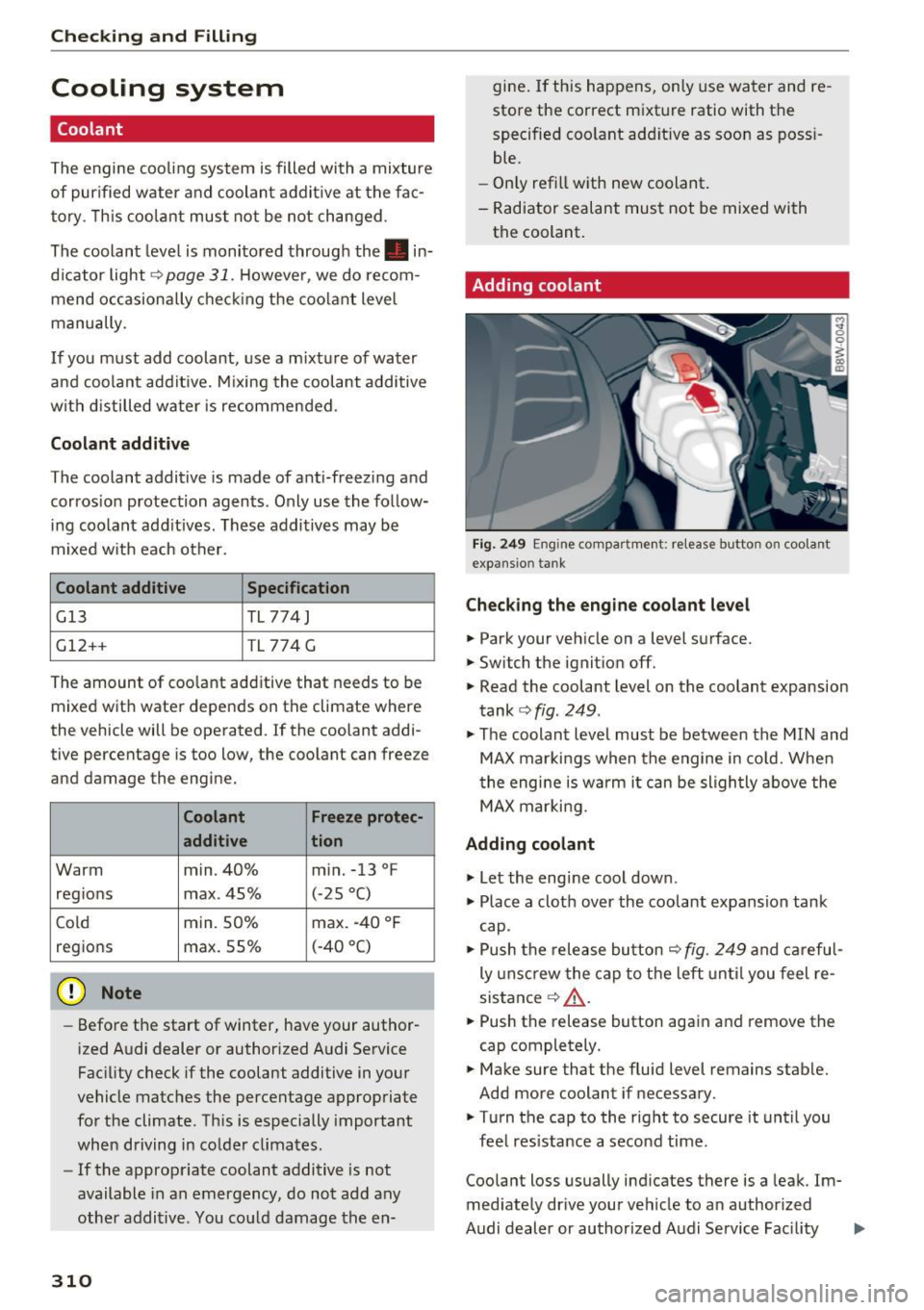
Fig. 24 9 Eng ine co mpart m ent: re lease button on coolant
expansio n tank
Check ing the engine coolant level
.,. Park your veh icle on a level surface.
.,. Switch the ignit ion off.
.,. Read the coolant level on the coolant expansion
tank
c:> fig . 249 .
.,. The coolant leve l mus t be between the MIN and
MAX mar kings when the engine in co ld. Whe n
t he engi ne is warm i t ca n be sligh tly above the
MAX mar kin g.
Adding coolant
.,. Let the engi ne cool down.
.,. Place a cloth over the coo lant expansion tank
cap.
.,. Push the rele ase button¢
fig. 249 and carefu l
ly unsc rew the cap to the left un til you feel re
sis tance ¢,&. .
.,. Push the release button again and remove the
cap completely.
.,. Make sure that the fluid level remains stab le.
Add more coolant if necessary .
.,. Turn the cap to the right to secure it until you
feel res istance a second time.
Coolant loss usually ind icates there is a leak. Im
med iate ly dr ive your vehicle to an author ized
Audi dealer or authorized A udi Service Fac ility ..,.
Page 315 of 386

<( a, .... N ,....
N .... 0 0
3 a,
where it will not freeze. This will prevent it
from being damaged and having to be re
placed.
Working on the battery
Be especially careful when working on or near the battery.
The battery is located in the engine compart
ment. Before you check anything in the engine
compartment,
read and heed all WARNINGS
c::>& .
Always heed the safety warnings, when wo rking
on the vehicle battery or the vehicle electrical
system to prevent injury.
The following WARNINGS are very important
when working on the battery:
Always heed the following WARNING SYM -
BOLS and safety precautions when working on
the battery.
®
Always wear eye protection.
&
Battery acid contains sulfuric acid. Al-
ways wear glov es and eye protection .
@
No
-sparks
- flames
- smoking.
~
When a battery i s charged, it produces
hydrogen gas which is explosive and
could cause personal injury.
®
Always keep the battery well out of reach
of children.
A WARNING
Whenever working on the battery or on the
electrical system, there is the risk of injury,
accident and even fire . Read and heed the fol
lowing WARNINGS:
-Always wear eye protection. Do not let bat
tery acid or any lead particles get on your
skin or clothing. Shield your eyes. Exp losive
gases can cause blindness or other injury .
- Battery acid contains su lfuric acid. Sulfuric
acid can cause blindness and severe burns.
-
Checking and Filling
-Always wear gloves and eye protection. Do
not tilt the battery because acid could leak
out of the ventilation openings.
- If you get battery acid in your eyes or on
your skin, immed iate ly r inse with cold wa
ter for several minutes and get med ical at
tent ion.
- If you shou ld ingest any battery acid, seek
med ica l attent ion immed iate ly.
- Do not expose the battery to an open flame,
electric sparks or an open light.
- Do not smoke.
- Do not interchange the positive and nega -
tive cables.
- When working on the battery, be sure not to
short-circuit the termina ls with tools or oth
er metal objects. This would cause the bat
tery to heat up very quickly, which cou ld
lead to damage or explosion and personal
injury .
- When a battery is charged, it produces hy
drogen gas which is explosive and could
cause personal injury.
- Always keep the battery well out of the
reach of children .
- Before work is done on the e lectrical sys
tem, disconnect the negat ive ground cable.
- Before performing any work on the electri
cal system, sw itch off the engine and ign i
tion as well as any electrical equipment. The
negat ive cable on the battery must be dis
connected. If you are just going to replace a light bulb, then it is enough to swi tch off
the lights.
- Before disconnecting the battery, switch off
the anti-theft alarm system! Otherwise you
will set off the alarm.
- When disconnecting the battery, first dis
connect the negative cable and then the
positive cable.
- Before reconnecting the battery, make sure
all electrical consumers are switched off.
Reconnect the positive cable first and then
the negative cable. Never interchange the
cables -this could start a fire!
313
Page 318 of 386
Check ing and F illing
Windshield washer
system
.........
w •
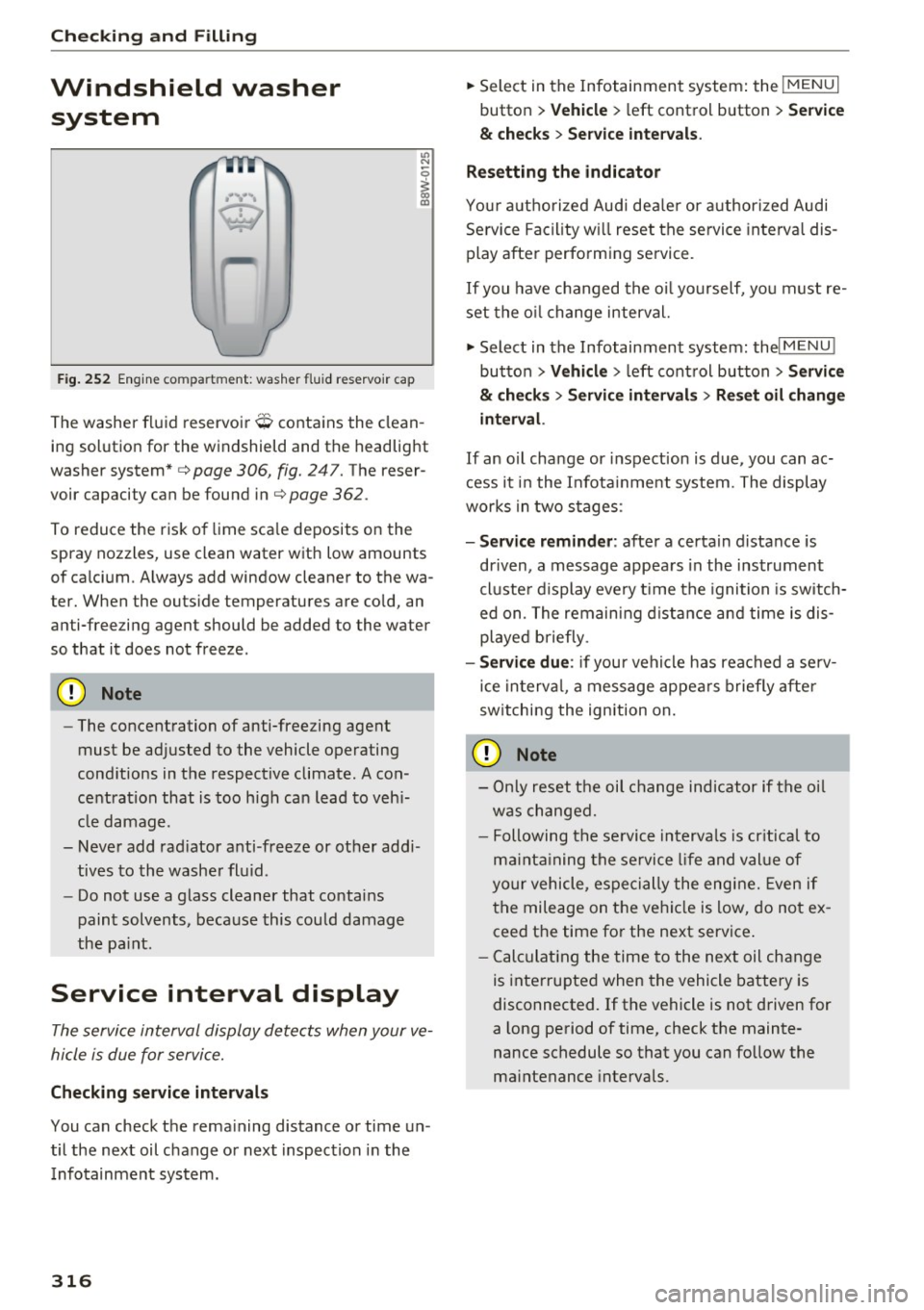
F ig. 252 Engin e comp artm ent : wash er fluid r ese rvoir cap
"' N
0
~ 00 m
The washer fluid reservoir O contains the clean
ing solution for the windshield and the headlight
washer system* c>
page 306, fig. 24 7. The reser
voir capacity can be found inc>
page 362 .
To reduce the risk of lime sca le deposits on the
spray nozzles, use clean water with low amounts
of calci um. Always add window cleaner to the wa
t er. When the outside temper atures are co ld, an
anti-free zing agent should be added to the water
so that it does not freeze .
Cl) Note
-The concentration of anti-free zing agent
must be adjusted to the vehicle operating
conditions in the respective climate. A con
centration that is too high can lead to veh i
cle damage .
- Never add rad iator anti -freeze or other addi
tives to the washer fluid .
- Do not use a glass cleaner that contains
paint solvents, beca use this could damage
the pa int.
Service interval display
The service interval display detects when your ve
hicle is due for service.
Checking se rv ice intervals
You can check the rema ining distance or time un
til the next oil change or next inspection i n the
I nfotainment system .
316
.. Select in the Infotainment system : the !MENUI
button > V ehicle > left control button > Se rvice
& che cks > Ser vice inte rvals .
Resettin g the indicator
You r authorized Audi dea le r or authorized Audi
Se rvice Facility w ill reset the se rvice interval dis
play after performing service.
If you have changed the oi l yourself, yo u must re
set the o il change interval.
.. Select in the Infotainment system: thel
M ENU !
button > Vehicle > left control button > Ser vic e
& check s > Service int erv al s > Re set oil chang e
int erva l.
If an o il cha nge or inspection is due, you can ac
cess it i n the Infota inment system. The display
works in two stages :
-Se rv ice re mind er: after a certain distance is
dr iven, a message appears in the instrument
cluste r display eve ry t ime the ignition is switch
ed on. The remaining d istance and time is dis
played briefly .
-Serv ic e due : if your vehicle has reached a se rv
ice in terva l, a message appears briefly after
sw itching the ignition on.
(D Note
- Only reset the oil change indicator if the oi l
was changed.
- Following the se rvice interva ls is cr itical to
ma inta ining the se rvice l ife and val ue of
yo ur vehicle, especially the engine. Even if
the mileage on the vehi cle is low, do not ex
ceed the time for the next service .
- Calc ulat ing the time to the next oil change
is interrupted when the vehicle battery is
disconnected.
If the vehicle is not driven for
a long period of time, check the mainte
nance schedule so that you can fo llow the
maintenance intervals .
Page 321 of 386
® Mud and snow capability
"M/5" or "M+S" indicates the tire
is suitable for driving on mud and
snow. £ indicates a winter tire.
@ Composition of the tire cord
and materials
The number of plies indicates the
number of rubberized fabric lay
ers in the tire . In general: the
more layers, the more weight a
tire can carry. Tire manufacturers must also specify the materials
used in the ti re . These inc lude
stee l, nylon, polyester and other
materials.
@ Maximum permitted load
This number indicates the maxi
mum load in kilograms and
pounds that the tire can carry.
@ Un iform tire quality grade
standards for treadwear,
traction and temperature resistance
Treadwear, traction and tempera
ture ranges
¢page 333.
@ Running direction
T he arrows indicate the running
direction of unidirectional tires.
You must always follow the speci
fied running direction
¢page 348.
Wheels
~ Maximum permitted tire
pressure
T his number indicates the maxi
mum pressure to which a tire can
be inflated under normal operat
ing conditions .
Glossary of tire and loading
terminology
Accessory weight
means the combined weight (in
excess of those standard items
which may be replaced) of auto matic t ransmission, power steer
ing, power brakes, power win
dows , powe r seats, radio, and
heater, to the extent tha t these
items are avai lab le as factory- in
stalled equipment (whether in
s t alled or not).
Aspect ratio
means the ratio of the height to
the w idth of the tire in percent.
Numbers of 55 or lower indicate a
low sidewall for improved steer
ing response and better overall
handling on dry pavement .
Bead
means the part of the tire that is
made of steel wires, wrapped or
reinfo rced by ply cords and that is
shaped to fit the rim. ...
319
Page 326 of 386
Wheels
for the number of seating positions. Refer to the table ¢
table
on page 329
for the number of
people that correspond to the ve
hicle normal load.
New tires or wheels
Audi recommends having all work on tires or wheels performed by
an authorized Audi dealer or au
thorized Audi Service Facility.
These facilities have the proper
knowledge and are equipped with
the required tools and replace ment parts.
.. New tires do not yet have the
optimum gripping properties.
Drive carefully and at moderate
speeds for the first 350 miles
(500 km) with new tires.
.. use tires of the same construc
tion, size (rolling circumference)
and as close to the same tread pattern as possible on all four
wheels.
11>D0 not replace tires individually.
At least replace both tires on the
same axle at the same time.
11>Audi recommends that you use
Audi Original Tires. If you would like to use different tires, please
note that the tires may perform
324
differently even if they are the
same size ¢
&.-
.,. If you would like to equip your
vehicle with a tire/rim combina
tion that is different from what
was installed at the factory, con
sult with an authorized Audi
dealer or authorized Audi Service Facility before making a pur
chase¢ &,.
If the spare tire is different from
the regular tires installed on the
vehicle - for example, if winter
tires or wide tires are installed -
then only use the spare tire tem porarily in case of emergency and
drive carefully while it is in use. It
should be replaced with a regular
tire as soon as possible .
On
all wheel drive vehicles , all
four wheels must be equipped
with tires that are the same brand
and have the same construction
and tread pattern so that the
drive system is not damaged by
different tire speeds . For this rea
son, in case of emergency, only
use a spare tire that has the same
circumference as the regular
tires . ""
Page 328 of 386
Wheels
Treadwear indicator
Original equipment tires contain
treadwear indicators in the tread
pattern, which are bars that are 1/16 in (1.6 mm) high and are
spaced evenly around the tire per pendicular to the running direc
tion
c::> fig. 254 . The letters "TWI"
or triangles on the tire sidewall indicate the location of the tread
wear indicators.
The tires have reached the mini
mum tread depth
l) when they
have worn down to the treadwear
indicators. Replace the tires with
new ones
c::> A .
Tire rotation
Rotating the tires regularly is rec
ommended to ensure the tires
wear evenly. To rotate the tries,
install the tires from the rear axle
on the front axle and vice versa.
This will allow the tires to have
approximately the same length of
service life.
For unidirectional tires, make
sure the tires are installed accord
ing to the running direction indi-
1> Obey any applicable regulations in your
country.
326
cated on the tire sidewall
c::> page 348.
Hidden damage
Damage to tires and rims can of
ten occur in locations that are
hidden. Unusual vibrations in the
vehicle or pulling to one side may indicate that there is tire damage .
Reduce your speed immediately.
Check the tires for damage. If no
damage is visible from the out
side, drive slowly and carefully to
the nearest authorized Audi deal
er or authorized Audi Service Fa
cility to have the vehicle inspect
ed.
A WARNING
Tread that has worn too low or different tread depths on the
tires can reduce driving safety.
This can especially have a nega
tive effect on handling, on the risk aquaplaning when driving
through water, when driving
through curves and when brak ing, which increases the risk of
an accident.
Page 335 of 386
<( a, .... N ,....
N .... 0 0
3 a,
A WARNING ,~
Using incorrect snow chains or insta lling snow
chains incorrectly can result in loss of vehicle
control, which increases the risk of an acc i
dent.
(D Note
Snow chains can damage the r ims/wheel cov
ers* if the chains come into d irect contact
w ith them. Remove the wheel covers* before
hand . Use coated snow chains.
{1) Tips
When using snow cha ins, it may be useful to
sw itch on sport mode
¢page 135.
Low aspect ratio tires
Your Aud i is facto ry-equipped with low aspect ra
tio ti res. These t ires have been tho rough ly tested
and been se lected specifically for yo ur model for
their superb per formance, road feel and handling
under a variety of driving conditions. Ask your au
thorized Audi dealer for more details .
The low aspect ratio of these t ires is indica ted by
a numera l of
55 or les s in the tire's size designa
tion. The numeral represents the ratio of the
tire's sidewall height in r elation to its tread width
expressed in percentage. Conventional tires have
a height/w idth rat io of 60 or more.
The performan ce of low-aspect- ratio tire s is par
ticularl y sensiti ve to improper inf lat ion pres
sure . It is therefore impo rtant that low aspect
ratio tir e s are infl ated to the specified pressu re
and tha t the inflation pr essure is regularly
checked and maint ained . Tire pre ssure s should
be check ed at lea st once a month and alwa ys
b efore a long trip<=:>
page 32 7.
What you can do to a void tire and rim
damage
L ow aspect rat io tires can be damaged more easi
l y by impact with potho les, cu rbs, gull ies or
r idges on the road, pa rtic ularly if the tire is un
derinflated.
Wh eel s
In order to min imize the occurrence o f impact
damage to the tires of your vehicle, we recom
mend that you observe the following precau
t ions:
- Always maintain recommended inflation pres
sures . Check your tire pressure every 2,000
m iles (3,000 km) and add air if necessary .
- Drive carefully on roads with potholes, deep
gu llies or ridges . The impact from driving
through or over such obstacles can damage
your tires. Impact with a curb may a lso cause
damage to your tires.
- After any impact, immed iate ly inspect your
tires or have them inspected by the nearest au
thorized Audi dealer . Replace a damaged tire as
soon as possible .
- Inspect your tires every 2,000 m iles (3,000 km)
for damage and wear. Damage is not always
easy to see . Damage can lead to loss of a ir and
underinflation, wh ich could eventually cause
tire fa ilu re . If yo u bel ieve that a tire may have
been damaged, replace the tire as soon as pos
sible.
= These tires may wear mo re quickly tha n others.
- Please also remember that , while these tires
de live r responsive ha nd ling, they may ride less
comfort ably and make more noise t han other
choices .
Reduced performance in w inter /cold season
conditions
All tires are des igned for certai n pu rposes. The
low aspect ratio, ultra high performance tires
origina lly installed on your vehicle are intended
for maximum dry and wet road performance and handling. They are not suitable for co ld, snowy or
icy weather conditions. If you drive under those
c ircumstances, you should equip your vehicle
with all -season or winter tires, which offer better
tract ion under those conditions . We suggest you
use the recommended s now or a ll-season tires
spe cified for your vehicle, o r their equiva lent.
Refer
to <=:> page 332 for more detailed informa
t ion regard ing winter tires.
Uniform tire quality grad ing
- Tread wear
333
Page 336 of 386
Wheels
-Traction AA A BC
- Temperature ABC
Quality grades can be found where applicable on
the tire side wall between tread shoulder and maximum section width
~ page 317, fig. 253.
For example: Tread wear 200, Traction AA, Tem
perature
A .
All passenger car tires must conform to Federal
Safety Requirements in addition to these grades.
Tread wear
The tread wear grade is a comparative rating
based on the wear rate of the tire when tested
under controlled conditions on a specified gov
ernment test course.
For example, a tire graded 150 would wear one
and one half
(1 1/2) times as well on the govern
ment course as a tire graded 100.
The relative performance of tires depends upon
the actual conditions of their use, however , and
may depart significantly from the norm due to
variations in driving habits, service practices and
differences in road characteristics and climate.
Traction
The traction grades, from highest to lowest, are
AA, A, Band
C. Those grades represent the tire's
ability to stop on wet pavement as measured un
der controlled conditions on specified govern
ment test surfaces of asphalt and concrete. A tire
marked C may have poor traction performance
~ .& .
Temperature
The temperature grades are A (the highest), B,
and C, representing the tire's resistance to the
generation of heat and its ability to dissipate
heat when tested under controlled conditions on
a specified indoor laboratory test wheel.
Sustained high temperature can cause the mate rial of the tire to degenerate and reduce tire life,
and excessive temperature can lead to sudden
tire failur e~ ,& .
The grade C corresponds to a level of perform
ance which all passenger car tires must meet un-
334
der the Federal Motor Vehicle Safety Standa rd
No. 109. Grades Band A represent higher levels
of performance on the laboratory test wheel than
the minimum required by law.
A WARNING
,--
The traction grade assigned to this tire is
based on straight -ahead braking traction
tests, and does not include acceleration, cor nering, hydroplaning or peak traction charac
teristics .
A WARNING
The temperature grade for this tire is estab
lished for a tire that is properly inflated and
not overloaded. Excessive speed, underinfla
tion, or excessive loading, either separately or
in combination, can cause heat buildup and
possible tire failure.
A WARNING
Temperature grades apply to tires that are properly inflated and not over or underinflat
ed.
Tire pressure monitoring indicator
(l) General notes
-
Each tire, including the spare (if provided),
should be checked monthly when cold and inflat
ed to the inflation pressure recommended by the
vehicle manufacturer on the vehicle placard or
tire inflation pressure label. (If your vehicle has
tires of a different size than the size indicated on
the veh icle placard or tire inflation pressure la
bel, you should determine the proper tire infla
tion pressure for those tires).
As an added safety feature, your vehicle has been
equipped with a tire pressure monitoring system
(TPMS) that illuminates a low tire pressure tell
tale when one or more of your tires is significant ly under-inflated. Accordingly, when the low tire
pressure telltale illuminates, you should stop and
check your tires as soon as possible, and inflate
them to the proper pressure. Driving on a
II>-