light AUDI A4 2018 Owners Manual
[x] Cancel search | Manufacturer: AUDI, Model Year: 2018, Model line: A4, Model: AUDI A4 2018Pages: 403, PDF Size: 66.81 MB
Page 249 of 403
System settings
System settings
Setting the date and
time
You con set the cloc k time manually or using the
CPS*.
"' Se lect : I MENU I button> Settings > left contro l
button >
MMI settings > Date & time .
"'Or: select : I MENU I but ton> Vehicle > lef t con-
t ro l button >
Vehicle settings > Date & time .
Automatic setting
W hen th is function is sw itched on~. the time
a nd date are a utomatically set.
Time
R equi rement: the Automatic setting must be
sw itche d off .
Pr ess the cont ro l knob . Yo u can set t he
Time
manu ally by tur ning and press ing the co ntr ol
knob.
Date
R equir em en t: the Automatic setting mus t be
s w itche d off .
P ress th e cont rol knob . Yo u ca n set the
Date
manually by tur ning and pr ess ing the cont rol
knob .
Time zone
When se lecting the approp riate t ime zone, a
sampling of countr ies in this zo ne will be lis ted .
Automatic time zone*
Wh en th is function is sw itche d on~, the t ime
w ill automatically a djust to the correspon ding
time zone .
Automatic daylight saving time*
When th is function is sw itche d on~, the tim e
wi ll automatically sw itch to day light saving time .
Time format
If yo u se lec t 24h , th e cl ock w ill disp lay, for ex
am ple,
13:00 . If you s elec t AM/PM , the clock
w ill di sp la y, for examp le,
1:00 PM .
248
Date format
If you se le ct DD.MM.YYYY , the d ate di spl ay will
show, fo r exam ple ,
31.08.2018. If you select
MM/DD/YYYY , th e date displ ay wi ll show, for ex
amp le,
08/31/2018. If you s elect YYYY -MM
DD ,
the date display will show, fo r example,
2018-08 -31 .
MMI settings
"'Select: !ME NUI button> Settings > left cont rol
button >
MMI settings .
Language
Y o u c an chan ge the display langua ge as well as
t h e lan guage fo r th e voice guidance * and vo ice
r ecognition system *.
The num ber o f langu ages av a ila ble depe nds on
t h e mar ket.
Measurement units
The following meas uremen t uni ts can be set d e
pend ing on av a ilab ility:
Speed , Distance , Tem
perature , Fuel consumption , Volume , Pressure.
Tool tips
Whe n this f unction is switched on ~' you r MMI
shows you tips fo r inpu t. The fre quency of how
oft en it displays decr ease s w it h tim e.
Speech dialog system
App lies to : vehicles with voice recog nitio n syste m
Depend ing on veh icle equipment, the following
funct io ns may be ava ilable:
Command display : when this function is switch
ed
on ~. the MMI will show yo u the p ossible
commands for voice input in the respective
menu.
Short dialog : when this function is sw itche d on
~' a shorter form of the promp ts is used .
Command during voice output* : thi s f un ction is
swi tc h ed on at t he factory . When this func tion is
switc hed
on ~' you can say new command s dur-
i ng announcements . You do no t need to wait for
the signal tone (beep) dur ing an anno unceme nt.
When the funct io n is swi tched off
0, you need to .,,.
Page 255 of 403
Driving sa fe ty
Driving safety
Basics
Safe driving habits
Please remember -safe ty first!
The individua l safety features of your vehicle can
work together as a system to help protect you
and your passengers in a wide range of accidents.
These features cannot work as a system if they
are not always correctly adjusted and correctly
used .
This chapter contains important informat ion,
tips, instruct ions and warn ings that you need to
read and observe for your own safety, the safety
of your passengers and others . We have summar
ized here what you need to know about safety
be lts , a ir bags, child restra ints as well as child
safety. Yo ur sa fe ty is for us
priority number 1 . Al
ways observe the information and wa rnings in
this section - for your own safety as well as that
of your passengers.
The informa tion in this section applies to all
model ve rsions of your vehicle . Some of the fea
tures described in th is sections may be standard
equipment on some models, or may be optional
equ ipment on others. If you are not sure, ask
your author ized Audi dealer.
A WARNING
- Always make sure that you follow the in
structions and heed the WARNINGS in th is
manual. It is in your inte rest and i n the in
te res t of your passengers .
- Always keep all of the Owner 's L iterature
man uals in yo ur Audi when you lend o r sell
yo ur vehicle so that this importan t info rma
t ion w ill always be availab le to the dr iver
and passenge rs.
- Alw ays keep t he Owner 's L ite ra tu re han dy
so that you can find i t easi ly if yo u have
questions .
254
· Important things to do before driving
Safety is everybody 's job! Vehicle and occupant
safety always depends on the informed and care
ful driver .
For your safety and the safety of your passen
gers,
before driving always:
.. Make sure that a ll lights and signals are operat
ing correctly .
.. Make sure tha t the tire pressure is correct .
.. Make sure that all windows are clean and afford
good vis ibility to the outs ide .
.,. Sec ure all luggage and othe r items ca refully
¢ page 259 .
.,. Mak e sure tha t noth ing ca n interfere with the
pedals .
.. Adjust front seat, head restraint and mirrors
correctly for your height.
.. Applies to: adjustable head restraints: Instruct
passengers to adjust the head restraints ac
cording to the ir height .
.. Make sure to use the rig ht child restraint cor
rectly to protect
chi ldren ~ page 295 , Child
safety.
.,. Si t properly in yo ur seat a nd make su re t hat
your passengers do the same ¢
page 65, Front
seats.
.. Fasten your safety belt and wear it properly . Al
so instruct your passenge rs to fasten thei r sa fe
ty belts properly ¢
page 263.
What impairs driving safety?
Safe driving is directly related to the condition of
the vehicle , the driver as well as the driver's abili
ty to concentra te on the road withou t being dis
tracted.
The driver is responsib le for the sa fety of the ve
hicle and a ll of its occupants . If your ability to
drive is impa ired, safety risks for everybody in the
vehicle increase and you a lso become a hazard to
everyone else on the road ¢
,&.. There fore:
.. Do not let yourse lf be distracted by passengers
or by using a cellular telephone .
.. NEVER dr ive whe n your driving ab ility is im -
paired (by med ications, alcohol, drugs, e tc.) .
..,.
Page 256 of 403
.,. Observe all traffic laws, rules of the road and
speed limits and plain common sense .
.. ALWAYS adjust your speed to road, traffic and
weather conditions.
.. Take frequent breaks on long trips. Do not drive
for more than two hours at a stretch.
.. Do NOT drive when you are tired, under pres
sure or when you are st ressed.
& WARNING
Impai red dr iv ing safe ty inc reases the risk of
ser ious personal inju ry and death whenever a
vehicle is being used.
Correct passenger
seating positions
Proper seating position for the driver
The proper driver seating position is important
for safe, relaxed driving.
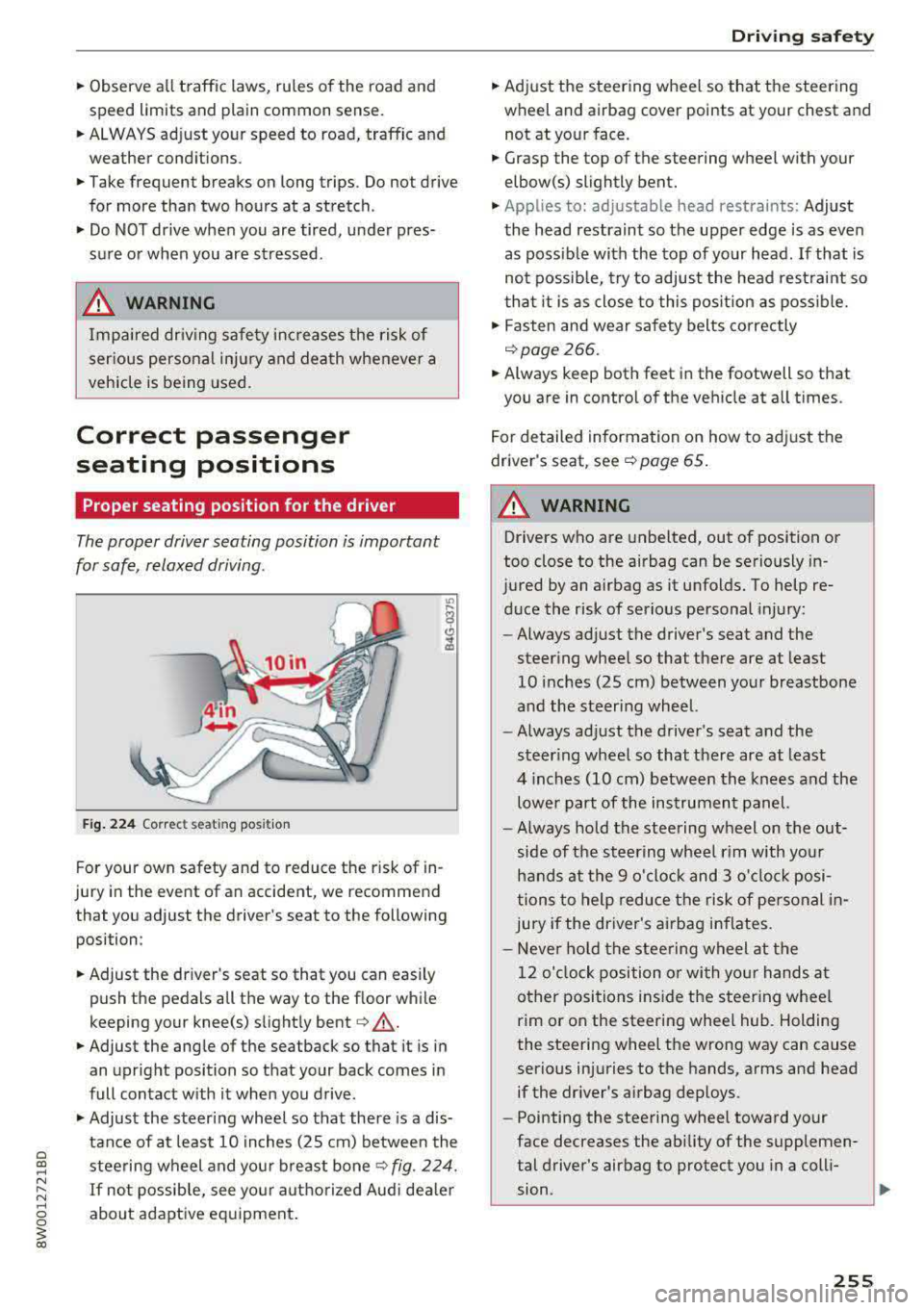
F ig . 2 24 Correct seating posit ion
F or your own safety and to reduce the risk of in
jury in the event of an accident, we recommend
that you adjust the driver's seat to the following position:
.. Adjust the dr iver's seat so that you can easily
push the pedals all the way to the floor while
keeping your knee(s) slight ly
bent ¢&_ .
.. Adjust the angle of the seatback so that it is in
an upright position so that your back comes in
full contact w ith it when you drive .
.,. Adjust the steering wheel so that there is a dis
tance of at least 10 in ches (25 cm) between the
steering wheel and you r breast
bone ¢ fig. 224.
If not possib le, see your aut horized Aud i dea le r
about adaptive eq uipment .
Driving safety
.. Adjust the steering wheel so that the steering
wheel and airbag cover points at your chest and
not at yo ur face .
.. Grasp the top of the steering wheel with your
elbow(s) slightly bent .
.,. Applies to: adjustable head restraints: Adjust
the head restraint so the upper edge is as even as poss ible with the top of your head. If that is
not possib le, try to adjust the head rest raint so
t ha t it is as close to this pos ition as poss ible .
.. Fasten and wear safety belts correctly
¢page 266.
.. Always keep both feet in the footwell so that
you are in contro l of the veh icle at a ll times.
F or detailed information on how to adj ust the
drive r's seat, see
¢page 65 .
A WARNING
-
Drivers who are unbelted, out of position or
too close to the airbag can be seriously in
jured by an airbag as it unfolds. To help re d uce the risk of serious personal injury:
- Always ad just the driver's seat and the
steer ing whee l so that there are at least
10 inc hes (25 cm) between you r breastbone
and the steering wheel.
- Always ad just the driver's seat and the
steer ing wheel so that there are at least
4 inches (10 cm) between the knees a nd the
lowe r part of the instrument panel.
- Always hold the steering w heel on the out
s ide of the steering wheel r im with yo ur
hands at the 9 o 'clock and 3 o'clo ck posi
tions to help reduce the risk of personal in
jury if the driver's airbag inflates.
- Never hold the stee ring wheel at the
12 o' clock position o r wi th yo ur hands at
other positions i nside the steer ing whee l
rim or on the steering wheel hub. Holding
the steering wheel the wrong way can cause
serio us injuries to the hands, arms and head
if the dr iver's airbag dep loys.
- Pointing the steering wheel toward your
face decreases the ability of the supplemen
tal driver's airbag to protect you in a coll i·
.,
sion. ..,
255
Page 264 of 403
Safety belts
General information
Always wear safety belts!
Wearing safety belts correctly saves lives!
This chapter explains why safety belts are neces
sary, how they work and how to adjust and wear
them correctly.
.. Read all the information that follows and heed
all of the instructions and WARNINGS.
A WARNING
Not wearing safety belts or wearing them im
properly increases the risk of serious personal
injury and death.
- Safety belts are the single most effective
means available to reduce the risk of serious
injury and death in automobile accidents.
For your protection and that of your passen
gers, always correctly wear safety belts
when the vehicle is moving.
- Pregnant women, injured, o r physically
im
paired persons must also use safety belts.
Like all vehicle occupants, they are more
likely to be seriously injured if they do not
wear safety belts. The best way to protect a
fetus is to protect the mother
-throughout
the entire pregnancy.
Number of seats
Your Audi has a total of five seating positions:
two in the front and three in the rear. Each seat
ing position has a safety belt.
A WARNING
Not wearing safety belts or wearing them im
properly increases the risk of serious personal
injury and death.
- Never strap more than one person, includ
ing small children, into any belt.
It is espe
cially dangerous to place a safety belt over a
~ child sitting on your lap.
~ -Never let mo re people ride in the vehicle
:::l than there are safety belts available. 0 0
3
-Be sure everyone riding in the vehicle is
properly restrained with a separate safety
belt or child restraint.
Safety belt warning light
Your vehicle has a warning system for the driver
and front seat passenger to remind you about the importance of buckling-up.
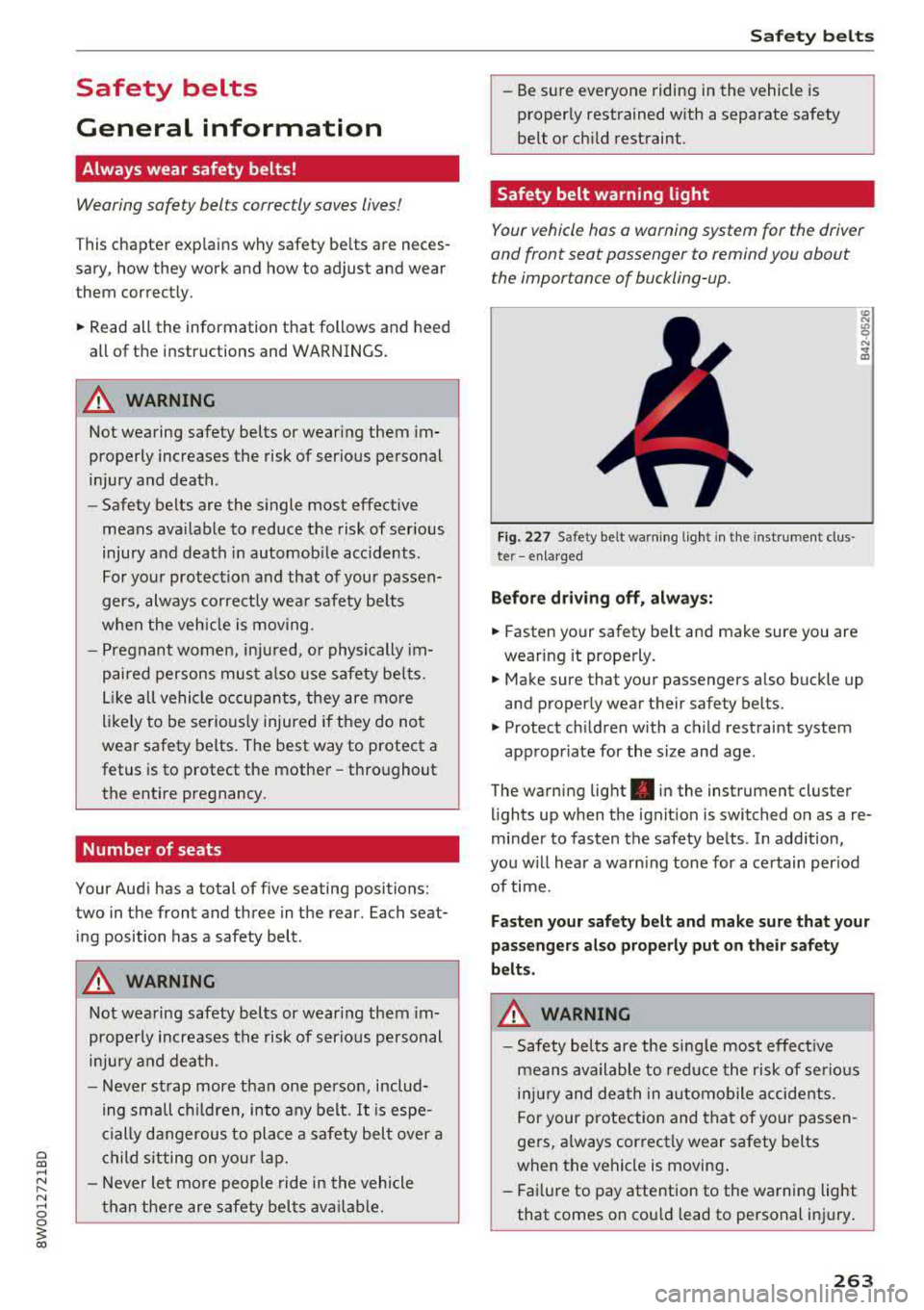
Fi g. 227 Safety belt warn ing light in the instrument clus ·
te r
-enlarged
Before driving off, always:
.. Fasten your safety belt and make sure you are
wearing it properly.
.,. Make sure that your passengers also buckle up
and properly wear their safety belts.
.,. Protect children with a child restraint system
appropr iate for the size and age.
The warning light . in the instrument cluster
lights up when the ignit ion is switched on as a re
minder to fasten the safety belts . In addition,
you w ill hear a warn ing tone for a certain period
of time.
Fasten your safety belt and make sure that your
passengers also properly put on their safety
belts.
A WARNING
-
- Safety belts are the sing le most effective
means available to reduce the risk of serious
injury and death in automobile accidents.
For your protection and that of your passen
gers, a lways correctly wear safety belts
when the vehicle is moving .
- Failure to pay attention to the warning light
that comes on could lead to personal injury.
263
Page 268 of 403
Automatic safety belt r etractors
Every safety be lt is equ ipped wi th an automatic
be lt retractor on the shoulder belt. Th is feature
l ocks the belt when the belt is p ulled out fast,
during hard braking and in an accident. The belt may also lock when you drive up or down a steep
h ill or through a sharp curve. During normal driv
ing the belt lets you move freely .
Safety be lt pret en sioner s
The safety belts are equipped with a belt preten
sioner that helps to tighten the safety belt and
remove slack when the pretensioner is activated
c:> page 269. The function of the pretensioner is
monitored by a warning light
c:> page 32.
Con vertible loc king retractor
Every safety belt exc ept the one on the driver
seat is equipped with a convertible locking retrac
tor that
mu st be used when the safety belt is
used to attach a child safety seat. Be sure to read
the impo rtant information about this feature
c:> page 306.
A WARNING
Improperly posit ioned safety be lts ca n cause
ser ious injury in an accident
c:> page 267,
Safety belt position.
-Safety belts offer optimum protection only
when the seatback is upr ight and belts are
prope rly pos itioned on the body.
-Always ma ke sure tha t the rear sea t bac k
rest to wh ic h t he cente r rea r safety be lt is
attached is secure ly latched whenever the
rear center safety belt is being used. If the
backrest is not securely latched, the passen
ger will move forward with the backrest dur
ing sudden braking, in a sudden maneuver
and especially in a cras h.
-Never attach the safety belt to the buckle
for another seat. Attaching the belt to the
wrong buckle w ill red uce safety belt effec
t iveness and can cause serious personal in
jury.
-A passenger who is not p roperly restrained
can be seriously in ju red by the safety be lt it
self when it moves from the stronger par ts
Safet y bel ts
of the body into critical areas like the abdo
men .
-Always lock the convertible locking retractor
when you are securing a child safety seat in
the vehicle
c:> page 308.
Safety belt position
Correct belt position is the key to getting maxi
mum protection from safety belts.
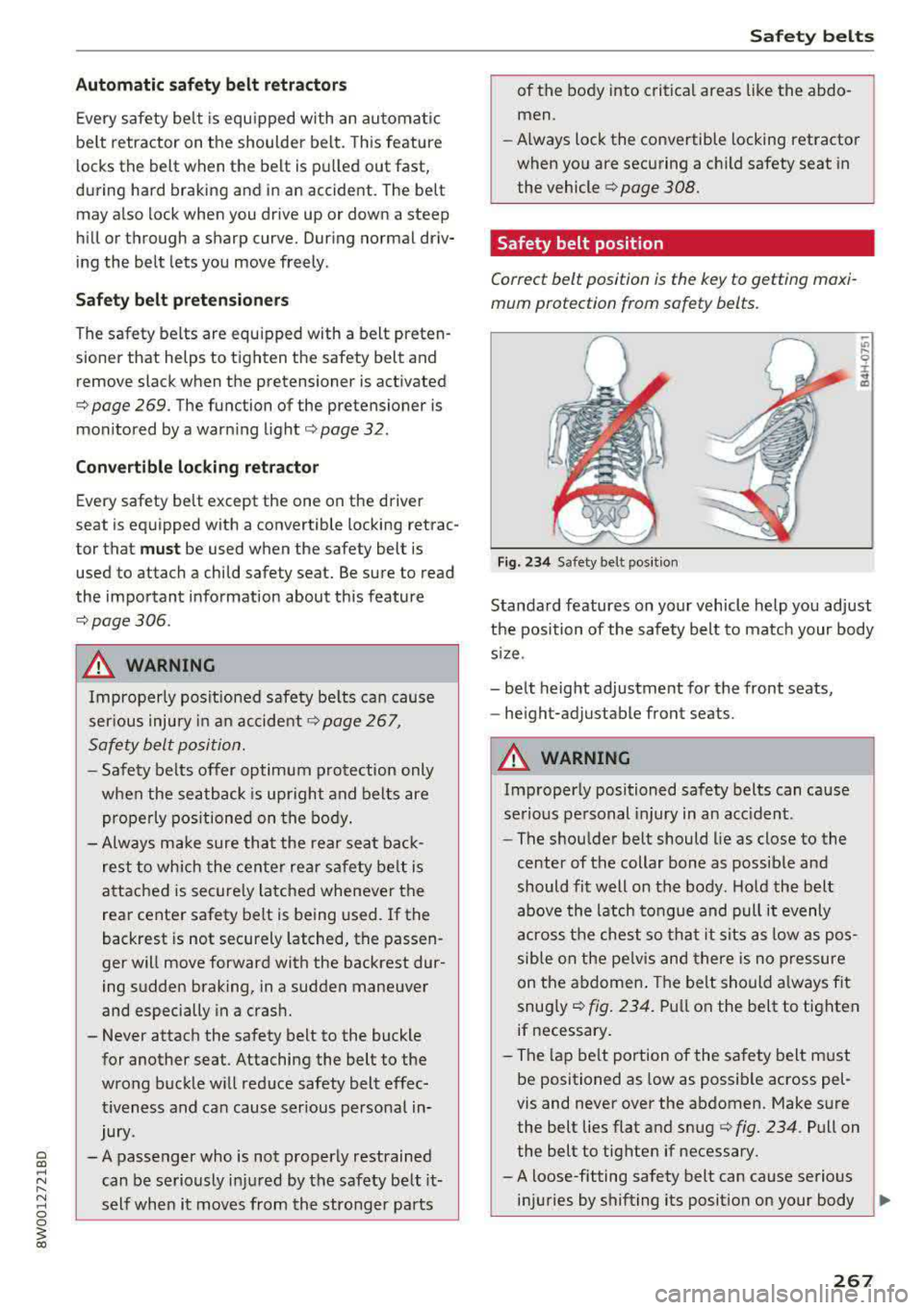
Fig. 23 4 Safety belt pos it ion
Standard features on your vehicle help you adjust
the position of the safety belt to ma tch your body
s iz e.
-be lt height adjustment for the front seats,
-he ight-adjustable front seats .
A WARNING
Improperly positioned safety belts can ca use
se rious personal injury in an acc ident.
-The shou lder belt should lie as close to the
center of the collar bone as possib le and
should fit well on the body . Ho ld the belt
above the latch to ngue and pull it evenly
across the chest so th at it sits as low as pos
sible on the pe lvis and there is no p ressure
on the abdomen . The belt should a lway s fit
snug ly
c:> fig. 234. Pu ll on the belt to tighten
if necessary .
-The lap be lt portion of the sa fety belt must
be positioned as low as possible across pel
vis and never over the abdomen. Make sure
the belt lies flat and snug
c:> fig. 234 . Pull on
the belt to tighte n if necessary.
-A loose-fitting safety belt can cause serious
in ju ries by shifting its position on your body
~
267
Page 274 of 403
a co .... N ,....
N .... 0 0
3 co
about children and Advanced Airbags
¢page 295 .
Even though yo ur vehicle is equipped with an Ad
vanced Airbag System, make certain that all chil
dren, especially those 12 years and younger,
a l
ways ride in the back seat properly restrained for
their age and size. The airbag on the passenger
side makes the front seat a potentially dangerous
place for a child to ride. The front seat is not the
safest place for a child in a forward-facing child
safety seat .
It can be a very dangerous place for
a n infant or a child in a rearward-fac ing seat.
The Advanced Airbag System in your veh icle has
been certified to comply with the requirements
of United States Federal Motor Vehicle Safety
Standa rd (FMVSS) 208, as well as Canada Motor
Veh icle Safety Standa rd (CMVSS) 208 as applica
b le a t the time your veh icle was m an ufact ured.
Accord ing to requirements, the front Advanced
Airbag System on the passenger side has been
certified for "suppression" for infants of about 12 month old and younger and for "low risk
de
ployment" for children aged 3 to 6 years old (as
defined in the standard) .
The
PASSENGER AIR BAG O FF ~ ; light in the
headliner tells you when the front Advanced Air
bag on the passenger side has been turned off by
the electronic control unit.
Each time yo u turn on the ignition, the
PASSEN
GER AIR BAG OFF
~; ON @ light will come on
for a few seconds and:
- PASSENGER AIR BAG OFF ~; will come on if
the front passenger seat is not occupied
- PASSENGER AIR BAG OFF ~; will come on if
the e lectrica l capacitance measured by the
ca
pacitive passenger detection system for the
front passenger seat equa ls the comb ined
ca
pacitance of an infant up to about one year of
age and one of the rearward-facing or forward
facing child restra ints listed i n Federa l Moto r
Vehicle Safety Standard ( FMVSS) 208 with
wh ich the Advanced Airbag System i n your veh i
cl e was certified . Fo r a listing of the child
re
straints that were used to ce rtify you r vehicle 's
compliance with the Safety Standard
¢ page 297 .
Airb ag sys tem
-PAS SENGER AIR BAG OFF ~; will come on if
there is a small chi ld or child restraint on the
front passenger seat
- PASSENGER AIR BAG ON @ will come on if the
front passenger seat is occupied by an ad ult as
registered by the capacit ive passenger detec
tion system
¢ page 283, Monitoring the Ad
vanced Airbag System .
The PASSENGER AIR BAG OFF ~; light comes on
when e lectrical capacitance registered on the
front passenger seat is equal to or less than the
combined capacitance of a typical 1 year-old
in
fant and one of the rearward-facing or forward
facing child restrai nts listed in Federal Motor Ve
hicle Safety Standard ( FMVSS) 208 with wh ich
the Advan ced Airbag System in yo ur vehicle was
ce rtified.
If the total electr ical capacitance reg istered on
t h e front passenger seat is mo re than that of a
typ ical 1 year -old ch ild but less than the weight
of a sm all adult, the front air bag on the passen
ger side can deploy (the
PASSENGER AIR BAG
OFF ~; light does not come on) .
If the
PASSENGER AIR BAG OFF ~; light does
not come on, the front airbag on the p assenger
s ide has not been turned off by the electronic
contro l unit and can deploy if the contro l unit
senses an impact that meets the conditions stor
ed in its memory.
For example , the airbag may deploy if :
-a small c hild that is heav ier than a typ ica l 1
year -o ld child is on the front passenger se at
(regardless o f whethe r the child is in one o f the
child sa fe ty seats listed
¢ page 29 7), o r
- a child who has outgrown c hild rest raints is on
t he front passenge r seat .
If the front passenge r airbag is t urned off, the
PASSENGER AIR BAG OFF ~; light comes on i n
t h e headliner a nd stays o n.
If the front passenger a irbag deploys, the Feder
al Standard requi res the airbag to meet the "low
r isk " dep loymen t criteria to redu ce the r isk of
in
j u ry through interaction w it h t he airbag. "Low
risk" deployment oc curs in those crashes that
take place at lowe r decelerations as defined in
Ill>
273
Page 275 of 403
Airbag syste m
the electronic control unit¢ page 283, PASSEN
GER AIR BAG
OFF~; ON@ light.
A lways remember, a child safety seat or infant
carrier installed on the front seat may be struck
and knocked out of position by the rapid ly inflat
ing passenger's airbag in a fronta l co llision. The
airbag cou ld greatly reduce the effect iveness of
the child restraint and even seriously injure the
child during inflation.
For this reason, and because the back seat is the
safest place for ch ildren
-when properly restra in
ed according to the ir age and size
-we strong ly
recommend that children always sit in the back
seat ¢ page 295, Child safety.
A WARNING
A child in a rearward-facing child safety seat
installed on the front passenger seat w ill be
ser iously injured and can be killed if the fron t
airbag infla tes
-even w ith an Advanced Ai rbag
System.
- T he inflating a irbag w ill hit the child safety
seat or infant carrier with great force and
will smash the chi ld safety seat and child
against the backrest, center armrest, door
or roof.
- Always install rear -facing child safety seats
on the rear seat .
- If you must install a rearward facing ch ild
safety seat on the front passenger seat be
cause of exceptiona l circumstances and the
PA SSENGER AIR BAG OFF ~; light does not
come on and stay on, immed iately install
the rear-fac ing ch ild safety seat in a rear
seat ing pos ition and have the airbag system
inspected by your authorized Audi dea ler.
- Forward-facing ch ild safety seats installed
on the front passenger's seat may interfere
with the deployment of the airbag and ca use serio us pe rsonal injury to the child.
A WARNING
If, in except ional circumstances, you must i n
stall a forward -facing chi ld res train t on the
front passenger's seat:
- Alw ays make sure the forward-facing seat
has been designed and ce rt ified by its man-
274
ufacturer for use on a front seat with a pas
senger front and side airbag.
- Never put the forward-facing child restraint
up against or very near the instrument pan
el.
- Always move the front passenger seat to
the highest posit ion in the up and down ad
justment range and move it back to the
rearmost posit ion in the seat's fore and aft
ad justment range, as far away from the a ir
bag as poss ible, before installing the for
ward-facing chi ld restraint.
- Always make sure that the safety be lt upper
anchorage is behind the ch ild rest raint and
not next to o r in front of the child rest raint
so th at the safety be lt will be p roperly posi
tioned.
- Ma ke sure that the
PASSENGER AIR BAG
OFF
~; light comes on and stays on all the
time wheneve r the ign it ion is switched on .
A WARNING
To reduce the risk of serious injury, make sure
that the PASSENGER AIR BAG OFF~; light
will be disp layed whenever a ch ild restraint is
installed on the front passenger seat and the
ignit ion is switched on.
- If the
PASSENGER AIR BAG OFF ~; light
does not stay on, perform the checks descri
bed
¢ page 283, Monitoring the Advanced
Airbag System.
- Take the child restra int off the front passen
ger seat and install it properly at one of the rear seat positions if the
PASSENGER AIR
BAG
OFF ~ light does not stay on .
- Have the airbag system inspected by your author ized Audi dealer immed iate ly.
- Always carefully follow instructions from
child restraint manufacturers when instal
ling child restra ints.
A WARNING
If, in exceptional ci rcumstances, you must in
stall a forward or rearward-fac ing child re-
stra int on the fron t passenger's seat:
..,.
Page 278 of 403
a co .... N ,....
N .... 0 0
3 co
The front Advanced Airbag System for the front
seat occupants is not a substitute for your safety be lts. Rather, it is part of the overa ll occupant re
straint system in your vehicle. A lways remember
that the airbag system can on ly help to protect
you, if you are sitting upr ight, wear ing your safe
ty belt and wear ing it properly. This is why you
and your passengers must always be properly re
stra ined, not just because the law requ ires you to
be.
The Advanced Airbag System in your ve hicle has
been certified to meet the
"low r isk" require
ments for 3 and 6 yea r-old children o n the pas
senger side and very sma ll adults on the drive r
side . The low r isk dep loyment cr iteria are intend
ed to help reduce the risk of injury through inter
action with the front airbag that can occur, for
examp le, by being too close to the steering wheel
and instrument pane l when the airbag inflates.
I n addition, the system has been certified to
comp ly with the "supp ression" requirements of
the Safety Standard, to turn off the front a irbag
for infants 12 months old and younger who are
restrained on the front passenger seat in child re
stra ints that are listed in the Standard
c::> page 297, Child restraints and Advanced Air
bags.
"Suppress ion" requ ires the front a irbag on the
passenger side to be turned off if:
- a ch ild up to about one year of age is restrained
on the front passenger seat in one of the rear
facing or forward-fac ing infant restra ints listed
in Federal Motor Vehicle Safety Standard 208
with wh ich the Advanced Airbag System in your
vehicle was ce rt ified. For a listi ng of the ch ild
restra ints tha t were used to certify your veh i
cl e's compl iance with the US Safety St andard
c::> page 297,
- When a person is dete cted on the front passen
ger seat that has an electrical capacitance that
is more than the tota l electrical capac itance of
a ch ild that is about 1 year old restrained in one
of the rear-facing or forward-facing infant re
straints (listed in Federal Motor Vehicle Safety
Standard 208 w ith which the Advanced A irbag
System in your veh icle was certified), the front
Airb ag sys tem
airbag on the passenger side may or may not
dep loy.
T he
PASSENGER AIR BAG OFF ~; ligh t comes on
whe n the elect ronic con trol uni t detects a tota l
electrical capacitance on the front passenger seat
that requires the front airbag to be turned off. If
the
PASSENGER AIR BAG OF F~; light does not
come on, the front airbag on the passenger side
has not been turned
off by the contro l unit and
can deploy if the contro l unit senses a n impact
that meets the cond itions stored in its memory.
If the total e lectr ica l capacitance reg istered on
the front passenger seat is more than that of a
typ ical 1 year-old, b ut less than the weight of a
small ad ult, the front a irbag on the passenger
s ide may dep loy (the
PASSENGER AIR BAG OFF
~; light does not come on).
For example, th e airbag may deploy if:
- a small ch ild that is heav ier than a typ ical 1
year-o ld child is on the front passenger seat
(regardless of whether the child is in one of the
child safety seats listed
c:> page 297),
- a child who has outgrown c hild restraints is on
the front passenger seat.
If the front passenger airbag is t urned
off, the
PASSENGER AIR BAG OFF ~; light in the head
liner w ill come on and stay on.
If the front passenge r airbag deploys, the Feder
al Standard requ ires the a irbag to meet the " low
risk" deployment criteria to help reduce the r isk
of inj ury through interaction with the airbag.
"Low risk" deployment occurs in those crashes
that take place at lower decelerations as defined
i n the electronic control unit .
c::>page 283
Always remember: Even though your vehicle is
equipped with Advanced Airbags, the safest place
for childre n is properly restrained on the back
seat. Please be sure to read the impor tant infor
mation in the sec tions that fo llow and be sure to
heed all of the WARNINGS.
_& WARNING
To redu ce the risk of injury when an airbag in-
f lates, always wear safe ty belts properly.
llill-
277
Page 279 of 403
Airbag syste m
-If you are unrestrained, leaning forward, sit
ting sideways or out of position in any way,
your risk of injury is much higher.
- You will also receive serious injuries and
could even be killed if you are up aga inst the
airbag or too close to it when it inflates
-
even with an Advanced Airbag ¢ page 2 71.
A WARNING
A child in a rearward-facing child safety seat
installed on the front passenger seat w ill be
ser iously injured and can be killed if the front
airbag inflates
-even w ith an Advanced Airbag
System.
- Although the Advanced A irbag System in
yo ur vehicle is designed to turn off the front
airbag when a rearward-facing child re
straint has been insta lled on the front pas
senger seat, nobody can absolutely guaran
tee that deployment is impossible in all con ceivable s ituations that may happen during
the useful life of your vehicle.
- The inf lating airbag will hit the child safety
seat or infant carrier with great force and
will smash the chi ld safety seat and child
against the backrest, center armrest, door,
or roof.
- Always install rearward-facing ch ild re
straints on the rear seat.
- If you must install a rearward fac ing ch ild
safety seat on the front passenger seat be
cause of exceptiona l circumstances and the
PAS SENGER AIR BAG OFF ~; light does not
come on and stay on, immed iate ly install
the rear-fac ing ch ild safety seat in a rear
seating position and have the airbag system
inspected by your authorized Audi dea ler.
A WARNING
If, in exceptional circumstances, you must in
stall a forward-facing chi ld restraint on the
front passenger's seat:
- Always make sure the forward-facing seat
has been designed and certified by its man
ufacturer for use on a front seat with a pas
senger front and side a irbag.
278
- Never put the forward-facing child restraint
up against or very near the instrument pan
el.
- Always move the front passenger seat to
the highest posit ion in the up and down ad
justment range and move it back to the rearmost posit ion in the seat's fore and aft
ad justment range, as far away from the a ir
bag as poss ible, before install ing the for
ward-facing chi ld restraint.
- Always make sure that the safety be lt upper
anchorage is behind the ch ild rest raint and
not next to o r in fron t of the child rest raint
so that the safety be lt will be properly posi
tioned.
- Always make sure th at there is noth ing on
the front passenger seat that will cause the
capacitive passenger detection system in
the seat to signal to the Airbag System that
the seat is occup ied by a person when it is
not, or to signal that it is occupied by some
one who is heavier than the person actually
sitt ing on the seat. The presence of addi
tional objects could cause the passenger
front airbag to be turned on when it should
be off, or could cause the airbag to work in a
way that is d ifferent from the way it wou ld
have worked withou t the objec t on the seat .
- Ma ke sure that the
PASSENGER AIR BAG
OFF
"1; light comes on and stays on all the
time wheneve r the ignit ion is switched on .
' Advanced Airbag System components
The front passenger seat in your vehicle has a lot
of very important parts of the Advanced Airbag
System in it. These parts include the capacitive passenger detection system, wir ing, brackets,
and more. The control unit monitors the system
on the front passenger seat when the ignit ion is
switched on and turns the airbag indicato r light
o n when a malfunction in the one of the system
components is detec ted
¢ page 283. Because
t h e fron t passenger seat contains impo rtant
parts of the Advanced Ai rbag System, you must
take care to prevent it from being damaged .
Damage to the seat may prevent the Advanced
.,.
Page 280 of 403
a co .... N ,....
N .... 0 0
3 co
Airbag System for the front passenger seat from
doing its job in a crash.
The f ront Ad vanced Airb ag S ystem con sists
of t he follo wing :
-Crash sensors in the front of the vehicle that
measure vehicle acceleration/deceleration to
provide information to the Advanced Airbag
System about the severity of the crash.
-An electronic control un it, with integrated
crash sensors for front and side impacts. The
control unit "decides" whether to fire the front
airbags based on the information received from
the crash sensors. The control unit also
"de
c ides" whether the safety belt pretens ioners
shou ld be activated .
-An Advanced Airbag with gas generator and
contro l valve for the driver ins ide the steer ing
wheel hub.
-An Advanced Airbag with gas generator and contro l valve inside the instrument pane l for
the front passenger.
-A capac itive passenger detect io n system unde r
neath the front passenger seat cover. This sys
tem measures the elect rical capac ita nce of the
person in the seat. The i nformation registe red
is sent continuously to the electron ic control
unit to regulate deployment of the front Ad
vanced Airbag on the passenger side.
-An airbag monitoring system and indicator
light
m in the instrument cluster .
-A sensor in each front seat reg isters the dis
tance between the respective seat and the
steering wheel or instrument panel. The infor
mation reg istered is sent continuously to the
electronic control unit to regulate deployment
of the front Advanced A irbags.
-The PA SS EN GER AIR BAG OFF ~; ON@ light
comes on in the
headliner¢ page 283,
fig. 241 and tells you the status of the Ad
vanced Airbag on the passenge r side .
-A sensor in the safety belt latch for the dr iver
and for the front seat passenger that senses
whether that safety belt is latched or not and
transm its this info rmat ion to the elect ronic
contro l unit.
Airb ag sys tem
_& WARNING
Damage to the front passenger seat can pre
vent the front airbag from working properly.
- Improper repair or disassembly of the front
passenger and driver seat will prevent the
Advanced Airbag System from funct ion ing
properly.
- Repairs to the front passenger seat must be
performed by qualified and properly trained
workshop personnel.
- Never remove the front passenger or driver seat from the vehicle.
- Never remove the upholstery from the front
passenger seat.
- Never disassemble or remove parts from the
seat or disconnect w ires from it.
- Never carry sharp objects in your pockets or
put them on the seat. The capacit ive pas
senger detect ion mat in the front passenger
seat will not function p roperly if it is punc
tured.
- Never carry things on your lap or carry ob
jects on the front passenger seat. S uch ob
jects can influence the capacitance reg is
tered by the capacitive passenger detection
system, so that incorrect informa tion is pro
vided to the airbag control unit.
- Never store i tems unde r the front passenger
seat . Parts of the Advanced Airbag System
under the passenger seat could be dam
aged, p reventing them and the airbag sys
tem from working proper ly.
- Never p lace seat covers or replacement up
holstery that have not been specifically ap
proved by Audi on the front seats.
- Seat covers can prevent the Advanced A ir
bag System from recognizing chi ld re
stra ints or occupants on the front passenger
seat and prevent the side airbag in the seat
backrest from deploying properly.
- If a seat heater has been retrofitted or oth
erwise added to the front passenger seat,
never install any child restra int system on
this seat.
- Never use cushions, p illows, blankets, or
similar items on the front passenge r seat .
279