warning light AUDI A4 2018 Owners Manual
[x] Cancel search | Manufacturer: AUDI, Model Year: 2018, Model line: A4, Model: AUDI A4 2018Pages: 403, PDF Size: 66.81 MB
Page 303 of 403
Child safety
seats support the baby's back, neck and head in a
crash
¢ fig. 249 .
The airbag on the passenger side makes the front
seat a potentially dangerous place for a child to ride. The front seat is not the safest place for a
child in a forward-facing child seat. It is a very
dangerous place for an infant or a larger child in
a rearward-facing seat .
A WARNING
Not using a child safety seat, using the wrong
child safety seat or improperly installing a
child restraint increases the risk of serious
personal injury and death in a crash.
- Never install rear -facing child safety seats
or infant carriers on the front passenger
seat -even with an Advanced Airbag Sys
tem . A child will be seriously injured and can
be killed when the inflating airbag hits the
child safety seat or infant carrier with great
force and smashes the child safety seat and child against the backrest, center armrest,
door or
roof <=> page 2 72, Child restraints on
the front seat -some important things to
know .
-Always install rear-facing child safety seats
or infant carriers on the rear seat.
- Never install a rear-facing child restraint in the forward-facing direction. Such restraints
are designed for the special needs of infants and very small children and cannot protect
them properly if the seat is forward-facing .
- If you must install a rearward facing child safety seat on the front passenger seat because of exceptional circumstances and the
PASSENGER AIR BAG OFF~; light does not
come on and stay on, immediately install
the rear-facing child safety seat in a rear
seating position and have the airbag system
inspected by your Audi dealer.
- Never place or use any electrical device (such as a laptop, CD player, electronic
games device, power inverter or seat heater
for child seats) on the front passenger seat
if the device is connected to the 12-volt
socket or the cigarette lighter socket.
302
-If a seat heater has been retrofitted or oth
erwise added to the front passenger seat,
never install any child restraint system on
this seat .
-Make sure that there are no wet objects
(such as a wet towel) and no water or other
liquids on the front passenger seat cushion.
-Never place objects on the seat (such as a
laptop, CD player, electronic games device,
power inverter or seat heater for child
seats) . These may influence the electrical
capacitance measured by the capacitive pas
senger detection system and can also fly
around in an accident and cause serious per
sonal injury.
- Always read and heed all WARNINGS when
ever using a child restrained in a vehicle is being used
¢ page 263, Safety belts,
¢ page 2 71, Airbag system and
c> page 295, Important information.
Page 304 of 403
Convertible child safety seats
Properly used convertible child safety seats can
help protect toddlers and children over age one
who weigh between
20 and 40 lbs. (9 and 18 kg)
in a crash.
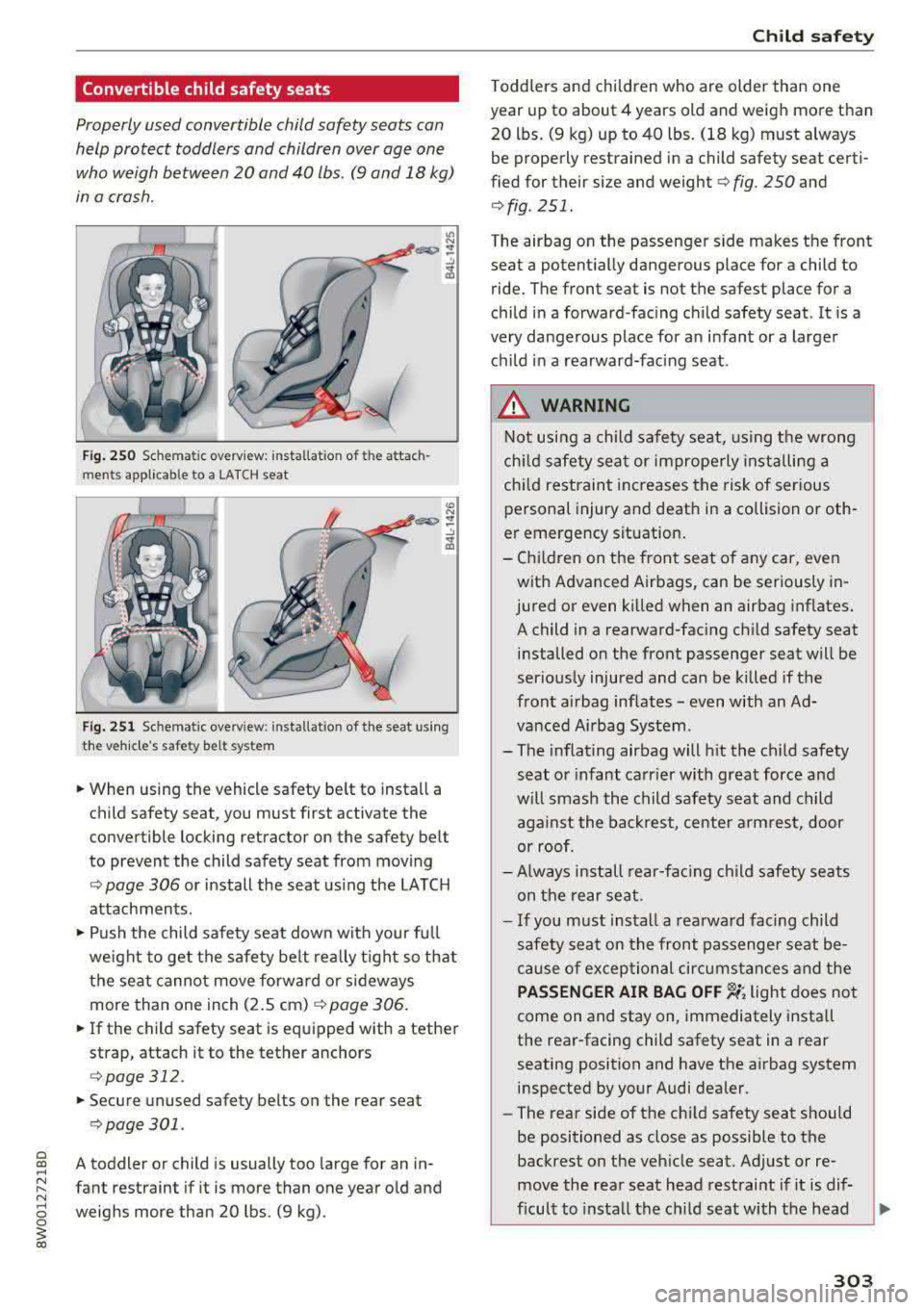
Fig. 250 Schematic overv iew: insta llatio n of the attach
ments applicab le to a LATCH seat
Fig. 251 Schematic overv iew: installat ion of the seat using
the vehicle 's safety belt system
.. When using the vehicle safety belt to install a
child safety seat, you must first activate the
convertible locking retractor on the safety belt
to prevent the child safety seat from moving
Q page 306 or install the seat us ing the LATC H
attachments .
.. Push the child safety seat down with your fu ll
weight to get the safety belt really tight so that
the seat cannot move forward o r sideways
more than one inch (2.5 cm)
Q page 306.
.. If the child safety seat is equipped with a tether
strap, attach it to the tether anchors
Q page 312.
.. Secure unused safety belts on the rear seat
Qpage 301 .
A toddler or child is usually too large for an in
fant restraint if it is more than one year old and
weighs more than 20 lbs. (9 kg).
Child safety
To ddlers and children who are older than one
year up to about 4 years old and weigh more than
20 lbs. (9 kg) up to 40 lbs. (18 kg) must always
be properly restrained in a child safety seat certi
fied for their size and weight
Q fig. 250 and
q fig . 251.
The airbag on the passenger side makes the front
seat a potentially dangerous place for a child to
ride. The front seat is not the safest place for a
child in a forward-facing child safety seat. It is a
very dangerous place for an infant or a larger
child in a rearward-facing seat .
_&. WARNING
Not using a child safety seat, us ing the wrong
child safety seat or improperly instal ling a
chi ld restraint increases the risk of serious
personal injury and death in a collision or oth
er emergency situation.
-Children on the front seat of any car, even
with Advanced Airbags, can be seriously in
jured or even killed when an airbag inflates.
A child in a rearward-facing ch ild safety seat
installed on the front passenger seat will be
seriously injured and can be killed if the
front airbag inflates
-even with an Ad
vanced Airbag System.
-The inflating airbag will hit the child safety
seat or infant carr ier with great force and
will smash the child safety seat and child
against the backrest, center armrest, door
or roof.
-Al ways install rear-fa cing child safety seats
on the rear seat .
-If you must insta ll a rearward facing child
safety seat on the front passenger seat be
cause of excep tional circumstances and the
PASSENGER AIR BAG OFF '-I; light does not
come on and stay on, immediately insta ll
the rear-facing child safety seat in a rear
seating position and have the a irbag system
inspected by your Audi dealer .
-The rear side of the ch ild safety seat shou ld
be positioned as close as possible to the
backrest on the veh icle seat. Adjust or re
move the rear seat head restraint if it is dif
f icult to install the child seat with the head
303
Page 305 of 403
Child safety
restraint in place~ page 67. Install the
head restraint again immediately once the
child seat is removed. Driving without head
restraints or with head restraints that are
not properly adjusted increases the risk of
serious or fatal neck injury dramatically .
- Always read and heed all WARNINGS when
ever using a child restrained in a vehicle is
being used
~ page 263, Safety belts,
~ page 2 71, Airbag system and
~ page 295, Important information.
_& WARNING
If exceptional circumstances require the use
of a forward-facing child restraint on the
front passenger's seat , the child's safety and
well-being require that the following special precautions be taken:
- Make sure the forward-facing seat has been
designed and certified by its manufacturer
for use on a front seat with a passenger
front and side airbag.
- Always follow the manufacturer 's instruc
tions provided with the child safety seat or
infant carrier.
- Always move the front passenger seat to the highest position in the up and down ad
justment range and move it back to the
rearmost position in the seat's fore and aft
adjustment range, as far away from the air
bag as possible, before installing the for
ward-facing child restraint.
- Always make sure that the safety belt upper
anchorage is behind the child restraint and
not next to or in front of the child restraint
so that the safety belt will be properly posi
tioned.
- Always make sure that nothing prevents the
front passenger's seat from being moved to
the rearmost position in its fore and aft ad
justment range.
- Always make sure the backrest is in an up
right position.
- Never place or use any electrical device (such as a laptop, CD player, electronic
games device, power inverter or seat heater
for child seats) on the front passenger seat
304 if the device is connected to the 12-volt
socket or the cigarette lighter socket.
- If a seat heater has been retrofitted or oth
erwise added to the front passenger seat,
never install any child restraint system on
this seat.
- Make sure that there are no wet objects (such as a wet towel) and no water or other
liquids on the front passenger seat cushion .
- Never place objects on the seat (such as a
laptop, CD player, electronic games device,
power inverter or seat heater for child
seats) . These may influence the electrical
capacitance measured by the capacitive pas
senger detect ion system and can also fly
around in an accident and cause serious per
sonal injury.
- Make sure that the
PASSENGER AIR BAG
OFF
11,;; light comes on and stays on all the
time whenever the ignition is switched on.
- If the
PASSENGER AIR BAG OFF 11,;; light
does not come on and stay on, immediately
install the forward-facing child seat at a
seating position on the rear seat and have
the airbag system inspected by your author
ized Audi dealer.
- Take the child restraint off the front passen
ger seat and install it properly at one of the rear seat positions if the
PASSENGER AIR
BAG OFF
11,;; light does not stay on whenever
the ignition is switched on .
Page 307 of 403
Child safety
body and the front of the passenger compart
ment, the airbag can inflate completely and pro
vide supplemental protection in certain frontal
collisions.
.,&. WARNING
Not using a booster seat, using the booster
seat improperly, incorrectly installing a boos
ter seat or using the vehicle safety belt im
properly increases the risk of serious personal
injury and death in a collision or other emer
gency situation. To help reduce the risk of se
rious personal injury and/or death:
- The shoulder belt must lie as close to the
center of the child's collar bone as possible
and must lie flat and snug on the upper
body.
It must never lie across the throat or
neck. The lap belt must lie across the pelvis
and never across the stomach or abdomen .
Make sure the belt lies flat and snug. Pull on
the belt to tighten if necessary .
- Failure to properly route safety belts over a
child's body will cause severe injuries in an
accident or other emergency situation
¢ page 263 .
-The rear side of the child safety seat should
be positioned as close as possible to the
backrest on the vehicle seat . Adjust or re
move the rear seat head restraint if it is dif
ficult to install the child seat with the head
restraint in place
¢page 67. Install the
head restraint again immediately once the
child seat is removed. Driving without head
restraints or with head restraints that are
not properly adjusted increases the risk of
serious or fatal neck injury dramatically.
- Never let a child put the shoulder belt under
the arm or behind the back, because it could
cause severe injuries in a crash.
- Children on the front seat of any car, even
with Advanced Airbags, can be seriously in
jured or even killed when an airbag inflates .
- Never let a child stand or kneel on any seat,
for example the front seat.
- Never let a child ride in the cargo area of
your vehicle.
- Always remember that a child leaning for
ward, sitting sideways or out of position in
306
any way during an accident can be struck by
a deploying airbag. This will result in serious
personal injury or death .
- If you must install a booster seat on the
front passenger seat because of exceptional
circumstances the
PASSENGER AIR BAG
OFF
fj,;; light must come on and stay on,
whenever the ignition is switched on.
- If the
PASSENGER AIR BAG OFF fj,;; light
does not come on and stay on, perform the
checks described ¢
page 283, Monitoring
the Advanced Airbag System.
- Take the child restraint off the front passen
ger seat and install it properly at one of the rear seat positions if the
PASSENGER AIR
BAG
OFF~; light does not stay on whenever
the ignition is switched on.
- Always read and heed all WARNINGS when
ever using a child restrained in a vehicle is
being used¢
page 263, Safety belts,
¢ page 2 71, Airbag system and
¢ page 295, Important information.
Securing child safety
seats
Securing a child safety seat using a safety
belt
Safety belts for the rear seats and the front pas
senger can be locked with the convertible locking
retractor to properly secure child safety seats.
The safety belts for the rear seats and for the
front passenger's seat have a convertible locking
retractor for child safety seats. The safety belt
must be locked so that belt webbing cannot un
reel. The retractor can be activated to lock the
safety belt and prevent the safety belt webbing
from loosening up during normal driving . A child
safety seat can only be properly installed when
the safety belt is locked so that the child and
child safety seat will stay in place.
Always remember : Even though your vehicle is
equipped with an Advanced Airbag system, all children, especially those 12 years and younger,
should always ride in the back seat properly re-
strained for their age and size.
ll-
Page 308 of 403
a co .... N ,....
N .... 0 0
3 co
A WARNING
-
Improperly installed child safety seats in
crease the risk of serious personal injury and
death in a collision.
- Always make sure that the safety belt re
tractor is locked when installing a child
safety seat. An unlocked safety belt retrac
tor cannot hold the child safety seat in place
during normal driving or in a crash.
-Always buckle the child safety seat firmly in place even if a child is not sitting in it. A
loose child safety seat can fly around during
a sudden stop or in a collision.
- Always make sure that the rear seat back
rest to which the center rear safety belt* is
attached is securely latched whenever the
rear center safety belt is being used to se
cu re a ch ild restraint .
-If the backrest is not securely latched, the
child and the child restraint will be thrown
forward together w ith the backrest and will
strike parts of the vehicle interior. The ch ild
can be se riously injured or killed .
-Never install rear-facing child safety seats
or infant carriers on the front passenger
seat . A child will be serious ly injured and
can be killed when the passenger airbag in
flates.
-The inflating airbag will hit the child safety seat or infant carrier with great force and
will smash the ch ild safety seat and chi ld
against the backrest, center armrest, door
or roof .
-Always install rear-facing child safety seats
or infant carriers on the rear seat.
-Forward-fac ing ch ild safety seats or infant
carriers installed on the front passenger's
seat may interfere with the deployment of
the a irbag and cause serious injury to the
child .
-It is safer to install a forward -fac ing ch ild
safety seat on the rear seat .
- Always read and heed all WARNINGS when
ever using a child restrained in a veh icle is
being used
~ page 295 . Specia l precaut ions
apply when installing a child safety seat on
the front passenger seat
~ page 2 72, Child
Ch ild safety
restraints an the front seat -some impor
tant things to know.
A WARNING
-A lways take special precautions if you must
i nstall a forward or rearward-facing child re
stra int on the front passenger's seat in excep
tional s ituations:
-Whenever a forward or rearward-fac ing
child restraint is installed on the front pas
senger seat, the
PASSENGER AIR BAG OFF
~; light must come on and stay on whenev
er the ign ition is switched o n.
-If the PASSENGER AIR BAG OFF ~; light
does not come on and stay on, perform the
checks desc ribed
~ page 283, Monitoring
the Advanced Airbag System.
-Take the child restra int off the front passen
ge r seat and install it prope rly at one of the
rear seat positions i f the
PASSENGER AIR
BAG
OFF ~; light does not stay on whenever
the ignition is switched on .
-Improper installat ion of child res tra ints can
reduce their effectiveness or even prevent
them f rom providing any protect ion .
-An improperly installed child restraint can
interfere with the airbag as it deploys and
serious ly injure or even kill the chi ld.
-Always carefully follow the manufacturer's
instr uctions provided with the child safety
seat or carr ier .
- After checking to make sure that the c hild
restraint is properly installed, make certain
that the child restraint is correctly recog
n ized by the capacitive passenger detection
system in the front passenger seat and that
the
PASSENGER AIR BAG OFF ~; light sig
na ls the cor rect front passenger fronta l air
bag status.
A WARNING
F orwa rd-facing child restra ints:
-Always make sure the forward-facing seat
has bee n des igned and certified by its man
ufacturer for use on a front seat with a pas
senger front and side airbag.
-
307
Page 309 of 403
Child safety
-Never put the forward-facing child restraint
up, against or very near the instrument pan
el.
- Always move the front passenger seat to
the highest position in the up and down ad
justment range and move it back to the
rearmost position in the seat's fore and aft
adjustment range, as far away from the air
bag as possible, before installing the for
ward-facing child restraint.
- Always make sure that the safety belt upper
anchorage is behind the child restraint and
not next to or in front of the child restraint
so that the safety belt will be properly posi
tioned.
- Make sure that the
PASSENGER AIR BAG
OFF~ ; light comes on and stays on all the
time whenever the ignition is switched on.
A WARNING
Rearward-facing child restraints:
- A child in a rearward-facing child safety seat
installed on the front passenger seat will be
seriously injured and can be killed if the
front airbag inflates -even with an Ad
vanced Airbag System.
- The inflating airbag will hit the child safety
seat or infant carrier with great force and
will smash the child safety seat and child
against the backrest, center armrest, door
or roof .
- Always be especially careful if you must in
stall a rearward facing child safety seat on
the front passenger seat in exceptional cir
cumstances .
- Make sure that the
PASSENGER AIR BAG
OFF~; light comes on and stays on all the
time whenever the ignition is switched on.
- If the
PASSENGER AIR BAG OFF~; light
does not come on and stay on, immediately
install the rear-facing child safety seat in a
rear seating position and have the airbag
system inspected by your Audi dealer .
308
· Activating the convertible locking retractor
Use the convertible locking retractor to secure a
child restraint.
Always heed the child safety seat manufacturer 's
instructions when installing a child restrain t in
your vehicle . To activate the convertible locking
retractor:
.. Place the child restraint on a seat, preferably
on the rear seat .
.. Slowly pull the belt all the way out.
.. Route it around or through the child restraint
belt path
~ ,&. .
.. Push the child safety seat down with your full
weight to get the safety belt really tight.
.. Insert the belt tongue into the buckle for that
seating position.
.. Guide the safety belt back into the retractor un
til the belt lies flat and snug on the child safety
seat.
.. You should hear a "clicking" noise as the belt
winds back into the inertia reel. Test the con
vertible locking retractor by pulling on the belt.
You should no longer be able to putt the belt
out of the retractor. The convertible locking re
tractor is now activated .
.. Make sure that the red release button is facing
away from the child restraint so that it can be
unbuckled quickly.
.. Pull on the belt to make sure the safety belt is
properly tight and fastened so that the seat
cannot move forward or sideways more than
one inch (2 .5 cm) .
A WARNING
Using the wrong child restraint or an improp
erly installed child restraint can cause serious
personal injury or death in a crash.
- Always make sure that the safety belt re
tractor is locked when installing a child
safety seat. An unlocked safety belt retrac
tor cannot hold the child safety seat in place
during normal driving or in a crash.
- Always buckle the child safety seat firmly in
place even if a child is not sitting in it. A
loose child safety seat can fly around during
a sudden stop or in a crash.
Page 314 of 403
Installing the upper tether strap on the
anchorage
Appliesto:Sedan
Fig. 258 Tether strap: proper routing and mo unting
Applies to: allroad
Fig. 259 Tether strap: pro per rout ing and mount ing
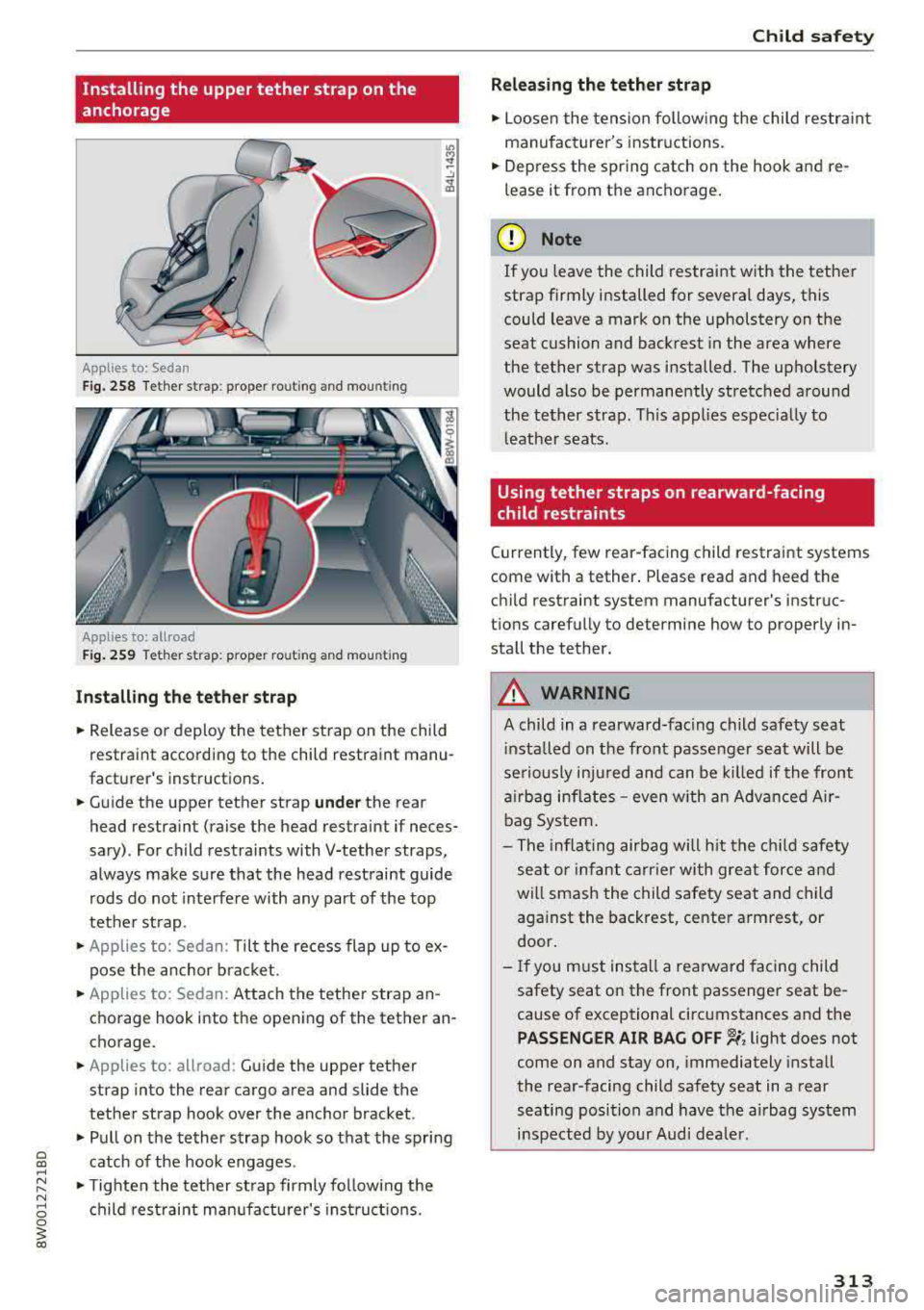
Installing the tether strap
• Release or deploy the tether strap on the child
restraint according to the child restraint manu
facturer's instructions .
• Guide the upper tether strap under the rear
head restraint (raise the head restraint if neces
sa ry) . For child restraints with V-tether straps,
always make sure that the head restraint guide
rods do not interfere with any part of the top
tether strap.
• Applies to: Sedan: Tilt the recess flap up to ex
pose the anchor bracket.
• Applies to: Sedan : Attach the tether strap an
chorage hook into the opening of the tether an
chorage.
• Applies to: allroad: Guide the upper tether
strap into the rear cargo area and slide the
tether strap hook over the anchor bracket .
•Pullon the tether strap hook so that the spring
catch of the hook engages .
• Tighten the tether strap firmly fo llow ing the
child restraint manufacturer's inst ruct ions.
Child safety
Releasing the tether strap
• Loosen the tension following the child restra int
manufacturer's instructions.
• Depress the spring catch on the hook and re
lease it from the anchorage.
(D Note
If you leave the child restraint with the tether
strap firmly installed for several days, this
could leave a mark on the upholstery on the
seat cushion and backrest in the area where
the tether strap was installed . The upholstery
would also be permanently stretched around
the tether strap . T hi s applies espec ially to
le ather seats.
Using tether straps on rearward-facing
child restraints
Currently, few rear-facing child restraint systems
come with a tether. Please read and heed the
child restraint system manufacturer's instruc
tions carefully to determine how to properly in
stall the tether.
_&. WARNING ~
A child in a rearward-facing child safety seat in sta lled on the front passenger seat will be
se riously inju red and can be killed if the front
airbag inflates -even w ith an Advanced Air
bag System.
- The inflating airbag will h it the child safety
seat or infa nt carrier with great force and
will smash the child safety seat and child against the backrest, cente r armrest, or
door.
- If you must install a rearward facing child
safety seat on the front passenger seat be
cause of exceptional circumstances and the
PASSENGER AIR BAG OFF "1; light does not
come on and stay on, immediately install
the rear-facing child safety seat in a rear
seating position and have the a irbag system
i n spected by your Audi dealer.
313
Page 323 of 403
Check ing and F illing
"' Position the bottle on the filler tube and turn
the bottle clockwise unti l it stops turning.
"' Press lightly aga inst the bottom of the bott le
to empty it. Continue pressing the bottom of
the bottle until it is empty or unti l fluid stops
flowing into the tank .
"' Remove the bottle and seal the filler neck
¢ page 322, Completing AdBlue refill .
0 Note
Only use refill bottles that are approved for
your vehicle. Us ing other systems can ca use
Ad Blue to leak.
-You can obta in refill bottles from an author
i zed Audi dealer or authorized A udi Service
F ac ility.
- A pe rm itted refill bottle conta ins approxi
mately 0 .5 gallon ( 1.9 liters) of Ad Blue.
Completing AdBlue refill
Applies to: vehicles with selective catalytic reduction
Closing the filler neck
"'Turn the Ad Blue cap to the r ight on the filler
tube unti l th e cap cl ic k s into
p lace ¢.&. in
Prepara tion on page 320,
¢ (Din Preparation
on page 320 ..
"' Then press on the left side of the tank door un-
ti l it latches.
After filling
The vehicle must be driven so tha t the system
recognizes t hat the Ad B lue was refilled. This can
t ake severa l m in utes.
"' If there was no Ad Blue left in the tank and a
r ange of O mi (0 km) was shown in the d isplay,
swi tch the ign ition on fo r abo ut 30 seconds be
f ore star ting the engine .
(D Tips
Ad Blue in the tank can free ze at very low tem
pera tures. If this happens, the system will
not detect that the AdB lue was refilled and it
w ill contin ue to inform you of the low AdBlue
322
leve l. The message tu rns off as soon as the
tank thaws out again .
Emissions control
systems
Cat alytic converter
Applies to: vehicles with gasoline engines
T he vehicle may only be driven w ith un leaded
gaso line, otherwise the catalytic converter will be
destroyed .
Never drive unti l the tan k is comp lete ly empty .
T he irregu lar supply of fuel that resu lts from that
can cause eng ine misfires. Uncombusted fuel will
enter the exhaust system , which can cause over
heating and damage to the catalytic converte r.
Di esel particulate filt er
Applies to: vehicles with diesel engines
The diese l particulate filter filters nearly all of
the soot part icles out of the exhaust. The filter
cleans itself automat ica lly under norma l dr iv ing
cond it io ns. If the filter cannot clean itself (for ex
amp le, because yo u are on ly driving short distan
ces), the filter becomes clogged with soot and
the
1111 i ndicato r light for the diese l particulate
filte r tu rns
on ¢ page 33.
_&. WARNING
The tempera ture o f the e xhaust sys tem is
h igh, both when driving and a fter stopping
the engine.
-
-Never tou ch the e xhaus t tail p ipes o nce they
have become hot. This cou ld resu lt in burns.
-D o not p ark your vehicle over flamm able
materials such as grass or leaves because
the hig h temperature of the emissions con
trol system (catalyt ic converter or d iese l
pa rticu late filter) co uld start a fire.
- Do not apply underbody protectant in the
exhaust system area, beca use this increases
the risk of f ire.
Page 325 of 403
Checking and Filling
_& WARNING
California Proposition 65 Warning:
- Engine exhaust, some of its constituents ,
and certain vehicle components contain or emit chemicals known to the State of Cali
fornia to cause cancer and birth defects and reproductive harm. In addition, certain flu
ids contained in vehicles and certain prod
ucts of component wear contain or emit
chemicals known to the State of California
to cause cancer and birth defects or other reproductive harm.
- Battery posts, terminals and related acces
sories contain lead and lead compounds, chemicals known to the State of California
to cause cancer and reproductive harms.
Wash hands after handling.
(D Note
When filling fluids, be sure not to mix the flu ids up . Otherwise severe malfunctions and
en
gine damage will occur.
@ For the sake of the environment
You should regularly check the ground under
your vehicle in order to detect leaks quickly . If
there are visible spots from oil or other fluids,
bring your vehicle to an authorized Audi deal
er or authorized Audi Service Facility to be
checked.
Opening and closing the hood
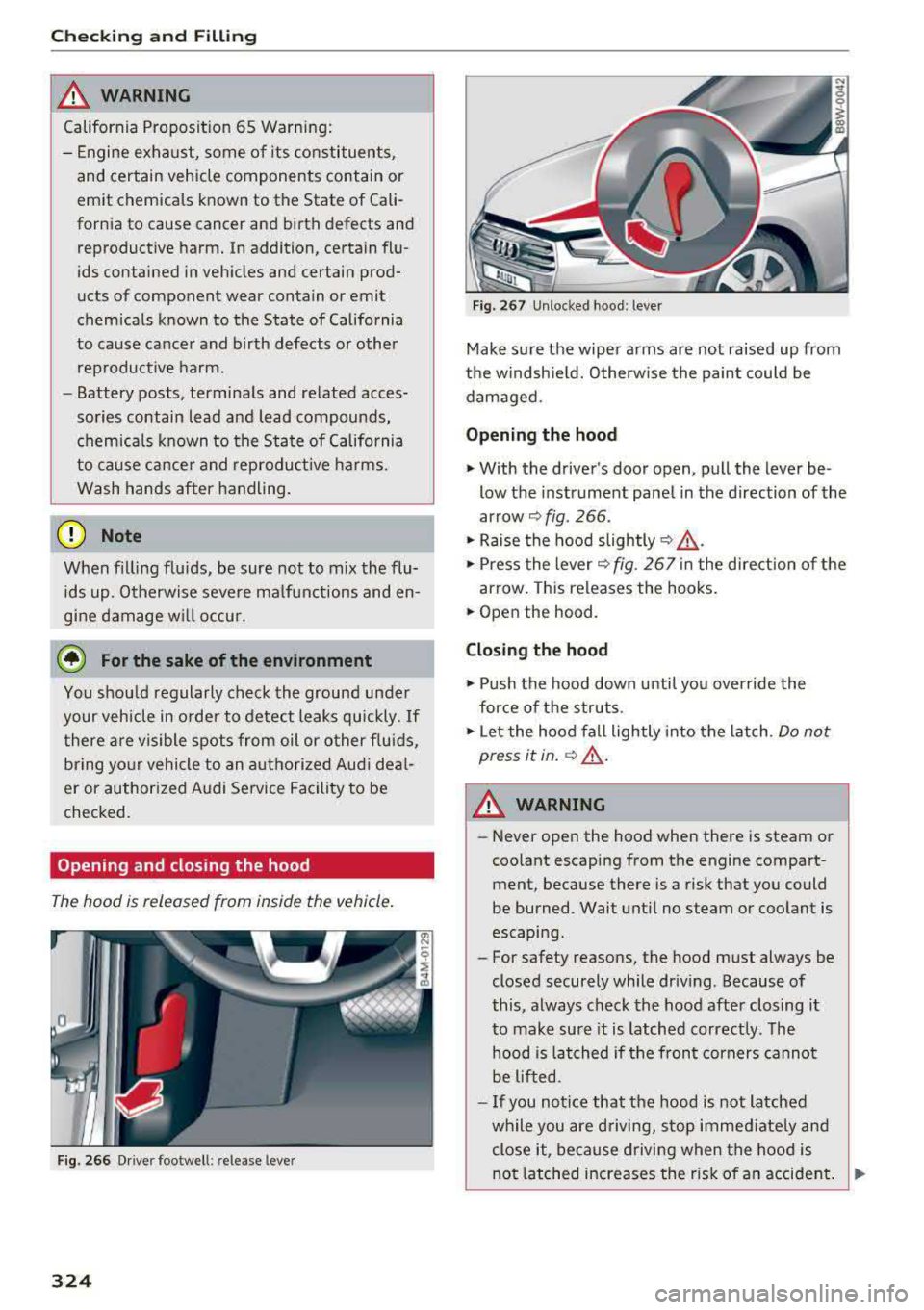
The hood is released from ins ide the vehicle.
Fig. 266 Drive r footwell : rele ase le v er
324
Fig. 267 Unlocked hood: lev er
Make sure the wiper arms are not raised up from
the windshield. Otherwise the paint could be
damaged .
Opening the hood
"'With the driver's door open, pull the lever be
low the instrument panel in the direction of the
arrow
9 fig . 266 .
"' Raise the hood slightly 9 ,&.
"'Press the lever ~ fig. 267 in the direction of the
arrow. This releases the hooks.
"' Open the hood.
Closing the hood
"' Push the hood down until you override the
force of the struts .
"'Let the hood fall lightly into the latch . Do not
press it in.
9 ,& .
_& WARNING
-Never open the hood when there is steam or
coolant escaping from the engine compart
ment, because there is a risk that you could
be burned. Wai t until no steam or coolan t is
escaping.
- For safety reasons, the hood must always be
closed securely while driving . Because of
this, always check the hood after closing it
to make sure it is latched correctly . The
hood is latched if the front corners cannot
be lifted .
- If you notice that the hood is not latched
while you are driving, stop immediately and
close it, because driving when the hood is
not latched increases the risk of an accident.
,...
Page 327 of 403
Check ing and F illing
I f you must add oi l between oi l changes, use an
oil that matches the Audi oi l quality standard
listed on the st icker. The sticker is located at the
front of the engine
compartment <=> page 325,
fig. 268.
Au di r ec omm end s
ocastrol i/g/g'fE:@t P'r(w.:::-..~J.D,'JAJ..
A udi r ecommends Longli fe high performa nce
e ngin e oil from Audi G enuin e Part s
Using the proper engine oil is important for the
functionality and service life of the eng ine. Your
engine was factory-filled with a h igh-quality oil
which can usually be used throughout the entire
yea r.
0 Note
Your Limited New Vehicle Warranty does not
cover damage o r malfunctions due to failure
to follow recommended maintenance and use
requirements as set fo rth in the Aud i Owner's
Man ual and Warranty
& Maintenance booklet.
- Use only a high qual ity eng ine oi l th at ex-
p ressly complies with the Audi oil q uality
standard specified for your vehicle's engine .
Using any other oil can cause se rious engine
damage .
- Do not mix any lubricants or other additives into the engine oil. Doing so can cause en
gine damage.
(D Tips
If you need to add oil and there is none availa
ble that meets the Audi oi l quality standard
your engine requi res, you may add a total of
no more than 0.5 qt (0.5 l) of a h igh-quality
"synthet ic" o il that meets the following speci
fications.
- Vehicles with gasoline eng ine: ACEA A3 or
API SM with a viscosity grade of SAE OW-30,
SAE 5W-30 or SAE 5W-40.
- Vehicles w ith diesel eng ine: ACEA C3 or
API CF with a v iscosity grade of SAE OW-30
or SAE 5W-30 .
- For more information about engine oi l that
has been approved for your vehicle, please
contact eithe r your authorized Aud i dealer
or Audi Custome r Relat ions at
326
1 (800) 822-2834 or visit our web site at
www.audi usa .com or www .audicanada .ca.
Engine oil consumption
The engine in your vehicle depends on an ade
quate amount of oil to lubricate and cool all of
its moving ports.
In order to prov ide effect ive lub ricat ion and cool
ing of internal engine components, all internal
combustion engines consume a certain amount
of oil. Oil consumption var ies from engine to en
gine and may change significantly over the life of
the engine. Typically, engines w ith a specified
break-in period
(see<=> page 80) consume more
o il dur ing the break-in per iod than they consume
after o il consumption has stabi lized .
U nder normal cond itions, the rate of oil con
sumption depends on the quality and viscos ity of
the oil, the RPM (revolutions per m inute) at
wh ich the engine is operated, the amb ient tem
perature and road condit ions. Furthe r facto rs a re
t h e amo unt of o il di lution from wate r condensa
t ion or fue l residue a nd the oxidat ion level of the
oi l. As any engine is subject to wear as mileage
builds up, the oi l consumption may increase ove r
ti me until replacement of worn components may
become necessary.
With a ll these variab les coming into p lay, no
standard rate of oil cons umption can be estab
li shed or specified . There is no alternative to reg
ular and frequent checking of the oil level, see
Note .
If the yellow engine oil leve l warning symbo l El
in the instrument cluster lights up, you should
check the o il level as soon as possible
<=> page 32 7. Top off the o il at your earliest con
venience
<=> page 32 7.
A WARNING
Before you check anyth ing in the e ngine com
partment, always read and heed all WARN
I NGS<=> .&. in Working in the engine compart-
ment on page 323.
1iJ>,