lock AUDI A4 2020 Owner's Guide
[x] Cancel search | Manufacturer: AUDI, Model Year: 2020, Model line: A4, Model: AUDI A4 2020Pages: 296, PDF Size: 80.45 MB
Page 79 of 296
8W1012721BB
Sitting correctly and safely
The top tether anchors in the vehicle are only
designed for child safety seats equipped with
an upper strap. To reduce the risk of serious or
fatal injury, never secure other child restraint
systems, belts, or objects to the anchors.
fatal injury. Always secure unused safety belts
so that they are not within reach of children in
child safety seats.
RONG Ot
NG = GSS
=
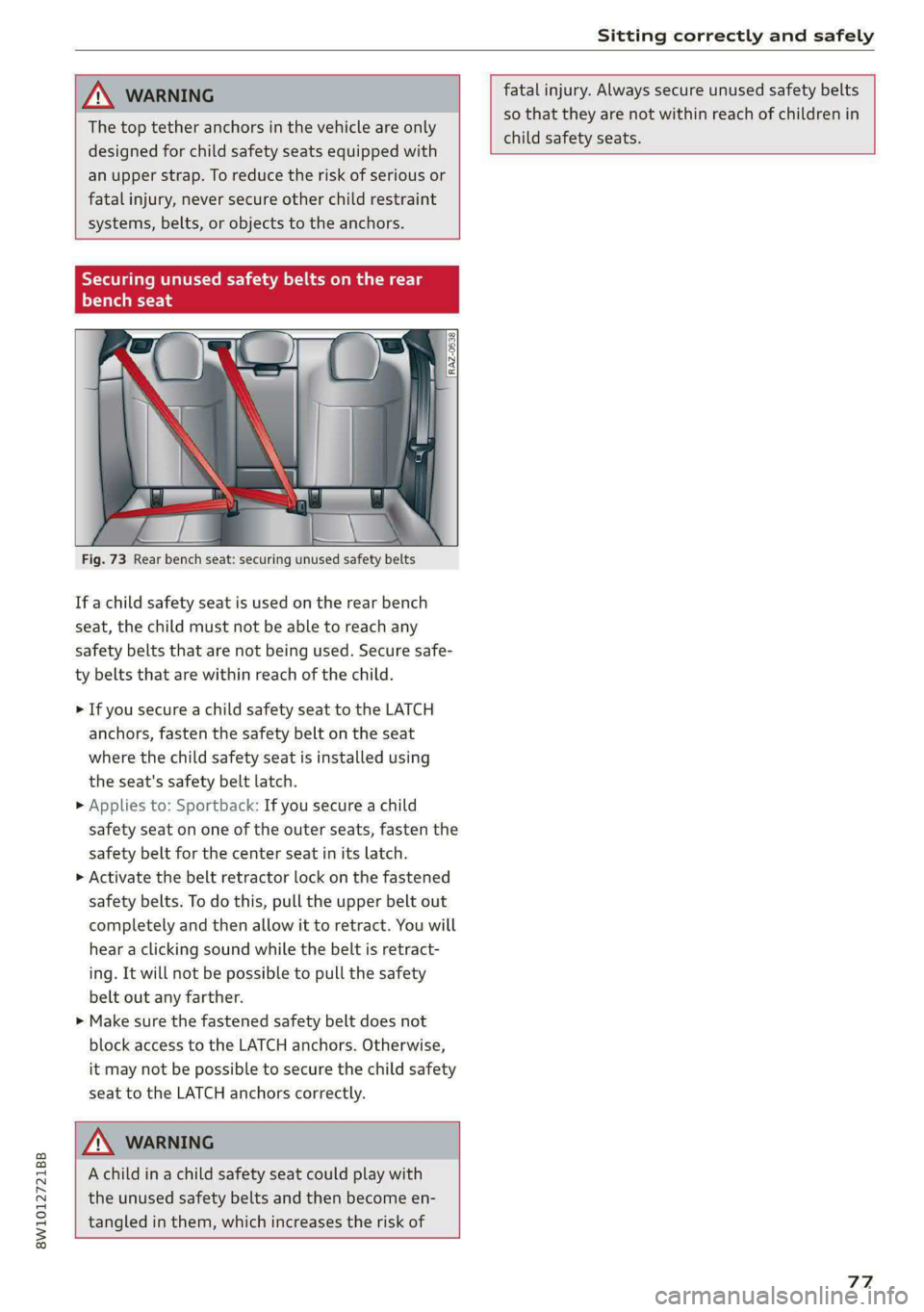
Fig. 73 Rear bench seat: securing unused safety belts
If a child safety seat is used on the rear bench
seat, the child must not be able to reach any
safety belts that are not being used. Secure safe-
ty belts that are within reach of the child.
> If you secure a child safety seat to the LATCH
anchors, fasten the safety belt on the seat
where the child safety seat is installed using
the seat's safety belt latch.
> Applies to: Sportback: If you secure a child
safety seat on one of the outer seats, fasten the
safety belt for the center seat in its latch.
> Activate the belt retractor lock on the fastened
safety belts. To do this, pull the upper belt out
completely and then allow it to retract. You will
hear a clicking sound while the belt is retract-
ing. It will not be possible to pull the safety
belt out any farther.
> Make sure the fastened safety belt does not
block access to the LATCH anchors. Otherwise,
it may not be possible to secure the child safety
seat to the LATCH anchors correctly.
A child in a child safety seat could play with
the unused safety belts and then become en-
tangled in them, which increases the risk of
77
Page 81 of 296

8W1012721BB
Stowing and using
— Glove compartment: the glove compartment
can be locked using the mechanical key
=> page 34.
— Storage compartments in the door trim panels
— Storage compartment in the center console
— Storage compartment under the front center
armrest
— Storage compartment in the rear center arm-
rest
— Storage compartment under the light switch
— Garment hooks above the rear doors
— Nets on the backrests of the front seats
— Storage compartments behind the rear head re-
straints: the storage compartments can be
used to store lightweight pieces of clothing.
— Nets on the left/right luggage compartment
trim panel
— Tie-downs on the left/right luggage compart-
ment trim panel
— Bag hooks in the luggage compartment
Z\ WARNING
—To reduce the risk of injury, make sure all
storage compartments are always closed
while driving.
— Loose objects can be thrown around the ve-
hicle interior during sudden driving or brak-
ing maneuvers, which increases the risk of
an accident. Store objects securely while
driving.
— Only use the storage compartments in the
door trim panels to store small objects that
will not stick out of the compartment and
impair the function of the side airbags.
— Due to strength reasons, only secure objects
up to 11 lbs (5 kg) with the tie-downs*.
Heavier objects are not adequately secured.
There is risk of personal injury.
— Applies to: vehicles with garment hooks: On-
ly lightweight clothing should be hung from
the garment hooks in the vehicle. Do not use
clothes hangers to hang clothing. The pock-
ets of the clothing must not contain any
heavy, breakable, or sharp-edged objects.
This could impair the effectiveness of the
side curtain airbags.
— Make sure your view toward the rear is not
blocked, for example by hanging clothing or
objects in the vehicle.
— Applies to: vehicles with storage areas be-
hind the rear head restraints: Do not store
any
heavy or hard objects or use to transport
animals. Such objects endanger vehicle oc-
cupants and increase the risk of injury dur-
ing sudden driving or braking maneuvers or
in an accident.
@) Note
Applies to: vehicles with storage areas behind
the rear head restraints: Make sure the heat-
ing grid strips for the rear window defogger
are not damaged by abrasive objects.
@) Tips
Applies to: vehicles with storage areas behind
the rear head restraints: To ensure the venti-
lation functions correctly, the ventilation slots
between the rear window and the storage
area must not be covered.
Luggage compartment
General information
All pieces of luggage or objects must be securely
fastened in the luggage compartment. Note the
following to maintain good vehicle handling:
> Distribute the load evenly in the luggage com-
partment.
> Stow heavy luggage as far forward in the lug-
gage compartment as possible.
> Use non-elastic cords attached to the tie-downs
to secure objects.
ZA\ WARNING
— Applies to: vehicles with luggage compart-
ment cover: The luggage compartment cov-
er is not a surface for storing objects. Ob-
jects placed on the cover increase the risk of
injury to all vehicle occupants during sudden
driving or braking maneuvers or in the event
of an accident. >
79
Page 82 of 296

Stowing and using
— Applies to: vehicles with luggage compart-
ment cover: The luggage compartment cov-
er must always be securely fastened when in
use to reduce the risk of an accident.
— Loose objects can be thrown around the ve-
hicle interior during sudden driving or brak-
ing maneuvers, which increases the risk of
an accident. Always stow objects securely in
the luggage compartment and secure them
at the tie-downs. Use straps suitable for
heavy objects.
— If pieces of luggage or objects are secured
to the tie-downs with unsuitable or dam-
aged straps, this can increase the risk of in-
jury during braking maneuvers or accidents.
— When transporting heavy objects, the vehi-
cle characteristics will change due to the
shift in the center of gravity, which increases
the risk of an accident. You may need to
adapt your driving style and speed to the
current conditions.
— The cargo net is only strong enough to se-
cure light objects. Heavy objects are not ade-
quately secured. Attempting to secure heavy
objects increases the risk of injury.
— Never exceed the permitted axle and load
and vehicle weight > page 278.
— Never secure a child safety seat to the tie-
downs.
— Never leave your vehicle unattended, espe-
cially if the luggage compartment lid is
open. Children could enter the luggage com-
partment and close the luggage compart-
ment lid from the inside. This creates the
risk of fatal injury, since the children would
be locked in and may not be able to escape
by themselves.
— Do not allow children to play in or on the ve-
hicle. Close and lock the luggage compart-
ment lid as well as all other doors when you
leave
the vehicle.
— Never transport passengers in the luggage
compartment. Every passenger must be cor-
rectly secured with the safety belts in the
vehicle > page 64.
— Be careful when releasing the backrest and
folding
it forward. To reduce the risk of be-
ing pinched, pay attention and check when
folding backrests forward.
— The backrest must be securely latched so
objects cannot slide forward out of the lug-
gage compartment during sudden braking.
— The backrest must be latched securely to en-
sure that the safety belt is protecting the
center seating position.
— Always pull forward on the backrest to make
sure it is check if it is correctly locked in
place.
80
() Note
—To reduce the risk of damage, move the rear
head restraints down before folding the rear
backrests forward > page 63.
— When folding the backrest forward, make
sure the outer safety belts are in the belt
guide recess so that they do not get pinched
in the backrest lock and damaged. Other ob-
jects should be removed from the rear
bench seat to protect the backrest from
damage.
— To reduce the risk of damaging the front
seats, make sure there is enough space be-
tween the front seat and the rear seat
equipment when folding the center backrest
forward.
— If you move the front seat back when the
rear seat backrest is folded forward, you
could damage the head restraints on the
rear seat.
— Make sure that the heating grid strips for
the rear window defogger are not damaged
by abrasive objects.
— Applies to: vehicles with manual luggage
compartment cover: Let the luggage com-
partment cover roll up slowly to reduce the
risk of damage.
— Applies to: vehicles with partition net: Let
the partition net roll up slowly to reduce the
risk of damage.
(i) Tips
— The tire pressure must be adapted to the
load > page 237.
— You can purchase straps at specialty stores.
Page 83 of 296
8W1012721BB
Stowing and using
Power luggage compartment cover
Applies to: vehicles with power luggage compartment cover
Manual luggage compartment cover
Applies to: vehicles with manual luggage compartment cover
oO R 2 &
9 + a
Fig. 77 Luggage compartment: cover attached
B4L-1256
AB
Fig. 76 Luggage compartment: removing and installing Fig. 78 Luggage compartment: removing and installing
the luggage compartment cover the luggage compartment cover
Follow the safety precautions > page 79. Follow the safety precautions > page 79.
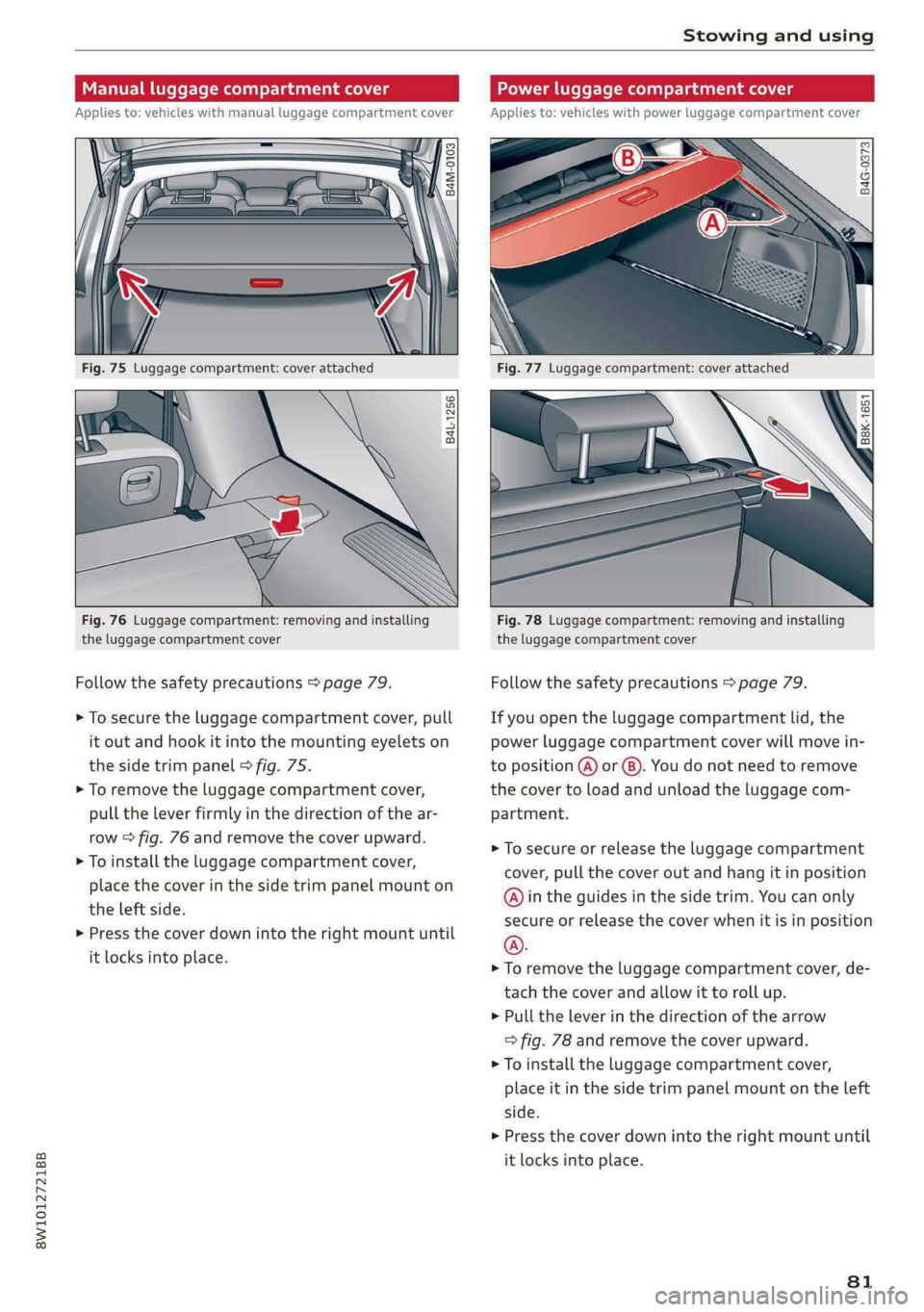
> To secure the luggage compartment cover, pull If you open the luggage compartment lid, the
it out and hook it into the mounting eyelets on power luggage compartment cover will move in-
the side trim panel > fig. 75. to position @) or (8). You do not need to remove
> To remove the luggage compartment cover, the cover to load and unload the luggage com-
pull the lever firmly in the direction of the ar- partment.
row > fig. 76 and remove the cover upward.
. > To secure or release the luggage compartment
> To install the luggage compartment cover,
lace th in the side tri [ « cover, pull the cover out and hang it in position
PABee EUS COVSE IN ME ee SINR ENS: MOA Ne On @ in the guides in the side trim. You can only
theileft.side: . . . secure or release the cover when it is in position
> Press the cover down into the right mount until ®
felocksiinto place: > To remove the luggage compartment cover, de-
tach the cover and allow it to roll up.
> Pull the lever in the direction of the arrow
=> fig. 78 and remove the cover upward.
> To install the luggage compartment cover,
place it in the side trim panel mount on the left
side.
> Press the cover down into the right mount until
it locks into place.
81
Page 84 of 296

Stowing and using
easing the size of the vehicle inter
Applies to: vehicles with folding backrests
oO aD R % ©
oO
Fig. 80 Center backrest: folding the center backrest for-
ward
The rear seat backrests can be folded forward ei-
ther separately* or together.
Follow
the safety precautions > page 79.
Folding the outer rear backrests forward and
backward
> Pull the release lever (@) in the direction of the
arrow and fold the backrest forward. Let the
backrest latch into the lowest position.
> Fold the backrest back up again until it locks in-
to place and the red marking (@) is no longer
visible.
Folding the center rear backrest forward and
backward
> Pull on the upper release lever @) and fold the
backrest forward (@).
>» Fold the backrest backward until it locks into
place.
Applies to: vehicles with lockable backrests in the rear and a
lockable pass-through.
To prevent access to the luggage compartment
from the vehicle interior, the backrest can be
82
locked with the mechanical key © when it is
latched in place and the pass-through can be
locked > page 84. You can only enlarge the lug-
gage compartment if the backrest is not locked.
reasing the size of the hs Is)
compartme
Applies to: vehicles with release lever in the luggage compart-
ment
| BEW-0268
Fig. 81 Luggage compartment: release lever
The rear seat backrests can be folded forward ei-
ther separately* or together.
Follow
the safety precautions > page 79.
> Pull the release lever > fig. 81 in the direction
of the arrow to fold the backrest forward.
> To set up the backrest again, fold it back until it
locks or the red marking (8) = page 82, fig. 79
is no longer visible.
Page 85 of 296
8W1012721BB
Stowing and using
Partition net (upright backrest position)
Applies to: vehicles with partition net
B8W-0121
‘ 2
Fig. 82 Behind the backrest: hanging the partition net
B8W-0122
Fig. 83 Behind the backrest: removing the partition net
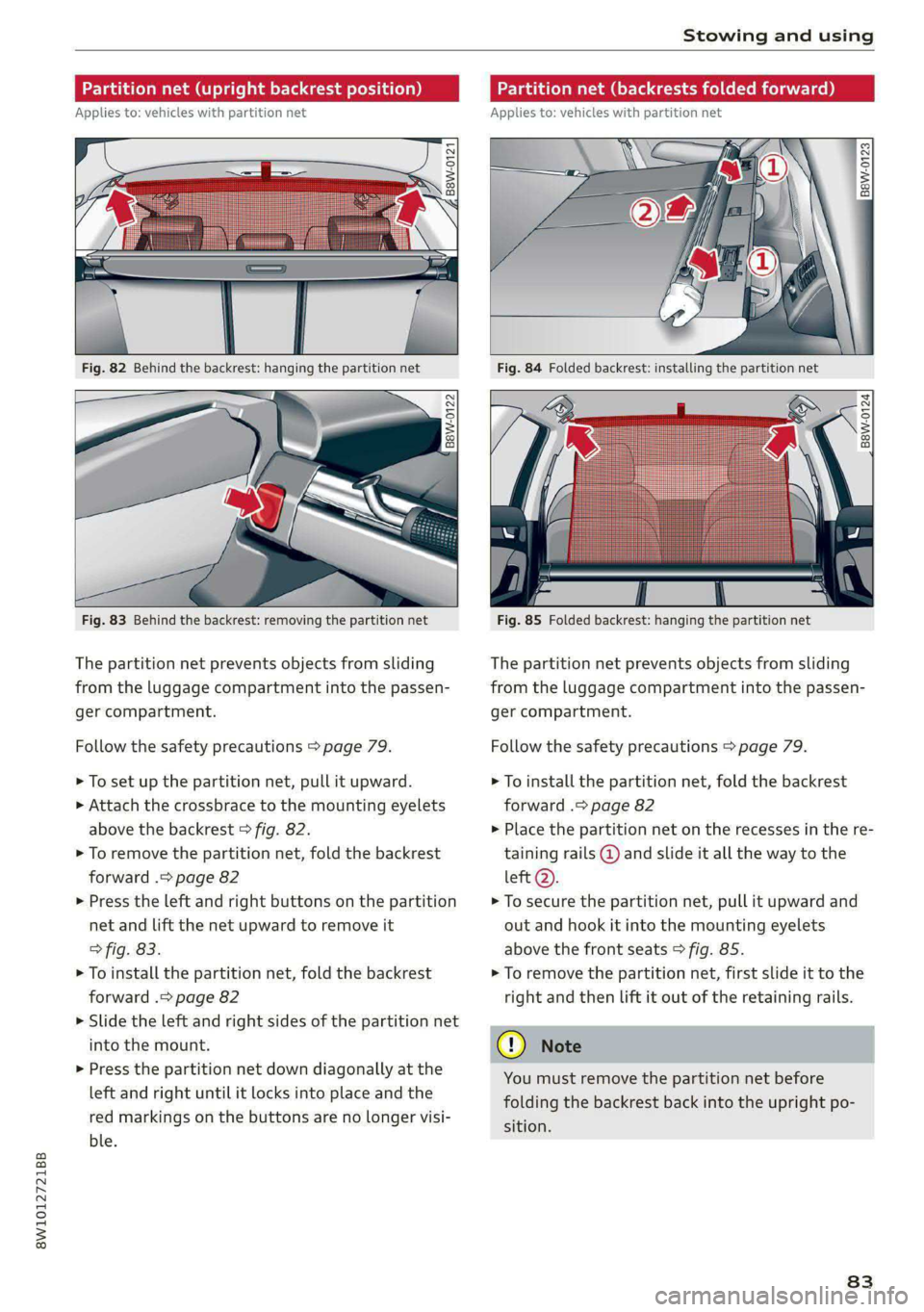
The partition net prevents objects from sliding
from the luggage compartment into the passen-
ger compartment.
Follow the safety precautions > page 79.
> To set up the partition net, pull it upward.
> Attach the crossbrace to the mounting eyelets
above the backrest > fig. 82.
> To remove the partition net, fold the backrest
forward .> page 82
> Press the left and right buttons on the partition
net and lift the net upward to remove it
> fig. 83.
> To install the partition net, fold the backrest
forward .> page 82
> Slide the left and right sides of the partition net
into the mount.
> Press the partition net down diagonally at the
left and right until it locks into place and the
red markings on the buttons are no longer visi-
ble.
Partition net (backrests folded forward)
Applies to: vehicles with partition net
B8W-0123
Fig. 84 Folded backrest: installing the partition net
. %
B8W-0124
Fig. 85 Folded backrest: hanging the partition net
The partition net prevents objects from sliding
from the luggage compartment into the passen-
ger compartment.
Follow the safety precautions > page 79.
> To install the partition net, fold the backrest
forward .> page 82
> Place the partition net on the recesses in the re-
taining rails @ and slide it all the way to the
left Q).
> To secure the partition net, pull it upward and
out and hook it into the mounting eyelets
above the front seats > fig. 85.
> To remove the partition net, first slide it to the
right and then lift it out of the retaining rails.
You must remove the partition net before
folding the backrest back into the upright po-
sition.
83
Page 86 of 296
Stowing and using
ie-downs and luggage compartment net
Fig. 86 Luggage compartment: movable tie-downs
mere NNN
Fig. 87 Luggage compartment: cargo net stretched out
Follow the safety precautions > page 79.
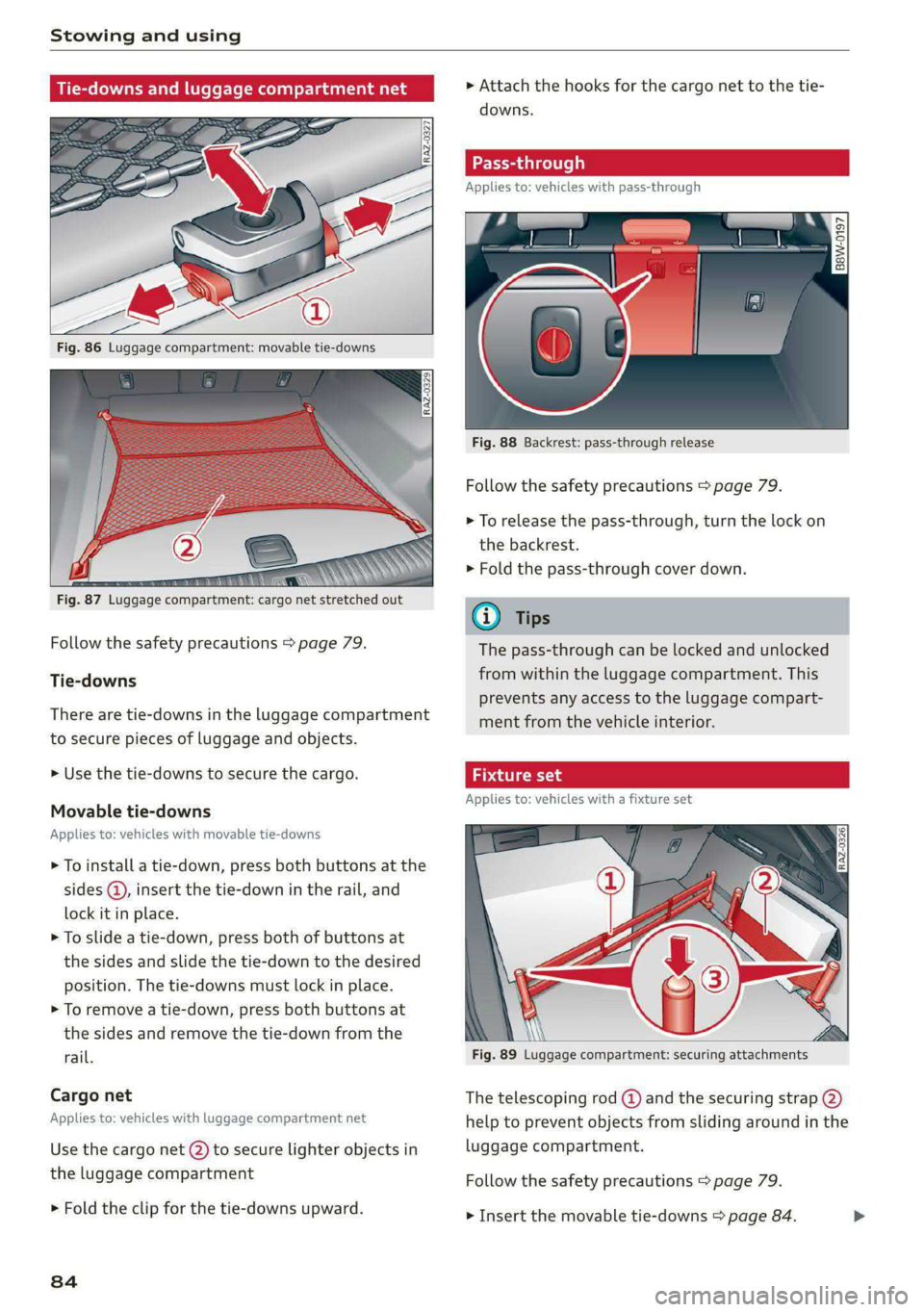
Tie-downs
There are tie-downs in the luggage compartment
to secure pieces of luggage and objects.
> Use the tie-downs to secure the cargo.
Movable tie-downs
Applies to: vehicles with movable tie-downs
> To install a tie-down, press both buttons at the
sides ® insert the tie-down in the rail, and
lock it in place.
> To slide a tie-down, press both of buttons at
the sides and slide the tie-down to the desired
position. The tie-downs must lock in place.
> To remove a tie-down, press both buttons at
the sides and remove the tie-down from the
rail.
Cargo net
Applies to: vehicles with luggage compartment net
Use the cargo net (2) to secure lighter objects in
the luggage compartment
> Fold the clip for the tie-downs upward.
84
» Attach the hooks for the cargo net to the tie-
downs.
Pas: rough
Applies to: vehicles with pass-through
B8W-0197
Fig. 88 Backrest: pass-through release
Follow the safety precautions > page 79.
> To release the pass-through, turn the lock on
the backrest.
> Fold the pass-through cover down.
7 ) Tips
The pass-through can be locked and unlocked
from within the luggage compartment. This
prevents any access to the luggage compart-
ment from the vehicle interior.
att IT 9
Applies to: vehicles with a fixture set
Fig. 89 Luggage compartment: securing attachments
The telescoping rod @) and the securing strap (2)
help to prevent objects from sliding around in the
luggage compartment.
Follow the safety precautions > page 79.
> Insert the movable tie-downs > page 84.
Page 87 of 296

8W1012721BB
Stowing and using
> Press the button (8) on the retainers and place
them on the tie-downs. Make sure the brackets
are locked into place.
> Slide the tie-downs into the desired position.
> Press the button to tighten the securing strap.
@ Tips
Store the movable tie-downs and the fixture
set in the openings under the front cargo
floor, if necessary.
2 q 3 5
s a
co
Fig. 90 Luggage compartment: cargo mat spread out
lengthwise
Fig. 91 Luggage compartment: (@) crosswise cargo mat /
@ lengthwise cargo mat
The cargo mat protects the luggage compart-
ment and bumper from dirt and scratches. You
can use both sides of the cargo mat.
Follow the safety precautions > page 79.
> To protect the luggage compartment and
bumper when loading and unloading objects,
lay the cargo mat out lengthwise with the
backrests folded down or upright > fig. 90.
> After loading or unloading, fold up the cargo
mat and close the luggage compartment lid.
> To also protect the side trim panels, lay the car-
go mat out widthwise.
> To divide the loading surfaces into separate sec-
tions > fig. 91, fold the cargo mat.
> Only store the cargo mat if it is dry.
You can save room by storing the cargo mat at
the sides of the luggage compartment.
q 8
&
= @ a
Fig. 92 Luggage compartment: cargo area floor
BEW-0128
(a
Fig. 93 Luggage compartment: cargo area floor reversed
You can transport dirty and damp objects in the
reversible cargo area floor.
8s
>
Page 90 of 296
Warm and cold
3-zone deluxe automatic climate control
Applies to: vehicles with 3-zone deluxe automatic climate control system
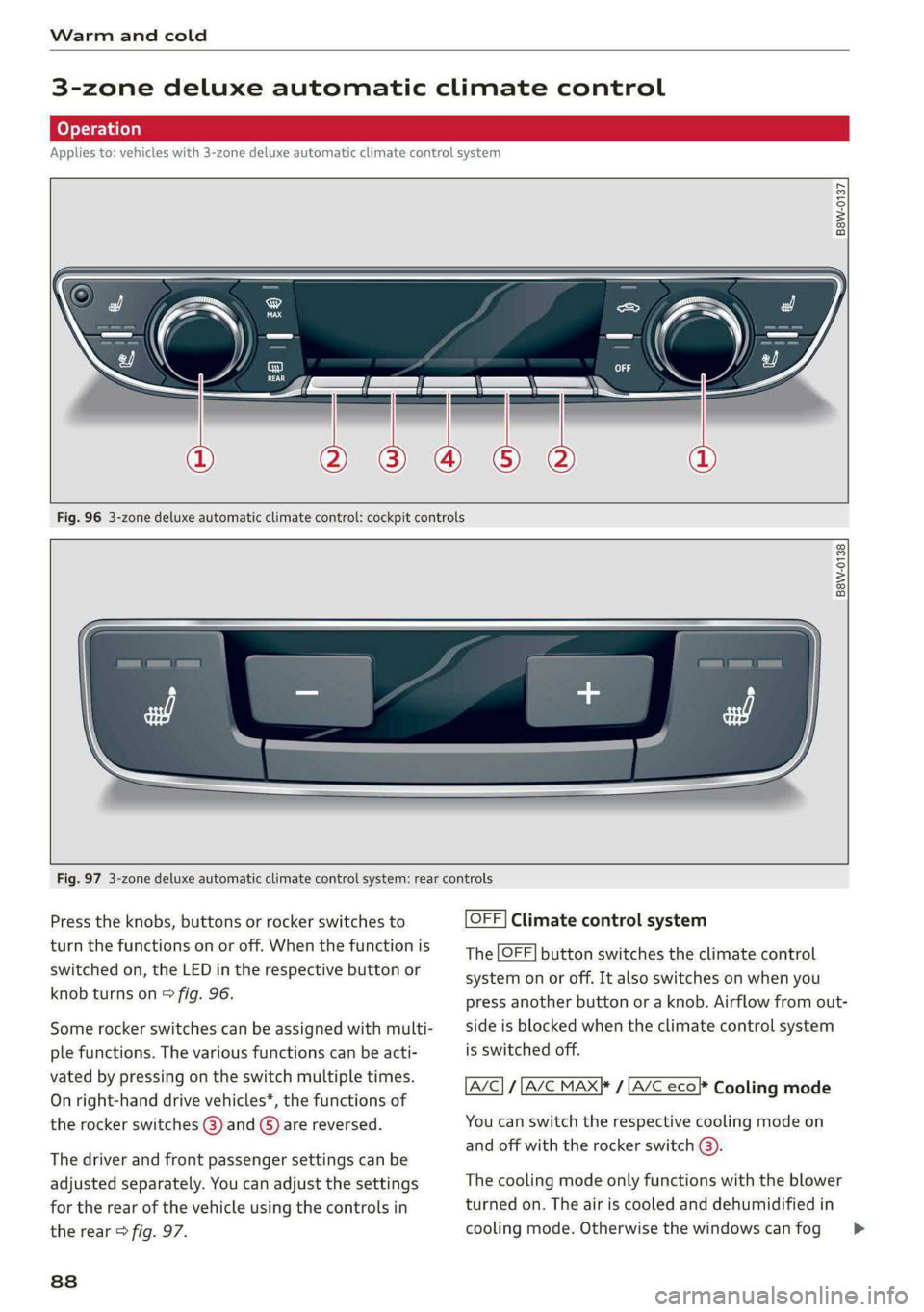
B8W-0137
Fig. 96 3-zone deluxe automatic climate control: cockpit controls
B8W-0138
Fig. 97 3-zone deluxe automatic climate control system: rear controls
Press the knobs, buttons or rocker switches to
turn the functions on or off. When the function is
switched on, the LED in the respective button or
knob turns on > fig. 96.
Some rocker switches can be assigned with multi-
ple functions. The various functions can be acti-
vated by pressing on the switch multiple times.
On right-hand drive vehicles*, the functions of
the rocker switches @) and ©) are reversed.
The driver and front passenger settings can be
adjusted separately. You can adjust the settings
for the rear of the vehicle using the controls in
the rear > fig. 97.
838
OFF] Climate control system
The OFF] button switches the climate control
system on or off. It also switches on when you
press another button or a knob. Airflow from out-
side is blocked when the climate control system
is switched off.
A/C} / [A/C MAX|* / [A/C eco}* Cooling mode
You can switch the respective cooling mode on
and off with the rocker switch @).
The cooling mode only functions with the blower
turned on. The air is cooled and dehumidified in
cooling mode. Otherwise the windows can fog >
Page 94 of 296
Driving
Driving
Starting the vehicle
eta
Applies to: vehicles with convenience key
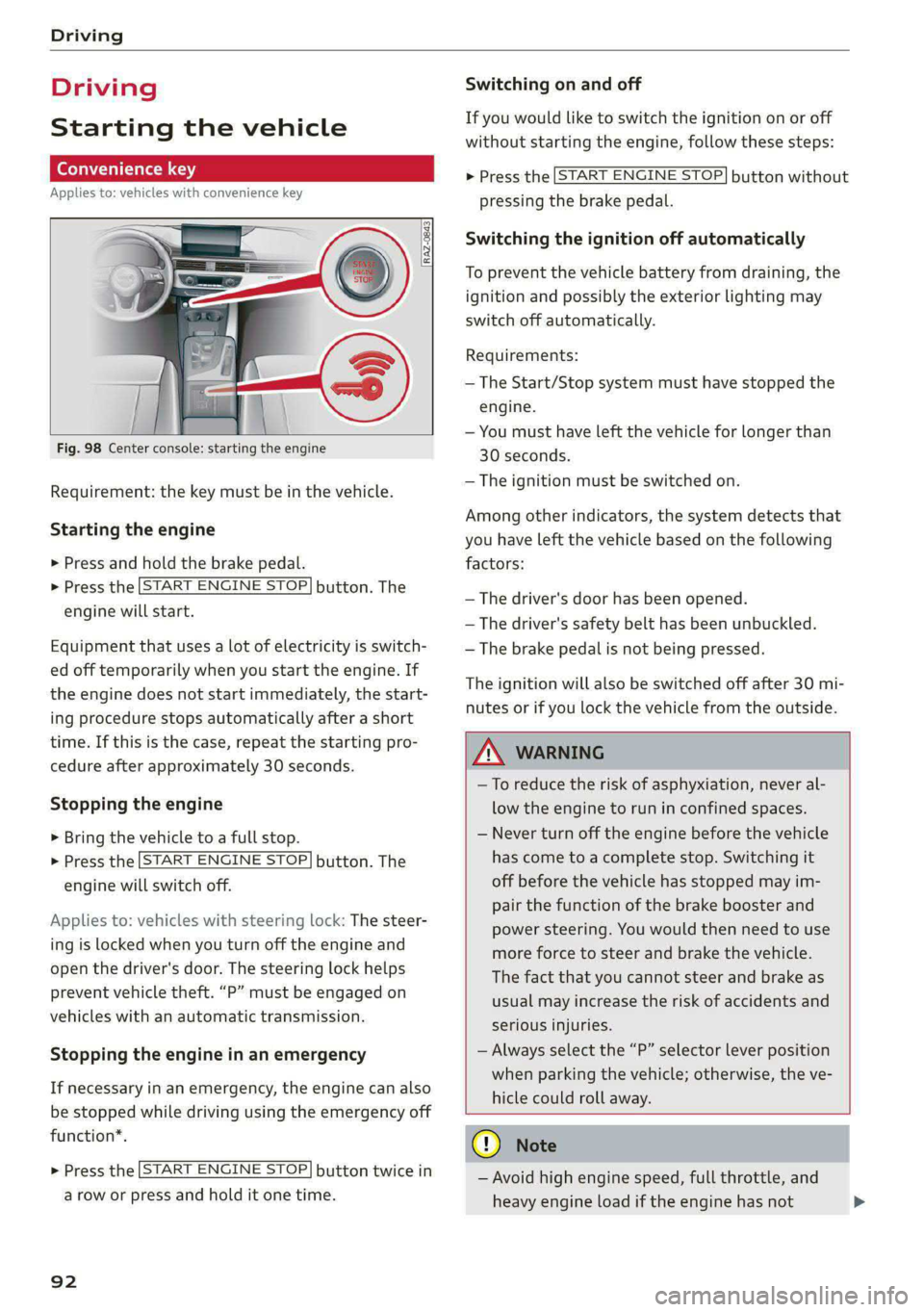
Fig. 98 Center console: starting the engine
Requirement: the key must be in the vehicle.
Starting the engine
> Press and hold the brake pedal.
> Press the [START ENGINE STOP] button. The
engine will start.
Equipment that uses a lot of electricity is switch-
ed off temporarily when you start the engine. If
the engine does not start immediately, the start-
ing procedure stops automatically after a short
time. If this is the case, repeat the starting pro-
cedure after approximately 30 seconds.
Stopping the engine
> Bring the vehicle to a full stop.
> Press the [START ENGINE STOP] button. The
engine will switch off.
Applies to: vehicles with steering lock: The steer-
ing is locked when you turn off the engine and
open the driver's door. The steering lock helps
prevent vehicle theft. “P” must be engaged on
vehicles with an automatic transmission.
Stopping the engine in an emergency
If necessary in an emergency, the engine can also
be stopped while driving using the emergency off
function*.
> Press the [START ENGINE STOP] button twice in
a row or press and hold it one time.
92
Switching on and off
If you would like to switch the ignition on or off
without starting the engine, follow these steps:
> Press the [START ENGINE STOP] button without
pressing the brake pedal.
Switching the ignition off automatically
To prevent the vehicle battery from draining, the
ignition and possibly the exterior lighting may
switch off automatically.
Requirements:
— The Start/Stop system must have stopped the
engine.
— You must have left the vehicle for longer than
30 seconds.
— The ignition must be switched on.
Among other indicators, the system detects that
you have left the vehicle based on the following
factors:
— The driver's door has been opened.
— The driver's safety belt has been unbuckled.
— The brake pedal is not being pressed.
The ignition will also be switched off after 30 mi-
nutes or if you lock the vehicle from the outside.
ZA\ WARNING
—To reduce the risk of asphyxiation, never al-
low the engine to run in confined spaces.
— Never turn off the engine before the vehicle
has come to a complete stop. Switching it
off before the vehicle has stopped may im-
pair the function of the brake booster and
power steering. You would then need to use
more force to steer and brake the vehicle.
The fact that you cannot steer and brake as
usual may increase the risk of accidents and
serious
injuries.
— Always select the “P” selector lever position
when parking the vehicle; otherwise, the ve-
hicle could roll away.
@) Note
— Avoid high engine speed, full throttle, and
heavy engine load if the engine has not