warning AUDI A4 AVANT 2008 Owners Manual
[x] Cancel search | Manufacturer: AUDI, Model Year: 2008, Model line: A4 AVANT, Model: AUDI A4 AVANT 2008Pages: 368, PDF Size: 46.19 MB
Page 273 of 368
Fuel supply and filling your fuel tank ------------ -=--=---=-----:::,.......c._ _ __,
/b, WARNING (continued)
-Make certain the fuel container meets industry standards
(ANSI / ASTM F852-861.
0 Note
If any fuel has spilled onto the car, it should be removed immedi
ately to prevent damage to the paint.
ffi For the sake of the environment
As soon as the correctly operated no zzle switches off automatically
for the first time, the tank is full. Do not try to add more fuel because
fu el may spill out . In addition, the expansion space in the fuel tank
will be filled
-causing the fuel to overflow when it becomes warm
and pollute the environment.
[ i] Tips
• Running your engine while refuelling may cause vapors to
escape or even fuel to spill out of the tank. This would then shut off
the fuel nozzle before the tank is full.
• Do not refuel your vehicle with the ignition switched on. The fuel
gauge may o therwise not indicate the correc t fuel level after
refuelling. •
Unlocking the fuel filler f lap by hand
You can open the fuel filler flap by hand if the power
locking system should fail.
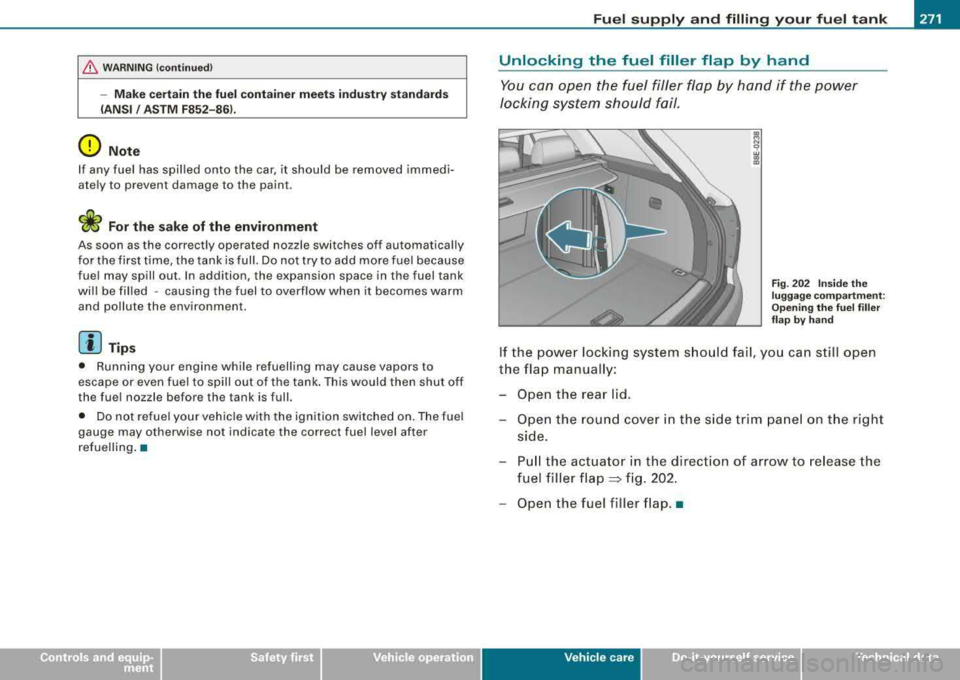
Fig . 202 Inside the
luggage compartment:
Opening the fuel filler
flap by hand
If the power locking system should fail, you can still open
the flap manually:
- Open the rear lid.
- Open the round cover in the side trim panel on the right
side.
- Pull the actuator in the direction of arrow to release the
fuel filler flap
=> fig. 202.
- Open the fuel filler flap. •
Vehic le care irechnical data
Page 274 of 368

-Checking and filling Pll':f..._--=--=--------------
Checking and filling
Engine hood
Releasing the engine hood
The engine hood is released from inside the vehicle.
Fig. 203 Driver's side
footwell: engine hood
release lever
- Pull the release lever on the left under the instrument
panel=> fig. 203 in the direction of the arrow.
The hood pops up slightly under spring pressure. •
Opening the engine hood
Fig. 204 Release lever
under the hood
Before opening the engine hood, make sure that the wind
shield wipers are flat against the windshield. Otherwise,
they could damage the paint on the hood.
Lift the hood
slightly=> ,&.
- Pull the release under the hood => fig. 204. This releases
the catch.
- Open the hood all the way.
The hood is kept in the open position by a gas strut.
& WARNING
Hot engine coolant can burn you.
• To reduce the risk of being burned, never open the hood
if you
see or hear steam or coolant escaping from the engine compart-.,..
Page 275 of 368

Checking and filling -
-----------------------------==--------=--
& WARNING (continued)
ment. Wait until no steam or coolant can be seen or heard before
carefully opening the hood.
•
Closing the engine hood
- Pull the hood down until the pressure from the strut is
reduced.
- Let the hood
drop down and latch in place. Do not try to
push
it shut; it may fail to engage =:>& .
& WARNING
A hood that is not completely latched could fly up and block your
view while driving.
• When you close the engine hood, check it to make sure the
safety catch has properly engaged. The hood should be flush with
the surrounding vehicle body parts.
• If you notice while driving that the hood is not secured prop
erly, stop at once and close it. •
Working in the engine compartment
Be especially careful whenever you work in the engine
compartment.
Whenever you must perform any work in the engine compartment,
for example checking and filling different fluids, there is a risk of
injury, burns and accidents. To prevent personal injury always
observe the following WARNINGS . The engine compartment of any
vehicle is a hazardous area
=> & .
• I I • • I
& WARNING
To help avoid injury, before you check anything under the hood:
• Turn off the engine.
• Remove the ignition key .
• Apply the parking brake.
• Move selector lever of automatic transmission to
"P" (Park);
put manual transmission in Neutral.
• Always let the engine cool down. Hot components will burn
skin on contact.
• To reduce the risk of being burned, never open the hood if you
see or hear steam or coolant escaping from the engine compart
ment. Wait until no steam or coolant can be seen or heard before
carefully opening the hood.
• Keep children away from the engine compartment.
• Never spill fluids on hot engine components. They can cause a
fire.
• Never touch the radiator fan. The auxiliary electric fan is
temperature controlled and can switch on suddenly.
• Never open the coolant reservoir cap when the engine is still
warm . The coolant system is pressurized and hot coolant could
spray out.
• Protect your face, hands and arm from steam or hot engine
coolant by placing a thick rag over the cap when you open the
coolant reservoir .
• If work on the fuel system or the electrical system is necessary: -Always disconnect the battery.
- Never smoke or work near heaters or open flames. Fluids in
the engine compartment could start a fire .
- Keep an approved fire extinguisher immediately available.
• To avoid electrical shock and personal injury while the engine
is running or being started, never touch:
- Ignition cables
.,_
Vehicle care
Page 276 of 368

lffll...__C_ h_ e_c _k _ i_n ..::g ,_ a_n_ d_ f_il _li _n....: g==-- --------------------------------------------
& WARNING (continued )
-Other components of the high voltage electronic ignition
system .
• If you must perform a che ck or repair with the engine running:
- Fir st, fully apply the parking brake , move selector lever of
automatic transmission to
" P " (Park ); put manual transmission
in Neutral.
- Alway s use extreme caution to prevent clothing , jewelry , or
long hair from getting caught in the radiator f an, V -belts or
other moving part s, or from contacting hot parts. Tie ba ck hair
before starting , and we ar no clothing that will hang or droop
into the engine.
• Min imize e xposure to emission and chemical hazards
=> & .
& WARNING
California Proposition 65 Warning :
• Engine exhaust , some of its constituents , and certa in vehicle
c omponents contain or emit chemicals known to the State of Cali
fornia to cause cancer and birth defects and reproductive harm . In
addition , certain fluids contained in vehicles and certain products
of component wear contain or emit chemical s known to the State
of California to cause cancer and birth defects or other reprodu c
tive harm.
• Battery posts, terminal s and related accessories contain lead
and lead compounds , chemicals known to the State of California
to cause cancer and reproductive harms . Wash hands after
handling.
0 Note
When a dding f luids, always make sur e tha t they are poured i nto the
prop er container or filler opening, otherwise serious damage to
ve hicle syste ms wi ll occur .
ffi For the sake of the environment
To detect leaks i n time, inspect the veh icle floor pan from unde r
neath regularly. If you see spots from oil or other vehicle fluids, have
your veh ic le i nspected by a n authori zed Audi dealer. •
Engine compartment
Applies to v ehic les: with 2 .0 I tur bo, 4-cy linder -e n gi ne
2 .0 I, 4-cy linder turbo engine (200 hp)
T hese are th e mo st impo rtant items that you ca n check .
Fig . 205 Engine comp artment : 2 .0 I , 4-cylind er turbo
G) Battery ... ..... .. ... .... ... ...... ... .. .. ... .. .
0 Engine oil fil le r cap (
© Engine oil dipstick ( orange) .. .... .. .... .... ... .. .
285
2 78
2 8 4
277 ....
Page 277 of 368
Checking and filling -
------------ ----=---a::;;._...a
©
©
(i)
Coolant expansion tank ( ... L) ...... ... .. ..... .. ... .
Windshield/headlight washer container
( 0 ) ...... . .
Power steering reservoir (green cap)
& WARNING
Before you check anything in the engine compartment, always
read and heed all WARNINGS
=> & in "Working in the engine
compartment" on
page 273. •
Applies to vehicles: with 6 -cy lin d er engine
3.2 liter , 6-cylinder engine (255 hp)
281
291
241
These are the most important items that you can check.
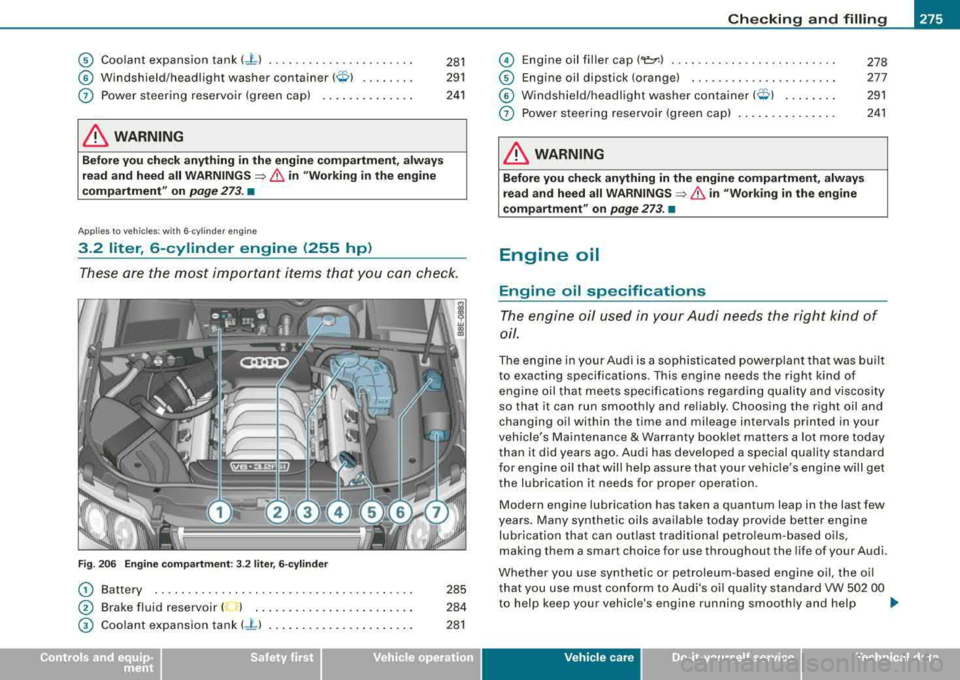
Fig . 206 Engine compartment: 3 .2 liter , 6-cylinder
CD
0
©
Battery .. ............... ... .. ...... .... ...... .
Brake fluid reservoir (
... ) . .. ... ... .... .... ...... .
Coo lant expansion tank
(J _)
285
284
281
©
©
©
(i)
Engine oil filler cap (
Windshield/headlight washer container
( O ) ... .... .
Power steering reservoir (green cap)
& WARNING
Before you check anything in the engine compartment , always
read and heed all WARNINGS
=> & in "Working in the engine
compartment" on
page 273. •
Engine oil
Engine oil specifications
278
277
291
241
The engine oil used in your Audi needs the right kind of
oil.
The engine in your Audi is a sophisticated powerplant that was built
to exacting specifications . This engine needs the right kind of
engine oil that meets specifications regarding quality and viscosity
so that it can run smoothly and re liably . Choosing the right oil and
changing oil within the time and mileage intervals printed in your
vehicle's Maintenance
& Warranty booklet matters a lot more today
than it did years ago. Audi has developed a special quality standard
f or engine oil that wil l help assure that your vehicle's engine wi ll get
the lubrication it needs for proper operation .
Modern engine lubrication has taken a quantum leap in the last few
years. Many synthetic oils available today provide better engine
lubrication that can outlast traditional petroleum-based oils,
making them a smart choice for use throughout the life of your Audi .
Whether you use synthetic or petroleum -based engine oil, the oil
that you use must conform to Audi's oi l quality standard VW 502 00
to help keep your vehicle 's engine running smoothly and help
.,_
Ve hic le care Technical data
Page 279 of 368

Checkin g a nd fillin g --------------~~~-
the form of Service or Repair Orders that all scheduled maintenance
was performed in a t ime ly manner .•
Engine oil consumption
The engine in your vehicle depends on an adequate
amount of oil to lubricate and cool all of its moving parts.
In order to prov ide effect ive lubrication and cool ing of in ternal
engine components, all internal combustion engines consume a
certain amount of o il. Oil consumption varies from engine to engine
and may change significantly over the life of the engine . Typically,
eng ines wi th a specified break -in period
(see ~ page 243) consume
more oil during the break -in period than they consume after oi l
consumption has stabi lized .
Under norma l condit ions, the rate of o il consumption depends on
the quality and viscosity of the oil, the RPM (revo lutions per minute)
at whic h the engine is operated, t he amb ient te mperature and road
conditions. Further factors are the amount of oil dilution from water
condensatio n or fuel residue and t he oxidation level of the o il. As
any engine is subject to wear as mileage builds up, the oil consump
t ion may increase over time until rep laceme nt of worn components
may become necessary .
With all these variables coming into play, no standard rate of oil consu mption can be estab lished or specified. T here is no a lternative
to regu lar and frequent checking of the oil level, see
Note .
If the yellow eng ine o il level warni ng symbol in the instrument
cluster ~ lights up, you should check the oil level as soon as
possible
with the oil dipstick ~ page 277 . Top off the o il at your
earl iest
convenience~ page 278.
& WARNING
Bef ore you che ck anything in the eng ine comp artment , alway s
read and heed all WARNINGS
~ & in "Working in the engine
c ompartment " on
page 27 3.
0 Note
Driving with an insuff ic ient oil level is l ikely to cause severe damage
to the engine.
[ i ] Tip s
• The oil pres sure warning displ ay "e:7: is n ot an indi cator of the oil
level . Do not rel y on it. Instead, check the oil level in your engine at
regular inter vals, preferably ea ch time you refuel , and al way s before
going on a long trip.
• If you have the impression your engine consumes excessive
amounts of oi l, we reco mmend that you consult your Audi dealer to
have the cause of your concern properly diagnosed . Keep in mind
that t he accurate measurement of oil consumptio n requ ires great
care and may take some time. Your Audi dealer has instructions
about how t o measure oil cons umpt ion accurately. •
Checking the engine oil level
Vehicle care
Fig. 2 07 Illu strati on of
prin ciple 1: M ark ers on
oil dip sti ck ...
Page 280 of 368
llffll...__C_ h_ e_c _k _ i_n ..::g ,_ a_n_ d_ f_il _li _n....: g==---------------------------------------------
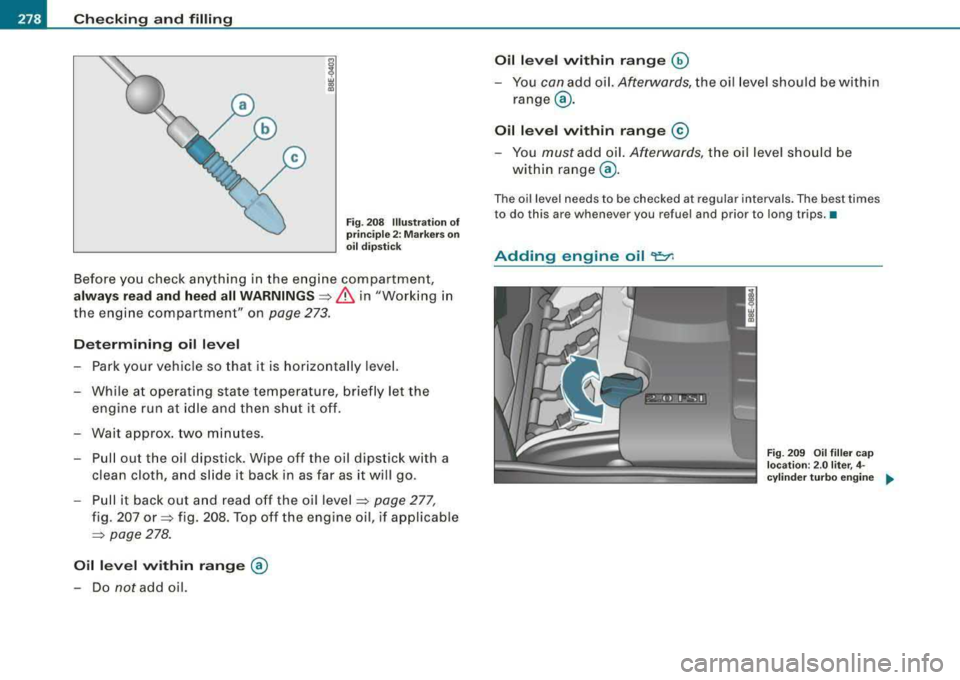
Fig. 208 Illustra tion o f
principle 2: Markers on
oil dipstick
Before you check anything in the engine compartment,
always read and heed all WARNINGS => & in "Working in
the engine compartment" on
page 273.
Determining oil level
-Park your vehicle so that it is horizontally level.
- While at operating state temperature, briefly let the
engine run at idle and then shut
it off.
- Wait approx. two minutes.
- Pull out the oil dipstick . Wipe off the oil dipstick with a
clean cloth, and s lide it back in as far as it will go.
- Pull it back out and read off the oil level
=> page 277,
fig. 207 or=> fig . 208. Top off the engine oil, if applicable
=> page 278.
Oil level within range @
-Do not add oil.
Oil level within range ~
You can add oil. Afterwards, the oil level should be within
range @.
Oil level within range ©
-You must add oil. Afterwards, the oil level should be
within range @.
The oil level needs to be checked at regular intervals. The best times
to do this are whenever you refuel and prior to long trips. •
Adding engine oil 'l:::7:
Fig. 209 Oil filler cap
locat ion: 2.0 liter , 4-
cylinder turbo engine
...
Page 281 of 368

_____________________________________________ C_h_ e_ c
_ k_in -= g_a
_ n_d _ f_il _li _n ..;::g ;;.___.ffllll
Fig. 21 O Oil filler cap
location: 3.2 liter, V6-
engine
Before you check anything in the engine compartment,
always read and heed all
WARNINGS=> & in "Working in
the engine compartment" on
page 273.
-Turn off the engine.
Unscrew the cap
"t=:r. to the engine oil filling hole
=> page 278, fig. 209 or=> fig. 210.
-Carefully top off with the appropriate oil in 0.5 liter doses.
-Check the oil level again after two minutes=> page 277.
-Top off the oil again, if necessary.
-Screw the cap back on the filling hole and slide the oil
dipstick in as far as it will go.
& WARNING
• While topping off, the oil must not come in contact with hot
engine parts
-fire hazard!
& WARNING (continued)
• The oil filler cap must be properly secured to prevent oil from
being sprayed on the hot engine and exhaust system when the
engine is running
-fire hazard!
• If your skin has come in contact with the engine oil, you must
subsequently cleanse it thoroughly.
0 Note
• The oil level must not be above range @-danger of converter or
engine damage! Contact an authorized dealership to draw off oil, if
necessary.
• Audi does not recommend the use of oil additives. They may
damage the engine and adversely affect your New Vehicle Warranty.
ffi For the sake of the environment
• Under no circumstances can the oil come in contact with the
sewage network or the soil.
• Observe and follow legal regulations when disposing of empty
oil containers. •
Changing the engine oil
We recommend that have your oil changed by an autho
rized Audi dealer or a qualified service station.
Before you check anything in the engine compartment, always read
and heed all WARNINGS =>
& in "Working in the engine compart
ment" on
page 273.
The engine oil must be changed according to the intervals specified
in your Maintenance
& Warranty booklet. This is very important
because the lubricating properties of oil diminish gradually during
normal vehicle use.
.,.
Vehic le care irechnical data
Page 282 of 368
-~_C_ h_ e_c _k _ i_n ..::g :..._ a_n_ d_ f_il _li _n_, g=-----------------------------------------------
Under some circumstances the engine oi l should be changed more
frequen tly . Change oil m ore often if you drive most ly shor t
distances, operate the vehicle in dusty areas or under predom i
n ant ly stop -and -go traffic conditions , or have yo ur vehicle whe re
temperatures remain below freezing for extended periods.
Detergent additives in the oil will make fresh oil look dark after the
engine has bee n run nin g fo r a sh ort time. This is nor mal and is not
a reason to change the oi l more often than recommended .
Beca use of the proble m of p roper d isposal, along wi th the s pec ia l
tools and necessary expertise required, we strongly recommend
t hat yo u have your oi l ch anged by an authorized
Audi dealer or a
qua lified serv ice stat ion .
If you choose to change your o il yourself , please note the follow ing
i mportan t informatio n:
& WARNING
To reduce the risk of personal injury if you must change the engine
oil in your vehicle yourself :
• Wear eye prote ction .
• To reduce the risk of burns from hot engine oil , let the engine
c ool down to the touch .
• When removing the oil drain plug with your fingers, stay as far
away as po ssible . Always keep your forearm parallel to the ground
to help prevent hot oil from running down your arm.
• Drain the oil into a container designed for this purpose , one
large enough to hold at least the total amount of oil in your engine.
• Engine oil is poisonous . Keep it well out of the rea ch of ch ildren .
• Continuous contact with used engine oil is harmful to your
skin . Always prote ct your skin by washing oil off thoroughly with
soap and water.
0 Note
Never m ix o il add it ives w ith your engine o il. These add it ives can
damage you r engine and adversely affect your A udi Limited New
Ve hicle Warranty.
'i> For the sake of the environment
• B efore chang ing you r oil, fi rst make sure you k now w here you
can properly dispose of the used o il.
• Always dispose o f used eng ine oil properly. Do not dump it o n
garden soi l, wooded areas, into open st reams or down sewage
drains .
• Recycle used engine oi l by ta king it to a used engine oi l collec
tion fac ility in your area, or contac t a service stat io n .•
Engine cooling system
Coolant
T he engine coolan t performs two fun ctions: it keeps the
engine from overhe ating and it pr otec ts the engine from
f reez ing i n th e win ter.
Th e cooling system is sea led and general ly requires l itt le attention.
T he coo ling system has been fi lled at the factory with a permanent
coo la nt which does not need to be c hange d. The c oolan t consis ts of
a mixture of water and the manufacturer's glycol -based coolant
additive G12 + an tifreeze wi th anticorros io n add itives (50% for USA
models; 60% for Canadian models). This mixture both assures the
necessary frost protection and protects me tal components in the
engine's cool ing system from corrosion and scaling . It also raises
the boiling poi nt of the coolant .
Do n ot reduce t he co ncentration o f the coolan t in the su mmer by
adding plain water .
The proportion of coolant additive must be at .,_
Page 283 of 368

_____________________________________________ C_h_ e_ c
_ k_in -= g_a
_ n_d _ f_il _li _n ..;::g ;;.___..
le as t 50 % but not more th an 60 % to maintain antifreeze protection
and cooling efficiency . If the coolant frost protection is too low, the
coolant could freeze and damage the vehic le heating and engine
cooling system.
For year -round driving, antifreeze is added at the factory for temper
atures down to :
•
-31 °F (- 35 °C) USA
•
-40 °F ( -40 °C) Canada.
You can mix the G12 + coolant additive with other additives (for
examp le G11 or G12) . Always check with your authorized Audi
dea ler.
& WARNING
Bef ore you check anything in the eng ine comp artm ent , a lw ays
re ad and h eed all W ARNING S
=> & in "Worki ng in the engine
c ompartm en t" on
page 273.
0 Note
• Before winter sets in, have the coolant checked to see if the
coolant additive in your vehicle is sufficient to meet the climate
conditions. This is especially important if you live in a region where
the winter is extremely cold. If necessary, increase the proportion of coolant additive to 60%.
• When adding coolant additive to your cooling system,
remember :
-We recommend using only coolant additive G12 + (check the
label) for your vehicle. This coo lant additive is avai lable at autho
rized Audi dealers . Other types of antifreeze can significantly
reduce corrosion protect ion. The resulting corrosion can cause a
loss of coolant and serious engine damage.
• Do no t add any type of radiator leak sealan t to you r vehicle's
engine coolant . Adding radiator repair fluid may adversely affect the function and performance of your cooling system and could result
in damage not covered by yo ur New Vehicle Limited Warranty. •
Checking the engine coolant level
The engine coolant level can be checked with a quick
glance.
F ig . 211 E ngine
co mpa rtm ent: Co olan t
e xp an sion tan k
Before you che ck a ny thing in the e ng ine compar tmen t,
alway s read and heed all
WARNINGS => & in "Working in
t h e engine compartment" on
page 273.
Turn off the ignitio n.
Let the engine cool down.
P lace a t hick rag over the coo lant expans ion tank
=> fig. 211 and carefully twist the cap counter-clockwise
=>& . ...
Ve hic le care irechnical data