air condition AUDI A4 AVANT 2008 User Guide
[x] Cancel search | Manufacturer: AUDI, Model Year: 2008, Model line: A4 AVANT, Model: AUDI A4 AVANT 2008Pages: 368, PDF Size: 46.19 MB
Page 130 of 368
_L_W:...:._: a::..:_: rm:....:...:..~ a::..: n~ d~ c~o :.:l.:::d :.._ _______________________________________________ _
By pressing both !AUTO l buttons for several seconds, the tempera
ture on the passenger's side can be set to the temperature of the
driver's side or vice versa . The new temperature set ting will be
shown in the display. The old temperature setting can be restored
by resetting the display as required. •
Switching between Fahrenheit and
Centigrade
You can change the temperature display from °F (Fahren
heit) to
°C (Centigrade) and vice versa.
- Press and hold[ ~] and press the plus button on the
driver's side temperature
switch ~ page 126, fig. 137 . •
Air recircul ation [~]
The air recirculation prevents exhaust fumes or other
pollution from entering the vehicle.
Switching on the air recirculation
-Press[ ~]~ page 126, fig. 137 ~ &
Switching off the air recirculation
-Press~ again, or
- press [AUTO], or
press[ ®].
In the air recirculation mode , the air in the passenger compartment
is recirculated to prevent exhaust fumes and other pollution from
entering the vehicle. We recommend that you use the manual air recirculation under the following conditions:
• when driving through tunnels
• in a tra ffic jam.
& WARNING
Do not use this setting for extended periods of time . The windows
could fog up since no fresh air can enter the vehicle.
If the
windows fog up, press the air recirculation button again immedi ately to switch off the air recirculation function or select defrost. •
ECON [ECON]
Using ECON helps save fuel
- Press [ECON] to activate ~ page 126, fig. 137.
Press [ECON] again or press [AUTO] to switch off.
In ECON mode the air conditioner is shut off and heating and venti
lation are automatically controlled . "ECON" translates "Economy"
since driving with the air conditioning compressor disengaged
improves your mileage noticeably.
When operating in ECON mode make sure the temperature inside
the vehicle is not lower than the outside temperature. The air is
nei ther cooled nor dehumidified, so there is a risk that the windows
can fog up .•
Switching the air conditioning on and off [ OFF]
Switching the air conditioning off
-Press [ OFF] to turn the air conditioner off and block
outside air from entering the vehicle.
Switching the air conditioning on
-Press [ OFF] again (indicator light comes on again), or
- Press [AUTO], or
- Press one of the following buttons:
[O J,[@!] or [-0, ].
Page 131 of 368
_______________________________________________ W_ a_ r_ m __ a_n _ d_ c_ o_ ld __ lJIII
Moreover, the a ir conditioning switches on again whenever you
press the fan speed or temperature buttons. •
Automatic air recirculation [@, I
If outside air is polluted, an air quality sensor in the
vehicle will automatically switch on the air recirculation .
Switching on air re circul ation
-Press[ ~)~ page 126, fig. 137 .
Swit ching off air r ecircul ati on
-Press~ again, or
- press [AUTO), or
-
press[ ®].
The automat ic air recirculation mode should normally be left
switched on at a ll times.
The system is ready to operate approximately 30 seconds after you
tu rn on the ignition or start the vehicle . Fresh air enters the vehicle
only during this initialization period .
If the
a ir quality sen sor in the air condit ion ing system detects
exhaust fumes in the outside air, the contro l unit wil l either pass the
incom ing a ir throug h the pol lution filter, or automat ical ly switch on
the air recirculation.
The air conditioning system wi ll automatically switch on the air
recirculation if it senses that the outside air is very po lluted . At the
same time, it will not allow any outside air to enter the vehic le until
the air quality has improved .
The air recircula tion opera tes for a maximum of
12 minu tes. If th e
windows start to fog up whi le the a ir rec irculation is on, press
[ @1
Under certain operating conditions (for example, if [@ ) or [Qi] are
pressed) the air recircu lation automatically switches off. If "ECON"
Controls and equip
ment
is pressed, or if the temperature is below 18° F (-8 °C), the air recir
culat ion will operate only for
1 2 seco nds .•
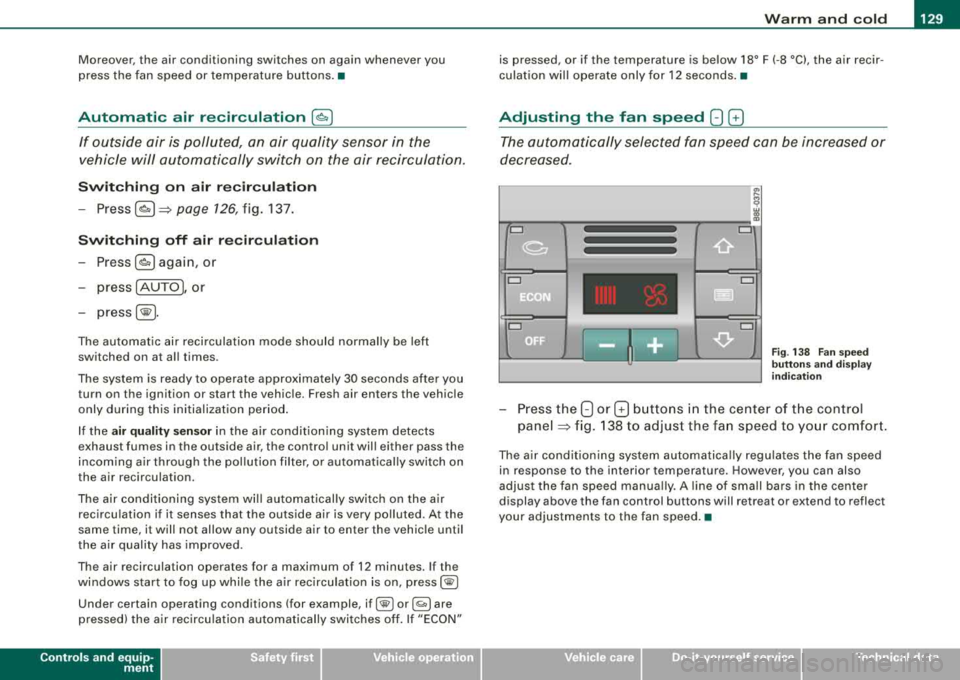
Adjusting the fan speed 8 G
The automatically selected fan speed can be increased or
decreased.
D
D
D
D
D
D
F ig . 138 Fa n sp ee d
but tons a nd di spl ay
indi cation
- Press the 8 or G b uttons in the center of the contr ol
pane l~ fi g. 1 38 to adjus t the fa n speed to yo ur comfor t.
The air condit ioning system automa tica lly regu lates the fan speed
in response to the interior tempera ture . However, you can also
adjust the fan speed manua lly . A lin e of sma ll bars in the center
display above the fan control buttons will retreat or extend to reflect
your adjustments to the fan speed. •
Page 133 of 368
Warm and cold -
-----------------'
Air outl ets
-. .. ~.
Fig. 1 39 Instr umen t pan el: air outlet locat ions and a irflow direc tion s
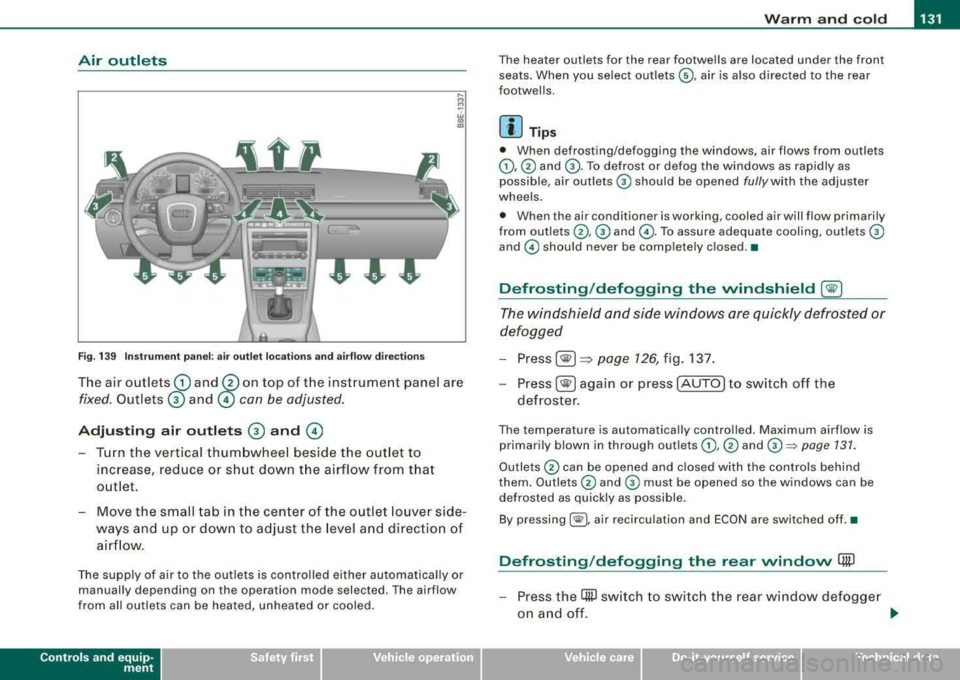
The air outlets G) and 0 on top of t he instrument panel are
fixed. Outlets 0 and © con be adjusted.
Adjusting air outlets 0 and ©
- Turn the vertical thumbwheel beside the out let to
increase, reduce or shut down t he airflow from that
o utlet .
- Move the sm all tab in t he cen ter of the o utle t lo uver side
ways and up or dow n to adj ust the level and directio n of
air flow.
The supp ly of air to the outlets is contro lled eit her automatical ly or
manually depending on the operation mode selected. The airflow
from all outlets can be heated, unheated or coo led .
Controls and equip
ment
The heater outlets for the rear footwe lls are located under the front
seats. When you select outlets ©, air is also directed to the rear
footwel ls.
[ i ] Tip s
• When defrosting/defogging the windows, air flows from outlets
G),@ and G) . To defrost or defog the windows as rapidly as
possible , air outlets
G) should be opened fully with the adjuster
whee ls .
• When the air conditioner is working, cooled air will flow primarily
from
ou tlets @, G) and @. To assure adequa te cooling, out lets G)
and © should never be completely closed .•
Defrosting /defogging the windshield [@)
The windshield and side windows are quickly defrosted or
defogged
- Press [® I=> page 126, fig. 137.
-
Press[ ®] ag ain or press [AUTO] to switch off the
defroster .
The temperature is automatically contro lled. Maximum airflow is
primarily b lown in through out lets
G) , @ and G):::) page 131 .
Outlets @ can be opened and c losed with the controls behind
them. Outlets
@ and G) must be opened so the windows can be
defrosted as quickly as possible.
By pressing[ @), air recirculation and ECON are switched off .•
Defrosting /defogging the rear window Qii)
- Press the (ffi) switch to swi tc h the rear wind ow d efo gge r
o n an d off.
.,_
Technical data
Page 134 of 368
-
Warm and cold
----------------
The rear window defogger works only when the ignition is switched
on. The light in the switch will illuminate when the defogger is on .
When the outside temperature is warmer than 32 °F (O °Cl , the rear
window defogger switches off automatically after about ten minutes.
'£> F o r the sake of the environment
Switch off the defogger when the rear window is clear . When you
save e lectricity, you save fuel. •
Using the climate controls economically
Using the climate controls prudently can help save fuel .
When you use the air conditioner, engine power is reduced
and fuel consumption increases . To save fuel, you should
use the air conditioner only when necessary . Also please
note the following points:
-If you want to save fuel, activate ECON.
-If you are goi ng to drive w ith the windows open, use
ECON.
'£> For th e sake of the environment
By reducing the amount of fue l you use , you also reduce the amount
of pollutants emitted into the air. •
Key coded settings
When the ignition is switched on, the air conditioner
settings are automatically assigned to the key being used.
The air conditioner settings selected are automatically stored and
assigned to the key being used. When the vehicle is started, the air
conditioner automatically selects the settings assigned to that key.
This way every dr iver will ma intain his/her own personal settings
and does not have to reset them manually .
[ i ] Tip s
If a different driver uses your key and changes the air conditioner
set tings, the latest adjustments will erase and replace the settings
you have stored. •
App lies to ve hicles: w ith e lec tric ally heat ed front seats
Electrically heated front seats
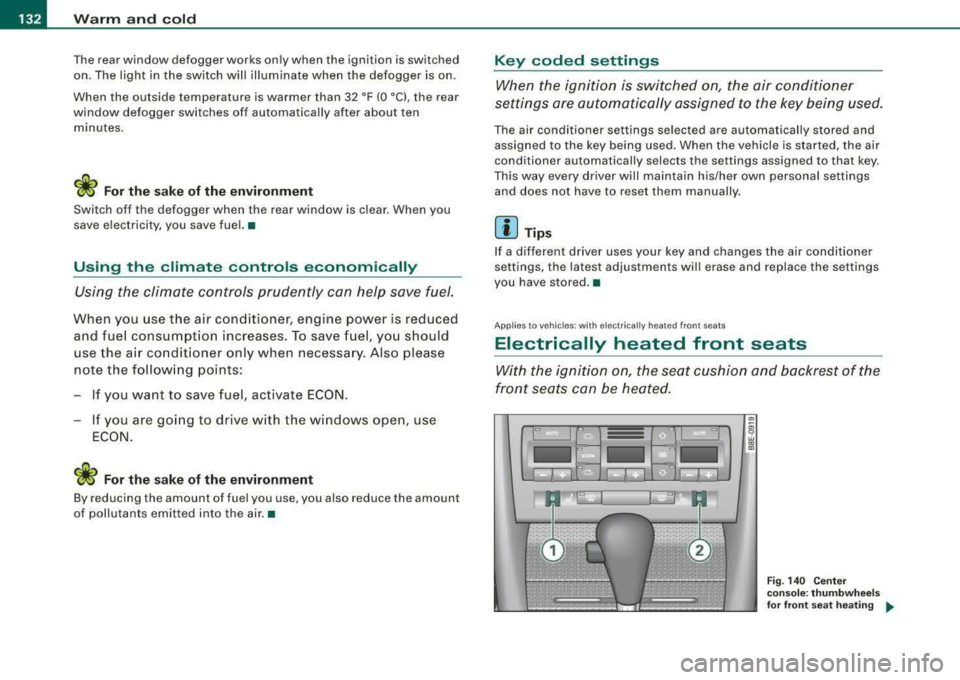
With the ignition on, the seat cushion and backrest of the
front seats can be heated.
Fig . 140 Cente r
cons ole: thumb whe els
fo r fr ont seat heati ng
....
Page 169 of 368
________________________________________________ D_r_iv _ i
_ n..; g::;_ S_ a_ fe---' ly'-----"'
Important things to do before driving
Safety is everybody's job! Vehicle and occupant safety
always depends on the informed and careful driver.
For your safety and the safety of your passengers, before
driving always:
- Make sure that all lights and signals are operat ing
correctly.
- Make sure that the tire pressure is correct.
- Make sure that all windows are clean and afford good
visibility to the outside.
- Secure all luggage and other items
carefully=> page 122.
-Make sure that nothing can interfere with the pedals.
- Adjust front seat, head restraint and mirrors correctly for your height .
- Instruct passengers to adjust the head restraints
according to their height.
- Make sure to use the right child restraint correctly to
protect
children => page 210, "Child Safety".
- Sit properly in your seat and make sure that your passen
gers do the
same => page 95, "General recommenda
tions".
- Fasten your safety belt and wear it properly. Also instruct
your passengers to fasten their safety belts properly
=> page 176. •
Controls and equip
ment Safety first
Vehicle operation
What impairs driving safety?
Safe driving is directly related to the condition of the
vehicle, the driver as well as the driver's ability to concen
trate on the road without being distracted.
The driver is responsible for the safety of the vehicle and all
of its occupants. If your ability to drive is impaired, safety
risks for everybody in the vehicle increase and you also
become a hazard to everyone else on the road
=>& .There
fore:
Do not let yourself be distracted by passengers or by
using a cellular telephone .
NEVER drive when your driving ability is impaired (by
medications, alcohol, drugs, etc.).
- Observe all traffic laws, rules of the road and speed limits
and plain common sense .
- ALWAYS adjust your speed to road, traffic and weather
conditions.
- Take frequent breaks on long trips. Do not drive for more
than two hours at a stretch.
- Do NOT drive when you are tired, under pressure or when
you are stressed .
& WARNING
Impaired driving safety increases the risk of serious personal
injury and death whenever a vehicle is being used. •
Vehicle care Do-it-yourself service Technical data
Page 189 of 368
________________________________________________ A_ i_ r _b _a..: g:::- s..: y:.. s_ t_ e_ m __ .... ffllll
Airbag system
Important things to know
Importance of wearing safety belts and
sitting properly
Airbags are only supplemental restraints. For airbags to
do their job, occupants must always properly wear their
safety belts and be in a proper seating position.
For your safety and the safety of your passengers, before
driving off, always:
- Adjust the driver's seat and steering wheel properly
=> page 168,
-Adjust the front passenger's seat properly=> page 96,
-Wear safety belts properly=> page 180 ,
- Always properly use the proper child restraint to protect
children
=> page 210 .
In a col lision airbags must inflate within the blink of an eye and with
considerable force . The suppl emental airbags can caus e injuries if
t he driver or the front seat passenger is not seated properly. There
fore in order to help the airbag to do its job , it is important, both as
a driver and as a passenger to sit properly at a ll times.
By keeping room between your body and the steering wheel and the
front of the passenger compartment, the airbag can inflate fully and
completely and provide supplementa l protect ion in certain frontal
collisions => page 168, "Proper occupant seating positions" . For
detai ls on the operation of the seat adjustment
contro ls => page 97.
It's especially important that children are properly restrained
=> page 210.
Controls and equip ment Safety first Vehicle operation
There is a lot that the driver and the passengers can and must do to
help the individual safety features installed in your Audi work
together as a system .
Proper sea ting position is important so that the fron t airbag on the
driver side can do its job. If you have a physical impairment or
condition that prevents you from sitting properly on the driver seat
with the safety belt properly fastened and reaching the pedals, or if
you have concerns with regard to the function or operation of the
Advanced Airbag System, please contact your authorized Audi
dea ler or qualified workshop, or ca ll Audi Customer CARE at 1 -800-
822 -2834 for possible modifications to your vehicle.
When the airbag system deploys, a gas generator wi ll fill the
airbags , break open the padded covers, and inflate between the
steering whee l and the driver and between the instrument pane l
and the front passenger. The airbags will deflate immediately after
deployment so that the front occupants can see through the wind
shie ld again without interruption .
All of this takes place in the blink of an eye, so fast that many people don't even realize that the airbags have deployed. The airbags also
inflate with a great deal of force and nothing should be in their way
when they deploy. Front airbags in combination with proper ly worn
safety belts slow down and limit the occupant's forward movement .
Together they help to prevent the driver and front seat passenger
from hitting parts of the inside the vehicle while reducing the forces acting on the occupant during the crash. In this way they help to
reduce the risk of injury to the head and upper body in the crash.
Airbags do not protect the arms or the lower parts of the body .
Both front airbags wi ll not inflate in all frontal collisions. The trig
gering of the airbag system depends on the vehic le dece leration
rate caused by the collision and registered by the electronic contro l
unit . If this rate is below the reference value programmed into the
control unit, the airbags will not be triggered, even though the car
may be badly damaged as a result of the collision . Vehicle damage, _,,
Vehicle care Do-it-yourself service Technical data
Page 194 of 368
-Airbag system
----:=-..:....--------------------------------------------
& WARNING
Never rely on airbags alone for protection.
• Even when they deploy, airbags provide only supplemental
protection .
• Airbag work most effectively when used with properly worn
safety belts.
• Therefore, always wear your safety belts and make sure that
everybody in your vehicle is properly restrained.
& WARNING
A person on the front passenger seat, especially infants and small children, will receive serious injuries and can even be killed by
being too close to the airbag when it inflates.
• Although the Advanced Airbag System in your vehicle is
designed to turn off the front passenger airbag if an infant or a
small child is on the front passenger seat, nobody can absolutely
guarantee that deployment under these special conditions is
impossible in all conceivable situations that may happen during
the useful life of your vehicle.
• The Advanced Airbag System will deploy in accordance with
the
"low risk" option under the U.S. Federal Standard if a child that
is heavier than the typical one-year old child is on the front
passenger seat and the other conditions for airbag deployment
are met.
• Accident statistics have shown that children are generally safer
in the rear seat area than in the front seating position.
• For their own safety, all children, especially 12 years and
younger, should always ride in the back properly restrained for
their age and size.
•
Advanced front airbag system
Your vehicle is equipped with a front Advanced Airbag System in compliance with United States Federal Motor Vehicle Safety Stan
dard 208 as applicable at the time your vehicle was manufactured .
The front Advanced Airbag System supplements the safety belts to
provide additional protection for the driver's and front passenger's
heads and upper bodies in frontal crashes. The airbags inflate only
in frontal impacts when the vehicle deceleration is high enough.
The front Advanced Airbag System for the front seat occupants is
not a substitute for your safety belts. Rather, it is part of the overall
occupant restraint system in your vehicle . Always remember that
the airbag system can only help to protect you, if you are sitting
upright, wearing your safety belt and wearing it properly. This is why
you and your passengers must always be properly restrained, not
just because the law requires you to be.
The Advanced Airbag System in your vehicle has been certified to
meet the "low risk" requirements for 3 and 6 year-old children on the
passenger side and very small adults on the driver side. The low risk
deployment criteria are intended to help reduce the risk of injury
through interaction with the front airbag that can occur, for example, by being too close to the steering wheel and instrument
panel when the airbag inflates .
In addition, the system has been certified to comply with the
"suppression" requirements of the Safety Standard, to turn off the
front airbag for infants 12 months old and younger who are
restrained on the front passenger seat in child restraints that are
listed in the
Standard~ page 272 .
"Suppression" requires the front airbag on the passenger side to be
turned off if:
• a child up to about one year of age is restrained on the front
passenger seat in one of the rear-facing or forward-facing infant
restraints listed in Federal Motor Vehicle Safety Standard 208 with
which the Advanced Airbag System in your vehicle was certified. For
~
Page 200 of 368
___ A_ ir_b _ a_ g=- s--=- y_s _t _e _m _________________________________________________ _
&, WARNING (continued )
airbag during braking or in a sudden maneuver . Objects near the
airbags can become projectiles and cause injury , particularly when
the seat is re clined .
& WARNING
The fine dust created when airbags deploy can cause breathing
problems for people with a history of asthma or other breathing
c ondit ions .
• To reduce the risk of breathing problems , those with asthma or
other respiratory conditions should get fresh air right away by
getting out of the vehicle or opening windows or doors .
• If you are in a collision in which airbags deploy, wash your
hands and face with mild soap and water before eating .
• Be careful not to get the dust into your eyes, or into any cuts or
scratches.
• If the residue should get into your eyes, flush them with
water. •
Monitoring the Advanced Airbag
System
Airbag monitoring indicator light t~
Two separate indicators monitor the func tion of the
Advanced A irba g System: th e airbag mon itoring ind ica tor
li g ht and the
PASSENGER AIR BAG OFF light.
T he Advanced Airbag System (inc luding the e lectronic control unit,
s en sor c ircuit s and s yste m wiri ng ) is moni tored con tin uou sly to
make sure that it is f unctioning properly whenever the ignition is o n.
E ac h time you t urn on the ignit ion , th e airb ag monito ring indic ator
light ~ will come on for a f ew s econds (s elf dia gnostics).
The system must be inspected when the indicator
light m:
• does not come on when the i gnition is switched on,
• d oes not go out a few sec onds after y ou h ave sw itch ed on th e
ignit ion, or
• comes on w hile d riv ing.
I f an airbag system malfunction is detected, the indicator li ght will
fir st sta rt fl ashing to ca tch the drive r's att ention a nd then s tay o n
cont inuously to serve as a cons tant rem inder to hav e the s yst em
in spec ted i mm ediatel y.
If a m alfu nctio n occ urs th at t urns the fron t airb ag on the pass eng er
s ide off, the PASSENGER AIR BAG OFF light will come on and stay on
w hen eve r th e ig niti on is on.
& WARNING
An airbag system that is not functioning properly cannot provide
supplemental protection in a frontal crash .
• If the airbag indicator light comes on , it means that there may
be something wrong with the Advanced Airbag System. It is
possible that the airbag will inflate when it is not supposed to , or
will not inflate when it should .
• Have the airbag system inspected immediately by your Audi
dealer .•
Page 238 of 368
-L-__;l.:..n ..::t ..::e :.:..11 :.:..ig ,.,_;: e:.:..n .:.. t:....:. te.::..::. c.:..h :.:..n.:.. o::..:..: lo~g~ y ___________________________________________ _
Intelligent technology
Notice about data recorded by
vehicle control modules
Your vehicle is not equipped with an Event Data Recorder (EDR),
installed by some manufacturers for the express purpose of
capturing data for retrieval after an accident or crash event . EDR's
are sometimes called "crash recorders" .
Some state laws restrict the retrieval or downloading of data stored
by EDR's that were insta lled in a vehicle for the express purpose of
retrieving data after an accident or crash event without the owner's
consent.
Although your vehicle is not equipped with an EDR, it is equipped
with a number of electronic control modules for various vehicle
systems such as, for example, engine function, emission control, as
we ll
as for the airbags and safety belts.
These electronic control modules also record vehicle-related data
during normal vehicle operation for diagnostic and repair purposes .
The recording capacity of the electronic control modules is limited
to data (no sound is recorded) and only a small amount of data is
actually recorded over a very limited period of time and stored when
a system fault or other condition is sensed by a control unit. Some
of the data then stored may relate to vehic le speed, d irection,
braking as well as restraint system use and performance in the
event of a crash or other condition . Stored data can only be read and
down loaded with special equipment. •
Electronic Stabilization Program (ESP)
General information
The ESP improves the vehicle stability.
(X) CD
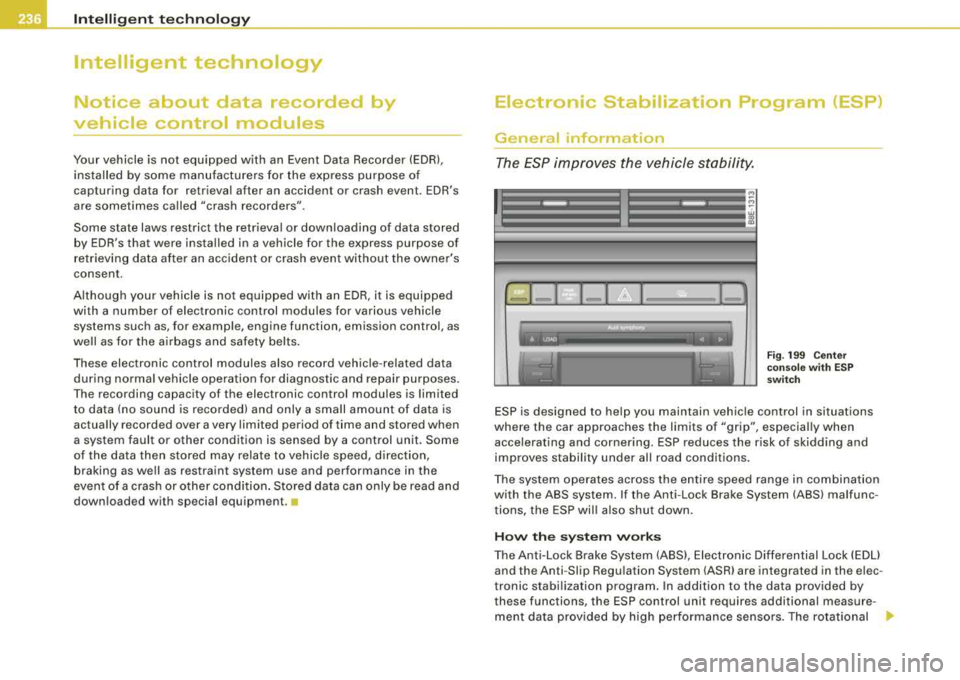
Fig. 199 Center
console with ESP
sw itch
ESP is designed to he lp you maintain vehic le control in situations
where the car approaches the limits of "grip", especial ly when
acce lerating and cornering. ESP reduces the risk of skidding and
improves stability under al l road conditions.
The system operates across the entire speed range in combination
with the ABS system . If the Anti-Lock Brake System (ABS) malfunc
t ions, the ESP will a lso shu t down.
How the system works
The Anti-Lock Brake System (ABS), Electronic Differential Lock (EDU
and the Anti -Slip Regu lation System (ASR) are integrated in the e lec
tronic stabilization program . In addition to the data provided by
these functions, the ESP control unit requires additional measure
ment data provided by high performance sensors. The rotational
.,,.
Page 242 of 368

llffl.___l_n _t _e _ll _ig =- e_n _ t_ te_ c_h _n_ o_ lo-'g'"'-=- y ___________________________________________ _
&, WARNING (continued )
• Before des cending a steep grade , reduce speed and shift trans
mi ssion into a lo wer gear or lower driving po sition . Do not ride the
brake s or hold the pedal down too long or too often . This could
cau se the brake s to get hot and dimini sh braking efficiency .
• Do not ride the brakes by resting your foot on the ped al when
you do not intend to brake. This may cause the brakes to overheat, premature wear and in creased stopping distan ce.
• Under certain climati c and operating conditions such a s
passing through water, driving in heavy rain or after washing the
v ehicle , the effectiveness of the brakes can be reduced . In winter ,
ice can a ccumulate on the brake pads , linings , discs and drums .
Cautiously apply brakes for a te st. Brakes will dry and ice coating s
will be cleaned off after a few cautious brake applicat ions .
• Driving for an extended period of time on salt-co vered roads
without using your brakes can also affect braking effi ciency . Clean
off accumulated salt coating from brake discs and pads with a few
c autious brake appli cations .
• If you damage the front spoiler , or if you install a different
spoiler , be sure the air flow to the front brakes is not obstructed .
Otherwise the brake system could overheat reducing the effective
ness of the entire brake system .
• Failure of one brake circuit will impair the braking capability
resulting in an increased stopping distance . Avo id driving the
vehicle and have it towed to the nearest Audi dealer or qualified
workshop .•
Brake booster
T he brake booster add s ex tra braking power.
The bra ke booster works wit h vacuum pressure which is created
only whe n th e e ng in e is
runn ing=> &,.
& WARNING
• Never let the vehi cle roll to a stop with the engine shut off .
• If the brake booster is not working , for example when towing
your vehicle , or because the brake booster has somehow been
damaged, the brake pedal must be pre ssed considerably harder to
make up for the lack of booster assistance . •
Functioning of Anti-Lock Brake System (ABS)
A BS preven ts th e wh eels fr om lock ing up und er b rak ing.
T he ABS contributes effectively to vehicle contro l since it prevents
th e w heels from
lo cki ng w he n t he brakes a re a ppli ed. T h is mea ns
that the vehicle remains steerable and is less likely to skid.
With ABS you do not need to pump the brake . Just hold the brake
pedal down .
However, do not expect that the ABS shortens braking distance
u nder all circum sta nces. Whe n driving o n gravel or on newly fa lle n
snow on top of icy surfaces, braking distance may be even longer,
t herefore, under these ci rcums tances, it is espec ial ly i mpo rtant th at
you driv e slowly and with great care.
How the ABS system works
An automatic check is made when a speed of about 4 mph (6 km/h)
i s r eac hed . Wh en th is happe ns, a pumpi ng noi se can be hea rd.
I f a n indiv idual wheel be gins to rotat e too slowly i n relation to
vehic le speed and tends to lock, the ABS automatical ly reduces
brake pressur e to prevent tha t whee l from loc king .
Th is a utomatic adjustment process wi ll cause a
slight vibration of
t he brake peda l a nd s om e noi ses t o a lert y ou th at ve hicle spee d
must be adapted to existing road and traffic conditions. _..