check oil AUDI A4 AVANT 2008 User Guide
[x] Cancel search | Manufacturer: AUDI, Model Year: 2008, Model line: A4 AVANT, Model: AUDI A4 AVANT 2008Pages: 368, PDF Size: 46.19 MB
Page 267 of 368

_______________________________________________ C_l_ e _a_ n_ in---= g'-- a_n_ d
_.:.. p_r_o _ t_ e_ c_ t·_
1o _ n __ l9III
Safety belts
Only well-maintained safety belts work reliably when
needed.
- Keep belts clean.
- For cleaning, use a mild soap and water solution. Let
belts dry thoroughly and away from direct sunlight.
- Do not allow inertia reel safety belts to retract before
they are completely dry.
- Check the condition of your safety belts
regularly.
Heavily soiled safety belts may not retract properly.
& WARNING
Damaged safety belts can break in a crash.
• Anything that might damage your safety belts could mean that
you and your passengers would not be adequately protected in an
accident.
• Safety belt performance depends on correct installation. Never
remove belts from the vehicle to clean them.
• Do not use chemical cleaning agents, bleach or dyes. They have
corrosive properties which weaken the webbing.
• When cleaning your safety belts, inspect them for damage. If
you discover damage, see your Audi dealer.
• Always read and heed all WARNINGS and the information
=> page 254. •
Engine compartment
Be especially careful when cleaning the engine compart
ment.
Always switch off the ignition before cleaning the engine => &.
Plenum panel
Remove leaves from the plenum panel in front of the windshield
under the engine hood. This prevents the water drain holes from
becoming blocked, and it prevents debris from entering the vehicle
interior through the heating and ventilation ducts .
Corrosion protection
The engine compartment and transmission have been corrosion
protected at the factory.
Good anti-corrosion treatment is very important, particularly in the
winter. If the vehicle is frequently driven on salt treated roads, the
entire engine compartment and plenum panel should be thor
oughly cleaned at the end of winter and retreated to prevent salt
damage. At the same time, the underside of the vehicle should be
washed as well.
If the engine compartment is cleaned at any time with grease
removing solutions
21 , or if you have the engine washed , the anti
corrosion treatment is almost always removed as well. It is therefore
essential to have a long-lasting corrosion protection reapplied to all
surfaces, seams, joints and components in the engine compart
ment.
& WARNING
Be aware: the engine compartment of any motor vehicle is a
potentially hazardous area.
• Before working in the engine compartment, be sure to read the
information
=> page 265 . .,,_
21 Use only the corr ect cleaning solutions. Never use gasoline or diesel fuel.
Vehicle care
Page 276 of 368

lffll...__C_ h_ e_c _k _ i_n ..::g ,_ a_n_ d_ f_il _li _n....: g==-- --------------------------------------------
& WARNING (continued )
-Other components of the high voltage electronic ignition
system .
• If you must perform a che ck or repair with the engine running:
- Fir st, fully apply the parking brake , move selector lever of
automatic transmission to
" P " (Park ); put manual transmission
in Neutral.
- Alway s use extreme caution to prevent clothing , jewelry , or
long hair from getting caught in the radiator f an, V -belts or
other moving part s, or from contacting hot parts. Tie ba ck hair
before starting , and we ar no clothing that will hang or droop
into the engine.
• Min imize e xposure to emission and chemical hazards
=> & .
& WARNING
California Proposition 65 Warning :
• Engine exhaust , some of its constituents , and certa in vehicle
c omponents contain or emit chemicals known to the State of Cali
fornia to cause cancer and birth defects and reproductive harm . In
addition , certain fluids contained in vehicles and certain products
of component wear contain or emit chemical s known to the State
of California to cause cancer and birth defects or other reprodu c
tive harm.
• Battery posts, terminal s and related accessories contain lead
and lead compounds , chemicals known to the State of California
to cause cancer and reproductive harms . Wash hands after
handling.
0 Note
When a dding f luids, always make sur e tha t they are poured i nto the
prop er container or filler opening, otherwise serious damage to
ve hicle syste ms wi ll occur .
ffi For the sake of the environment
To detect leaks i n time, inspect the veh icle floor pan from unde r
neath regularly. If you see spots from oil or other vehicle fluids, have
your veh ic le i nspected by a n authori zed Audi dealer. •
Engine compartment
Applies to v ehic les: with 2 .0 I tur bo, 4-cy linder -e n gi ne
2 .0 I, 4-cy linder turbo engine (200 hp)
T hese are th e mo st impo rtant items that you ca n check .
Fig . 205 Engine comp artment : 2 .0 I , 4-cylind er turbo
G) Battery ... ..... .. ... .... ... ...... ... .. .. ... .. .
0 Engine oil fil le r cap (
© Engine oil dipstick ( orange) .. .... .. .... .... ... .. .
285
2 78
2 8 4
277 ....
Page 277 of 368
Checking and filling -
------------ ----=---a::;;._...a
©
©
(i)
Coolant expansion tank ( ... L) ...... ... .. ..... .. ... .
Windshield/headlight washer container
( 0 ) ...... . .
Power steering reservoir (green cap)
& WARNING
Before you check anything in the engine compartment, always
read and heed all WARNINGS
=> & in "Working in the engine
compartment" on
page 273. •
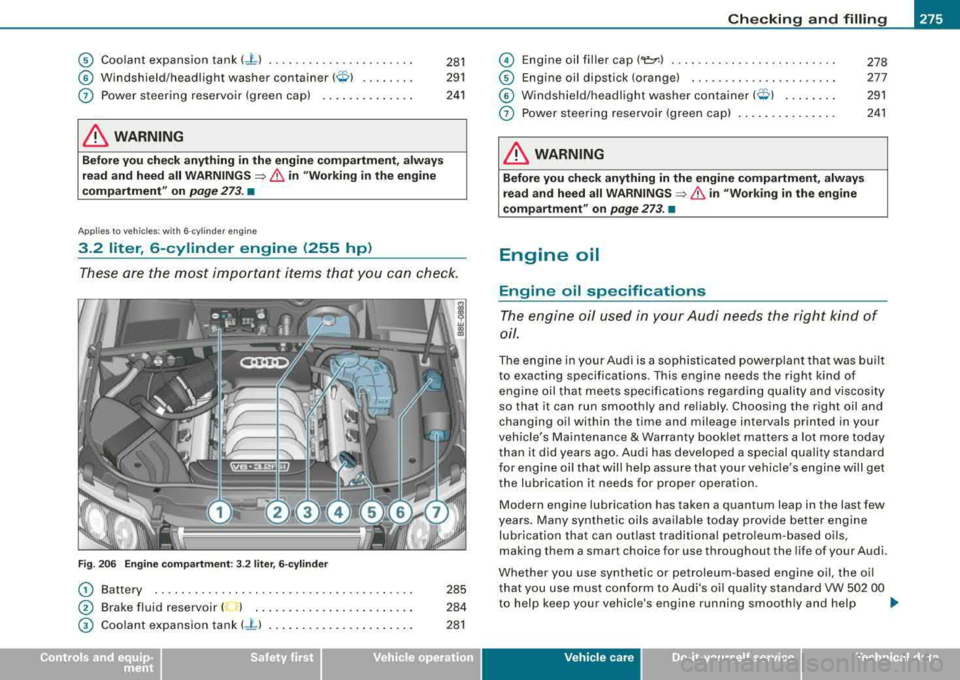
Applies to vehicles: with 6 -cy lin d er engine
3.2 liter , 6-cylinder engine (255 hp)
281
291
241
These are the most important items that you can check.
Fig . 206 Engine compartment: 3 .2 liter , 6-cylinder
CD
0
©
Battery .. ............... ... .. ...... .... ...... .
Brake fluid reservoir (
... ) . .. ... ... .... .... ...... .
Coo lant expansion tank
(J _)
285
284
281
©
©
©
(i)
Engine oil filler cap (
Windshield/headlight washer container
( O ) ... .... .
Power steering reservoir (green cap)
& WARNING
Before you check anything in the engine compartment , always
read and heed all WARNINGS
=> & in "Working in the engine
compartment" on
page 273. •
Engine oil
Engine oil specifications
278
277
291
241
The engine oil used in your Audi needs the right kind of
oil.
The engine in your Audi is a sophisticated powerplant that was built
to exacting specifications . This engine needs the right kind of
engine oil that meets specifications regarding quality and viscosity
so that it can run smoothly and re liably . Choosing the right oil and
changing oil within the time and mileage intervals printed in your
vehicle's Maintenance
& Warranty booklet matters a lot more today
than it did years ago. Audi has developed a special quality standard
f or engine oil that wil l help assure that your vehicle's engine wi ll get
the lubrication it needs for proper operation .
Modern engine lubrication has taken a quantum leap in the last few
years. Many synthetic oils available today provide better engine
lubrication that can outlast traditional petroleum-based oils,
making them a smart choice for use throughout the life of your Audi .
Whether you use synthetic or petroleum -based engine oil, the oil
that you use must conform to Audi's oi l quality standard VW 502 00
to help keep your vehicle 's engine running smoothly and help
.,_
Ve hic le care Technical data
Page 279 of 368

Checkin g a nd fillin g --------------~~~-
the form of Service or Repair Orders that all scheduled maintenance
was performed in a t ime ly manner .•
Engine oil consumption
The engine in your vehicle depends on an adequate
amount of oil to lubricate and cool all of its moving parts.
In order to prov ide effect ive lubrication and cool ing of in ternal
engine components, all internal combustion engines consume a
certain amount of o il. Oil consumption varies from engine to engine
and may change significantly over the life of the engine . Typically,
eng ines wi th a specified break -in period
(see ~ page 243) consume
more oil during the break -in period than they consume after oi l
consumption has stabi lized .
Under norma l condit ions, the rate of o il consumption depends on
the quality and viscosity of the oil, the RPM (revo lutions per minute)
at whic h the engine is operated, t he amb ient te mperature and road
conditions. Further factors are the amount of oil dilution from water
condensatio n or fuel residue and t he oxidation level of the o il. As
any engine is subject to wear as mileage builds up, the oil consump
t ion may increase over time until rep laceme nt of worn components
may become necessary .
With all these variables coming into play, no standard rate of oil consu mption can be estab lished or specified. T here is no a lternative
to regu lar and frequent checking of the oil level, see
Note .
If the yellow eng ine o il level warni ng symbol in the instrument
cluster ~ lights up, you should check the oil level as soon as
possible
with the oil dipstick ~ page 277 . Top off the o il at your
earl iest
convenience~ page 278.
& WARNING
Bef ore you che ck anything in the eng ine comp artment , alway s
read and heed all WARNINGS
~ & in "Working in the engine
c ompartment " on
page 27 3.
0 Note
Driving with an insuff ic ient oil level is l ikely to cause severe damage
to the engine.
[ i ] Tip s
• The oil pres sure warning displ ay "e:7: is n ot an indi cator of the oil
level . Do not rel y on it. Instead, check the oil level in your engine at
regular inter vals, preferably ea ch time you refuel , and al way s before
going on a long trip.
• If you have the impression your engine consumes excessive
amounts of oi l, we reco mmend that you consult your Audi dealer to
have the cause of your concern properly diagnosed . Keep in mind
that t he accurate measurement of oil consumptio n requ ires great
care and may take some time. Your Audi dealer has instructions
about how t o measure oil cons umpt ion accurately. •
Checking the engine oil level
Vehicle care
Fig. 2 07 Illu strati on of
prin ciple 1: M ark ers on
oil dip sti ck ...
Page 280 of 368
llffll...__C_ h_ e_c _k _ i_n ..::g ,_ a_n_ d_ f_il _li _n....: g==---------------------------------------------
Fig. 208 Illustra tion o f
principle 2: Markers on
oil dipstick
Before you check anything in the engine compartment,
always read and heed all WARNINGS => & in "Working in
the engine compartment" on
page 273.
Determining oil level
-Park your vehicle so that it is horizontally level.
- While at operating state temperature, briefly let the
engine run at idle and then shut
it off.
- Wait approx. two minutes.
- Pull out the oil dipstick . Wipe off the oil dipstick with a
clean cloth, and s lide it back in as far as it will go.
- Pull it back out and read off the oil level
=> page 277,
fig. 207 or=> fig . 208. Top off the engine oil, if applicable
=> page 278.
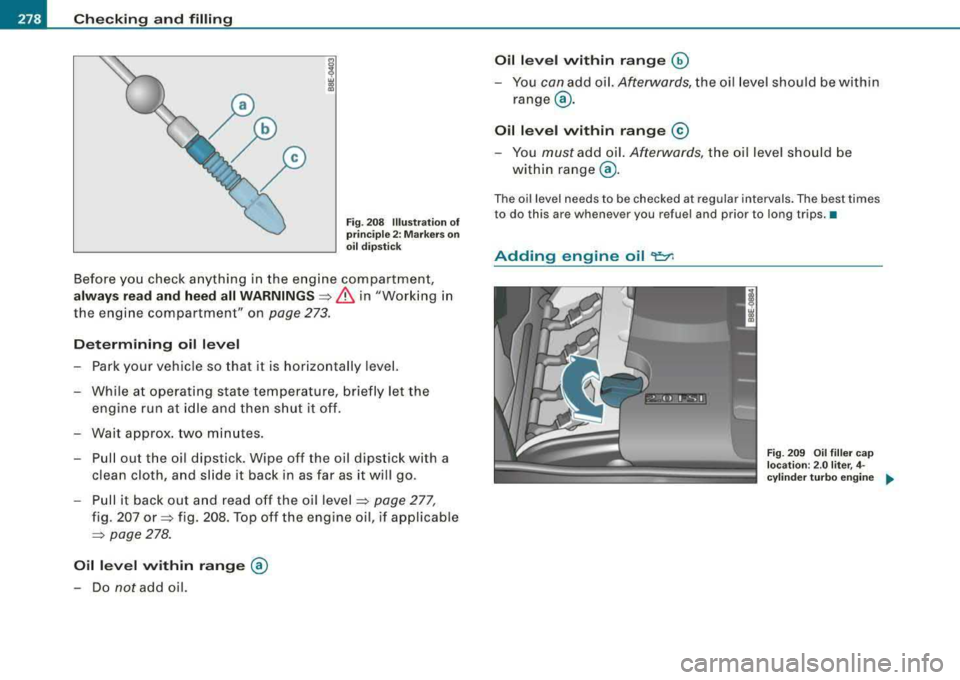
Oil level within range @
-Do not add oil.
Oil level within range ~
You can add oil. Afterwards, the oil level should be within
range @.
Oil level within range ©
-You must add oil. Afterwards, the oil level should be
within range @.
The oil level needs to be checked at regular intervals. The best times
to do this are whenever you refuel and prior to long trips. •
Adding engine oil 'l:::7:
Fig. 209 Oil filler cap
locat ion: 2.0 liter , 4-
cylinder turbo engine
...
Page 281 of 368

_____________________________________________ C_h_ e_ c
_ k_in -= g_a
_ n_d _ f_il _li _n ..;::g ;;.___.ffllll
Fig. 21 O Oil filler cap
location: 3.2 liter, V6-
engine
Before you check anything in the engine compartment,
always read and heed all
WARNINGS=> & in "Working in
the engine compartment" on
page 273.
-Turn off the engine.
Unscrew the cap
"t=:r. to the engine oil filling hole
=> page 278, fig. 209 or=> fig. 210.
-Carefully top off with the appropriate oil in 0.5 liter doses.
-Check the oil level again after two minutes=> page 277.
-Top off the oil again, if necessary.
-Screw the cap back on the filling hole and slide the oil
dipstick in as far as it will go.
& WARNING
• While topping off, the oil must not come in contact with hot
engine parts
-fire hazard!
& WARNING (continued)
• The oil filler cap must be properly secured to prevent oil from
being sprayed on the hot engine and exhaust system when the
engine is running
-fire hazard!
• If your skin has come in contact with the engine oil, you must
subsequently cleanse it thoroughly.
0 Note
• The oil level must not be above range @-danger of converter or
engine damage! Contact an authorized dealership to draw off oil, if
necessary.
• Audi does not recommend the use of oil additives. They may
damage the engine and adversely affect your New Vehicle Warranty.
ffi For the sake of the environment
• Under no circumstances can the oil come in contact with the
sewage network or the soil.
• Observe and follow legal regulations when disposing of empty
oil containers. •
Changing the engine oil
We recommend that have your oil changed by an autho
rized Audi dealer or a qualified service station.
Before you check anything in the engine compartment, always read
and heed all WARNINGS =>
& in "Working in the engine compart
ment" on
page 273.
The engine oil must be changed according to the intervals specified
in your Maintenance
& Warranty booklet. This is very important
because the lubricating properties of oil diminish gradually during
normal vehicle use.
.,.
Vehic le care irechnical data
Page 284 of 368

___ C_ h_ e_c _k _ i_n ~g _ a_n_ d_ f_il _li _n_ g~--------------------------------------------
-Read the engine coolant level in the open coolant expan
sion
tank => fig. 211. With a cold engine, the coolant level
should be between the "min" and "max" markings. When
the engine is warm, the level may be slightly above the "max" marking.
The location of the coolant expansion tank can be seen in the
engine compartment
illustration=> page 275 .
To obtain an accurate reading, the engine must be sw itched off.
The expansion tank in your vehicle is equipped with an electric
coolant level sensor.
When the coolant level is too low, the warning light in the Auto
Check System
=> page 31 will blink until you add coolant and the
level has been restored to normal. Even though there is an electric
coolant level sensor, we still recommend you check the coolant level
from time to time.
Coolant loss
Coolant loss may indicate a leak in the cooling system . In the event
of coolant loss, the cooling system should be inspected immedi
ately by your authorized Audi dealer . It is not enough merely to add
coolant.
In a
sealed system, losses can occur only if the boiling point of the
coolant is exceeded as a result of overheating.
& WARNING
The cooling system is under pressure and can get very hot. Reduce
the risk of scalding from hot coolant by following these steps.
• Turn off the engine and allow it to cool down.
• Protect your face, hands and arms from escaping fluid and
steam by covering the cap with a large, thick rag.
& WARNING (continued)
• Turn the cap slowly and very carefully in a counter-clockwise
direction while applying light, downward pressure on the top of
the cap.
• To avoid being burned, do not spill antifreeze or coolant on the
exhaust system or hot engine parts. Under certain conditions, the
ethylene glycol in engine coolant can catch fire.
0 Note
Do not add any type of radiator leak sealant to your vehicle's engine
coolant. Adding radiator repair fluid may adversely affect the func
tion and performance of your cooling system and could result in damage not covered by your New Vehicle Limited Warranty. •
Adding coolant
Be very careful when adding engine coolant.
Before you check anything in the engine compartment,
always read and heed all WARNINGS => & in "Working in
the engine compartment" on
page 273.
-Turn off the engine.
-Let the engine cool down.
-Place a thick rag over the coolant expansion tank
=> page 281 , fig. 211 and carefully twist the cap counter
clockwise
=> & .
-Add coolant.
-Twist the cap on again tightly.
Replacement engine coolant must conform to exact spec ifications
=> page 280, "Coolant". If in an emergency coolant additive G12 + is .,,
Page 296 of 368
___ T_ ir_e _ s_ a_ n
_ d_ w_ h_ e_ e_ls _________________________________________________ _
&, WARNING (continued)
crashes and serious personal injuries . Have worn or damaged tires
replaced immediately.
• Tires age even if they are not being used and can fail suddenly,
especially at high speeds. Tires that are more than 6 years old can
only be used in an emergency and then with special care and at
low speed.
Glossary of tire and loading terminology
Accessory weight
means the combined weight (in excess of those standard items
which may be replaced) of automatic transmission, power steering,
power brakes, power windows, power seats, radio, and heater, to
the extent that these items are available as factory-installed equip
ment (whether installed or not).
Aspect ratio means the ratio of the height to the width of the tire in percent.
Numb ers of 55 or lower indicate a low sidewall for improved
steering response and better overall handling on dry pavement.
Bead means the part of the tire that is made of steel wires, wrapped or
reinforced by ply cords and that is shaped to fit the rim.
Bead separation
means a breakdown of the bond between components in the bead.
Cord
means the strands forming the plies in the tire.
&, WARNING (continued)
• Never mount used tires on your vehicle if you are not sure of
their "previous history." Old used tires may have been damaged
even though the damage cannot be seen that can lead to sudden
tire failure and loss of vehicle control.
• If you notice unusual vibration or if the vehicle pulls to one side
when driving, always stop as soon as it is safe to do so and check
the wheels and tires for damage.
•
Cold tire inflation pressure
means the tire pressure recommended by the vehicle manufacturer
for a tire of a designated size that has not been driven for more than
a couple of miles (kilometers) at low speeds in the three hour period
before the tire pressure is measured or adjusted .
Curb weight
means the weight of a motor vehicle with standard equipment
including the maximum capacity of fuel, oil, and coolant, air condi
tioning and additional weight of optional equipment.
Extra load tire
means a tire designed to operate at higher loads and at higher infla
tion pressures then the corresponding standard tire. Extra load tires
my be identified as "XL", "xi", "EXTRA LOAD", or
"RF" on the side
wall.
Gross Axle Weight Rating ("GAWR")
means the load-carrying capacity of a single axle system, measured
at the tire-ground interfaces .
Gross Vehicle Weight Rating ("GVWR")
means the maximum total loaded weight of the vehicle.
Page 306 of 368
___ T_ ir_e _ s_ a_ n
_ d_ w_ h_ e_ e_ls _________________________________________________ _
make, there w ill be six to eight of t hem evenly p laced around the
tir e. M arks o n the tire s idewall ( for example "TWI " or oth er sy mb ols)
indicate th e positions of the tread wear indicators. Worn tires must
b e re placed . Di fferen t fig ure s m ay apply i n other
c ountr ies=> & .
Tire pressure
Incorr ect tir e p ress ure c auses prematu re wear a nd can ca use
sudden tir e blow -out . For th is r eason, tir e pressur e must b e check ed
at leas t once a month
=> pa ge 299 .
Dri ving style
Drivi ng fa st aro und curv es, heavy acce le ra ti on and ha rd bra kin g
increase tire wear .
Rotating tires for more even wear
For all four tires on your vehic le to have the same service life, we
r ecom mend t hat the front a nd rea r tires ar e rotate d accord ing to the
tire manufacturer 's suggested tire rotation interva ls. Please
r e m emb er t he fo llo wi ng :
• Ti re rotation interva ls m ay d iffer from th e vehic le servic e inter
vals outl ined in y our M aintenance and Warran ty Boo kle t.
• T he longer one tire is used in one location on the vehicle, the
mor e it wea rs a t ce rtain points ; the re fo re, we rec omm end that yo u
fo llow t he ti re manufactu rer's su ggested tir e rotat ion int ervals .
• Vehi cle s with front -wh eel d rive e xper ience mo re trea d wea r on
the front wheels compared to al l-wheel drive (quattro®l .
• Ple as e ro tat e ti res as
sh ow n=> page 303, fig. 220.
• Extra care must be taken when rotating direction -specific tires
=> pag e 32 4.
Wheel balancing
T he wheels on n ew vehic les are bala nced. However, various situa
tions during eve ryday driving can cause them to become unba l
ance d, res ulting i n vi brat ions you ca n us ual ly f eel thro ugh t he
steering whee l. U
nba lanc ed wh eels must be rebalanced to avoid excessive wear on
s tee ring, s uspen sio n an d tir es. A w heel m ust also be reba la nced
when a new tire is install ed.
Incorrect wheel alignment
Incorrect whee l alignment can cause excessive tire wear, impairing
t he sa fety o f the vehicl e. If ti res sh ow ex cessiv e w ear, h av e the
whee l al ignm ent check ed by an autho riz ed Aud i d eal er or qualifi ed
w ork shop.
All Wheel Drive
Ve hicl es wi th qu attr o® must alw ays h ave t ires of t he sa me siz e,
construction and tread type . For deta ils
see=> page 242 .
& WARNING
Sudden tire failure can lead to loss of control , a crash and serious
personal injury!
• Never drive a vehicle when the tread on any tire is worn down
to the wear indicators .
• Especially in wet and slick driving situations , a preferably large
profile depth of the tires is necessary , and an approximately
similar profile depth of the front and rear axle tires.
• The diminished driving safety , caused by too small of a tire
profile, is negatively perceivable especially in handling , in danger
of hydroplaning when driving through deep puddles and ponds,
when driving around curves , and in braking behavior.
• Worn tires are a safety hazard , they do not grip well on wet
roads and increase your risk of "hydroplaning" and loss of control.
• Always keep chem icals that can cause tire damage , such as
grease, oil, gasoline and brake fluid away from tires .
• Tires age even if they are not being used and can fail suddenly ,
especially at high speeds. Tires that are more than 6 years old can
only be used in an emergency and then with special care and at
lower speeds .
~
Page 337 of 368

Emergency situations -
----------------=-=---
Rear hook up
These s te p s app ly fo r w in chi ng the vehi cle on to a car
c arr ier w ith the re a r f ir st.
- Have the vehic le ali gne d cent ered wi th the ca r carr ier
r a mp.
- Attach the win ch hook to t he
rear to wline eye
=> pa ge 334, fig. 237 .
- On ce th e ca r is po sit io ned on t he car ca rrie r, ha ve safety
c hain (s ) a ttach ed t o the
fron t towline eye => pag e 333an d
ti ghte ned .
[ i] Tips
Chec k carefu lly to ma ke sure the veh icle is hoo ked up securel y
b ef ore mov ing the ca r up the ca r ca rrier r amp. •
Lifting the vehicle
Important safety precautions
Be aware of the following hazards before l ift ing the vehic le w ith a
w ork sho p ho is t or f lo or jack :
• The vehicle should never be lifted or jacked up from underneath
the engine oil pan, the transmission housing , the front or rear axle
or the body side members . This could lead to serious damage.
• Use lifting equipment with padded contact surfaces to avoid
damage to the underbody or chassis frame.
• Alternatively, cover the contact surfaces on workshop hoist or
floor ja ck with rubber pads before lifting.
• Before driving over a workshop hoist , check that the vehicle
weight does not exceed the permissible lifting capacity of the hoist. •
Before driving over a workshop hoist , ensure that there is suffi
cient clearance between the hoist and low parts of the vehicle .
& WARNING
To reduce the risk of serious injury and vehicle damage:
• Always lift the vehicle only at the special workshop hoist and
floor jack lift points illustrated
=> fig . 239 and => fig . 240 .
• Failure to lift the vehicle at these points could cause the vehicle
to tilt or fall from a lift if there is a change in vehicle weight distri
bution and balance . This might happen, for example, when heavy
components such as the engine block or transmission are
removed .
• When removing such heavy components, anchor vehicle to
hoist or add corresponding weights to maintain the center of
gravity . Otherwise , the vehicle might tilt or slip off the hoist ,
causing serious personal injury .
•
Do-it -yourself service