engine oil AUDI A4 AVANT 2008 User Guide
[x] Cancel search | Manufacturer: AUDI, Model Year: 2008, Model line: A4 AVANT, Model: AUDI A4 AVANT 2008Pages: 368, PDF Size: 46.19 MB
Page 246 of 368
llffll.,__ __ D_r_ iv _ in_.... g,_ a_n_ d __ e_n _v_ ir_o_ n_ m_ e_n_ t _____________________________________________ _
New brake pads
Remember that new brake pads do not have a full braking
effec t during the first 250 miles (400 kilometers) after they
are i nstalled .
New brake pads have to be "burn ished in" befo re they have opti mal
grab =>& .
During the break -in period, you s hou ld avo id putti ng severe loads
on the brakes . Severe loads include, for examp le, sudden hard
braking, in particular at very h igh speeds or, for example, on moun
t ain passes .
& WARNING
New brake p ad s don't h ave th e be st sto pping p ower a nd mu st b e
" brok en -in " durin g th e initial 100 to 1 50 mil es (150 t o 200 kil ome
t e rs) of norm al cit y dri ving . You can comp en sa te for thi s by
pr ess ing the brak e ped al mor e firmly . Thi s al so appli es later when
ne w pad s a re in sta lled. •
Catalytic converter
It is very important that your emission control sys tem
(catalytic conver ter) is functioning properly to ensure that
y o ur vehicle is running in an environmentally sound
manner.
-Always use lead-free gasoline => page 267, "Fuel supply".
-Never run the tank down a ll the way to empty.
-Never put too much motor o il in your engine => page 278,
"Add ing eng ine oil
The catalytic converter is an efficient "clean-up " device built into the
exhaust system of the vehicle. The catalyt ic converter burns many
of the po llutants in the exhaust gas before they are released into the
atmosphere.
T he exc lusive use o f un leaded fue l is critica lly important for the l ife
of the catalytic converter and proper functioning of the engine.
& WARNING
• Do not park or operate th e veh icle in ar eas wh ere the hot
ex hau st sys tem m ay come in contac t w ith dr y gra ss, bru sh , fuel
s pill or other material which can cau se a fire .
• Do not appl y additi ona l under coating or ru stpr oofing on or
ne ar the e xhau st m anifol d, ex haust pipe s, ca ta lytic converter or
he at shield s. Du ring dri ving , the sub sta nce u sed f or under coating
c ould overhe at and cau se a fir e.
0 Note
• Be aware that just one tank filling with leaded fue l wi ll already
ser iously degrade the performance of the catalyt ic converter.
• Do not exceed the correct engine oi l
level=> page 278.
• Do not drive until the fuel tank becomes comp letely empty . The
engine could misfire . Unburned fuel could also get into the exhaust
system and this could cause the catalytic conver ter to overheat .
• Do not turn off the ignition wh ile the vehicle is moving.
• Do not continue to operate your vehicle under these conditions,
as otherwise fuel can reach the cata lyt ic converter . This cou ld result
in overheating of the converter, requiring its rep lacement .
• To assure eff icient operat ion of the Em iss ion Control System:
- Have your vehicle maintained properly and in accordance with
the service recommendations in your Maintenance
& Warranty
booklet.
..,
Page 247 of 368
______________________________________________ D_ ri_v _ i_ n _, g..,_ a_ n_d _ e_ n_ v_i_r o_ n_m_ e_ n_t _____ ffllll
- Lack of proper maintenance as wel l as improper use of the
vehic le wi ll impair the func tion of the emission control system
and cou ld lead to damage .
<£> For the sake of the envir onm ent
Even when the Emission Control System is operating properly, the
exhaust gas can have a su lfur -like exhaust gas sme ll under some
operat ing states . Th is depends on the sulfur content of the fuel
being used. Using a different brand of fue l may he lp, or fil ling the
tank with lead -free super grade gasol ine. •
Avoid damaging the vehicle
When you are driving on poor roads, or over curbs, steep ramps,
e tc., make certain that low- lying parts such as spoilers and exhaust
system parts do not bottom out and get damaged.
This is especial ly true for vehicles with low -s lung chassis (sports
chassis)* and ful ly loaded vehicles .•
Operate your vehicle economically
and minimize pollution
General
Y o ur personal style of driving will determine the economy
of your vehicle, as well as exhaust and noise levels.
Fuel economy, env ironmental impact, and wear on your engine,
brakes and t ires largely depend on three factors :
• your personal driving sty le
• operat ing cond it ions
• technica l limitat ions
Controls and equip
ment Safety first Vehicle operation
If you anticipate what you need to do next and drive economica
lly,
you can easily cut your fuel consumptio n by 10 -15 percent . This
section wil l give you some tips on how you can help the environ
ment and your pocketboo k.
[ i ] Tips
The cons umption estimates as pub lished by ENV IRO NM EN TAL
PRO TECTION AGENCY (EPA) and Transport Canada may not corre
spond to your actua l consumption on the road, which wi ll vary
depending upon veh icle load and speed, road and weather condi
tions, trip length, etc. •
Drive smoothly and keep a lookout ahead
Vehicles use the most fuel when they ore accelerating .
-Avoid unnecess ary accelerating and brak ing.
Vehic les use the most fue l when they are accelerating . If you ant ici
pate what is going to happen ne xt, you wi ll need to brake less and,
thus , acce lerate less. Let the vehicle coast whenever poss ib le -for
examp le when you see that the next traffic light is red. •
Avoid full throttle
Driving at moderate speeds saves fuel and improves your
mileage.
- Try and keep we ll below your car 's max imum speed.
Acce lerating gent ly reduces fue l consump tion , engine wear, and
does no t disturb the environme nt.
Fue l consumption, exhaust emissions and engine noise increase
disproportionately at h ig h speeds . If you drive at approx imate ly
three quarters of top speed, fuel consumpt ion wil l be reduced by _,,,
Vehicle care Do-it-yourself service Technical data
Page 248 of 368

lffll.,__ __ D_r_ i_v _i_n _.g..,_ a_ n_d_ e_ n_v _ i
_ r_o _ n_ m_ e_ n_ t _______________________________________________ _
one half. Never drive faster than the posted speed limit and weather
conditions permit. •
Reducing unnecessary idling
Even when your car is just idling it burns up fuel.
- Shut the engine off when you are not driving the vehicle .
- Do not warm up the vehic le by letting the engine run at
id le .
It makes sense to shut off the engine in traff ic jams, when waiting
for tra ins to pass at rai lroad crossings , or at traffic lights that have
long waits on red. Turning the engine off for just 30 -40 seconds
saves more fue l than is burned starting the engine again .
It takes a long time for the engine to warm up fu lly when it is
running at idle. However, wear and noxious emiss ions are espec ially
high when the engine is warming up . So you should drive away as
soon as you sta rt the engine and avoid running at high rpms w hile
the engine is sti ll warming up.
0 Note
Do not leave engine idling unattended after starting . If warning
lights should come on to indicate improper operation, they would
go unheeded. Extended id ling also produces heat, which could
resu lt in overheating or other damage to the vehic le or other
property .•
Regular maintenance
A badly tuned engine unnecessarily wastes a lot of fuel.
- Have your ve hicle serviced at regular intervals .
By having your vehicle regularly serviced by an Audi dealer helps to
ensure that it runs properly and economical ly . The cond ition of your
vehic le not only affects its safety and abi lity to hold its value, it also
affects
fuel consumpt ion .
Check your oil ea ch time you fill your t ank .
The amount of oil used is related to engine load and speed.
I t is norma l for the oi l consumption of a new engine to reach its
lowest value after a certain mi leage has been driven.
You must drive your vehicle about 3,000 miles (5,000 kilometers) before you can properly assess oil consumption .
This also applies to fue l consump tion and engine output .
0 Note
• Have your vehicle maintained properly and in accordance with
t he service recom mendat io n s in your Maintenance
& Wa rranty
booklet. Lack of proper ma intenance as well as improper use of the
vehic le wi ll impai r the function of the emission cont rol system and
cou ld lead to damage.
• Do no t alte r or remove any component of the Emission Contro l
System unless approved by the manufacturer .
• Do not alte r or remove any dev ice, such as heat shields,
switches, ignition wires, valves, which are designed to protec t your
vehic le's Emission Control System and other important veh ic le
components .•
Fewer short trips
Fuel consumption will alw ays be rel atively high on short
t r ips.
- Try to avo id driving short dis ta n ces wi th a cold engine. ~
Page 267 of 368

_______________________________________________ C_l_ e _a_ n_ in---= g'-- a_n_ d
_.:.. p_r_o _ t_ e_ c_ t·_
1o _ n __ l9III
Safety belts
Only well-maintained safety belts work reliably when
needed.
- Keep belts clean.
- For cleaning, use a mild soap and water solution. Let
belts dry thoroughly and away from direct sunlight.
- Do not allow inertia reel safety belts to retract before
they are completely dry.
- Check the condition of your safety belts
regularly.
Heavily soiled safety belts may not retract properly.
& WARNING
Damaged safety belts can break in a crash.
• Anything that might damage your safety belts could mean that
you and your passengers would not be adequately protected in an
accident.
• Safety belt performance depends on correct installation. Never
remove belts from the vehicle to clean them.
• Do not use chemical cleaning agents, bleach or dyes. They have
corrosive properties which weaken the webbing.
• When cleaning your safety belts, inspect them for damage. If
you discover damage, see your Audi dealer.
• Always read and heed all WARNINGS and the information
=> page 254. •
Engine compartment
Be especially careful when cleaning the engine compart
ment.
Always switch off the ignition before cleaning the engine => &.
Plenum panel
Remove leaves from the plenum panel in front of the windshield
under the engine hood. This prevents the water drain holes from
becoming blocked, and it prevents debris from entering the vehicle
interior through the heating and ventilation ducts .
Corrosion protection
The engine compartment and transmission have been corrosion
protected at the factory.
Good anti-corrosion treatment is very important, particularly in the
winter. If the vehicle is frequently driven on salt treated roads, the
entire engine compartment and plenum panel should be thor
oughly cleaned at the end of winter and retreated to prevent salt
damage. At the same time, the underside of the vehicle should be
washed as well.
If the engine compartment is cleaned at any time with grease
removing solutions
21 , or if you have the engine washed , the anti
corrosion treatment is almost always removed as well. It is therefore
essential to have a long-lasting corrosion protection reapplied to all
surfaces, seams, joints and components in the engine compart
ment.
& WARNING
Be aware: the engine compartment of any motor vehicle is a
potentially hazardous area.
• Before working in the engine compartment, be sure to read the
information
=> page 265 . .,,_
21 Use only the corr ect cleaning solutions. Never use gasoline or diesel fuel.
Vehicle care
Page 276 of 368

lffll...__C_ h_ e_c _k _ i_n ..::g ,_ a_n_ d_ f_il _li _n....: g==-- --------------------------------------------
& WARNING (continued )
-Other components of the high voltage electronic ignition
system .
• If you must perform a che ck or repair with the engine running:
- Fir st, fully apply the parking brake , move selector lever of
automatic transmission to
" P " (Park ); put manual transmission
in Neutral.
- Alway s use extreme caution to prevent clothing , jewelry , or
long hair from getting caught in the radiator f an, V -belts or
other moving part s, or from contacting hot parts. Tie ba ck hair
before starting , and we ar no clothing that will hang or droop
into the engine.
• Min imize e xposure to emission and chemical hazards
=> & .
& WARNING
California Proposition 65 Warning :
• Engine exhaust , some of its constituents , and certa in vehicle
c omponents contain or emit chemicals known to the State of Cali
fornia to cause cancer and birth defects and reproductive harm . In
addition , certain fluids contained in vehicles and certain products
of component wear contain or emit chemical s known to the State
of California to cause cancer and birth defects or other reprodu c
tive harm.
• Battery posts, terminal s and related accessories contain lead
and lead compounds , chemicals known to the State of California
to cause cancer and reproductive harms . Wash hands after
handling.
0 Note
When a dding f luids, always make sur e tha t they are poured i nto the
prop er container or filler opening, otherwise serious damage to
ve hicle syste ms wi ll occur .
ffi For the sake of the environment
To detect leaks i n time, inspect the veh icle floor pan from unde r
neath regularly. If you see spots from oil or other vehicle fluids, have
your veh ic le i nspected by a n authori zed Audi dealer. •
Engine compartment
Applies to v ehic les: with 2 .0 I tur bo, 4-cy linder -e n gi ne
2 .0 I, 4-cy linder turbo engine (200 hp)
T hese are th e mo st impo rtant items that you ca n check .
Fig . 205 Engine comp artment : 2 .0 I , 4-cylind er turbo
G) Battery ... ..... .. ... .... ... ...... ... .. .. ... .. .
0 Engine oil fil le r cap (
© Engine oil dipstick ( orange) .. .... .. .... .... ... .. .
285
2 78
2 8 4
277 ....
Page 277 of 368
Checking and filling -
------------ ----=---a::;;._...a
©
©
(i)
Coolant expansion tank ( ... L) ...... ... .. ..... .. ... .
Windshield/headlight washer container
( 0 ) ...... . .
Power steering reservoir (green cap)
& WARNING
Before you check anything in the engine compartment, always
read and heed all WARNINGS
=> & in "Working in the engine
compartment" on
page 273. •
Applies to vehicles: with 6 -cy lin d er engine
3.2 liter , 6-cylinder engine (255 hp)
281
291
241
These are the most important items that you can check.
Fig . 206 Engine compartment: 3 .2 liter , 6-cylinder
CD
0
©
Battery .. ............... ... .. ...... .... ...... .
Brake fluid reservoir (
... ) . .. ... ... .... .... ...... .
Coo lant expansion tank
(J _)
285
284
281
©
©
©
(i)
Engine oil filler cap (
Windshield/headlight washer container
( O ) ... .... .
Power steering reservoir (green cap)
& WARNING
Before you check anything in the engine compartment , always
read and heed all WARNINGS
=> & in "Working in the engine
compartment" on
page 273. •
Engine oil
Engine oil specifications
278
277
291
241
The engine oil used in your Audi needs the right kind of
oil.
The engine in your Audi is a sophisticated powerplant that was built
to exacting specifications . This engine needs the right kind of
engine oil that meets specifications regarding quality and viscosity
so that it can run smoothly and re liably . Choosing the right oil and
changing oil within the time and mileage intervals printed in your
vehicle's Maintenance
& Warranty booklet matters a lot more today
than it did years ago. Audi has developed a special quality standard
f or engine oil that wil l help assure that your vehicle's engine wi ll get
the lubrication it needs for proper operation .
Modern engine lubrication has taken a quantum leap in the last few
years. Many synthetic oils available today provide better engine
lubrication that can outlast traditional petroleum-based oils,
making them a smart choice for use throughout the life of your Audi .
Whether you use synthetic or petroleum -based engine oil, the oil
that you use must conform to Audi's oi l quality standard VW 502 00
to help keep your vehicle 's engine running smoothly and help
.,_
Ve hic le care Technical data
Page 278 of 368
___ C_ h_ e_c _k _ i_n ~g _ a_n_ d_ f_il _li _n_ g~--------------------------------------------
prevent the formation of harmful deposits, sometimes called
"sludge", that over time can lead to expensive repairs.
At the time of printing, engine oils available in the U .S . and Canada
that meet the exacting specifications of Audi oil standard VW 502 00
are synthetic engine oils. This does not mean, however, that every
synthetic engine oil will meet Audi oil standard VW 502 00. So
always be sure that you use an approved oil.
To help prevent the formation of harmful deposits use only oil with
the following specifications printed on the oil container:
Audi oil standard VW 502 00
Oil container labels may carry the specification singly or in combi
nation with other designations and oil quality standards.
Viscosity
Engine oils are graded according to their viscosity. The proper
viscosity grade oil for your engine depends on climactic or seasonal
condi tions where you drive. You can use oil wi th a viscosity grade of
SAE 5W40 across all temperature ranges for normal driving condi
tions .
However, if engine oil viscosity grade SAE 5W40 is not available, you
can also use viscosity grade SAE 5W-30 or SAE 0W-40 as long as it
meets Audi oil quality standard VW 502 00 specifications.
Because engine oil that meets the Audi oil standard may not be
available everywhere when you need it, we strongly recommend
that you always carry with you an extra quart (liter) of oil that
expressly conforms to the VW 502 00 specification, in case you have
to top off the oil while on the road.
Only if the level of the oil is at or below the minimum mark on the
oil dipstick -and no oil that expressly conforms to Audi oil standard
VW 502 00 specifications is available - may you top off with a high
quality engine oil, preferably synthetic -based , that meets ACEA A3,
ACEA A5 or ACEA B5, API SL or ILSAC GF -3 specifications, but even
then, only in viscosity grades SAE 5W -40, SAE 5W -30, or SAE 0W -40 .
However, during the entire time between oil change intervals, never top off with more than a total of 0
.5 qt/liter engine oil that does not
conform to Audi oil specification VW 502 00.
For more information about engine oil that has been approved for
your vehicle, please contact either your authorized Audi dealer or
Audi Customer Relations at 1 (800) 822-2834 or visit our web site at
www.audiusa.com or www.audicanada.ca. Here you will also find a
current list of oils (manufacturers, brand names etc.) that conform
to Audi oil standard VW 502 00.
Changing the engine oil
The engine oil and oil filter must be changed according to the
mileage (kilometers) and time intervals specified in your vehicle's
Maintenance & Warranty booklet. Do not exceed these intervals -
harmful deposits from old engine oil can reduce engine perfor
mance and can lead to expensive engine repairs.
Changing the oil at the recommended intervals is so very important
because the lubricating properties of oil decrease gradually during
normal vehicle use. If you are not sure when you have your oil
changed, ask your authorized Audi Service Advisor.
Under some circumstances the engine oil should even be changed
more frequently . Change oil more often if you drive mostly short
distances, operate the vehicle in dusty areas or mostly under stop
and-go traffic conditions, or when you use your vehicle where
temperatures stay below freezing point for long periods.
Detergent additives in the oil will make fresh oil look dark after the
engine has been running for a short time. This is normal and is not
a reason to change the oil more often than recommended.
Damage or malfunctions due to lack of maintenance
It is essential that you change your oil at the recommended intervals
using only engine oil that complies with Audi oil standard
VW 502 00. Your Limited New Vehicle Warranty does not cover
damage or malfunctions due to failure to follow recommended
maintenance and use requirements as set forth in the Audi Owner's
Manual and Maintenance & Warranty booklet. Your dealer will have
to deny warranty coverage unless you present to the dealer proof in
.,_
Page 279 of 368

Checkin g a nd fillin g --------------~~~-
the form of Service or Repair Orders that all scheduled maintenance
was performed in a t ime ly manner .•
Engine oil consumption
The engine in your vehicle depends on an adequate
amount of oil to lubricate and cool all of its moving parts.
In order to prov ide effect ive lubrication and cool ing of in ternal
engine components, all internal combustion engines consume a
certain amount of o il. Oil consumption varies from engine to engine
and may change significantly over the life of the engine . Typically,
eng ines wi th a specified break -in period
(see ~ page 243) consume
more oil during the break -in period than they consume after oi l
consumption has stabi lized .
Under norma l condit ions, the rate of o il consumption depends on
the quality and viscosity of the oil, the RPM (revo lutions per minute)
at whic h the engine is operated, t he amb ient te mperature and road
conditions. Further factors are the amount of oil dilution from water
condensatio n or fuel residue and t he oxidation level of the o il. As
any engine is subject to wear as mileage builds up, the oil consump
t ion may increase over time until rep laceme nt of worn components
may become necessary .
With all these variables coming into play, no standard rate of oil consu mption can be estab lished or specified. T here is no a lternative
to regu lar and frequent checking of the oil level, see
Note .
If the yellow eng ine o il level warni ng symbol in the instrument
cluster ~ lights up, you should check the oil level as soon as
possible
with the oil dipstick ~ page 277 . Top off the o il at your
earl iest
convenience~ page 278.
& WARNING
Bef ore you che ck anything in the eng ine comp artment , alway s
read and heed all WARNINGS
~ & in "Working in the engine
c ompartment " on
page 27 3.
0 Note
Driving with an insuff ic ient oil level is l ikely to cause severe damage
to the engine.
[ i ] Tip s
• The oil pres sure warning displ ay "e:7: is n ot an indi cator of the oil
level . Do not rel y on it. Instead, check the oil level in your engine at
regular inter vals, preferably ea ch time you refuel , and al way s before
going on a long trip.
• If you have the impression your engine consumes excessive
amounts of oi l, we reco mmend that you consult your Audi dealer to
have the cause of your concern properly diagnosed . Keep in mind
that t he accurate measurement of oil consumptio n requ ires great
care and may take some time. Your Audi dealer has instructions
about how t o measure oil cons umpt ion accurately. •
Checking the engine oil level
Vehicle care
Fig. 2 07 Illu strati on of
prin ciple 1: M ark ers on
oil dip sti ck ...
Page 280 of 368
llffll...__C_ h_ e_c _k _ i_n ..::g ,_ a_n_ d_ f_il _li _n....: g==---------------------------------------------
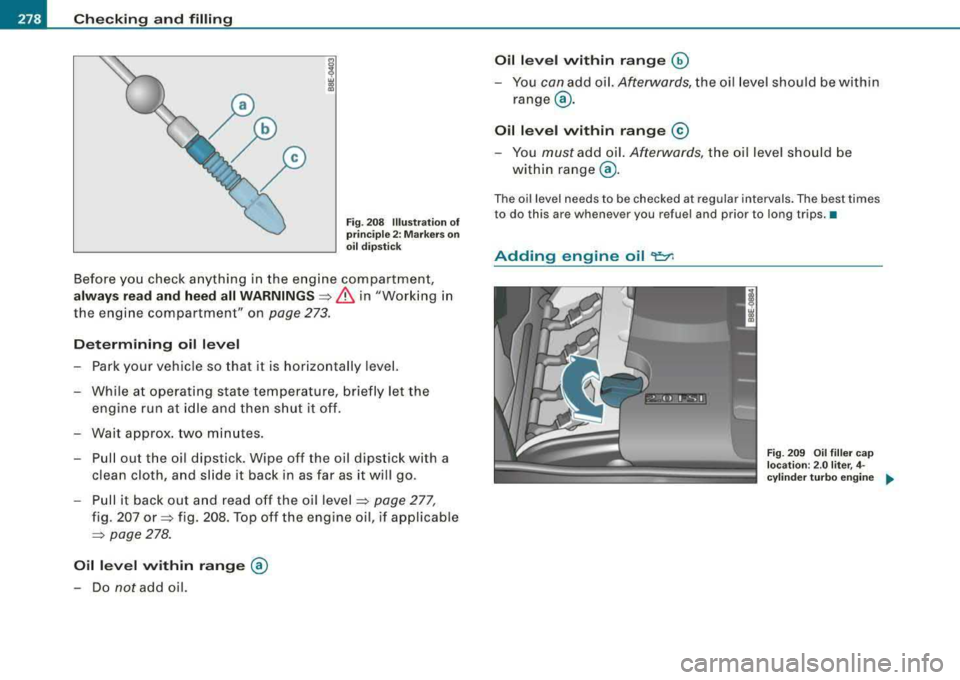
Fig. 208 Illustra tion o f
principle 2: Markers on
oil dipstick
Before you check anything in the engine compartment,
always read and heed all WARNINGS => & in "Working in
the engine compartment" on
page 273.
Determining oil level
-Park your vehicle so that it is horizontally level.
- While at operating state temperature, briefly let the
engine run at idle and then shut
it off.
- Wait approx. two minutes.
- Pull out the oil dipstick . Wipe off the oil dipstick with a
clean cloth, and s lide it back in as far as it will go.
- Pull it back out and read off the oil level
=> page 277,
fig. 207 or=> fig . 208. Top off the engine oil, if applicable
=> page 278.
Oil level within range @
-Do not add oil.
Oil level within range ~
You can add oil. Afterwards, the oil level should be within
range @.
Oil level within range ©
-You must add oil. Afterwards, the oil level should be
within range @.
The oil level needs to be checked at regular intervals. The best times
to do this are whenever you refuel and prior to long trips. •
Adding engine oil 'l:::7:
Fig. 209 Oil filler cap
locat ion: 2.0 liter , 4-
cylinder turbo engine
...
Page 281 of 368

_____________________________________________ C_h_ e_ c
_ k_in -= g_a
_ n_d _ f_il _li _n ..;::g ;;.___.ffllll
Fig. 21 O Oil filler cap
location: 3.2 liter, V6-
engine
Before you check anything in the engine compartment,
always read and heed all
WARNINGS=> & in "Working in
the engine compartment" on
page 273.
-Turn off the engine.
Unscrew the cap
"t=:r. to the engine oil filling hole
=> page 278, fig. 209 or=> fig. 210.
-Carefully top off with the appropriate oil in 0.5 liter doses.
-Check the oil level again after two minutes=> page 277.
-Top off the oil again, if necessary.
-Screw the cap back on the filling hole and slide the oil
dipstick in as far as it will go.
& WARNING
• While topping off, the oil must not come in contact with hot
engine parts
-fire hazard!
& WARNING (continued)
• The oil filler cap must be properly secured to prevent oil from
being sprayed on the hot engine and exhaust system when the
engine is running
-fire hazard!
• If your skin has come in contact with the engine oil, you must
subsequently cleanse it thoroughly.
0 Note
• The oil level must not be above range @-danger of converter or
engine damage! Contact an authorized dealership to draw off oil, if
necessary.
• Audi does not recommend the use of oil additives. They may
damage the engine and adversely affect your New Vehicle Warranty.
ffi For the sake of the environment
• Under no circumstances can the oil come in contact with the
sewage network or the soil.
• Observe and follow legal regulations when disposing of empty
oil containers. •
Changing the engine oil
We recommend that have your oil changed by an autho
rized Audi dealer or a qualified service station.
Before you check anything in the engine compartment, always read
and heed all WARNINGS =>
& in "Working in the engine compart
ment" on
page 273.
The engine oil must be changed according to the intervals specified
in your Maintenance
& Warranty booklet. This is very important
because the lubricating properties of oil diminish gradually during
normal vehicle use.
.,.
Vehic le care irechnical data