height AUDI A4 AVANT 2008 User Guide
[x] Cancel search | Manufacturer: AUDI, Model Year: 2008, Model line: A4 AVANT, Model: AUDI A4 AVANT 2008Pages: 368, PDF Size: 46.19 MB
Page 118 of 368
___ S_ e_a _t_s _ a_n_ d_ s_ t_ o_ ra~ g_e ______________________________________________ _
Roof rack installation
General information
The vehicle is equipped with integrated r oof railings. A
r oo f rack c an be used to carry additional luggage on the
r oo f.
- Always heed and read t he instructions prov ided by the
roo f rack manuf act urer when t he roof rack system must
be installed.
If a roof rack or simi lar luggage carry ing equipment is to be
insta lled, please note the fo llowing :
• T he ve hicle is eq uip ped with
integrated roof railings, which can
be covered into roof rack by installing cross bars . Only insta ll cross
b ars spec ifically des igned for this vehicle .
• These bars are the basis for a comp lete roof rack system . Addi
tio nal a ttachments are necessary to safe ly t ransport luggage, b icy
cles, surf boards, skis or small boats .
• All n ecessary har dware for these systems is ava ilable from your
authorized Audi dea ler.
When should the ro of r ac k be removed ?
• Before going through an automatic car wash (it is best to ask the
car was h operator}.
• When not in use (reduce fuel consumption, reduce wind noise
and guard agai nst theft).
_& WARNING
• Use of an unappro ved roof ra ck or incorre ct mounting of an
approved roof rack can cause the roof rack or the items carried on
it to fall off the roof onto the ro ad .
& W ARNING (continued )
• Objects falling from the roof of a vehi cle can cause a crash and
per sonal injury .
• Only mount the sy stem between the markings shown in
=> page 11 7, fig. 124.
• The roof ra ck sy stem must be installed exactly according to the
instruct ions prov ided.
0 Note
• Any damage to the vehicle caused by using roof racks or other
t ypes o f cross bars that have not been approved by Audi for y our
vehic le, or incorrect roof rack instal lation, is not covered by the
Warranty .
• Always check the roof rack mountings and hardware before each
t rip and during a trip to make s ure everyth ing is securely tightened .
If necessary, retighten the mountings and check the entire system
from time to time.
• After mounting a roof rack system, or when you transport
objects on the roo f of your vehicle, the height of the vehicle is natu
ra lly increased . Be carefu l when driving under low bridges or in
park garages for example . Th is cou ld cause damage to the vehic le
and even the load. •
Page 136 of 368
___ O_ n_ t
_ h_ e_ ro_ a_d __________________________________________________ _
On the road
Steering
Adjusting the steering wheel column
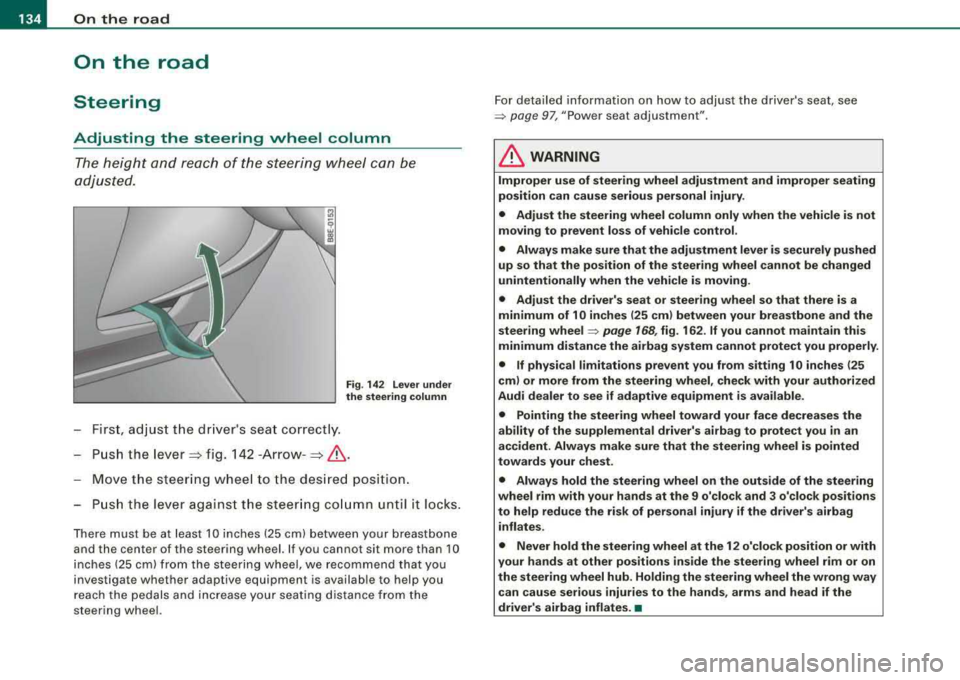
The height and reach of the steering wheel can be
adjusted.
Fig . 142 Lever under
the steering column
First, adjust the driver's seat correctly.
- Push the
lever => fig. 142 -Arrow- =>& .
Move the steering wheel to the desired position.
- Push the lever against the steering column unt il it locks.
There must be at least 10 inches (25 cm) between your breastbone
and the center of the steering wheel. If you cannot sit more than 10
inches (25 cm) from the steering wheel,
we recommend that you
investigate whether adaptive equipment is available to help you
reach the pedals and increase your seating distance from the
steering wheel. For detailed information on how to adjust the driver's seat, see
=> page 97, "Power seat adjustment"
.
& WARNING
Improper use of steering wheel adjustment and improper seating
position can cause serious personal injury .
• Adjust the steering wheel column only when the vehicle is not
moving to prevent loss of vehicle control.
• Always make sure that the adjustment lever is securely pushed
up so that the position of the steering wheel cannot be changed
unintentionally when the vehicle is moving.
• Adjust the driver's seat or steering wheel so that there is a
minimum of 10 inches (25 cm) between your breastbone and the
steering
wheel ~ page 168, fig. 162. If you cannot maintain this
minimum distance the airbag system cannot protect you properly.
• If physical limitations prevent you from sitting 10 inches (25
cm) or more from the steering wheel, check with your authorized
Audi dealer to see if adaptive equipment is available.
• Pointing the steering wheel toward your face decreases the
ability of the supplemental driver's airbag to protect you in an
accident. Always make sure that the steering wheel is pointed
towards your chest .
• Always hold the steering wheel on the outside of the steering
wheel rim with your hands at the 9 o'clock and 3 o'clock positions
to help reduce the risk of personal injury if the driver's airbag inflates.
• Never hold the steering wheel at the 12 o'clock position or with
your hands at other positions inside the steering wheel rim or on
the steering wheel hub. Holding the steering wheel the wrong way
can cause serious injuries to the hands, arms and head if the
driver's airbag inflates.
•
Page 168 of 368
___ D_ r_ i_v _in -= g'- S
_ a_f _e _lY.,_ ______________________________________________ _
Driving Safely
General notes
Safe driving habits
Please remember -safety first!
This chapter contains important information, tips, suggestions and
warnings that you need to read and observe for your own safety, the safety of your passengers and others. We have summarized here
what you need to know about safety belts, airbags, child restraints as well as child safety. Your safety is for us
priority number 1. Always
observe the information and warnings in this section
-for your own
safety as well as that of your passengers.
The information in this section applies to all model versions of your
vehicle. Some of the features described in this sections may be
standard equipment on some models, or may be optional equip
ment on others. If you are not sure, ask your authorized Audi dealer .
& WARNING
• Always make sure that you follow the suggestions and heed
the WARNINGS in this Manual. It is in your interest and in the interest of your passengers.
• Always keep the complete Owner's Literature in your Audi
when you lend or sell your vehicle so that this important informa
tion will always be available to the driver and passengers.
• Always keep the Owner's literature handy so that you can find
it easily if you have questions. •
Safety equipment
The safety features are part of the occupant restraint
system and work together to help reduce the risk of injury
in a wide variety of accident situations.
Your safety and the safety of your passengers should not be left to
chance. Advances in technology have made a variety of features
available to help reduce the risk of injury in an accident. The
following is a listing of just a few of the safety features in your Audi:
• sophisticated safety belts for driver and all passenger seating
positions,
• safety belt pre-tensioners for the outboard seating positions,
• safety belt height adjustment systems for the front seats,
• front airbags,
• side airbags in the front seats and outer rear seats* ,
• side curtain airbags (SIDEGUARD),
• special LATCH anchorages for child restraints,
• head restraints for each seating position,
• adjustable steering column.
These individual safety features can work together as a system to
help protect you and your passengers in a wide range of accidents.
These features cannot work as a system if they are not always prop
erly adjusted and properly used .
Safety is everybody's responsibility! •
Page 169 of 368
________________________________________________ D_r_iv _ i
_ n..; g::;_ S_ a_ fe---' ly'-----"'
Important things to do before driving
Safety is everybody's job! Vehicle and occupant safety
always depends on the informed and careful driver.
For your safety and the safety of your passengers, before
driving always:
- Make sure that all lights and signals are operat ing
correctly.
- Make sure that the tire pressure is correct.
- Make sure that all windows are clean and afford good
visibility to the outside.
- Secure all luggage and other items
carefully=> page 122.
-Make sure that nothing can interfere with the pedals.
- Adjust front seat, head restraint and mirrors correctly for your height .
- Instruct passengers to adjust the head restraints
according to their height.
- Make sure to use the right child restraint correctly to
protect
children => page 210, "Child Safety".
- Sit properly in your seat and make sure that your passen
gers do the
same => page 95, "General recommenda
tions".
- Fasten your safety belt and wear it properly. Also instruct
your passengers to fasten their safety belts properly
=> page 176. •
Controls and equip
ment Safety first
Vehicle operation
What impairs driving safety?
Safe driving is directly related to the condition of the
vehicle, the driver as well as the driver's ability to concen
trate on the road without being distracted.
The driver is responsible for the safety of the vehicle and all
of its occupants. If your ability to drive is impaired, safety
risks for everybody in the vehicle increase and you also
become a hazard to everyone else on the road
=>& .There
fore:
Do not let yourself be distracted by passengers or by
using a cellular telephone .
NEVER drive when your driving ability is impaired (by
medications, alcohol, drugs, etc.).
- Observe all traffic laws, rules of the road and speed limits
and plain common sense .
- ALWAYS adjust your speed to road, traffic and weather
conditions.
- Take frequent breaks on long trips. Do not drive for more
than two hours at a stretch.
- Do NOT drive when you are tired, under pressure or when
you are stressed .
& WARNING
Impaired driving safety increases the risk of serious personal
injury and death whenever a vehicle is being used. •
Vehicle care Do-it-yourself service Technical data
Page 184 of 368
___ s_a_ f_ e_ t-= y_ b_e_ l_ t _s _______________________________________________ _
& W ARNING (continued )
• Safety belts offer optimum protection only when the seat back
is upright and belts are properly positioned on the body.
• Always make sure that the rear seat backrest to which the
center rear safety belt is attached is securely latched whenever
the rear center safety belt is being used. If the backrest is not securely latched, the passenger will move forward with the back
rest dur ing sudden braking , in a sudden maneuver and especially
in a crash.
• Never attach the safety belt to the buckle for another seat.
Attaching the belt to the wrong buckle will reduce safety belt
effectiveness and can cause ser ious personal injury .
• A passenger who is not properly restrained can be ser iously
injured by the safety belt itself when it moves from the stronger
parts of the body into critical areas like the abdomen .
• Always lock the convertible locking retractor when you are
securing a child safety seat in the vehicle
=> page 222. •
Safety belt position
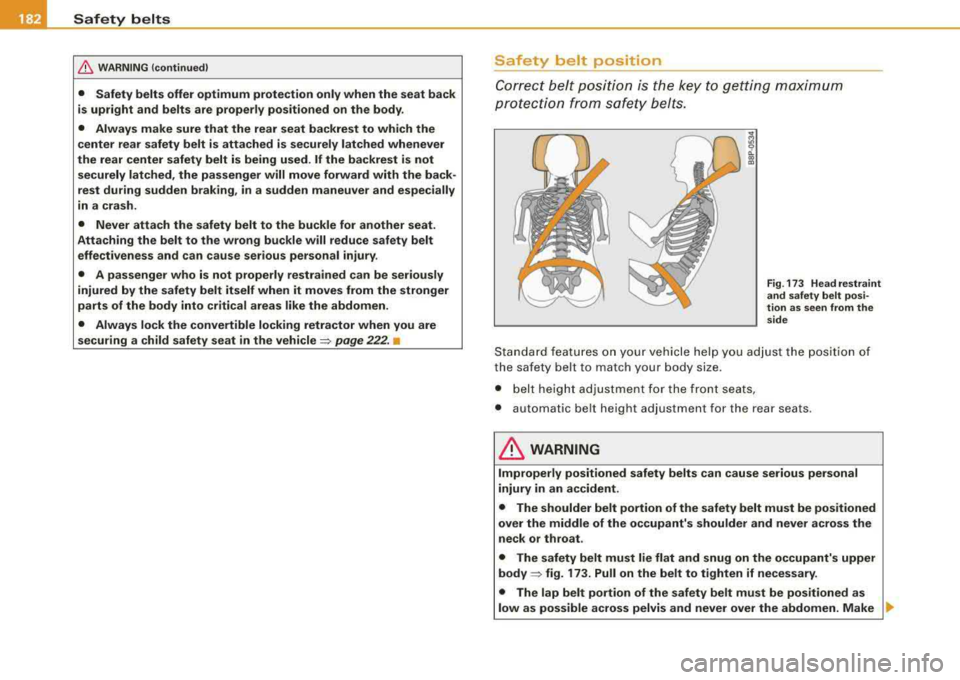
Corre ct be lt posit ion is th e key to get ting maximum
p ro te ct ion fro m sa fe ty belt s.
Fig . 17 3 Head restraint
and safety belt posi
tion as seen from the
side
Sta ndard fea tures on you r veh icl e help yo u a djust the po sit io n of
the safety belt to match your body size .
• b elt heig ht adj ustm ent for th e fron t sea ts ,
• automatic belt height ad justment for the rear se ats .
& WARNING
Improperly positioned safety belts can cause serious personal
injury in an accident .
• The shoulder belt portion of the safety belt must be positioned
over the middle of the occupant's shoulder and never across the
neck or throat.
• The safety belt must lie flat and snug on the occupant's upper
body
=> fig . 173. Pull on the belt to tighten if necessary.
• The lap belt portion of the safety belt must be positioned as
low as possible across pelvis and never over the abdomen . Make _.
Page 186 of 368
___ s_a_ f_ e_ t-= y_ b_e_ l_ t _s _______________________________________________ _
Unfastening safety belts
Unbuckle the safety belt with the red release button only
after the vehicle has stopped.
Fig . 175 Releasing the
tongue from the buckle
-Push the red release button on the buckle ~ fig. 175. The
belt tongue will spring out of the
buckle~ &,.
-Let the belt wind up on the retractor as you guide the belt
tongue to its stowed position.
& WARNING
Never unfasten safety belt while the vehicle is moving. Doing so
will increase your risk of being injured or killed. •
Adjusting safety belt height
Use the safety belt height adjustment to change belt posi
tion on the shoulder.
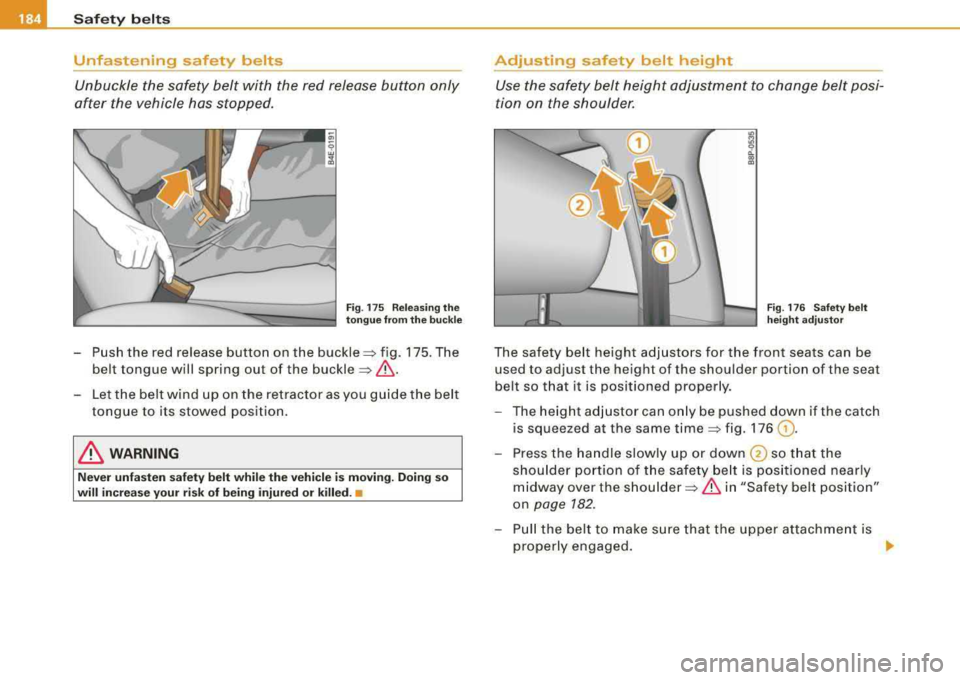
Fig . 176 Safety belt
height adjustor
The safety belt height adjustors for the front seats can be
used to adjust the height of the shoulder portion of the seat
belt so that it is positioned properly.
-The height adjustor can only be pushed down if the catch
is squeezed at the same
time => fig. 176 G).
-Press the handle slowly up or down 0 so that the
shoulder portion of the safety belt is positioned nearly
midway over the
shoulder~ &, in "Safety belt position"
on page
182.
-Pull the belt to make sure that the upper attachment is
properly engaged.
.,
Page 187 of 368

_________________________________________________ s_a _f_e _t .!,y _ b
;,;;..;; e.;.lt ;;,,; s;;...__1111
& WARNING
Always read and heed all WARNINGS and other important informa
tion
=> page 180.
[ i] Tips
The seat height adjustment on the front seats can also be used the adjust the position of the safety belts .•
Improperly worn safety belts
Incorrectly positioned safety belts can cause severe inju
nes.
Wearing safety belts improperly can cause serious injury or
death. Safety belts can only work when they are correctly
positioned on the body. Improper seating positions reduce
the effectiveness of safety belts and will even increase the
risk of injury and death by moving the safety belt to critical
areas of the body . Improper seating positions also increase
the risk of serious injury and death when an airbag deploys and strikes an occupant who is not in the correct seating position. A driver is responsible for the safety of all vehicle
occupants and especially for children. Therefore:
- Never permit anyone to assume an incorrect sitting posi
tion in the vehicle while
traveling =>& .
& WARNING
Improperly worn safety belts increase the risk of serious personal
injury and death whenever a vehicle is being used.
• Always make sure that all vehicle occupants are correctly
restrained and stay in a correct seating position whenever the
vehicle is being used.
Controls and equip ment Safety first Vehicle operation
& WARNING
(continued)
• Always read and heed all WARNINGS and other important infor
mation
=> page 180. •
Safety belt tensioner
How safety belt pretensioners work
In front, side and rear collisions above a particular
severity, safety belts in use are tensioned automatically.
The safety belts are equipped with safety belt pretensioners . The
system is activated by sensors in front, side and rear collisions of
great severity. This tightens the belt and takes up belt
slack=> & in
"Care, service and disposal of safety belt pretensioner". Taking up
the slack helps to reduce forward occupant movement during a collision .
0 Note
Never let the belt remain over a rear seat back that has been folded
forward. The rear belt pretensioner will be activated unnecessarily
in a collision and then has to be replaced .
[ i] Tips
The safety belt pretensioner can only be activated once.
• In minor frontal, side and rear -end collisions, in a rollover and in
accidents involving very little impact force, the safety belt preten
sioner are not activated.
• When the safety belt pretensioner is activated, a fine dust is
released. This is normal and is not caused by a fire in the vehicle.
• The relevant safety requirements must be observed when the
vehicle or components of the system are scrapped. A qualified
deal -_,,.
Vehicle care Do-it-yourself service Technical data
Page 296 of 368
___ T_ ir_e _ s_ a_ n
_ d_ w_ h_ e_ e_ls _________________________________________________ _
&, WARNING (continued)
crashes and serious personal injuries . Have worn or damaged tires
replaced immediately.
• Tires age even if they are not being used and can fail suddenly,
especially at high speeds. Tires that are more than 6 years old can
only be used in an emergency and then with special care and at
low speed.
Glossary of tire and loading terminology
Accessory weight
means the combined weight (in excess of those standard items
which may be replaced) of automatic transmission, power steering,
power brakes, power windows, power seats, radio, and heater, to
the extent that these items are available as factory-installed equip
ment (whether installed or not).
Aspect ratio means the ratio of the height to the width of the tire in percent.
Numb ers of 55 or lower indicate a low sidewall for improved
steering response and better overall handling on dry pavement.
Bead means the part of the tire that is made of steel wires, wrapped or
reinforced by ply cords and that is shaped to fit the rim.
Bead separation
means a breakdown of the bond between components in the bead.
Cord
means the strands forming the plies in the tire.
&, WARNING (continued)
• Never mount used tires on your vehicle if you are not sure of
their "previous history." Old used tires may have been damaged
even though the damage cannot be seen that can lead to sudden
tire failure and loss of vehicle control.
• If you notice unusual vibration or if the vehicle pulls to one side
when driving, always stop as soon as it is safe to do so and check
the wheels and tires for damage.
•
Cold tire inflation pressure
means the tire pressure recommended by the vehicle manufacturer
for a tire of a designated size that has not been driven for more than
a couple of miles (kilometers) at low speeds in the three hour period
before the tire pressure is measured or adjusted .
Curb weight
means the weight of a motor vehicle with standard equipment
including the maximum capacity of fuel, oil, and coolant, air condi
tioning and additional weight of optional equipment.
Extra load tire
means a tire designed to operate at higher loads and at higher infla
tion pressures then the corresponding standard tire. Extra load tires
my be identified as "XL", "xi", "EXTRA LOAD", or
"RF" on the side
wall.
Gross Axle Weight Rating ("GAWR")
means the load-carrying capacity of a single axle system, measured
at the tire-ground interfaces .
Gross Vehicle Weight Rating ("GVWR")
means the maximum total loaded weight of the vehicle.
Page 307 of 368
__________________________________________________ T_ ir_e _ s_ a_ n
_ d_ w_ h_ e_ e_ls _ __. 11111
/b, W ARNING (continued )
• Never mount u sed tires on your vehicle if you are not sure of
their "previou s history. " Old used ti res may ha ve been damaged
even though the damage cannot be seen that can lead to sudden
tire failu re and loss of vehicle control.
•
New tires and replacing tires and wheels
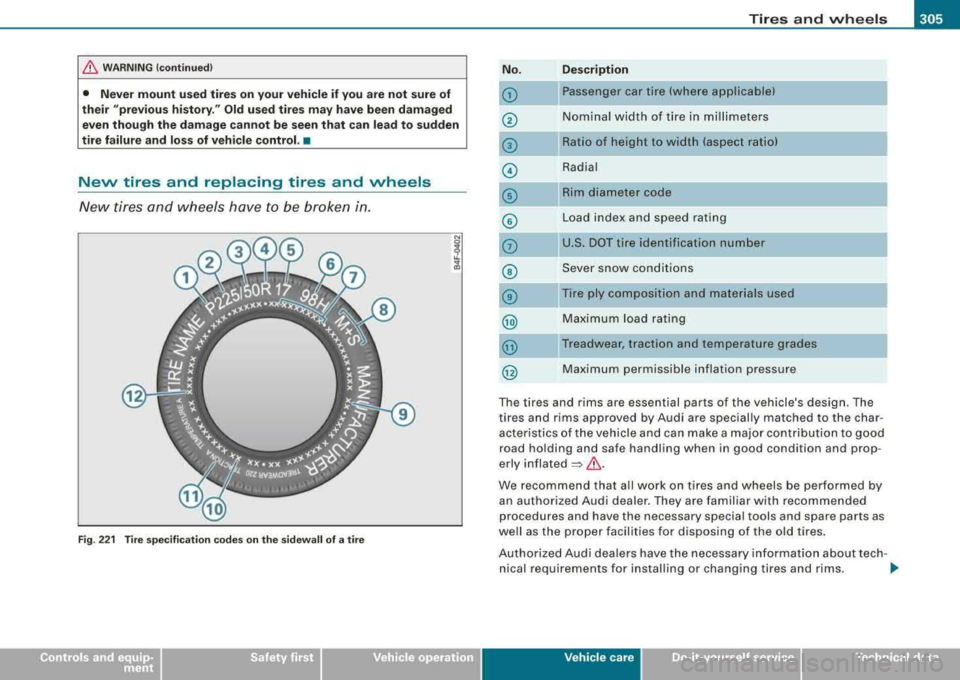
N ew tires and wheels have to be bro ken i n.
12
9
Fig . 22 1 Tire spe cificati on code s on the sidewall of a tire
No .
0
@
®
©
©
Description
Passenger car tire (where applicable)
Nominal w idth o f tire in mi llime ters
Ratio of height to width (aspect ratio)
Radia l
Rim diameter code
© Load index and speed rating
0
©
©
@)
1ju.s. DOT tire identification number
Sever snow cond itions
Tire ply composition and materials used
Max imu m load rating
@ Treadwear, traction and temperature grades
@ Maximum permissible inflation pressure
The t ires and rims are ess ential parts of the ve hicle's design . T h e
tires and rims approved by Audi are specially matched to the char
ac ter is ti cs of th e vehicle and can mak e a major contribution to good
road holding and safe hand ling when in good condition and prop
erly i nflated
=> /b, .
We recommend that a ll work on tires and wheels be perfo rmed by
an au thorized Audi dealer . They a re familia r with recommended
procedures and have the necessary specia l tools and spare parts as
we ll as the proper facilities fo r dispo sing of the o ld tires.
Authori zed Audi d ea lers have the n ecessa ry in for mati on abo ut tec h-
nical requirements for instal ling or changing tires and rims . _...
Vehic le care Technical data
Page 308 of 368
___ T_ ir_e_ s_ a_ n
_ d_ w_ h_ e_ e_l_
s _________________________________________________ _
R ep laci ng tires a nd whee ls
T ires shou ld be replaced at least in pairs and not ind ividually (for
examp le bo th front tires or both rear tires together!.
On v ehicles with tire pressure monitoring system *, be sure to read
and heed the informat ion
=> page 307.
A lways buy rep lacement radia l tires that have the same sp ecifica
t ions as the tires approved for your veh ic le by Aud i. Replacement
tires must always have the same load rating specification as the
orig ina l equipment or approved optional t ires listed in the table
=> page 297.
Audi -approved specification tires are specially matched to your
vehic le and its load limits, and can contribute to the important road
holding, driving characteristics, and safety of the vehicle . The table
(=> page 297) lists specifications of the tires approved for the Audi
models covered by your Owner's Literature .
The tire pressure labe l located either on driver 's side 8 -pi llar or
inside the fuel fi ller
flap(=> page 297, fig. 218) lists the specifica
tions of the origina l equipment tires installed on your vehicle at the
time it was manufactured .
Federa l law requires tire manufacturers to place standardized infor
mation on the s idewall of all
tires => page 305, fig. 221 . This informa
tion identifies and describes the fundamental characteristics, the quality grade of the tire and a lso provides a tire identification
number for safety standard certification and in case of a recall.
Tir e specificat ions
Knowledge of tire specifications makes it easier to choose the
correct tires . Ra dial t ires have the tire specifications marked o n the
sidewall, for example :
P235 / 45 R 1 7 94 H
This contains the following informat ion:
P Indicates the tire is for passenger cars (where app licable)
2 35 No minal t ire wid th i n mm of the tire fro m sidewall edge to side
wall edge. In general, the larger the number, the wider the tire
45 Height/width ratio in percent (aspect ratio)
R Tire construction: Radial
17 Rim diameter code (in inches)
94 Load rat ing code
H Speed rating letter code
X L (or "xi", "EXTRA LOAD" or "RF") indicates that the t ire is a "Rein
forced" or an "Extra Load" ti re
M +S (or "M/S") Ind icates that the tire has some mud and snow capa -
bility
The tires cou ld also have the information of direction of rotation
=> page 293.
Tire m anuf acturing date
The manufacturing date is a lso indicated on the tire sidewall
(possibly on ly on the
inner side of the wheel):
"DOT ... 2205 . ..
" means, for example, that the tire was produced in
the 22th week of 2005.
S peed r ating (le tt e r code )
The speed rating letter code on the whee ls indicates the maximum
permissible road
speeds => & in "W inter tires" on page 310 .
p up to 93 mph ( 150 km/h)
Q up to 99 mph (158 km/h)
R up to 106 mph (170 km/h)
s up to 110 mph (180 km/h)
T up to 118 mph (190 km/h)
u up to 124 mph (200 km/h)
H up to 130 mph (210 km/
h)
V up to 149 mph (240 km/h)3
l
z over 149 mph (240 km/h)31
3> For tires w ith a maximum speed capabi lity over 149 mph (240 km/h) , tire
manufacturers sometimes use the letters " ZR."