oil level AUDI A4 AVANT 2008 User Guide
[x] Cancel search | Manufacturer: AUDI, Model Year: 2008, Model line: A4 AVANT, Model: AUDI A4 AVANT 2008Pages: 368, PDF Size: 46.19 MB
Page 280 of 368
llffll...__C_ h_ e_c _k _ i_n ..::g ,_ a_n_ d_ f_il _li _n....: g==---------------------------------------------
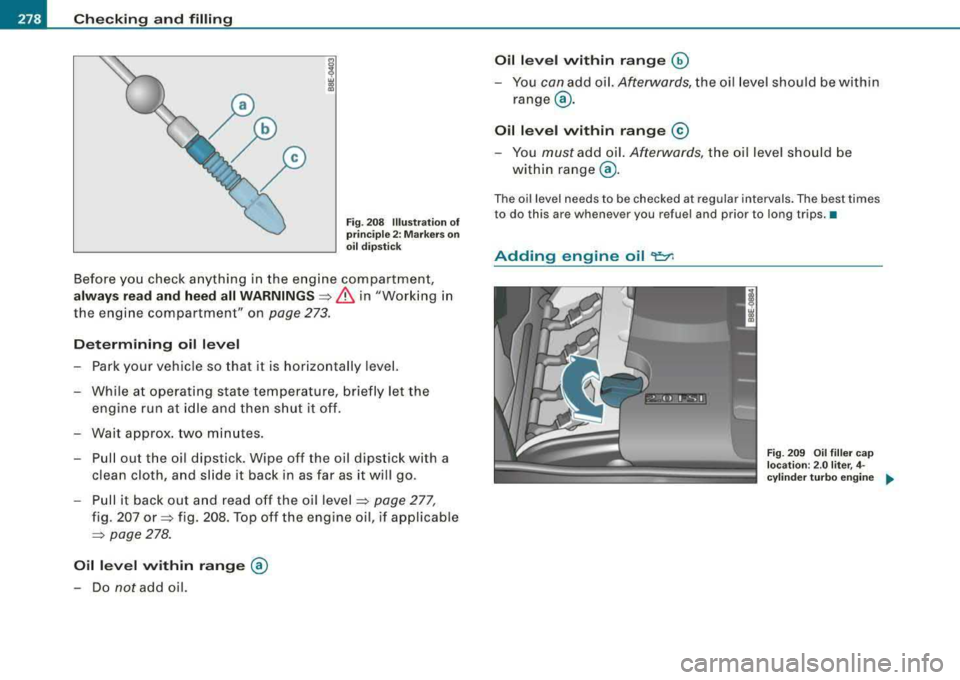
Fig. 208 Illustra tion o f
principle 2: Markers on
oil dipstick
Before you check anything in the engine compartment,
always read and heed all WARNINGS => & in "Working in
the engine compartment" on
page 273.
Determining oil level
-Park your vehicle so that it is horizontally level.
- While at operating state temperature, briefly let the
engine run at idle and then shut
it off.
- Wait approx. two minutes.
- Pull out the oil dipstick . Wipe off the oil dipstick with a
clean cloth, and s lide it back in as far as it will go.
- Pull it back out and read off the oil level
=> page 277,
fig. 207 or=> fig . 208. Top off the engine oil, if applicable
=> page 278.
Oil level within range @
-Do not add oil.
Oil level within range ~
You can add oil. Afterwards, the oil level should be within
range @.
Oil level within range ©
-You must add oil. Afterwards, the oil level should be
within range @.
The oil level needs to be checked at regular intervals. The best times
to do this are whenever you refuel and prior to long trips. •
Adding engine oil 'l:::7:
Fig. 209 Oil filler cap
locat ion: 2.0 liter , 4-
cylinder turbo engine
...
Page 281 of 368

_____________________________________________ C_h_ e_ c
_ k_in -= g_a
_ n_d _ f_il _li _n ..;::g ;;.___.ffllll
Fig. 21 O Oil filler cap
location: 3.2 liter, V6-
engine
Before you check anything in the engine compartment,
always read and heed all
WARNINGS=> & in "Working in
the engine compartment" on
page 273.
-Turn off the engine.
Unscrew the cap
"t=:r. to the engine oil filling hole
=> page 278, fig. 209 or=> fig. 210.
-Carefully top off with the appropriate oil in 0.5 liter doses.
-Check the oil level again after two minutes=> page 277.
-Top off the oil again, if necessary.
-Screw the cap back on the filling hole and slide the oil
dipstick in as far as it will go.
& WARNING
• While topping off, the oil must not come in contact with hot
engine parts
-fire hazard!
& WARNING (continued)
• The oil filler cap must be properly secured to prevent oil from
being sprayed on the hot engine and exhaust system when the
engine is running
-fire hazard!
• If your skin has come in contact with the engine oil, you must
subsequently cleanse it thoroughly.
0 Note
• The oil level must not be above range @-danger of converter or
engine damage! Contact an authorized dealership to draw off oil, if
necessary.
• Audi does not recommend the use of oil additives. They may
damage the engine and adversely affect your New Vehicle Warranty.
ffi For the sake of the environment
• Under no circumstances can the oil come in contact with the
sewage network or the soil.
• Observe and follow legal regulations when disposing of empty
oil containers. •
Changing the engine oil
We recommend that have your oil changed by an autho
rized Audi dealer or a qualified service station.
Before you check anything in the engine compartment, always read
and heed all WARNINGS =>
& in "Working in the engine compart
ment" on
page 273.
The engine oil must be changed according to the intervals specified
in your Maintenance
& Warranty booklet. This is very important
because the lubricating properties of oil diminish gradually during
normal vehicle use.
.,.
Vehic le care irechnical data
Page 284 of 368

___ C_ h_ e_c _k _ i_n ~g _ a_n_ d_ f_il _li _n_ g~--------------------------------------------
-Read the engine coolant level in the open coolant expan
sion
tank => fig. 211. With a cold engine, the coolant level
should be between the "min" and "max" markings. When
the engine is warm, the level may be slightly above the "max" marking.
The location of the coolant expansion tank can be seen in the
engine compartment
illustration=> page 275 .
To obtain an accurate reading, the engine must be sw itched off.
The expansion tank in your vehicle is equipped with an electric
coolant level sensor.
When the coolant level is too low, the warning light in the Auto
Check System
=> page 31 will blink until you add coolant and the
level has been restored to normal. Even though there is an electric
coolant level sensor, we still recommend you check the coolant level
from time to time.
Coolant loss
Coolant loss may indicate a leak in the cooling system . In the event
of coolant loss, the cooling system should be inspected immedi
ately by your authorized Audi dealer . It is not enough merely to add
coolant.
In a
sealed system, losses can occur only if the boiling point of the
coolant is exceeded as a result of overheating.
& WARNING
The cooling system is under pressure and can get very hot. Reduce
the risk of scalding from hot coolant by following these steps.
• Turn off the engine and allow it to cool down.
• Protect your face, hands and arms from escaping fluid and
steam by covering the cap with a large, thick rag.
& WARNING (continued)
• Turn the cap slowly and very carefully in a counter-clockwise
direction while applying light, downward pressure on the top of
the cap.
• To avoid being burned, do not spill antifreeze or coolant on the
exhaust system or hot engine parts. Under certain conditions, the
ethylene glycol in engine coolant can catch fire.
0 Note
Do not add any type of radiator leak sealant to your vehicle's engine
coolant. Adding radiator repair fluid may adversely affect the func
tion and performance of your cooling system and could result in damage not covered by your New Vehicle Limited Warranty. •
Adding coolant
Be very careful when adding engine coolant.
Before you check anything in the engine compartment,
always read and heed all WARNINGS => & in "Working in
the engine compartment" on
page 273.
-Turn off the engine.
-Let the engine cool down.
-Place a thick rag over the coolant expansion tank
=> page 281 , fig. 211 and carefully twist the cap counter
clockwise
=> & .
-Add coolant.
-Twist the cap on again tightly.
Replacement engine coolant must conform to exact spec ifications
=> page 280, "Coolant". If in an emergency coolant additive G12 + is .,,
Page 329 of 368

Fuses and bulbs -
----------------
0 Note No. Equipment Amps
• On no account should fuses be repaired (e.g. patched up with tin 13 Steering column module 10
foil or wire) as this may cause serious damage elsewhere in the elec -14 Brake lights 10
trical circuit or cause fire.
15 Instrument cluster, Navigation system 10
• If a fuse blows repeatedly, do not keep replacing it. Instead, have
the cause for the repeated short circuit or overload tracked and Garage door opener
5
fixed.
•
Level, tire pressure control, park assist,
17 light/rain sensor 10
Fuse list Automatic headlight range control, left 5
Fuses which can be replaced. 19 Fog lights, rear fog light 15
20
Not used
No. Equipment Amps
21 Not used
1 Air conditioner 10 Front doors 15
2
Footwell illumination 5 23 Rear doors 15
3 Heated washer jets 5 Central convenience electrical system 20
4 Radiator fan 5 25 Heater blower 30
5
Telephone, oil level sensor, multifunction 10 26 Rear window defogger 30
switch, rear heated Seat, shift gate
27 Socket for trailer towing (controller) 30
6
Air conditioner (air quality sensor), air pressure 5 28 Fuel pump 20 sensor
Electronic Stabilization Program (ESP), brake
29 Not used
7 light switch, clutch pedal switch, steering angle 10 Power sunroof 20
sensor Automatic transmission, mirror dimming, diag-
31 15 8 Telephone 5 nosis socket
9 Brake booster (vacuum pump) 15 Towing assembly 15
10
Automatic headlight beam adjustment, auto -5 33 Cigarette
lighter 20
matic headlight range control, right
Electrical socket 20
11
Airbag 5 35 Luggage compartment socket 20
12
Diagnosis socket 10 Windshield wiper system 30
Do -it -yourself service
Page 350 of 368

llffl _ __::C:::.::: o:.:.n.:.: s:::.::: u:.:.m .:.:.: e:.: r~ I n:..:.:. f.::
o :.:.r .:.m :.:.:: a:.: t:.:. i.::o :.:.n.:.... _____________________________________________ _
&, W ARNING (continued )
• Always support your vehicle with safety stands if it i s neces
sary to work underneath the vehicle. The jack supplied with the
vehicle is not adequate for this purpose and could collapse
causing serious personal injury .
• If you must work underneath the vehicle with the wheels on
the ground , always make sure the vehicle is on level ground , that
the wheels are always securely blocked and that the engine
cannot be started .
• Always make sure the transmission selector lever (automatic
transmission) is in
" P " (Park position) and the park brake is firmly
applied.
ffi For the sake of the environment
• Changing the engine settings wi ll adverse ly affect emission
l eve ls . T hi s is detri menta l to th e envi ro nm ent and increas es fu el
consumption .
• Always observ e env ironmenta l re gulations w hen disposing of
old e ngine oil, used brake f luid, dirty engine coo lant, spent batteries
or worn out tires .•
Additional accessories,
modifications and parts replacement
Additional accessories and parts
replacement
Alway s co nsult an autho rized Audi de aler before
pu rchasing acc essories .
Your vehicle incorporates t he latest safety d esig n f eatures ensuring
a high standa rd of active and pas sive safety . Th
is saf ety could be compromised by non -approved changes to the
v ehi cle . F or thi s re aso n, if par ts have to be re pla ced , pl ease obs erve
th e fo llow ing points when insta lling add itional acc essories :
A pproved Aud i accesso ries and gen uine Audi pa rts a re avai la bl e
fr om authori zed Aud i dea lers .
Th ese dealers also have the necessary faci lities, tools and tra ined
spec ia li sts to in sta ll th e parts an d acce ssor ies pr op erly .
& WARNING
Using the wrong spare parts or using non -approved accessories
can cause serious personal injury .
• Use only accessories expressly approved by Audi and genuine
Audi spare parts .
• These parts and accessories have been specially designed to
be used on your vehicle .
• Never install accessories such as telephone cradles or
beverage holders on airbag covers or within the airbag deploy
ment zones . Doing so will increase the risk of injury if airbags are
triggered in an accident!
• Before you check anything in the engine compartment , always
read and heed all WARNINGS
=> page 265.
0 Note
• I f item s ot her than ge nuin e Audi s pa re pa rts, add- on eq uipment
and accessory items are us ed or if r epair wor k is not performed
according to s pecified methods, thi s can re sult in severe damage to
your v ehicle's eng ine and body (suc h as c orros io n) a nd advers ely
affect yo ur vehic le 's wa rranty.
• Th e manufacturer cannot be held liable for damage w hich occurs
d ue t o fa ilur e to comply w it h these stipu lation s.•
Page 356 of 368
111'1_....::::A::.:l:.!: p :.:h..:.: a:::.:: b:.::e :.:t::i c::.::: a.:..l ..:.: in :..:.:: d:.:e :.:x::..... ___________________________________________ _
Centigrade
Switching between Centigrade and Fahre nheit ...... .... .... ... ....
128
Changing a flat tire .. .... .... .... 50,318
Changing a wheel ................... 318
Changing engine oil ...... .... ...... . 279
Chassis
Undercoating .. .... .... .... .... ..
261
CHECK button . . . . . . . . . . . . . . . . . . . . . . . 16
Checking
Battery acid leve l . . . . . . . . . . . . . . . . .
288
Eng ine coo lant level . ... .. .... .... 281
Checking tire pressure ............... 299
Child restraint
Danger of using child restraints in the front seat . . . . . . . . . . . . . . . . . . . . . .
189
Child restraints
What types of chi ld restraint anchors are
ava ilable? . .... .... .... ........
223
Where can I get additional information
about child restraints? ... .... ....
224
Child safety .. .... .... ....... ... 210 ,215
Additional information .... .... .... 229
Booster seats . . . . . . . . . . . . . . . . . . . . 218
Convertible child safety seats . . . . . . 216
Convertible locking retractor . . . . . . . 220
Guidance fixtures for lower anchorages
226
Important safety instructions for using
ch ild safety seats .... .... ... ....
213
Important things to know when driving
with chi ldren ...................
210
Infant seats ..................... 215
Installing a child restraint using the
LATCH system ... ... .... .... ....
228
Lower anchorages .... ....... .... . 225
Mounting and re leasing the anchorage
hook .... .... ...... .... ... .. ...
229
Older children and safety belts 219
Safety belts and o ld er children .. ... 219
Tether anchors ...... .... .... .... 229
Tether strap .. ....... .... .... .... 230
Which rest raint system should my o lder
chi ld wear? .. ...... .... ... .. ...
219
Child safety lock ... .... ... .. ...... ... 63
child safety seat
LATCH system ....... .... .... ....
228
Child safety seats .............. .... . 215
Convertible locking retractor ....... 220
How do I properly insta ll a child safety
· h ' I 7 213 seat in my ve 1c e, .. .... .... ... .
Installing .... .... ... .. .... ......
220
Safety instructions .... .... .... ... 213
Cigarette lighter ........ .... ... .. ... 120
Cleaning
Alcantara (synthetic suede) ........
264
Engine compartment .. ... ... .. ... 265
Fabrics and fabric coverings ... .... 261
Instrument pane l .. ... .. ...... .... 262
Interior ...... .... ... .. .... .... .. 261
Leather . . . . . . . . . . . . . . . . . . . . . . . . . 263
P lastic and vinyl . .... .... ... .. ... 258
Plastic parts . .... .... .... ... .... . 262
Safety belts . . . . . . . . . . . . . . . . . . . . . 265
Trim strips . .... .... ... .... .... .. 257
trim strips . .... ...... .... ... .. ... 258
Cleaning and protection ........ .... . 254
Climate controls ...... .... .......... 125
Air distribution .... .... ..... .. ... 130
Air outlets . .... .... ... ........... 131
Air recirculation ... .... .... ..... .. 128
AUTO (standard setting) .... .... ... 127
Automatic a ir recircu lation ... ..... 129
controls . . . . . . . . . . . . . . . . . . . . . . . . 126
Defrosting/defogging .... .... .... . 131
Description ... .... .... ........... 125
ECON .... ... .. .... ...... .... .... 128
Fan .. .... .... .... .... ... .... ... 129
Key -coded setting . .... .... .... ... 132
Recommended settings ........... 125
Setting the temperature .... .... ... 127
Switching between Fahrenheit and
Centigrade . .... .... .... .... ....
128
Switching the air conditioning on and off
128
Using the c limate control economically ..
132
Warm and cold ... .... .... .... ... 125
Clock ... .... .... .... ... .. ...... .... . 14
Closing
Power sunroof ....................
68
Coat hooks . . . . . . . . . . . . . . . . . . . . . . . . . 124
Co ld tire inflation pressure .... .... ... 297
Coming-home-function .... .... ...... . 77
Compartments in the door trims ..... . 124
Compass mirror .. .... .... ..... .. .... 93
Consumer Information .... ........... 345
Continuously Variable Transmission (CVT)
See multitronic™ .. .... ........... 149
Page 358 of 368
___ A_l-=- p _h_ a_ b_e _t_ic _ a_l _in _ d_e _x ____________________________________________ _
Starting .. .. .. ...... .... .... 135, 136
Starting with jumper cables ... .... 330
Stopping . .... .... .... ... .... ... 137
Engine compartment ... .. .... .... ... 274
Safety instructions . . . . . . . . . . . . . . . 273
Working the engine compartment .. 273
Engine coolant system . ...... ...... . 280
Adding coolant .. ...... .......... 282
Checking coo lant leve l .. .. .... .... 281
Checking the engine coo lant leve l .. 281
Radiator fan . . . . . . . . . . . . . . . . . . . . . 283
Engine coolant temperature Gauge ...... ...... .... ........... 13
Engine cooling system Ma lfunction .. .... ..... .. .... .... . 31
Engine data ...... .... .... .......... 343
Engine hood Closing . ...... ..... .. .... ...... . 273
How to release the hood . . . . . . . . . . 272
Engine oil ...... .... .... .... ... .... 275
Adding ... .... ... .... .... ...... . 278
Additives . . . . . . . . . . . . . . . . . . . . . . . 278
Changing ... .. .... .... ...... .... 279
Checking the engine oi l level .. .... . 277
Indications and conditions requiring extra
checking ..... .. .... .... ... .... 277
Oil consumption .. .... .... ... .... 277
Oil grades . . . . . . . . . . . . . . . . . . . . . . . 275
Recommended o il check interva ls .. 277
Specification and viscosity . . . . . . . . 275
Engine oil level .. .... .... .... ... .... . 34
Engine oil pressure Malfunction ...... ..... .. .... .... . 32 Engine oil sensor defective
....... .... . 34
Environment Break -in period .. ...... .... .... .. 243
Catalytic converter .. ...... .... ... 244
Disposing of your vehicle battery ... 291
Driving at high speeds .. .... .... .. 245
Driving to minimize pollution and noise . 245
Fuel ... ...... .... ... .. .... .... .. 269
Fuel economy ....... ...... .... .. 245
Leaks under your vehicle ... .... ... 273
Letting the vehicle stand and warm up .. 246
Proper disposa l of drained brake fluid
284
Proper disposal of drained engine
coo lant ...... ............. ..... 282
Proper disposa l of drained engine oil
278 ,279
Recycling used eng ine oil .. .... ... 278
Un leaded fuel ..... .... ... .... ... 267
What should I do with an old battery?
291
EPC
See Electronic power control .. ... .. . 23
ESP
See Electronic stabi ll ization program
(ESP) . ... .... .... ........ ... 22, 236
Event Data Recorder (EDR) .. ....... .. 236
Expansion tank .. .... ... .... .... .... 281
F
Fahrenheit
Switching between Fahrenheit and Centigrade . ...... .... ...... .... 128
Fan Adjusting the fan speed .. ...... ... 129
Climate controls ................. 129
Radiator ...... .... .... ...... .... 283
Fastening eyes ... .... .... .... .... .. 108
Flat tire ............................. 50
Changing .. .... .... ... .... .... .. 318
Flat tire changing .. ...... .... .... .... 50
Floor mats .. ... ... .... .... .... .... . 172
Fog lights ........................... 76
Fo lding master key with remote control . 52
Foot pedals .. .. .. .... .... .... ...... 17 2
For the sake of the environment Gaso line fumes and the environment 269
Letting your engine warm up ....... 136
Reducing engine noise by early upshifting .... .... ... .... .... ... 13
Reducing engine noise by upshift ing
early . .... .... .... ... .... .... ... 13
Refueling .... .... .... ....... .... 269
Saving fuel by early upshifting . .... . 13
Saving fuel by upshifting early .. .... 13
Using the rear window defogger 131, 132
Front airbags
Description . .... .... ... .... .... .. 191
How they work .. .... ... .... .... .. 196
Front ashtray . . . . . . . . . . . . . . . . . . . . . . . 119
Front fog lights .... .... .... .... .... .. 76