rns AUDI A4 AVANT 2008 User Guide
[x] Cancel search | Manufacturer: AUDI, Model Year: 2008, Model line: A4 AVANT, Model: AUDI A4 AVANT 2008Pages: 368, PDF Size: 46.19 MB
Page 120 of 368
___ S_ e_ a_t _s _a_ n_d _ s_t _o _ r_ a...: g==-- e ______________________________________________ _
vehicle wi ll unnecessarily use more fuel. Remove the roof rack if you
are not going to use i t.•
Cupholder
Cuphold er in th e center consol e
---==-----
Fig. 12 5 Center
c onsole : d u al
c uph older
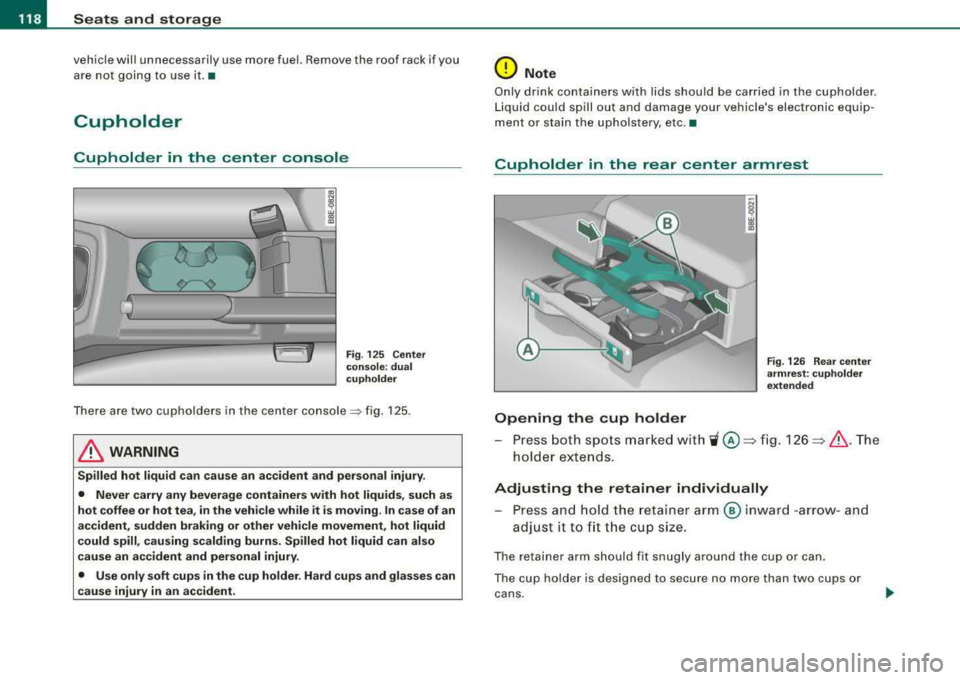
T here are two cupholders in the center console => fig. 125.
& WARNING
Spilled hot liquid can cau se an accident and pe rsonal injury .
• Never carry any beverage containers with hot liquid s, such as
hot coffee or hot tea , in the vehi cle while it i s moving . In case of an
accident , sudden braking or other vehicle movement , hot liquid
could spill , cau sing scalding burns. Spilled hot liquid can also
c ause an ac cident and personal injury .
• Use only soft cups in the cup holder . Hard c ups and gla sses can
c au se injury in an accident.
0 Note
On ly dr ink containers with lids shou ld be carr ied in the cupholder .
Li quid could spill out and damage your vehicle's electronic equip
ment or stai n th e upho lstery, etc .•
Cupholder in the re ar center armrest
Opening the cup holder
Fig . 126 Rea r center
a rmrest : cupholder
extended
- Press both spots marked wit h 'i@ ~ fig. 1 26 ~ & .T he
holde r exte nds.
Adjusting the retainer individually
Pr ess an d ho ld t he retain er arm ® inwar d -arrow -an d
adjust it to
fi t th e cup size.
The retainer arm sh ould fi t snugly ar oun d the c up or can .
The cup holder is designed to secure no more than two cups or cans .
Page 121 of 368
________________________________________________ s_e_ a_ ts_ a_ n_d _ s_t _o _r_ a ..;; g:. e _ __.11111
& WARNING
Spilled hot liquid can cause an accident and personal injury .
• Never carry any beverage containers with hot liquids , such as
hot coffee or hot tea , in the vehicle while it is moving . In case of an
accident, sudden braking or other vehicle movement , hot liquid
c ould spill , causing scalding burns . Spilled hot liquid can also
cause an accident and personal injury.
• Use only soft cups in the cup holder. Hard cups and glasses can
cause injury in an accident .
0 Note
Only dri nk containers w it h lids sh oul d be carri ed in the cupho ld er .
Li quid could spill out and damage your vehicle's electronic equip
ment or stai n t he upholste ry, etc .•
Ashtrays
Front ashtray
JI
Controls and equip
ment
Fig . 127 Center
co nsole : fr ont ashtra y
To open ashtray
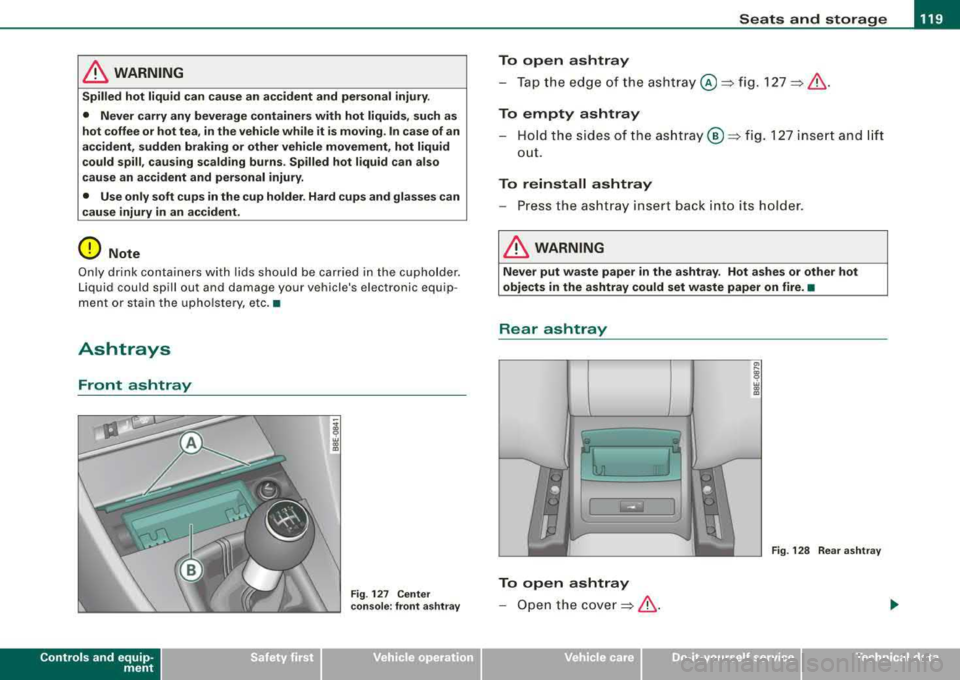
-Ta p t he e dge of the asht ra y @ => fig. 12 7 => &.
To empty ashtray
Ho ld th e sid es of th e ashtray @=> fig. 1 27 in sert and li ft
o ut.
To reinstall ashtray
-P ress the ash tra y inse rt back in to its hol der.
& WARNING
Never put waste paper in the ashtray . Hot ashes or other hot
obje cts in the ashtray could set waste paper on fire .
•
Rear ashtray
Fig. 128 Re ar ashtray
To open ashtray
-O pen th e cover => & .
irechnical data
Page 141 of 368

On the ro ad 11111 ---------------------------------------------------------------~
acoustic park assist
A pplies to vehicles : with 4 -c h an nel a cou sti c par k ass is t
Rear acoustic park assist
The rear acoustic park assist warns you of obstacles or
objects behind your car.
How it wor ks
The acoustic park assist warning system (4 -channel acoustic park
assist) uses ultrasonic sensors to warn you when you are
backing
your vehicle close to an obstac le . The system 's 4 sensors are located
inside the rear bumper.
A cti va ting
The rea r acoustic park ass ist is activa ted whenever you shift into
Re verse . You will hear a warn ing tone when the system is on.
Reverse
With the car backing up in reverse gear, the collision warning sound
se ts in at the fo llowing
approximate d istances to obstacles:
st raight a ft 5ft(
1.5ml
a ngl ing aft of f ve hicle corners 2 ft (0.6 ml
As the distance shr inks, the time interval between the audible tones
grows shorter.
The sound changes to a continuous tone as soon as the remaining
d istance to an obstacle c loses to less than about 1 ft. (0.3 ml. The
steady tone cautions you that you have backed up hazardously
close and you risk co llis ion by back ing up any furt her .
Malfunction s in the system
If a warning tone is audible for about five seconds when you turn on
the ignition, there is a ma lfunction in the system . Have the prob lem
corrected by your authorized Aud i dealer.
Controls and equip
ment
Keep the sensors in the rear bumper clean and free from ic e so t hat
the acoustic park assist system can funct ion proper ly .
& WARNING
• Sensors have dead spaces in which object s cannot be
detected . Be especiall y alert for small ch ildren and animals , since
they are not always dete cted by the sensor s.
• The acousti c pa rk assist system is not a substitute for the
driver's own caution and alertne ss . Ultimate re sponsibility alway s
remains w ith the driver dur ing parking and s imilar maneuvers .
Alway s watch where you are driving _
0 Note
• Remem ber t hat low obstac les for wh ich a warning has already
been issued may "dive" below the system's sensing zone if the
veh ic le is be ing bac ked up cl oser. In this case, the warning sound
shutting off does
not indica te that you have cleared the obstacle .
Instead , impact is imminent.
• Objects such as trai ler hitches, barrier chains, narrow posts or
f ences covered by a th in laye r of pa int may not always be detected
by the system . T hey can sti ll damage your vehic le without a
warning.
[ i ] Tips
Keep the sensors in the rear bumper clean and free of snow and ice
so that the acoust ic park ing ass ist system can function properly .•
Page 189 of 368
________________________________________________ A_ i_ r _b _a..: g:::- s..: y:.. s_ t_ e_ m __ .... ffllll
Airbag system
Important things to know
Importance of wearing safety belts and
sitting properly
Airbags are only supplemental restraints. For airbags to
do their job, occupants must always properly wear their
safety belts and be in a proper seating position.
For your safety and the safety of your passengers, before
driving off, always:
- Adjust the driver's seat and steering wheel properly
=> page 168,
-Adjust the front passenger's seat properly=> page 96,
-Wear safety belts properly=> page 180 ,
- Always properly use the proper child restraint to protect
children
=> page 210 .
In a col lision airbags must inflate within the blink of an eye and with
considerable force . The suppl emental airbags can caus e injuries if
t he driver or the front seat passenger is not seated properly. There
fore in order to help the airbag to do its job , it is important, both as
a driver and as a passenger to sit properly at a ll times.
By keeping room between your body and the steering wheel and the
front of the passenger compartment, the airbag can inflate fully and
completely and provide supplementa l protect ion in certain frontal
collisions => page 168, "Proper occupant seating positions" . For
detai ls on the operation of the seat adjustment
contro ls => page 97.
It's especially important that children are properly restrained
=> page 210.
Controls and equip ment Safety first Vehicle operation
There is a lot that the driver and the passengers can and must do to
help the individual safety features installed in your Audi work
together as a system .
Proper sea ting position is important so that the fron t airbag on the
driver side can do its job. If you have a physical impairment or
condition that prevents you from sitting properly on the driver seat
with the safety belt properly fastened and reaching the pedals, or if
you have concerns with regard to the function or operation of the
Advanced Airbag System, please contact your authorized Audi
dea ler or qualified workshop, or ca ll Audi Customer CARE at 1 -800-
822 -2834 for possible modifications to your vehicle.
When the airbag system deploys, a gas generator wi ll fill the
airbags , break open the padded covers, and inflate between the
steering whee l and the driver and between the instrument pane l
and the front passenger. The airbags will deflate immediately after
deployment so that the front occupants can see through the wind
shie ld again without interruption .
All of this takes place in the blink of an eye, so fast that many people don't even realize that the airbags have deployed. The airbags also
inflate with a great deal of force and nothing should be in their way
when they deploy. Front airbags in combination with proper ly worn
safety belts slow down and limit the occupant's forward movement .
Together they help to prevent the driver and front seat passenger
from hitting parts of the inside the vehicle while reducing the forces acting on the occupant during the crash. In this way they help to
reduce the risk of injury to the head and upper body in the crash.
Airbags do not protect the arms or the lower parts of the body .
Both front airbags wi ll not inflate in all frontal collisions. The trig
gering of the airbag system depends on the vehic le dece leration
rate caused by the collision and registered by the electronic contro l
unit . If this rate is below the reference value programmed into the
control unit, the airbags will not be triggered, even though the car
may be badly damaged as a result of the collision . Vehicle damage, _,,
Vehicle care Do-it-yourself service Technical data
Page 196 of 368
___ A_ ir_b _ a_ g=- s--=- y_s _t _e _m _________________________________________________ _
&, WARNIN G (continu ed )
• The inflating airbag will hit the child s afety seat or infant
car rier with gre at for ce and will sma sh the child safe ty se at and
c hild agai nst the ba ckre st, center arm re st, door , or roof .
• Alwa ys in sta ll re arw ard -f aci ng child re str aint s in the b ack se at .
• If you mu st in stall a rearw ard facing child safety seat on the
front p assenger se at be cause of e xce pti ona l ci rc um stan ce s a nd
the PASSENGER AIR BAG OFF light doe s not come on and stay on ,
immedi atel y insta ll the re ar-f a cing child s afet y s ea t in a re ar
se ating position and h av e the airb ag sy stem inspe cted by your
Audi dealer .
& WARNING
If, in e xception al c ir cum sta nces, you mu st in sta ll a forward -f ac in g
c hild re straint on the front p assenger 's seat:
• Alway s mak e sure the forward-f acing seat ha s been designed
and certified by it s manufacturer for u se on a front seat with a
p asseng er front and side airb ag .
• Never put the forw ard -fa cing child re straint up again st or very
near the instrument panel.
• Alway s move the p assenger seat into it s re armost position in
the se at's fore and aft adju stment range , as far a way from the
a irbag a s pos sible , before installing the forward -f a cing child
rest raint . The ba ckrest must be ad justed to an upright po sitio n.
• Make sure that the PASSENGER AIR BAG OFF light come s on
a nd stay s on all th e time whenever the ignit ion i s swi tched on .
•
Advanced Airbag System components
The front passenger seat in your vehicle has a lot of very impo rtant
parts of the Advanced A irbag System in it . These parts include the
we ight -sensing mat , sensors, wiring, brackets , and more. The func -tion of the system in the front passenger seat is checked by the e
lec
tronic contro l unit w hen t he ignit ion is on . The co ntrol uni t monitors
the Advanced Airbag System and turns the airbag indicator light on
whe n a malfunction i n the system components is detected. T he
function of the airbag ind icator light is described in greater detai l
below. Because the front passenger seat contains important parts
o f the Advanced Airbag System, you must take care to prevent it
from being damaged . Damage to the seat may prevent the
Advanced Airbag for the front passenger seat from do ing its job in
a crash .
The front Adva nc ed Airbag S ystem consi sts of th e
following :
• Crash sensors in the front of the ve hicle that measure veh ic le
acce leration/deceleration to provide information to the Advanced
A irbag System about t he severity of t he crash .
• An electronic control unit, with integrated crash sensors for front
and side impacts. The control unit "dec ides" whethe r to fire the
front airbags based on the information received from the crash sensors . The control unit also "dec ides" whether the safety be lt
pretensioners should be activated.
• A dual -stage Advanced Airbag with gas generator for the driver
inside the steering wheel hub.
• A dual-stage Advanced A irbag and gas generator inside the
instrument pane l for the front passenger .
• A we ight -sensing mat under the upholstery padding of the front
passenger seat cushion that measures the tota l weight on the seat .
T he information registered is sent continuously to the electronic
control un it to regu late dep loyment of the front Advanced Airbag on
the passenger side .
• An airbag monitor ing system and indicator light in the instru
ment
cluster=> page 198 .
• The PASSENGER AIR BAG OFF light comes on and stays on in t he
center of the instrument panel
=> page 199, fig . 180 and te lls you
when the fron t Advanced Airbag on the passenger side has been
turned off.
~
Page 200 of 368
___ A_ ir_b _ a_ g=- s--=- y_s _t _e _m _________________________________________________ _
&, WARNING (continued )
airbag during braking or in a sudden maneuver . Objects near the
airbags can become projectiles and cause injury , particularly when
the seat is re clined .
& WARNING
The fine dust created when airbags deploy can cause breathing
problems for people with a history of asthma or other breathing
c ondit ions .
• To reduce the risk of breathing problems , those with asthma or
other respiratory conditions should get fresh air right away by
getting out of the vehicle or opening windows or doors .
• If you are in a collision in which airbags deploy, wash your
hands and face with mild soap and water before eating .
• Be careful not to get the dust into your eyes, or into any cuts or
scratches.
• If the residue should get into your eyes, flush them with
water. •
Monitoring the Advanced Airbag
System
Airbag monitoring indicator light t~
Two separate indicators monitor the func tion of the
Advanced A irba g System: th e airbag mon itoring ind ica tor
li g ht and the
PASSENGER AIR BAG OFF light.
T he Advanced Airbag System (inc luding the e lectronic control unit,
s en sor c ircuit s and s yste m wiri ng ) is moni tored con tin uou sly to
make sure that it is f unctioning properly whenever the ignition is o n.
E ac h time you t urn on the ignit ion , th e airb ag monito ring indic ator
light ~ will come on for a f ew s econds (s elf dia gnostics).
The system must be inspected when the indicator
light m:
• does not come on when the i gnition is switched on,
• d oes not go out a few sec onds after y ou h ave sw itch ed on th e
ignit ion, or
• comes on w hile d riv ing.
I f an airbag system malfunction is detected, the indicator li ght will
fir st sta rt fl ashing to ca tch the drive r's att ention a nd then s tay o n
cont inuously to serve as a cons tant rem inder to hav e the s yst em
in spec ted i mm ediatel y.
If a m alfu nctio n occ urs th at t urns the fron t airb ag on the pass eng er
s ide off, the PASSENGER AIR BAG OFF light will come on and stay on
w hen eve r th e ig niti on is on.
& WARNING
An airbag system that is not functioning properly cannot provide
supplemental protection in a frontal crash .
• If the airbag indicator light comes on , it means that there may
be something wrong with the Advanced Airbag System. It is
possible that the airbag will inflate when it is not supposed to , or
will not inflate when it should .
• Have the airbag system inspected immediately by your Audi
dealer .•
Page 246 of 368
llffll.,__ __ D_r_ iv _ in_.... g,_ a_n_ d __ e_n _v_ ir_o_ n_ m_ e_n_ t _____________________________________________ _
New brake pads
Remember that new brake pads do not have a full braking
effec t during the first 250 miles (400 kilometers) after they
are i nstalled .
New brake pads have to be "burn ished in" befo re they have opti mal
grab =>& .
During the break -in period, you s hou ld avo id putti ng severe loads
on the brakes . Severe loads include, for examp le, sudden hard
braking, in particular at very h igh speeds or, for example, on moun
t ain passes .
& WARNING
New brake p ad s don't h ave th e be st sto pping p ower a nd mu st b e
" brok en -in " durin g th e initial 100 to 1 50 mil es (150 t o 200 kil ome
t e rs) of norm al cit y dri ving . You can comp en sa te for thi s by
pr ess ing the brak e ped al mor e firmly . Thi s al so appli es later when
ne w pad s a re in sta lled. •
Catalytic converter
It is very important that your emission control sys tem
(catalytic conver ter) is functioning properly to ensure that
y o ur vehicle is running in an environmentally sound
manner.
-Always use lead-free gasoline => page 267, "Fuel supply".
-Never run the tank down a ll the way to empty.
-Never put too much motor o il in your engine => page 278,
"Add ing eng ine oil
The catalytic converter is an efficient "clean-up " device built into the
exhaust system of the vehicle. The catalyt ic converter burns many
of the po llutants in the exhaust gas before they are released into the
atmosphere.
T he exc lusive use o f un leaded fue l is critica lly important for the l ife
of the catalytic converter and proper functioning of the engine.
& WARNING
• Do not park or operate th e veh icle in ar eas wh ere the hot
ex hau st sys tem m ay come in contac t w ith dr y gra ss, bru sh , fuel
s pill or other material which can cau se a fire .
• Do not appl y additi ona l under coating or ru stpr oofing on or
ne ar the e xhau st m anifol d, ex haust pipe s, ca ta lytic converter or
he at shield s. Du ring dri ving , the sub sta nce u sed f or under coating
c ould overhe at and cau se a fir e.
0 Note
• Be aware that just one tank filling with leaded fue l wi ll already
ser iously degrade the performance of the catalyt ic converter.
• Do not exceed the correct engine oi l
level=> page 278.
• Do not drive until the fuel tank becomes comp letely empty . The
engine could misfire . Unburned fuel could also get into the exhaust
system and this could cause the catalytic conver ter to overheat .
• Do not turn off the ignition wh ile the vehicle is moving.
• Do not continue to operate your vehicle under these conditions,
as otherwise fuel can reach the cata lyt ic converter . This cou ld result
in overheating of the converter, requiring its rep lacement .
• To assure eff icient operat ion of the Em iss ion Control System:
- Have your vehicle maintained properly and in accordance with
the service recommendations in your Maintenance
& Warranty
booklet.
..,
Page 248 of 368

lffll.,__ __ D_r_ i_v _i_n _.g..,_ a_ n_d_ e_ n_v _ i
_ r_o _ n_ m_ e_ n_ t _______________________________________________ _
one half. Never drive faster than the posted speed limit and weather
conditions permit. •
Reducing unnecessary idling
Even when your car is just idling it burns up fuel.
- Shut the engine off when you are not driving the vehicle .
- Do not warm up the vehic le by letting the engine run at
id le .
It makes sense to shut off the engine in traff ic jams, when waiting
for tra ins to pass at rai lroad crossings , or at traffic lights that have
long waits on red. Turning the engine off for just 30 -40 seconds
saves more fue l than is burned starting the engine again .
It takes a long time for the engine to warm up fu lly when it is
running at idle. However, wear and noxious emiss ions are espec ially
high when the engine is warming up . So you should drive away as
soon as you sta rt the engine and avoid running at high rpms w hile
the engine is sti ll warming up.
0 Note
Do not leave engine idling unattended after starting . If warning
lights should come on to indicate improper operation, they would
go unheeded. Extended id ling also produces heat, which could
resu lt in overheating or other damage to the vehic le or other
property .•
Regular maintenance
A badly tuned engine unnecessarily wastes a lot of fuel.
- Have your ve hicle serviced at regular intervals .
By having your vehicle regularly serviced by an Audi dealer helps to
ensure that it runs properly and economical ly . The cond ition of your
vehic le not only affects its safety and abi lity to hold its value, it also
affects
fuel consumpt ion .
Check your oil ea ch time you fill your t ank .
The amount of oil used is related to engine load and speed.
I t is norma l for the oi l consumption of a new engine to reach its
lowest value after a certain mi leage has been driven.
You must drive your vehicle about 3,000 miles (5,000 kilometers) before you can properly assess oil consumption .
This also applies to fue l consump tion and engine output .
0 Note
• Have your vehicle maintained properly and in accordance with
t he service recom mendat io n s in your Maintenance
& Wa rranty
booklet. Lack of proper ma intenance as well as improper use of the
vehic le wi ll impai r the function of the emission cont rol system and
cou ld lead to damage.
• Do no t alte r or remove any component of the Emission Contro l
System unless approved by the manufacturer .
• Do not alte r or remove any dev ice, such as heat shields,
switches, ignition wires, valves, which are designed to protec t your
vehic le's Emission Control System and other important veh ic le
components .•
Fewer short trips
Fuel consumption will alw ays be rel atively high on short
t r ips.
- Try to avo id driving short dis ta n ces wi th a cold engine. ~
Page 252 of 368
III.___T_ r_a _il _e_ r_ t_o _vv_ i_ n """g"'- ---------------------------------------------------
W eig ht d is tri buti on
Towing a loaded tra iler wit h an empty car resu lts in a high ly
unstable distribution of weight . If this cannot be avoided drive at
ve ry low speeds only to avo id the risk of losing steering control.
A "ba lanced" rig is easier to operate and control. This means that
the tow vehicle should be loaded to the extent possible and permis
sib le whi le keeping the trailer as light as possib le under the circum
stances. Whenever possible, transfer some cargo to the luggage
compar tment of the tow veh icle whi le observi ng tongue load
requirements and vehicle loading considerations.
Speed
T he higher the speed, the more difficu lt it becomes for the driver to
contro l the rig . Do not drive at the maximum permissible speed.
Reduce your speed even more under unfavorable load, weather or
wind conditions -part icularly when going dow nh ill.
Reduce vehicle speed
immedi ately if the trailer shows the slightest
sign of swaying.
Do not tr y to stop the s waying by a cceler ating .
Observe speed limits . In some areas speeds for veh ic les towi ng
trai lers are lower than for regular vehicles.
Always app ly brakes early. When driving downhi ll, shift into lower
gear to use the engine braking effect to slow down the vehicle. Use
of the brakes alone can cause them to overheat and fail.
C oo la nt tempe ra tu re
The coola nt temperature gauge => page 13 must be observed care
ful ly. If the needle moves close to the upper end of the scale, reduce
speed immediately and/or switch off the air conditioner.
If the coolant te mperature warning light in the instrument cluster
starts
flashing -~-, pul l off the road, stop and let the engine idle for
about two minutes to prevent heat build -up .
& WARNING
An yone not p rop erl y res trained in a mo ving vehicl e is at a much
gre ate r risk in an accident. Never let an yone rid e in your car who
is not p rop erl y wear ing the re stra int s pro vided b y Aud i. •
Trailer towing tips
Important to know
Your vehicle handles differently when towing a tra iler because of
the additional weight and weight distribution. Safety, performance
and economy wi ll great ly depend on how carefu lly you load your
trai ler and operate your rig.
Before you actual ly tow your tra iler, practice turning, stoppi ng and
backing up in an area away from traffic. Keep practicing unti l you
have comp letely become familiar with the way yo ur vehicle -trailer
combination behaves and responds .
Backing up is difficu lt and requires practice. Backing up with a
trai ler genera lly requ ires steering action oppos ite of that when
backing up your vehic le without a trailer.
Mainta in a greater distance between you r vehic le and the one in
front of you. You will need more room to stop.
To compensate for the trai ler, you wi ll need a larger than normal
t urning radius .
When passing, remember that you cannot accelerate as fast as you nor mally wou ld because of t he added load . Make sure yo u have
enough room to pass. After passing, al low plenty of room for your
trai ler before changing lanes again .
Avo id jerky starts, sharp turns or rapid lane changes.
Page 272 of 368
Fuel supply and filling your fuel tank
Taking the fuel cap off
- To open the fuel filler flap, pull the button~ page 269,
fig. 200.
- Unscrew fuel filler cap counter-clockwise and hang it on the fuel filler flap.
Refuelling procedure
- Insert the fuel nozzle from the gasoline pump into the
fuel filler neck as far as it will go.
- Select a medium refuelling rate so that the nozzle
switches off automatically when the tank is full.
Putting the fuel cap back on
- After filling your tank, twist the fuel filler cap clockwise
until you hear a definite click.
- Close the fuel filler flap.
To avoid fuel spilling or evaporating from the fuel tank always close
fuel filler cap properly and completely. An improperly closed fuel
filler cap may also cause the MIL lamp => page 27to come on.
& WARNING
Improper refueling or handling of fuel can cause fire, explosion
and severe burns .
• Fuel is highly flammable and can cause severe burns and other
injuries.
• Failure to shut the engine off while refueling and/or to insert
the pump nozzle fully into the car's filler neck could cause fuel
overflow and fuel spray. Fuel spray and overflowing fuel are
dangerous because they can cause fire or serious injury.
& WARNING (continued)
• Never use a cellular telephone while refueling. The electromag
netic radiation can cause sparks that can ignite fuel vapors and
cause a fire .
• Never get back into your vehicle while refueling. If in excep
tional circumstances you must get back in your vehicle while refu
eling, make certain that you close the door and touch metal to
discharge static electricity before touching the filler nozzle again .
Static electricity can cause sparks that can ignite fuel vapors
released during refueling .
• Never smoke or have an open flame anywhere in or near your
vehicle when refueling or filling a portable fuel container.
• For your safety, we strongly recommend that you do not travel
with a portable fuel container in your vehicle. The container, full or
empty may leak and could cause a fire, especially in a crash.
• If, under exceptional circumstances, you must transport a
portable fuel container, please observe the following:
- Never fill a portable fuel container while it is anywhere in or
on the vehicle (for example, in the luggage compartment, or on
the trunk). Static electricity can build up while filling and can
ignite fuel vapors causing a fire.
- Always place a portable fuel container on the ground before
filling.
- Always keep the filler nozzle completely inside the portable container before and during filling.
- If filling a portable container made of metal, the filler nozzle must always be in contact with the container. This will help
prevent static electricity from discharging and cause a fire.
- Never spill fuel inside the vehicle or luggage compartment .
Fuel vapors are highly flammable.
- Always observe local and state/provincial laws regarding the
use, storage and transportation of fuel containers
~