flat tire AUDI A4 AVANT 2008 Owner's Manual
[x] Cancel search | Manufacturer: AUDI, Model Year: 2008, Model line: A4 AVANT, Model: AUDI A4 AVANT 2008Pages: 368, PDF Size: 46.19 MB
Page 310 of 368
___ T_ ir_e _ s_ a_ n
_ d_ w_ h_ e_ e_ls _________________________________________________ _
& WARNING
• Using incorrect or unmatched tires and / or wheels or improper
tire and wheel combinations can lead to loss of control , collision
and serious personal injury .
• Always u se tires , rims and wheel bolts that meet the specifica
tions of original factory -installed tires or other combinations that
have been specifically approved by the vehicle manufacturer.
• Tires age even if they are not being used and can fail suddenly ,
especially at high speeds . Tires that are more than 6 years old can
only be used in an emergen cy and then with special care and at
lower speed s.
• Never mount used tires on your vehi cle if you are not sure of
their "previous history." Old used tires may have been damaged
even though the damage cannot be seen that can lead to sudden
tire failure and loss of vehicle control.
• All four wheels must be fitted with radial tires of the same type ,
size (rolling circumference ) and the same tread pattern. Driving
with different tires reduces vehi cle handling and can lead to a loss
of control.
• If the spare t ire is not the same as the tires that are mounted
on the vehicle -for example with winter tires -only use the spare
tire for a short period of time and drive with extra care . Refit the
normal road wheel as soon as safely possible.
• Never drive faster than the ma ximum speed for wh ich the tires
on your vehicle are rated because tires that are driven faster than
their rated speed can fail suddenly .
• Overloading tire s cause heat build -up , sudden tire failure ,
including a blowout and sudden deflation and loss of control.
• Temperature grades apply to tires that are properly inflated and
not over or underinflated .
• For technical reasons it is not always possible to use wheel s
from other vehicles - in some cases not even wheels from the
same vehicle model.
& WARNING (continued )
• If you install wheel trim discs on the vehicle wheels, make sure
that the air flow to the brakes is not blocked . Reduced airflow to
the brakes can them to overheat , increasing stopping distances
and causing a collision .
• Run flat tires may only be used on vehicles that were equipped
with them at the factory. The vehicle must have a chassis designed
for run flat tires and a factory-installed tire pressure monitoring
s ystem that indicate s a loss of tire pressure . Incorrect use of run
flat tires can lead to vehicle damage or ac cidents . Check with an
authorized Audi dealer or tire specialist to see if your vehicle can
be equ ipped with run flat tires . If run flat tires are used , they must
be installed on all four wheels . Mixing tire types is not permitted.
0 Note
• For tec hnical r eas ons, it is no t gene rally possible to use the
whee l rims from other vehicles . ihis can hold true for wheels of the
same ve hicle type.
• I f the spare tire is different from the tires that you have mounted
on y our ve hicle (f or exampl e wi nter t ires or wide p ro fi le tir es), then
use the spa re tire fo r a short per iod of time on ly and d rive with extra
c a re . Rep lace the flat t ire wi th the ti re m atc h ing t he oth ers o n you r
vehic le as soon as possib le .
• If yo u should put diff eren t w heels a nd tires on yo ur vehi cle (e. g.
winter wheels and tires), you must be certa in that the wheels and
t ires a re co mpatibl e w ith the tire press ur e m onit orin g sys te m.
Otherwise the system will regist er a ma lfunction and a fau lt
mes sage wil l be d isp layed . Fo r mo re info rmation, contact yo ur Audi
dea ler .
0 Note
• When i nsta lling new ti res, be care fu l n ot to damage t he va lves o r
tire press ure mon itoring system* sensors . .,_
Page 311 of 368

__________________________________________________ T_ ir_e_ s_ a_ n_d _ w_ h_ e
_ e_l_s __ fflll
• Never drive without the valve stem cap. The valves could get
damaged.
• If the sensors must be replaced, then the valve must also be
replaced at the same time.
For the sake of the environment
Dispose of old tires in accordance with the local requirements.•
Uniform tire quality grading
• Tread wear
• Traction AA A B C
• Temperature A B C
Quality grades can be found where applicable on the tire side wall
between tread shoulder and maximum section width
=> page 305,
fig. 221.
For example: Tread wear 200, Traction AA, Temperature A.
All passenger car tires must conform to Federal Safety Require
ments in addition to these grades .
Tread wear
The tread wear grade is a comparative rating based on the wear rate
of the tire when tested under controlled conditions on a specified
government test course .
For example, a tire graded 150 would wear one and one half (1 1/2)
times as well on the government course as a tire graded 100.
The relative performance of tires depends upon the actual condi
tions of their use, however , and may depart significantly from the
norm due to variations in driving habits, service practices and differ
ences in road characteristics and climate.
Traction
The traction grades, from highest to lowest, are AA, A, Band C.
Those grades represent the tire's ability to stop on wet pavement as measured under controlled conditions on specified government
test surfaces of asphalt and concrete. A tire marked C may have
poor traction performance
=> & .
Temperature
The temperature grades are A (the highest), B, and C, representing
the tire's resistance to the generation of heat and its ability to dissi
pate heat when tested under controlled conditions on a specified
indoor laboratory test wheel.
Sustained high temperature can cause the material of the tire to
degenerate and reduce tire life, and excessive temperature can lead
to sudden tire
failure =>& .
The grade C corresponds to a level of performance which all
passenger car tires must meet under the Federal Motor Vehicle
Safety Standard No. 109. Grades Band A represent higher levels of
performance on the laboratory test wheel than the minimum
required by law .
& WARNING
The traction grade assigned to this tire is based on straight-ahead
braking traction tests, and does not include acceleration,
cornering, hydroplaning or peak traction characteristics.
& WARNING
The temperature grade for this tire is established for a tire that is
properly inflated and not overloaded. Excessive speed, underinfla
tion, or excessive loading, either separately or in combination, can
cause heat buildup and possible tire failure.
•
Vehicle care
Page 312 of 368
___ T_ ir_e_ s_ a_ n
_ d_ w_ h_ e_ e_l_
s _________________________________________________ _
Winter tires
Winter tires can impr ove vehicle handling on snow and
ice. At temperatures below 45 °F (7 °C) we recommend
changing to winter tires.
I n some heavy snow areas, local governments may require true
winter or "snow" tires, those with very deeply cut tread . These tires
should only be used in pairs and be instal led on a ll four wheels .
Make sure you purchase snow tires that are the same s ize and
construction type as the other tires on your vehicle .
If your vehic le is equipped with al l-wheel drive*, this will improve
traction during winter driving, even with the standard tires.
H owever, we strongly recommend that you a lways equ ip al l four
whee ls on your vehic le with correct ly fitted winter tires or all-season
t ires, when winter road conditions are expec ted. This also improves
t he vehic le's braking performance and reduces stopping distances.
Summer tires provide less grip on ice and snow.
W inter tires (snow t ires) must a lways be fi tted on a ll four wheels .
If your vehicle is equipped with a tire pressure monitoring system* ,
compatible tire pressu re monitoring sensors must be instal led on
a ll f our winter t ires for the system to function
properly=> page 307.
Ask your authorized Audi dealer or qualified workshop for permitted
winter tire size s. Use only rad ial winter tires.
Winter tires lose their effect iveness when the tread is worn down to
a depth of 4 mm (0.157 inch).
Only drive with w inter tires under winter conditions. Summer tires
handle better when there is no snow or ice on the roads and the
t emperature is above 45 °F (7 °C).
If you have a flat tire, see notes on spare
wheel=> page 305 .
Please a lways remember that winter tires may have a lower speed
rating than the tires original ly instal led on your vehicle at the ti me
it was manufactured . Please see
=> page 306 , "Speed rating (letter code)" for a listing of the speed rating letter codes and the
maximum speed at which t he tires can be d riven .
The speed rating letter
code(=> page 2961 i s on the side wa ll of the
tire => page 305.
& WARNING
Winter tire s have maximum speed limits that may be lower than
your vehi cle's ma ximum speed . Al wa ys know the ma ximum speed
before driving off . Never drive fa ster th an the speed permitted for
y our s pecifi c w inter tire s. Thi s will cau se damage to the tire s
lead ing to an a ccident and seriou s per sonal injury to you and your
p ass engers.
& WARNING
Driving fa ster th an the m aximum speed for whi ch the winte r tire s
on your vehi cle were de signed c an cause tir e failure in cluding a
blowout and sudden deflat ion , lo ss of contr ol, c rashe s and seriou s
per sonal injuries . Have worn or damaged tires repl aced immedi
ately .
• Winter tires have ma ximum speed rating that may be lower
than your vehicle' s m axi mum speed .
• Never drive faster than the speed for which the winter or other
ti re s in sta lled on you r vehi cle are r ated .
& WARNING
Always adju st your driving to the ro ad and traff ic condit ions .
Never let the good acceleration of th e win ter tire s and all-wheel
dr ive tempt you into taking extra ri sks. Al ways rem ember :
• When braking, an all -wheel driv e vehicle handle s in th e same
w ay as a front dr ive veh icle .
• Drive ca refully and redu ce your speed on i cy and slippery r oads,
e ven w inter tires cannot h elp under bl ack ice condit ions .
...,
Page 314 of 368
-
Tires and wheels
----------------
&, WARNING (continued )
• Only u se wheel bolts that belong to the rim being installed.
• Never use different wheels bolt s on your vehi cle .
• Alway s maintain the correct tightening torque for the wheel
bolts to reduce the risk of a wheel los s.
If the tightening torque of
the wheel bolts is too low , they can loosen and come out when the
vehi cle is moving. If the tightening torque is too high , the wheel
bolts and threads can be damaged and the wheel can become
loose .
0 Note
The specified torque for the wheel bolts is 90 ft lb (12 0 Nm) with a
tolerance of± 7,4 ft lb(± 10 Nm). Torque whee l bolts diagonally.
After changing a wheel, the torque must be c hecked as soon as
possible with a torque wrench -preferably by an authorized Audi
d ea ler or qua lifi ed works hop.•
Low aspect ratio tires
Your Aud i is factory -equipped with low aspect ratio tires . T hese tires
have been thorough ly tested and been selected specifical ly for your
mod el for t he ir superb perf or mance, r oad feel and ha ndling u nder
a variety of driving conditions . Ask your authorized Audi dealer for
mo re deta ils.
The low aspect ratio of these tires is indicated by a numeral of
55 or
less
i n the ti re's size designatio n. The numeral rep resents the ra tio
of the t ire's sidewa ll height in relation to its tread width expressed
in percentage . Conventiona l tires have a height/width ratio of 60 or
m ore.
The performan ce of low -aspe ct-ratio tires is part icularly sensitive to
improper inflation pressure . It is therefore important that low
aspe ct ratio tires are inflated to the specified pressure and that the
inflation pressure i s regularly checked and maintained. Tire pres- sures should be checked at least once a month and always before a
long
trip => page 299, "C heck ing tire pre ssure" .
What you can do to avoid tire and rim damage
Low as pect r ati o ti res can be da maged more easi ly by impact w ith
potho les, curbs, gullies or ridges on the road, particularly if the tire
i s u nde rinfl ated.
I n order to min imize the occurrence of impact damage to the t ires
of your vehic le, we recommend that you observe the fo llowing
precautions :
• Always maintain recommended inflation pressures . Check your
t ire pr essu re every 2,000 miles (3,000 k m) a nd add air if necessary .
• Drive careful ly on roads with potholes, deep gu llies or ridges.
T he im pac t from driving t hroug h or ov er suc h ob stacl es ca n
damage your tires. Impact with a curb may also cause damage to
yo ur tir es .
• After any impact, immediately inspect your tires or have them
inspec te d by the neares t au thori ze d Aud i dealer. Replac e a
damaged tire as soon as possible.
• I nspect you r ti res eve ry 2,0 00 m iles (3,000 km) for damage and
wear. Damage is not always easy to see. Damage can lead to loss of
a ir a nd und eri nfl ation, whic h cou ld eve ntual ly ca use tire fa ilur e. If
you be lieve that a tire may have been damaged, rep lace the tire as
s o on as p ossi ble.
• T hese tires may wear more quickly than others .
• P lease a lso remember that, whi le these tires de liver respons iv e
handling, they may ride less comfortably and make more noise t han
other choices.
Reduced performance in winter /cold season
c onditions
A ll tir es a re desig ned f or certai n purposes. The low a spect rati o,
u ltra hi gh pe rf ormance t ires or igin a lly ins tal led on your ve hicle are
intended for maximum dry and wet road performance and handling .
Th ey a re not su itab le fo r co ld, snowy or ic y weat her co nd it io ns. If
~
Page 319 of 368
_____________________________________________ W_ h_ a_t _d_ o_l
_ d_o _ n_o_ w_ ? _ __,_
/b, WARNING (continued)
• Using a bumper jack to raise the vehicle will damage the
bumper system. The jack may slip, causing injury.
• Never support your vehicle on cinder blocks, bricks or other
objects. These may not be able to support the load and could
cause injury when they fail.
• Never start or run the engine while the vehicle is supported by
the jack.
• If you must work under the vehicle, always use safety stands
specifically designed for this purpose.
• Never try and use the hexagonal socket
in the handle of the
screwdriver to loosen or tighten the wheel bolts.
• Always make sure the spare tire and even a flat tire are secured
in place and not loose, otherwise they could fly forward, causing
personal injury to passengers in the vehicle in an accident or
sudden maneuver.
• Never use the jack supplied with your Audi on another vehicle,
particularly on a heavier one. The jack is only suitable for use on
the vehicle it came with.
•
Spare wheel
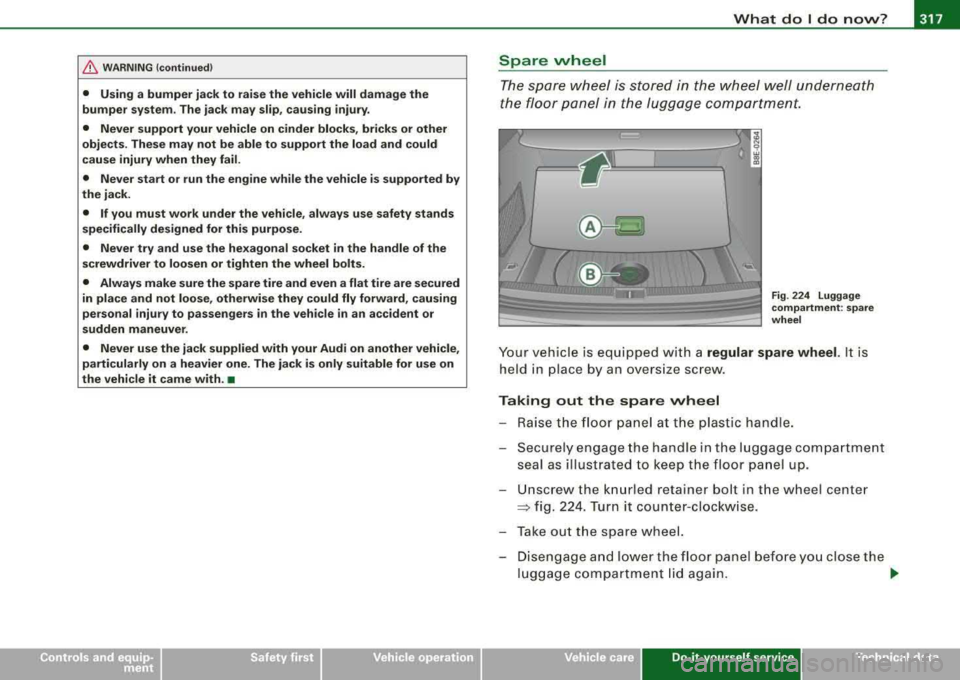
The spare wheel is stored in the wheel well underneath
the floor panel in the luggage compartment.
Fig. 224 Luggage
compartment : spare
wheel
Your vehicle is equipped with a regular spare wheel. It is
held in place by an oversize screw.
Taking out the spare wheel
- Raise the floor panel at the plastic handle.
- Securely engage the handle in the luggage compartment
seal as illustrated to keep the floor panel up.
- Unscrew the knurled retainer bolt in the wheel center
=> fig. 224. Turn it counter -clockwise .
- Take out the spare wheel.
- Disengage and lower the floor panel before you close the
luggage compartment lid again.
..,.
Do-it-yourse lf service irechnical data
Page 320 of 368

___ w_ h_ a_t _ d_ o_ l_d _ o_ n_ o_w _ ? ______________________________________________ _
Storing the replaced wheel
- Place the replaced wheel inside the spare wheel well in
the luggage compartment.
- Tighten the knurled retaining screw clockwise to secure
the wheel in place.
- Disengage and lower the floor panel before you close the
luggage compartment lid again.
& WARNING
Loose items in the passenger compartment can cause serious
personal injury during hard braking or in an accident.
• Never store the spare wheel or jack and tools
in the passenger
compartment.
• Always store all jacking equipment, tools, and the spare wheel
in the luggage compartment.
• Tighten the knurled retaining screw for the spare wheel
securely.
[ i] Tips
Check the inflation pressure of the spare tire periodically to keep the
tire ready for use. •
Wheel change
Before changing a wheel
Follow these points for your own and your passenger's
safety when replacing a wheel.
After you experience a tire failure, pull the car well away
from moving traffic and try to reach
level ground before
you
stop ~& .
-All passengers should leave the car and move to a safe
location (for instance, behind the
guardrail) ~& .
-Apply the parking brake firmly ~& .
-Move selector lever to position P on an automatic trans-
mission; put manual transmission in
first gear~& .
-If you are towing a trailer: unhitch the trailer from your
vehicle.
- Take the
tool case and the spare tire ~ page 316 out of
the luggage compartment.
& WARNING
You or your passengers could be injured while changing a wheel if
you do not follow these safety precautions:
• If you have a flat tire, move a safe distance off the road. Turn off
the engine, turn the emergency flasher on and use other warning
devices to alert other motorists.
• Make sure that passengers wait
in a safe place away from the
vehicle and well away from the roadway and traffic.
• To help prevent the vehicle from moving suddenly and possibly
slipping off the jack, always fully set the parking brake and block
the wheel diagonally opposite the wheel being changed . When one
front wheel is lifted off the ground, placing the Automatic Trans-
~
Page 321 of 368
What do I do now? 11111111
-----------------------------------
& WARNING (continued)
mission in "P" (Park), or engaging a gear in a manual transmission
will
not prevent the vehicle from moving.
• Before you change a wheel, be sure the ground is level and firm.
If necessary, use a sturdy board under the jack.
• After installing the spare wheel, make sure that you remount
the flat tire/wheel in its storage area properly and tighten the
knurled retaining screw securely . •
Changing a wheel
When you change a wheel, follow the sequence described
below step-by-step and exactly in that order.
1. Remove the decorative wheel cover*. For more details
see also
=> page 320, "Decorative wheel covers" or
=> page 320, "Wheels with cap -covered wheel bolts".
2. Loosen the wheel bolts => page 321.
3.
Locate the proper mounting point for the jack and align
the jack below that
point=> page 321.
4. Lift the car with the jack => page 321.
5.
Take the flat wheel off and then put the spare on
=> page 323.
6. Tighten all wheel bolts lightly.
7.
Lower the vehicle with the jack.
8. Use the wheel bolt wrench and
firmly tighten all wheel
bolts=> page 321.
9. Put the decorative wheel cover* back on.
LJ}. WARNING
Always read and head all WARNINGS and information :::::> & in
"Raising the vehicle" on
page 321 and :::::, page 324. •
After changing a wheel
A wheel change is not complete without the following
actions.
-Store and secure the replaced wheel in the spare wheel
well.
-Put the tool case and the jack back in place in the luggage
compartment.
-Check the tire pressure on the spare wheel immediately
after mounting it.
- As soon as possible, have the
tightening torques on all
wheel bolts checked with a torque wrench. The correct
tightening torque is
90 ft lb (120 Nml.
- Have the flat tire
replaced as soon as possible.
[ i] Tips
• If you notice while changing a tire that the wheel bolts are
corroded and difficult to turn, then they should be replaced before
you check the tightening torque.
• Drive at reduced speed until you have the tightening torques
checked .•
Do -it -yourself service
Page 326 of 368
____ w_ h_ a_t _ d_ o_ l_d _ o_ n_ o_w _ ? ______________________________________________ _
• Pull the reversible b lade from the screwdriver before you use the
h exago nal soc ket i n the ha ndle to tur n the wheel bo lts.
• When mounting tires with
unidirectional tread design make sure
th e trea d pat tern is po inte d the rig ht
way => page 324.
• T he whee l bo lts should be clean and easy to turn. Check for dirt
and c orrosio n on the m ating su rfaces of bo th the whee l a nd th e
hub . Remove a ll dirt from these surfaces before remou nting the
w heel. •
Tires with unidirectional tread design
T ir es wit h unid irectio nal tr ea d d esign must b e moun ted
with th eir tread pattern po int ed the r ight direction .
Using a spare tire with a tread pattern intended for use
in a specific direction
Whe n usi ng a s pa re t ire wi th a tre ad patte rn inte nd ed for use in a
specific direct ion, please note the followin g:
• The di rec tio n of rot ation is marked by an arr ow on th e s ide o f the
tir e.
• If the s pare tir e ha s to be ins talle d in th e inco rrect directi on i n the
event of a flat tire, use th e spar e tire on ly temporarily since the tire
w ill n ot be a ble to achieve it s optimum pe rform ance cha rac te ri sti cs
wi th r egar d to a qua plani ng , noise an d w ear .
• W e rec om mend th at p arti cula r att ent ion be pai d to this fac t
dur in g wet weath er and that you adjust your sp eed to match road
c o nd it io ns.
• R eplace the flat ti re with a new one and have it instal led on your
v e hi cle as soo n as poss ib le to re st ore th e hand ling a dva ntages of a
p roper ly pointed direction -dependent t ire.•
Notes on wheel change
P lease read the information => page 305 , "N ew tire s and replacing
t ir es a nd whe els" if you are going to use a spa re tire w hich is
different from the t ires on you r ve h ic le.
Aft er you ch ange a tire:
• Check the tire pressure on the spare immediately after
mounting .
• Have the wheel bolt tightening torque checked with a torque
wrench as soon as possible by your authorized Audi dealer or a qualified service station .
• On steel and alloy wheel rims , the wheel bolts are correctly tight
ened with a torque of 90 ft lb (120 Nm ).
• If you notice while changing a tire that the wheel bolts are
corroded and difficult to turn while changing a tire , they should be
replaced before you check the tightening torque.
• Replace the flat tire with a new one and have it installed on your
vehicle as soon as possible . Remount the wheel cover.
Until then, drive with extra care and at reduced speeds .
& WARNING
• If you are going to equip your vehi cle with tires or rims which
differ from those which were factory installed , then be sure to read
the information
=> page 305 , "New tires and replacing tires and
wheels ".
• Always make sure the damaged wheel or even a flat tire and
the jack and tool kit are properly secured in the luggage compart
ment and are not loose in the passenger compartment .
• In an accident or sudden maneuver they could fly forward ,
injuring anyone in the vehicle .
• Always store damaged wheel, jack and tools securely in
luggage compartment . Otherwise, in an accident or sudden
Page 356 of 368
111'1_....::::A::.:l:.!: p :.:h..:.: a:::.:: b:.::e :.:t::i c::.::: a.:..l ..:.: in :..:.:: d:.:e :.:x::..... ___________________________________________ _
Centigrade
Switching between Centigrade and Fahre nheit ...... .... .... ... ....
128
Changing a flat tire .. .... .... .... 50,318
Changing a wheel ................... 318
Changing engine oil ...... .... ...... . 279
Chassis
Undercoating .. .... .... .... .... ..
261
CHECK button . . . . . . . . . . . . . . . . . . . . . . . 16
Checking
Battery acid leve l . . . . . . . . . . . . . . . . .
288
Eng ine coo lant level . ... .. .... .... 281
Checking tire pressure ............... 299
Child restraint
Danger of using child restraints in the front seat . . . . . . . . . . . . . . . . . . . . . .
189
Child restraints
What types of chi ld restraint anchors are
ava ilable? . .... .... .... ........
223
Where can I get additional information
about child restraints? ... .... ....
224
Child safety .. .... .... ....... ... 210 ,215
Additional information .... .... .... 229
Booster seats . . . . . . . . . . . . . . . . . . . . 218
Convertible child safety seats . . . . . . 216
Convertible locking retractor . . . . . . . 220
Guidance fixtures for lower anchorages
226
Important safety instructions for using
ch ild safety seats .... .... ... ....
213
Important things to know when driving
with chi ldren ...................
210
Infant seats ..................... 215
Installing a child restraint using the
LATCH system ... ... .... .... ....
228
Lower anchorages .... ....... .... . 225
Mounting and re leasing the anchorage
hook .... .... ...... .... ... .. ...
229
Older children and safety belts 219
Safety belts and o ld er children .. ... 219
Tether anchors ...... .... .... .... 229
Tether strap .. ....... .... .... .... 230
Which rest raint system should my o lder
chi ld wear? .. ...... .... ... .. ...
219
Child safety lock ... .... ... .. ...... ... 63
child safety seat
LATCH system ....... .... .... ....
228
Child safety seats .............. .... . 215
Convertible locking retractor ....... 220
How do I properly insta ll a child safety
· h ' I 7 213 seat in my ve 1c e, .. .... .... ... .
Installing .... .... ... .. .... ......
220
Safety instructions .... .... .... ... 213
Cigarette lighter ........ .... ... .. ... 120
Cleaning
Alcantara (synthetic suede) ........
264
Engine compartment .. ... ... .. ... 265
Fabrics and fabric coverings ... .... 261
Instrument pane l .. ... .. ...... .... 262
Interior ...... .... ... .. .... .... .. 261
Leather . . . . . . . . . . . . . . . . . . . . . . . . . 263
P lastic and vinyl . .... .... ... .. ... 258
Plastic parts . .... .... .... ... .... . 262
Safety belts . . . . . . . . . . . . . . . . . . . . . 265
Trim strips . .... .... ... .... .... .. 257
trim strips . .... ...... .... ... .. ... 258
Cleaning and protection ........ .... . 254
Climate controls ...... .... .......... 125
Air distribution .... .... ..... .. ... 130
Air outlets . .... .... ... ........... 131
Air recirculation ... .... .... ..... .. 128
AUTO (standard setting) .... .... ... 127
Automatic a ir recircu lation ... ..... 129
controls . . . . . . . . . . . . . . . . . . . . . . . . 126
Defrosting/defogging .... .... .... . 131
Description ... .... .... ........... 125
ECON .... ... .. .... ...... .... .... 128
Fan .. .... .... .... .... ... .... ... 129
Key -coded setting . .... .... .... ... 132
Recommended settings ........... 125
Setting the temperature .... .... ... 127
Switching between Fahrenheit and
Centigrade . .... .... .... .... ....
128
Switching the air conditioning on and off
128
Using the c limate control economically ..
132
Warm and cold ... .... .... .... ... 125
Clock ... .... .... .... ... .. ...... .... . 14
Closing
Power sunroof ....................
68
Coat hooks . . . . . . . . . . . . . . . . . . . . . . . . . 124
Co ld tire inflation pressure .... .... ... 297
Coming-home-function .... .... ...... . 77
Compartments in the door trims ..... . 124
Compass mirror .. .... .... ..... .. .... 93
Consumer Information .... ........... 345
Continuously Variable Transmission (CVT)
See multitronic™ .. .... ........... 149
Page 358 of 368
___ A_l-=- p _h_ a_ b_e _t_ic _ a_l _in _ d_e _x ____________________________________________ _
Starting .. .. .. ...... .... .... 135, 136
Starting with jumper cables ... .... 330
Stopping . .... .... .... ... .... ... 137
Engine compartment ... .. .... .... ... 274
Safety instructions . . . . . . . . . . . . . . . 273
Working the engine compartment .. 273
Engine coolant system . ...... ...... . 280
Adding coolant .. ...... .......... 282
Checking coo lant leve l .. .. .... .... 281
Checking the engine coo lant leve l .. 281
Radiator fan . . . . . . . . . . . . . . . . . . . . . 283
Engine coolant temperature Gauge ...... ...... .... ........... 13
Engine cooling system Ma lfunction .. .... ..... .. .... .... . 31
Engine data ...... .... .... .......... 343
Engine hood Closing . ...... ..... .. .... ...... . 273
How to release the hood . . . . . . . . . . 272
Engine oil ...... .... .... .... ... .... 275
Adding ... .... ... .... .... ...... . 278
Additives . . . . . . . . . . . . . . . . . . . . . . . 278
Changing ... .. .... .... ...... .... 279
Checking the engine oi l level .. .... . 277
Indications and conditions requiring extra
checking ..... .. .... .... ... .... 277
Oil consumption .. .... .... ... .... 277
Oil grades . . . . . . . . . . . . . . . . . . . . . . . 275
Recommended o il check interva ls .. 277
Specification and viscosity . . . . . . . . 275
Engine oil level .. .... .... .... ... .... . 34
Engine oil pressure Malfunction ...... ..... .. .... .... . 32 Engine oil sensor defective
....... .... . 34
Environment Break -in period .. ...... .... .... .. 243
Catalytic converter .. ...... .... ... 244
Disposing of your vehicle battery ... 291
Driving at high speeds .. .... .... .. 245
Driving to minimize pollution and noise . 245
Fuel ... ...... .... ... .. .... .... .. 269
Fuel economy ....... ...... .... .. 245
Leaks under your vehicle ... .... ... 273
Letting the vehicle stand and warm up .. 246
Proper disposa l of drained brake fluid
284
Proper disposal of drained engine
coo lant ...... ............. ..... 282
Proper disposa l of drained engine oil
278 ,279
Recycling used eng ine oil .. .... ... 278
Un leaded fuel ..... .... ... .... ... 267
What should I do with an old battery?
291
EPC
See Electronic power control .. ... .. . 23
ESP
See Electronic stabi ll ization program
(ESP) . ... .... .... ........ ... 22, 236
Event Data Recorder (EDR) .. ....... .. 236
Expansion tank .. .... ... .... .... .... 281
F
Fahrenheit
Switching between Fahrenheit and Centigrade . ...... .... ...... .... 128
Fan Adjusting the fan speed .. ...... ... 129
Climate controls ................. 129
Radiator ...... .... .... ...... .... 283
Fastening eyes ... .... .... .... .... .. 108
Flat tire ............................. 50
Changing .. .... .... ... .... .... .. 318
Flat tire changing .. ...... .... .... .... 50
Floor mats .. ... ... .... .... .... .... . 172
Fog lights ........................... 76
Fo lding master key with remote control . 52
Foot pedals .. .. .. .... .... .... ...... 17 2
For the sake of the environment Gaso line fumes and the environment 269
Letting your engine warm up ....... 136
Reducing engine noise by early upshifting .... .... ... .... .... ... 13
Reducing engine noise by upshift ing
early . .... .... .... ... .... .... ... 13
Refueling .... .... .... ....... .... 269
Saving fuel by early upshifting . .... . 13
Saving fuel by upshifting early .. .... 13
Using the rear window defogger 131, 132
Front airbags
Description . .... .... ... .... .... .. 191
How they work .. .... ... .... .... .. 196
Front ashtray . . . . . . . . . . . . . . . . . . . . . . . 119
Front fog lights .... .... .... .... .... .. 76