instrument panel AUDI A4 AVANT 2008 Owner's Manual
[x] Cancel search | Manufacturer: AUDI, Model Year: 2008, Model line: A4 AVANT, Model: AUDI A4 AVANT 2008Pages: 368, PDF Size: 46.19 MB
Page 199 of 368
Airbag system 111111
-----------------------------=--=-------
It is important to remember that while the supplemental airbag
system is designed to reduce the likelihood of serious injuries, other
injuries, for example swelling, bruising and minor abrasions, can
also happen when airbags inflate. Airbags do not protect the arms
or the lower parts of the body. Front airbags only supplement the
three point safety belts in some frontal collisions in which the
vehicle deceleration is high enough to deploy the airbags.
Front airbags
will not deploy:
• if the ignition is switched off when a crash occurs,
• in side collisions,
• in rear -end collisions,
• in rollovers ,
• when the crash deceleration measured by the airbag system is
less than the minimum threshold needed for airbag deployment as
registered by the electronic control unit.
The front passenger airbag
will also not deploy:
• when the front passenger seat is not occupied,
• when the weight on the front passenger seat as sensed by the
Advanced Airbag System indicates that the front airbag on the
passenger side has to be turned off by the electronic control unit
(the PASSENGER AIR BAG OFF light comes on and stays onl.
& WARNING
Sitting in the wrong position can increase the risk of serious injury
in crashes.
• To reduce the risk of injury when the airbags inflate, the driver
and passengers must always sit in an upright position, must not
lean against or place any part of their body too close to the area
where the airbags are located.
• Occupants who are unbelted, out of position or too close to the
airbag can be seriously injured by an airbag as it unfolds with
great force in the blink of an
eye :::::, page 189.
Controls and equip ment Safety first
Vehicle operation
& WARNING
A child in a rearward-facing child safety seat installed on the front
passenger seat will be seriously injured and can be killed if the
front airbag inflates
-even with an Advanced Airbag System.
• The inflating airbag will hit the child safety seat or infant
carrier with great force and will smash the child safety seat and
child against the backrest, center arm rest, door or roof.
• Always install rear-facing child safety seats on the rear seat.
• If you must install a rearward facing child safety seat on the
front passenger seat because of exceptional circumstances and
the PASSENGER AIR BAG OFF light does not come on and stay on, immediately install the rear-facing child safety seat in a rear
seating position and have the airbag system inspected by your
Audi dealer .
& WARNING
Objects between you and the airbag will increase the risk of injury
in a crash by interfering with the way the airbag unfolds or by
being pushed into you as the airbag inflates .
• Never hold things in your hands or on your lap when the vehicle
is in use.
• Never transport items on or in the area of the front passenger
seat. Objects could move into the area of the front airbags during
braking or other sudden maneuver and become dangerous projec
tiles that can cause serious personal injury if the airbags inflate.
• Never place or attach accessories or other objects (such as cup
holders, telephone brackets, large, heavy or bulky objects) on the
doors, over or near the area marked "AIRBAG" on the steering
wheel, instrument panel, seat backrests or between those areas
and yourself. These objects could cause injury in a crash, espe
cially when the airbags inflate.
• Never recline the front passenger's seat to transport objects.
Items can also move into the area of the side airbag or the front _,,
Vehicle care Do-it-yourself service Technical data
Page 202 of 368

__ .....;.A..;.;.;. ir.;;b ;..; a;;;. g=.... s;;;..!. y.;;s ;.;;t ..;;e ;.;.m.;..;... ________________________________________________ _
• make sure that the safety belt tension sensor is not blocked.
Shake the safety belt latch on the front passenger seat back and
forth;
• If a strap or tether is being used to tie the child safety seat to the
front passenger seat, make sure that it is not so tight that it causes
the weight -sensing mat to measure more weight than is actually on
the seat.
If the PASSENGER AIR BAG OFF light still does not come on and does
not stay on continuously (when the ignition is switched on),
• take the child restraint off the front passenger seat and install it
properly at one of the rear seat positions. Have the airbag system
inspec ted by your Audi dealer immediately .
• move the child to a rear seat position and make sure that the
child is properly restrained in a child restraint that is appropriate for
its size and age.
The
PASSENGER AIR BAG OFF light should NOT come on when the
ignition is on and an adult is sitting in a proper seating position on
the front passenger seat. If the
PASSENGER AIR BAG OFF light
comes on and stays on or flashes for about 5 seconds while driving,
under these circumstances, make sure that:
• the adult on the front passenger seat is properly seated on the
center of the seat cushion with his or her back up against the back
rest and the backrest is not
reclined~ page 168, "Proper occupant
seating positions",
• the adult is not taking weight off the seat by holding on to the
passenger assist handle above the front passenger door or
supporting their weight on the armrest,
• the safety belt is being properly worn and that there is not a lot
of slack in the safety belt webbing,
• accessory seat covers or cushions or other things that may cause
an incorrect reading or impression on the weight-sensing mat
under the upholstery of the seat have been removed from the front
passenger seat, •
a safety belt extender has not been left in the safety belt latch for
the front passenger seat.
In addition to the
PASSENGER AIR BAG OFF light in the center of the
instrument panel, the message
PASSENGER AIR BAG OFF or
PASSENGER AIR BAG ON will briefly appear in the instrument cluster
display. This is to inform the driver of the current front passenger
airbag status. •
Important safety instructions on monitoring
the Advanced Airbag System
& WARNING
An airbag system that is not functioning properly cannot provide
supplemental protection in a frontal crash.
• If the airbag indicator light comes on, it means that there may
be something wrong with the Advanced Airbag System. It is
possible that the airbag will inflate when it is not supposed to, or
will not inflate when it should.
• Have the airbag system inspected immediately by your Audi
dealer.
& WARNING
If the front airbag inflates, a child without a child restraint, in a
rearward-facing child safety seat or
in a forward-facing child
restraint that has not been properly installed will be seriously
injured and can be killed .
• Even though your vehicle is equipped with an Advanced Airbag
System, make certain that all children, especially 12 years and
younger, always ride on the back seat properly restrained for their age and size .
• Always install forward or rear-facing child safety seats on the
rear seat -even with an Advanced Airbag System.
.,_
Page 203 of 368
& WARNING (continued)
• If you must install a rearward-facing child safety seat on the
front passenger seat because of exceptional circumstances and
the PASSENGER AIR BAG OFF light does not appear and stay on ,
immediately install the rear -facing child safety seat in a rear
seating posit ion and have the airbag system inspected by your
Audi dealer .
• A tight tether or other strap on a rearward-facing child restraint
attached to the front passenger seat can put too much pressure
on the weight-sensing mat in the seat and register more weight
than is actually on the seat. The heavier weight registered can make the system work as though an adult were on the seat and
deploy the Advanced Airbag when it must be suppressed causing
serious or even fatal injury to the child.
• If , in exceptional circumstances , you must install a forward
facing child restraint on the front passenger seat , always move the
seat into its rearmost position in the seat 's fore and aft adjust
ment range , as far away from the airbag as possible. The backrest
must be adjusted to an upright position . Make sure that the
PASSENGER AIR BAG OFF light comes on and stays on all the time
whenever the ignition is switched on .
& WARNING
• If the PASSENGER AIR BAG OFF light does not go out when an
adult is sitting on the front passenger seat after taking the steps
described above , make sure the adult is properly seated and
restrained at one of the rear seating positions .
• Have the airbag system inspected by your Audi dealer before
transporting anyone on the front passenger seat .
Controls and equip ment Safety first
Vehicle operation
Airbag system
[ i ] Tips
If the w eig ht-sens ing ma t in th e front passe nger seat detects an
e m pty seat , the front airbag on the pa ssenge r side wil l be turned
o ff , a nd PASSENGER AIR BAG OFF will stay o n.
a
Repair, care and disposal of the airbags
Pa rts o f the airba g sy ste m are i nsta lled at many d ifferen t pl aces on
y our Audi. Instal ling, removing , se rvicing or re pairing a pa rt in an
ar ea of th e ve hicle ca n da mage a part of an airbag syst em and
prevent that system from wor king properly in a co llision.
T he re a re so me impo rtant thin gs you have to know t o make sure
that the effectiv eness of the system will not be impaired and that
di scar ded co mpon ents do not ca use inju ry o r po llut e th e env iron
m ent .
& WARNING
Improper care , servicing and repair pro cedures can increase the
risk of personal injury and death by preventing an airbag from
deploying when needed or deploying an airbag unexpectedly :
• Never cover, obstruct, or change the steering wheel horn pad
or airbag cover or the instrument panel or modify them in any way.
• Never attach any objects such as cup holders or telephone
mountings to the surfaces covering the airbag units .
• For cleaning the horn pad or instrument panel , use only a soft ,
dry cloth or one moistened with plain water . Solvents or cleaners
could damage the airbag cover or change the stiffness or strength
of the material so that the airbag cannot deploy and protect prop
erly .
• Never repair , adjust , or change any parts of the airbag system.
• All work on the steering wheel, instrument panel, front seats or
electrical system (including the installation of audio equipment ,
...,
Vehicle care Do-it-yourself service Technical data
Page 209 of 368
Side curtain airbags (SIDEGUARD™)
Description of SIDEGUARD™ airbags
The SIDEGUARD™ airbag system can provide supple
mental protection to properly restrained occupants.
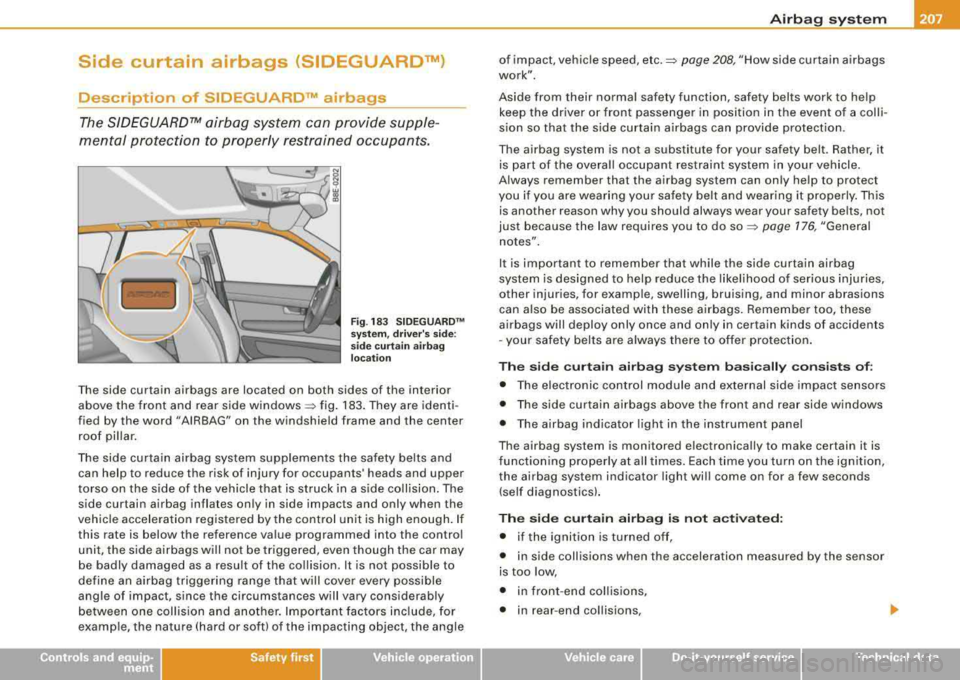
F ig . 18 3 S IDEGUARD ™
sys tem , driver's s id e:
s id e cu rtain air b a g
l oca tio n
The side curtain airbags are located on both sides of the interior
above the front and rear side
windows => fig. 183 . They are identi
fied by the word "AIRBAG" on the windshield frame and the center
roof pillar.
The side curtain airbag system supplements the safety belts and can help to reduce the risk of injury for occupants' heads and upper
torso on the s ide of the vehicle that is struck in a side collision . The
side curtain airbag inflates only in side impacts and only when the
vehicle accele ra tion reg istered by the contro l unit is high enough. If
this rate is below the reference va lue programmed into the contro l
unit, the side airbags w ill not be triggered, even though the car may
be badly damaged as a result of the co llision . It is not possible to
define an airbag triggering range that will cover every possible
angle of impact, since the circumstances will vary considerably
between one collision and ano the r. Important factors include, for
example, the nature (hard or soft) of the impacting object, the angle
Safety first
Airb ag syst em
of impact, vehicle speed, etc .=> page 208, "How side curtain airbags
work".
Aside from their norma l safety function, safety belts work to help
keep the driver or front passenger in position in the event of a colli
s ion so that the side curtain airbags can provide protection .
The airbag system is not a substitute for your safety belt . Rather, it
is part of the overall occupant restrain t system in your veh icle.
Always remember that the airbag system can only he lp to protect
you if you are wear ing your safety belt and wear ing it properly . This
is another reason why you should always wear your safety belts, not
just because the law requires you to do so
=> page 176, "General
notes".
It is important to remember that while the side curtain airbag
system is designed to help reduce the likelihood of serious injuries,
other injuries, for examp le, swelling, bruising, and minor abrasions
can a lso be associa ted with these a irbags . Remembe r too, these
airbags will deploy only once and on ly in certain kinds of accidents
- your safety belts are always there to offer protection .
The side curta in air b ag system b asi cally consists of :
• The elec tronic co ntrol mod ule and external side impact sensors
• The side curtain airbags above the front and rear side windows
• The airbag indicator light in the instrument panel
The airbag system is monitored electronica lly to make certain it is
f u n ction ing properly at all times. Each time you turn on the ignition,
the airbag system indicator light wi ll come on for a few seconds
(se lf diagnostics).
The s ide curt ain ai rbag is not acti vated :
• if the ignition is turned off,
• in side collisions when the acceleration measured by the sensor
is too low,
• in front -end collisions,
• in rear -end collisions,
.,
irechnical data
Page 213 of 368

& WARNING (conti nued )
• Alw ays install r ear-facing child saf ety s eats on the r ear seat.
• If you mu st in sta ll a re arwa rd f acing child safe ty s eat on the
front pas senger seat in exc eptional cir cum stances and the
PASSENGER AIR BAG OFF light doe s not come on and stay on,
immediat ely install th e rear-fa cing child safety s eat in a rear
s e ating po sit ion and h ave the airb ag sys tem in spe cted immedi
a tel y by y our Audi dealer .
& WARNING
If, in exceptional circum stance s, you must in stall a forward -fac ing
c hild re st ra int on the fr ont p assenge r's s eat:
• Alway s make sure the forward -facing seat ha s been de signed
and cert ified by it s m anuf acturer for u se on a front se at with a
pa ssenger front and side airbag .
• Always follow the m anufacturer's instruct ions provided w ith
the child safet y seat or c arrier.
• Alway s m ov e th e passeng er sea t into it s re arm ost p osit ion in
the seat' s fore and aft adju stment range , as far away from the
a irb ag as possible before installin g the ch ild r estr aint . The b ack
rest must be adjusted to an upright po sition.
• Alway s ma ke sure th at the PASSENGER AIR BAG OFF light
come s on and stay s on all the time wheneve r the ignition i s
s wit ched on . •
Advanced front airbag system and children
Your vehicle is equipped with a dual -stage front "Advanced Airbag
System" in comp liance with United States Federal Motor Vehicle
Safety Standard ( FMVSS) 208 as applicab le at the time your vehic le
was manufactured .
Controls and equip
ment Safety first Vehicle operation
Chi
ld Sa fe ty
The Advanced Airbag system in your vehic le has been certified to
meet the " low -risk" require ments for 3 and 6 yea r- old c hild ren on
the passenger side and small adu lts on the driver side . The low risk
deployment c rite ria are intended to reduce the risk of inju ry th rough
interaction with the airbag that can occur, for example, by being too
close to the steering whee l and instrument panel when the airbag
in flates . In add it ion, the system has been cert ified to comply with
the "suppression" requirements of the Safety Standard, to turn off
the front airbag for in fants up to 12 months who are restrained on
the front passeng er seat in child restraints that are listed in the
Standard.
Even though your vehic le is equipped with an Advanced Airbag
system, all ch ildren, especially those 12 years and younger, sho uld
a lways ride in the back seat proper ly restra ined for the ir age and
size . The airbag on the passenger side makes the front seat a poten
tially dangerous p lace for a chi ld to r ide. The front seat is not the
safest p lace for a chi ld in a forward -facing child safety seat. It can be
a very dangerous place for an infant or a larger chi ld in a rearward
facing seat. •
Advanced Airbags and the weight-sensing
mat in the front seat
The Advanced A irbag System in your ve hicle detects the p resence
of an infant or chi ld in a child restraint on the front passenger seat
using the weight -sensing mat in the seat cushion and the sensor
below the safety belt latch on the front passenger seat that
measures the tension on the safety belt .
The weight -sensing mat meas ures total we ig ht of the ch ild and the
child safety seat and a chi ld blanket on the front passenger seat. The
weight o n the fr ont passenge r seat is related to the desig n of the
child restraint and its "footprint" , the size and shape of the bottom
of the child restraint as it sits on the seat. The weight of a child
restraint and its "footprint" vary for different kinds of chi ld
_..
Vehicle care Do-it-yourself service Technical data
Page 223 of 368
& WARNING (continued)
• If the backrest is not securely latched, the child and the child
restraint will be thrown forward together with the backrest and
will strike parts of the vehicle interior . The child can be seriously
injured or killed.
• Never install rear-facing child safety seats or infant carriers on
the front passenger seat. A child will be seriously injured and can be killed when the passenger airbag inflates .
• The inflating airbag will hit the child safety seat or infant
carrier with great force and will smash the child safety seat and
child against the backrest, center arm rest, door or roof.
• Always install rear-facing child safety seats or infant carriers on
the rear seat.
• Forward-facing child safety seats or infant carriers installed on
the front passenger's seat may interfere with the deployment of
the airbag and cause serious injury to the child.
• It is safer to install a forward-facing child safety seat on the rear
seat.
• Always read and heed all WARNINGS whenever using a child
restrained in a vehicle is being used
=> page 210. Special precau
tions apply when installing a child safety seat on the front
passenger
seat => page 189, "Child restraints on the front seat -
some important things to know".
& WARNING
Always take special precautions if you must install a forward or
rearward -facing child restraint on the front passenger's seat in
exceptional situations :
• Whenever a forward or rearward-facing child restraint is
installed on the front passenger seat, the PASSENGER AIR BAG
OFF light must come on and stay on whenever the ignition is
switched on.
Controls and equip ment Safety first
Vehicle operation
Child Safety
& WARNING (continued)
• If the PASSENGER AIR BAG OFF light does not come on and stay
on, perform the checks described
=> page 198, "Monitoring the
Advanced Airbag System" .
• Take the child restraint off the front passenger seat and install
it properly at one of the rear seat positions if the PASSENGER AIR
BAG OFF light does not stay on whenever the ignition is switched
on .
• Improper installation of child restraints can reduce their effec
tiveness or even prevent them from providing any protection.
• An improperly installed child restraint can interfere with the
airbag as it deploys and seriously injure or even kill the child.
• Always carefully follow the manufacturer's instructions
provided with the child safety seat or carrier.
• Never place additional items on the seat that can increase the
total weight registered by the weight -sensing mat and can cause
injury in a crash.
& WARNING
Forward-facing child restraints:
• Always make sure the forward-facing seat has been designed
and certified by its manufacturer for use on a front seat with a
passenger front and side airbag.
• Never put the forward-facing child restraint up, against or very
near the instrument panel .
• Always move the passenger seat into its rearmost position in
the seat's fore and aft adjustment range, as far away from the airbag as possible before installing the forward-facing child
restraint. The backrest must be adjusted to an upright position.
• Make sure that the PASSENGER AIR BAG OFF light comes on
and stays on all the time whenever the ignition is switched on. ...
Vehicle care Do-it-yourself service Technical data
Page 264 of 368
___ C_ le_a_ n_in ~ g_ a_n _ d_ p_ ro_ t_e _c _t _io _ n ___________________________________________ _
In the case of genera l soiling of the upho lstery and cover material,
we recom mend hiring a spec ialis t that has the equ ipment to c lean
the seat covers and other fabric surfaces by shampooing and spray
extraction .
& WARNING
Always read and heed all WARNINGS and the information
=> page 254.
[ i] Tip s
Open Ve lcro fasteners on your clothing can damage the seat cover .
Please make sure that Ve lcro fas te n ers are c losed. •
Plastic parts and instrument panel
Always us e a c lean cloth mo istened in clear wa ter to c lean thes e
areas . For persistent dirt use an Audi approved
solvent -free plastic
cleane r/p rotec tant.
& WARNING
Solvents can change the propertie s of some pla stics and make it
harder for the airbag to deplo y.
• Never clean the instrument panel or the surface of Airbag
modules with cle aning produ cts th at contain solvents .
• Produ cts c ontaining sol vent s will make the surf ace of thi s part
porous.
• Serious injur ies can re sult if pla stic p art s come l oose when the
airbag is deployed .
• Always read and heed all WARNINGS and the info rm ation
~ page 254 .
0 Note
Cleaning agents conta ining solvents wil l attac k the mater ial and can
change the way it behaves .•
Ap plies to vehic les: w it h n atu ral lea ther
Natural leather
Audi makes grea t efforts t o main tain the pro perties,
n at ural look and feel of in terior le ather.
Gener al
We offer many d ifferent types of leather on our vehic les. Most are
different types o f nappa leather, which has a smooth surface and
comes in various co lors.
T he in tensity of the color determi nes the vis ual c h aracteristics and
appearance . If the surface of the leather has a typical natura l look ,
t hen t he leat her is a nap pa lea ther that has been left in a re lati vely
natural condition. Th is leather offers part icu lar ly good comfort and
breathes wel l. Fine veins, closed grains, insect bites, skin folds, and
subt le variations in color remain visible. These characteristics
demonstrate that the material is genuinely natural.
Na tura l nappa leather is n ot covered by a color fi nish . It is there fore
more sensitive to soiling a wear, which is something you need to
co nsider if chi ldren, a nimals or other factors m igh t prove to be
particularly hard on the leather.
By contrast, leather types that are covered by a colored finish layer
are more durable. Th is has a posit ive effect on the leather's resis
tance to wear and soiling in daily use. On the other hand, the typical
character istics o f natura l leather are barely or not appare nt.
However, this does not mean that the leather itself is of inferior
qual ity.
Care and handling
Because of the exclusive nature of t he types o f leather tha t Audi
uses and their unique properties (such as sensit ivity to oi ls, grease, .,_
Page 274 of 368

-Checking and filling Pll':f..._--=--=--------------
Checking and filling
Engine hood
Releasing the engine hood
The engine hood is released from inside the vehicle.
Fig. 203 Driver's side
footwell: engine hood
release lever
- Pull the release lever on the left under the instrument
panel=> fig. 203 in the direction of the arrow.
The hood pops up slightly under spring pressure. •
Opening the engine hood
Fig. 204 Release lever
under the hood
Before opening the engine hood, make sure that the wind
shield wipers are flat against the windshield. Otherwise,
they could damage the paint on the hood.
Lift the hood
slightly=> ,&.
- Pull the release under the hood => fig. 204. This releases
the catch.
- Open the hood all the way.
The hood is kept in the open position by a gas strut.
& WARNING
Hot engine coolant can burn you.
• To reduce the risk of being burned, never open the hood
if you
see or hear steam or coolant escaping from the engine compart-.,..
Page 328 of 368

1119....__F_ u_ s_ e_s _ a_n _ d_ b_ u_lb _ s _______________________________________________ _
Fuses and bulbs
Fuses
Repl ac ing a fu se
A problem in the electrical system may be caused by a
blown fuse.
Fig . 232 End face of
instrument panel :
removing cover plate
to access fuses
Fig . 233 Fuse carrier
behind the instrument
panel end face, cover
removed
- Switch off the ignition and the electrical component
affected.
- Carefully pry the face cover off the instrument panel
using the ignition key or a
screwdriver ~ fig. 232.
- Check the fuse listing on the next pages to find out which
fuse belongs to the component which has failed
~ page 327, "Fuse list".
- Remove the blown fuse with the plastic clip provided.
The clip is located on the holder in the fuse box.
- Replace a blown fuse (recognizable by the melted metal
strip inside) with a fuse of the same amperage .
- Firmly snap the cover back onto the instrument panel
face.
The various electrical circuits are protected by fuses. The fuses are
clustered in a centralized unit. The unit is located behind the face
panel at the end of the instrument panel. The crank for operating
the sunroof in case of a power failure is also stored behind the face
panel ~ page 70.
Two spare fuses and a sticker identifying the fuses are located on
the inside of the fuse box cover.
You are well advised to keep a supply of spare fuses in your vehicle.
Fuses with the proper ampere ratings are available at your Audi
d ea le r.
& WARNING
Never replace a fuse with one that has a higher amperage rating.
• A fuse with a too high amperage could damage the electrical
part and cause a fire.
~
Page 360 of 368
-Alphabetical index
---=------------------------------------------------
I
Ignition key 135
Ignition lock ... ... .. .... .... ...... . 135
Electronic immobiliz er ..... ........ 54
Ignition lock posit ions .... .... ...... . 135
167
185
Impor
tant things to do before driving ..
Improperly worn safety belts
Ind icator light
Airbag system . . . . . . . . . . . . . . . 198 , 199
PASSENGER AIR BAG OFF ......... 199
Indica tor lights . . . . . . . . . . . . . . . . . . . 12, 19
Infant seats . . . . . . . . . . . . . . . . . . . . . . . . 215
How do I properly install an infa nt seat in
my vehicle? .............. ...... 215
Safety instructions . . . . . . . . . . . . . . . 215
Ins ide rear view mirror .... ....... .... . 90
Installing child safety seats
Safety belts . . . . . . . . . . . . . . . . . . . . . 220
Inst rument cluster il lum ination ........ 15
In strument panel
Illum ination ...... ........ ... .... . 78
Inst rument panel and controls .. ....... 12
Ins truments and controls
Genera l ill ustration .... ....... .... . 11
In terior lights ....................... 81
Ambient lighting .................. 82
Luggage compartment ............. 83
Rear ............................ 82
J
Jack and tools . . . . . . . . . . . . . . . . . . . . . . 316 Jumper cables
.......... .... .... .... 331
Jump -starting 330
K
Key ...... ..... .. ...... .... ... .. .... 52
Battery replacement . . . . . . . . . . . . . . . 54
Coded settings .. .... ....... ..... 132
Convenience opening and closing of windows ... .... ... .. .... .... ... 59
Emergency key . . . . . . . . . . . . . . . . . . . 52
Key replacement . . . . . . . . . . . . . . . . . . 52
Master key .......... ...... .... ... 52
Valet key . . . . . . . . . . . . . . . . . . . . . . . . . 52
Key-coded settings Climate controls .. ........ ....... 132
Keyl ess entry remote control
Keys 53, 56
Electronic immobilizer ...... .... ... 16
Kick-down ...... ....... ...... .. 146, 153
L
LATCH ............................ 225
Description ...................... 225
Guidance fixtures for lower anchorages .
226
Ins talling a child restraint .. .. .. ... 228
Location ......... .... .... .... ... 225
Mounting and re leasing the anchorage
hook .. ...... ...... .... ... .. ... 229
Leather ..... .. ...... ... .. .... .... .. 262
Cleaning ........................ 263
Le aving -home-function ............... 77 Lifting jack
......... .... .... .... .... 321
Lifting points ...... ...... ... .. .... .. 336
Lifting/raising the vehic le ............ 335
Light sensor defective ................ 34
Light sensor package
Automatic headlight contro l .. .. ... . 73
Lights Coming-home/leaving-home-function 77
Emergency flasher ................ 79
Front fog lights ............... .... 76
Headlights ....................... 72
High beam ..... .. .... .... .... . 72, 80
High beam warning/indicator light .. . 23
Instrument pane l il lumination . ...... 78
Rear fog lights ..... ............... 76
Side marker lights ................. 72
Turn signals ...................... 80
Xenon headlights ...... ..... .. .... 79
Loading the luggage compartment ... . 173
Loading the roof rack .. ....... .... ... 117
Locking Power locking switch .............. 59
Rear lid .......................... 61
Remote control . . . . . . . . . . . . . . . . . . . 56
Using the key .. .... .... ..... .. .... 58
Lower anchorage locator button ...... 225
Luggage Stowing ........................ 173
Luggage compartment Attachment hooks . ........ .... ... 112
Cargo net .... .... .... ........... 108
Fastening eyes ................... 108
Light ............................ 83