instrument panel AUDI A4 AVANT 2008 User Guide
[x] Cancel search | Manufacturer: AUDI, Model Year: 2008, Model line: A4 AVANT, Model: AUDI A4 AVANT 2008Pages: 368, PDF Size: 46.19 MB
Page 172 of 368
___ D_ r
_ i_v _i_n ..;::g :;_ S_ a_ f_ e_, ly'----------------------------------------------------
&, WARNING (continued)
• Passengers must always sit in an upright position and never
lean against or place any part of their body too close to the area
where the airbags are located.
• Passengers who are unbelted, out of position or too close to the
airbag can be seriously injured by an airbag as it unfolds with
great force in the blink of an eye.
• Always make sure that there are at least 10 inches (25 cm)
between the front passenger's breastbone and the instrument
panel.
• Each passenger must always sit on a seat of their own and
properly fasten and wear the safety belt belonging to that seat.
• Before driving, always adjust the front passenger seat and
head restraint properly.
• Always keep your feet on the floor in front of the seat. Never
rest them on the seat, instrument panel, out of the window, etc.
The airbag system and safety belt will not be able to protect you properly and can even increase the risk of injury in a crash.
• Never drive with the backrest reclined or tilted far back! The
farther the backrests are tilted back, the greater the risk of injury due to incorrect positioning of the safety belt and improper
seating position.
• Children must always ride in child safety
seats => page 210.
Special precautions apply when installing a child safety seat on
the front passenger seat
=> page 187. •
Proper seating positions for passengers in
rear seats
Rear seat passengers must sit upright with both feet on
the floor consistent with their physical size and be prop
erly restrained whenever the vehicle is in use.
To reduce the risk of injury caused by an incorrect seating
position in the event of a sudden braking maneuver or an
accident , your passengers on the rear bench seat must
always observe the following :
- Make sure that the seatback is securely latched in the
upright position =>
page 104.
- Adjust the head restraint so that the upper edge is as
even with the top of your head as possible but no lower
than eye level =>
page 171.
-Keep both feet flat in the footwell in front of the rear seat.
- Fasten and wear safety belts properly =>
page 181.
-Make sure that children are always properly restrained in
a child restraint that is appropriate for their size and age
=>
page 210.
& WARNING
Passengers who are improperly seated on the rear seat can be
seriously injured in a crash.
• Each passenger must always sit on a seat of their own and
properly fasten and wear the safety belt belonging to that seat.
• Safety belts only offer maximum protection when the seatback
is securely latched in the upright position and the safety belts are
properly positioned on the body. By not sitting upright, a rear seat
passenger increases the risk of personal injury from improperly
positioned safety belts!
_,.
Page 174 of 368
__ .....;;;D;..; r..;. iv.,;..;.; in~ g:...S
.;;;..;; a;.;.f .,;;e .,;.IY !.... ______________________________________________ _
position. A driver is responsible for the safety of all vehicle
occupants and especially for children. Therefore:
- Never allow anyone to assume an incorrect seating posi -
tion when the vehicle is being
used ~& .
The following bulletins list only some sample positions that will
increase the risk of serious injury and death. Our hope is that these
examples will make you more aware of seating positions that are
dangerous.
Therefore, whenever the vehicle is moving:
• never stand up in the vehicle
• never stand on the seats
• never kneel on the seats
• never ride with the seatback reclined
• never lie down on the rear seat
• never lean up against the instrument panel
• never sit on the edge of the seat
• never sit sideways
• never lean out the window
• never put your feet out the window
• never put your feet on the instrument panel
• never rest your feet on the seat cushion or back of the seat
• never ride in the footwell
• never ride in the cargo area
& WARNING
Improper seating positions increase the risk of serious personal
injury and death whenever a vehicle is being used.
• Always make sure that all vehicle occupants stay in a proper
seating position and are properly restrained whenever the vehicle
is being used.
•
Pedal area
Pedals
The pedals must always be free to move and must never
be interfered with by a floor mat or any other object.
Make sure that all pedals move freely without interference and that
nothing prevents them from returning to their original positions.
Only use floor mats that leave the pedal area free and can be
secured with floor mat fasteners.
If a brake circuit fails, increased brake pedal travel is required to
bring the vehicle to a full stop.
& WARNING
Pedals that cannot move freely can cause loss of vehicle control
and increase the risk of serious injury.
• Never place any objects in the driver's footwell. An object could
get into the pedal area and interfere with pedal function. In case
of sudden braking or an accident, you would not be able to brake
or accelerate!
• Always make sure that nothing can fall or move into the
driver's footwell. •
Floor mats on the driver side
Always use floor mats that can be securely attached to
the floor mat fasteners and do not interfere with the free
movement of the pedals.
- Make sure that the floor mats are properly secured and
cannot move and interfere with the
pedals~& . ~
Page 176 of 368
___ D_ r
_ i_v _i_n ..;::g :;_ S_ a_ f_ e_, ly'----------------------------------------------------
& WARNING
Improperly stored luggage or other items can fly through the
vehicle causing serious personal injury in the event of hard braking
or an accident. To help reduce the risk of serious personal injury:
• Always put objects, for example, luggage or other heavy items
in the luggage compartment .
• Always secure objects in the luggage compartment using the
tie-down hooks and suitable straps .
& WARNING
Heavy loads will influence the way your vehicle handles. To help
reduce the risk of a loss of control leading to serious personal
injury :
• Always keep in mind when transporting heavy objects, that a
change in the center of gravity can also cause changes in vehicle
handling:
-Always distribute the load as evenly as possible.
- Place heavy objects as far forward in the luggage compart-
ment as possible.
• Never exceed the Gross Axle Weight Rating or the Gross
Vehicle Weight Rating specified on the safety compliance sticker on the left door jamb. Exceeding permissible weight standards
can cause the vehicle to slide and handle differently.
• Please observe information on safe
driving => page 166.
& WARNING
To help prevent poisonous exhaust gas from being drawn into the
vehicle, always keep the rear lid closed while driving.
• Never transport objects larger than those fitting completely
into the luggage area because the rear lid cannot be fully closed.
& WARNING (continued)
• If you absolutely must drive with the rear lid open, observe the
following notes to reduce the risk of poisoning :
- Close all windows,
- Close the power roof*,
- Open all air outlets in the instrument panel,
- Switch off the air recirculation,
- Set the fresh air fan to the highest speed.
& WARNING
Always make sure that the doors, all windows, the power roof*
and the read lid are securely closed and locked to reduce the risk
of injury when the vehicle is not being used.
• After closing the rear lid, always make sure that it is properly
closed and locked.
• Never leave your vehicle unattended especially with the rear lid
left open. A child could crawl into the vehicle through the luggage
compartment and close the rear lid becoming trapped and unable
to get out . Being trapped in a vehicle can lead to serious personal
injury.
• Never let children play in or around the vehicle.
• Never let passengers ride in the luggage compartment . Vehicle
occupants must always be properly restrained in one of the
vehicle's seating positions.
[ i] Tips
Air circulation helps to reduce window fogging. Stale air escapes to
the outside through vents in the trim panel, on the left side of the
luggage compartment. Be sure to keep these slots free and open. •
Page 181 of 368
of safety restraint systems, the unrestrained occupant will slam
violently into the steering wheel, instrument panel, windshield, or
whatever else is in the
way=> fig . 169. This impact with the vehicle
interior has all the energy they had just before the crash.
Never rely on airbags alone for protection . Even when they dep loy,
airbags provide only additional protection . Airbags are not
supposed to deploy in all kinds of accidents . Although your Audi is
e quipped wi th airbags, all vehicle occupan ts , including the driver,
must wear safety belts correctly in order to minimize the risk of
severe injury or death in a crash .
Remember too, that airbags will deploy only once and that your
safety belts are always there to offer protection in those accidents
in which airbags are not supposed to deploy or when they have
already deployed . Unbelted occupants can also be thrown out of the
vehicle where even more severe or fatal injuries can occur.
It is also important for the rear passengers to wear safety belts
correctly . Unbelted passengers in the rear seats endanger not only
themselves but also the driver and other
passengers~ page 178,
fig. 170. In a frontal collision they will be thrown forward violently,
where they can hit and injure the driver and/or front seat
passenger. •
Safety first
Safety belts
Safety belts protect
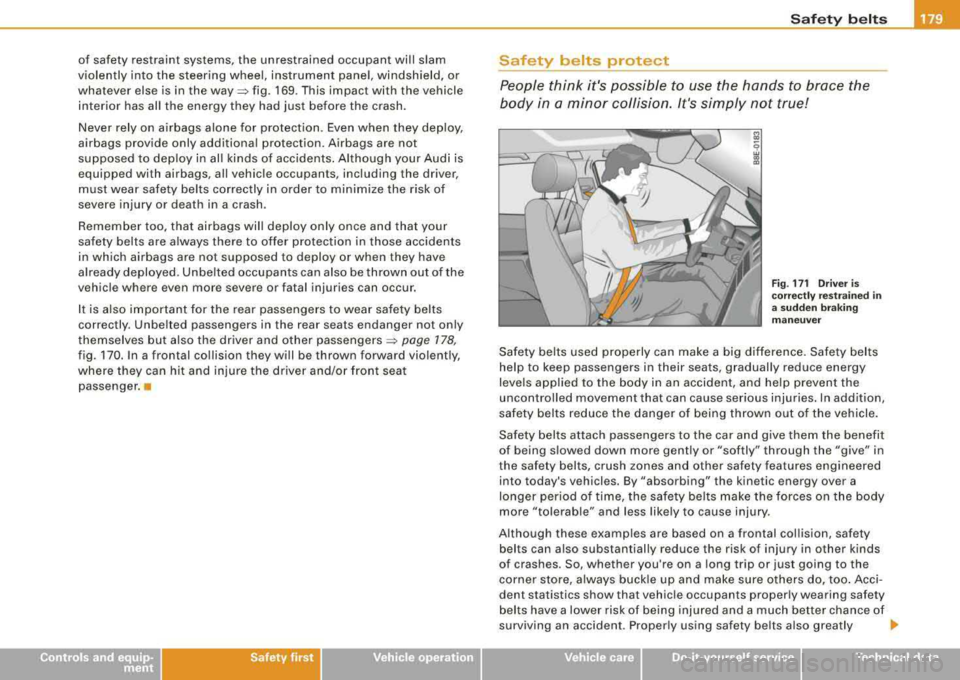
People think it's possible to use the hands to brace the
body in a minor collision. It's simply not true!
&l
9 w a, a,
Fig. 171 Driver is
correctly restrained in
a sudden braking
maneuver
Safety belts used properly can make a big difference. Safety belts
help to keep passengers in their seats, gradually reduce energy
levels applied to the body in an accident, and help prevent the
uncontrolled movement that can cause serious injuries. In addition ,
safety belts reduce the danger of being thrown out of the vehicle .
Safety belts attach passengers to the car and give them the benefit
of being slowed down more gently or "softly" through the "give" in
the safety belts, crush zones and other safety features engineered
into today's vehicles. By "absorbing" the kinetic energy over a
longer period of time, the safety belts make the forces on the body
more "tolerable" and less likely to cause injury .
Although these examples are based on a frontal collision, safety belts can also substantially reduce the risk of injury in other kinds
of crashes. So, whether you're on a long trip or just going to the
corner store, a lways buckle up and make sure others do, too . Acci
dent statistics show that vehicle occupants properly wearing safety
belts have a lower risk of being injured and a much better chance of
surviving an accident . Properly using safety belts also greatly .,,_
irechnical data
Page 182 of 368
___ S_a_ f_ e_ t...: y_ b_e_ l_ t _s _______________________________________________ _
increases the ability of the supplemental airbags to do their job in a
collision. For this reason, wearing a safety belt is legally required in
most countries including much of the United States and Canada .
Although your Audi is equipped with airbags, you still have to wear
the safety belts provided. Front airbags, for example, are activated
only in some frontal collisions. The front airbags are not activated in
all frontal collisions, in side and rear collisions, in roll overs or in
cases where there is not enough deceleration through impact to the
front of the vehicle. The same goes for the other airbag systems in
your Audi . So, always wear your safety belt and make sure every
body in your vehicle is properly restrained!
•
Important safety instructions about safety
belts
Safety belts must always be correctly positioned across the strongest bones of your body.
-Always wear safety belts as illustrated and described in
this chapter.
- Make sure that your safety belts are always ready for use
and are not damaged.
& WARNING
Not wearing safety belts or wearing them improperly increases
the risk of serious personal injury and death. Safety belts can work
only when used correctly.
• Always fasten your safety belts correctly before driving off and
make sure all passengers are correctly restrained.
• For maximum protection, safety belts must always be posi
tioned properly on the body.
• Never strap more than one person, including small children,
into any belt.
& WARNING (continued)
• Never place a safety belt over a child sitting on your lap.
• Always keep feet in the footwell in front of the seat while the
vehicle is being driven.
• Never let any person ride with their feet on the instrument
panel or sticking out the window or on the seat.
• Never remove a safety belt while the vehicle is moving. Doing
so will increase your risk of being injured or killed.
• Never wear belts twisted.
• Never wear belts over rigid or breakable objects in or on your
clothing, such as eye glasses, pens, keys, etc., as these may cause
injury.
• Never allow safety belts to become damaged by being caught
in door or seat hardware.
• Do not wear the shoulder part of the belt under your arm or
otherwise out of position .
• Several layers of heavy clothing may interfere with correct posi
tioning of belts and reduce the overall effectiveness of the system.
• Always keep belt buckles free of anything that may prevent the
buckle from latching securely.
• Never use comfort clips or devices that create slack in the
shoulder belt. However, special clips may be required for the
proper use of some child restraint systems.
• Torn or frayed safety belts can tear, and damaged belt hard
ware can break in an accident. Inspect belts regularly. If webbing,
bindings, buckles, or retractors are damaged, have belts replaced
by an authorized Audi dealer or qualified workshop.
• Safety belts that have been worn and loaded in an accident
must be replaced with the correct replacement safety belt by an
authorized Audi dealer . Replacement may be necessary even if
damage cannot be clearly seen. Anchorages that were loaded
must also be inspected.
.,_
Page 190 of 368
___ A_ ir_b _ a_ g=- s--=- y_s _t _e _m _________________________________________________ _
repair costs or even the lack of vehicle damage is not necessarily an
indication of whether an airbag should inflate or not.
It is not possib le to define a range of vehicle speeds that will cover
every possible kind and ang le of impact that wil l always trigger the
a irbags, since the circumstances wi ll vary cons iderably between
one co llision and another . Important factors include, for example,
the nature (hard or soft) of the object which the car hits, the angle of impact, vehicle speed , etc . The front airbags will also not inf late
in s ide or rear co llisio ns, or in rol l-overs .
Al way s remember : Airbags wi ll deploy only once , and on ly in certain
kinds of collisions. Yo ur safety belts are a lways there to offer protec
tion in those situat ions in which airbags are not supposed to deploy ,
or when they have already deployed; for example, when your vehic le
str ikes or is struck by another after the first co llision.
T his is just one of the reasons why an airbag is a supplem entary
r es tra int and is not a substitute for a safety be lt. The a irbag system
works most effective ly when used with the safety be lts . T herefore,
a lways properly wear your safety
be lts ~ page 176 .
& WARNING
Sitting too clo se to the steering wheel or instrument panel will
de cre ase the effect ivene ss of the airbags and will increase the risk
of personal injury in a colli sion.
• N ever si t closer than 10 in ches (25 cm) to the steer ing wheel or
in strument panel .
• If you cannot sit more than 10 inches (25 cm ) from the steering
wheel , inve stigate whether ad aptive equipment may be available
to held you re ach the pedal s and in crease your s eating distanc e
from the steering wheel.
• If you are unrestr ained , le aning forward , sitting sideways or out
of position in any way , your risk of injury i s much higher.
• You will also receive seriou s injuries and could even be killed if
you are up again st the airbag or too close to it when it infl ates
-
even with an Advanced A irbag .
& WARNING (continued )
• To reduce the risk of injury when an airbag inflates , always
we ar s afety belt s
properly ~ page 181, "Safety belt s".
• Alway s make certain that children age 12 or young er always
ride in the rear sea t. If children are not properl y re st ra ined , they
may b e severely injured or killed when an airbag inflate s.
• Never let children ride unre str ained or improperly restr ained in
the vehicle. Adjust the front seat s properly .
• Ne ver rid e w ith the b ackrest re clined.
• Alway s sit as far a s po ssible from the steering wheel or the
i nst rument
panel ~ page 168.
• Alway s sit upright with your ba ck ag ain st th e ba ckre st of your
s eat.
• Ne ver pla ce your feet on the in strument panel or on the seat.
Alwa ys keep both feet on the floor in front of the seat to help
prevent seriou s injuri es to th e le gs and hips if the airbag infl ates.
• Never re cline the front pa ssenger's seat to tran sport object s.
Item s can al so mo ve into the a re a of the side airbag or the front
airbag during braking or in a sudden m aneuver. Objects near the
airbags can becom e projectile s and cau se injury wh en an airbag
i nflates .
& WARNING
Airbags that have deplo yed in a cr ash must be replaced .
• Use only original equipment airb ag s a pproved by Audi and
in stalled by a trained techni cian who has the nece ssary tool s and
diagno stic equipment to pr operly repl ace any airbag in y our
vehicle and a ssure sys tem effectiv enes s in a crash .
• N ever p ermit salv aged or re cycled airb ags to be in sta lled in
y our vehicle. •
Page 191 of 368
__________________________________________________ A_ i_ r _b _a-' g=- s_ y=-- s_t _e _m ______ lfflll
Child restraints on the front seat - some
important things to know
- Be sure to read the important information and head the
WARNINGS for important details about children and
Advanced
Airbags=> page 210.
Even though your vehicle is equipped with an Advanced Airbag
System, make certain that all children, especially those 12 years and
younger, always ride in the back seat properly restrained for their
age and size . The airbag on the passenger side makes the front seat
a potentially dangerous place for a child to ride. The front seat is not
the safest place for a child in a forward -facing child safety seat. It
can be a very dangerous place for an infant or a child in a rearward
facing seat.
The Advanced Airbag System in your vehicle has been certified to comply with the Requirements of United States Federal Motor
Vehicle Safety Standard 208 as applicable at the time your vehicle
was manufactured.
The Standard requires the front airbag on the passenger side to be
turned off ("suppressed") if a child up to about one year of age
restrained in one of the rear-facing or forward-facing infant
restraints listed in Federal Motor Vehicle Safety Standard 208 with
which the Advanced Airbag System in your vehicle was certified has been installed on the front passenger seat. For a listing of the child
restraints that were used to certify compliance with the US Safety
Standard ::::, page 212.
The PASSENGER AIR BAG OFF light in the instrument panel tells you
when the front Advanced Airbag on the passenger side has been
turned off by the electronic control unit.
Each time you turn on the ignition, the
PASSENGER AIR BAG OFF
light will come on for a few seconds and:
• will stay on if the front passenger seat is not occupied,
Controls and equip
ment Safety first
Vehicle operation
• will stay on if there is a small child or child restraint on the front
passenger seat,
• will go off if the front passenger seat is occupied by an adult as
registered by the weight-sensing
mat ::::, page 198, "Monitoring the
Advanced Airbag System" .
The
PASSENGER AIR BAG OFF light comes on when the control unit
detects a total weight on the front passenger seat that requires the
front airbag to be turned off.
If the total weight on the front passenger seat is more than that of
a typical 1 year-old child but less than the weight of a small adult,
the front airbag on the passenger side can deploy (the
PASSENGER
AIR BAG OFF
light does not come on). If the PASSENGER AIR BAG
OFF
light does not come on, the front airbag on the passenger side
has not been turned off by the electronic control unit and can
deploy if the control unit senses an impact that meets the condi
tions stored in its memory.
For example, the airbag may deploy if:
• a small child that is heavier than a typical 1 year-old child is on
the front passenger seat (regardless of whether the child is in one
of the child safety seats
listed ::::, page 212), or
• a child who has outgrown child restraints is on the front
passenger seat.
If the front passenger airbag is turned off, the
PASSENGER AIR BAG
OFF
light comes on in the instrument cluster and stays on.
The front airbag on the passenger side may
not deploy (the
PASSENGER AIR BAG OFF light does not illuminate and stay lit) even
if a small adult or teenager, or a passenger who is not sitting upright
with their back against a non-reclined backrest with their feet on the
vehicle floor in front of the seat is on the front passenger seat
=> page 168, "Proper seating position for the driver".
If the front passenger airbag deploys, the Federal Standard requires
the airbag to meet the "low risk" deployment criteria to reduce the risk of injury through interaction with the airbag . "Low risk" deploy
ment occurs in those crashes that take place at lower decelerations _,,.
Vehicle care Do-it-yourself service Technical data
Page 192 of 368
___ A_ ir_b _ a_ g=- s--=- y_s _t _e _m _________________________________________________ _
as defi ne d i n th e el ectronic contro l unit=> page 19 9, " PA SSE NGER
AI R B AG OFF lig ht ".
A lways remember, a c hild safety s eat or infant carrier instal led on
the front seat may be struck and knocked out of po sition by the
r a pi dly i nfla ting passe nger's ai rbag in a fron tal c olli sion . The a irbag
co uld greatly red uce the effectiveness of the child restraint and
e ven se riou sly inju re the child d urin g infla tion .
F or th is reason, and because the bac k seat is the safest plac e for
chi ldr en
-whe n prop erly r estrain ed accord in g to t he ir age an d size
-we stro ngly recomme nd that ch il d ren a lwa ys sit in the bac k se at
=> p age 210, "Child S afety".
& WARNING
A child in a rearward -facing child safety seat installed on the front
passenger seat will be seriously injured and can be killed if the
front airbag inflates
-even with an Advanced Airbag System .
• The inflating airbag will hit the child safety seat or infant
carrier with great force and will smash the child safety seat and
child against the ba ckrest , center arm rest , door or roof .
• Always install rear-facing child safety seats on the rear seat .
• If you must install a rearward facing child safety seat on the
front passenger seat because of exceptional circumstances and
the PASSENGER AIR BAG OFF light does not come on and stay on ,
immediately install the rear-facing child safety seat in a rear
seating position and have the airbag system inspected by your
Audi dealer .
• Forward-facing child safety seats installed on the front
passenger's seat may interfere with the deployment of the airbag
and cause serious personal injury to the child .
& WARNING
If, in exceptional circumstances , you must install a forward-facing
child restraint on the front passenger's seat:
& WARNING (continued)
• Always make sure the forward-facing seat has been designed
and certified by its manufacturer for use on a front seat with a
passenger front and side airbag .
• Never put the forward-facing child restraint up against or very
near the instrument panel.
• Always move the passenger seat into its rearmost position in
the seat's fore and aft adjustment range, as far away from the
airbag as possible before installing the forward-facing child
restraint. The backrest must be adjusted to an upright position.
• Make sure that the PASSENGER AIR BAG OFF light comes on
and stays on all the time whenever the ignition is switched on.
& WARNING
To reduce the risk of serious injury , make sure that the PASSENGER
AIR BAG OFF light will be displayed whenever a child restraint is
installed on the front passenger seat and the ignition is switched
on.
• If the PASSENGER AIR BAG OFF light does not stay on, perform
the checks
described => page 198, "Monitoring the Advanced
Airbag System" .
• Take the child restraint off the front passenger seat and install
it properly at one of the rear seat positions if the PASSENGER AIR
BAG OFF light does not stay on.
• Have the airbag system inspected by your Audi dealer immedi
ately .
• Always carefully follow instructions from child restraint manu
facturers when installing child restraints .
& WARNING
If, in exceptional circumstances, you must install a forward or
rearward -facing child restraint on the front passenger's seat :
Page 194 of 368
-Airbag system
----:=-..:....--------------------------------------------
& WARNING
Never rely on airbags alone for protection.
• Even when they deploy, airbags provide only supplemental
protection .
• Airbag work most effectively when used with properly worn
safety belts.
• Therefore, always wear your safety belts and make sure that
everybody in your vehicle is properly restrained.
& WARNING
A person on the front passenger seat, especially infants and small children, will receive serious injuries and can even be killed by
being too close to the airbag when it inflates.
• Although the Advanced Airbag System in your vehicle is
designed to turn off the front passenger airbag if an infant or a
small child is on the front passenger seat, nobody can absolutely
guarantee that deployment under these special conditions is
impossible in all conceivable situations that may happen during
the useful life of your vehicle.
• The Advanced Airbag System will deploy in accordance with
the
"low risk" option under the U.S. Federal Standard if a child that
is heavier than the typical one-year old child is on the front
passenger seat and the other conditions for airbag deployment
are met.
• Accident statistics have shown that children are generally safer
in the rear seat area than in the front seating position.
• For their own safety, all children, especially 12 years and
younger, should always ride in the back properly restrained for
their age and size.
•
Advanced front airbag system
Your vehicle is equipped with a front Advanced Airbag System in compliance with United States Federal Motor Vehicle Safety Stan
dard 208 as applicable at the time your vehicle was manufactured .
The front Advanced Airbag System supplements the safety belts to
provide additional protection for the driver's and front passenger's
heads and upper bodies in frontal crashes. The airbags inflate only
in frontal impacts when the vehicle deceleration is high enough.
The front Advanced Airbag System for the front seat occupants is
not a substitute for your safety belts. Rather, it is part of the overall
occupant restraint system in your vehicle . Always remember that
the airbag system can only help to protect you, if you are sitting
upright, wearing your safety belt and wearing it properly. This is why
you and your passengers must always be properly restrained, not
just because the law requires you to be.
The Advanced Airbag System in your vehicle has been certified to
meet the "low risk" requirements for 3 and 6 year-old children on the
passenger side and very small adults on the driver side. The low risk
deployment criteria are intended to help reduce the risk of injury
through interaction with the front airbag that can occur, for example, by being too close to the steering wheel and instrument
panel when the airbag inflates .
In addition, the system has been certified to comply with the
"suppression" requirements of the Safety Standard, to turn off the
front airbag for infants 12 months old and younger who are
restrained on the front passenger seat in child restraints that are
listed in the
Standard~ page 272 .
"Suppression" requires the front airbag on the passenger side to be
turned off if:
• a child up to about one year of age is restrained on the front
passenger seat in one of the rear-facing or forward-facing infant
restraints listed in Federal Motor Vehicle Safety Standard 208 with
which the Advanced Airbag System in your vehicle was certified. For
~
Page 196 of 368
___ A_ ir_b _ a_ g=- s--=- y_s _t _e _m _________________________________________________ _
&, WARNIN G (continu ed )
• The inflating airbag will hit the child s afety seat or infant
car rier with gre at for ce and will sma sh the child safe ty se at and
c hild agai nst the ba ckre st, center arm re st, door , or roof .
• Alwa ys in sta ll re arw ard -f aci ng child re str aint s in the b ack se at .
• If you mu st in stall a rearw ard facing child safety seat on the
front p assenger se at be cause of e xce pti ona l ci rc um stan ce s a nd
the PASSENGER AIR BAG OFF light doe s not come on and stay on ,
immedi atel y insta ll the re ar-f a cing child s afet y s ea t in a re ar
se ating position and h av e the airb ag sy stem inspe cted by your
Audi dealer .
& WARNING
If, in e xception al c ir cum sta nces, you mu st in sta ll a forward -f ac in g
c hild re straint on the front p assenger 's seat:
• Alway s mak e sure the forward-f acing seat ha s been designed
and certified by it s manufacturer for u se on a front seat with a
p asseng er front and side airb ag .
• Never put the forw ard -fa cing child re straint up again st or very
near the instrument panel.
• Alway s move the p assenger seat into it s re armost position in
the se at's fore and aft adju stment range , as far a way from the
a irbag a s pos sible , before installing the forward -f a cing child
rest raint . The ba ckrest must be ad justed to an upright po sitio n.
• Make sure that the PASSENGER AIR BAG OFF light come s on
a nd stay s on all th e time whenever the ignit ion i s swi tched on .
•
Advanced Airbag System components
The front passenger seat in your vehicle has a lot of very impo rtant
parts of the Advanced A irbag System in it . These parts include the
we ight -sensing mat , sensors, wiring, brackets , and more. The func -tion of the system in the front passenger seat is checked by the e
lec
tronic contro l unit w hen t he ignit ion is on . The co ntrol uni t monitors
the Advanced Airbag System and turns the airbag indicator light on
whe n a malfunction i n the system components is detected. T he
function of the airbag ind icator light is described in greater detai l
below. Because the front passenger seat contains important parts
o f the Advanced Airbag System, you must take care to prevent it
from being damaged . Damage to the seat may prevent the
Advanced Airbag for the front passenger seat from do ing its job in
a crash .
The front Adva nc ed Airbag S ystem consi sts of th e
following :
• Crash sensors in the front of the ve hicle that measure veh ic le
acce leration/deceleration to provide information to the Advanced
A irbag System about t he severity of t he crash .
• An electronic control unit, with integrated crash sensors for front
and side impacts. The control unit "dec ides" whethe r to fire the
front airbags based on the information received from the crash sensors . The control unit also "dec ides" whether the safety be lt
pretensioners should be activated.
• A dual -stage Advanced Airbag with gas generator for the driver
inside the steering wheel hub.
• A dual-stage Advanced A irbag and gas generator inside the
instrument pane l for the front passenger .
• A we ight -sensing mat under the upholstery padding of the front
passenger seat cushion that measures the tota l weight on the seat .
T he information registered is sent continuously to the electronic
control un it to regu late dep loyment of the front Advanced Airbag on
the passenger side .
• An airbag monitor ing system and indicator light in the instru
ment
cluster=> page 198 .
• The PASSENGER AIR BAG OFF light comes on and stays on in t he
center of the instrument panel
=> page 199, fig . 180 and te lls you
when the fron t Advanced Airbag on the passenger side has been
turned off.
~