tow AUDI A4 AVANT 2008 Owner's Manual
[x] Cancel search | Manufacturer: AUDI, Model Year: 2008, Model line: A4 AVANT, Model: AUDI A4 AVANT 2008Pages: 368, PDF Size: 46.19 MB
Page 171 of 368
________________________________________________ D_r_iv _ i
_ n..; g::;_ S_ a_ fe---' ly'---__ lfflJI
& WARNING
Drivers who are unbelted, out of position or too close to the airbag
can be seriously injured by an airbag as it unfolds. To help reduce
the risk of serious personal injury:
• Always adjust the driver's seat and the steering wheel so that
there are at least 10 inches (25 cm) between your breastbone and
the steering wheel.
• Always hold the steering wheel on the outside of the steering
wheel rim with your hands at the 9 o'clock and 3 o'clock positions
to help reduce the risk of personal injury if the driver's airbag
inflates.
• Never hold the steering wheel at the 12 o'clock position or with
your hands at other positions inside the steering wheel rim or on
the steering wheel hub. Holding the steering wheel the wrong way
can cause serious injuries to the hands, arms and head if the
driver's airbag inflates
• Pointing the steering wheel toward your face decreases the
ability of the supplemental driver's airbag to protect you in a colli
sion.
• Always sit in an upright position and never lean against or
place any part of your body too close to the area where the airbags
are located.
• Before driving, always adjust the front seats and head
restraints properly and make sure that all passengers are properly
restrained.
• Never adjust the seats while the vehicle is moving . Your seat
may move unexpectedly and you could lose control of the vehicle.
• Never drive with the backrest reclined or tilted far back! The
farther the backrests are tilted back, the greater the risk of injury due to incorrect positioning of the safety belt and improper
seating position.
• Children must always ride in child safety seats
~ page 210.
Special precautions apply when installing a child safety seat on
the front passenger seat
~ page 187 . •
Controls and equip ment Safety first
Vehicle operation
Proper seating position for the front
passenger
The proper front passenger seating position is important
for safe, relaxed driving.
For your own safety and to reduce the risk of injury in the
event of an accident, we recommend that you adjust the
seat for the front passenger to the following position:
- Move the front passenger seat back as far as possible.
There must be a minimum of 10 inches (25 cm) between
the breastbone and the instrument
panel=> &.
-Adjust the angle of the seatback so that it is in an upright
position and your back comes in full contact with it
whenever the vehicle is moving.
- Adjust the head restraint so that the upper edge is as
even with the top of your head as possible but not lower
than eye level and so that it is as close to the back of your
head as
possible => page 171.
-Keep both feet flat on the floor in front of the front
passenger seat.
- Fasten and wear safety belts
correctly=> page 181.
For detailed information on how to adjust the front passenger's
seat, see
~ page 95.
& WARNING
Front seat passengers who are unbelted, out of position or too
close to the airbag can be seriously injured or killed by the airbag
as it unfolds. To help reduce the risk of serious personal injury:
.,,
Vehicle care Do-it-yourself service Technical data
Page 175 of 368
Driving Safely -
--------------=-='------'
Use only floor mats that leave the pedal area unobstructed and that
are firmly secured so that they cannot slip out of position. You can
obtain suitable floor mats from your authorized Audi Dealer.
Floor mat fasteners are installed in your Audi.
Floor mats used in your vehicle must be attached to these fasteners.
Properly securing the floor mats will prevent them from sliding into
positions that could interfere with the pedals or impair safe opera
tion of your vehicle in other ways .
& WARNING
Pedals that cannot move freely can result in a loss of vehicle
control and increase the risk of serious personal injury.
• Always make sure that floor mats are properly secured.
• Never place or install floor mats or other floor coverings in the
vehicle that cannot be properly secured in place to prevent them
from slipping and interfering with the pedals or the ability to
control the vehicle.
• Never place or install floor mats or other floor coverings on top
of already installed floor mats. Additional floor mats and other
coverings will reduce the size of the pedal area and interfere with
the pedals.
• Always properly reinstall and secure floor mats that have been
taken out for cleaning.
• Always make sure that objects cannot fall into the driver foot
well while the vehicle is moving. Objects can become trapped under the brake pedal and accelerator pedal causing a loss of
vehicle control. •
Controls and equip ment Safety first Vehicle operation
Stowing luggage
Loading the luggage compartment
All
luggage and other objects must be properly stowed
and secured in the luggage compartment.
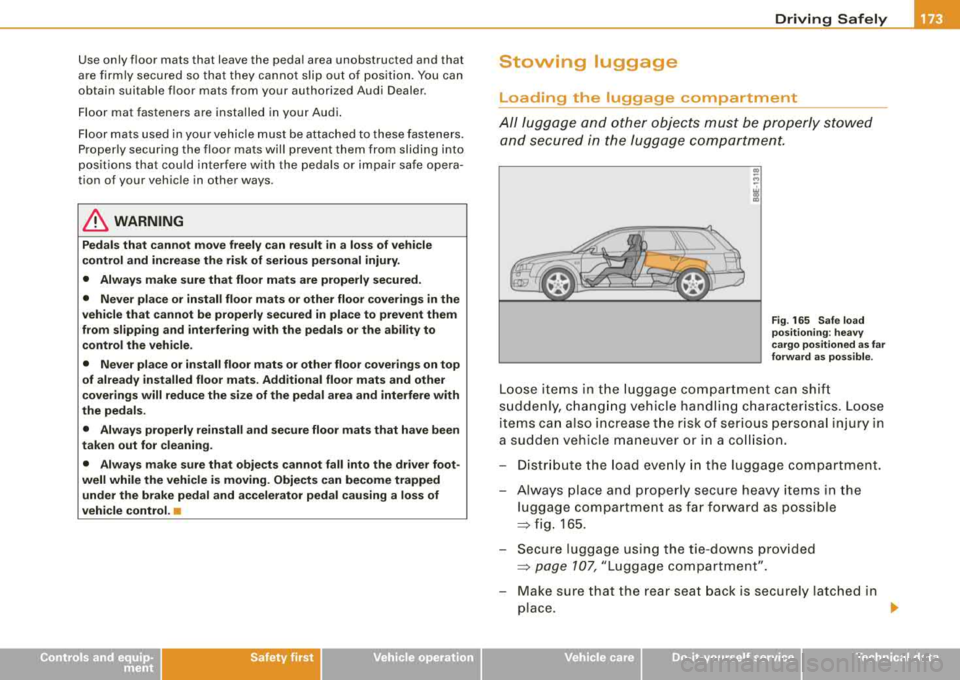
Fig. 165 Safe load
positioning: heavy
cargo positioned as
far
forward as possible.
Loose items in the luggage compartment can shift
suddenly, changing vehicle handling characteristics. Loose
items can also increase the risk of serious personal injury in
a sudden vehicle maneuver or in a collision.
- Distribute the load evenly in the luggage compartment.
- Always place and properly secure heavy items in the
luggage compartment as far forward as possible
=> fig. 165.
- Secure luggage using the tie-downs provided
=> page 107, "Luggage compartment".
- Make sure that the rear seat back is securely latched in
place. .,_
Vehicle care Do-it-yourself service Technical data
Page 186 of 368
___ s_a_ f_ e_ t-= y_ b_e_ l_ t _s _______________________________________________ _
Unfastening safety belts
Unbuckle the safety belt with the red release button only
after the vehicle has stopped.
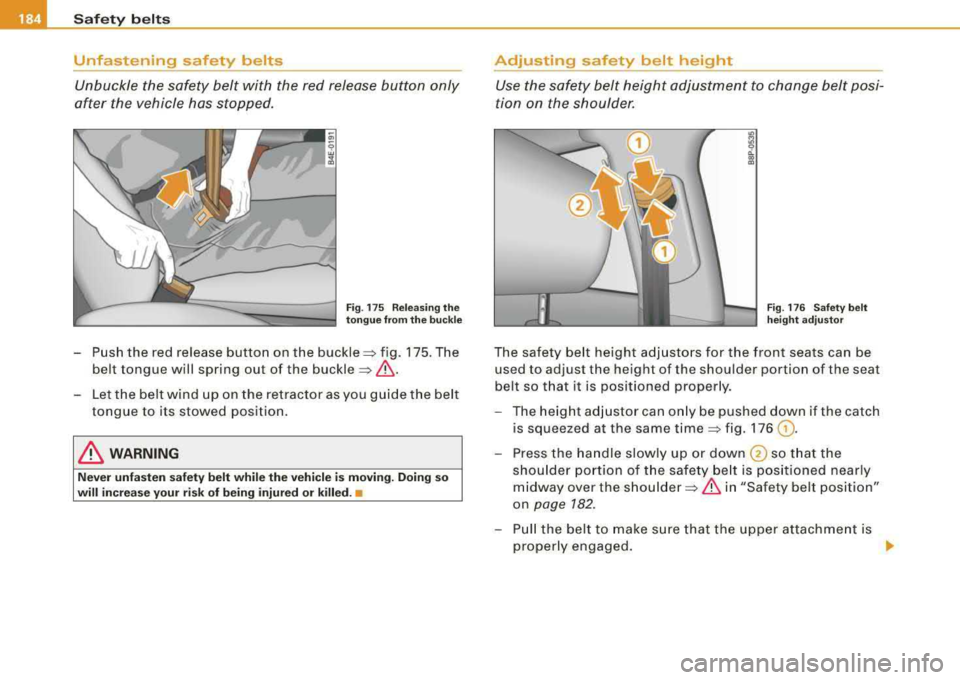
Fig . 175 Releasing the
tongue from the buckle
-Push the red release button on the buckle ~ fig. 175. The
belt tongue will spring out of the
buckle~ &,.
-Let the belt wind up on the retractor as you guide the belt
tongue to its stowed position.
& WARNING
Never unfasten safety belt while the vehicle is moving. Doing so
will increase your risk of being injured or killed. •
Adjusting safety belt height
Use the safety belt height adjustment to change belt posi
tion on the shoulder.
Fig . 176 Safety belt
height adjustor
The safety belt height adjustors for the front seats can be
used to adjust the height of the shoulder portion of the seat
belt so that it is positioned properly.
-The height adjustor can only be pushed down if the catch
is squeezed at the same
time => fig. 176 G).
-Press the handle slowly up or down 0 so that the
shoulder portion of the safety belt is positioned nearly
midway over the
shoulder~ &, in "Safety belt position"
on page
182.
-Pull the belt to make sure that the upper attachment is
properly engaged.
.,
Page 197 of 368

Airbag system 111111
-------------------------------------------- -=-:~--___.
• A sensor below the safety belt latch for the front seat passenger
t o m easure the tens io n on t he sa fety be lt. T he tension on the safe ty
belt and the weight registered by the weight -sensing mat help the
contr ol unit "decide" whe the r the front ai rbag for the fron t
passenger seat should be turned off or
not=> page 189, "Child
r est ra ints on the front seat - some important th ings to know".
• A sensor in the safety belt latch for the driver and for the front
seat passenge r that senses whether t hat safety bel t is la tched or no t
and transmits this information to the e lectronic control unit.
& WARNING
Damage to the front pas senger seat can pre vent the front airbag
from working properly.
• Improper repair or disassembly of the front passenger and
driver seat will prevent the Advanced Airbag System from func
tioning properly .
• Repairs to the front passenger seat must be performed by qual
ified and properly trained workshop personnel .
• Never remove the front pa ssenger or driver seat from the
vehi cle .
• Ne ver remo ve the upholstery from the front passenger seat .
• Never disassemble or remove parts from the seat or disconnect
wires from it .
• Never carry sharp objects in your pockets or place them on the
seat . If the weight -sen sing mat in the passenger seat i s pun ctured
it cannot work properly.
• Never carry things on your lap or carry objects on the
passenger seat . Such items can increase the weight registered by
the weight -sensing mat and send the wrong informat ion to the
airbag control unit .
• Never store items under the front passenger seat . Parts of the
Advanced Airbag System under the passenger seat could be
d amaged , preventing them and the airbag system from working
properly.
Controls and equip ment Safety first
Vehicle operation
& WARNING (continued )
• Never place seat covers or replacement upholstery that have
not been specifically appro ved by Audi on the front seat s.
• Seat covers can prevent the Advanced Airbag System from
recognizing child restraint s or occupants on the front passenger
seat and prevent the side airbag in the seat backrest from
deploying properly.
• Never use cushions, pillows , blankets or similar items on the
front passenger seat. The additional padd ing will prevent the
weight-sensing mat in the seat from accurately registering the
child restraint or person on the seat and prevent the Ad vanced
Airbag System from functioning properly .
• If you mu st use a child re straint on the front pas senger seat
and the child restraint manufacturer's instru ctions require the use
of a towel , foam cu shion or something el se to properly position
the child restraint , make certain that the PASSENGER AIR BAG OFF
light comes on and stays on whenever the child restraint i s
installed on the front passenger seat.
• If the PASSENG ER AIR BAG OFF light does not come on and stay
on , immed iately install child re straint in a re ar seat ing position
and have the airbag sy stem inspected by your Audi dealer . •
How the Advanced Airbag System
components work together
The front Advanced Airbag System and the side airbags supplement
the prote ction off ered by the fro nt three -p oi nt safe ty belts with
pretensioners and load limiters and the adjustable head restra ints
to help reduce the risk of injury in a wide range of accident and
crash situations. Be sure to read the important informat ion about
safety and heed the WARNI NGS in this chapter.
Dep loyment of the Adva nced Ai rbag Sys tem a nd th e activation of
the safety belt pretensioners depends on the dece leration
measu red by the crash senso rs and registered by the electro nic _.,
Vehicle care Do-it-yourself service Technical data
Page 225 of 368
____________________________________________ C_ h_ i_ ld _ S_a_ f_e _t .:..Y _ .... 911
& WARNING (continued)
• Always buckle the child safety seat firmly in place even if a
child is not sitting in it. A loose child safety seat can fly around
during a sudden stop or in a crash.
• Always make sure the seat backrest to which the child restraint
is installed is in an upright position and securely latched into place
and cannot fold forward. Otherwise, the seat back with the child
safety seat attached to it could fly forward in the event of an acci
dent or other emergency situation.
• Always read and heed all WARNINGS whenever using a child
restrained in a vehicle is being used
=> page 210. Special precau
tions apply when installing a child safety seat on the front
passenger
seat=> page 189, "Child restraints on the front seat -
some important things to know" .•
Deactivating the convertible locking retractor
The convertible locking retractor for child restraints will
be deactivated automatically when the belt is wound all
the way back into the retractor.
- Press the red button on the safety belt buckle. The belt
tongue will pop out of the buckle.
- Guide the belt all the way back into its stowed position.
Always let the safety belt retract completely into its stowed position.
The safety belt can now be used as an ordinary safety belt without
the convertible locking retractor for child restraints.
If the convertible locking retractor should be activated inadvert
ently, the safety belt must be unfastened and guided completely
back into its stowed position to deactivate this feature. If the
convertible locking retractor is not deactivated, the safety belt will
gradually become tighter and uncomfortable to wear.
Controls and equip ment Safety first Vehicle operation
LJ}. WARNING
Improperly installed
child safety seats increase the risk of serious
personal injury and death in a collision.
• Never unfasten the safety belt to deactivate the convertible
locking retractor for child restraints while the vehicle is moving.
You would not be restrained and could be seriously injured in an
accident.
• Always read and heed all WARNINGS whenever using a child
restrained in a vehicle is being used
=> page 210. Special precau
tions apply when installing a child safety seat on the front
passenger
seat => page 189, "Child restraints on the front seat -
some important things to know" .•
Additional Information
What types of child restraint anchors are
available and hovv are they related to child
safety?
For years, child restraints have been installed using the safety belts
already present in every vehicle.
Since September 1, 1999, child restraint manufacturers have been
providing tether straps that attach the top of the child restraint to
the vehicles structure, on most of their forward-facing systems in order to comply with U.S. Federal regulations for child restraint
performance in a crash. Vehicle manufacturers are required to
phase -in tether anchorages for attachment of the tether strap in
their U.S. vehicles beginning September 1, 1999.
The combination of the tether anchorages and the lower anchor ages is now generally called the LATCH system for "Lower Anchor
and Tether for Children".
.,._
Vehicle care Do-it-yourself service Technical data
Page 242 of 368

llffl.___l_n _t _e _ll _ig =- e_n _ t_ te_ c_h _n_ o_ lo-'g'"'-=- y ___________________________________________ _
&, WARNING (continued )
• Before des cending a steep grade , reduce speed and shift trans
mi ssion into a lo wer gear or lower driving po sition . Do not ride the
brake s or hold the pedal down too long or too often . This could
cau se the brake s to get hot and dimini sh braking efficiency .
• Do not ride the brakes by resting your foot on the ped al when
you do not intend to brake. This may cause the brakes to overheat, premature wear and in creased stopping distan ce.
• Under certain climati c and operating conditions such a s
passing through water, driving in heavy rain or after washing the
v ehicle , the effectiveness of the brakes can be reduced . In winter ,
ice can a ccumulate on the brake pads , linings , discs and drums .
Cautiously apply brakes for a te st. Brakes will dry and ice coating s
will be cleaned off after a few cautious brake applicat ions .
• Driving for an extended period of time on salt-co vered roads
without using your brakes can also affect braking effi ciency . Clean
off accumulated salt coating from brake discs and pads with a few
c autious brake appli cations .
• If you damage the front spoiler , or if you install a different
spoiler , be sure the air flow to the front brakes is not obstructed .
Otherwise the brake system could overheat reducing the effective
ness of the entire brake system .
• Failure of one brake circuit will impair the braking capability
resulting in an increased stopping distance . Avo id driving the
vehicle and have it towed to the nearest Audi dealer or qualified
workshop .•
Brake booster
T he brake booster add s ex tra braking power.
The bra ke booster works wit h vacuum pressure which is created
only whe n th e e ng in e is
runn ing=> &,.
& WARNING
• Never let the vehi cle roll to a stop with the engine shut off .
• If the brake booster is not working , for example when towing
your vehicle , or because the brake booster has somehow been
damaged, the brake pedal must be pre ssed considerably harder to
make up for the lack of booster assistance . •
Functioning of Anti-Lock Brake System (ABS)
A BS preven ts th e wh eels fr om lock ing up und er b rak ing.
T he ABS contributes effectively to vehicle contro l since it prevents
th e w heels from
lo cki ng w he n t he brakes a re a ppli ed. T h is mea ns
that the vehicle remains steerable and is less likely to skid.
With ABS you do not need to pump the brake . Just hold the brake
pedal down .
However, do not expect that the ABS shortens braking distance
u nder all circum sta nces. Whe n driving o n gravel or on newly fa lle n
snow on top of icy surfaces, braking distance may be even longer,
t herefore, under these ci rcums tances, it is espec ial ly i mpo rtant th at
you driv e slowly and with great care.
How the ABS system works
An automatic check is made when a speed of about 4 mph (6 km/h)
i s r eac hed . Wh en th is happe ns, a pumpi ng noi se can be hea rd.
I f a n indiv idual wheel be gins to rotat e too slowly i n relation to
vehic le speed and tends to lock, the ABS automatical ly reduces
brake pressur e to prevent tha t whee l from loc king .
Th is a utomatic adjustment process wi ll cause a
slight vibration of
t he brake peda l a nd s om e noi ses t o a lert y ou th at ve hicle spee d
must be adapted to existing road and traffic conditions. _..
Page 246 of 368
llffll.,__ __ D_r_ iv _ in_.... g,_ a_n_ d __ e_n _v_ ir_o_ n_ m_ e_n_ t _____________________________________________ _
New brake pads
Remember that new brake pads do not have a full braking
effec t during the first 250 miles (400 kilometers) after they
are i nstalled .
New brake pads have to be "burn ished in" befo re they have opti mal
grab =>& .
During the break -in period, you s hou ld avo id putti ng severe loads
on the brakes . Severe loads include, for examp le, sudden hard
braking, in particular at very h igh speeds or, for example, on moun
t ain passes .
& WARNING
New brake p ad s don't h ave th e be st sto pping p ower a nd mu st b e
" brok en -in " durin g th e initial 100 to 1 50 mil es (150 t o 200 kil ome
t e rs) of norm al cit y dri ving . You can comp en sa te for thi s by
pr ess ing the brak e ped al mor e firmly . Thi s al so appli es later when
ne w pad s a re in sta lled. •
Catalytic converter
It is very important that your emission control sys tem
(catalytic conver ter) is functioning properly to ensure that
y o ur vehicle is running in an environmentally sound
manner.
-Always use lead-free gasoline => page 267, "Fuel supply".
-Never run the tank down a ll the way to empty.
-Never put too much motor o il in your engine => page 278,
"Add ing eng ine oil
The catalytic converter is an efficient "clean-up " device built into the
exhaust system of the vehicle. The catalyt ic converter burns many
of the po llutants in the exhaust gas before they are released into the
atmosphere.
T he exc lusive use o f un leaded fue l is critica lly important for the l ife
of the catalytic converter and proper functioning of the engine.
& WARNING
• Do not park or operate th e veh icle in ar eas wh ere the hot
ex hau st sys tem m ay come in contac t w ith dr y gra ss, bru sh , fuel
s pill or other material which can cau se a fire .
• Do not appl y additi ona l under coating or ru stpr oofing on or
ne ar the e xhau st m anifol d, ex haust pipe s, ca ta lytic converter or
he at shield s. Du ring dri ving , the sub sta nce u sed f or under coating
c ould overhe at and cau se a fir e.
0 Note
• Be aware that just one tank filling with leaded fue l wi ll already
ser iously degrade the performance of the catalyt ic converter.
• Do not exceed the correct engine oi l
level=> page 278.
• Do not drive until the fuel tank becomes comp letely empty . The
engine could misfire . Unburned fuel could also get into the exhaust
system and this could cause the catalytic conver ter to overheat .
• Do not turn off the ignition wh ile the vehicle is moving.
• Do not continue to operate your vehicle under these conditions,
as otherwise fuel can reach the cata lyt ic converter . This cou ld result
in overheating of the converter, requiring its rep lacement .
• To assure eff icient operat ion of the Em iss ion Control System:
- Have your vehicle maintained properly and in accordance with
the service recommendations in your Maintenance
& Warranty
booklet.
..,
Page 250 of 368

lllffl.___T_ r_a _il _e_ r_ t_o _vv_ i_ n """g"'- ---------------------------------------------------
Trailer towing
Driving with a trailer
General information
Your Audi was designed primarily for passenger transpor
tation.
If you plan to tow a trailer, please remember t hat the add it ional load
wi ll affect durability, economy and performance.
Trailer towing not only p laces more stress on the veh icle, it a lso ca lls
for more concentration from the driver.
For th is reasons, always fo llow the operating and dr iving instruc
t ions provided and use common sense. •
Technical requirements
Trailer hit ch
Use a weight -carrying hitch conforming to the gross trailer weight.
The hitc h must be suitab le for your veh ic le and tra iler and must be
mounted securely on the vehicle's chassis at a technically sound
l ocation. Use only a tra iler hitch with removable bal l mount. A lways
check with the trai ler hitch manufacturer to make sure that you are
using t he correct hitch .
Do not use a bumper hit ch .
The hitch must be installed in such a way that it does not interfere
with the impact-absorb ing bumper system . No mod ifications
shou ld be made to the vehicle exhaust and brake systems. From
time to time, check that all hitch mount ing bo lts re main securely
fastened.
When you are not towing a trai ler, remove the trailer hit c h ball
mount. Th is prevents the hitch from causing damage s hou ld your
vehic le be struck from
behind ~& .
Tire pre ssure
When towing a trailer, inf late the tires of your vehic le to the cold tire
pressure listed under "Full load" on the s ticker on the right door
jamb . Inflate trai ler tires to tra iler and tire manufacturers' specifica
t ions.
Lights
T he head ligh t settings shou ld be checked with the trailer at tached
before driving off. Have the head lights adjusted as necessary so
t hat you can see t he road ahead bu t not bl ind oncom ing traffic.
Check to make sure both vehicle and trailer lights are working prop
e rly .
Engine cool ing sy stem
Towing a t railer makes the eng ine work ha rder. It is imp ortant tha t
the cooling system's performance stands up to the additiona l
strain. Make sure that the coo ling system has enoug h fluid.
Traile r br ake s
If your tra ile r i s eq uipped wi th a braki ng system, check to be s ure
that it conforms to al l regu lations .
T he tra iler hydraulic brake system must no t be direct ly connected to
the vehic le's hydrau lic brake system .
Safety chains
Be sure trailer safety chains are properly connected from the trai ler
t o the h itch on the vehicle. Leave enough s lack in t he chains to
permit turning corners. When you install safety chains, make sure
they will not drag on the road when you are driving.
T he chains shou ld cross under t he trailer tongue to prevent it from
dropping in case of separation from the hitch. _,,,
Page 251 of 368
____________________________________________________ T_r_a _i_le _ r_t_ o _ w_ i
_ n...; g=- ---
Trailer lights
Trailer lights must meet all regulations. Be sure to check with your
authorized Audi dealer for correct wiring, switches and relays .
Mirrors
If you are unable to see the traffic behind you using the regular
outside mirrors, then you
must install extended mirrors. It is impor
tant that you
always have clear vision to the rear .
& WARNING
After removing the trailer hitch, do not store it in your vehicle. In
case of sudden braking, the hitch could fly forward and injure you
or your passengers. •
Operating instructions
Maximum trailer weight
A trailer for your vehicle is limited to a typical class 1 or class 2
trailer .
Trailer load distribution
Be sure the load in the trailer is held securely in place to guard
against shifting, be it forward, backward or sideways.
Never allow a passenger to ride in a trailer~ & in "Driving instruc
tions".
Tire pressure
When towing a trailer, inflate the tires of your vehicle to the cold tire
pressure listed under "Full load" on the sticker on the right door
jamb. Inflate trailer tires to trailer and tire manufacturers' specifica
tions .
Controls and equip
ment Safety first Vehicle operation Lights
The
headlight settings should be checked with the trailer attached
before driving off. Adjust as necessary so that you can see the road
ahead but not blind oncoming traffic.
Check proper working of vehicle and trailer lights .
Power Supply
The power supply to the trailer is disconnected when the ignition
key is removed.
Safety chains
Be sure trailer safety chains are properly connected from the trailer
to the hitch on the vehicle . Leave enough slack in the chains to
permit turning corners. When you install safety chains, make sure
they will not drag on the road when you are driving.
The chains should cross under the trailer tongue to prevent it from
dropping in case of separation from the hitch.•
Driving instructions
Driving with a trailer always requires extra care and
consideration.
To obtain the best possible handling of vehicle and trailer,
please note the following:
- Do not tow a loaded trailer when your car itself is not
loaded.
- Be especially careful when passing other vehicles.
- Observe speed limits.
- Do not drive at the maximum permissible speed.
- Always apply brakes early.
- Monitor the temperature gauge.
Vehicle care Do-it-yourself service Technical data
Page 252 of 368
III.___T_ r_a _il _e_ r_ t_o _vv_ i_ n """g"'- ---------------------------------------------------
W eig ht d is tri buti on
Towing a loaded tra iler wit h an empty car resu lts in a high ly
unstable distribution of weight . If this cannot be avoided drive at
ve ry low speeds only to avo id the risk of losing steering control.
A "ba lanced" rig is easier to operate and control. This means that
the tow vehicle should be loaded to the extent possible and permis
sib le whi le keeping the trailer as light as possib le under the circum
stances. Whenever possible, transfer some cargo to the luggage
compar tment of the tow veh icle whi le observi ng tongue load
requirements and vehicle loading considerations.
Speed
T he higher the speed, the more difficu lt it becomes for the driver to
contro l the rig . Do not drive at the maximum permissible speed.
Reduce your speed even more under unfavorable load, weather or
wind conditions -part icularly when going dow nh ill.
Reduce vehicle speed
immedi ately if the trailer shows the slightest
sign of swaying.
Do not tr y to stop the s waying by a cceler ating .
Observe speed limits . In some areas speeds for veh ic les towi ng
trai lers are lower than for regular vehicles.
Always app ly brakes early. When driving downhi ll, shift into lower
gear to use the engine braking effect to slow down the vehicle. Use
of the brakes alone can cause them to overheat and fail.
C oo la nt tempe ra tu re
The coola nt temperature gauge => page 13 must be observed care
ful ly. If the needle moves close to the upper end of the scale, reduce
speed immediately and/or switch off the air conditioner.
If the coolant te mperature warning light in the instrument cluster
starts
flashing -~-, pul l off the road, stop and let the engine idle for
about two minutes to prevent heat build -up .
& WARNING
An yone not p rop erl y res trained in a mo ving vehicl e is at a much
gre ate r risk in an accident. Never let an yone rid e in your car who
is not p rop erl y wear ing the re stra int s pro vided b y Aud i. •
Trailer towing tips
Important to know
Your vehicle handles differently when towing a tra iler because of
the additional weight and weight distribution. Safety, performance
and economy wi ll great ly depend on how carefu lly you load your
trai ler and operate your rig.
Before you actual ly tow your tra iler, practice turning, stoppi ng and
backing up in an area away from traffic. Keep practicing unti l you
have comp letely become familiar with the way yo ur vehicle -trailer
combination behaves and responds .
Backing up is difficu lt and requires practice. Backing up with a
trai ler genera lly requ ires steering action oppos ite of that when
backing up your vehic le without a trailer.
Mainta in a greater distance between you r vehic le and the one in
front of you. You will need more room to stop.
To compensate for the trai ler, you wi ll need a larger than normal
t urning radius .
When passing, remember that you cannot accelerate as fast as you nor mally wou ld because of t he added load . Make sure yo u have
enough room to pass. After passing, al low plenty of room for your
trai ler before changing lanes again .
Avo id jerky starts, sharp turns or rapid lane changes.