tow AUDI A4 AVANT 2008 User Guide
[x] Cancel search | Manufacturer: AUDI, Model Year: 2008, Model line: A4 AVANT, Model: AUDI A4 AVANT 2008Pages: 368, PDF Size: 46.19 MB
Page 114 of 368
-
Seats and storag e
----=---------------
Removing luggage compartment
cover /partition net
- Ope n the right rea r door.
- Fo ld the se at backs down
~ page 104 .
Fig . 116 Inst alling
luggage comp art m ent
c o ver /p arti tion n et
- Pull the partition net in the direction ind icated by the
arrow~ page 111, fig. 115 and lift it out of the retaining
rails .
Installing luggag e comp artment cover /part ition
n et
- Open the right rea r door .
- F old th e seat backs down
~ page 104 .
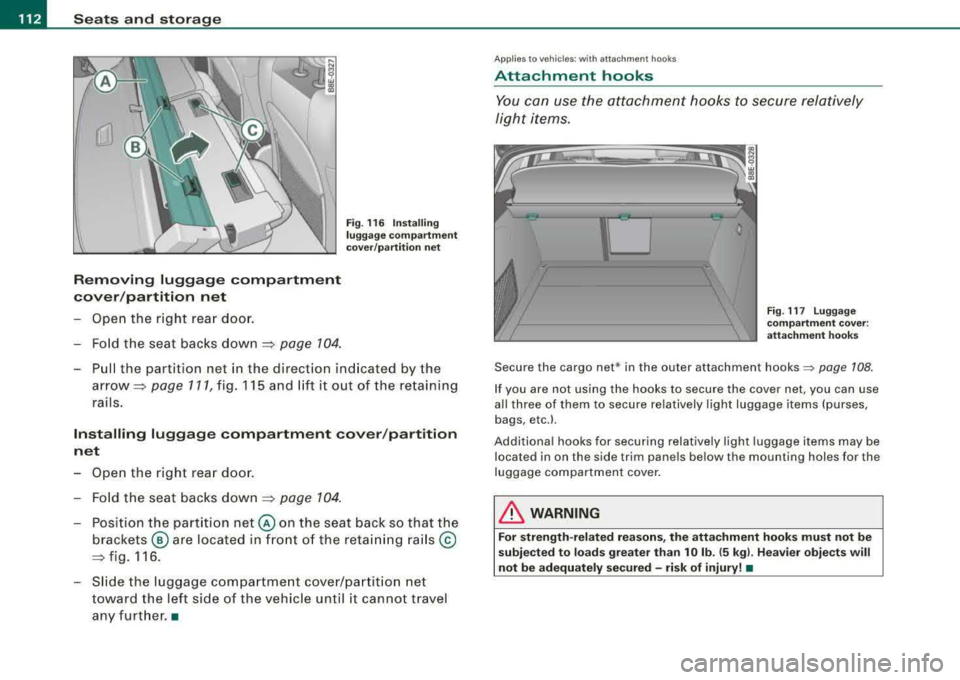
- Position the pa rtition net @ on the seat back s o that the
brackets @ are located in fron t of the retai ning ra ils ©
~fig .116.
- Slide the luggage compa rtme nt cove r/partit io n net
toward the left side of the vehicle until it cannot travel
any furt her. •
Applies to vehi cles: w ith attach men t hoo ks
Attachment hooks
You can use the attachment hooks to secure relatively
li g ht items.
Fig. 117 Lugg ag e
c omp artment cove r:
atta chm ent hook s
Secure the cargo net* in the outer attachment hooks~ page 108.
If you are not using the hooks to secure the cover net, you can use
a ll three of them to secure re latively l ight luggage items (purses,
bags,
etc.l.
Addi tiona l hooks for securing relat ively ligh t luggage items may be
located in on the side trim pane ls below the mounting holes for the
luggage compar tment cover .
& WARNING
For str ength -r e lated rea son s, the atta chment hooks must not be
s ubje cted to lo ads greater th an 10 lb . (5 kg l. Hea vier obje cts will
not be adequately sec ured -risk of injury! •
Page 115 of 368
Seats and storage -______________ __,:_____.
Applies to vehi cles: with protect ive li ner
Protective liner
The protective liner should be used for carrying dirty or
wet objects.
Fig . 118 Cargo floor:
folded upright
Fig . 119 Removing the
cargo floor
The space for stowing the protective liner can be enlarged
by folding the entire cargo floor all the way forward or
removing the entire cargo floor.
Controls and equip
ment
Putting the cargo floor in the upright position
-Open the rear lid.
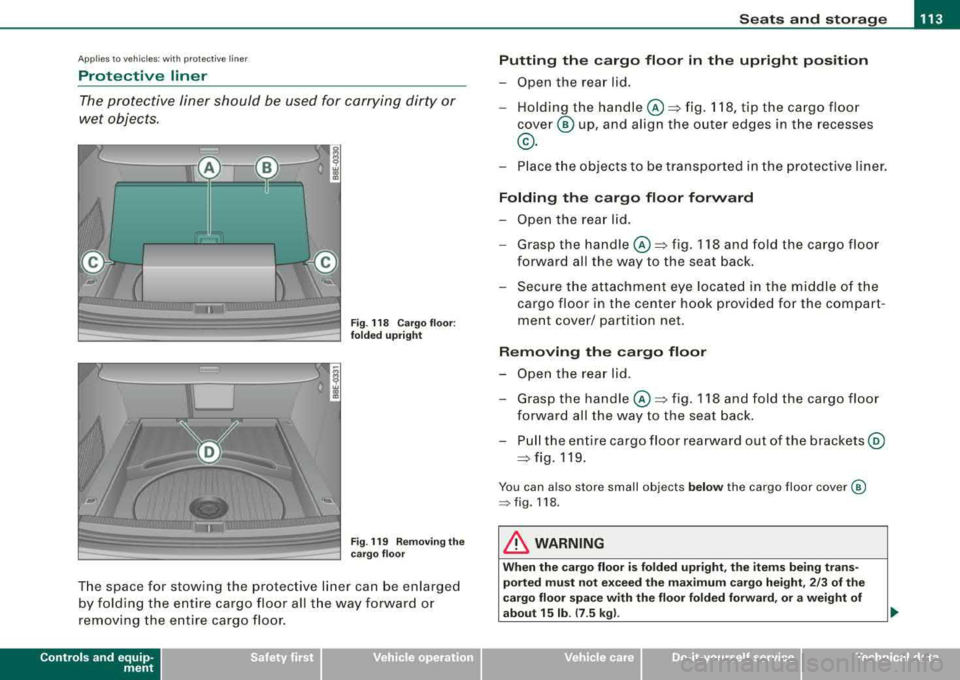
-Holding the handle@~ fig. 118, tip the cargo floor
cover @ up, and align the outer edges in the recesses
®·
-Place the objects to be transported in the protective liner.
Folding the cargo floor forward
-Open the rear lid.
-Grasp the handle@~ fig. 118 and fold the cargo floor
forward all the way to the seat back .
-Secure the attachment eye located in the middle of the
cargo floor in the center hook provided for the compart
ment cover/ partition net.
Removing the cargo floor
-Open the rear lid.
-Grasp the handle @~ fig. 118 and fold the cargo floor
forward all the way to the seat back.
-Pull the entire cargo floor rearward out of the brackets @
~ fig. 119.
You can also store small objects below the cargo floor cover @
=> fig. 118.
& WARNING
When the cargo floor is folded upright, the items being trans
ported must not exceed the maximum cargo height, 2/3 of the
cargo floor space with the floor folded forward, or a weight of
about 15 lb.
(7 . 5 kg).
irechnical data
Page 117 of 368
Seats and storage -______________ __,:_____.
Fig. 123 Ski sack:
securing
Load the ski sack from the luggage compartment.
Loading
- Open the rear lid and clear a space in the center.
- Press the button (arrow)
~ page 114, fig. 122 on the
hatch cover to release the cover from the seatback back
panel.
- Inside the passenger compartment, fold the armrest out
of the rear seatback.
- Reach into the recess, release and open the inner hatch
cover .
- Pull out and unfold the ski sack.
- Load skis or similar objects through the luggage
compartment into the interior of the
vehicle~ &.
Securing
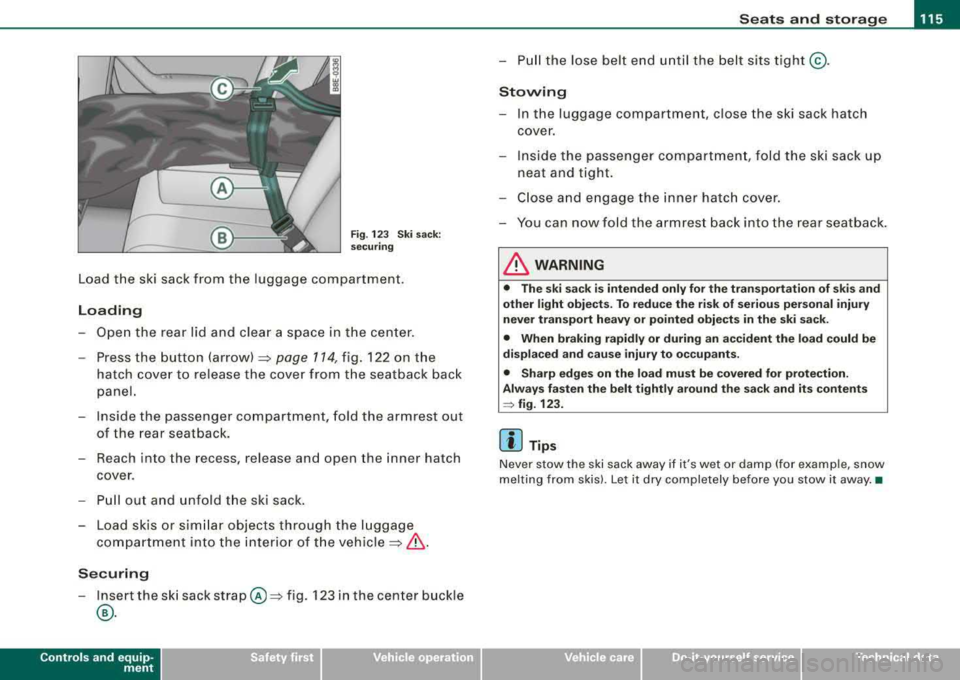
-Insert the ski sack strap @~ fig. 123 in the center buckle
®·
Controls and equip
ment
- Pull the lose belt end until the belt sits tight@.
Stowing
- In the luggage compartment, close the ski sack hatch
cover.
- Inside the passenger compartment, fold the ski sack up
neat and tight.
- Close and engage the inner hatch cover.
You can now fold the armrest back into the rear seatback.
& WARNING
• The ski sack is intended only for the transportation of skis and
other light objects. To reduce the risk of serious personal injury
never transport heavy or pointed objects in the ski sack.
• When braking rapidly or during an accident the load could be
displaced and cause injury to occupants.
• Sharp edges on the load must be covered for protection.
Always fasten the belt tightly around the sack and its contents
~ fig. 123.
[ i] Tips
Never stow the ski sack away if it's wet or damp (for example, snow
melting from skis). Let it dry completely before you stow it away. •
irechnical data
Page 136 of 368
___ O_ n_ t
_ h_ e_ ro_ a_d __________________________________________________ _
On the road
Steering
Adjusting the steering wheel column
The height and reach of the steering wheel can be
adjusted.
Fig . 142 Lever under
the steering column
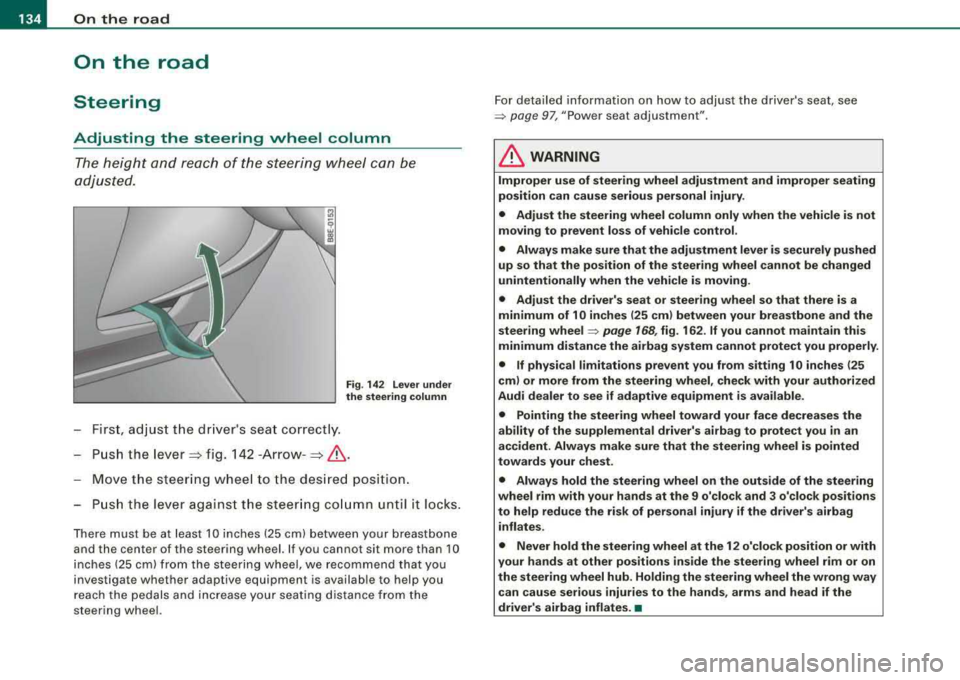
First, adjust the driver's seat correctly.
- Push the
lever => fig. 142 -Arrow- =>& .
Move the steering wheel to the desired position.
- Push the lever against the steering column unt il it locks.
There must be at least 10 inches (25 cm) between your breastbone
and the center of the steering wheel. If you cannot sit more than 10
inches (25 cm) from the steering wheel,
we recommend that you
investigate whether adaptive equipment is available to help you
reach the pedals and increase your seating distance from the
steering wheel. For detailed information on how to adjust the driver's seat, see
=> page 97, "Power seat adjustment"
.
& WARNING
Improper use of steering wheel adjustment and improper seating
position can cause serious personal injury .
• Adjust the steering wheel column only when the vehicle is not
moving to prevent loss of vehicle control.
• Always make sure that the adjustment lever is securely pushed
up so that the position of the steering wheel cannot be changed
unintentionally when the vehicle is moving.
• Adjust the driver's seat or steering wheel so that there is a
minimum of 10 inches (25 cm) between your breastbone and the
steering
wheel ~ page 168, fig. 162. If you cannot maintain this
minimum distance the airbag system cannot protect you properly.
• If physical limitations prevent you from sitting 10 inches (25
cm) or more from the steering wheel, check with your authorized
Audi dealer to see if adaptive equipment is available.
• Pointing the steering wheel toward your face decreases the
ability of the supplemental driver's airbag to protect you in an
accident. Always make sure that the steering wheel is pointed
towards your chest .
• Always hold the steering wheel on the outside of the steering
wheel rim with your hands at the 9 o'clock and 3 o'clock positions
to help reduce the risk of personal injury if the driver's airbag inflates.
• Never hold the steering wheel at the 12 o'clock position or with
your hands at other positions inside the steering wheel rim or on
the steering wheel hub. Holding the steering wheel the wrong way
can cause serious injuries to the hands, arms and head if the
driver's airbag inflates.
•
Page 138 of 368
___ o_ n_ t_h _e _ r_o _a_ d __________________________________________________ _
temporarily interrupted to conserve battery power. After the engine
has started, release the key and it will return to position
0-
Before the starter can be operated again the key must be turned
back to position
G) . The non-repeat lock prevents you from
damaging the starter when the engine is running.
_& WARNING
• Never remove the key from the ignition lock while the vehicle is
moving. The steering wheel will lock causing loss of control.
• If you have to leave your vehicle-even for just a minute- always
remove the ignition key and take it with you. This is especially
important if you are going to leave children behind in the vehicle.
The children could start the engine or use other vehicle controls.
Unsupervised use of vehicle controls (for example, power
windows) can cause serious personal injuries.
[ i] Tips
If the vehicle battery has been disconnected and then reconnected,
then you must leave the key in position
0 for about 5 seconds
before you can start the engine. •
Ignition key safety lock
The ignition key can only be removed when the selector
lever is in the
"P" (Park) position.
After switching off the ignition, the ignition key can only be
removed from the ignition lock when the selector lever is in the
"P"
(Park) position. After you have removed the key, the selector lever is
locked and cannot be moved. •
Starting and stopping the engine
Starting the engine
The engine can only be started with your original Audi
key.
-Set the parking brake.
-Move the selector lever to the neutral position (automatic
transmission: selector lever in P or N)
=> & .
-On vehicles with manual transmission, fully depress the
clutch pedal.
-Turn the ignition key to position 0 => page 135, fig. 143
- do not depress the gas pedal when starting the engine!
-Let go of the key as soon as the engine starts.
A cold engine may at first be loud after it has been started. This is
due to the hydraulic valves building up the oil pressure . This is
normal and no need for concern.
If the engine does not start immediately, stop trying after 10
seconds and then try to restart the engine about 30 seconds later.
What to do if the engine does not start
• ~ page 330
• ~ page 332, "Emergency towing with commercial tow truck"
_& WARNING
Never start or let the engine run in a confined or enclosed area.
Exhaust fumes from the engine contain carbon monoxide, a color
less and odorless gas. Carbon monoxide can be fatal if inhaled.
• Never leave the engine idling unattended. An unattended
vehicle with a running engine poses a danger of personal injury or
theft.
~
Page 139 of 368
_________________________________________________ O_ n_ t_h _e _ ro_ a_d _ __._
0 Note
• Avo id high eng ine speeds, fast acceleration or heavy e ngine
loads while the engine is still cold . This could damage the engine!
• The engine cannot be started by pushing or towing the vehic le.
ffi For the sake of the environment
To avoid unnecessary e ngine wear and to reduce exhaust emis
sions, do not let your vehic le stand and warm up. Be ready to drive
o ff immediate ly aft er starting your vehicle. Mai ntain mode rate
speed until the engine is completely warm. R emember, the engine
per forms bes t at opera ting temperature .•
Stopping the engine
- Tur n t he ignitio n ke y t o posit io n G) => page 135 , fig. 14 3.
& WARNING
• Nev er turn off the engine until the vehicle has come to a
complete stop.
• The brake boo ster and servotronic only work when the engine
is running . With the ignition turned off , you have to app ly more
force when steering or braking . Since you cannot steer and stop
normally, th is can lead to accidents and seriou s injurie s.
• The radiator fan can continue to run for up to 10 minutes even
afte r you have turned off the engine and removed the ignition key .
The radiator fan can also turn on again if the engine coolant heats
up because of intense sunlight or heat build-up in the engine
c ompartment.
Controls and equip
ment
0 Note
Do not stop the e ng ine immed iately after hard or extended drivin g.
Keep the engine running for appro ximate ly two minutes to prevent
e xcessive heat build -up. •
Parking brake
Parking brake
When the parkin g brake is set , it prevents the vehicle from
rolling aw ay unin tentionally.
Setting the parking brake
Fig . 144 Cent er
co nso le : P ark ing bra ke
set
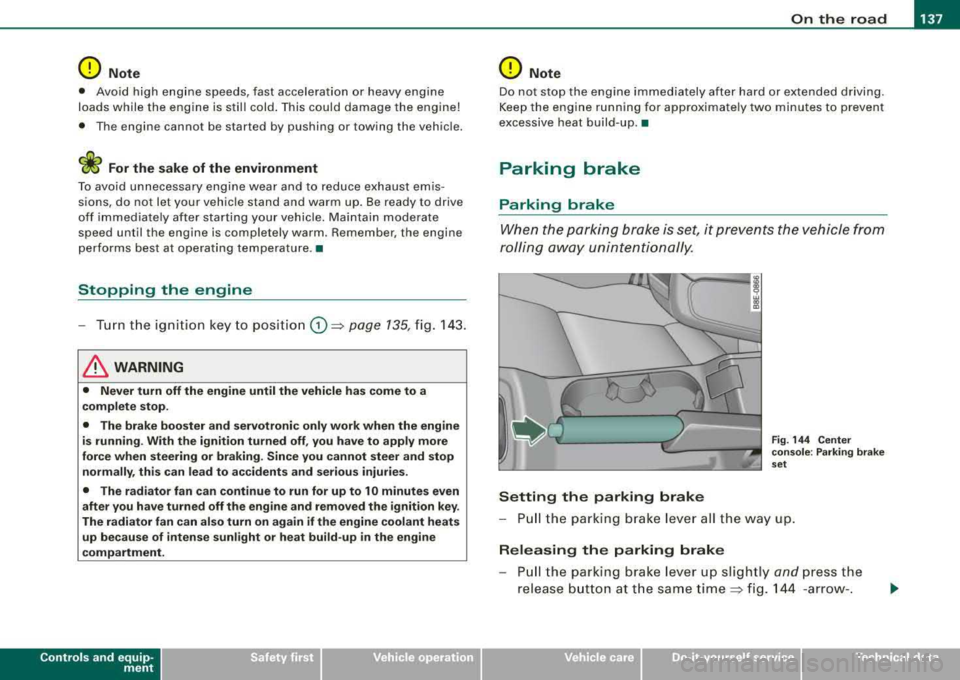
- Pull the p arking brak e lever all the way up.
Releasing the parking brake
Pull t he pa rkin g brake lever up sligh tly and press the
release butto n at th e s ame tim e::::> fig . 144 -ar row- .
irechnical data
Page 140 of 368
___ o_ n_ t_h _e _ r_o _a_ d __________________________________________________ _
-Keep the release button pressed and lower the parking
brake~ &.
If you should drive off with the parking brake still set, a warning tone
will sound and the following will appear in the instrument cluster to
remind you to release the parking brake:
Parking brake set
The parking brake warning comes on only after you have driven for
longer than 3 seconds and faster than 5 mph (5 km/h).
The parking brake warning light Brake (USA)/
«Dl (CDN) illuminates
when the parking brake is set and you switch on the ignition.
& WARNING
Always release the parking brake completely. A partially engaged
brake will overheat the rear brakes, reduce their effectiveness and
cause excessive wear. This could lead to brake failure and an acci
dent.
0 Note
Only after the vehicle has come to complete stop, should you firmly
set the parking brake and either move the gearshift lever into 1st.
gear (manual transmission) or move the selector lever into
"P"
(Automatic transmission).•
Parking
To prevent a parked vehicle from rolling away, there are a
few things you should do.
When you park your vehicle, do the following:
-Stop the vehicle using the brake pedal.
-Set the parking brake firmly.
-Move the selector lever into the P position ~ &.
-Switch off the engine and remove the ignition key from
the ignition lock.
What else you should do when parking your vehicle on
an incline or decline
Turn the steering wheel so that if the vehicle should start to roll, it
will roll into the curb.
If you are parking on a
decline (the front of your vehicle facing
downhill), turn the front wheels to the right so that they point
toward the curb.
If you are parking on an incline (the front of your vehicle facing
uphill), turn the front wheels to the left so that they point
away from
the curb.
Move the selector lever into the P position.
& WARNING
This is how you can reduce the risk of injury when leaving your
vehicle.
• Never park the vehicle where it can come in contact with dry
grass, spilled fuel or any other flammable materials.
• Never allow anyone -especially small children -to remain in the
vehicle when it is locked. Locked doors make it more difficult for
rescuers to access the passenger compartment in the event of an
emergency. Danger to life!
• Never leave children unsupervised in the vehicle. Children
could release the parking brake or move the gearshift lever out of
gear. The vehicle could start to roll away and cause an accident.
• No matter what the season is, the temperature in a parked
vehicle can reach dangerous levels. •
Page 142 of 368
___ O_ n_ t_h _e_ r_o _ a_ d ____________________________________________________ _
Cruise control
General information
The cruise control system allows you to maintain a
constant speed.
The cruise control system allows you to maintain and constant
driving speed when driving faster than 18 mph (30 km/h) -to the
extent this is possible with the given engine power and braking
characteristics. This allow you to take your foot off the "gas" and
rest it, especially on long trips .
The indicator light CRUISE (USA)/
•l'l (CDNl in the instrument cluster
illuminates when the system is on .
& WARNING
• To help keep the vehicle under control, do not use the cruise
control system when driving on winding or slippery roads (as
caused by heavy rain or loose gravel on the road surface), or in
heavy or varying traffic.
• Only use the cruise control when traffic, road and weather
co nd itions allow you to drive at a steady speed.
[ i] Tips
The cruise control cannot maintain a constant speed when driving
downhill. The vehicle will accelerate under its own weight. Down
shift to a lower gear or use the brakes to slow down .•
Storing a speed
You must set and then store a vehicle speed using the
cruise control.
Fig. 145 Cruise control
switches
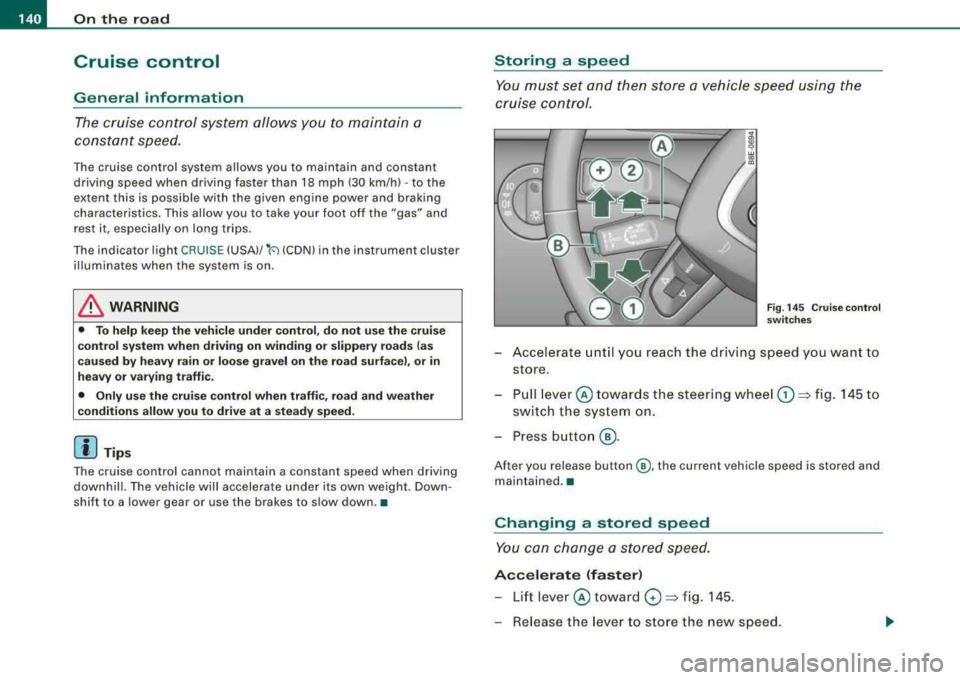
- Accelerate until you reach the driving speed you want to
store.
- Pull
lever © towards the steering wheel G) => fig. 145 to
switch the system on.
- Press button
@.
After you release button @, the current vehicle speed is stored and
maintained .•
Changing a stored speed
You can change a stored speed.
Accelerate (faster)
-Lift lever © toward 0 => fig. 145 .
- Release the lever to store the new speed.
Page 143 of 368
_________________________________________________ O
_ n_ t_h _e _ r_o _a _d __ ftllll
D ece le rat e (slow er)
- Lower lever @ toward Q => page 140, fig. 145.
- Release the lever to store the new speed.
You can a lso increase the vehic le speed by depressing the acce ler
ator pedal. The vehicle speed wil l increase as long as you keep the
accelerator pedal depressed . When you let up on the accelerator
pedal, t he veh icle speed w ill automatica lly return the to previously
stored vehicle speed in th e cruis e control.
I f the actua l veh icle speed exceeds the stored vehicle speed in the
cruise control for longer than five minutes and by more than 6 mph
(10 km/h), the c ruise control wil l auto matica lly erase the stored
veh ic le speed and you w ill have to rese t the cruise contro l again.
T apping the lever lightly
@
By lightly tapping the lever @toward 0 => page 140, fig. 145, you
can increase ve hicle speed by approximately 1 mph (2 km/h).
By lightly tapp ing the lever @toward
O => page 140, fig. 145, you
can decrease vehicle speed by approximately 1 mph (2 km/h). •
Switching the system off temporarily
Either of the follow ing actions will tempora rily deact ivate
the cru ise con trol:
- press ing t he brake pedal, or
- p ressing t he c lutch pedal (on manua l transmission
mo dels), or
- pu shing the
lever @ towa rds the instrume nt panel 0
(n ot engaging)=> page 140, fig. 14 5.
When you tempo rari ly deac tiva te the cru ise co ntrol fo r a brie f
period, th e previous ly s tored vehicle speed remains in the memory .
Controls and equip
ment T
o resume the previously stored vehicle speed, release the brake (or
clutch) pedal, or you pull lever @toward t he stee ring wheel
G) .
If no veh ic le speed was stored when you switched off the system
temporarily, you must reset a new vehicle speed : Acce lerate to the
des ired speed and press
button @ (SET) => page 140, fig. 145.
& WARNING
Do not use the cruise control if the stored veh icle speed is faster
than exi sting traffic condition s permit .•
Switching off the cruise control system
While driving
- Pu sh lever © towa rds the inst rument p anel 0 un til it
e n gages => page 140, fig . 1 45.
When the vehicle is at a standstill
- Sw itch off the ignit ion. •
Page 151 of 368
_______________________________________________________ T_ ra_ n_s_ m
__ is_s_ io_ n __ llll
Appl ies to vehicles: wi th 6-speed automatic transm is sion
Fail-safe mode
If the tiptronic® suffers a malfunction, the fail-safe mode
maintains minimum driveability.
If there is a malfunct ion in t he system, the automatic transmiss ion
wi ll shift to the fai l- safe mode. Al l the segments in the display will
l ight up to indicate th is condi tion .
Display col ors inv ersed
If there's a ma lfunction in the system, the automatic transmission
wi ll shift to the fail -safe mode. The entire row of gear selector posi
t ions wi ll light up in the d isplay in inverse colors ( light background,
dark characters) to indicate this condition . If there is an electrical
f ailure, t he gear posi tion ind ica tor row wi ll turn blank .
You wi ll sti ll be able to put the se lected lever in any of the positions .
However, the transmission will remain in 4th gear when it is placed
in positions D and S.
[ i ] Tip s
• The electronic lock that protects t he reverse gear while driv ing is
inoperative when the transmission is in the fail- safe mode .
• The manua l shift program is inoperative in fail -safe mode .
• The transm ission aut omatically shif ts to and rema ins in 4t h gear
regard less of which of the forward gears is selected. This means
that it may not be possible to tow a t rai ler or to drive uphill on a
steep gradient. Reverse gear can sti ll be engaged.
• In case the engine goes out i t must b e restarted wi th the veh ic le
stationary and the selector lever in position ( Pl or (Nl.
• The 4 th gear remains engaged even whe n the veh icle comes to
a ha lt . T he transmission will respond with noticeable jolts as you
shi ft fr om "D" to "P" and back aga in. The ca r wil l acce lerate s lug
gishly as you take off again. •
Controls and equip
ment
multitronic ™
App lies to veh icles: with mu lt itron ic'" Cont inuous ly Va riab le Transm ission (CVTl
General information
Your vehicle is equipped with a electronically controlled continu
ously variable transmission
(multitronic,..l. Inside the multitronic™
system, the gear ratios are not shifted in finite steps as in a conven
t ional automatic transmiss ion, but rat her
continuously . As a result,
engine power is applied smoothly and comfortably, and better fuel
econo my is ac hieved.
The transmission se lects the appropriate gear rat io (upshifts and
downshif tsl a utomat ical ly based on set dr iv ing progra ms
=> page 153, "Dynamic shift program (DSP)" .
You can a lso ma nua lly select a shift p rogram (tiptronic®)
=> page 154.
You shou ld note, that the multitronic transmission differs from a
conventiona l Aut omatic Transmiss io n . In the mu lt it ronic transm is
sion the engine power is transferred via a link -p late chain, rather
than by a conventi onal torque c onver ter . The multitronic transm is
s ion greatly reduces vehic le "creep"" when at a standst ill and the
transmission is in D Sor R.
•