light AUDI A4 CABRIOLET 2009 Owners Manual
[x] Cancel search | Manufacturer: AUDI, Model Year: 2009, Model line: A4 CABRIOLET, Model: AUDI A4 CABRIOLET 2009Pages: 340, PDF Size: 77.32 MB
Page 265 of 340
_____________________________________________ C_h_ e_ c _ k_in -= g_a _ n_d _ f_il _li _n """g ;;..._____..
Working on the battery
Be especially careful when working on or near the battery.
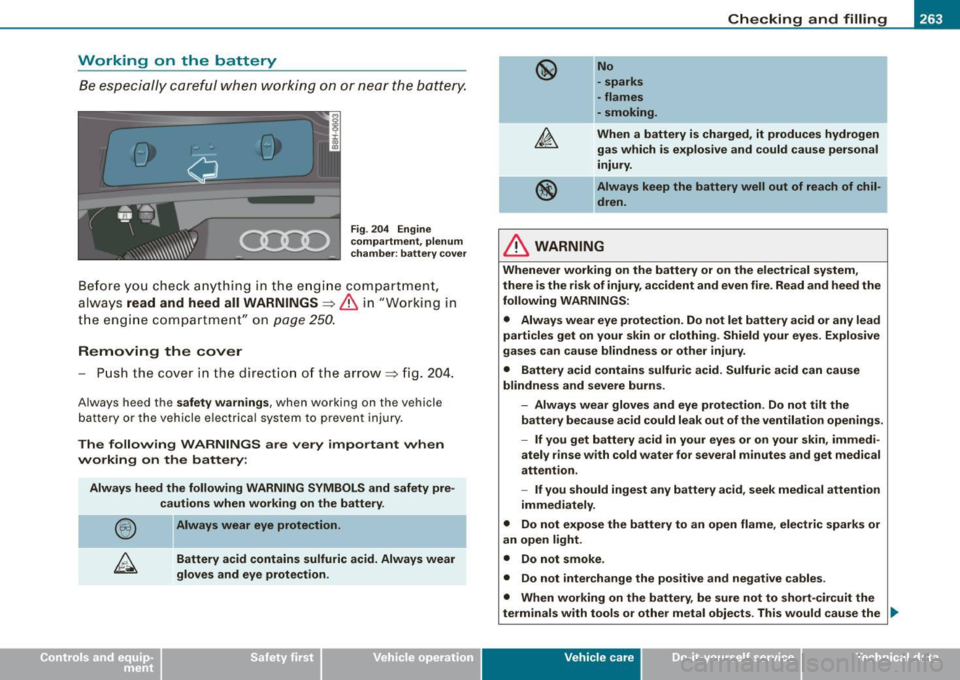
•·•·•·•
Fig. 204 Engine
compartment, plenum
chamber : battery cover
Before you check anything in the engine compartment,
always read and heed all WARNINGS=>
& in "Working in
the engine compartment" on
page 250.
Removing the cover
-Push the cover in the direction of the arrow => fig. 204.
Always heed the safety warnings, when working on the vehicle
battery or the vehicle electrical system to prevent injury.
The following WARNINGS are very important when
working on the battery:
Always heed the following WARNING SYMBOLS and safety pre
cautions when working on the battery .
®
Always wear eye protection.
Battery acid contains sulfuric acid. Always wear
gloves and eye protection.
No
- sparks
- flames
- smoking.
When a battery is charged, it produces hydrogen
gas which is explosive and could cause personal
injury.
Always keep the battery well out of reach of chil
dren.
& WARNING
Whenever working on the battery or on the electrical system,
there is the risk of injury, accident and even fire. Read and heed the
following WARNINGS:
• Always wear eye protection. Do not let battery acid or any lead
particles get on your skin or clothing. Shield your eyes. Explosive
gases can cause blindness or other injury.
• Battery acid contains sulfuric acid. Sulfuric acid can cause
blindness and severe burns .
- Always wear gloves and eye protection. Do not tilt the battery because acid could leak out of the ventilation openings .
- If you get battery acid in your eyes or on your skin, immedi
ately rinse with cold water for several minutes and get medical
attention.
- If you should ingest any battery acid, seek medical attention
immediately.
• Do not expose the battery to an open flame , electric sparks or
an open light.
• Do not smoke.
• Do not interchange the positive and negative cables .
• When working on the battery, be sure not to short-circuit the
terminals with tools or other metal objects. This would cause the .,,.
Vehic le care irechnical data
Page 266 of 340
•---=C:.:h..:. e=-= c..:.k :..:.in =-=-= g~ a..:.n :.:d::....:. f.:.:il .:.:li ..:.n :..::g:!..- ___________________________________________ _
& WARNING (continued )
battery to heat up very q uickly, which could lead to damage or
explo sion and per sonal injury .
• When a battery is charged , it produces hydrogen gas whic h i s
explo sive and could cause per son al injury .
• Always keep the battery well out of the re ach of children.
• Before work i s done on the electrical system , di sconne ct the
negative ground cable .
• Before per forming any work on the ele ctri cal system , switch off
the engine and ignition as well as any electrical equipment. The
negative cable on the battery must be disconnected .
If you are just
going to replace a light bulb , then it is enough to switch off the
light s.
• Before disconnecting the battery , switch off the anti -theft
alarm system! Otherw ise you will set off the alarm .
• When di sconne cting the battery , fir st di sconnect the negative
c able and then the positive cable .
• Before reconnecting the battery , make sure all electrical
c onsumers are sw itched off . Reconnect the posit ive cable first and
then the negative cable. Never interchange the cables -this could
start a fire !
• Never charge a frozen or a thawed -out battery. It could
e xplode! If a battery has frozen , then it must be replaced. A
discharged batte ry can freeze over at 32 °F (0 °C ).
• Make sure the vent hose is always attached to the opening on
the side of the battery.
• Never use batteries which are damaged . There is the danger of
an explosion! Alway s replace a damaged battery.
& WARNING
California Propo sition 65 Warning :
& WARNING (continued )
• Battery post s, terminals and related accessories contain le ad
and lead compounds , chemicals known to the State of California
to cause can cer and reproduct ive problems . Wash hand s after
handling .
0 Note
• Do not disco nnect t he vehicle battery when the igni tion is
switched on or when the engine is running , otherwise, you wi ll
damage e le ctronic c ompone nts in the electrical syst em.
• I f your vehicle is going to stand for a long period of time without
being dr iven, protect the battery from "freezing" otherwise it wil l be
damaged and wi ll then have to be replaced .•
Checking the battery acid level
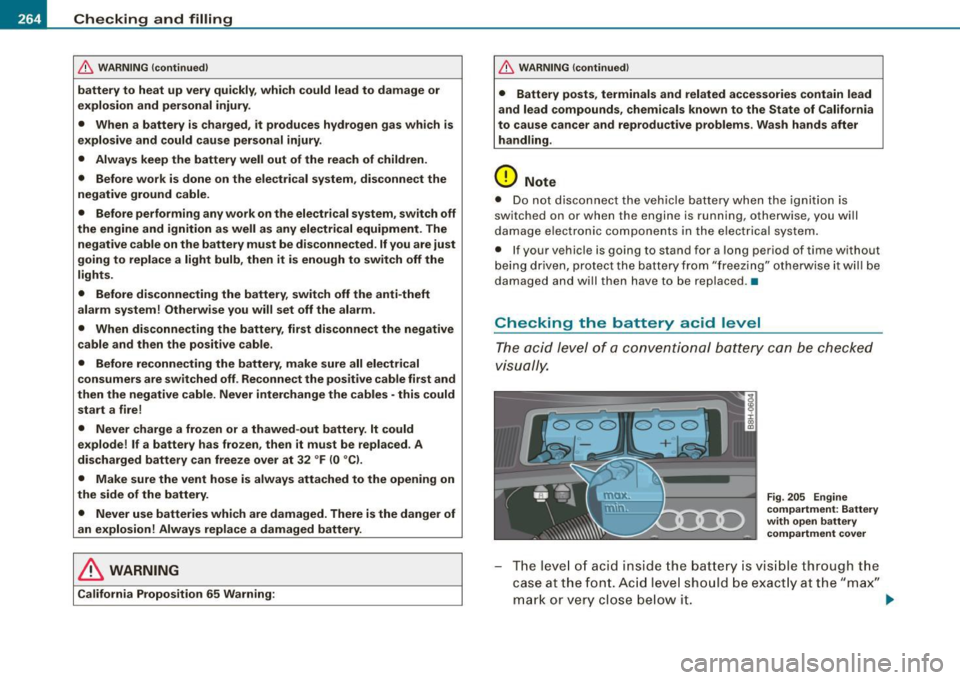
T he aci d l evel of a co nv enti onal ba ttery c an be c hecke d
vis ually.
·•
Fig . 2 05 Engine
c ompartment : Battery
w it h o pen b atter y
compartment cover
T he leve l of acid inside the b atte ry is vis ib le th rough the
case a t the fo nt. Ac id le ve l shou ld be ex actly at t he " max "
m ark or v ery clo se belo w it.
~
Page 268 of 340
___ C_h_ e_ c_k _in --== g'-- a_n _d_ f_il _li _n ..::g=-- --------------------------------------------
Windshield /headlight washer
reservoir
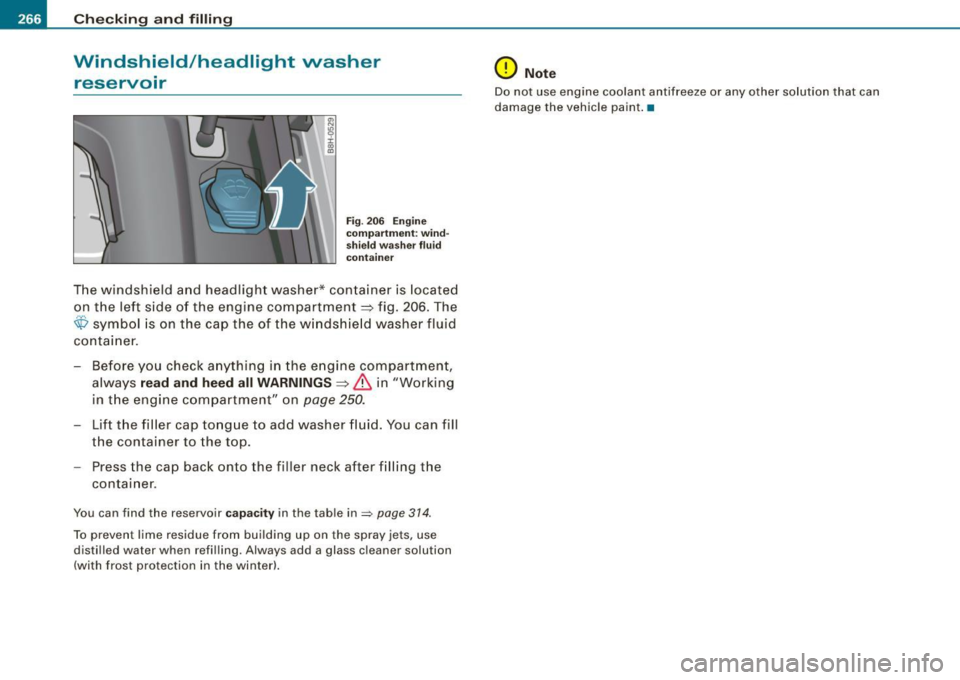
Fig . 206 Engine
compartment : wind
shield washer fluid
container
The windshield and headlight washer* container is located
on the left side of the engine compartment
~ fig. 206. The
~ symbol is on the cap the of the windshield washer fluid
container.
- Before you check anything in the engine compartment,
always
read and heed all WARNINGS~ & in "Working
in the engine compartment" on
page 250.
-Lift the filler cap tongue to add washer fluid. You can fill
the container to the top.
- Press the cap back onto the filler neck after filling the
container .
You can find the reservoir capacity in the table in~ page 314.
To prevent lime residue from building up on the spray jets , use
dis tilled water when refilling . Always add a glass cleaner solution
(with frost protection in the winter).
(D Note
Do not use engine coolant antifreeze or any other solution that can
damage the vehicle paint. •
Page 269 of 340

Tires a nd wh eels BIii ________________________________ :....:.:.....::.=.....::.:..:..:..::..:___:___:..__ __
•
Tires and wheels
Tires
General notes
Tires may be the least appreciated and most abused parts
of a motor vehicle.
Tires may be the least appreciated and most abused parts of a
motor vehicle. Tires are, however, one of the most important parts
of a vehicle, particular ly considering the comparative ly sma ll patch
of rubber on each tire that assures that all -important contact
between you, your vehicle and the road .
Maintaining the correct tire pressure, making sure that your vehicle
and its tires do not have to carry more weight than they can safely
handle, avoiding damage from road hazards and regular ly
inspecting tires for damage inc luding cuts , slashes irregular wear
and overal l condition are the most important things that you can do
to help avoid sudden tire failure including tread separation and
b lowouts .
Avo iding d am age
If you have to drive over a curb or similar obstacle, drive very slowly
and as close as possible at a right angle to the curb.
A lways keep chemica ls including grease, oil, gasoline and brake
flu id off the ti res .
I nspect the tires regularly for damage (cuts, cracks or blisters, etc .!.
Remove any foreign bodies embedded in the treads .
Storing tire s
Mark tires when you remove them to indicate the direction of rota
tion. This ensures you to be ab le to mount them correctly when you
reinstall them. When removed, the whee
ls or tires should be stored in a coo l, dry
and preferably dark place.
Store tires in a vertical position i f they are not mounted on r ims, in
a horizontal position if they are mounted on rims.
N ew tire s
New tires have to be broken in => &.
The tread depth of new tires may vary, according to the type and
make of tire and the tread pattern.
Hidd en d am ag e
Damage to tires and rims is often not readily visible . If you notice
unusua l vibration or the vehic le pul ls to one side, this may indicate
that one of the tires has been damaged . The tires must be checked
immediately by an author ized Audi dealer or qualified workshop .
Uni dir ection al tire s
A unidirect ional tire can be identified by arrows on the sidewa ll, that
point in the direction the tire is designed to rotate. You must fo llow
the specified direction of ro tation . This is necessary so that these
tires can deve lop their optimum characteristics regarding grip, road
noise, wear and hydroplaning resistance . For more information
=> page 298.
Rim s with bolted rim ring *
Light-alloy wheels with a bo lted rim ring consist of several parts .
These parts are screwed together with special bo lts, using a specific
technique. This ensures proper function, seal, safety, and true running of the wheel. For this reason, damaged rims shou ld be
replaced, and you should never repair or dismantle them
=> & .
Rim s with screw -on decorative co vers *
Light-a lloy whee ls can be furnished with interchangeab le decora -
tive covers that are mounted to the rim with se lf -locking bolts. ...
Vehic le care
Page 274 of 340
-Tires and wheels
P'U:1-------------------
warmed up than when it is "cold." It is the inflation pressure in a
"cold" tire that counts. Therefore, you should never let air out of a
warm tire to match "cold tire inflation pressure" recommendations .
The tires would then be underinflated and could fail suddenly.
Maintaining proper tire pressure is one of the most important
things you can do to help avoid sudden tire failure. Underinflated
tires are a major cause of sudden tire failure. Keeping tires at the
right pressure is also important for safe and responsive vehicle
handling, traction, braking and load carrying.
Tire pressures are
particularly important when the vehicle is being driven at higher
speeds, and then especially when heavily loaded even within the
permissible load-carrying capacities approved for your vehicle .
The recommended tire pressures for your Audi depend on the kind
of tires on your vehicle and the number of passengers and/or
amount of luggage you will be transporting.
On USA vehicles, the tire pressure label is located on the driver's
side B-pillar . On Canada vehicles, the tire pressure label is located
either on the driver's side B-pillar or inside the fuel filler flap. The tire
pressure label lists the recommended cold tire inflation pressures
for the vehicle at its maximum capacity weight and tires that were
on your vehicle at the time it was manufactured.
If you wish to improve comfort when operating the vehicle at
normal load (up to 2 occupants), you can adjust tire pressures to
-
those specified for normal vehicle load. Before operating the vehicle
at maximum load, you must increase the tire pressures to those
specified for maximum vehicle load
=> & .
If your vehicle is equipped with a tire pressure monitoring system *,
bear in mind that the system can only monitor the tire pressures you
have stored. The system does not recognize the load condition of
your vehicle.
The effectiveness of the tire pressure monitoring system will be
impaired if you store normal load pressures but then operate the
vehicle at its maximum load=>&.
See the illustration =>
page 271, fig. 207 for the location of the label
either on driver's side B-pillar or inside the fuel filler flap (color of
the actual label and exact location on the vehicle will vary slightly).
Note that the following table is accurate at the time of going to
press and is subject to change. In the event of discrepancies, the tire
pressure label (either on driver's side B-pillar or inside the fuel filler
flap) always takes precedence .
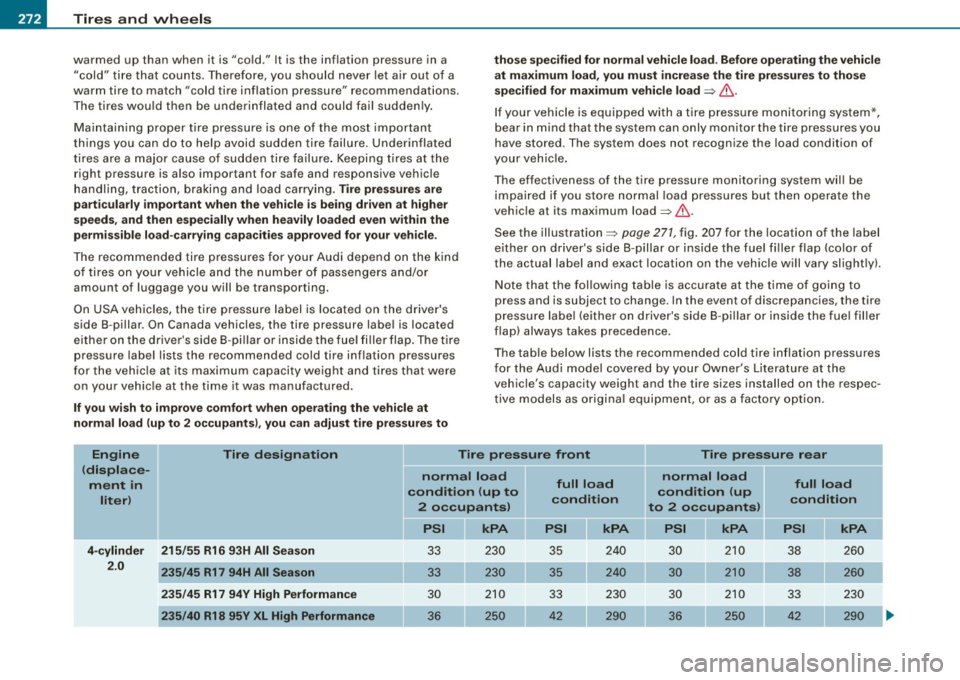
The table below lists the recommended cold tire inflation pressures
for the Audi model covered by your Owner's Literature at the
vehicle's capacity weight and the tire sizes installed on the respec
tive models as original equipment, or as a factory option.
Engine
(displace
ment in liter) Tire designation
Tire pressure front Tire pressure rear
4-cylinder
2.0 215/55 R16 93H All Season
235/45 R17 94H All Season
235/45 R17 94Y High Performance
235/40 R18 95Y XL High Performance
normal load
condition (up to
2 occupants)
PSI
33
33
30
36
kPA
230
230
210
250
full load
condition
PSI
35
35 33
42
II kPA
240
240
230
290
normal load
condition (up
to 2 occupants)
PSI
30
30
30
36
JI kPA
210
210
210
250
11 full load
condition
PSI
38
38
33
42
JI kPA
260
260
230
290
I
Page 277 of 340

Tires and wheels -
----------------
•
• The tire pressures should only be checked and adjusted when
t he t ires are co ld . The s lightly raised press ures of warm tires must
not be reduced .
• Adjust t he tire p re ssure to the load you are carrying.
• Reinstall the va lve stem cap on the valve.
When should I check the tire pressure?
The correc t tire p re ssur e is espec ially i mportant at high speeds. The
pressure should there fore be c hecked at least once a month and
a lways before starting a journey. Do not forget to check the tire pres
su re for t he spare whee l::::>
page 291.
When should I adjust the tire pressures?
Adjust the ti re pressur e to the load you are carrying. A fter chang in g
a wheel
or replacing whee ls you have to adj ust t he t ire pressure s on
a ll whee ls. In addition, o n ve hicles w ith t ire pressure monito ring
system * you must then store the new tire pressures in the system
=> page 41.
& WARNING
Incorrect tire pres sures and /or underinflation can lead sudden tire
failure, loss of control , collision, serious personal injury or even
death .
• When the warning symbol ( appears in the instrument
cluster , stop and inspect the tires .
• Incorrect tire pressure and /or underinflation can cause
increased tire wear and can affe ct the handling of the vehicle and
stopping ability .
• Incorre ct tire pressures and /or underinflat ion can also lead to
sudden tire failure, including a blowout and sudden deflation,
causing loss of vehi cle control.
• The driver is responsible for the correct tire pressures for all
tires on the vehicle . The appli cable pre ssure values are located on
a sticker on the driver 's side 8-pillar or on the inside of the fuel
filler flap .
& WARNING (continued )
• Only when all tires on the veh icle are filled to the correct pres
s ure, the tire pressure monitoring system * can work correctly .
• The use of incorrect tire pressure values can lead to accidents
or other damage . Therefore it is essential that the driver observe
the specified tire pressure values for the tires and the correct pres
sures for the function of the tire pressure monitoring system*.
• Alway s inflate tires to the recommended and corre ct tire pres
sure before driving off.
• Driving with underinflated tires bend more , letting them get
too hot resulting in tread separation , sudden tire failure and loss
of control.
• Excessive speed and /overloading can cause he at build -up ,
sudden tire failure and loss of control.
• If the tire pressure is too low or too high , the tires will wear
prematurely and the vehicle will not handle well.
• If the tire is not flat and you do not have to change a wheel
immediately, drive at reduced speed to the nearest service station
to che ck the tire pressure and add air as required .
0 Note
Driving without valve stem caps can cause damage to the tire
valves. To p revent this, a lways make sure tha t factory installe d va lve
stem caps on al l wheels are securely mounted on the va lve .
<£> For the sake of the environment
Underinflated tires wi ll a lso increase the fue l consumption. •
Tires and vehicle load limits
There are limits to the amount of load or weight that any vehic le and
any tire can carry. A vehicle that is overloa ded wil l n o t handle well _,.
Vehic le care
Page 296 of 340

_1.--_W:...:....: h..:.. a=-.: t..:..d= o....:... I .=d .:..;o:......;. n..:.. o.::...;. vv..:....:.. ? ______________________________________________ _
5. Take the flat wheel off and then put the spare on
=> page 297.
6. Tighten all wheel bolts lightly.
7.
Lower the vehicle with the jack.
8. Use the wheel bolt wrench and
firmly tighten all wheel
bolts
=> page 295.
9. Put the decorative wheel cover* back on.
& WARNING
Always read and head all WARNINGS and information ~ & in
"Raising the vehicle" on
page 296 and ~ page 298. •
After changing a wheel
A wheel change is not complete without the following
actions.
- Store and secure the replaced wheel in the spare wheel
well.
- Put the tool case and the jack back in place in the luggage
compartment .
- Check the
tire pressure on the spare wheel immediately
after mounting it.
- As soon as possible , have the
tightening torques on all
wheel bolts checked with a torque wrench. The correct
tightening torque is 90 ft lb (120 Nm).
- Have the flat tire
replaced as soon as possible.
[ i ] Tips
• If you notice while changing a tire that the wheel bolts are
corroded and difficult to turn, then they should be replaced before
you check the tightening torque.
• Drive at reduced speed until you have the tightening torques
checked .•
A pp lies to vehicle s: wi th dec orat ive w heel cove rs
Decorative wheel covers
The decorative wheel covers must be removed first to
access the wheel bolts.
Removing
"' ....
"' 0 ±. .,
"'
Fig. 216 Wheel
change : removing the
wheel cover
- Insert the hook provided with the onboard tool kit into
the hole on the center hub piece.
- Pull off the
decorative wheel cover=> fig. 216. •
Page 300 of 340
1111.___W_ h_ a_ t_d_ o_ l _d _o_ n_ o_ w_ ? ______________________________________________ _
-Screw the threaded end o f the alignment pin from the
tool kit hand -tight into t he now vacant bo lt hole
=>
page 297, fig . 222.
- Then completely unscrew the other wheel bolts as
described above .
- Take off the wheel leaving the alignment p in in the bolt
hole.
Puttin g on th e sp are
- Lift the spare wheel up and carefu lly s lide it over the
alignment pin to gu ide it in place .
- Use t he hexagonal socket in the screwd river handle to
screw in and tighten all w heel bolts
slightly.
- Unscrew the alignment pin and insert and tighten the
remaining w heel bolt slightly like the rest.
- Turn the handle on the jack counter-clockwise to lower
the vehicle until the jack is fully released.
- Use the wheel bo lt wrench to tighten all wheel bo lts
firmly=>
page 295. Tighten crosswise, from one bolt to
the (approx imately) oppos ite one, to keep the wheel
centered.
[ i ] Tip s
Never try and use the hexagona l socket in the handle of the screw
driver to loosen or tighten the wheel bolts.
• Pull the reversible b lade from the screwdriver before you use the
hexagonal socket in the handle to turn the wheel bo lts.
• When mounting tires with
uni dire cti on al tread desig n make sure
the tread pattern is pointed the right way~
page 298.
• The whee l bolts should be clean and easy to turn. Check for dirt
and corrosion on the ma ting surfaces of both the wheel and the
hub. Remove all dirt from these surfaces before remounting the
wheel. •
Tires with unidirectional tread design
Tires with unidirectional tread design must be mounted
with their tread pattern pointed the right direction.
U sin g a spa re tire wit h a tre ad p atte rn int ended for u se
i n a sp ec ific dir ection
When using a spare tire with a tread pattern intended for use in a
specific direction, please note the following:
• The direction of rotation is marked by an arrow on the side of the
tire.
• If the spare tire has to be installed in the incorrect direction in the
event of a flat tire, use the spare tire on ly temporarily since the tire
will not be able to achieve its optimum performance characteristics
with regard to aquaplaning, noise and wear.
• We recommend that particular attention be paid to this fact
dur ing wet weather and that you adjust your speed to match road
conditions.
• Replace the flat tire with a new one and have it instal led on your
vehic le as soon as possible to restore the handling advantages of a
proper ly pointed direction-dependent tire. •
Notes on wheel change
Please read the information~ page 279, "New tires and replacing
tires and whee ls", if you are going to use a spare tire which is
different from the tires on your veh ic le.
After you change a tire: .,_
Page 303 of 340
![AUDI A4 CABRIOLET 2009 Owners Manual _________________________________________________ F_ u_ s_ e_s _ a_n _ d_ b_ u_lb _ s ____ llll
[ i ] Tip s No . Equipm ent Amps
You are wel l adv ised to keep a supply of spare fuses in you](/img/6/57553/w960_57553-302.png "AUDI A4 CABRIOLET 2009 Owners Manual _________________________________________________ F_ u_ s_ e_s _ a_n _ d_ b_ u_lb _ s ____ llll
[ i ] Tip s No . Equipm ent Amps
You are wel l adv ised to keep a supply of spare fuses in you")
_________________________________________________ F_ u_ s_ e_s _ a_n _ d_ b_ u_lb _ s ____ llll
[ i ] Tip s No . Equipm ent Amps
You are wel l adv ised to keep a supply of spare fuses in your vehic le.
15 Instrument c luster, Navigation system 10
Fuses with the proper ampere ratings are available at your Audi 16 Garage door opener 5
dea ler. •
17 Level , tire pressure control , park assist, 10 light/rain sensor
Fuse list Automatic headlig ht range control, left 5
Fuses which con be replaced. 19 Fog lights 15
Vacant
N o. Equipm ent Amps
21 Vacant
1 Air conditioner 10
22 Doors 15
2 Footwell illumination 5 23 Vacant
3 Heated washer jets 5 Central convenience electrical system 20
Radiator fan 5 25 Heater blower 30
5
Telephone, oil level sensor, multifunction 10 Rear window defogger 30 switch, rear heated seat, shift gate
Air conditioner (air quality sensor), air pressure
27 Socket for tra iler towing (controller) 30
6 5
sensor 28 Fuel pump 20
Electronic Stabil izat ion Program (ESP), bra ke 29 Vacant
7 light switch, clutch peda l switch, steering angle 10
sensor
30 Power top control un it 30
8 Telephone 5 31
Automatic transmission, mirror dimming, diag-15 nosis socket
9 Brake booster (vacuum pump) 15 Towing assembly 15
10
Automatic headl ight beam adjustment, auto -5 33 Cigarette
lighter 20 matic headlight range control, right
34 Electrical socket 20
11
Airbag control unit, front passenge r seat recog -10 nition USA (bladder mat) 35 Luggage compartment socket 20
Diagnosis socket 10 Windshield wiper system 30
13
Steering c olumn module 10
37 Pump for windshie ld an d head light washer* 30
14
Brake lights 10
system
• Do-it-yourself service
Page 304 of 340
111!11.--___;;F...; u::. s.::..:: e~s :.....:: a..:..n .:..; d::....; b.:..:. u..:..lb ;:..:: s _______________________________________________ _
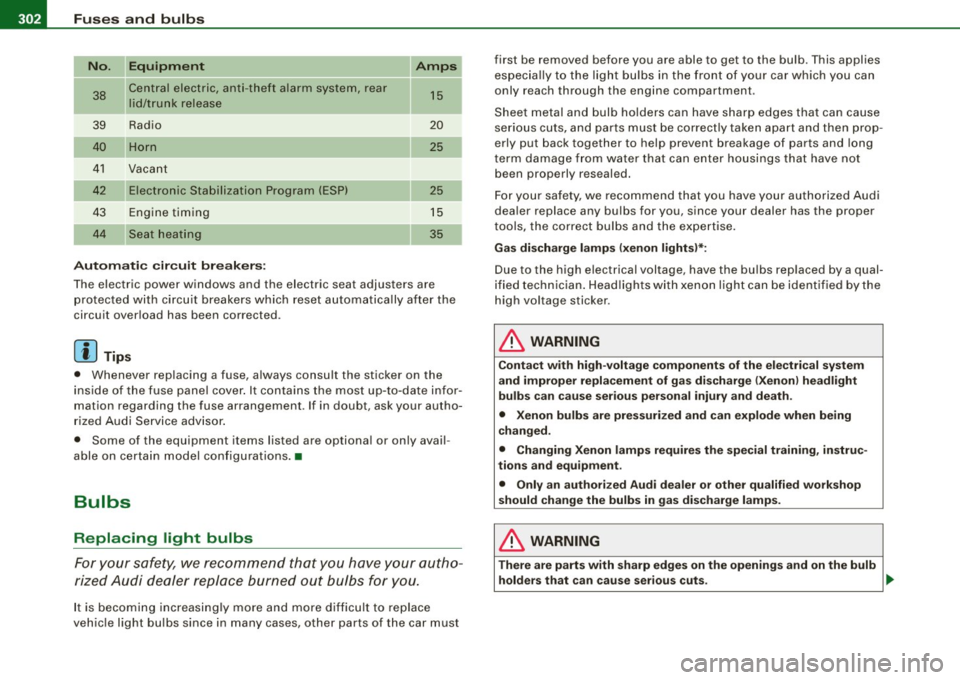
No.
38
39
41
42
43
Equipment
Central electric, anti -theft alarm system, rear
lid/trunk release
Radio
Horn
Vacant
Electronic Stabilization Program (ESP)
Engine timing
Seat heating
Automatic circuit breakers: Amps
15
20
25
25
15
35
The electric power windows and the electric seat adjusters are
protected with circuit breakers which reset automatically after the
circuit overload has been corrected .
[ i] Tips
• Whenever replacing a fuse, always consult the sticker on the
inside of the fuse panel cover. It contains the most up-to-date infor
mation regarding the fuse arrangement . If in doubt, ask your autho
rized Audi Service advisor.
• Some of the equipment items listed are optional or only avail
able on certain model configurations. •
Bulbs
Replacing light bulbs
For your safety, we recommend that you have your autho
rized Audi dealer replace burned out bulbs for you.
It is becoming increasingly more and more difficult to replace
vehicle light bulbs since in many cases, other parts of the car must first be removed before
you are able to get to the bulb. This applies
especially to the light bulbs in the front of your car which you can
only reach through the engine compartment.
Sheet metal and bulb holders can have sharp edges that can cause
serious cuts, and parts must be correctly taken apart and then prop
erly put back together to help prevent breakage of parts and long
term damage from water that can enter housings that have not
been properly resealed.
For your safety, we recommend that you have your authorized Audi
dealer replace any bulbs for you, since your dealer has the proper
tools, the correct bulbs and the expertise.
Gas discharge lamps (xenon lights)*:
Due to the high electrical voltage, have the bulbs replaced by a qual
ified technician. Headlights with xenon light can be identified by the
high voltage sticker.
& WARNING
Contact with high-voltage components of the electrical system
and improper replacement of gas discharge (Xenon) headlight
bulbs can cause serious personal injury and death.
• Xenon bulbs are pressurized and can explode when being
changed.
• Changing Xenon lamps requires the special training, instruc
tions and equipment.
• Only an authorized Audi dealer or other qualified workshop
should change the bulbs in gas discharge lamps.
& WARNING
There are parts with sharp edges on the openings and on the bulb holders that can cause serious cuts .
~