coolant AUDI A4 CABRIOLET 2009 User Guide
[x] Cancel search | Manufacturer: AUDI, Model Year: 2009, Model line: A4 CABRIOLET, Model: AUDI A4 CABRIOLET 2009Pages: 340, PDF Size: 77.32 MB
Page 259 of 340
_____________________________________________ C_h_ e_ c_k _in ---= g'--- a_n _d_ f_il _li _n ....:g=-------"'
•
& W ARNING (conti nued )
• To reduce the ri sk of burns from hot engine oil , let the engine
c ool down to the tou ch.
• When removing the oil drain plug with your fingers , stay as far
a w ay as possible. Alway s keep your forearm parallel to the ground
to help prevent hot oil from running down your arm.
• Drain the oil into a container designed for thi s purpo se , on e
large enough to hold at least the total amount of oil in your engine.
• Engine oil is poisonous . Keep it well out of the reach of children .
• Continuous contact with used engine oil i s harmful to your
skin . Always prote ct you r skin by washing oil off thoroughly with
soap and water .
0 Note
Never m ix oil a ddi tives with yo ur engine oil. These additives can
damage your engine and adversely affect your Audi Limited New
Vehi cle Warranty.
~ For the sake of the environment
• Befo re c ha ng ing y our oi l, f irst make sure you k now w here y ou
can properly dispose of the used oil.
• Always dispose o f used e ngine oi l prop erl y. D o not dump i t on
garden soil, wooded areas, into open streams or down sewage
drains.
• Recycle used engine oi l by taking it to a used engine oil col lec
t ion facili ty in y our a rea, or co n tact a serv ice s ta tion .•
Engine cooling system
Coolant
T he e ngin e cool ant p erform s tw o functio ns: it k eep s th e
e ng ine f rom ov erh ea ting and it pro tects the engine fr om
freezing in the winter.
The cooling system is sealed and general ly requires little attention.
The coo ling syst em has been fil led at the fac tory with a perm an ent
coolant which does not need to be changed. The coo lant consists of
a m ix ture of wa te r and the manufacturer 's gl yco l- b ase dco olant
add it ive G 12++ antifreeze with anticorrosion additives (50% for USA
mode ls; 60% for Canadian mode ls) . T his m ixtu re bo th a ssure s the
n ecessary frost protectio n and p ro tects m etal co mponents in t he
eng ine's cooling system from co rrosion and scaling. It a lso raises
the boili ng poi nt o f the coolant.
D o not reduce the concentrat ion of the coo lant in the summer by
adding pla in wate r. The proportion of coolant additive must be at
least 50 % but not more than 60 % to maintain antifreeze protection
and coo ling eff iciency . If the c oolant frost p ro tecti on is t oo low, the
coo lant could freeze and damage th e vehic le heating and en gine
cool ing sy stem .
For year -rou nd driv ing, ant ifreeze is added at the facto ry fo r tempe r
atures down to:
• -31 °F ( -35 °C) USA
• - 40 °F ( - 40 °C) Canada.
You can mix the G12 ++ coolan t add itive with othe r additives (G12 +
or G12). A lways check wit h your authorized Audi dea ler.
& WARNING
Before you check anything in the engine co m partment , always
read and heed all WARNINGS
=> & in "Working in the engine
c ompartment " on
page 250 .
Vehic le care
Page 260 of 340

___ C_h_ e_ c_k _in --== g'-- a_n _d_ f_il _li _n ..::g=-- --------------------------------------------
0 Note
• Before winter sets in, have the coolant checked to see if the
coolant additive in your vehicle is sufficient to meet the climate
conditions. This is especially important if you live in a region where
the winter is extremely cold . If necessary, increase the proportion of
coolant additive to 60% .
• When adding coolant additive to your cooling system,
remember:
-We recommend using only coolant additive G12+ + (check the
label) for your vehicle. This coolant additive is available at autho
rized Audi dealers. Other types of antifreeze can significantly
reduce corrosion protection . The resulting corrosion can cause a
loss of coolant and serious engine damage.
• Do not add any type of radiator leak sealant to your vehicle's
engine coolant. Adding radiator repair fluid may adversely affect the
function and performance of your cooling system and could result
in damage not
covered by your New Vehicle Limited Warranty. •
Checking the engine coolant level
The engine coolant level can be checked with a quick
glance.
Fig . 202 Engine
compartment: Coolant
expansion tank
Before you check anything in the engine compartment,
always read and heed all WARNINGS~ & in "Working in
the engine compartment" on
page 250.
Turn off the ignition.
- Let the eng ine cool down.
Place a thick rag over the coolant expansion tank
~ fig. 202 and carefully twist the cap counter-clockwise
~& .
Read the engine coolant level in the open coolant expan
sion tank~ fig. 202. With a cold engine, the coolant level
should be between the "min" and "max" markings. When
the engine is warm, the level may be slightly above the
"max" marking .
The location of the coolant expansion tank can be seen in the
engine compartment illustration=>
page 252.
To obtain an accurate reading , the engine must be switched off .
The expansion tank in your vehicle is equipped with an electric
coolant level sensor.
When the coolant l evel is too low, the warning light in the Auto
Check System :::::,
page 31 will blink until you add coolant and the
level has been restored to normal. Even though there is an electric
coolant level sensor, we still recommend you check the coolant level
from time to time .
Coolant loss
Coolant loss may indicate a leak in the cooling system. In the event
of coolant loss, the cooling system should be inspected immedi
ately by your authorized Audi dealer . It is not enough merely to add
coolant.
In a
sealed system, losses can occur only if the boiling point of the
coolant is exceeded as a result of overheating. ..,.
Page 261 of 340
_____________________________________________ C_h_ e_ c_k _in ---= g'--- a_n _d_ f_il _li _n ....:g=-------IJIII
•
& WARNING
The cool ing system i s under pre ssure and can get very hot . Redu ce
the risk of scalding from hot coolant by following these steps.
• Turn off the engine and allow it to cool down .
• Protect your face , hands and arms from escaping fluid and
steam by cover ing the cap with a large , thick rag .
• Turn the cap slowly and very carefully
in a counter -clockwi se
dire ction while applying light , downward pressure on the top of
the cap .
• To avoid being burned, do not spill antifreeze or coolant on the
exhaust system or hot engine parts . Under certain conditions, the
ethylene glycol in engine coolant can catch fire .
0 Note
Do not add any type of radiator leak sealant to your vehicle's engine
coolant. Adding radiat or repa ir fl uid may adversely affect t he func
tion and performance of your coo ling system and could resu lt in
damage not cove red by y our New Vehicle Limi ted Wa rran ty .•
Adding coolant
B e very c are ful when addi ng engi ne cool ant.
Be fore you check a nything in the e ng ine comp artmen t,
always read and heed all WARNINGS=> & in "Work ing in
t h e eng ine compa rtment" on
page 250 .
-Tur n off th e engine.
- Le t th e eng in e co ol d ow n.
- Place a t hick rag over the coo la nt expansio n tank
~ page 258 , fig. 202 an d carefully tw is t th e cap coun te r
cl ockw ise
~ & .
Add co o lant .
- Twist the cap on aga in
tig htly .
Replacement engine coolant must conform to exact specifications
~ page 257 , "C oola nt". Even in an eme rgency, if co ola nt addi tive
G 12 ++, G12+ or G1 2 is not availab le, do
not use a different additive .
Us e pla in wate r instead until you can ge t the co rrect add itive and
can res tor e th e correc t ra tio. T his shou ld be don e as soon as
pos sible.
If y ou have los t a co nsid era ble amount of coo la nt, t hen y ou should
add cold antifreeze and cold water only when the engine is cold.
A lways use
new engine c oo la nt whe n refil ling .
Do not fill coola nt a bove the "M AX" mark. Excess coo lant w ill be
forced out through the pressure relief va lve in the cap when the
eng ine beco mes hot.
& WARNING
• The cooling system i s under pressure and can get very hot.
Reduce the risk of scalding from hot coolant by following these
steps.
-Turn off the engine and allow it to cool down .
- Protect your face , hands and arms from escaping fluid and
steam by covering the cap with a large , thick rag .
- Turn the cap slowly and very carefully in a counter -clockwise
direction while applying light , downward pressure on the top
of the cap.
- To avoid being burned , do not spill antifreeze or coolant on
the exhau st system or hot engine parts. Under certain condi
tions, the ethylene glycol in engine coolant can catch fire .
• Antifreeze is poisonous . Always store antifreeze in its original
container and well out of the reach of children .
• If you drain the coolant , it must be caught and safely stored in
a proper container clearly marked "poison ". _,.
Ve hic le care
Page 262 of 340
•---=C:.:h..:. e=-= c..:.k :..:.in =-=-= g~ a..:.n :.:d::....:. f.:.:il .:.:li ..:.n :..::g:!..- ___________________________________________ _
0 Note
• Coolant pollutes the environment and could cause an engine
fire. Excess coolant will be forced out through the pressure relief
valve in the cap when the engine becomes hot.
• If, in an emergency, only water can be added, the correct ratio
between water and antifreeze~
page 257must be restored as soon
as possible.
<£> For the sake of the environment
Drained coolant should not be reused. Always dispose of used
coolant while observing all environmental regulations. •
Radiator fan
The radiator fan switches on automatically by itself.
The radiator fan is driven by the engine via the V-belt. The viscous
clutch regulates the speed of the fan according to the temperature
of the coolant.
An auxiliary electric radiator fan* switches on and off depending on coolant temperature and other vehicle operating conditions.
After you switch the engine off, the auxiliary fan can continue running for up to 10 minutes - even with the ignition off. It can even
switch on again later by itself~&, if
• the temperature of the engine coolant rises due to the heat
build -up from the engine in the engine compartment, or
• the engine compartment heats up because the vehicle is parked
in intense sunlight.
& WARNING
• To reduce the risk of personal injury never touch the radiator
fan .
_& WARNING (continued)
• The auxiliary electric fan is temperature controlled and can
switch on suddenly even when the engine is not running .
• The auxiliary radiator fan switches on automatically when the
engine coolant reaches a certain temperature and will continue to
run until the coolant temperature drops. •
Brake fluid
Checking brake fluid level
The brake fluid level can be checked with a quick glance.
Fig. 203 Engine
compartment: Brake
fluid reservoir
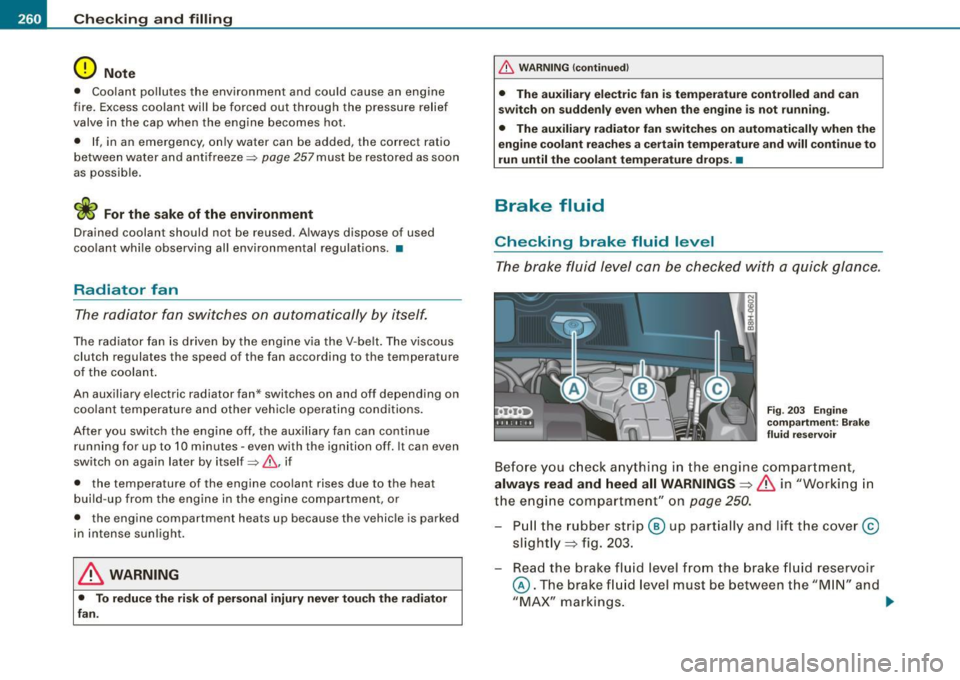
Before you check anything in the engine compartment,
always read and heed all WARNINGS:::::, & in "Working in
the engine compartment" on
page 250.
Pull the rubber strip@ up partially and lift the cover @
slightly :::::, fig. 203.
- Read the brake fluid level from the brake fluid reservoir
©. The brake fluid level must be between the "MIN" and
"MA X" markings. _..
Page 268 of 340
___ C_h_ e_ c_k _in --== g'-- a_n _d_ f_il _li _n ..::g=-- --------------------------------------------
Windshield /headlight washer
reservoir
Fig . 206 Engine
compartment : wind
shield washer fluid
container
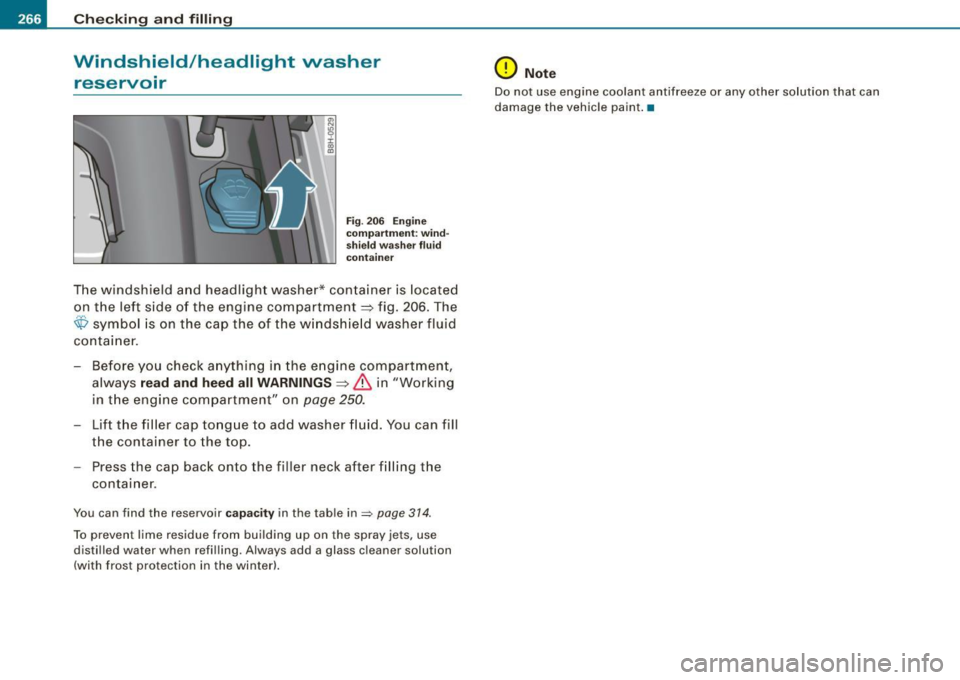
The windshield and headlight washer* container is located
on the left side of the engine compartment
~ fig. 206. The
~ symbol is on the cap the of the windshield washer fluid
container.
- Before you check anything in the engine compartment,
always
read and heed all WARNINGS~ & in "Working
in the engine compartment" on
page 250.
-Lift the filler cap tongue to add washer fluid. You can fill
the container to the top.
- Press the cap back onto the filler neck after filling the
container .
You can find the reservoir capacity in the table in~ page 314.
To prevent lime residue from building up on the spray jets , use
dis tilled water when refilling . Always add a glass cleaner solution
(with frost protection in the winter).
(D Note
Do not use engine coolant antifreeze or any other solution that can
damage the vehicle paint. •
Page 271 of 340

__________________________________________________ T_ ir_e_ s_ a_ n_d _ w_ h_ e_ e_l_s _ ...... lJII
•
Curb weight
means the weight of a motor vehicle with standard equipment
including the maximum capacity of fue l, oi l, and coolant, air condi
tioning and additional weight of optional equipment.
Extra load tire
means a tire designed to operate at higher loads and at higher infla
tion pressures then the corresponding standard tire . Extra load tires
my be identified as "XL", "xi", "EXTRA LOAD", or "RF" on the side
wa ll.
Gross Axle Weight Rating ("GAWR")
means the load-carrying capacity of a single axle system, measured
at the tire -ground interfaces.
Gross Vehicle Weight Rating ("GVWR ")
means the maximum total loaded weight of the vehicle.
Groove
means the space between two adjacent tread ribs.
Load rating (code)
means the maximum load that a tire is rated to carry for a given
inflation pressure. You may not find this information on al l tires
because it is not required by law.
Maximum load rating
means the load rating for a tire at the maximum permissible infla
tion pressure for that tire.
Maximum loaded vehicle weight
means the sum of :
(a) Curb weight
(b) Accessory weight
(c) Vehicle capacity we ight, and
(d) Product ion options weight
Maximum (permissible) inflation pressure
means the maximum cold inflat ion pressure to which a tire may be
inflated. Also called "maximum inflation pressure."
Normal occupant weight
means 150 lbs. (68 kilograms) times the number of occupants
seated in the vehicle up to the total seating capacity of your vehicle.
Occupant distribution
means distribution of occupants in a vehicle.
Outer diameter
means the overall diameter of an inflated new tire.
Overall width
means the linear distance between the exteriors of the sidewalls of
an inflated tire, including elevations due to labeling, decorations, or
protective bands or ribs.
Ply
means a layer of rubber -coated para lle l cords .
Production options weight
means the combined weight of those installed regular production
options weighing over 5 lbs. (2 .3 kg) in excess of those standard
items which they replace, not previously considered in curb weight
or accessory weight, including heavy duty brakes, ride levelers,
heavy duty batter y, and special trim.
Radial ply tire
means a pneumatic tire in which the ply cords that extend to the
beads are laid at substantially 90 degrees to the centerline of the
tread.
Recommended inflation pressure
see::;, page 268, "Cold tire inflation pressure".
Ve hic le care
Page 278 of 340
-~_T_ ir_e_ s_ a_ n_d _ w_ h_ e_e _l_s _________________________________________________ _
and is more difficult to stop. Overloading can not only lead to loss
of vehic le contro l, but can also damage important parts of the
vehic le and can lead to sudden tire failure, including a blowout and
sudden deflation that can cause the vehicle to crash .
Your safety and that of your passengers also depends on making sure that load limits are not exceeded . Vehicle load includes every
body and everything in and on the veh icle . These load lim its are
technically referred to as the vehicle's
G ross Vehicle Weight R ating
("GVWR").
The "GVWR" includes the weight of the basic vehic le, all factory
installed accessories, a ful l tank of fuel, oil, coolant and other fluids
p lus maximum load. The maximum load includes the number of
passengers that the vehicle is intended to carry ("seating capacity")
with an assumed we ight of 150 lbs (68 kg) for each passenger at a
designated seating position and the total weight of any luggage in
t he vehicle. If you tow a trai ler, the weight of the trailer hitch and the
tongue weight of the loaded trai ler must be included as part of the
vehic le load .
T he
G ros s Axle Weight Rating ("GAWR") is the maximum load that
can be applied at each of the vehicle's two axles .
The Gross Vehicle Weight Rat ing and the Gross Axle Weight Rating
are listed on the safety compliance sticker labe l located either on
the d river's side B -pillar o r on t he inside of the f ue l fi ller flap. Yo ur
Audi has 4 seating positions, 2 in the front and 2 in the rear for total
seating capaci ty of 4. Each seating posi tion has a safety belt
=>
page 159, "Safety be lts" .
T he fact that there is an upper limit to your vehicle's Gross Vehicle
Weight Rating means that the total weight of whatever is being carried in the vehicle (including the weight of a trailer hitch and the
tongue weigh t of the loaded trailer) is lim ite d. The more passengers
in the vehicle or passengers who are heavier than the standard
weights assumed mean that less weight can be carried as luggage.
The tire pressure labe l on your Audi also lists the maximum
combined weight of a ll of the occupants and luggage or othe r cargo that the vehicle can carry
. For the location of the label=>
page 271,
f ig. 207 .
& WARNING
Overloading a vehicle can cau se lo ss of vehicle control , a cra sh or
other a ccident , seriou s personal injury , and even de ath .
• Carrying more weight th an your vehi cle w as designed to ca rry
will prevent the vehi cle from handling properly and in cre ase the
ri sk of the lo ss of vehicle control.
• The brakes on a veh icle th at ha s been overloaded ma y not be
able to stop the vehicle within a safe distance .
• Tire s on a vehicle that has been overloaded can fail suddenly,
i ncluding a blowout and sudden defla tion , cau sin g los s of control
and a crash .
• Alwa ys make sure that the tot al l oad be ing tran sported -
including the weight of a trai ler hit ch and the tongue weight of a
loaded trailer -does not m ake the vehicle heavie r than the
v ehicle 's Gro ss Vehicle Weight Rat ing .•
Determining correct load limit
U se th e exa mple below to calculat e the
total weight of the passengers and luggage or other things that you plan to
tran sport so that you can make sure that
your vehi cle will n ot be ov erlo ad ed.
~
Page 315 of 340

General information -________________ ,,..
vehicle identification number of your vehicle (perforation) as well as
t he Gross Vehicle Weight Rating (GVWR) and the Gross Axle Weight
Rating (GAWR).
Th e high voltage warning label
is located on the lock carrier .
The s pa rk ign iti on syst em compl ies with th e Canadi an
s tandard ICES-002 . •
Weights
G ross V ehicl e W eight R atin g
The Gross Vehic le Weight Rating (GVWR), and the Gross Axle Weigh t
Rating (GAWR) for front and rear are listed on a sticker on the left
door ja mb.
The Gross Vehicle Weight Rating includes the weight of the basic
vehicle pl us fu ll f uel tank, oil and coolant, plus maximum load,
wh ic h inc ludes passenger weight (150 lbs/68 kg per designated
seating position) and luggage weight.
Gross Axle We ight Rating
The Gross Axle Weight Rating is the maximum load that can be
app lied at each axle of the vehicle~ &.
Vehicle capacity weight
The vehicle capacity weigh t (max. load) is listed ei ther on the
driver's side B -p illar or inside the fuel filler flap .
& WARNING
• The actual Gro ss Axle Weight Rating at the front and rear axles
s h ould not e xceed the permi ssible weight s, and their comb in ation
mu st not exceed the Gro ss Vehicle Wei ght Rating.
Controls . and equip
ment . Safety first Vehicle operation
& W
ARNING (conti nued )
• Exceeding pe rmi ssible weight ratings can result in vehicle
d am age , ac ciden ts a nd per sonal inj ury .
0 Note
• The vehicle capacity weight figures apply when the load is
distributed even ly in the vehicle (passengers and luggage) . When
transporting a heavy load in the luggage compartment, carry the
load as near to the rear axle as possib le so that the vehicle 's
handl ing is not impai red.
• Do not exceed the maximum permiss ib le axle loads or the
maximum gross vehicle weight . Always remember tha t the veh ic le's
handling wil l be affected by the extra load. Therefore, adjust your
speed according ly .
• Always observe local regulations. •
Dimensions
The specifications refer to the basic model. Differences may occur
depending on the mode l type and op tions o rdered, for example, tire
sizes.
0 Note
When driving up steep ramps, on rough roads, over curbs , etc . it is
important to remember that some parts of your vehic le, such as
spoilers or exhaust system components, may be close to the
g round. Be ca reful not to damage them. •
Vehicle care Do-it-yourself service Tec hn ica l da ta
Page 320 of 340
___ C_ o_n_ s_ u_m _ e_ r_ ln_ f_o _r_m _ a_ t_ i_o _n ______________________________________________ _
& WARN ING (continued )
• The engine compartment of any motor vehicle is a potentially
hazardous area . Never reach into the area around or touch the
radiator fan . It is temperature controlled and can sw itch on
suddenly -even when the engine is off and the ignition key has
been removed . The radiator fan switches on automatically when
the coolant reaches a certain temperature and will continue to run until the coolant temperature drops .
• Always remove the ignition key before anyone gets under the
vehi cle .
• Always support your vehicle with safety stands if it is neces
sary to work underneath the vehicle . The jack suppl ied with the
vehicle is not adequate for this purpose and could collapse causing serious personal injury .
• If you must work underneath the vehicle with the wheels on
the ground, always make sure the veh icle is on level ground , that
the wheels are always securely blocked and that the engine
cannot be sta rted .
• Always make sure the transmission selector lever (automatic
transmission) is in "P " (Park position ) or Neutral (manual transm is
sion) and the park brake is firmly applied.
W For the sake of the environment
• Cha ng ing t he e ngine sett ings will adverse ly aff ect em iss ion
l eve ls. This is detrimenta l to the environment and increases fuel
co nsu mp tio n .
• Always observe environmental regu lations when disposing of
ol d eng ine oil, u sed br ake fluid , d irty e ngin e coo la nt , spe nt batter ies
or worn out tires.
• Undeployed airba g modu les and prete nsioners might be classi
fied as Perchlorate Material -specia l handling may apply, see
www .dtsc.ca .gov/ hazar douswaste/perc hlorat e. When the vehic le o r
parts of the restraint system including airbag modules safety be lts
w it h pr eten sion ers ar e sc ra p pe d, a ll ap pli cab le la w s and reg ula- tions must be observed. Your authorized Audi dealer is familiar with
t
hese requi re m ents and we re co m mend th at you h ave your dealer
perform this service for you .•
Additional accessories,
modifications and parts replacement
Additional accessories and parts
replacement
Always consult an author ized Audi dealer before
pu rchasin g acc ess ori es.
Your vehicle incorporates the latest safety design features ensuring
a high standa rd o f act ive and passiv e safety .
T his saf ety coul d be compromised by non -approved changes to the
vehic le . F or t his reason, if parts have to be replace d, p lease obse rve
t h e f ollow ing po ints when i nsta lling addi tio na l acc essor ies:
App roved Aud i accessories and genuine Audi pa rts a re avai lab le
fr om autho rize d Aud i dea lers.
T hese dealers also have the necessary fac ilities, tools and trained
spec ia lists t o ins tal l the part s and accessor ie s pr oper ly .
& WARNING
Using the wrong spare parts or using non -approved accessories
can cause serious personal injury.
• Use only accessorie s expressly approved by Audi and genuine
Audi spare parts.
• These parts and accessories have been specially designed to
be used on your vehicle .
• Never install accessories such as telephone cradles or
beverage holders on airbag covers or within the airbag deploy-
Page 326 of 340

llffl __ A_l-=- p _h_ a_ b_e _t_ic _ a_l _in _ d_e _x ____________________________________________ _
A
Accessories . . . . . . . . . . . . . . . . . . . . . . . . 318
Acoustic park assist . . . . . . . . . . . . . . . . . 122
Adaptive Light Air outlets
Climate controls .. .... ...... ..... 115
How should I adjus t the air outlets to de
frost my windows as quickly as
possible? . . . . . . . . . . . . . . . . . . . . . . 115 Warning/indicator lights
... ... .... .. 20
When must the system be inspected? . ..
179
All Wheel Drive ... .... .... ...... .... 218
Alloy wheels . . . . . . . . . . . . . . . . . . . . . . . 237
defective ............. ........ .. . 34 Air quality sensor .
.... .... .... .... .. 114 All-whee l drive
adaptive light .. ... .... .... ... ...... . 79 Air recirculation
............... ..... 113
Winter tires .. ......... .... .... .. 284
Adding Engine coolant ... .... .... ...... .
259
Engine oi l ..... .... ... .... .... .. .
255
Windshield washer fluid .... .... . .
266
Additiona l accessories .. ...... ...... . 318
Additives Engine oil . ..... .. ..... ... ...... . 255
Adjusting Instrument cluster illumination .. .... 15
Steering wheel co lumn .... ... .... 118
Adjusting the seats
Manual seats ...... .... ........... 94
Advanced Airbag System . . . . . . . . . . . . 172
Children ... ........... .... ... ... 191
Components ...... .... .......... 175
Front airbags . . . . . . . . . . . . . . . . . . . . 173
How the components work together 176
Monitoring . . . . . . . . . . . . . . . . . . . . . . 179
Weight -sensing mat . .... ... .. .... 191
Air conditioning
See Climate controls . . . . . . . . . . . . . . 110
Air distribution Clima te con trols ... .... ... .... ... 114 Climate controls
...... ...... ... .. 114 Alternator
When should I use the air recircu lation?
114
Air ventilation in the glove compartment ...
108
Airbag system ..... ... .... ..... . 168, 188
Care ... ... .... .... .... .... .... .. 182
Child restraints .............. .... 192
Components (front airbags) .. ... ... 175
Danger of fitting a child safety seat on the
front passenger seat . . . . . . . . . . . . 170
Disposal . . . . . . . . . . . . . . . . . . . . . . . . 182
Front airbags . ....... ..... .... ... 172
How do the front airbags work? . . . . 177
How many airbags does my vehicle have? 175
Important safety instructions on the knee
airbag system .... .... .... .... .. 186
Important things to know ... .... .. 168
Indicator light ... .......... ... ... 179
Knee airbags .... . .. .. ........... 184
Monitoring .... .... .... .... .... .. 179
PASSENGER AIR BAG OFF light ..... 180
Repairs . . . . . . . . . . . . . . . . . . . . . . . . . 182
Side airbags . . . . . . . . . . . . . . . . . . . . . 187
See Generator . . . . . . . . . . . . . . . . . . . . 22
Anti -freeze
S ee Engine coolant system .. ...... 257
Anti-glare inside day-night mirror ...... 88
Anti-lock brake system How the ABS system works . .... ... 216
Warning/indicator lights ........... . 20
An ti- Slip Regulation System (ASR)
How the sys tem works .. ... .... ... 214
Anti-Theft Alarm System Tilt sensors ..... ....... ..... ...... 58
Anti-theft alarm system .. .. .. .... .... . 57
Anti -theft systems
Electronic immobilizer ......... .... 49
Armrest Adjusting ...... .... ..... .. ..... . 100
Storage bin
Ashtray 100
Front ....... .................... 104
Rear .......... .... .... ........ .. 105
Asterisk What does it mean when something is marked with an asterisk? . ..... ... .. 6
Audi Service Repair Manuals and Literature 316