seat adjustment AUDI A4 CABRIOLET 2009 User Guide
[x] Cancel search | Manufacturer: AUDI, Model Year: 2009, Model line: A4 CABRIOLET, Model: AUDI A4 CABRIOLET 2009Pages: 340, PDF Size: 77.32 MB
Page 153 of 340
Driving Safely ---------------=------=~
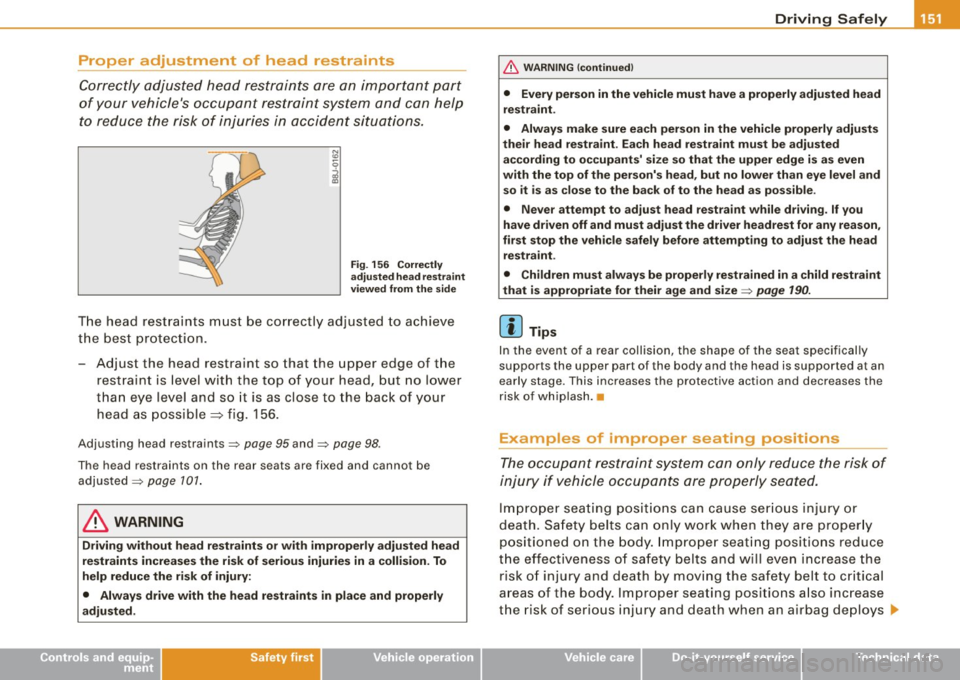
Proper adjustment of head restraints
Correctly adjusted head restraints are an important part
of your vehicle's occupant restraint system and can help
to reduce the risk of injuries in accident situations.
Fig . 156 Correctly
adjusted head restraint
viewed from the side
The head restraints must be correctly adjusted to achieve
the best protection.
- Adjust the head restraint so that the upper edge of the
restraint is level with the top of your head, but no lower
than eye level and so it is as close to the back of your
head as possible
=> fig . 156.
Adjusting head restraints=> page 95 and=> page 98.
The head restraints on the rear seats are fixed and cannot be
adjusted =>
page 101.
& WARNING
Driving without head restraints or with improperly adjusted head
restraints increases the risk of serious injuries in a collision . To
help reduce the risk of injury:
• Always drive with the head restraints in place and properly
adjusted .
Controls and equip ment Safety first Vehicle operation
& WARNING
(continued)
• Every person in the vehicle must have a properly adjusted head
restraint.
• Always make sure each person in the vehicle properly adjusts
their head restraint. Each head restraint must be adjusted
according to occupants' size so that the upper edge is as even
with the top of the person's head, but no lower than eye level and
so it is as close to the back of to the head as possible .
• Never attempt to adjust head restraint while driving. If you
have driven off and must adjust the driver headrest for any reason,
first stop the vehicle safely before attempting to adjust the head
restraint .
• Children must always be properly restrained in a child restraint
that is appropriate for their age and size=>
page 190.
[ i] Tips
In the event of a rear collision, the shape of the seat specifically
supports the upper part of the body and the head is supported at an
early stage. This increases the protective action and decreases the
risk of whiplash. •
Examples of improper seating positions
The occupant restraint system can only reduce the risk of
injury if vehicle occupants ore properly seated.
Improper seating positions can cause serious injury or
death. Safety belts can only work when they are properly
positioned on the body. Improper seating positions reduce
the effectiveness of safety belts and will even increase the risk of injury and death by moving the safety belt to critical
areas of the body. Improper seating positions also increase
the risk of serious injury and death when an airbag deploys ..,
Vehicle care Do-it-yourself service Technical data
Page 170 of 340
___ A_ ir_b _ a_ g~ s_ y_s _t _e _m _________________________________________________ _
Airbag system
Important things to know
Importance of wearing safety belts and
sitting properly
Airbags are only supplemental restraints. For airbags to
do their job, occupants must always properly wear their
safety belts and be in a proper seating position.
For your safety and the safety of your passengers, before
driving off, a lways:
- Adjust the driver's seat and steering wheel properly
=>
page 148,
- Adjust the front passenger's seat properly => page 93,
- Wear safety belts properly=> page 162,
- Always properly use the proper child restraint to protect
children=>
page 190 .
In a collision airbags must inflate within the blink of an eye and with
considerable force . Th e suppl emental airbags can caus e injuries if
the driver or the front seat passenger are not seated proper ly . There
fore in order to help the airbag to do its job, it is impor tant, both as
a driver and as a passenger to sit properly at all times.
By keeping room between your body and the steering wheel and the
front of the passenger compartment, the airbag can inflate fully and
completely and prov ide supplementa l protection in certain frontal
collisions ~
page 148, "Proper occupant seating positions" . For
details on the operation of the seat adjustment controls~
page 93
and ~ page 96.
It's especially important that chi ldren are proper ly restrained
~ page 190.
There is a lot that the driver and the passengers can and must do to
help the individual safety features installed in your Audi work
together as a system.
Proper seating posi tion is important so that the front airbag on the
driver side can do its job. If you have a physical impairment or
condition that prevents you from sitting properly on the driver seat
with the safety belt properly fastened and reaching the pedals, or if
you have concerns with regard to the function or operation of the
Advanced Airbag System, please contact your authorized Audi
dea ler or qua lif ied workshop, or call Audi Customer CARE at 1-800 -
822 -2834 for possible modifications to your vehicle .
When the airbag system deploys, a gas generator wi ll fill the
airbags, break open the padded covers, and inflate between the
steering wheel and the driver and between the instrument panel
and the front passenger. The airbags will deflate immediately after
deployment so that the front occupants can see through the wind
shield again without interruption .
All of this takes p lace in the blink of an eye, so fast that many people
don't even rea lize that the airbags have dep loyed. The airbags also
inflate with a great deal of force and nothing should be in their way
when they deploy . Front airbags in combination with properly worn
safety bel ts slow down and limit the occupant's forward movement.
Together they help to prevent the driver and front seat passenger
from hitting parts of the inside the vehicle while reducing the forces acting on the occupant during the crash . In this way they help to
reduce the risk of injury to the head and upper body in the crash .
Airbags do not protect the arms or the lower parts of the body.
Both front airbags w ill not in flate in al l frontal collisions . The trig
gering of the airbag system depends on the vehic le deceleration
rate caused by the collision and registered by the electronic contro l
unit. If this rate is below the reference value programmed into the
control unit, the airbags will not be triggered, even though the car
may be badly damaged as a result of the collision . Vehicle damage, .,
Page 173 of 340
Airbag system -----------------=~-
as defined in the electronic contro l unit:::::, page 18 0, "P ASSENG ER
A IR BAG OFF lig ht".
A lways remember, a ch ild safety s eat or infant carrier insta lled on
the front seat may be struck a nd knocked out of position by the
rap id ly infl atin g p ass eng er's ai rba g in a front al co llision . The air bag
co uld greatly reduce the effectiveness of the chi ld re st raint and
e v en s erio usl y inju re the chi ld during inflati on.
F or this reason, and because the bac k seat is t he safest plac e for
c hi ldr en -w he n prop erly res train ed acc ordi ng to th eir age a nd size
- w e stro ng ly recomme nd that c hildren a lways s it in t he bac k seat
::::;, page 190, "Chil d Safe ty" .
& WARNING
A child in a rearward -facing child safety seat installed on the front
passenger seat will be seriously injured and can be killed if the
front airbag inflates - even with an Advanced Airbag System.
• The inflating ai rbag will hit the child safety seat or infant
carrier with great force and will smash the child safety seat and
child against the ba ckrest , center arm rest , door or roof.
• Always install rear-facing child safety seats on the rear seat. • If you must install a rearward facing child safety seat on the
front passenger seat because of exceptional circumstances and
the PASSENGER AIR BAG OFF light does not come on and stay on,
immediately install the rear-facing child safety seat in a rear
seating position and have the airbag system inspected by your
Audi dealer .
• Forward-facing child safety seats installed on the front
passenger's seat may interfere with the deployment of the airbag
and cause serious personal injury to the child .
& WARNING
If, in exceptional circumstances , you must install a forward-facing
child restraint on the front passenger's seat:
Controls and equip ment Safety first
Vehicle operation
& WARNING (continued)
• Always make sure the forward-facing seat has been designed
and certified by its manufacturer for use on a front seat with a
passenger front and side airbag .
• Never put the forward -facing child restraint up against or very
near the instrument panel .
• Always move the passenger seat into its rearmost position in
the seat's fore and aft adjustment range, as far away from the
airbag as possible before installing the forward-facing child
restraint. The backrest must be adjusted to an upright position.
• Make sure that the PASSENGER AIR BAG OFF light comes on
and stays on all the time whenever the ignition is switched on.
& WARNING
To reduce the risk of serious injury, make sure that the PASSENGER
AIR BAG OFF light will be displayed whenever a child restraint is installed on the front passenger seat and the ignition is switched
on.
• If the PASSENGER AIR BAG OFF light does not stay on , perform
the checks described :::::,
page 179, "Monitoring the Advanced
Airbag System" .
• Take the child restraint off the front passenger seat and install
it properly at one of the rear seat positions if the PASSENGER AIR
BAG OFF light does not stay on .
• Have the airbag system inspected by your Audi dealer immedi
ately .
• Always carefully follow instructions from child restraint manu
facturers when installing child restraints .
& WARNING
If, in exceptional circumstances, you must install a forward or
rearward-facing child restraint on the front passenger's seat :
Vehicle care Do-it-yourself service Technical data
Page 177 of 340

Airbag system -----------------=~-
& WARNING (continued)
• If you must install a rearward facing child safety seat on the
front passenger seat because of exceptional circumstances and
the PASSENGER AIR BAG OFF light does not come on and stay on,
immediately install the rear -facing child safety seat in a rear
seating position and have the airbag system inspected by your
Audi dealer.
_& WARNING
If, in exceptional circumstances, you must install a forward-facing
child restraint on the front passenger's seat:
• Always make sure the forward-facing seat has been designed
and certified by its manufacturer for use on a front seat with a
passenger front and side airbag .
• Never put the forward-facing child restraint up against or very
near the instrument panel.
• Always move the passenger seat into its rearmost position in
the seat's fore and aft adjustment range, as far away from the
airbag as possible, before installing the forward-facing child
restraint. The backrest must be adjusted to an upright position.
• Make sure that the PASSENGER AIR BAG OFF light comes on
and stays on all the time whenever the ignition is switched on. •
Advanced Airbag System components
The front passenger seat in your vehicle has a lot of very important
parts of the Advanced Airbag System in it. These parts include the
weight-sensing mat, sensors, wiring, brackets, and more. The func
tion of the system in the front passenger seat is checked by the elec
tronic control unit when the ignition is on. The control unit monitors
the Advanced Airbag System and turns the airbag indicator light on
when a malfunction in the system components is detected. The
function of the airbag indicator light is described in greater detail
Controls and equip ment Safety first Vehicle operation
below.
Because the front passenger seat contains important parts
of the Advanced Airbag System, you must take care to prevent it
from being damaged. Damage to the seat may prevent the
Advanced Airbag for the front passenger seat from doing its job in
a crash.
The front Advanced Airbag System consists of the
following:
• Crash sensors in the front of the vehicle that measure vehicle
acceleration/deceleration to provide information to the Advanced
Airbag System about the severity of the crash.
• An electronic control unit, with integrated crash sensors for front
and side impacts. The control unit "decides" whether to fire the
front airbags based on the information received from the crash sensors. The control unit also "decides" whether the safety belt
pretensioners should be activated.
• An Advanced Airbag with gas generator for the driver inside the
steering wheel hub.
• An Advanced Airbag with gas generator inside the instrument
panel for the front passenger .
• A weight-sensing mat under the upholstery padding of the front
passenger seat cushion that measures the total weight on the seat.
The information registered is sent continuously to the electronic
control unit to regulate deployment of the front Advanced Airbag on
the passenger side.
• An airbag monitoring system and indicator light in the instru
ment cluster ~
page 179.
• The PASSENGER AIR BAG OFF light comes on and stays on in the
center of the instrument panel~
page 180, fig. 174 and tells you
when the front Advanced Airbag on the passenger side has been
turned off .
• A sensor below the safety belt latch for the front seat passenger
to measure the tension on the safety belt. The tension on the safety
belt and the weight registered by the weight -sensing mat help the
control unit "decide" whether the front airbag for the front _,.
Vehicle care Do-it-yourself service Technical data
Page 197 of 340
& WARNING (continued)
-Always move the front passenger seat into the rearmost
position of the passenger seat's fore and aft adjustment range,
and as far away from the airbag as possible before installing
the child restraint.
- Always make sure that nothing prevents the front
passenger's seat from being moved to the rearmost position in
its fore and aft adjustment range.
- Always make sure that the backrest is in the upright posi
tion.
• Always buckle the child safety seat firmly in place even if a
child is not sitting in it. A loose child safety seat can fly around
during a sudden stop or in a collision.
• Always read and heed all WARNINGS whenever using a child
restrained in a vehicle is being used=>
page 159, "Safety belts",
=>
page 168, "Airbag system" and=> page 190, "Child Safety".
& WARNING
To reduce the risk of serious injury, make sure that the PASSENGER
AIR BAG OFF light comes on and stays on whenever a child
restraint is installed on the front passenger seat and the ignition
is switched on.
• Take the child restraint off the front passenger seat and install
it properly at one of the rear seat positions if the PASSENGER AIR
BAG OFF light does not stay on.
• Have the airbag system inspected by your authorized Audi
dealer immediately. •
Safety first
Child Safety
Child safety seats
Infant seats
Babies and infants up to about one year old and 22 lbs or
10 kg need special rearward-facing child restraints that
support the back, neck and head in a crash.
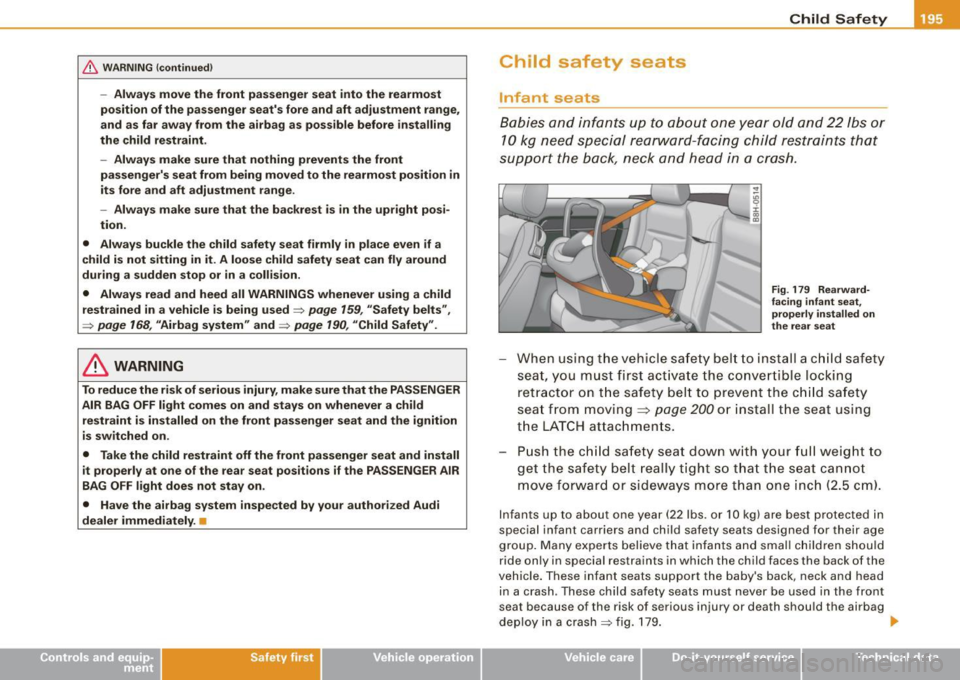
Fig. 179 Rearward
facing infant seat,
properly installed on
the rear seat
-When using the vehicle safety belt to install a child safety
seat, you must first activate the convertible locking
retractor on the safety belt to prevent the child safety
seat from moving
=> page 200 or install the seat using
the LATCH attachments.
- Push the child safety seat down with your full weight to
get the safety belt really tight so that the seat cannot
move forward or sideways more than one inch (2.5 cm).
Infants up to about one year (22 lbs. or 10 kg) are best protected in
special infant carriers and child safety sea ts designed for their age
group. Many experts believe that infants and small children should
ride only in special restraints in which the child faces the back of the
vehicle. These infant seats support the baby's back, neck and head
in a crash. These child safety seats must never be used in the front
seat because of the risk of serious injury or death should the airbag
deploy in a crash => fig. 179. .,,.
~ehicle care irechnical data
Page 199 of 340
___________________________________________ _:C :..: h..:: i:.:..:: ld :::......: S:: a::..: f:..::e :.::t Ly __ ffl!III
place for a chi ld in a forward -facin g chil d safet y seat . It is a very
dan gerous place for an infant o r a larger chi ld in a rearward -fac ing
s ea t.
& WARNING
Not using a child safety seat, using the wrong child safety seat or
improperly installing a child restraint increases the risk of serious
personal injury and death in a collision or other emergency situa
tion.
• Children on the front seat of any car, even with Advanced
Airbags, can be seriously injured or even killed when an airbag inflates . A child in a rearward -facing child safety seat installed on
the front passenger seat will be seriously injured and can be killed if the front airbag inflates - even with an Advanced Airbag System .
• The inflating airbag will hit the child safety seat or infant
carrier with great force and will smash the child safety seat and
child against the backrest, center arm rest, or door .
• Always install rear-facing child safety seats on the rear seat .
• If you must install a rearward facing child safety seat on the
front passenger seat because of exceptional circumstances and
the PASSENGER AIR BAG OFF light does not come on and stay on ,
immediately install the rear-facing child safety seat in a rear
seating position and have the airbag system inspected by your
Audi dealer .
• Always read and heed all WARNINGS whenever using a child
restrained in a vehicle is being used=>
page 159, "Safety belts ",
=>
page 168 , "Airbag system" and=> page 190, "Important things
to know ".
& WARNING
If exceptional circumstances require the use of a forward-facing
child restraint on the front passenger's seat , the child's safety and
well-being require that the following special precautions be taken :
Controls and equip ment Safety first
Vehicle operation
& WARNING (continued)
• Make sure the forward-facing seat has been designed and certi
fied by its manufacturer for use on a front seat with a passenger
front and s ide airbag .
• Always follow the manufacturer's instructions provided with
the child safety seat or carrier.
• Always move the front passenger seat into the rearmost posi
tion of the passenger seat's fore and aft adjustment range, and as
far away from the airbag as possible before installing the child
restraint.
• Always make sure that nothing prevents the front passenger's
seat from being moved to the rearmost position in its fore and aft
adjustment range.
• Always make sure the backrest is in an upright position.
• Make sure that the PASSENGER AIR BAG OFF light comes on
and stays on all the time whenever the ignition is switched on.
• If the light does not stay on , perform the checks =>
page 179,
"Monitoring the Advanced Airbag System" .
• Take the child restraint off the front passenger seat and install
it properly at one of the rear seat positions if the PASSENGER AIR
BAG OFF light does not stay on whenever the ignition is switched
on .•
Vehicle care Do-it-yourself service Technical data
Page 203 of 340
Child Safety 11!1111
-------------------------------------------------=-------
& WARNING (continued)
will strike parts of the vehicle interior. The child can be seriously
injured or killed.
• Never install rear-facing child safety seats or infant carriers on
the front passenger seat. A child will be seriously injured and can be killed when the passenger airbag inflates .
• The inflating airbag will hit the child safety seat or infant
carrier with great force and will smash the child safety seat and
child against the backrest, center arm rest, door or roof.
• Always install rear-facing child safety seats or infant carriers on
the rear seat.
• Forward-facing child safety seats or infant carriers installed on
the front passenger's seat may interfere with the deployment of
the airbag and cause serious injury to the child.
• It is safer to install a forward -facing child safety seat on the rear
seat.
• Always read and heed all WARNINGS whenever using a child
restrained in a vehicle is being used~
page 190. Special precau
tions apply when installing a child safety seat on the front passenger seat~
page 170, "Child restraints on the front seat -
some important things to know" .
& WARNING
Always take special precautions if you must install a forward or
rearward -facing child restraint on the front passenger's seat in
exceptional situations:
• Whenever a forward or rearward-facing child restraint is
installed on the front passenger seat, the PASSENGER AIR BAG
OFF light must come on and stay on whenever the ignition is
switched on.
• If the PASSENGER AIR BAG OFF light does not come on and stay
on , perform the checks described
~ page 179, "Monitoring the
Advanced Airbag System".
Controls and equip ment Safety first
Vehicle operation
& WARNING (continued)
• Take the child restraint off the front passenger seat and install
it properly at one of the rear seat positions if the PASSENGER AIR
BAG OFF light does not stay on whenever the ignition is switched
on.
• Improper installation of child restraints can reduce their effec
tiveness or even prevent them from providing any protection.
• An improperly installed child restraint can interfere with the
airbag as it deploys and seriously injure or even kill the child.
• Always carefully follow the manufacturer's instructions
provided with the child safety seat or carrier.
• Never place additional items on the seat that can increase the
total weight registered by the weight-sensing mat and can cause
injury in a crash.
& WARNING
Forward-facing child restraints:
• Always make sure the forward-facing seat has been designed
and certified by its manufacturer for use on a front seat with a
passenger front and side airbag.
• Never put the forward-facing child restraint up, against or very
near the instrument panel .
• Always move the passenger seat into its rearmost position in
the seat's fore and aft adjustment range, as far away from the
airbag as possible before installing the forward-facing child
restraint. The backrest must be adjusted to an upright position.
• Make sure that the PASSENGER AIR BAG OFF light comes on
and stays on all the time whenever the ignition is switched on.
& WARNING
Rearward -facing child restraints:
Vehicle care Do-it-yourself service Technical data
Page 303 of 340
![AUDI A4 CABRIOLET 2009 User Guide _________________________________________________ F_ u_ s_ e_s _ a_n _ d_ b_ u_lb _ s ____ llll
[ i ] Tip s No . Equipm ent Amps
You are wel l adv ised to keep a supply of spare fuses in you](/img/6/57553/w960_57553-302.png "AUDI A4 CABRIOLET 2009 User Guide _________________________________________________ F_ u_ s_ e_s _ a_n _ d_ b_ u_lb _ s ____ llll
[ i ] Tip s No . Equipm ent Amps
You are wel l adv ised to keep a supply of spare fuses in you")
_________________________________________________ F_ u_ s_ e_s _ a_n _ d_ b_ u_lb _ s ____ llll
[ i ] Tip s No . Equipm ent Amps
You are wel l adv ised to keep a supply of spare fuses in your vehic le.
15 Instrument c luster, Navigation system 10
Fuses with the proper ampere ratings are available at your Audi 16 Garage door opener 5
dea ler. •
17 Level , tire pressure control , park assist, 10 light/rain sensor
Fuse list Automatic headlig ht range control, left 5
Fuses which con be replaced. 19 Fog lights 15
Vacant
N o. Equipm ent Amps
21 Vacant
1 Air conditioner 10
22 Doors 15
2 Footwell illumination 5 23 Vacant
3 Heated washer jets 5 Central convenience electrical system 20
Radiator fan 5 25 Heater blower 30
5
Telephone, oil level sensor, multifunction 10 Rear window defogger 30 switch, rear heated seat, shift gate
Air conditioner (air quality sensor), air pressure
27 Socket for tra iler towing (controller) 30
6 5
sensor 28 Fuel pump 20
Electronic Stabil izat ion Program (ESP), bra ke 29 Vacant
7 light switch, clutch peda l switch, steering angle 10
sensor
30 Power top control un it 30
8 Telephone 5 31
Automatic transmission, mirror dimming, diag-15 nosis socket
9 Brake booster (vacuum pump) 15 Towing assembly 15
10
Automatic headl ight beam adjustment, auto -5 33 Cigarette
lighter 20 matic headlight range control, right
34 Electrical socket 20
11
Airbag control unit, front passenge r seat recog -10 nition USA (bladder mat) 35 Luggage compartment socket 20
Diagnosis socket 10 Windshield wiper system 30
13
Steering c olumn module 10
37 Pump for windshie ld an d head light washer* 30
14
Brake lights 10
system
• Do-it-yourself service
Page 330 of 340
IIPJI Alphabetical index _ __,__ ___ ____;_...::.:...::... ___________________________ _
Hood ...... ... ...... .. ... .. .. ... 249
Starting .. .... .... ....... ... 119,120
Starting with jumper cables ....... 304
Stopping . . . . . . . . . . . . . . . . . . . . . . .
120
Engine compartment
Safety instructions . . . . . . . . . . . . . . .
250
Working in the engine compartment 250
Engine coolant .................. ... 258
Checking the engine coo lant level .. 258
Malfunction warning symbol ... ..... 31
Engine coolant level
Checking ... .. .... .... ..........
258
E . I
ngine coo ant system ... .... ....... 257
Adding coolant .................. 259
Radiator fan . . . . . . . . . . . . . . . . . . . . . 260
Engine coolant temperature
Temperature gauge ....... .... ....
13
Engine data ...... ............... ... 314
Engine hood Closing ... .... ... .... .... ...... .
250
How to release the hood . . . . . . . . . . 249
Opening .. .... .... ....... .... ... 249
Engine oil ... ... .... .... .... ... .... 252
Adding ... .. ...... ... .... ...... . 255
Additives . . . . . . . . . . . . . . . . . . . . . . . 255
Changing . .............. ........ 256
Checking the engine oil level ...... . 254
Indications and conditions requiring extra
checking .... .... ....... .... ...
254
Indicator light . . . . . . . . . . . . . . . . . . . . 33
Oil capacity . . . . . . . . . . . . . . . . . . . . .
314
Oil consumption ................. 254
Oil grades . . . . . . . . . . . . . . . . . . . . . . . 252
Recommended oil check intervals .. 254
Sensor defective . . . . . . . . . . . . . . . . . . 33
Specification and viscosity ...... ..
252
Engine oil pressure
Malfunction .. ....... ..... ... .... . 32
Environment Break -in period .... .... .... .... ..
219
Catalytic converter .... .... .... ... 220
Disposing of your vehic le battery ...
262
Driving at high speeds ...... .... .. 221
Driving to minimize pollution and noise .
221
Fuel ......... .... ... .. .... .... .. 246
Fuel economy ....... ...... ...... 221
Leaks under your vehicle . ...... ... 250
Letting the vehicle stand and warm up
222
Proper disposa l of drained brake fluid
261
Proper disposal of drained engine
coo lant ..................... ...
259
Proper disposa l of drained engine oil
255,256
Recycling used eng ine oil ......... 255
Unleaded fuel ... .... ..... .... ... 244
What should I do with an old battery?
262
EPC
See Electronic power control .. ... .. . 22
ESP Electronic stabi lization program ....
212
See also Electronic stabilization program
(ESP) . ... .... .... ........ ......
212
Event Data Recorder (EDR) .. ....... .. 212
Expansion tank .. .. .. .. .. .... .... ... 258
F
Fahrenheit
Switching between Fahrenheit and Centigrade ... .... ..............
113
Fan
Climate controls ... ....... .... ...
114
Radiator ...... .... ........... ... 260
Setting the fan speed 114
Flat tire
Changing .. .... .... ............. 293
Floor mats
Fog lights
153
Front ....... ...... .... ........ ... 79
Folding master key with remote control . 47
Foot pedals . ... .. .... .... .... ...... 152
For the sake of the environment
Gaso line fumes and the environment
246
Letting your engine warm up ....... 120
Reducing engine noise by early
upshifting ......................
13
Refueling ......... ...... ........ 246
Saving fuel by early upshifting . ..... 13
Using the rear window defogger ....
116
Front airbags
Description ......................
172
How they work ..... .... ....... ... 177
Front ashtray . . . . . . . . . . . . . . . . . . . . . . . 104
Front seat adjustment
Safety guide lines .................. 92
Page 334 of 340
llffl _ __:._A..:.:IL: p :...:h..:.: a== b:..:e :...:t:.:..ic =-= a..:..l ..:..in :..:..:: d:...:e :.:x-=-----------------------------------------------
Opening and closing the windows 53
Operating locks with the fold-out key 53
Rear lid .......................... 55
Remote control ................ 48, 51
Un locking and locking vehicle ....... 51
Power outlets . . . . . . . . . . . . . . . . . . . . . . 106
Power seats Adjusting the seatback ............. 97
Adjustment . ...... .... .... .... ... 96
Folding the seatback forward ...... . 99
Power steering . . . . . . . . . . . . . . . . . . . . . 217
Power top . . . . . . . . . . . . . . . . . . . . . . . . . . 61
Care and cleaning ...... .... .. .... 233
Closing ........................ .. 62
Convenience close/open feature .. ... 63
Conven ience opening/closing ....... 63
Correcting a malfunct ion . . . . . . . . . . . 65
Display messages . . . . . . . . . . . . . . . . . 64
Genera l information . . . . . . . . . . . . . . . 61
Malfunction ...... ..... .. .... .... . 64
Manual operation . .... .... ...... .. 68
Opening ..................... .... 62
Variable storage bay . . . . . . . . . . . . . . . 64
Warning/indictor lights ........ .... 21
Wind deflector . . . . . . . . . . . . . . . . . . . . 66
Power window switches . . . . . . . . . . . . . . 59
In the driver's door ... .... ... ...... 59
In the front passenger's door . . . . . . . 60
Reactivating the system . . . . . . . . . . . . 60
Pregnant women Special considerations when wearing a safety belt . . . . . . . . . . . . . . . . . . . . . 165 Programming
the Homelink® universal re-
mote control . . . . . . . . . . . . . . . . . . . 139
Proper occupant seating positions .... 148
Proper safety belt position . . . . . . . . . . . 164
Proper seat ing position
Front passenger . . . . . . . . . . . . . . . . . 149
Occupants . . . . . . . . . . . . . . . . . . . . . . 148
Rear passengers 150
a
Quartz
clock . . . . . . . . . . . . . . . . . . . . . . . . . 14
quattro®
See All Wheel Drive ............... 218
Question
R
What happens to unbelted occupants? ..
161
Why safety belts? . . . . . . . . . . . . . . . . 159
Radiator fan ......... ............ ... 260
Radio Replacing . .... ... .... ........ ... 319
Rain sensor defective .. .... .... ....... 33
Reading lights .... ............. ...... 84
Rear ashtray . . . . . . . . . . . . . . . . . . . . . . . 105
Rear lid Locking/unlocking ............. ... . 55
Rear light
Defective ... .. ........ .... .... ... 35
Rear view mirror Inside rear view mirror .. .... ....... 88 Rear window defogger
..... .. ... .... . 116
Rearview mirror
See Mirrors ............ .... .... ... 88
Red symbols .. .... .... ... ........ ... 30
Refuelling .......................... 246
Release lever for engine hood ......... 249
Remote control ........ ...... .... . 48, 51
Resetting remote control ... .... .... 52
Un locking and locking . .... .... .... 51
Remote control garage door opener (Homelink®) ...... ... ..... .... . 139
Remote master key Battery replacement ..... ....... ... 48
Check light ....................... 48
Remote rear lid release ........... .... 56
Repair manuals ....... .... .... ...... 316
Repairs Airbag system
Replacing 182
Wheel rims ..... ................. 281
Replacing a fuse ...... .... .... ...... 300
Replacing a sound system .. .... ...... 319
Replacing light bulbs ...... .... .... .. 302
Replacing tires and wheels . ....... ... 280
Reporting Safety Defects ... .... ...... 155
Reset button . . . . . . . . . . . . . . . . . . . . . 15, 18
Resetting remote control ...... .... .... 52
Retractor . . . . . . . . . . . . . . . . . . . . . . . . . . 163
Rims Cast a lloy .. ........... .... ...... 237
Replacing .. ........... ........ .. 281
Stee l rims ...... .... ......... .... 236