Oil AUDI A4 CABRIOLET 2009 Owner's Manual
[x] Cancel search | Manufacturer: AUDI, Model Year: 2009, Model line: A4 CABRIOLET, Model: AUDI A4 CABRIOLET 2009Pages: 340, PDF Size: 77.32 MB
Page 255 of 340
Checkin g a nd fillin g -
-----------------=-------"=--------
•
prevent the formation of harmful deposits, sometimes called
"sludge", that over time can lead to expensive repairs.
At the time of printing, engine oi ls available in the U.S . and Canada
that meet the exacting specifications of Audi oil standard VW 502 00
are synthetic engine oils. This does not mean, however, that every
synthetic engine oil will meet Audi oil standard VW 502 00. So
always be sure that you use an approved oil.
To help prevent the formation of harmful deposits use only oil with
the fo llowing specifications pr inted on the oil container:
A ud i oil stan dard VW 50 2 0 0
Oil container labels may carry the specification singly or in combi
nation with other designations and oil quality standards.
V isc osi ty
Engine oils are graded according to their viscosity . The proper
viscosity grade oil for your engine depends on climactic or seasona l
conditions where you drive. You can use oil with a viscosity grade of
SAE 5W40 across all temperature ranges for normal dr iving condi
tions.
However, if engine oil viscosity grade SAE 5W40 is not available, you
can a lso use viscosity grade SAE 5W-30 or SAE 0W-40 as long as it
meets Audi oil qua lity standard VW 502 00 specifications .
Because engine oil that meets the Audi oil standard may not be
avai lable everywhere when you need it, we strongly recommend
t hat you a lways carry with you an extra quart ( liter) of oil that
express ly conforms to the VW 502 00 specification, in case you have
t o top off the oil while on the road .
On ly if the level of the oil is at or be low the minimum mark on the
oi l dipstick -and no oil that express ly conforms to Audi oil standard
VW 502 00 specifications is available -may you top off with a high
quality engine oil, preferably synthetic -based, that meets ACEA A3,
ACEA A5 or ACEA B5, API S L or ILSAC GF -3 specifications, but even
then, on ly in viscosity grades SAE 5W -40, SAE 5W -30, or SAE 0W -40.
However, during the ent ire time between oi l change intervals, never top off with more than a total of 0
.5 qt/ liter engine oi l that does not
conform to Audi oil specification VW 502 00.
For more information about engine oi l that has been approved for
your vehicle, p lease contact either your authorized Audi dea ler or
Audi Customer Relations at 1 (800) 822-2834 or visit our web site at
www.audiusa.com or www.audicanada.ca. Here you will also find a current list of o ils (manufacture rs, brand names etc.) that confo rm
to Audi oil standard VW 502 00.
Changing th e engine oil
The engine oil and oil f ilter must be changed according to the
mi leage (ki lometers) and time intervals specified in your vehic le's
Warranty & Maintenance booklet. Do no t exceed these intervals -
harmfu l deposits from old engine oil can reduce engine perfor
mance and can lead to expensive eng ine repa irs.
Changing the oil at the recommended intervals is so very important
because the l ubricating properties of oi l decrease gradua lly during
norma l vehicle use. If you are not sure when you have your oil
changed, as k your authorized Audi Service Advisor.
Under so me circumstances the engine oil should even be changed
more frequently . Change oil more often if you drive mostly short
distances, opera te the vehicle in dusty areas or m ostly under stop
and-go traffic conditions, or when you use your vehicle where
temperatures stay below freezing point for long periods .
Detergent additives in the oil will make fresh oil look dark after the
engine has been running for a short time. This is normal and is not
a reason to change the oil more often than recommended.
D amag e or malf unct ions due to la ck of maintenan ce
It is essential that you change your oi l at the recommended intervals
using on ly engine oil that complies with Audi oil standard
VW 502 00. Your Limited New Vehic le Warranty does not cover
damage or malfunctions due to failure to fol low recommended
maintenance and use requirements as set forth in the Audi Owner's
Manual and Wa rranty & Maintenance booklet. Your dea ler wi ll have
to deny warranty coverage unless you present to the dealer proof in _,.
Vehic le care
Page 256 of 340
-~_C_ h_e _c _ k_ i_ n ...:::g:;..._ a_n_ d_ f_ i_ll _in ....;g:::;.._ ___________________________________________ _
the form of Service or Repair Orders that all scheduled maintenance
was performed in a timely manner. •
Engine oil consumption
The engine in your vehicle depends on an adequate
amount of oil to lubricate and cool all of its moving parts.
In order to provide effective lubrication and cooling of internal
engine components , all internal combustion engines consume a
certain amount of oil. Oil consumption varies from engine to engine
and may change significantly over the life of the engine. Typically,
engines with a specified break -in period (see~
page 219) consume
more oil during the break-in period than they consume after oil
consumption has stabilized.
Under normal conditions, the rate of oil consumption depends on
the quality and viscosity of the oil, the RPM (revolutions per minute)
at which the engine is operated, the ambient temperature and road
conditions. Further factors are the amount of oil dilution from water
condensation or fuel residue and the oxidation level of the oil. As
any engine is subject to wear as mileage builds up , the oil consump
tion may increase over time until replacement of worn components
may become necessary .
With all these variables coming into play, no standard rate of oil
consumption can be established or specified. There is no alternative
to regular and frequent checking of the oil level, see
Note.
If the yellow engine oil level warning symbol in the instrument
cluster lights up, you should check the oil level as soon as
possible
with the oil dipstick~ page 254. Top off the oil at your
earliest convenience~
page 255.
& WARNING
Before you check anything in the engine compartment, always
read and heed all WARNINGS
~ & in "Working in the engine
compartment" on
page 250.
0 Note
Driving with an insufficient oil level is likely to cause severe damage
to the engine.
[ i] Tips
• The oil pressure warning display 't!::r. is not an indicator of the oil
level. Do not rely on it. Instead, check the oil level in your engine at
regular intervals, preferably each time you refuel, and always before
going on a long trip.
• If you have the impression your engine consumes excessive
amounts of oil, we recommend that you consult your Audi dealer to
have the cause of your concern properly diagnosed . Keep in mind
that the accurate measurement of oil consumption requires great
care and may take some time . Your Audi dealer has instructions
about how to measure oil consumption accurately. •
Checking the engine oil level
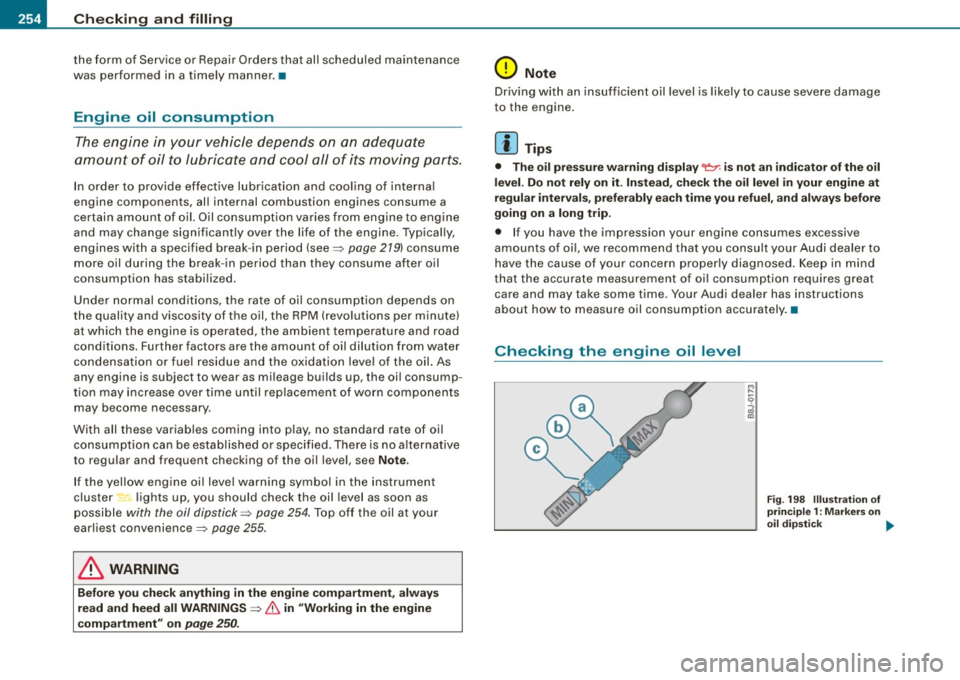
Fig. 198 Illustration of
principle 1: Markers on
oil dipstick ..,_
Page 257 of 340
Checking and filling -_____________ _______::;____;;:;;____...j
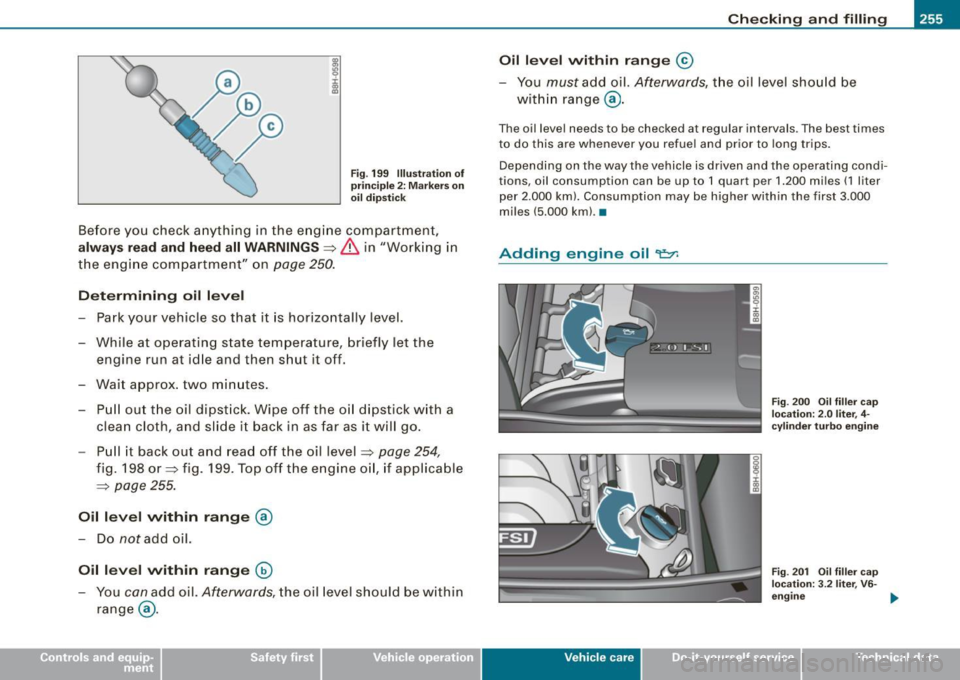
Fig. 199 Illustration of
principle 2: Markers on
oil dipstick
Before you check anything in the engine compartment,
always read and heed all WARNINGS=> & in "Working in
the engine compartment" on
page 250.
Determining oil level
Park your vehicle so that it is horizontally level.
- While at operating state temperature, briefly let the
engine run at idle and then shut it off.
- Wait approx. two minutes.
- Pull out the oil dipstick. Wipe off the oil dipstick with a
clean cloth, and slide it back in as far as it will go.
- Pull it back out and read off the oil level
=> page 254,
fig. 198 or:::> fig. 199. Top off the engine oil, if applicable
=> page 255.
Oil level within range @
- Do not add oil.
Oil level within range G)
- You con add oil. Afterwords, the oil leve l should be within
range @.
Oil level within range ©
-You must add oil. Afterwords, the oil level should be
within range @.
The oil level needs to be checked at regular intervals . The best times
to do this are whenever you refuel and prior to long trips.
Depending on the way the vehicle is driven and the operating condi
tions, oil consumption can be up to 1 quart p er 1.200 miles (1 liter
per 2.000 km). Consumption may be higher within the first 3.000
miles (5.000 km). •
Adding engine oi l 'e::1':
Vehicle care
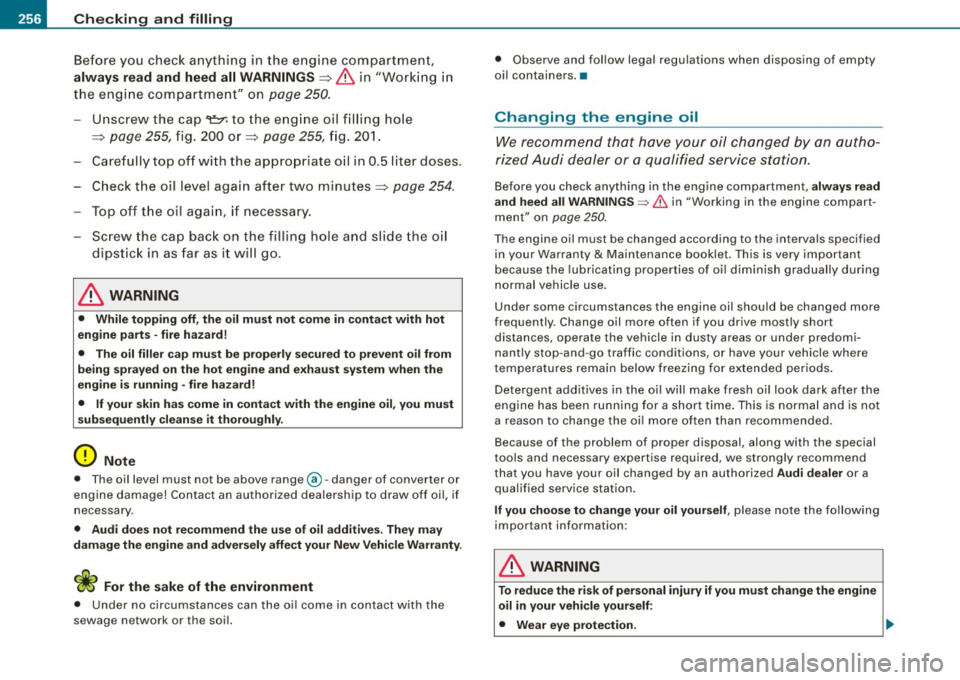
Fig . 200 Oil filler cap
loc ation: 2.0 liter, 4-
cylinder turbo engine
Fig . 201 Oil filler cap
location: 3.2 liter , VG-
engine _,,
irechnical data
Page 258 of 340
-~_C_ h_e _c _ k_ i_ n ...:::g:;..._ a_n_ d_ f_ i_ll _in ....;g:::;.._ ___________________________________________ _
Before yo u check a nything in the e ngine compartmen t,
always read and heed all WARNINGS~
& in "Working in
the eng ine compartment" on
page 250.
Unscrew the ca p~ to the e ngine oil filling hole
~ page 255, fig . 200 or~ page 255, fig. 20 1.
- Carefully top off wi th the appropriate o il in 0.5 liter doses.
- C heck the oil level aga in afte r two minutes ~
page 254.
-Top off t he oi l aga in, if necessary .
- Sc rew the ca p back on the fi lling h ole a nd s lide the o il
d ips tic k in as far as i t will go .
& WARNING
• While topping off , the oil must not come in contact with hot
eng ine part s -fi re hazard!
• The oil filler cap mu st be prope rly secured to prevent o il from
being spra yed on the hot engine and exhaust sy stem when the
engine i s runnin g -fire hazard!
• If your skin has come in conta ct with the engine oil , you mu st
s ub sequently clean se it thoroughly .
0 Note
• The oil level must not be above range@-danger of converter or
engine damage! Contact an authorized dealership to draw off oi l, if
necessary.
• Audi do es not recommend the use of oil additives . They may
d amage the engine and adver sely affe ct your New Vehicle Warr anty.
ffi For th e sake of the environment
• Under no circumstances can the oi l come in contact w ith t he
sewage network or the soil. •
Observe and follow legal regulations when disposing of empty
o il con tainers .•
Changing the engine oil
We recommend that have your oil changed by an autho
rize d Audi de aler or a qualified service s tation.
Before you check any thi ng in the engine compartment, alway s read
and heed all WARNINGS =>
& in "Working in the engine compart
ment" on
page 250.
The engine oil must be changed according to the intervals specified in you r War ranty
& Main tenance booklet . This is very important
because the lubricating properties of oil diminish gradually during
normal vehicle use .
Under some circumstances the engine oil shou ld be changed more
frequently . Change oil more often if you drive mostly short
distances, opera te the ve hicle in dusty areas or under predom i
nant ly stop -and -go traffic conditions, or have your vehicle where
t emperatures remai n below freezing fo r extended periods .
Detergent add it ives i n the oil wi ll make fresh oil look dark after the
engine has been running for a short time . This is norma l and is not
a reason to change the oi l more of ten than recommended.
Because of the problem of proper disposal, along with the special
t ools and necessa ry expert ise required, we strong ly recommend
that you have your oil changed by an authorized
Audi dealer or a
qual ified se rvice sta tion .
If you choo se to change your oil yourself , please note the follow ing
important information :
& WARNING
To reduce the risk of personal injury if you must change the engine
oil in your vehicle you rself:
• We ar eye protection . _.,
Page 259 of 340
_____________________________________________ C_h_ e_ c_k _in ---= g'--- a_n _d_ f_il _li _n ....:g=-------"'
•
& W ARNING (conti nued )
• To reduce the ri sk of burns from hot engine oil , let the engine
c ool down to the tou ch.
• When removing the oil drain plug with your fingers , stay as far
a w ay as possible. Alway s keep your forearm parallel to the ground
to help prevent hot oil from running down your arm.
• Drain the oil into a container designed for thi s purpo se , on e
large enough to hold at least the total amount of oil in your engine.
• Engine oil is poisonous . Keep it well out of the reach of children .
• Continuous contact with used engine oil i s harmful to your
skin . Always prote ct you r skin by washing oil off thoroughly with
soap and water .
0 Note
Never m ix oil a ddi tives with yo ur engine oil. These additives can
damage your engine and adversely affect your Audi Limited New
Vehi cle Warranty.
~ For the sake of the environment
• Befo re c ha ng ing y our oi l, f irst make sure you k now w here y ou
can properly dispose of the used oil.
• Always dispose o f used e ngine oi l prop erl y. D o not dump i t on
garden soil, wooded areas, into open streams or down sewage
drains.
• Recycle used engine oi l by taking it to a used engine oil col lec
t ion facili ty in y our a rea, or co n tact a serv ice s ta tion .•
Engine cooling system
Coolant
T he e ngin e cool ant p erform s tw o functio ns: it k eep s th e
e ng ine f rom ov erh ea ting and it pro tects the engine fr om
freezing in the winter.
The cooling system is sealed and general ly requires little attention.
The coo ling syst em has been fil led at the fac tory with a perm an ent
coolant which does not need to be changed. The coo lant consists of
a m ix ture of wa te r and the manufacturer 's gl yco l- b ase dco olant
add it ive G 12++ antifreeze with anticorrosion additives (50% for USA
mode ls; 60% for Canadian mode ls) . T his m ixtu re bo th a ssure s the
n ecessary frost protectio n and p ro tects m etal co mponents in t he
eng ine's cooling system from co rrosion and scaling. It a lso raises
the boili ng poi nt o f the coolant.
D o not reduce the concentrat ion of the coo lant in the summer by
adding pla in wate r. The proportion of coolant additive must be at
least 50 % but not more than 60 % to maintain antifreeze protection
and coo ling eff iciency . If the c oolant frost p ro tecti on is t oo low, the
coo lant could freeze and damage th e vehic le heating and en gine
cool ing sy stem .
For year -rou nd driv ing, ant ifreeze is added at the facto ry fo r tempe r
atures down to:
• -31 °F ( -35 °C) USA
• - 40 °F ( - 40 °C) Canada.
You can mix the G12 ++ coolan t add itive with othe r additives (G12 +
or G12). A lways check wit h your authorized Audi dea ler.
& WARNING
Before you check anything in the engine co m partment , always
read and heed all WARNINGS
=> & in "Working in the engine
c ompartment " on
page 250 .
Vehic le care
Page 260 of 340

___ C_h_ e_ c_k _in --== g'-- a_n _d_ f_il _li _n ..::g=-- --------------------------------------------
0 Note
• Before winter sets in, have the coolant checked to see if the
coolant additive in your vehicle is sufficient to meet the climate
conditions. This is especially important if you live in a region where
the winter is extremely cold . If necessary, increase the proportion of
coolant additive to 60% .
• When adding coolant additive to your cooling system,
remember:
-We recommend using only coolant additive G12+ + (check the
label) for your vehicle. This coolant additive is available at autho
rized Audi dealers. Other types of antifreeze can significantly
reduce corrosion protection . The resulting corrosion can cause a
loss of coolant and serious engine damage.
• Do not add any type of radiator leak sealant to your vehicle's
engine coolant. Adding radiator repair fluid may adversely affect the
function and performance of your cooling system and could result
in damage not
covered by your New Vehicle Limited Warranty. •
Checking the engine coolant level
The engine coolant level can be checked with a quick
glance.
Fig . 202 Engine
compartment: Coolant
expansion tank
Before you check anything in the engine compartment,
always read and heed all WARNINGS~ & in "Working in
the engine compartment" on
page 250.
Turn off the ignition.
- Let the eng ine cool down.
Place a thick rag over the coolant expansion tank
~ fig. 202 and carefully twist the cap counter-clockwise
~& .
Read the engine coolant level in the open coolant expan
sion tank~ fig. 202. With a cold engine, the coolant level
should be between the "min" and "max" markings. When
the engine is warm, the level may be slightly above the
"max" marking .
The location of the coolant expansion tank can be seen in the
engine compartment illustration=>
page 252.
To obtain an accurate reading , the engine must be switched off .
The expansion tank in your vehicle is equipped with an electric
coolant level sensor.
When the coolant l evel is too low, the warning light in the Auto
Check System :::::,
page 31 will blink until you add coolant and the
level has been restored to normal. Even though there is an electric
coolant level sensor, we still recommend you check the coolant level
from time to time .
Coolant loss
Coolant loss may indicate a leak in the cooling system. In the event
of coolant loss, the cooling system should be inspected immedi
ately by your authorized Audi dealer . It is not enough merely to add
coolant.
In a
sealed system, losses can occur only if the boiling point of the
coolant is exceeded as a result of overheating. ..,.
Page 263 of 340
_____________________________________________ C_ h_ e _ c_k _in ---= g'--- a_n _d_ f_il _li _n __.,g==----•
•
The brake fluid reservoir is located at the rear partition of the engine
compartment on the left side~
page 252 .
The fluid level may drop slightly after some time due to the auto
matic adjustment of the brake pads. This is not cause for alarm .
If the brake fluid level falls
considerably below the "MIN" mark, the
brake warning/indicator light (U .S. models :
BRAKE, Canadian models :
(CD) ) wi ll come on
~ page 23 and ~ page 30. Do not continue to
operate the vehicle. The complete brake system should be thor
oughly checked by an authorized Audi dealer or qualified workshop
and the cause corrected . If the brake fluid level is too low, the brake
warning/indicator light will illuminate. Contact an authorized Audi
dea ler
immediately .•
Changing brake fluid
Have the brake fluid changed by an experienced techni
cian.
Brake fluid absorbs moisture from the air . If the water content in the
brake fluid is too high, corrosion in the brake system may result
after a period of time. The boiling point of the brake fluid wil l also
decrease considerably and decrease braking performance.
Therefore, the brake fluid must be changed
every two years. Always
use new brake fluid which conforms to Federa l Motor Vehic le Stan
dard "FMVSS 116 DOT 4".
The brake fluid reservoir can be difficult to reach, therefore, we
recommend that you have the brake fluid changed by your autho
rized
Audi dealer. Your dealer has the correct tools, the right brake
fluid and the know -how to do this for you.
& WARNING
• Brake fluid is poisonous. It must be stored only in the closed
original container out of the reach of children!
& WARNING (continued)
• Brake failure can result from old or inappropriate brake fluid.
Observe these precautions :
- Use only brake fluid that meets SAE specification
J 1703 and
conforms to Federal Motor Vehicle Standard 116. Always check
with your authorized Audi dealer to make sure you are using
the correct brake fluid. The correct type of brake fluid is also
indicated on the brake fluid reservoir .
- The brake fluid must be new . Heavy use of the brakes can
cause a vapor lock if the brake fluid is left in the system too
long. This can seriously affect the efficiency of the brakes as
well as your safety . This could result in an accident.
0 Note
Brake fluid wil l damage the paint of your vehicle .
ci> For the sake of the environment
Because of the problem of proper disposal of brake fluid as well as
the special tools required and the necessary expertise, we recom
mend that you have the brake fluid changed by your authorized Audi
dealer. •
Battery
General information
Under normal operating conditions, the battery in your Audi does
not need any maintenance. With
high outside temperatures it is
advisab le however to check the fluid level at regular intervals
through the transparent battery housing. Also check the fluid level
each time you charge the battery . After charging the battery
~ page 265, you shou ld likewise check the battery acid level. ...
Vehic le care
Page 269 of 340

Tires a nd wh eels BIii ________________________________ :....:.:.....::.=.....::.:..:..:..::..:___:___:..__ __
•
Tires and wheels
Tires
General notes
Tires may be the least appreciated and most abused parts
of a motor vehicle.
Tires may be the least appreciated and most abused parts of a
motor vehicle. Tires are, however, one of the most important parts
of a vehicle, particular ly considering the comparative ly sma ll patch
of rubber on each tire that assures that all -important contact
between you, your vehicle and the road .
Maintaining the correct tire pressure, making sure that your vehicle
and its tires do not have to carry more weight than they can safely
handle, avoiding damage from road hazards and regular ly
inspecting tires for damage inc luding cuts , slashes irregular wear
and overal l condition are the most important things that you can do
to help avoid sudden tire failure including tread separation and
b lowouts .
Avo iding d am age
If you have to drive over a curb or similar obstacle, drive very slowly
and as close as possible at a right angle to the curb.
A lways keep chemica ls including grease, oil, gasoline and brake
flu id off the ti res .
I nspect the tires regularly for damage (cuts, cracks or blisters, etc .!.
Remove any foreign bodies embedded in the treads .
Storing tire s
Mark tires when you remove them to indicate the direction of rota
tion. This ensures you to be ab le to mount them correctly when you
reinstall them. When removed, the whee
ls or tires should be stored in a coo l, dry
and preferably dark place.
Store tires in a vertical position i f they are not mounted on r ims, in
a horizontal position if they are mounted on rims.
N ew tire s
New tires have to be broken in => &.
The tread depth of new tires may vary, according to the type and
make of tire and the tread pattern.
Hidd en d am ag e
Damage to tires and rims is often not readily visible . If you notice
unusua l vibration or the vehic le pul ls to one side, this may indicate
that one of the tires has been damaged . The tires must be checked
immediately by an author ized Audi dealer or qualified workshop .
Uni dir ection al tire s
A unidirect ional tire can be identified by arrows on the sidewa ll, that
point in the direction the tire is designed to rotate. You must fo llow
the specified direction of ro tation . This is necessary so that these
tires can deve lop their optimum characteristics regarding grip, road
noise, wear and hydroplaning resistance . For more information
=> page 298.
Rim s with bolted rim ring *
Light-alloy wheels with a bo lted rim ring consist of several parts .
These parts are screwed together with special bo lts, using a specific
technique. This ensures proper function, seal, safety, and true running of the wheel. For this reason, damaged rims shou ld be
replaced, and you should never repair or dismantle them
=> & .
Rim s with screw -on decorative co vers *
Light-a lloy whee ls can be furnished with interchangeab le decora -
tive covers that are mounted to the rim with se lf -locking bolts. ...
Vehic le care
Page 278 of 340
-~_T_ ir_e_ s_ a_ n_d _ w_ h_ e_e _l_s _________________________________________________ _
and is more difficult to stop. Overloading can not only lead to loss
of vehic le contro l, but can also damage important parts of the
vehic le and can lead to sudden tire failure, including a blowout and
sudden deflation that can cause the vehicle to crash .
Your safety and that of your passengers also depends on making sure that load limits are not exceeded . Vehicle load includes every
body and everything in and on the veh icle . These load lim its are
technically referred to as the vehicle's
G ross Vehicle Weight R ating
("GVWR").
The "GVWR" includes the weight of the basic vehic le, all factory
installed accessories, a ful l tank of fuel, oil, coolant and other fluids
p lus maximum load. The maximum load includes the number of
passengers that the vehicle is intended to carry ("seating capacity")
with an assumed we ight of 150 lbs (68 kg) for each passenger at a
designated seating position and the total weight of any luggage in
t he vehicle. If you tow a trai ler, the weight of the trailer hitch and the
tongue weight of the loaded trai ler must be included as part of the
vehic le load .
T he
G ros s Axle Weight Rating ("GAWR") is the maximum load that
can be applied at each of the vehicle's two axles .
The Gross Vehicle Weight Rat ing and the Gross Axle Weight Rating
are listed on the safety compliance sticker labe l located either on
the d river's side B -pillar o r on t he inside of the f ue l fi ller flap. Yo ur
Audi has 4 seating positions, 2 in the front and 2 in the rear for total
seating capaci ty of 4. Each seating posi tion has a safety belt
=>
page 159, "Safety be lts" .
T he fact that there is an upper limit to your vehicle's Gross Vehicle
Weight Rating means that the total weight of whatever is being carried in the vehicle (including the weight of a trailer hitch and the
tongue weigh t of the loaded trailer) is lim ite d. The more passengers
in the vehicle or passengers who are heavier than the standard
weights assumed mean that less weight can be carried as luggage.
The tire pressure labe l on your Audi also lists the maximum
combined weight of a ll of the occupants and luggage or othe r cargo that the vehicle can carry
. For the location of the label=>
page 271,
f ig. 207 .
& WARNING
Overloading a vehicle can cau se lo ss of vehicle control , a cra sh or
other a ccident , seriou s personal injury , and even de ath .
• Carrying more weight th an your vehi cle w as designed to ca rry
will prevent the vehi cle from handling properly and in cre ase the
ri sk of the lo ss of vehicle control.
• The brakes on a veh icle th at ha s been overloaded ma y not be
able to stop the vehicle within a safe distance .
• Tire s on a vehicle that has been overloaded can fail suddenly,
i ncluding a blowout and sudden defla tion , cau sin g los s of control
and a crash .
• Alwa ys make sure that the tot al l oad be ing tran sported -
including the weight of a trai ler hit ch and the tongue weight of a
loaded trailer -does not m ake the vehicle heavie r than the
v ehicle 's Gro ss Vehicle Weight Rat ing .•
Determining correct load limit
U se th e exa mple below to calculat e the
total weight of the passengers and luggage or other things that you plan to
tran sport so that you can make sure that
your vehi cle will n ot be ov erlo ad ed.
~
Page 281 of 340

__________________________________________________ T_ ir_e _ s_ a_ n _ d_ w_ h_ e_ e_ls _ _____,ffllll
In correct wheel alignment
Inc orrect wheel alignment can cause excessive tire wea r, impairing
the saf ety of the vehicle . If tires s how excessive wear , have the
whee l alig nment chec ked by an autho rized A udi deale r or q ualif ied
workshop .
All Wheel Drive
Vehicles with quattro ® must always have tires of the same si ze ,
cons tructi on and tread type . For details see => page 218 .
& WARNING
Sudden tire failure can lead to loss of control, a crash and serious
personal injury!
• Never drive a vehicle when the tread on any tire is worn down
to the wear indi cators .
• E specially in wet and slick driving situations , a preferably large
profile depth of the tires is necessary , and an approximately
similar profile depth of the front and rear axle tire s.
• The diminished driving safety , caused by too small of a tire
profile , is negatively perceivable especially in handling , in danger
of hydroplaning when driving through deep puddles and ponds ,
when driving around curve s, and in braking behavior.
• Worn t ires are a safety hazard , they do not grip well on wet
roads and increase your risk of "hydroplaning " and loss of control.
• Always keep chemicals that can cause tire damage , such a s
grease , oil , gasoline and brake flu id away from tires.
• Tires age even if they are not being used and can fail suddenly ,
espe cially at high speeds . Tires that are more than 6 years old can
only be used in an emergency and then with special care and at
lowe r speeds.
• Never mount used tire s on your vehicle if you are not sure of
their "previous history ." Old u sed tires may have been damaged
even though the damage cannot be seen that can lead to sudden
tire failure and los s of vehicle control. •
New tires and replacing tires and wheels
New tires and wheels ha ve to be bro ken in.
Fig. 211 Tire spe cification cod es on the sidewall of a tir e
No. Description
©
@
@
@
©
©
Passenger car tire (where applicable)
Nominal w id th of tire in mi llimeters
Ratio of height to width (aspect ratio)
Radia l
ii Rim diameter code
Load index an d sp eed ra ting
Vehic le care irechnical data