instrument panel AUDI A4 CABRIOLET 2009 Owner's Manual
[x] Cancel search | Manufacturer: AUDI, Model Year: 2009, Model line: A4 CABRIOLET, Model: AUDI A4 CABRIOLET 2009Pages: 340, PDF Size: 77.32 MB
Page 184 of 340
___ A_ ir_b _ a_ g~ s_ y_s _t _e _m _________________________________________________ _
& WARN IN G (c ontinu ed )
seating posit ion and ha ve the airb ag system inspected by your
Audi dealer .
• A t ight tether or other strap on a rearward-fa cing child restr aint
atta ched to the front pas senger se at can put too much pres sure
on the weight-sensing mat in the seat and reg ister more weight
than i s actually on the seat. The heavier weight registered can
make the system work as though an adult were on the seat and
deploy the Advanced Airbag when it must be suppre ssed causing
serious or even fatal injury to the child .
• If, in exc eptional cir cum stance s, you mu st in stall a forward
facing child restraint on the front passenger seat , always move the
seat into its rearmost po sition in the seat's fore and aft adjust
ment range , as far away from the airbag as possible . The ba ckrest
must be adjusted to an upright position. Make sure that the
PASSENGER AIR BAG OFF light comes on and stays on all the time
whenever the ignition is switched on .
& WARNING
• If the PASSENGER AIR BAG OFF light does not go out when an
adult is sitting on the front passenger seat after taking the steps
described above, make sure the adult i s properly seated and
restrained at one of the rear seating position s.
• Have the airbag system inspected by your Audi dealer before
transpo rting anyone on the front passenger seat .
[ i ] Tips
If the weight -sensing mat in the front passenger seat detects an
e m pty seat , the fron t airbag on the passenge r side will be tu rned
off, and PASSENGER AIR BAG OFF will stay on.•
Repair, care and disposal of the airbags
P arts of the airbag system are installed at many different p laces on
your Au di. Insta lli ng, removing, se rvic ing or repa iring a par t in an
area of the vehicle can damage a part of an airbag system and
p revent that system from w orking properly in a c ollisi on.
There are some important things you have to know to make sure
that the effectiveness of the system will not be impai red and that
discarded componen ts do no t cause injury or po llute t he e nv iro n
ment .
& WARNING
Improper care , servicing and repair procedures can increase the
risk of personal injury and death by preventing an airbag from
deploying when needed or deploying an airbag unexpectedly:
• Never cover , obstruct , or change the steering wheel horn pad
or airbag cover or the instrument panel or modify them in any way .
• Never attach any objects su ch as cup holders or telephone
mountings to the surfa ces covering the airbag units .
• For cleaning the horn pad or instrument panel , use only a soft ,
dry cloth or one moistened with plain water. Solvents or cleaner s
c ould damage the airbag cover or change the st iffness or strength
of the material so that the airbag cannot deploy and protect prop
erly .
• Never repair , adju st, or change any parts of the airbag sy stem .
• All work on the steering wheel , instrument panel, front seats or
electrical system (including the installation of audio equipment ,
cellular telephones and CB rad ios , etc .I must be performed by a
qualified technician who has the training and special equipment
necessary .
• For any work on the airbag system, we strongly recommend
that you see your author ized Audi dealer or qualified workshop .
• Never modify the front bumper or parts of the vehicle body .
Page 186 of 340
___ A_ ir_b _a_ g:-- s-=- y_s _t _e _m _________________________________________________ _
& WARNING
Item s s to red betwe en th e safe ty belt b uckle a nd th e cente r
co nso le can c au se the sen sors in the buc kle to send the wro ng
inf orm ation t o the e lec tronic c ontrol m odule and pre vent th e
Adv anced Airb ag System fr om working pr operly .
• Always make su re that n oth ing ca n int erfere with the saf ety
belt buckle s and that they ar e not ob structed.
<£> For the sake of the environment
Undeployed airbag modules and pretensioners might be c lassified
as Perchlorate Material -specia l handling may apply, see
www .dtsc.ca .gov/hazardouswaste/perchlorate. When the vehicle o r
parts of the restraint system including airbag modules safety be lts
with pretensioners are scrapped, all applicable laws and regula
tions must be observed . Your author ized Audi dealer is fami liar with
these requirements and we recommend that you have your dea ler
perform th is service for you. •
Knee airbags
Description of knee airbags
The airbag system can pr ovide supplemental protection
t o properly restrained fron t se at occu pants.
Fi g. 175 Dr iver's
ai rba g
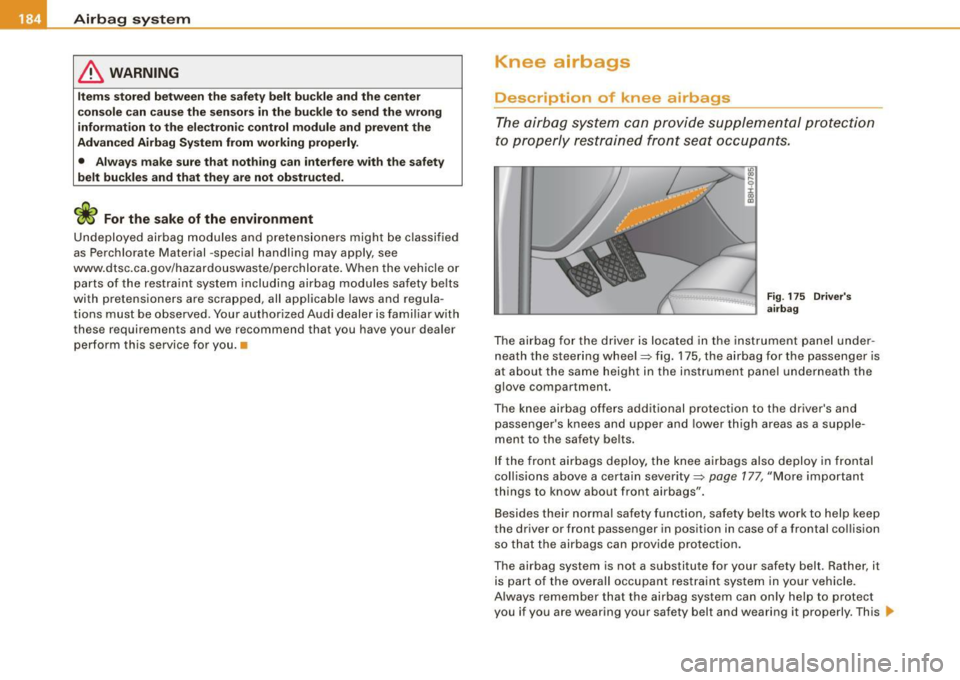
The airbag for the driver is located in the instrument panel under
neath the steering wheel=> fig. 175, the airbag for the passenger is
at about the same height in the instrument panel underneath the
g love compartment.
The knee airbag offers additional protection to the driver 's and
passenger's knees and upper and lower thigh areas as a supple
ment to the safety be lts.
If the front airbags deploy, the knee airbags also deploy in frontal
coll isions above a certain severity=>
page 177, "More important
things to know about front airbags".
Besides their normal safety function, safety be lts work to help keep
the driver or front passenger in position in case of a frontal collision
so that the airbags can provide protection.
The airbag system is not a substitute for your safety belt. Rather, it is part of the overall occupant restraint system in your vehicle.
Always remember that the airbag system can only help to protect
you if you are wearing your safety belt and wearing it properly. This
~
Page 188 of 340
-Airbag system ----=--=---------------------------------
If the front airbags d ep loy, the kne e airbags a lso d ep loy in frontal
c oll is ions abov e a certai n s ev er ity.
Whe n the syst em is dep loy ed, the airba gs start to f ill with a prope l
l ant gas, and inf late bet ween t he lower pa rt of the instr ument pa ne l
and the drive r and the l ower part of th e instru ment pane l a nd th e
front passenge r:::;, page
177 , fig. 173 .
A lth oug h the y are no t a s oft p illow, t hey can "cushion" th e im pact
and in this way they can help to r educe the ris k of injury to the lower
e xt remitie s.
A ll thi s takes place ins ta nta ne ous ly, so fast tha t many p eople don't
even realize that the airbags have deployed. The ai rbags a lso inf late
w it h a gre at d eal o f f orce and it is im por tant for occupa nt safety t hat
nothing sho uld be in their way when they dep loy.
Full y infla ted ai rbags i n co mbina tion wi th properl y w orn safe ty bel ts
s low down and limit the occupant's forward movement and he lp to
r e du ce t he risk .•
Important safety instructions on the knee
airbag system
Air bag s are only sup plemen tal restra ints. Alwa ys wea r
s af ety bel ts co rr e ctly and ride i n a prop er se atin g po sition .
Ther e is a lo t that you and your passe ngers must know a nd do to
he lp the safety belts and airbags to provide supp lemental protec
ti on .
& WARNING
An inflating knee airbag can cause serious injury. Wearing safety
belts incorrectly and improper seating positions increase the risk
of serious personal injury and death whenever a vehicle is being
used .
• The airbag system cannot protect you properly if you are
seated too close to any of the airbag locations . When adjusting
& WARNING (continued )
their seat positions, it is important that both the driver and the
front passenger keep their upper bodies and knees at the
following minimum safe d istances :
-1 O inches (25 cm) between the chest and the steering
wheel /instrument panel .
- 4 inches (10 cm) between the knees and the lower part of the
instrument panel.
• The risk of personal injury increases if you lean forward or to
the side, or if the seat is improperly positioned and you are not
wearing your safety belt. The r isk increases even more should the
airbag deploy .
• Always make sure that the knee airbag can inflate without
interference. Objects between yourself and the airbag can
increase the risk of injury in an accident by interfering with the
way the airbag deploys or by being pushed into you as the airbag
deploys.
-No persons (children) or animals should ride in the footwell
in front of the passenger seat . If the airbag deploys, this can
result in serious or fatal injuries.
- No objects of any kind should be carried in the footwell area
in front of the driver's or passenger's seat. Bulky objects (shop
ping bags , for example) can hamper or prevent proper deploy
ment of the airbag . Small objects can be thrown through the
vehicle if the airbag deploys and injure you or your passengers .
• Make sure there are no cracks , deep scratches or other damage
in the area of the instrument panel where the knee airbags are
located .
• If children are incorrectly seated , their risk of injury increases in
the case of an accident:::;,
page 190, "Child Safety". •
Page 193 of 340
--------------------------------------------~C~ h~ il~d ~S~ a~f e~ t~ YL _III
& WA RNIN G (conti nu ed )
• Alway s install rear-facing child safety se ats on the rear seat.
• If you mu st in stall a rearw ard f acing chi ld safety seat on the
front pa ssenger seat in exc eptional cir cum stance s and the
PA SSENGER AIR BAG OFF light do es not come on and stay on,
im medi ate ly install the re ar-fa cing child safety s eat in a rear
s e ating po sit ion and h ave the airb ag sys tem inspe cted im medi
ately by your Audi de aler .
& WARNING
If, in exceptional circum stance s, you must in stall a forward -facing
c hild re st ra int on the fr ont p ass eng er' s s eat :
• Alway s make sure the forward -facing seat ha s been de signed
and cert ified by it s manufa cturer f or use on a front se at with a
p ass enger front and side airbag .
• Always follow the m anufacturer's instruct ions provided with
the child safety seat or carrier.
• Alway s m ove the pa ss e nger sea t into its rearm ost p osit ion in
the seat' s fo re and aft adju stment r ange , as far away from the
a irb ag as possib le before installing the child r estr aint . The b ack
rest mu st be adju sted to an upr ight po sition.
• Alw ays ma ke sure th at the PAS SENGER AIR BAG OFF light
c ome s on and stay s on all the time whenever the ignition i s
s witched on . •
Advanced front airbag system and children
Your vehicle is equipped with an "Advanced Airbag System" in
compliance with United States Federal Motor Vehicle Sa fety Stan
dard (FMVSS) 208 as applicab le at the time your vehicle was manu
factured .
Controls and equip
ment Safety first Vehicle operation
The Advanced Airbag system in your vehicle has been certified to
meet the " low -risk" requirements for 3 and 6 yea r- old child ren on
the passenger side and small adu lts on the driver side. The low risk
deployment c rite ria are intended to reduce the risk of injury th rough
interaction with the airbag that can occur, for example, by being too
close to the steering whee l and instrument panel when the airbag
in flates . In add ition, the system has been cert ified to comply with
the "suppression" requirements of the Safety Standard, to turn off
the front airbag for infants up to 12 months who are restrained on
the front passenger seat in child restraints that are listed in the
Standard.
Even though your vehic le is equipped with an Advanced Airbag
system, all ch ildren, especially those 12 years and younger, should
a lways ride in the back seat proper ly restrained for the ir age and
s ize . The a irbag on the passenger side makes the front seat a poten
tially dangerous p lace for a chi ld to r ide. The front seat is not the
safest place for a chi ld in a forward -facing child safety seat. It can be
a very dangerous place for an infant or a larger chi ld in a rearward
facing seat. •
Advanced Airbags and the weight-sensing
mat in the front seat
The Advanced Airbag System in your vehicle detects the p resence
of an infant or chi ld in a chi ld restraint on the front passenger seat
using the weight -sensing mat in the seat cushion and the sensor
below the safety belt latch on the front passenger seat that
measures the tension on the safety belt .
The weight -sensing mat measures t otal weight of the ch ild and the
child safety seat and a chi ld blanket on the front passenger seat. The
weight on the front passenge r seat is related to the design of the
child restraint and its "footprint", the size and shape of the bottom
of the child restraint as it sits on the seat. The weight of a child
restraint and its "footprint" vary for different kinds of child .,
Vehicle care Do-it-yourself service Technical data
Page 203 of 340
Child Safety 11!1111
-------------------------------------------------=-------
& WARNING (continued)
will strike parts of the vehicle interior. The child can be seriously
injured or killed.
• Never install rear-facing child safety seats or infant carriers on
the front passenger seat. A child will be seriously injured and can be killed when the passenger airbag inflates .
• The inflating airbag will hit the child safety seat or infant
carrier with great force and will smash the child safety seat and
child against the backrest, center arm rest, door or roof.
• Always install rear-facing child safety seats or infant carriers on
the rear seat.
• Forward-facing child safety seats or infant carriers installed on
the front passenger's seat may interfere with the deployment of
the airbag and cause serious injury to the child.
• It is safer to install a forward -facing child safety seat on the rear
seat.
• Always read and heed all WARNINGS whenever using a child
restrained in a vehicle is being used~
page 190. Special precau
tions apply when installing a child safety seat on the front passenger seat~
page 170, "Child restraints on the front seat -
some important things to know" .
& WARNING
Always take special precautions if you must install a forward or
rearward -facing child restraint on the front passenger's seat in
exceptional situations:
• Whenever a forward or rearward-facing child restraint is
installed on the front passenger seat, the PASSENGER AIR BAG
OFF light must come on and stay on whenever the ignition is
switched on.
• If the PASSENGER AIR BAG OFF light does not come on and stay
on , perform the checks described
~ page 179, "Monitoring the
Advanced Airbag System".
Controls and equip ment Safety first
Vehicle operation
& WARNING (continued)
• Take the child restraint off the front passenger seat and install
it properly at one of the rear seat positions if the PASSENGER AIR
BAG OFF light does not stay on whenever the ignition is switched
on.
• Improper installation of child restraints can reduce their effec
tiveness or even prevent them from providing any protection.
• An improperly installed child restraint can interfere with the
airbag as it deploys and seriously injure or even kill the child.
• Always carefully follow the manufacturer's instructions
provided with the child safety seat or carrier.
• Never place additional items on the seat that can increase the
total weight registered by the weight-sensing mat and can cause
injury in a crash.
& WARNING
Forward-facing child restraints:
• Always make sure the forward-facing seat has been designed
and certified by its manufacturer for use on a front seat with a
passenger front and side airbag.
• Never put the forward-facing child restraint up, against or very
near the instrument panel .
• Always move the passenger seat into its rearmost position in
the seat's fore and aft adjustment range, as far away from the
airbag as possible before installing the forward-facing child
restraint. The backrest must be adjusted to an upright position.
• Make sure that the PASSENGER AIR BAG OFF light comes on
and stays on all the time whenever the ignition is switched on.
& WARNING
Rearward -facing child restraints:
Vehicle care Do-it-yourself service Technical data
Page 241 of 340
![AUDI A4 CABRIOLET 2009 Owners Manual _____________________________________________ C_ l_ e _ a_ n_ in--= g--- a_n _d___, p_ r _o_ te_ c_t _io _ n __ lftll
•
[ i ] Tip s
Open Ve lcro fasteners on your cloth ing can damage the](/img/6/57553/w960_57553-240.png "AUDI A4 CABRIOLET 2009 Owners Manual _____________________________________________ C_ l_ e _ a_ n_ in--= g--- a_n _d___, p_ r _o_ te_ c_t _io _ n __ lftll
•
[ i ] Tip s
Open Ve lcro fasteners on your cloth ing can damage the")
_____________________________________________ C_ l_ e _ a_ n_ in--= g'--- a_n _d___, p_ r _o_ te_ c_t _io _ n __ lftll
•
[ i ] Tip s
Open Ve lcro fasteners on your cloth ing can damage the seat cover .
Please make sure that Ve lcro fasteners are closed .•
Plastic parts and instrument panel
A lways use a c lean cloth moistened in clear water to clean these
areas . For persistent dirt use an Audi approved
solvent-free plastic
cleaner/protectant.
& WARNING
Solvents can change the properties of some plastics and make it
harder for the airbag to deploy .
• Never clean the instrument panel or the surfa ce of Airbag
module s with c leaning produ cts that contain sol vents .
• Products containing solvent s will make the surface of th is part
porous .
• Serious injuries can re sult if plastic parts come loo se when the
airbag is deployed .
• Alway s read and heed all WARNINGS and the information
~ page 230 .
0 Note
Cleaning agents containing solvents wil l attack the material and can
change the way it be haves. •
Applies to veh ic les : wi th n atural leat her
Natural leather
Audi makes great effor ts to maintain the proper ties,
n at ural look an d feel of in terior le ather.
General
We offer many different types of leather on our vehic les . Most are
d iff erent types of nappa leather, which has a smoo th surface and
comes in various co lors .
The in tens ity of the c olor de termines the visua l characteristics and
appearance. I f the surface of the leather has a typ ical natu ra l loo k,
then the leather is a nappa leather that has been left in a re latively
natura l condition. This leathe r off ers pa rticu larly good com fort and
breathes we ll. Fine veins, closed grains, insect bites, skin folds, and
su btle varia tions in c olor remain visib le . These characterist ics
demonstrate that the material is natural.
Natura l nappa lea ther is not c ove red by a color finish. It is th erefo re
more sensitive to soiling and wear, which is something you need to
consider if children, animals or other factors might prove to be
particularly hard on the leather .
By contrast, leather types that are covered by a colored finish layer
are m ore dura ble. This has a pos itive effect on the lea ther's resis
tance to wear and soiling in daily use. On the other hand, the typical
c haracte ristics of natura l leather are barely or not appa re nt.
However , this does not mean that the leather itse lf is of inferior
quality.
Care and handling
Because of the exclusive nature of the types of leat her that Audi
uses and their unique properties (such as sensitivity to oi ls, grease ,
s o iling, etc.), y ou will need to be somewhat ca ref ul w ith t hese
leathers, and a certain type of care is required . For example, dark
c lothing materials can discolor leathe r seats (especially if such
clothing is damp and was not dyed correctly!. Dust and dirt particles .,_
Vehic le care
Page 251 of 340
_____________________________________________ C_h_ e_ c _ k_in -= g_a _ n_d _ f_il _li _n """g ;;..._ ____.ffllll
Checking and filling
Engine hood
Releasing the engine hood
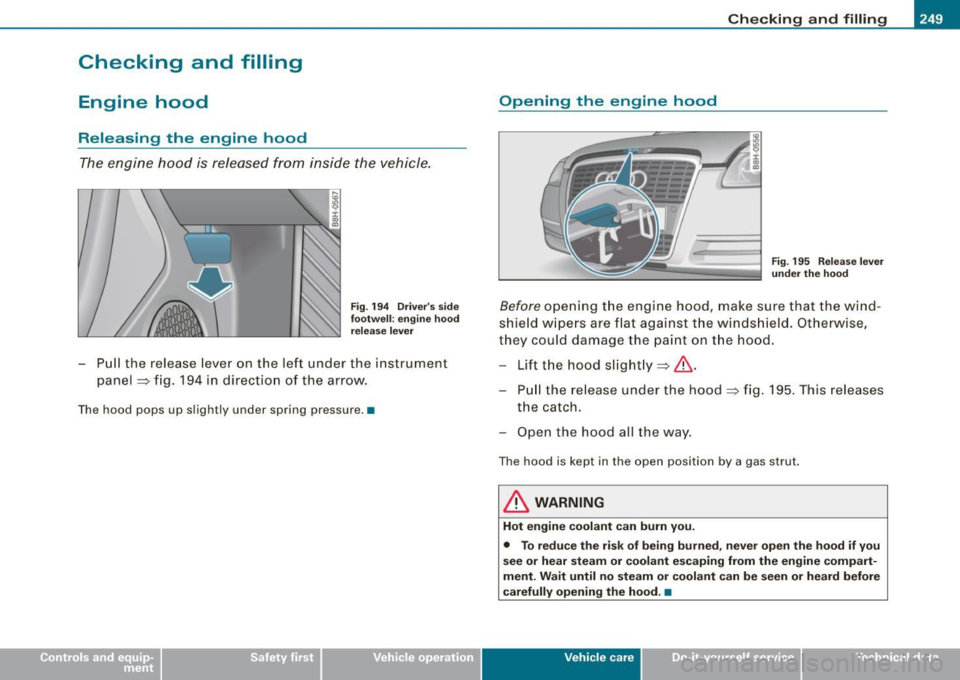
The engine hood is released from inside the vehicle.
Fig . 194 Driver's side
footwell: engine hood
release lever
-Pull the release lever on the left under the instrument
panel => fig. 194 in direction of the arrow.
The hood pops up slightly under spring pressure .•
Opening the engine hood
Fig. 195 Release lever
under the hood
Before opening the engine hood, make sure that the wind
shield wipers are flat against the windshield. Otherwise,
they could damage the paint on the hood.
Lift the hood slightly =>& .
- Pull the release under the hood
=> fig. 195. This releases
the catch.
- Open the hood all the way.
The hood is kept in the open position by a gas strut .
& WARNING
Hot engine coolant can burn you .
• To reduce the risk of being burned, never open the hood if you
see or hear steam or coolant escaping from the engine compart
ment. Wait until no steam or coolant can be seen or heard before
carefully opening the hood. •
Vehicle care irechnical data
Page 302 of 340
111!1...__F_ u_ s _ e_s _ a_n_ d_ b_ u_lb _ s _______________________________________________ _
Fuses and bulbs
Fuses
Replacing a fuse
A problem in the electrical system may be caused by a
blown fuse.
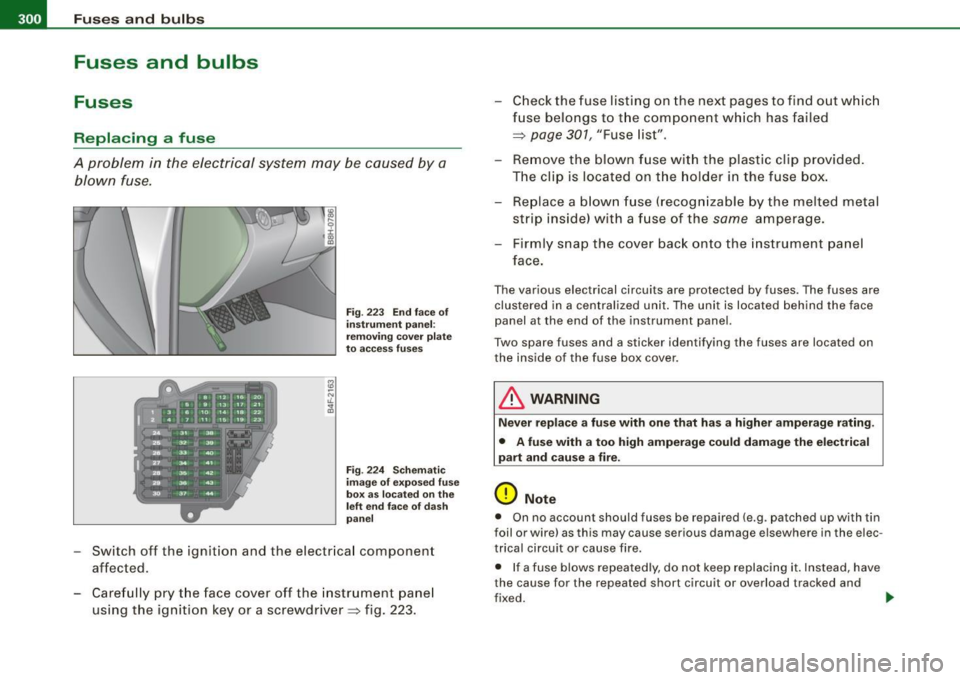
Fig. 223 End face of
instrument panel :
removing cover plate
to access fuses
Fig. 224 Schematic
image of exposed fuse
box as located on the
left end face of dash
panel
- Switch off the ignition and the electrical component
affected.
Carefully pry the face cover off the instrument panel
using the ignition key or a screwdriver~ fig . 223 . -
Check the fuse listing on the next pages to find out which
fuse belongs to the component which has failed
~ page 301 , "Fuse list".
- Remove the blown fuse with the plast ic clip provided.
The clip is located on the holder in the fuse box.
- Replace a blown fuse (recognizable by the melted metal
strip inside) w ith a fuse of the
some amperage.
- Firmly snap the cover back onto the instrument panel
face.
The various electrical circuits are protected by fuses . The fuses a re
clustered in a centralized unit. The unit is located behind the face
panel at the end of the instrument panel.
Two spare fuses and a sticker identifying the fus es are located on
the inside of the fuse box cover.
& WARNING
Never replace a fuse with one that has a higher amperage rating.
• A fuse with a too high amperage could damage the electrical
part and cause a fire.
(D Note
• On no account should fuses be repaired (e.g . patched up with tin
foil or wire) as this may caus e se rious damage elsewhere in the elec
trical circuit or cause fire.
• If a fuse blows repeatedly, do not keep replacing it. Instead, have
the cause for the repeated short circuit or overload tracked and
fixed. _,,
Page 328 of 340

ll'JI Alphabetical index _ __,__ ___ ____;_...::.:...::... ___________________________ _
Changing engine oil ...... ... ... .. ... 256
Chassis Undercoating ........ ...... .... .. 237
CHECK button . . . . . . . . . . . . . . . . . . . . . . . 16
Checking Battery acid level . . . . . . . . . . . . . . . . . 264
Engine coolant level .. ............ 258
Checking tire pressure ............... 274
Child restraint Danger of using child restraints in the
front seat . . . . . . . . . . . . . . . . . . . . . . 170
Child restraints What types of chi ld restraint anchors are
available? ..................... 203
Where can I get additional information
about child restraints? ... .... .... 204
Child safety .. ........ ....... ... 190, 195
Booster seats . . . . . . . . . . . . . . . . . . . . 198
Convertible child safety seats . . . . . . 196
Convertible locking retractor . . . . . . . 200
Guidance fixtures for lower anchorages 206
Important safety instructions for using
child safety seats .. ...... ....... 193
Important things to know when driving
with chi ldren ............. ...... 190
Infant seats . . . . . . . . . . . . . . . . . . . . . 195
Installing a child restraint using the
LATCH system .... ... .... ...... . 208
Lower anchorages .... .... ... ... . 205
Mounting and releasing the anchorage
hook ...... ...... .... .......... 209
O lder children and safety belts ... .. 199 Safety belts and oldler children
... .. 199
Which restraint system should my older chi ld wear? ........ .... ... .. ... 199
child safety seat LATCH system . .... .... .... ...... 208
Childsafetyseats .... ........ .... ... 195
Convertible locking retractor .... ... 200
How do I properly install a child safety seat in my vehicle? .. ...... .... .. 193
Installing .... .... ... .. .... .... .. 200
Safety instructions .............. .
Cigarette lighter .......... .... ..... .
Cleaning Alcantara (synthetic suede) ....... .
E . ngine compartment . .... ... .. .. .
Fabrics and fabric coverings ... ... .
Instrument panel ....... .... ..... . 193
105
241
242
238
239
I . ntenor ......................... 238
Leather .... ...... ... .. .... ...... 240
Plastic and vinyl . .... .... ... .. ... 234
P lastic parts ........... .... ... ... 239
Safety be lts ...... ............ ... 242
Trim strips ............. ... .... .. 234
trim strips ... .. ...... .... ..... ... 235
Cleaning and protection .......... ... 230
Climate controls .. .... ......... ..... 11
O
Air distribution . . . . . . . . . . . . . . . . . . 114
Air outlets . . . . . . . . . . . . . . . . . . . . . . . 115
Air recirculation .... .... .... .... .. 113
AUTO (standard setting) .... .... ... 112
Automatic air recirculation ... .. ... 114
Contro ls . . . . . . . . . . . . . . . . . . . . . . . . 111
Defrosting / Defogging . . . . . . . . . . . . 116
Description . . . . . . . . . . . . . . . . . . . . . . 11
O
ECON ... .. .. .. .... .... ..... .. ... 113
Fan .. ............ .... ... .... ... 114
Key coded setting ................ 11
O
Recommended settings ........... 11 O
Setting the temperature ........... 112
Switching between Fahrenheit and Centigrade ... .... .... ...... .... 113
Switching the air conditioning on or off .
113
Using the climate control economically . .
116
Warm and cold .................. 110
Clock .. ........... ........... .... ... 14
Closing Power top . . . . . . . . . . . . . . . . . . . . . . . . 62
Cold tire inflation pressure .. .... ..... 271
Coming -home -function .. ............. 80
Compartments in the door trims ... ... 109
Compass mirror .. .... ...... ... ..... . 90
Comp liance .......... ....... .... ... 320
Consumer Information ........... 155, 316
Contacting NHTSA .................. 155
Continuously Variable Transmission (CVT)
See multitronic® ........ ... ...... 131
Convenience close/open feature Power top . . . . . . . . . . . . . . . . . . . . . . . . 63
Windows ......................... 53
Convertible child seats How do I properly install a convertib le
chi ld seat in my vehic le? ...... ... 196
Safety instructions .. ...... .... ... 196
Page 332 of 340
___ A---=- lp_h_ a_b_ e_ t _i_ c _ a_ l_ in_ d_ e_x ______________________________________________ _
Infant seats . . . . . . . . . . . . . . . . . . . . . . . . 195
How do I properly ins tall an infant seat in
my vehicle? ...... .... .... .... .. 195
Safety instructions . . . . . . . . . . . . . . . 195
Inside rear view mirror ..... .. .... .... . 88
Installing child safety seats
Sa fet y bel ts . . . . . . . . . . . . . . . . . . . . . 200
Instruments and controls ............. 12
Genera l ill ustration .... ... .... .... . 11
Illumination ...... ... . ......... 15, 81
Interior lights . ...... ... ........ .... . 84
Luggage compartment .. ...... ... .. 84
J
Jack and tools . . . . . . . . . . . . . . . . . . . . . . 290
Jumpe r cables . . . . . . . . . . . . . . . . . . . . . 305
Jump -starting 304
K
Key ...... ... .... .... .... .... ....... 47
Battery replacement . . . . . . . . . . . . . . . 49
Coded sett ings . . . . . . . . . . . . . . . . . . 110
Conveni ence op ening and closing of pow -
er top . ... .. .... .... .... ........ 63
Convenience opening and closing of w indows ....... ........ .... ... . 53
Emergency key . . . . . . . . . . . . . . . . . . . 47
Key replacement . . . . . . . . . . . . . . . . . . 47
Master key . . . . . . . . . . . . . . . . . . . . . . . 47
Valet key . . . . . . . . . . . . . . . . . . . . . . . . . 47
Key coded s ettings
Clima te con trols ... ...... ... . .... 110 Keyless
entry remote control
Kick -down 48, 51
multitronic® . . . . . . . . . . . . . . . . . . . . 135
tiptronic® ............. .... ... ... 129
Knee airbags . .... ..... .. .... .... ... 184
Description ... ... ... ... .... .... .. 184
How they work . . . . . . . . . . . . . . . . . . . 185
Important safety instructions 186
L
LATCH .................. .... .... .. 205
Description ... ... ... ... .... .... .. 205
Guidance fixtur es for lower anchorages .
206
Installing a child restraint .. .... ... 208
Location ... .. .... .. .. ... .. .. .... 205
Mounting and re leasing the anchorage
hook .... ... .... .. .. .. .. .. .. ... 209
Leather .. ... .. ... .. . ..... .... .... .. 239
Cleaning .............. .... .... .. 240
Leaving-home-function ...... .... .... . 80
Lifting jack .. . ... .... ... .. ...... .... 296
Lifting vehicle . .... ................. 308
Light sensor defec tive . ...... ...... ... 33
Ligh t se nsor package
Auto mat ic headligh t control ... .... . 77
Lights Coming -home /leavi ng-home -function 80
Emergency flasher .......... ...... 82
Front fog lights . ...... .... .... .... 79
Headligh ts . .... ....... .... .... ... 76
High beam .... .... .... .... .... 76 , 83 High bea
m wa rning /indicator light ... 22
Ins trumen t panel illum ination ... .... 81
Side marker lights ..... ... ........ . 76
Turn signals ... .... ... ... . ... ..... 83
Xenon headlights .. .... ... .... .... 82
Load ing the luggag e compartmen t 153
Locking Power locking switch .............. 54
Rear lid .... ... .... ............... 55
R emote control .. .. ........... .. .. 51
Using the key ...... .... ... .... .. .. 53
Lower anchorage locator button ...... 205
Lower universal anchorage (Canada) ... 205
Lower universal anchorage bars (Canada) ...
205
Luggage
Stowing 153
Luggage compartment
Light .......... ....... .. .. .... ... 84
Sk i sack . . . . . . . . . . . . . . . . . . . . . . . . . 103
S ee also Loading the luggage
c ompartment .......... . ... .... 153
Lumbar support . ........... . ... ..... 98
M
Maintenance .. ..... .. .... .... ...... 316
Malfunction Indicator Lamp (MIU .. .. 19 , 27
Manual operat ion
Power top . . . . . . . . . . . . . . . . . . . . . . . . 68
Manual s eats
Adjus ting the h ead restra ints ... .... 95
Fold ing the seatback forward ... ... . 95