instrument panel AUDI A4 CABRIOLET 2009 User Guide
[x] Cancel search | Manufacturer: AUDI, Model Year: 2009, Model line: A4 CABRIOLET, Model: AUDI A4 CABRIOLET 2009Pages: 340, PDF Size: 77.32 MB
Page 165 of 340
& WARNING (continued)
• Never let any person ride with feet on the instrument panel or
sticking out the window or on the seat.
• Never remove a safety belt while the vehicle is moving. Doing
so will increase your risk of being injured or killed.
• Never wear belts twisted .
• Never wear belts over rigid or breakable objects in or on your
clothing, such as eye glasses, pens, keys , etc. , as these may cause
injury .
• Never wear the shoulder part of the belt under your arm or
otherwise out of position .
• Several layers of heavy clothing may interfere with correct posi
tioning of belts and reduce their effectiveness.
• Always keep belt buckles free of anything that may prevent the
buckle from latching securely.
• Never use comfort clips or devices that create slack in the
shoulder belt. However , special clips may be required for the
correct use of some child restraint systems.
• Never allow safety belts to become damaged by being caught
in door or seat hardware .
• Torn or frayed safety belts can tear and damaged belt hardware
can break in an accident . Inspect belts regularly. If webbing, bind
ings, buckles , or retractors are damaged , have belts replaced by an
authorized Audi dealer or qualified workshop.
• Safety belts that have been worn and loaded in an accident
must be replaced with the correct replacement safety belt by an
authorized Audi dealer or qualified workshop. Replacement may
be necessary even if damage cannot be clearly seen. Anchorages
that were loaded must also be inspected.
• Never remove, modify, disassemble, or try to repair the safety
belts yourself .
Safety first
Safety belts
& WARNING (continued)
• Always keep the belts clean. Dirty belts may not work properly
and can impair the function of the inertia reel
~ page 242, "Safety
belts" .•
Safety belts
Fastening safety belts
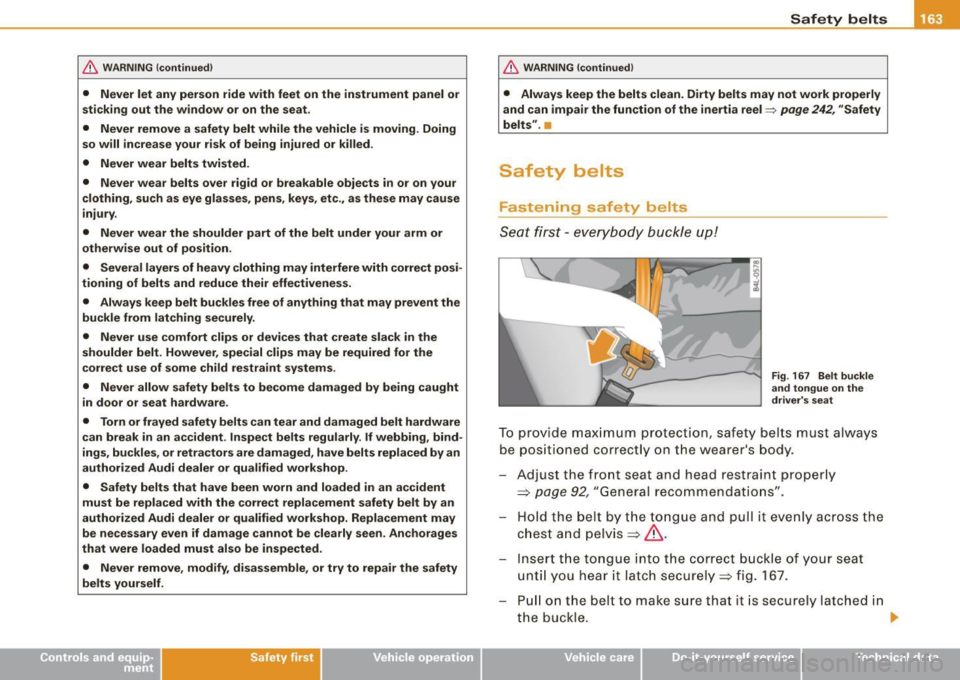
Seat first -everybody buckle up!
Fig. 167 Belt buckle
and tongue on the
driver 's seat
To provide maximum protection, safety belts must always
be positioned correctly on the wearer's body .
Adjust the front seat and head restraint properly
=> page 92, "General recommendations".
Hold the belt by the tongue and pull it evenly across the
chest and pelvis=>& .
Inse rt the tongue into the correct buckle of your seat
until you hear it latch securely=> fig. 167.
Pull on the belt to make sure that it is securely latched in
the buckle. ..,
~ehicle care irechnical data
Page 170 of 340
___ A_ ir_b _ a_ g~ s_ y_s _t _e _m _________________________________________________ _
Airbag system
Important things to know
Importance of wearing safety belts and
sitting properly
Airbags are only supplemental restraints. For airbags to
do their job, occupants must always properly wear their
safety belts and be in a proper seating position.
For your safety and the safety of your passengers, before
driving off, a lways:
- Adjust the driver's seat and steering wheel properly
=>
page 148,
- Adjust the front passenger's seat properly => page 93,
- Wear safety belts properly=> page 162,
- Always properly use the proper child restraint to protect
children=>
page 190 .
In a collision airbags must inflate within the blink of an eye and with
considerable force . Th e suppl emental airbags can caus e injuries if
the driver or the front seat passenger are not seated proper ly . There
fore in order to help the airbag to do its job, it is impor tant, both as
a driver and as a passenger to sit properly at all times.
By keeping room between your body and the steering wheel and the
front of the passenger compartment, the airbag can inflate fully and
completely and prov ide supplementa l protection in certain frontal
collisions ~
page 148, "Proper occupant seating positions" . For
details on the operation of the seat adjustment controls~
page 93
and ~ page 96.
It's especially important that chi ldren are proper ly restrained
~ page 190.
There is a lot that the driver and the passengers can and must do to
help the individual safety features installed in your Audi work
together as a system.
Proper seating posi tion is important so that the front airbag on the
driver side can do its job. If you have a physical impairment or
condition that prevents you from sitting properly on the driver seat
with the safety belt properly fastened and reaching the pedals, or if
you have concerns with regard to the function or operation of the
Advanced Airbag System, please contact your authorized Audi
dea ler or qua lif ied workshop, or call Audi Customer CARE at 1-800 -
822 -2834 for possible modifications to your vehicle .
When the airbag system deploys, a gas generator wi ll fill the
airbags, break open the padded covers, and inflate between the
steering wheel and the driver and between the instrument panel
and the front passenger. The airbags will deflate immediately after
deployment so that the front occupants can see through the wind
shield again without interruption .
All of this takes p lace in the blink of an eye, so fast that many people
don't even rea lize that the airbags have dep loyed. The airbags also
inflate with a great deal of force and nothing should be in their way
when they deploy . Front airbags in combination with properly worn
safety bel ts slow down and limit the occupant's forward movement.
Together they help to prevent the driver and front seat passenger
from hitting parts of the inside the vehicle while reducing the forces acting on the occupant during the crash . In this way they help to
reduce the risk of injury to the head and upper body in the crash .
Airbags do not protect the arms or the lower parts of the body.
Both front airbags w ill not in flate in al l frontal collisions . The trig
gering of the airbag system depends on the vehic le deceleration
rate caused by the collision and registered by the electronic contro l
unit. If this rate is below the reference value programmed into the
control unit, the airbags will not be triggered, even though the car
may be badly damaged as a result of the collision . Vehicle damage, .,
Page 171 of 340
__________________________________________________ A_ i_ r _b _a...; g::- s_ y=--- s_t _e _m ___ lJII
repair costs or even the lack of vehicle damage is not necessarily an
indication of whether an airbag should inflate or not .
It is not possible to define a range of vehicle speeds that will cover
every possible kind and angle of impact that will always trigger the
airbags, since the circumstances will vary considerably between
one collision and another. Important factors include, for example,
the nature (hard or soft) of the object which the car hits, the angle of impac t, vehicle sp eed , etc . The front airbags will also not inflate
in side or rear collisions, or in roll-overs.
Always remember : Airbags will deploy only once, and only in certain
kinds of collisions. Your safety belts are always there to offer protec
tion in those situations in which airbags are not supposed to deploy,
or when they have already deployed; for example, when your vehicle
strikes or is struck by another after the first collision.
This is just one of the reasons why an airbag is a suppl em entary
restraint and is not a substitute for a safety belt. The airbag system
works most effectively when used with the safety belts. Therefore ,
always properly wear your safety belts=>
page 159.
& WARNING
Sitting too close to the steering wheel or instrument panel will
decrease the effectiveness of the airbags and will increase the risk
of personal injury in a collision.
• Never sit closer than 10 inches (25 cm) to the steering wheel or
instrument panel.
• If you cannot sit more than 10 inches (25 cm) from the steering
wheel, investigate whether adaptive equipment may be available
to held you reach the pedals and increase your seating distance
from the steering wheel.
• If you are unrestrained, leaning forward, sitting sideways or out
of position in any way, your risk of injury is much higher.
• You will also receive serious injuries and could even be killed if
you are up against the airbag or too close to it when it inflates -
even with an Advanced Airbag.
Controls and equip ment Safety first
Vehicle operation
& WARNING (continued)
• To reduce the risk of injury when an airbag inflates, always
wear safety belts properly~
page 163, "Safety belts".
• Always make certain that children age 12 or younger always
ride in the rear seat. If children are not properly restrained, they
may be severely injured or killed when an airbag inflates.
• Never let children ride unrestrained or improperly restrained in
the vehicle. Adjust the front seats properly.
• Never ride with the backrest reclined.
• Always sit as far as possible from the steering wheel or the
instrument panel~
page 148, "Proper occupant seating posi
tions".
• Always sit upright with your back against the backrest of your
seat.
• Never place your feet on the instrument panel or on the seat .
Always keep both feet on the floor in front of the seat to help
prevent serious injuries to the legs and hips if the airbag inflates.
• Never recline the front passenger's seat to transport objects.
Items can also move into the area of the side airbag or the front
airbag during braking or in a sudden maneuver. Objects near the
airbags can become projectiles and cause injury when an airbag
inflates.
& WARNING
Airbags that have deployed in a crash must be replaced.
• Use only original equipment airbags approved by Audi and
installed by a trained technician who has the necessary tools and
diagnostic equipment to properly replace any airbag in your
vehicle and assure system effectiveness in a crash.
• Never permit salvaged or recycled airbags to be installed in
your vehicle. •
Vehicle care Do-it-yourself service Technical data
Page 172 of 340
___ A_ ir_b _ a_ g~ s_ y_s _t _e _m _________________________________________________ _
Child restraints on the front seat - some
important things to know
- Be sure to read the important information and head the
WARNINGS for important details about children and
Advanced Airbags~
page 190.
Even though your vehic le is equipped with an Advanced Airbag
System, make certain that a ll children, especia lly those 12 years and
younger, a lways ride in the back seat properly restrained for their
age and size . The airbag on the passenger side makes the front seat
a potentia lly dangerous place for a child to ride. The front seat is not
the safest p lace for a chi ld in a forward -facing child safety seat. It
can be a very dangerous place for an infant or a child in a rearward
facing seat.
The Advanced Airbag System in your vehicle has been certified to
comply with the Requirements of United States Federal Motor
Vehicle Safety Standard 208 as applicab le at the time your vehicle
was manufactured.
Th e Standard requires the front airbag on the passenger side to be
turned off ("suppressed") if a chi ld up to about one year of age
restrained in one of the rear-facing or forward-facing infant
restraints listed in Federa l Motor Vehicle Safety Standard 208 with
which the Advanced Airbag System in your vehicle was certified has been instal led on the front passenger seat. For a listing of the child
restraints that were used to certify compliance with the US Safety
Standard =>
page 192.
The PASSENGER AIR BAG OFF light in the instrument panel tells you
when the front Advanced Airbag on the passenger side has been
t urned off by the electronic control unit.
Each time you turn on the ignition, the
PASSENGER AIR BAG OFF
light will come on for a few seconds and:
• will stay on if the front passenger seat is not occupied, •
will stay on if there is a small child or child restraint on the front
passenger seat,
• will go off if the front passenger seat is occupied by an adult as
registered by the weight-sensing mat=>
page 179, "Monitoring the
Advanced Airbag System" .
The
PASSENGER AIR BAG OFF light comes on when the control unit
detects a tota l weight on the front passenger seat that requires the
front airbag to be turned off.
If the total weight on the front passenger seat is more than that of
a typical 1 year -old child but less than the weight of a small adult,
the fron t airbag on the passenger side can deploy (the
PASSENGER
AIR BAG OFF
light does not come on). If the PASSENGER AIR BAG
OFF
light does not come on, the front airbag on the passenger s ide
has not been turned off by the electronic contro l unit and can
deploy if the control unit senses an impact that meets the condi
tions stored in its memory.
For example, the airbag may deploy if:
• a small ch ild that is heavier than a typical 1 year-o ld child is on
the front passenger seat (regardless of whether the child is in one
of the child safety seats listed =>
page 192), or
• a child who has outgrown chi ld restraints is on the front
passenger seat .
If the front passenger airbag is turned off, the
PASSENGER AIR BAG
OFF
light comes on in the instrument cluster and stays on.
The front airbag on the passenger side may
not deploy (the
PASSENGER AIR BAG OFF light does not illuminate and stay lit) even
if a small adult or teenager, or a passenger who is not sitting upright
with their back against a non -reclined backrest with their feet on the
vehicle floor in front of the seat is on the front passenger seat
=>
page 148, "Proper seating position for the driver".
If the front passenger airbag deploys, the Federal Standard requires
the airbag to meet the "low risk" deployment criteria to reduce the
risk of injury through interaction with the airbag. "Low risk" deploy
ment occurs in those crashes that take p lace at lower decelerations .,.
Page 173 of 340
Airbag system -----------------=~-
as defined in the electronic contro l unit:::::, page 18 0, "P ASSENG ER
A IR BAG OFF lig ht".
A lways remember, a ch ild safety s eat or infant carrier insta lled on
the front seat may be struck a nd knocked out of position by the
rap id ly infl atin g p ass eng er's ai rba g in a front al co llision . The air bag
co uld greatly reduce the effectiveness of the chi ld re st raint and
e v en s erio usl y inju re the chi ld during inflati on.
F or this reason, and because the bac k seat is t he safest plac e for
c hi ldr en -w he n prop erly res train ed acc ordi ng to th eir age a nd size
- w e stro ng ly recomme nd that c hildren a lways s it in t he bac k seat
::::;, page 190, "Chil d Safe ty" .
& WARNING
A child in a rearward -facing child safety seat installed on the front
passenger seat will be seriously injured and can be killed if the
front airbag inflates - even with an Advanced Airbag System.
• The inflating ai rbag will hit the child safety seat or infant
carrier with great force and will smash the child safety seat and
child against the ba ckrest , center arm rest , door or roof.
• Always install rear-facing child safety seats on the rear seat. • If you must install a rearward facing child safety seat on the
front passenger seat because of exceptional circumstances and
the PASSENGER AIR BAG OFF light does not come on and stay on,
immediately install the rear-facing child safety seat in a rear
seating position and have the airbag system inspected by your
Audi dealer .
• Forward-facing child safety seats installed on the front
passenger's seat may interfere with the deployment of the airbag
and cause serious personal injury to the child .
& WARNING
If, in exceptional circumstances , you must install a forward-facing
child restraint on the front passenger's seat:
Controls and equip ment Safety first
Vehicle operation
& WARNING (continued)
• Always make sure the forward-facing seat has been designed
and certified by its manufacturer for use on a front seat with a
passenger front and side airbag .
• Never put the forward -facing child restraint up against or very
near the instrument panel .
• Always move the passenger seat into its rearmost position in
the seat's fore and aft adjustment range, as far away from the
airbag as possible before installing the forward-facing child
restraint. The backrest must be adjusted to an upright position.
• Make sure that the PASSENGER AIR BAG OFF light comes on
and stays on all the time whenever the ignition is switched on.
& WARNING
To reduce the risk of serious injury, make sure that the PASSENGER
AIR BAG OFF light will be displayed whenever a child restraint is installed on the front passenger seat and the ignition is switched
on.
• If the PASSENGER AIR BAG OFF light does not stay on , perform
the checks described :::::,
page 179, "Monitoring the Advanced
Airbag System" .
• Take the child restraint off the front passenger seat and install
it properly at one of the rear seat positions if the PASSENGER AIR
BAG OFF light does not stay on .
• Have the airbag system inspected by your Audi dealer immedi
ately .
• Always carefully follow instructions from child restraint manu
facturers when installing child restraints .
& WARNING
If, in exceptional circumstances, you must install a forward or
rearward-facing child restraint on the front passenger's seat :
Vehicle care Do-it-yourself service Technical data
Page 175 of 340
Airbag syst em -----------------=~-
& WARNIN G (cont in u ed)
• Airb ag work m ost effectiv ely when u sed with properly worn
sa fet y be lt s .
• Ther efore , always wear your safety belt s and ma ke sure that
eve rybod y in your vehi cle is prope rly re str ained.
& WARNING
A person on the front p assenger se at, espe cially infant s and small
c hildren , will re ceive seriou s injuries and can ev en be killed by
being t oo clos e to the airbag when it infl ates.
• Although the Adva nced Airbag System in your ve hicle i s
de signed to turn off the front passenger airb ag i f a n infant or a
s mall child i s on the front pa ssenger seat , nobody can absolutely
gu ara ntee that deployment under these spe cial co nditio ns is
impos sible in all conceivable situations that m ay happen during
the useful life of your vehicle.
• The Adv an ced Airbag Sy stem can deploy in a ccordance with
the "lo w risk" option unde r the U .S. Feder al Stand ard if a child t hat
is heavier than the typi cal on e-year old child i s on th e front
pa sse nger seat an d the other condition s for airb ag dep loym ent
are met.
• Acc ident stat istics have sh own that children are gen erally s afer
in the rear se at area than in the front seating posit ion .
• For th eir own safet y, all children , espe cially 12 yea rs and
younger , should alway s ride in th e back properly r estrained for
their age and size. •
Advanced front airbag system
Your vehicle is equipped with a front Advanced Airbag System in
compliance with United States Federal Motor Vehicle Sa fety Stan
dard 208 as applicable at the time your vehicle was manufactured.
Controls and equip
ment Safety first Vehicle operation
The front Advanced Airbag System supplements the safety belts to
provide additional protection for the driver's and front passenger's
heads and upper bodies in frontal crashes. The airbags inflate only
in frontal impacts when the vehic le deceleration is high enough.
The front Advanced Airbag System for the front seat occupants is not a substitute for your safety belts . Rather, it is part of the overall
occupant restraint system in your vehicle. A lways remember that
the airbag system can only help to protect you, if you are sitting
upright, wear ing your safety be lt and wear ing it proper ly . This is why
you and your passengers must a lways be properly restrained, not
just because the law requires you to be .
The Advanced A irbag System in your veh ic le has been certified to
meet the "low risk" requirements for 3 and 6 year -o ld children on the
passenger side and very small adults on the driver side. The low risk
deployment criteria are intended to he lp reduce the risk of injury
through interact ion with the front airbag that can occur, for
examp le, by being too close to the steering whee l and instrument
panel when the airbag inflates.
In addition, the system has been certified to comply with the
"suppression" requirements of the Safety Standard, to turn off the
front airbag for infants 12 months old and younger who are restrained on the front passenger seat in child restraints that are
listed in the Standard~
page 192, "Child restraints and Advanced
Airbags".
"S uppression" requi res the front ai rbag on the passenger side to be
turned off if:
• a child up to about one year of age is restrained on the front
passenger seat in one of the rear-facing or forward-facing infant
restraints listed in Federal Motor Vehicle Safety Standard 208 with
wh ich the Advanced Airbag System in your vehicle was certified. For
a listing of the child restraints that were used to certify your
vehic le's compliance wi th the US Safety Standard ~
page 192,
• weight less than a threshold leve l stored in the control unit is
detected on the front passenger sea t. _.
Vehicle care Do-it-yourself service Technical data
Page 177 of 340

Airbag system -----------------=~-
& WARNING (continued)
• If you must install a rearward facing child safety seat on the
front passenger seat because of exceptional circumstances and
the PASSENGER AIR BAG OFF light does not come on and stay on,
immediately install the rear -facing child safety seat in a rear
seating position and have the airbag system inspected by your
Audi dealer.
_& WARNING
If, in exceptional circumstances, you must install a forward-facing
child restraint on the front passenger's seat:
• Always make sure the forward-facing seat has been designed
and certified by its manufacturer for use on a front seat with a
passenger front and side airbag .
• Never put the forward-facing child restraint up against or very
near the instrument panel.
• Always move the passenger seat into its rearmost position in
the seat's fore and aft adjustment range, as far away from the
airbag as possible, before installing the forward-facing child
restraint. The backrest must be adjusted to an upright position.
• Make sure that the PASSENGER AIR BAG OFF light comes on
and stays on all the time whenever the ignition is switched on. •
Advanced Airbag System components
The front passenger seat in your vehicle has a lot of very important
parts of the Advanced Airbag System in it. These parts include the
weight-sensing mat, sensors, wiring, brackets, and more. The func
tion of the system in the front passenger seat is checked by the elec
tronic control unit when the ignition is on. The control unit monitors
the Advanced Airbag System and turns the airbag indicator light on
when a malfunction in the system components is detected. The
function of the airbag indicator light is described in greater detail
Controls and equip ment Safety first Vehicle operation
below.
Because the front passenger seat contains important parts
of the Advanced Airbag System, you must take care to prevent it
from being damaged. Damage to the seat may prevent the
Advanced Airbag for the front passenger seat from doing its job in
a crash.
The front Advanced Airbag System consists of the
following:
• Crash sensors in the front of the vehicle that measure vehicle
acceleration/deceleration to provide information to the Advanced
Airbag System about the severity of the crash.
• An electronic control unit, with integrated crash sensors for front
and side impacts. The control unit "decides" whether to fire the
front airbags based on the information received from the crash sensors. The control unit also "decides" whether the safety belt
pretensioners should be activated.
• An Advanced Airbag with gas generator for the driver inside the
steering wheel hub.
• An Advanced Airbag with gas generator inside the instrument
panel for the front passenger .
• A weight-sensing mat under the upholstery padding of the front
passenger seat cushion that measures the total weight on the seat.
The information registered is sent continuously to the electronic
control unit to regulate deployment of the front Advanced Airbag on
the passenger side.
• An airbag monitoring system and indicator light in the instru
ment cluster ~
page 179.
• The PASSENGER AIR BAG OFF light comes on and stays on in the
center of the instrument panel~
page 180, fig. 174 and tells you
when the front Advanced Airbag on the passenger side has been
turned off .
• A sensor below the safety belt latch for the front seat passenger
to measure the tension on the safety belt. The tension on the safety
belt and the weight registered by the weight -sensing mat help the
control unit "decide" whether the front airbag for the front _,.
Vehicle care Do-it-yourself service Technical data
Page 180 of 340
__ __::_A:::..:..:. ir..::b ~ a::. g::!...: s:::L y..::s :.::t :.::e :.:.m.:..:.... ________________________________________________ _
or the lower parts of t he body. Front airbags on ly supp lement the
th ree p oint safe ty belts in s ome front al c olli sio ns in which the
vehic le dece leration is high enou gh to deploy th e airbags .
Front airbags will not deploy:
• if the ignition is switched off when a crash occ urs,
• i n sid e coll is ions ,
• i n rea r- e nd collisi ons ,
• in rollovers,
• when th e c ras h de cele rat io n measu red by th e airba g sys tem is
l ess than the minimum threshold needed for a irbag deplo yment as
r egi stere d by t he ele ctr onic con trol unit.
The front passenger airbag will also not deploy :
• whe n t he fr ont pass enge r sea t is not occup ied,
• when the weight on the front passenger seat as sensed by the
A dvanced A ir b ag Sys te m in d ica tes th at the fr ont airba g on the
p assenge r side has to be t urned off b y the e lectronic cont rol unit
(t he
PASSENGER AIR BAG OFF ligh t com es o n an d stays o nl.
& WARNING
Sitting in the wrong posit ion can increase the risk of serious injury
in crashes .
• To reduce the risk of injury when the airbags inflate , the driver
and passengers must always sit in an upright position , must not
lean against or place any part of the ir body too close to the area
where the airbags are located.
• Occupants who are unbelted , out of posit ion or too close to the
airbag can be seriously injured by an airbag as it unfolds with
great force in the blink of an eye:::::,
page 170 .
& WARNING
A child in a rearward-facing child safety seat installed on the front
passenger seat will be seriously injured and can be killed if the
front airbag inflates - even with an Advanced Airbag System .
• The inflating airbag will hit the child safety seat or infant
carrier with great force and will smash the child safety seat and
child against the backrest , center arm rest , door or roof.
• Always install rear-facing child safety seats on the rear se at.
• If you must install a rearward facing child safety seat on the
front passenger seat because of exceptional circumstances and
the PASSENGER AIR BAG OFF light does not come on and stay on, i mmediately install the rear-facing child safety seat in a rear
seating position and have the airbag system inspected by your
Audi dealer .
& WARNING
Objects between you and the airbag will increase the risk of injury
in a crash by interfering with the way the airbag unfolds or by
being pushed into you as the airbag inflates .
• Never hold things in your hands or on your lap when the vehicle
is in use.
• Never transport items on or in the area of the front passenger
seat. Objects could move into the area of the front airbags during
braking or other sudden maneuver and become dangerous projec
tiles that can cause serious personal injury if the airbags inflate .
• Never place or attach accessories or other objects (such as cup
holders , telephone brackets , large, heavy or bulky obje cts) on the
doors , over or near the area marked "AIRBAG" on the steering
wheel, instrument panel , seat backrests or between those areas
and yourself . These objects could cause injury in a crash, espe
cially when the airbags inflate .
• Never recline the front passenger's seat to transport objects .
Items can also move into the area of the side airbag or the front ..,
Page 182 of 340
___ A_ ir_b_ a..::g =-- s__,y:.... s_ t _e_ m ___________________________________________________ _
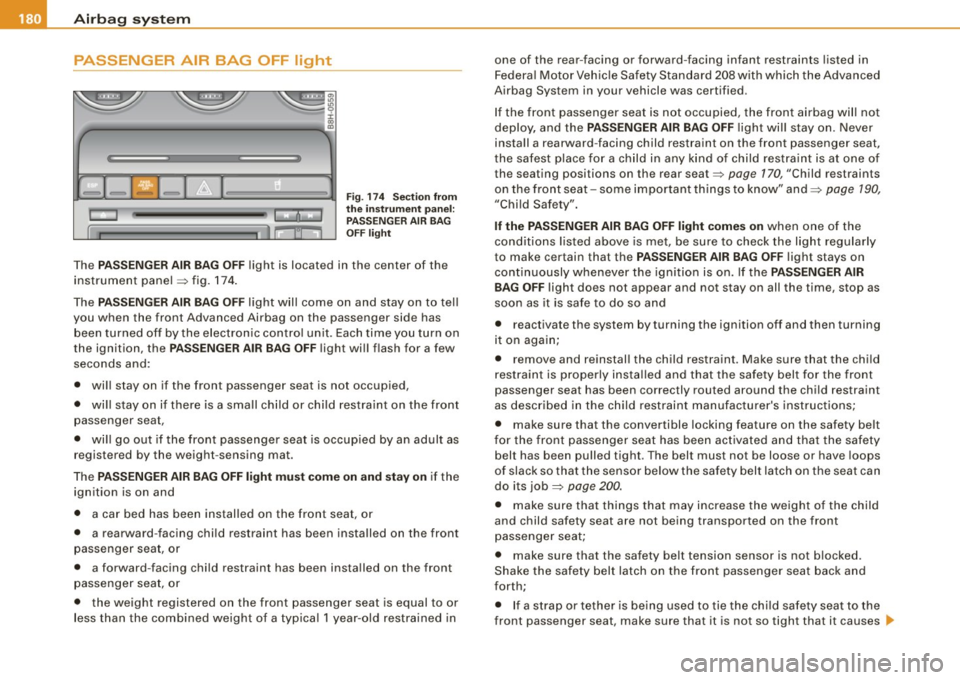
PASSENGER AIR BAG OFF light
............. Fig. 174 Section from
the instrument panel:
PASSENGER AIR BAG
OFF light
The PASSENGER AIR BAG OFF light is located in the center of the
instrument panel
~ fig. 174.
The
PASSENGER AIR BAG OFF light will come on and stay on to tell
you when the front Advanced Airbag on the passenger side has
been turned off by the electronic control unit . Each time you turn on
the ignition , the
PASSENGER AIR BAG OFF light will flash for a few
seconds and :
• will stay on if the front passenger seat is not occupied,
• will stay on if there is a small child or child restraint on the front
passenger seat,
• will go out if the front passenger seat is occupied by an adult as
registered by the weight -sensing mat .
The
PASSENGER AIR BAG OFF light must come on and stay on if the
ignition is on and
• a car bed has been installed on the front seat, or
• a rearward-facing child restraint has been installed on the front
passenger seat, or
• a forward-facing child restraint has been installed on the front
passenger seat, or
• the weight registered on the front passenger seat is equal to or
less than the combined weight of a typical 1 year-old restrained in one of the rear-facing or forward-facing infant restraints
listed in
Federal Motor Vehicle Safety Standard 208 with which the Advanced
Airbag System in your vehicle was certified .
If the front passenger seat is not occupied, the front airbag will not
deploy, and the
PASSENGER AIR BAG OFF light will stay on. Never
install a rearward -facing child restraint on the front passenger seat,
the safest place for a child in any kind of child restraint is at one of
the seating positions on the rear seat~
page 170, "Child restraints
on the front seat- some important things to know" and~
page 190,
"Child Safety".
If the PASSENGER AIR BAG OFF light comes on when one of the
conditions listed above is met, be sure to check the light regularly
to make certain that the
PASSENGER AIR BAG OFF light stays on
continuously whenever the ignition is on. If the
PASSENGER AIR
BAG OFF
light does not appear and not stay on all the time, stop as
soon as it is safe to do so and
• reactivate the system by turning the ignition off and then turning
it on again;
• remove and reinstall the child restraint. Make sure that the child
restraint is properly installed and that the safety belt for the front
passenger seat has been correctly routed around the child restraint
as described in the child restraint manufacturer's instructions;
• make sure that the convertible locking feature on the safety belt
for the front passenger seat has been activated and that the safety
belt has been pulled tight . The belt must not be loose or have loops
of slack so that the sensor below the safety belt latch on the seat can
do its job
~ page 200.
• make sure that things that may increase the weight of the child
and child safety seat are not being transported on the front
passenger seat;
• make sure that the safety belt tension sensor is not blocked.
Shake the safety belt latch on the front passenger seat back and
forth;
• If a strap or tether is being used to tie the child safety seat to the
front passenger seat, make sure that it is not so tight that it causes _,,
Page 183 of 340
__________________________________________________ A_ i_ r _b _a...; g::- s_ y=--- s_t _e _m ___ ffllll
the weight -sensing mat to measure more weight than is actually on
the seat .
If the PA SSENGER AIR BAG OFF light still d oes not come on and does
not stay on continuously (when the ignition is switched on),
• take the child restraint off the front passenger seat and insta ll it
properly at one of the rear seat positions. Have the airbag system
inspec ted by your Audi dea ler immediately .
• move the child to a rear seat position and make sure that the
child is proper ly restrained i n a child restraint that is appropriate for
its size and age.
The
PASSENGER AIR BAG OFF light shou ld NOT come on when the
ignition is on and an adult is sitting in a proper seating position on
the front passenger seat . If the
PASSENGER AIR BAG OF F light
comes on and stays on or flashes for about 5 seconds whi le driving,
under these circumstances, make sure that:
• the adult on the front passenger seat is properly seated on the
center of the seat cushion with his or her back up against the back
rest and the back rest is not reclined => page 148, "Pro per occupant
seating positions",
• the adult is not taking weight off the sea t by ho lding o n to the
passenger assist handle above the front passenger door or
suppo rting thei r weight on the armrest,
• the safety belt is being proper ly worn and that there is not a lot
of slack in the safety bel t webbing,
• accessory seat covers or cushions or other things that may cause
an incorrect reading or impression on the weight -sensing mat
under the upho lstery of the seat have been removed from the front
passenger seat,
• a safety belt extender has not been left in the safety be lt latch for
t he front passenger seat .
In addition to the
PASSENGER AIR BAG OFF l ight in the center of the
instr ument panel, the message
PASSENGER AIR BAG OFF or
PAS SENGER AIR BAG ON wi ll briefly appear in the instrument c luster
Controls and equip ment Safety first
Vehicle operation display. This is to inform the driver of the current front passenger
a
ir b ag status .•
Important safety instructions on monitoring
the Advanced Airbag System
& WARNING
An airbag system that is not fun ctioning properly cannot provide
supplemental protection in a frontal cra sh .
• If the airbag ind icator li ght come s on , it means that there may
be something wrong with the Advan ced Airbag System . It is
possible that the airbag will inflate when it is not suppo sed to , or
will not inflate when it should .
• Ha ve the airb ag system inspected immedi ately by your Audi
dealer.
& WARNING
If the front airbag inflate s, a child witho ut a child restraint , in a
rearward-facing child safety seat or i n a forward -fa cing child
restr aint that has not been properly installed will be seriously
injured and can be killed .
• Even though your vehicle is equipped with an Advanced Airbag
Sy stem , make certain that all children , e speci ally 12 year s and
younger , always ride on the back seat p roperly re strained for their
age and size .
• Always install forward or rear -facing child safety seat s on the
re ar s eat - even with an Ad van ced Airb ag Sy stem .
• If you mu st install a rearward -fa cing child safety seat on the
front pa ssenger seat be cau se of ex ceptional cir cum stance s and
the PASSENGER AIR BAG OFF light does not appear and stay on ,
immediately in stall the rear -facing child safety seat in a rear ...
Vehicle care Do-it-yourself service Technical data