seats AUDI A4 CABRIOLET 2009 Owner's Manual
[x] Cancel search | Manufacturer: AUDI, Model Year: 2009, Model line: A4 CABRIOLET, Model: AUDI A4 CABRIOLET 2009Pages: 340, PDF Size: 77.32 MB
Page 151 of 340
__________________________________________________ D _r_iv _ in_ g=- S_ a_f _e _l..:.. Y _ ....... 911
& WARNING (continued)
• Always adjust the driver's seat and the steering wheel so that
there are at least 4 inches 110 cm) between the knees and the
lower part of the instrument panel.
• Always hold the steering wheel on the outside of the steering
wheel rim with your hands at the 9 o'clock and 3 o'clock positions
to help reduce the risk of personal injury if the driver's airbag inflates .
• Never hold the steering wheel at the 12 o'clock position or with
your hands at other positions inside the steering wheel rim or on
the steering wheel hub. Holding the steering wheel the wrong way can cause serious injuries to the hands, arms and head if the
driver's airbag inflates
• Pointing the steering wheel toward your face decreases the
ability of the supplemental driver's airbag to protect you in a colli
sion .
• Always sit in an upright position and never lean against or
place any part of your body too close to the area where the airbags
are located.
• Before driving, always adjust the front seats and head
restraints properly and make sure that all passengers are properly
restrained.
• Never adjust the seats while the vehicle is moving. Your seat
may move unexpectedly and you could lose control of the vehicle.
• Never drive with the backrest reclined or tilted far back! The
farther the backrests are tilted back, the greater the risk of injury
due to incorrect positioning of the safety belt and improper
seating position.
• Children must always ride in child seats
=> page 190. Special
precautions apply when installing a child seat on the front
passenger seat
=> page 168. •
Controls and equip
ment Safety first
Vehicle operation
Proper seating position for the front
passenger
The proper front passenger seating position is important
for safe, relaxed driving.
For your own safety and to reduce the risk of injury in the
event of an accident, we recommend that you adjust the
seat for the front passenger to the following pos ition:
- Move the front passenger seat back as far as possible.
There must be a minimum of 10 inches (25 cm) between
the breastbone and the instrument panel =>
&.
- Adjust the angle of the seatback so that it is in an upright
position and your back comes in full contact with it
whenever the vehicle is moving.
- Adjust the head restraint so that the upper edge is as
even with the top of your head as possible but not lower
than eye level and so that it is as close to the back of your
head as possible =>
page 151.
-Keep both feet flat on the floor in front of the front
passenger seat.
- Fasten and wear safety belts correctly=>
page 163.
For detailed information on how to adjust the front passenger's
seat, see => page 92.
LJ}. WARNING
Front seat passengers who are unbelted, out of position or too
close to the airbag can be seriously injured or killed by the airbag
as it unfolds. To help reduce the risk of serious personal injury :
jll,,
Vehicle care Do-it-yourself service Technical data
Page 152 of 340
___ D_ r _i_v _i_n ..;;:g ::;,._ S_ a_ f_ e---= ly'----------------------------------------------------
& WARNING (continued)
• Passengers must always sit in an upright position and never
lean against or place any part of their body too close to the area
where the airbags are located.
• Passengers who are unbelted, out of position or too close to the
airbag can be seriously injured by an airbag as it unfolds with
great force in the blink of an eye.
• Always make sure that there are at least 10 inches (25 cm)
between the front passenger's breastbone and the instrument
panel.
• Always make sure that there are at least 4 inches (10 cm)
between the front passenger's knees and the lower part of the
instrument panel.
• Each passenger must always sit on a seat of their own and
properly fasten and wear the safety belt belonging to that seat.
• Before driving, always adjust the front passenger seat and
head restraint properly.
• Always keep your feet on the floor in front of the seat. Never
rest them on the seat, instrument panel, out of the window, etc .
The airbag system and safety belt will not be able to protect you properly and can even increase the risk of injury in a crash.
• Never drive with the backrest reclined or tilted far back! The
farther the backrests are tilted back, the greater the risk of injury
due to incorrect positioning of the safety belt and improper
seating position.
• Children must always ride in child seats~
page 190. Special
precautions apply when installing a child seat on the front
passenger seat~
page 168. •
Proper seating positions for passengers in
rear seats
Rear seat passengers must sit upright with both feet on
the floor consistent with their physical size and be prop
erly restrained whenever the vehicle is in use.
To reduce the risk of injury caused by an incorrect seating
position in the event of a sudden braking maneuver or an
accident, your passengers on the rear bench seat must
always observe the follow ing :
- Make sure that the seatback of the front seats are securely latched in the upright position~
page 99.
Keep both feet flat in the footwell in front of the rear seat .
Fasten and wear safety belts properly ~
page 163.
-Make sure that children are always properly restrained in
a child restraint that is appropriate for their size and age
~ page 190.
& WARNING
Passengers who are improperly seated on the rear seat can be
seriously injured in a crash.
• Each passenger must always sit on a seat of their own and
properly fasten and wear the safety belt belonging to that seat.
• Safety belts only offer maximum protection when the seatback
is securely latched in the upright position and the safety belts are
properly positioned on the body . By not sitting upright, a rear seat
passenger increases the risk of personal injury from improperly
positioned safety belts! •
Page 153 of 340
Driving Safely ---------------=------=~
Proper adjustment of head restraints
Correctly adjusted head restraints are an important part
of your vehicle's occupant restraint system and can help
to reduce the risk of injuries in accident situations.
Fig . 156 Correctly
adjusted head restraint
viewed from the side
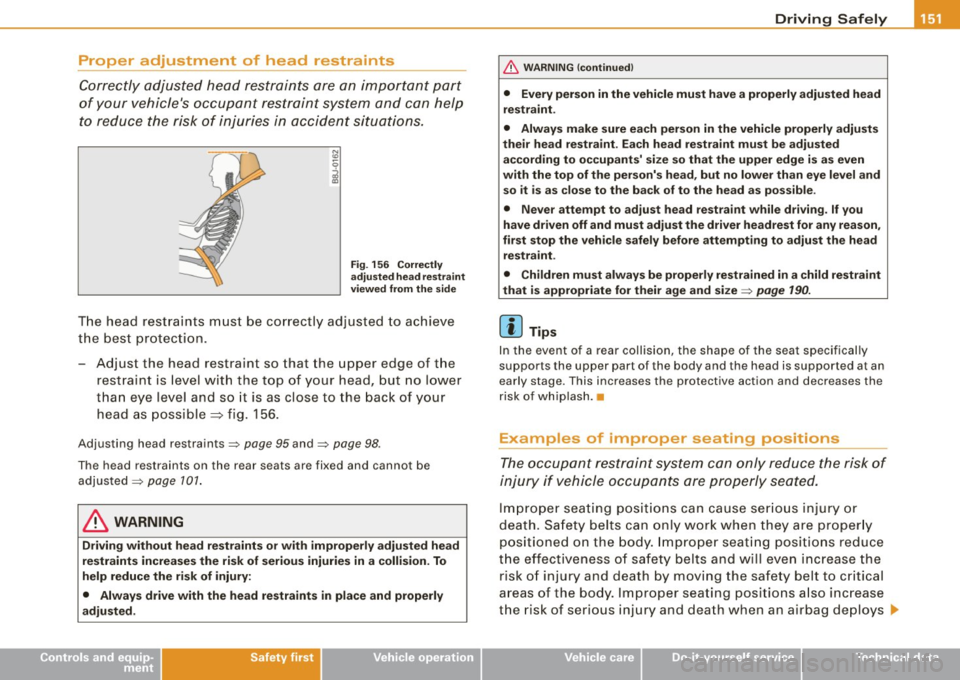
The head restraints must be correctly adjusted to achieve
the best protection.
- Adjust the head restraint so that the upper edge of the
restraint is level with the top of your head, but no lower
than eye level and so it is as close to the back of your
head as possible
=> fig . 156.
Adjusting head restraints=> page 95 and=> page 98.
The head restraints on the rear seats are fixed and cannot be
adjusted =>
page 101.
& WARNING
Driving without head restraints or with improperly adjusted head
restraints increases the risk of serious injuries in a collision . To
help reduce the risk of injury:
• Always drive with the head restraints in place and properly
adjusted .
Controls and equip ment Safety first Vehicle operation
& WARNING
(continued)
• Every person in the vehicle must have a properly adjusted head
restraint.
• Always make sure each person in the vehicle properly adjusts
their head restraint. Each head restraint must be adjusted
according to occupants' size so that the upper edge is as even
with the top of the person's head, but no lower than eye level and
so it is as close to the back of to the head as possible .
• Never attempt to adjust head restraint while driving. If you
have driven off and must adjust the driver headrest for any reason,
first stop the vehicle safely before attempting to adjust the head
restraint .
• Children must always be properly restrained in a child restraint
that is appropriate for their age and size=>
page 190.
[ i] Tips
In the event of a rear collision, the shape of the seat specifically
supports the upper part of the body and the head is supported at an
early stage. This increases the protective action and decreases the
risk of whiplash. •
Examples of improper seating positions
The occupant restraint system can only reduce the risk of
injury if vehicle occupants ore properly seated.
Improper seating positions can cause serious injury or
death. Safety belts can only work when they are properly
positioned on the body. Improper seating positions reduce
the effectiveness of safety belts and will even increase the risk of injury and death by moving the safety belt to critical
areas of the body. Improper seating positions also increase
the risk of serious injury and death when an airbag deploys ..,
Vehicle care Do-it-yourself service Technical data
Page 154 of 340
-Driving Safely
_---:;.._----=------------------
and strikes
an occupant who is not in the proper seating
position. A driver is responsible for the safety of all vehicle
occupants and especially for children. Therefore:
Never allow anyone to assume an incorrect seating posi
tion when the vehicle is being used~&, .
The following bullets list only some sample positions that will
increase the risk of serious injury and death. Our hope is that these
examples will make you more aware of seating positions that are
dangerous.
Therefore, whenever the vehicle is moving: • never stand up in the vehicle
• never stand on the seats
• never kneel on the seats
• never ride with the seatback reclined
• never lie down on the rear seat
• never lean up against the instrument panel
• never sit on the edge of the seat
• never sit sideways
• never lean out the window
• never put your feet out the window
• never put your feet on the instrument panel
• never rest your feet on the seat cushion or back of the seat
• never ride in the footwell
• never ride in the cargo area
& WARNING
Improper seating positions increase the risk of serious personal
injury and death whenever a vehicle is being used.
& WARNING (continued)
• Always make sure that all vehicle occupants stay in a proper
seating position and are properly restrained whenever the vehicle
is being used . •
Driver and passenger side footwell
Important safety instructions
& WARNING
Always make sure that the knee airbag can inflate without inter
ference. Objects between yourself and the airbag can increase the risk of injury in an accident by interfering with the way the airbag
deploys or by being pushed into you as the airbag deploys.
• No persons (children) or animals should ride in the footwell in
front of the passenger seat.
If the airbag deploys, this can result in
serious or fatal injuries .
• No objects of any kind should be carried in the footwell area in
front of the driver's or passenger's seat. Bulky objects (shopping
bags, for example) can hamper or prevent proper deployment of
the airbag. Small objects can be thrown through the vehicle if the
airbag deploys and injure you or your passengers. •
Pedal area
Pedals
The pedals must always be free to move and must never
be interfered with by a floor mat or any other object.
Make sure that all pedals move freely without interference and that
nothing prevents them from returning to their original positions.
~
Page 158 of 340
___ D_ r _i_v _i_n ..;::g =-- S_ a_ f_ e--= ly'----------------------------------------------------
Automatic rollover protection system
Function
The automatic roll over protection system helps to protect
the passengers in case the vehicle turns over.
1J ~
I ...
,
... . ' : :
: :
'
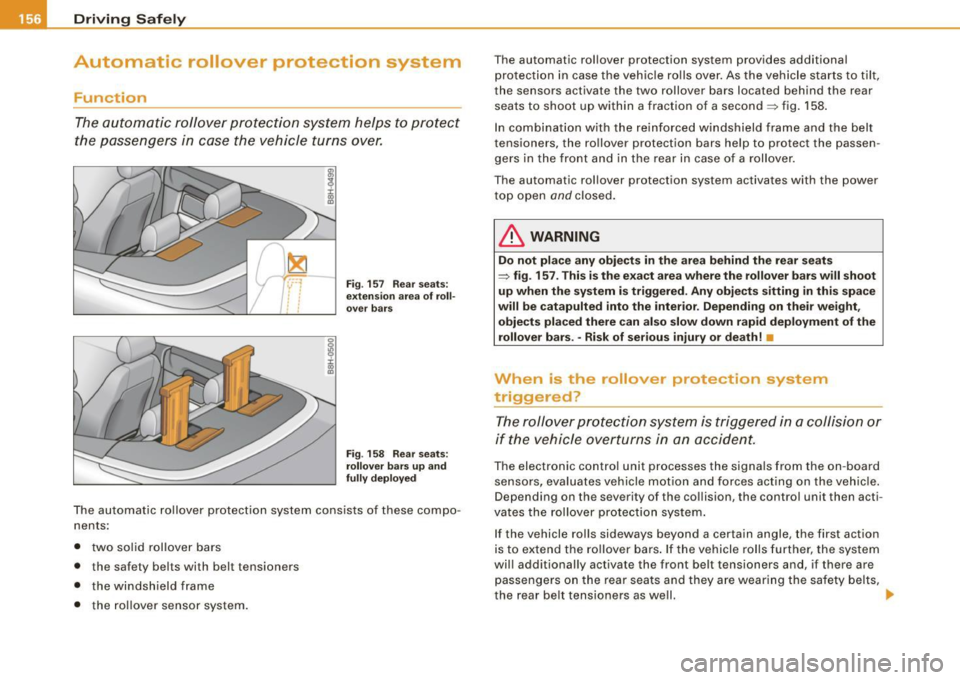
F ig . 157 Rear sea ts:
ex te n sio n area o f ro ll
over ba rs
F ig . 158 Rea r sea ts :
r ollo ver bars up and
full y dep loyed
The automatic rollover protection system cons ists of these compo
nents:
• two solid rollover bars
• the safety bel ts with belt tensioners
• the windshield frame
• the ro llover sensor system. The automatic rol
lover protection system provides additional
protection in case the vehicle ro lls over. As the vehicle starts to tilt,
the sensors activate the two rollover bars located behind the rear
seats to shoot up wi thin a fraction of a second~ fig. 158 .
In combinat ion with the reinforced windshield frame and the bel t
tensioners, the rollover p rotection bars help to protect the passen
gers in the front and in the rear in case of a rollover.
The automatic rollover protection system activates with the power
top open
and closed.
& WARNING
Do not place any obje cts in the ar ea be hind the r ear seats
~ fig . 157. T his is the e xact area where the rollover b ars will shoot
up wh en th e syst e m i s triggered . An y ob jects si tting in th is s pac e
w ill be cata p ulte d into the inter ior. Depending on the ir wei ght,
object s pl ace d there can also s lo w do wn rap id deploym ent of th e
r o llover bars. -Ri sk of seri ou s inj ur y or deat h! •
When is the rollover protection system
triggered?
T he rollover protection system is triggered in a collisi on or
if the vehicle overturns in an accident.
The electronic control unit processes the signals from the on -board
sensors, evaluates vehicle motion and forces act ing on the vehic le.
Depending on the severity of the co llision, the control unit then acti
vates the rol lover protection system .
If the vehicle rol ls sideways beyond a certain angle , the first action
is to extend the ro llover bars . If the vehicle rolls further, the system
wil l additional ly activate the front belt tensioners and, if there are
passengers on the rear seats and they are wearing the safety belts,
the rear belt tensioners as well. ..,
Page 161 of 340
_______________________________________________ S_a _f _e _t -=-y _ b_ e_lt _s ______ lffllll
Safety belts
General notes
Always wear safety belts!
Wearing safety belts correctly saves lives!
This chapter explains why safety belts are necessary, how
they work and how to adjust and wear them correctly.
- Read all the information that follows and heed all of the
instructions and WARNINGS.
& WARNING
Not wearing safety belts or wearing them improperly increases
the risk of serious personal injury and death.
• Safety belts are the single most effective means available to
reduce the risk of serious injury and death in automobile acci
dents. For your protection and that of your passengers, always
correctly wear safety belts when the vehicle is moving.
• Pregnant women, injured, or physically impaired persons must
also use safety belts . Like all vehicle occupants, they are more
likely to be seriously injured if they do not wear safety belts. The
best way to protect a fetus is to protect the mother -throughout
the entire pregnancy. •
Number of seats
Your vehicle has a total of four seating positions : two in the front
and two in the rear. Each seating posi tion has a safety belt .
Controls and equip ment Safety first
Vehicle operation
& WARNING
Not wearing safety belts or wearing them improperly increases
the risk of serious personal injury and death.
• Never strap more than one person, including small children,
into any belt. It is especially dangerous to place a safety belt over
a child sitting on your lap.
• Never let more people ride in the vehicle than there are safety
belts available.
• Be sure everyone riding in the vehicle is properly restrained
with a separate safety belt or child restraint. •
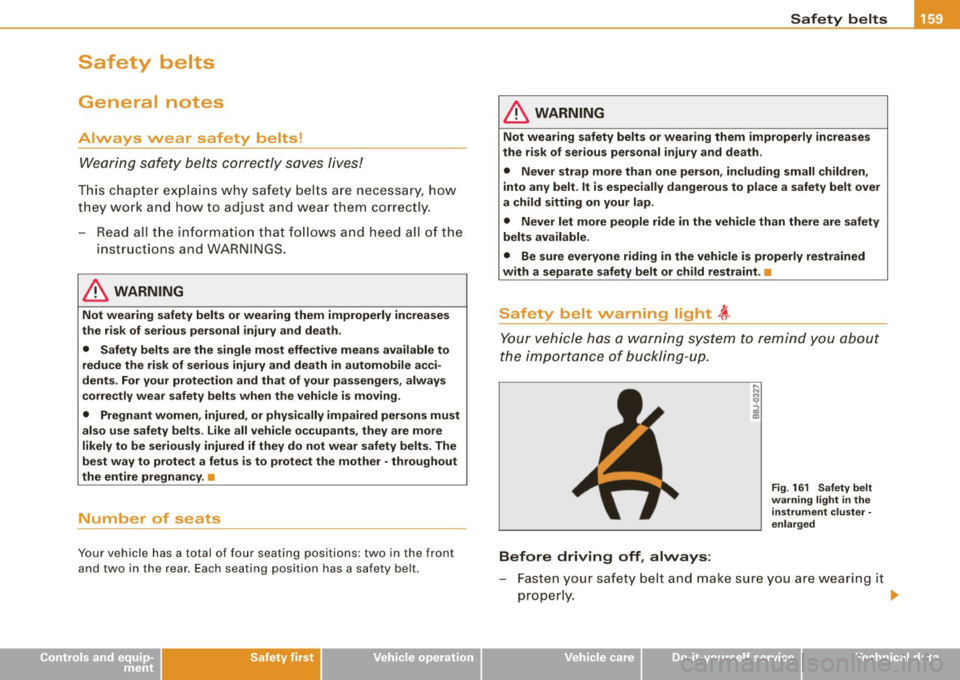
Safety belt warning light ~
Your vehicle has a warning system to remind you about
the importance of buckling-up.
Before driving off, always:
Fig. 161 Safety belt
warning light in the
instrument cluster ·
enlarged
- Fasten your safety belt and make sure you are wearing it
properly. .,
Vehicle care Do-it-yourself service Technical data
Page 163 of 340

Because the passengers of this vehicle are not using safety belts
~ page 160, fig. 162, they will keep moving at the same speed the
vehicle was moving just before the crash, until something stops
them -here, the wall
~ page 160, fig. 163.
The same principles apply to people sitting in a vehicle that is involved in a frontal collision. Even at city speeds of 20 to 30 mph
(30 to 50 km/h), the forces acting on the body can reach one ton
(2,000 lbs, or 1,000 kg) or more. At greater speeds, these forces are
even higher.
People who do not use safety belts are also not attached to their
vehicle. In a frontal collision they will also keep moving forward at
the speed their vehicle was travelling just before the crash. Of course, the laws of physics don't just apply to frontal collisions, they
determine what happens in all kinds of accidents and collisions. •
What happens to occupants not wearing
safety belts?
In crashes unbelted occupants cannot stop themselves
from flying forward and being injured or killed. Always
wear your safety belts!
Safety first
Fig . 164 A driver not
wearing a safety belt is
violently thrown
forward
Safety belts
Fig. 165 A rear
passenger not wearing
a safety belt will fly
forward and strike the
driver
Unbelted occupants are not able to resist the tremendous forces of
impact by holding tight or bracing themselves. Without the benefit
of safety restraint systems, the unrestrained occupant will slam
violently into the steering wheel, instrument panel, windshield, or
whatever else is in the way~ fig. 164 . This impact with the vehicle
interior has all the energy they had just before the crash.
Never rely on airbags alone for protection. Even when they deploy,
airbags provide only additional protection. Airbags are not
supposed to deploy in all kinds of accidents. Although your Audi is
equipped with airbags, all vehicle occupants, including the driver,
must wear safety belts correctly in order to minimize the risk of
severe injury or death in a crash.
Remember too, that airbags will deploy only once and that your
safety belts are always there to offer protection in those accidents
in which airbags are not supposed to deploy or when they have
already deployed. Unbelted occupants can also be thrown out of the
vehicle where even more severe or fatal injuries can occur.
It is also important for the rear passengers to wear safety belts
correctly . Unbelted passengers in the rear seats endanger not only
themselves but also the driver and other passengers~ fig. 165. In a
frontal collision they will be thrown forward violently, where they can hit and injure the driver and/or front seat passenger. •
~ehicle care Technical data
Page 164 of 340
--~S~a ~f ~e ~t l'.y ...: b~ e~lt =:s!._ _____________________________________________ _
Safety belts protect
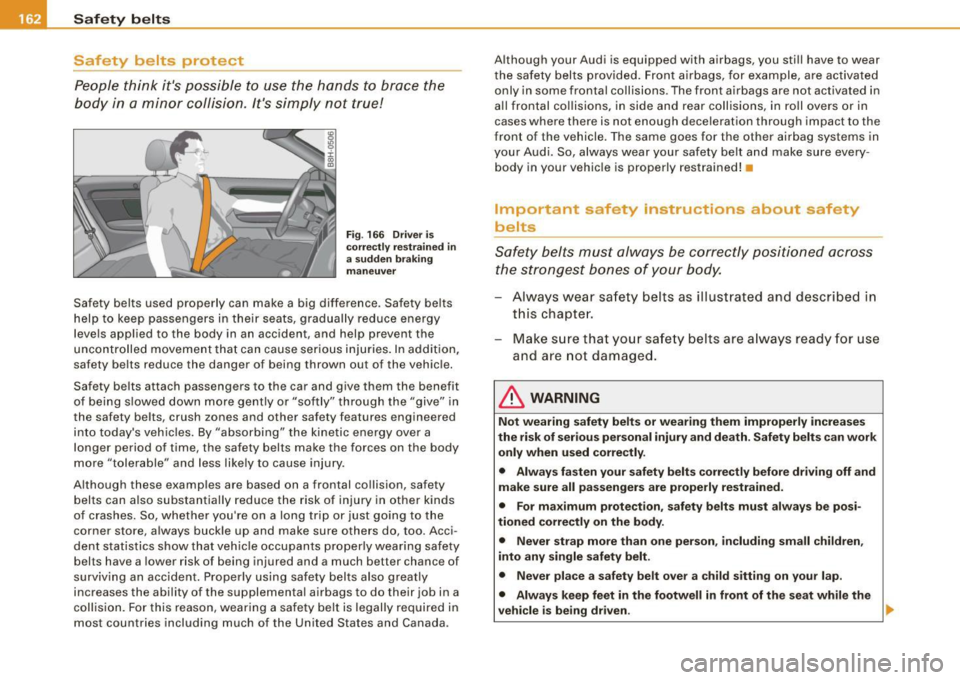
People think it's possible to use the hands to brace the
body in a minor collision . It's simply not true!
Fig . 166 Dri ver is
co rrec tly r est rai ned i n
a s ud den braking
man euv er
Safety belts used properly can make a big difference . Safety belts
help to keep passengers in their seats, gradually reduce energy levels app lied to the body in an accident, and help prevent the
uncontrolled movement that can cause serious injuries . In addition,
safety be lts reduce the danger of being thrown out of the vehic le.
Safety belts attach passengers to the car and give them the benefit
of being s lowed down more gently or "sof tly" through the "give" in
the safety belts, crush zones and other safety features engineered
into today's vehicles. By "absorbing" the kinetic energy
over a
longer period of time, the safety belts make the forces on the body
more "tolerable" and less likely to cause injury.
Although these examples are based on a frontal co llision, safety
belts can a lso substantially reduce the risk of injury in other kinds
of crashes. So, whether you're on a long tr ip or just going to t he
corner store, always buckle up and make sure others do, too. Acci
dent statistics show that vehic le occupants properly wearing safety
belts have a lower risk of being injured and a much better chance of
s u rviv ing an acc ident. Proper ly using safety belts also great ly
increases the abi lity of the supplementa l airbags to do their job in a
coll ision. For this reason, wearing a safety be lt is legally required in
most countries including much of the United States and Canada . Although your Audi is equipped with airbags, you sti
ll have to wear
t he safety belts provid ed. Fron t airbags, for example, are activated
only in some frontal collisions. The front airbags are not activated in
a ll frontal co llisions, in side and rear collisions, in ro ll
ove rs or in
cases where there is not enough dece leration through impact to the
front of the vehicle. The same goes for the other ai rbag systems in
your Audi. So, a lways wear your safety belt and make sure
eve ry
body in your vehic le is properly restrained! •
Important safety Instructions about safety
belts
Safety belts must always be correctly positioned across
the strongest bones of your body.
Always wear safety belts as illustrated and described in
this cha pte r.
Make s ure tha t your sa fe ty belts ar e always ready for us e
and are not damaged .
& WARNING
Not wearing safety belts or wearing them improperl y increases
the risk of serious per sonal injury and death . Safety belt s can w ork
only when used corre ctl y.
• Alway s fa sten yo ur safety belt s correctl y before driving off and
make sure all pa ssenger s are properl y restrained .
• For m aximum protection , safet y belts must alw ays be po si
tion ed corre ctly on the body .
• Never strap mo re than one person , including sm all children ,
into any single safety belt.
• Never pla ce a s afety belt ove r a child sitting on your lap .
• Alway s ke ep feet in the footwell in front of the seat while the
vehicle is being dr iven .
~
Page 171 of 340
__________________________________________________ A_ i_ r _b _a...; g::- s_ y=--- s_t _e _m ___ lJII
repair costs or even the lack of vehicle damage is not necessarily an
indication of whether an airbag should inflate or not .
It is not possible to define a range of vehicle speeds that will cover
every possible kind and angle of impact that will always trigger the
airbags, since the circumstances will vary considerably between
one collision and another. Important factors include, for example,
the nature (hard or soft) of the object which the car hits, the angle of impac t, vehicle sp eed , etc . The front airbags will also not inflate
in side or rear collisions, or in roll-overs.
Always remember : Airbags will deploy only once, and only in certain
kinds of collisions. Your safety belts are always there to offer protec
tion in those situations in which airbags are not supposed to deploy,
or when they have already deployed; for example, when your vehicle
strikes or is struck by another after the first collision.
This is just one of the reasons why an airbag is a suppl em entary
restraint and is not a substitute for a safety belt. The airbag system
works most effectively when used with the safety belts. Therefore ,
always properly wear your safety belts=>
page 159.
& WARNING
Sitting too close to the steering wheel or instrument panel will
decrease the effectiveness of the airbags and will increase the risk
of personal injury in a collision.
• Never sit closer than 10 inches (25 cm) to the steering wheel or
instrument panel.
• If you cannot sit more than 10 inches (25 cm) from the steering
wheel, investigate whether adaptive equipment may be available
to held you reach the pedals and increase your seating distance
from the steering wheel.
• If you are unrestrained, leaning forward, sitting sideways or out
of position in any way, your risk of injury is much higher.
• You will also receive serious injuries and could even be killed if
you are up against the airbag or too close to it when it inflates -
even with an Advanced Airbag.
Controls and equip ment Safety first
Vehicle operation
& WARNING (continued)
• To reduce the risk of injury when an airbag inflates, always
wear safety belts properly~
page 163, "Safety belts".
• Always make certain that children age 12 or younger always
ride in the rear seat. If children are not properly restrained, they
may be severely injured or killed when an airbag inflates.
• Never let children ride unrestrained or improperly restrained in
the vehicle. Adjust the front seats properly.
• Never ride with the backrest reclined.
• Always sit as far as possible from the steering wheel or the
instrument panel~
page 148, "Proper occupant seating posi
tions".
• Always sit upright with your back against the backrest of your
seat.
• Never place your feet on the instrument panel or on the seat .
Always keep both feet on the floor in front of the seat to help
prevent serious injuries to the legs and hips if the airbag inflates.
• Never recline the front passenger's seat to transport objects.
Items can also move into the area of the side airbag or the front
airbag during braking or in a sudden maneuver. Objects near the
airbags can become projectiles and cause injury when an airbag
inflates.
& WARNING
Airbags that have deployed in a crash must be replaced.
• Use only original equipment airbags approved by Audi and
installed by a trained technician who has the necessary tools and
diagnostic equipment to properly replace any airbag in your
vehicle and assure system effectiveness in a crash.
• Never permit salvaged or recycled airbags to be installed in
your vehicle. •
Vehicle care Do-it-yourself service Technical data
Page 172 of 340
___ A_ ir_b _ a_ g~ s_ y_s _t _e _m _________________________________________________ _
Child restraints on the front seat - some
important things to know
- Be sure to read the important information and head the
WARNINGS for important details about children and
Advanced Airbags~
page 190.
Even though your vehic le is equipped with an Advanced Airbag
System, make certain that a ll children, especia lly those 12 years and
younger, a lways ride in the back seat properly restrained for their
age and size . The airbag on the passenger side makes the front seat
a potentia lly dangerous place for a child to ride. The front seat is not
the safest p lace for a chi ld in a forward -facing child safety seat. It
can be a very dangerous place for an infant or a child in a rearward
facing seat.
The Advanced Airbag System in your vehicle has been certified to
comply with the Requirements of United States Federal Motor
Vehicle Safety Standard 208 as applicab le at the time your vehicle
was manufactured.
Th e Standard requires the front airbag on the passenger side to be
turned off ("suppressed") if a chi ld up to about one year of age
restrained in one of the rear-facing or forward-facing infant
restraints listed in Federa l Motor Vehicle Safety Standard 208 with
which the Advanced Airbag System in your vehicle was certified has been instal led on the front passenger seat. For a listing of the child
restraints that were used to certify compliance with the US Safety
Standard =>
page 192.
The PASSENGER AIR BAG OFF light in the instrument panel tells you
when the front Advanced Airbag on the passenger side has been
t urned off by the electronic control unit.
Each time you turn on the ignition, the
PASSENGER AIR BAG OFF
light will come on for a few seconds and:
• will stay on if the front passenger seat is not occupied, •
will stay on if there is a small child or child restraint on the front
passenger seat,
• will go off if the front passenger seat is occupied by an adult as
registered by the weight-sensing mat=>
page 179, "Monitoring the
Advanced Airbag System" .
The
PASSENGER AIR BAG OFF light comes on when the control unit
detects a tota l weight on the front passenger seat that requires the
front airbag to be turned off.
If the total weight on the front passenger seat is more than that of
a typical 1 year -old child but less than the weight of a small adult,
the fron t airbag on the passenger side can deploy (the
PASSENGER
AIR BAG OFF
light does not come on). If the PASSENGER AIR BAG
OFF
light does not come on, the front airbag on the passenger s ide
has not been turned off by the electronic contro l unit and can
deploy if the control unit senses an impact that meets the condi
tions stored in its memory.
For example, the airbag may deploy if:
• a small ch ild that is heavier than a typical 1 year-o ld child is on
the front passenger seat (regardless of whether the child is in one
of the child safety seats listed =>
page 192), or
• a child who has outgrown chi ld restraints is on the front
passenger seat .
If the front passenger airbag is turned off, the
PASSENGER AIR BAG
OFF
light comes on in the instrument cluster and stays on.
The front airbag on the passenger side may
not deploy (the
PASSENGER AIR BAG OFF light does not illuminate and stay lit) even
if a small adult or teenager, or a passenger who is not sitting upright
with their back against a non -reclined backrest with their feet on the
vehicle floor in front of the seat is on the front passenger seat
=>
page 148, "Proper seating position for the driver".
If the front passenger airbag deploys, the Federal Standard requires
the airbag to meet the "low risk" deployment criteria to reduce the
risk of injury through interaction with the airbag. "Low risk" deploy
ment occurs in those crashes that take p lace at lower decelerations .,.