heating AUDI A4 SEDAN 2013 User Guide
[x] Cancel search | Manufacturer: AUDI, Model Year: 2013, Model line: A4 SEDAN, Model: AUDI A4 SEDAN 2013Pages: 294, PDF Size: 73.71 MB
Page 195 of 294
A WARNING ,~ ~
After driving through water, mud, slush,
etc., the brakes may be slow to take effect
because of wet brake rotors and pads. Dry
the brakes first by braking carefully to re
store the full brak ing effect.
([) Note
Vehicle components such as the engine,
transmiss ion, suspension or electrical sys
tem can be severely damaged by driving
through wate r.
@ Tips
- Check the depth of the water before dr iv
i ng through it.
- Do not stop the veh icle, dr ive in reverse
or switch the engine off when driving
th rough water.
- Keep in mind that oncoming vehicles
may create waves that raise the water
level and make it too deep for you r vehi
cle to drive th rough safely.
- Avoid dr iving through sa lt water because
i t can ca use corrosion.
Catalytic converter
It is very important that your emission con
trol system (catalytic converter) is function
ing properly to ensure that your vehicle is run
ning in an environmentally sound manner.
11-Always use lead-free gasoline q page 210,
Fuel supply .
"'" Never run the tank down a ll the way to
empty.
11-Never put too much motor oil in your en-
gine
q page 220, ~ Adding engine oil .
11-Never try to push -or tow-start your veh icle .
The catalytic converter is an efficient "clean up" device built into the exhaust system of
the vehicle . The catalytic converter burns
many of the pollutants in the exhaust gas be
fore they are released into the atmosphere .
Drivin g and en vironm ent 193
The exclusive use of unleaded fuel is critically
important for the life of the catalytic convert
er and proper funct ion ing of the engine.
A WARNING
-
- Do not park or operate the vehicle in
areas where the hot exhaust system may
come in contact with dry grass, brush,
fuel spill or other mate rial wh ich can
cause a fir e.
- Do not apply additional undercoating or rustp roof ing on or near the exhaust
manifold, exhaust pipes, catalytic con
ve rter or heat shields. During driv ing, the
substance used for undercoating co uld
overheat and cause a fire.
(D Note
- Be aware that just one tank filling with
leaded fu el w il l already ser iously de
gra de the performance of the catalytic
c onverte r.
- Do not ex ceed t he cor rect eng ine oil level
qpage 220.
- Do not drive until the fue l tank becomes
comple tely empty. The engine co uld m is
fire . Unburned fuel could also get in to
the exhaust system and th is co uld cause
the catalytic converter to overheat .
- Do not turn off the ignition while the ve
hicle is moving.
- Do not continue to ope rate your veh icle
unde r these conditions, as otherwise fuel
can reach the catalytic converte r. T his
cou ld result in overheating of the con
verter, requir ing its replacement.
- To assure efficient operation of the Emis
sion Control System:
- H ave you r vehicle maintained prope rly
and in accorda nce w ith the serv ice rec
ommendat ions in yo ur Warranty &
M ain tenance boo klet.
- L ack of prope r maintenance as we ll as
improper use of the vehi cle w ill impair
the function of the em ission contro l
system and could lead to damage . ..,. •
•
Page 197 of 294
(D Note
Do not leave engine idling unattended af
ter starting . If warning lights should come
on to indicate improper operation, they
would go unheeded. Extended idling also
produces heat, which could result in over
heating or other damage to the vehicle or
other property .
Regular maintenance
A badly tuned engine unnecessarily wastes a
lot of fuel .
.,. Have your vehicle serv iced at regular inter-
vals .
By having your vehicle regularly serviced by an
authori zed Audi dealer helps to ensure that it
runs properly and economically . The condition
of your vehicle not only affects its safety and
ab il ity to hold its value, it also affects
fuel
consumption.
Check your oil each time you fill your tank.
The amount of oil used is related to engine
load and speed.
It is normal for the oil consumption of a new
engine to reach its lowest value after a certain
mileage has been driven.
You must drive your vehicle about 3 ,000 miles
(5,000 kilometers) before you can properly
assess oi l consumption.
This a lso applies to fuel consumption and en
g ine output .
0 Note
-Have your vehicle maintained properly
and in accordance with the service rec
ommendations in your Warranty
& Main
tenance booklet. Lack of proper mainte
nance as well as improper use of the ve
hicle will impair the function of the
emission control system and could lead
to damage.
Driving and environment 195
- Do not alter or remove any component of
the Emission Control System unless ap
proved by the manufacturer .
- Do not alter or remove any device, such
as heat shields, switches, ignition wires,
valves, which are designed to protect
your vehicle's Emission Control System and other important vehicle compo
nents .
Fewer short trips
Fuel consumption will always be rela tively
high on short trips .
.,. Try to avoid driving short distances with a
cold engine.
The engine and cata lytic converter have to
reach their opt imal
operating temperature to
reduce fuel consumpt ion and noxious emis
sions effectively .
Just after starting, a co ld engine in a mid-size
car only achieves a fuel economy of 6-8 miles
per gallon (30-40 l/100 km). After about a
half a mile, fuel economy climbs to 12 mpg
(20 l/100 km) . After about
2 .5 miles (4 km),
the engine is at its proper operat ing tempera
ture and fuel economy has reached a normal
level. So you can see that you should avoid
short trips whenever possible.
T he
outside temperature is also cr itical in th is
regard. Your car consumes more fue l in the
winter than in the summer.
•
•
Page 210 of 294
208 Cleaning and protection
-Never use chemical solvents (e.g . lighter
fluid, turpentine), waxes, shoe polish or
similar products on the leather surfaces
in your Audi.
- To avoid damage, have stubborn stains removed by a commerc ial cleaning spe
cialist.
Cleaning Alcantara ® (synthetic suede)
App lies to vehicles: with A lcantara® up holstery
Removing dust and dirt
,. Moisten a cloth,
squeeze out excess water
and wipe down the seat surfaces .
Removing stains
,. Moisten a cloth with lukewarm water or
with diluted
ethyl (rubbing) alcohol.
,. Dab at the stain. Start at the outside and
work inwards .
,. Once the stain is no longer visible, use a
soft dry cloth or tissue to soak up the mois
ture.
Do not use leather cleaning products on Al
cantara ®.
You may use a suitable shampoo for removing
dust and dirt.
Dust and grit in the pores and seams can
scratch and damage the surface. If the car is
left standing in the sun for long periods, the
Alcantara ® should be protected against direct
sunlight to prevent it from fading . Slight color
variations will develop in normal use and are
not an indication of material deterioration .
IQ) Note
- Never use chemical solvents (e.g . lighter
fluid, turpentine), waxes, shoe polish or
s imilar products on Alcantara ® surfaces .
- To avoid damage, have stubborn stains
removed by a commerc ial cleaning spe
cialist.
- Do not use brushes, st iff sponges or sim
i larly abrasive cleaning aids . Safety belts
Only well-maintained safety belts work relia
bly when needed
.
,. Keep belts clean.
,. For cleaning, use a mild soap and water sol
ution. Let belts dry thorough ly and away
from d irect sunlight.
,. Do not allow inertia reel safety belts to re
tract before they are completely dry.
,. Check the condition of your safety be lts
reg
ularly.
Heavily soiled safety belts may not retract
properly.
A WARNING
-
Damaged safety belts can break in a crash .
- Anyth ing that might damage your safety
be lts could mean that you and your pas
sengers would not be adequate ly pro
tected in an accident.
- Safety belt performance depends on cor
rect installation. Never remove belts
from the vehicle to clean them.
- Do not use chemical cleaning agents,
bleach or dyes. They have corrosive prop
erties which weaken the webbing.
- When cleaning your safety be lts, inspect
them for damage . If you discover dam
age, see your authorized Audi dealer.
- Always read and heed all WARNINGS and
other information ¢
page 199.
Engine compartment
Be especially careful when cleaning the en
gine compartment.
Always switch off the ignition before clean
ing the engine
c.? .&, .
Plenum panel
Remove leaves from the plenum panel in front
of the windshield under the engine hood. This
prevents the water drai n holes from becoming
blocked, and it prevents debris from entering
the vehicle interior through the heating and
ventilat ion ducts .
Page 224 of 294
222 Check ing and filling
Engine cooling system
Coolant
The engine coolant performs two functions: it
keeps the engine from overheating and it pro
tects the engine from freezing in the winter .
The cooling system is sealed and generally re
quires little attention.
The cooling system has been filled at the fac
tory with a permanent coolant which does not need to be changed. The coolant consists of a
mixture of water and the manufacturer's gly
col-basedcoolant additive G 13 antifreeze with
anticorrosion add itives (SO% for USA mode ls;
60% for Canadian models). This mixture both
assures the necessary frost protection and protects metal components in the engine's
cooling system from corrosion and scaling. It
a lso raises the boiling point of the coolant .
Do not reduce the concentration of the coo l
ant in the summer by adding plain water .
The
p ro po rti on of c ool ant add it iv e mu st b e at
lea st 50 % but not mo re th an 60%
to main
tain antifree ze protection and cooling efficien
cy. If the coolant frost protect ion is too low,
the coolant could freeze and damage the veh i
cle heating and eng ine cooling system .
For year-round driving, antifreeze is added at
the factory for temperatures down to:
- -31° F(-3S°C)USA
- - 40 ° F ( - 40 °C) Canada.
_& WARNING
Before yo u check anything in the engine
compartment, always read and heed all
WARNINGS
¢ &. in Working in the engine
compartment on page 215.
(]) Note
-
- Before winter sets in, have the coolant
checked to see if the coo lant additive in
your vehicle is s uffic ient to meet the cli
mate cond it ions . Th is is especially impor
tant if you live in a region where the w in
ter is extremely cold . If necessary, in- crease the p
roportion of coo lant additive
to 60%.
- When adding coolant additive to your
cooling system, remember:
- We recommend us ing on ly coolant ad
d itive G12++ or G13 for your veh icle .
This coolant additive is availab le at au
thor ized Audi dealers. Other types of
ant ifreeze can s ignificantly reduce cor
rosion pro tection. The resulting cor ro
sion can cause a loss o f coolant and se
rious engine damage.
- Do not add any type of rad iator leak seal
ant to yo ur vehicle's engine coolant .
Adding radiator repair fl uid may adverse
ly affect the function and performance of
your cooling system and cou ld resu lt in
damage not covered by your New Veh icle
Limited Warranty.
' Checking the engine coolant level
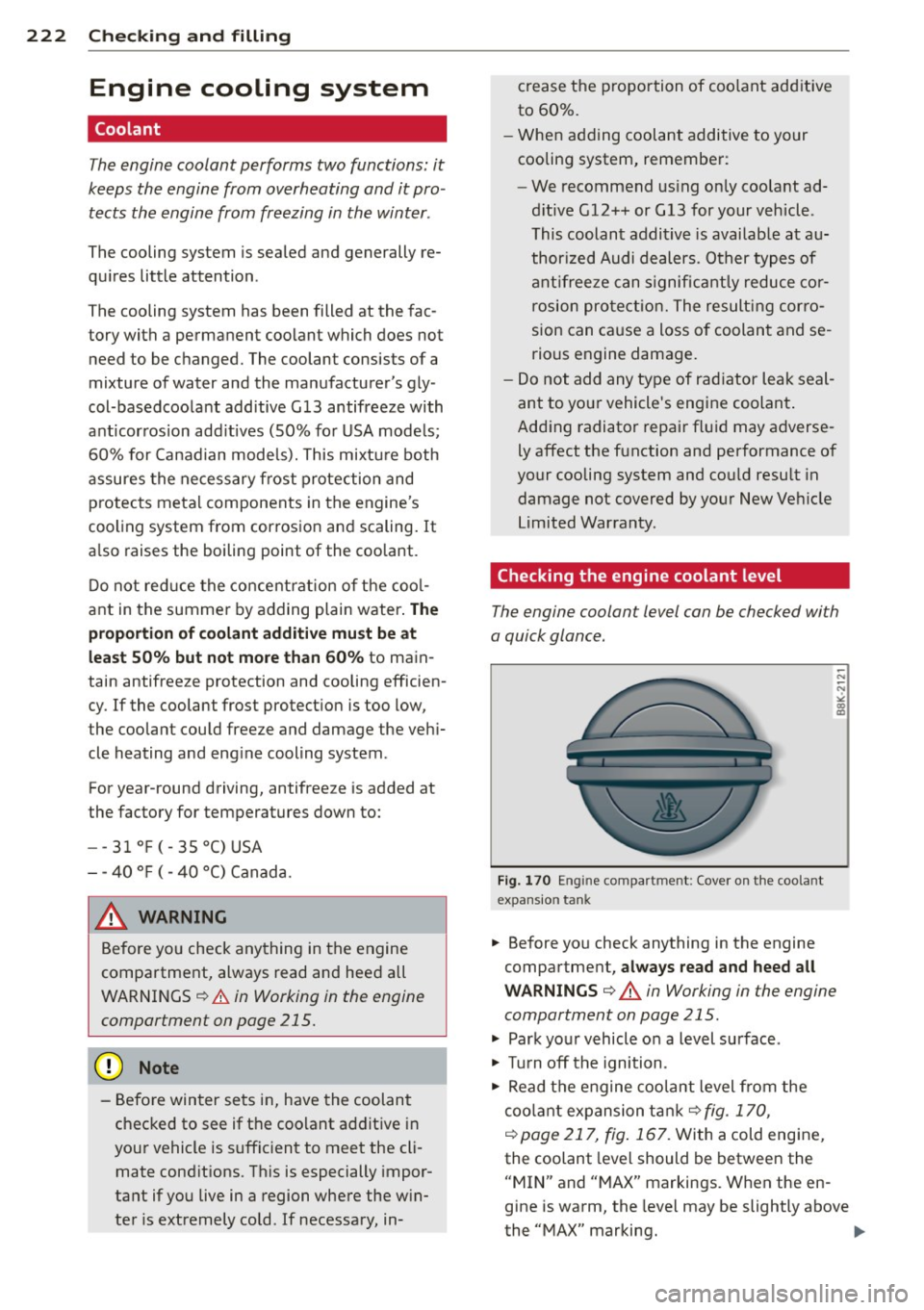
The engine coolant level can be checked with
a quick glance.
F ig. 170 En gin e compa rtm en t: Cover o n the coo la n t
expans io n ta nk
-"' -"' >< .,
"'
.. Before yo u check anything in the engine
compartment,
alwa ys read and heed all
W ARNINGS ¢ .&. in Working in the engine
compartment on page 215 .
.,. Park your vehicle o n a level surface .
.,. Tu rn off the ignition .
.. Read t he engine coolant level from the
coo la nt expansion tank ¢
fig. 170 ,
r=:> page 217, fig . 167. With a cold engine,
the coolant leve l should be between the
"MIN" and "MAX" markings . When the en
gine is warm, the level may be slightly above
the "MAX" marking.
IJII,
Page 225 of 294
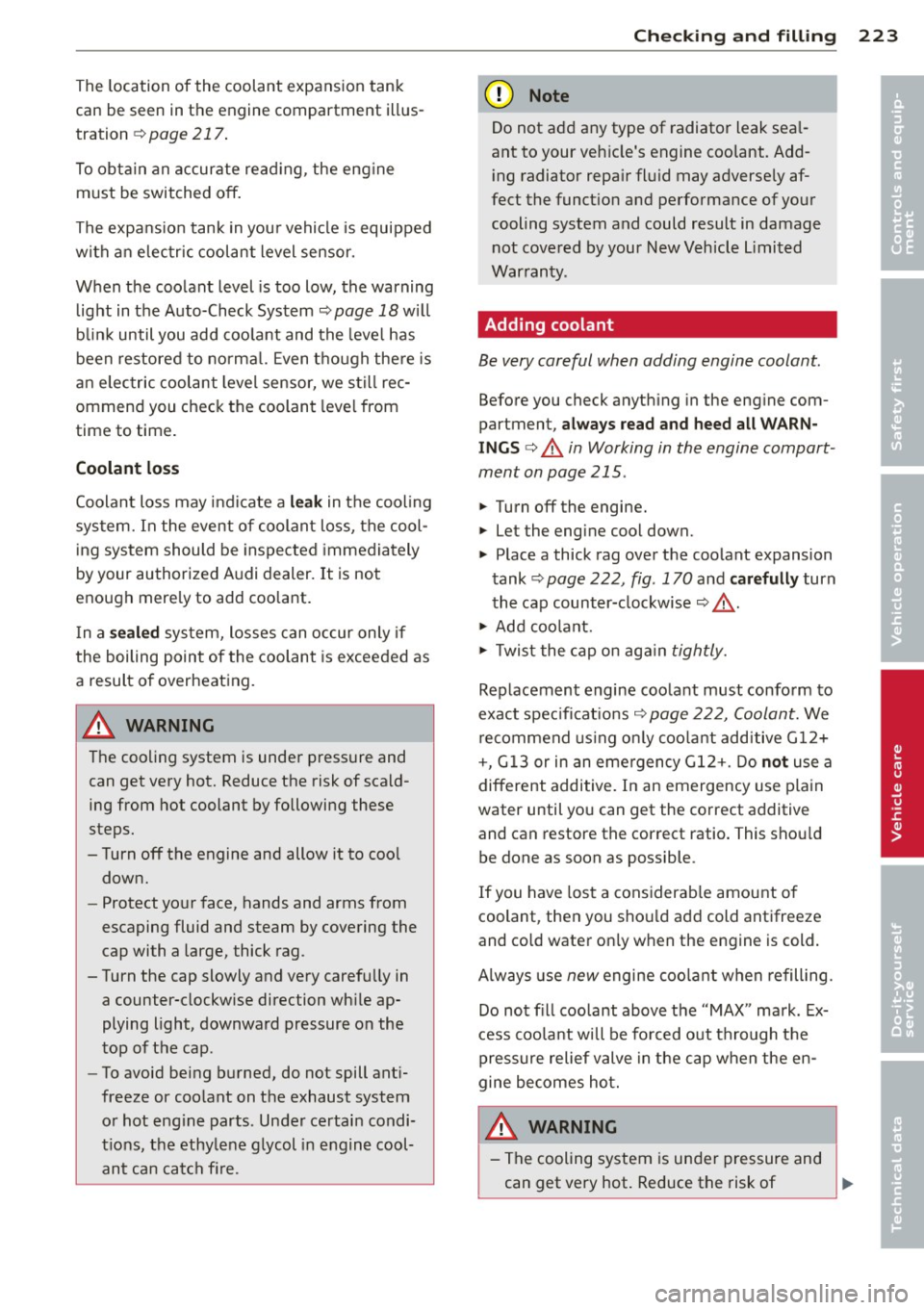
The location of the coolant expansion tank
can be seen in the engine compartment illus
tration
q page 217 .
To obtain an accurate read ing , the eng ine
must be switched off .
The expa nsion tank in you r vehicle is equipped
with an elec tric coolant level sensor.
When the coolant level is too low, the warning
light in the Auto-Check System
q page 18 wi ll
b lin k until you add coo lant and the level has
been restored to norma l. Even t hough the re is
an e lec tric coolant level sensor, we s till rec
ommend you check the coolant leve l from
time to time .
Coolant loss
Coolant loss may indi cate a leak in the coo ling
sys tem. In the event of coolant loss, the cool
ing system should be inspected immedia tely
by your authorized A udi dealer. It is not
enough merely to add coolant.
I n a
s ealed system, losses can occur only if
the boiling point of the coolant is exceeded as
a result of overheating.
A WARNING
The cooling system is unde r press ure and
can get ve ry hot. Reduce the risk of sca ld
ing from hot coolant by following these
steps.
- Turn off the engine and allow it to coo l
down.
- Protect yo ur face, hands and arms from
escaping fluid and steam by covering the
cap with a large, thick rag.
- Turn the cap slowly and very carefu lly in
a counter-clockwise direction wh ile ap
plying light, downward pressure on the
t op of the cap .
- To avoid being bu rned, do not spill ant i
freeze or coo lant on the exhaust system
o r hot eng ine parts . Unde r certai n condi
t ions, the ethy lene g lycol in engine cool
an t ca n catc h fire.
Checkin g and fillin g 223
@ Note
Do not ad d any type of radiator leak sea l
ant to your ve hicle's engine coolant. Add
i ng radiator repa ir flui d may adverse ly af
fect the funct ion and performance of your
cooling system and could result in damage not cove red by your New Vehicle l imi ted
Warranty .
Adding coolant
Be very careful when adding engine coolant.
Before you check anyth ing in the eng ine com
partment,
always read and heed all WARN
INGS q & in Working in the engine compart
ment on page
215 .
.,. Turn off the engine.
.,. let the engi ne cool down.
.,. Place a thick rag over the coolant expansion
tank
q page 222, fig . 170 and carefully turn
the cap counter-clockwise
q &_ .
.,. Add coo la nt.
.,. Twist the cap o n aga in
tightly.
Rep lacement engine coo lant must confo rm to
exact spec ificat ions
q page 222, Coolant. We
recommend using on ly coo lant additive G 12+
+ , G 13 or in an eme rgency G12+. Do
not use a
different additive. In an emergency use pla in
water until you can get the correct additive
and can restore the correct ratio . This sho uld
be done as soon as possible.
If you have los t a cons iderab le amount o f
coolant , then you sho uld add cold antifreeze
and co ld water on ly when the engine is cold.
A lw ays use
new engine coo lant w hen refilling.
Do not f ill coo lant above t he "MAX" mark. Ex
cess coola nt w ill be fo rced o ut through t he
pressure relief valve in the cap when the en
gine becomes hot.
A WARNING
- The cooling system is under pressure and
can get very hot. Reduce the risk of ..,.
•
•
Page 261 of 294
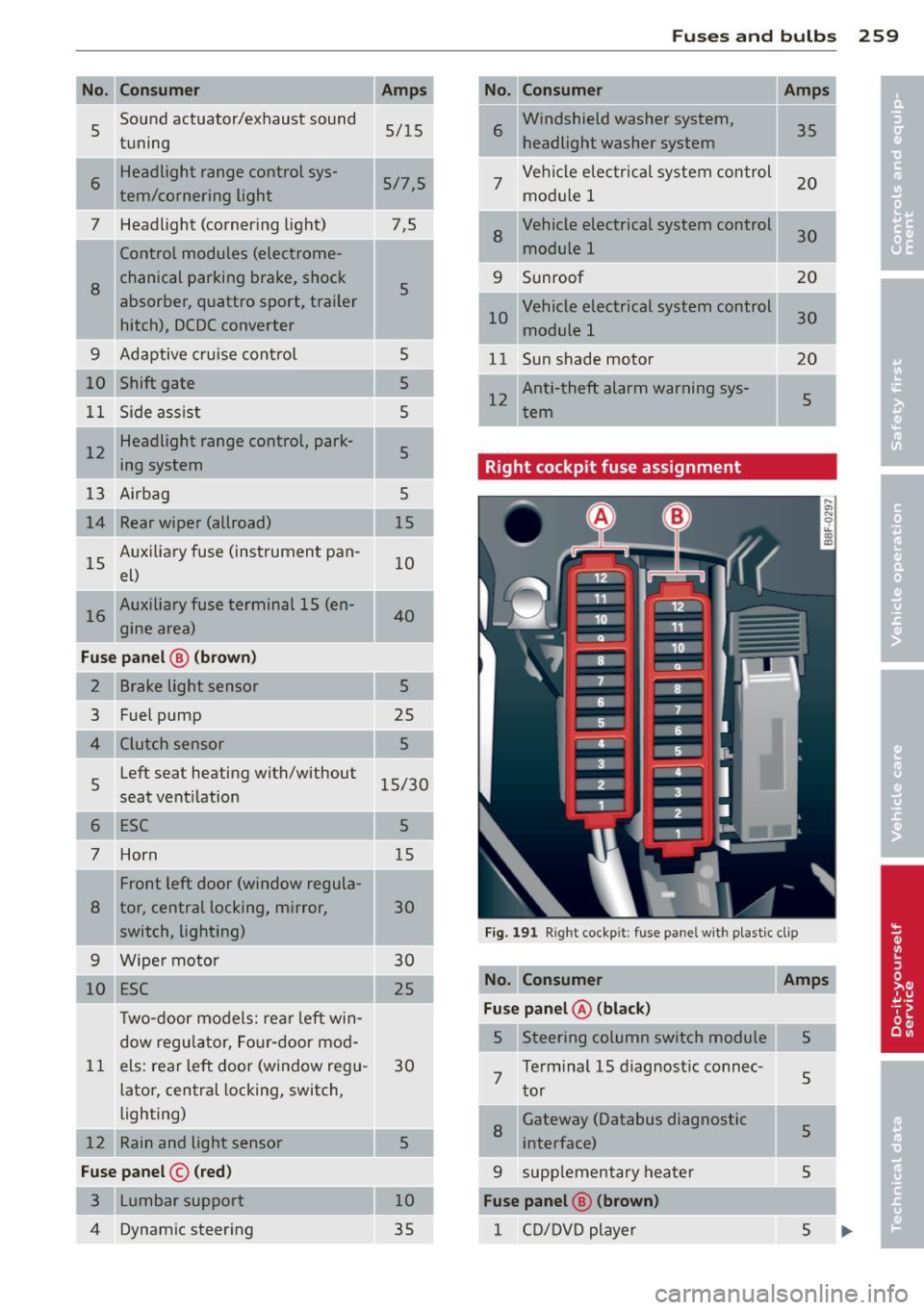
Fuses and bulbs 259
-No. No. Consumer Amps
5 Sound
actuato r/exhaust sound
5/15
tuning 6
Windshield washer system,
35
headlight washer system
.
6 Headlight range control sys-
5/7,5
tern/cornering light 7 Vehicle electrical system control
20
module 1
7 Headlight (cornering light) 7,5
Control modules (electrome-
8
Vehicle electrical system control
30
module 1
'
8
chanical parking brake, shock
5
absorber, quattro sport, trailer
hitch), DCDC converter 9 Sunroof 20
10 Vehicle electrical system control
30
module
1
9 Adaptive cruise control 5
11 Sun shade motor 20
10 Shift gate
5
11 Side assist 5 12 Anti-theft alarm
warning sys-
5
tern
I 12 Headlight range control, park-
5
ing system
Right cockpit fuse assignment
13 Airbag 5
14 Rear wiper (allroad) 15
15 Auxiliary fuse (instrument pan-
10
el)
I 16 Auxiliary fuse terminal 15 (en-
40
gine area)
Fuse panel @ (brown)
2 Brake light sensor 5
3 Fuel pump
25
4
5 Left seat
heating with/without
15/30
seat ventilation
6
7 Horn Front left door (window regula-
8 tor, central locking, mirror, 30
switch, lighting)
Fig. 191 Right cockpit : fuse panel with plastic cl ip
9 Wiper motor 30
10 ESC 25
No. Consumer Amps
Two-door models: rear left win-Fuse panel @ (black)
dow regulator, Four-door mod- 5 Steering column switch module 5
11
els:
rear left door (window regu-
30
lator, central locking, switch, 7 Terminal 15 diagnostic connec-
5
tor
lighting)
12 Rain and light sensor 5
8
Gateway (Databus diagnostic
5
interface)
-..
Fuse panel © (red) 9 supplementary heater 5
3
Fuse panel @ (brown)
4 Dynamic steering
1 CD/DVD player 5
Page 262 of 294
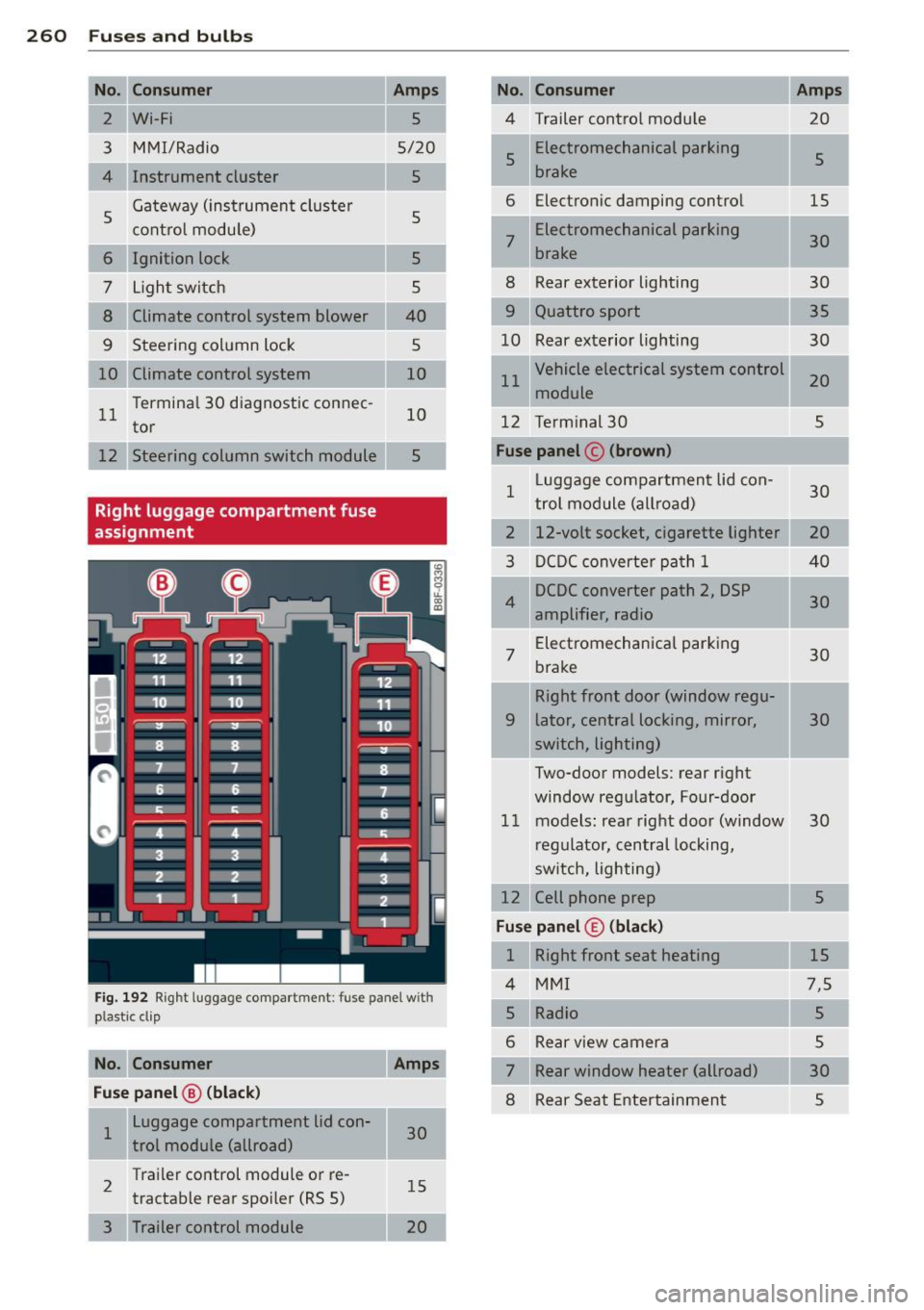
260 Fuses a nd bulb s
I
-No. Consumer
2 Wi-Fi
3 MMI/Radio
4 Instrument cluster
5 Ga
teway (instrument cluster
control module)
6 Ignition lock
7 L igh t switch
8 Climate control system blower
9 Steer ing column lock
10 Climate control system
11 Termina
l 30 diagnostic connec-
tor
12 Steering column switch module
Right luggage compartment fuse
assignment
Amps
5
5/20
5
5 5
5
40 5
10
10
5
Fig. 192 R ig ht l uggag e compar tmen t: fu se pan el w ith
plas tic cl ip
No. Con sumer Amps
Fu se pan el
@ (bl ack )
1 Luggage compartment lid con-
30
trol module (allroad)
2 Trail
er control module or re-
15
tractable rear spoiler (RS 5)
3 Trailer control module
20
No . Consumer
4 Trailer contro l modu le
5 Electromechanical parking
5
brake
6 Elec tronic damping control
15
--
7 Electromechanical parking
30
brake
8 Rear exterior lighting 30
9 Quattro sport
10 Rear exterior lighting
11 Vehicle electrical system control
20
module
12 Te rminal 30 5
Fuse panel© (brown )
1 L
uggage compartment lid con-
30
trol module (all road)
2 12-volt socket, cigarette lighter
20
3 DCDC converter pa th 1 40
4 DCDC converter path 2, DSP
30
amplifier , radio
7 Electromechanical parking
30
b rake
Right front door (window regu-
9 lator, central locking, mirror, 30
switch, lighting)
Two-door models : rear righ t
window regu lator, Four-door
11 models : rear right door (window
30
regulator, central locking,
switch, lighting)
Cell phone prep 5
Fuse panel © (blac k)
1 Right front seat heating
15
4 MMI 7,5
5 Radio 5
6 Rear view camera 5
7 Rear window heater (allroad)
30
8 Rear Seat Entertainment 5
Page 283 of 294
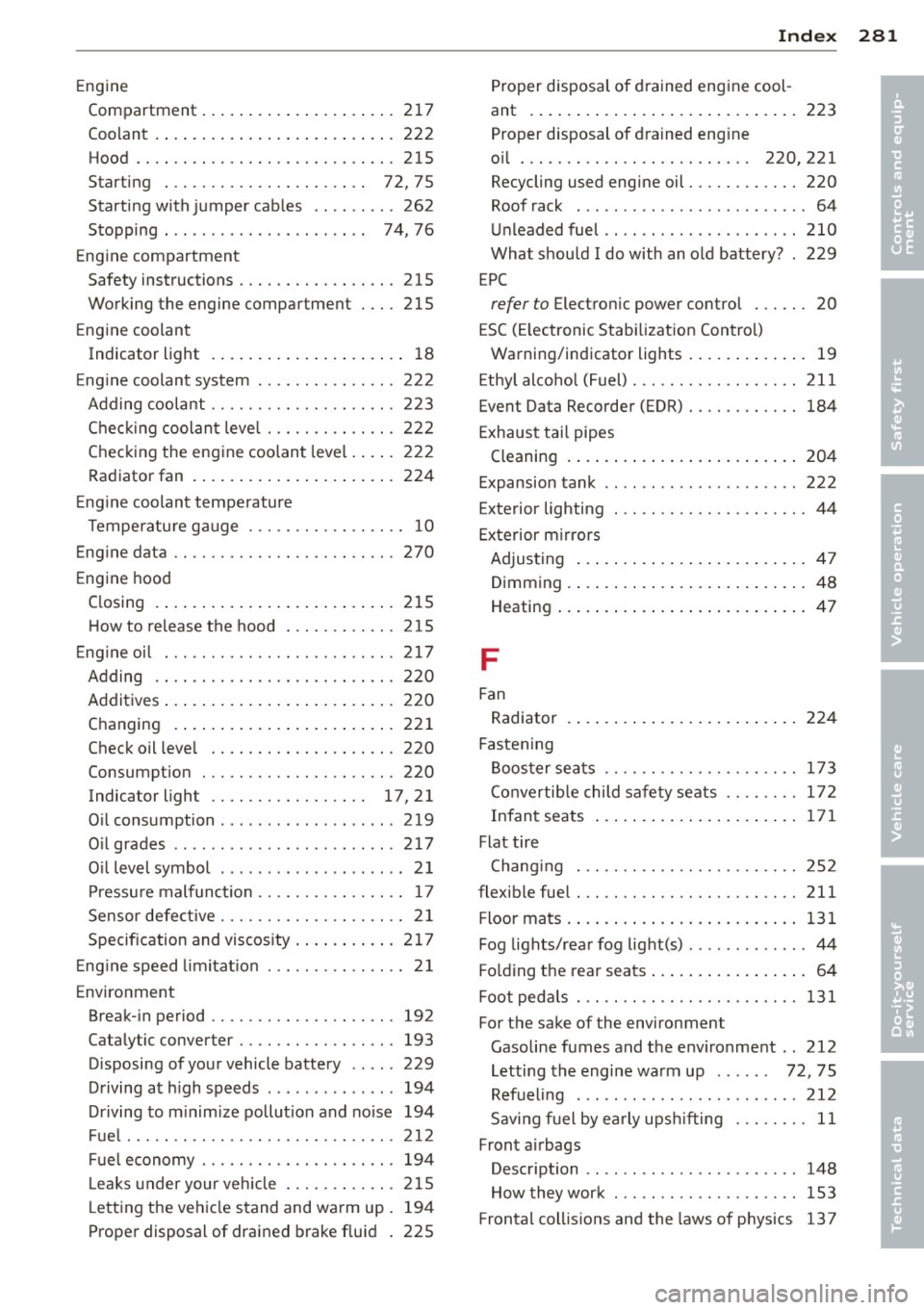
Engine Compartment ................ .. ... 217
Coolant .. .. ................. .. .. . 222
Hood .... .. ................. .. ... 215
Starting . . . . . . . . . . . . . . . . . . . . . . 72, 75
Starting with jumper cables .. .. . ... . 262
Stopping . . . . . . . . . . . . . . . . . . . . . . 74, 76
Engine compartment Safety instructions ........ .. .. .. .. . 215
Working the engine compartment 215
Engine coolant
Indicator light . . . . . . . . . . . . . . . . . . . . . 18
Engine coolant system ...... .. .. .. .. . 222
Adding coolant ........... .... .. .. . 223
Checking coolant leve l ..... .. .. .. .. . 222
Checking the engine coolant level .. .. . 222
Radiator fan ................ ... ... 224
Engine coolant temperature
Temperatu re gauge ....... .. .. .. .. .. 10
Engine data .. ............. .... .. ... 270
Engine hood Closing . . . . . . . . . . . . . . . . . . . . . . . . . . 215
How to release the hood ... .. .. .. .. . 215
Engine oil ... .. ........... .. .. .. ... 217
Adding .. .. ............. .... .. ... 220
Additives ... ................ ... ... 220
Changing . ................. ... ... 221
Check oil level ........... .. .. .. ... 220
Consumption ............ .... .. .. . 220
Indicator light ........... .. .. .. 17,21
Oil consumption . ............. ... .. 219
Oil grades ................ ... ... .. 217
O il level symbol ............. ... ... . 21
Pressure malfunction ...... .. .. .. .. .. 17
Sensor defective . . . . . . . . . . . . . . . . . . . . 21
Specification and viscosity . . . . . . . . . . . 217
Engine speed limitation ........ .... ... 21
Environment Break-in period ........... .... .. ... 192
Catalytic converter ........ .. .. .. .. . 193
Disposing of your vehicle battery .. .. . 229
Driving at high speeds .......... .... 194
Driving to minimize pollution and noise 194
Fuel ..... .. ................. .. ... 212
Fuel economy . ........... .. .. .. ... 194
Leaks under your vehicle ... .. .. .. .. . 215
Letting the vehicle stand and warm up. 194
Proper disposal of drained brake fluid . 225
Index 281
Proper disposal of drained engine cool-
ant ....... ... .... ............... 223
Proper disposal of drained eng ine
oil . . . . . . . . . . . . . . . . . . . . . . . . . 220, 221
Recycling used engine oil ............ 220
Roof rack . . . . . . . . . . . . . . . . . . . . . . . . . 64
Unleaded fuel .. .. .. . .. .... ........ 210
What should I do with an old battery? . 229
EPC
refer to E lectronic power control . . . . . . 20
ESC (Electronic Stabilization Control)
Warning/indicator lights ............. 19
Ethyl alcohol (Fuel) . . . . . . . . . . . . . . . . . . 211
Event Data Recorder (EDR) ............ 184
Exhaust tail pipes
Cleaning ... ..... .. ............... 204
Expansion tank .. .. .. ............... 222
Exterior lighting . .. ............... .. .
44
Exterior mirrors
Adjusting ..... .... ................ 47
Dimming ... ..... .. ................ 48
Heating ....... .... ................ 47
F
Fan
Radiator 224
Fastening Booster seats .. .. .... ......... .... 173
Convertib le child safety seats .... .. .. 172
Infant seats ..... ................. 171
Flat tire
Chang ing ... .. .... ... .......... .. 252
flexible fuel . .. .. .. .. .. ........... .. 211
Floor mats ... ... .... ............... 131
Fog lights/rear fog light(s) ............. 44
Fo lding the rear seats ............... .. 64
Foot pedals . .. .. .. .. . .............. 131
For the sake of the environment Gasoline fumes and the environment .. 212
Letting the engine warm up . . . . . . 72, 75
Refueling . .. .. .. .. ............... 212
Saving fuel by early upsh ifting ..... .. . 11
Front airbags Description . . . . . . . . . . . . . . . . . . . . . . . 148
How they work ... .. ... ....... .... . 153
Frontal collisions and the laws of physics 137
•
•
Page 284 of 294
282 Index
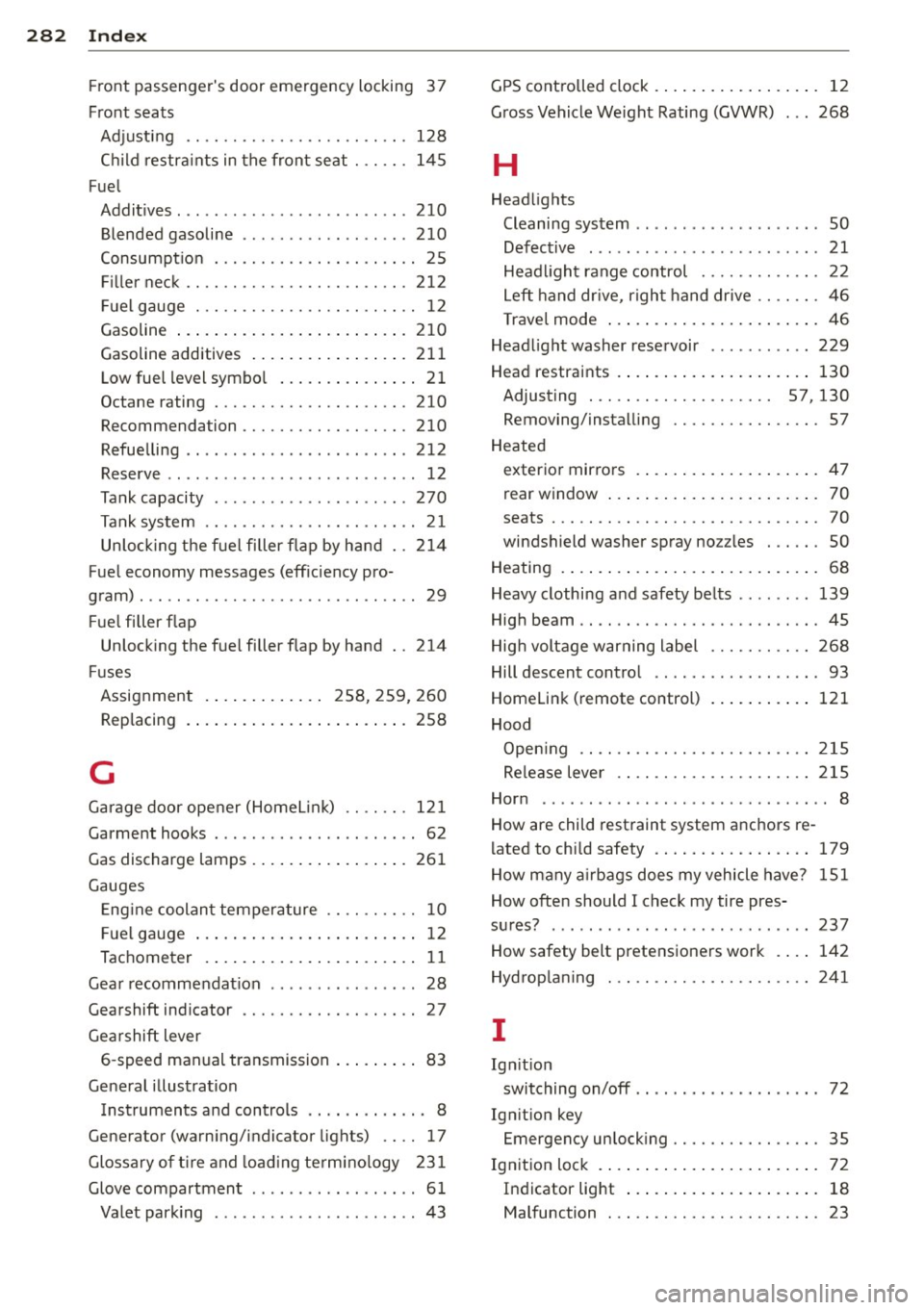
Front passenger's door emergency locking 3 7
Front seats Adjusting .... ............. .. .... . 128
Ch ild restra ints in the front seat ... ... 145
Fuel Addit ives . .. .......... ...... ... .. . 210
Blended gasoline .......... ... .. ... 210
Consumpt ion .......... .. .. .. .. .. .. 25
Fill er neck .... ........... .. .. .... . 212
Fu el gauge ............ .. .. .. .. .. .. 12
Gasoline ... ............ ... .. .... . 210
Gasoline additives ................ . 211
Low fuel level symbo l . . . . . . . . . . . . . . . 21
Octane rating ............ .. .. .. .. . 210
Recommendation ............. .... . 210
Refuelling .. .......... ...... ... .. . 212
Reserve .... .......... ...... ... .. .. 12
Tank capacity ............. ... .. ... 270
Tank system ........... .. .. .. .. .. .. 21
Un locki ng the f uel filler flap by hand .. 214
Fuel economy messages (eff iciency pro-
gram) ..... .. ................ ... .. .. 29
Fu el filler f lap
Unlocking the fuel filler f lap by hand .. 214
Fu ses
Assignment . . . . . . . . . . . . . 258, 259, 260
Replacing . . . . . . . . . . . . . . . . . . . . . . . . 258
G
Garage door opener (Homel ink) .. .. .. . 121
Garment hooks . . . . . . . . . . . . . . . . . . . . . . 62
Gas discharge lamps ....... ... .. .. .. . 261
Gauges Eng ine coolant temperature .. .. .. .... 10
Fu el gauge .... ........ .......... .. 12
Tachometer . . . . . . . . . . . . . . . . . . . . . . . 11
Gear recommendation ....... ... .. .. .. 28
Gearshift indicator ........... .. .... .. 27
Gearshift lever
6-speed manual transmission . . . . . . . . . 83
General illustration
I nstruments and controls . . . . . . . . . . . . . 8
Generator (warn ing/indicator lights) .... 17
Glossary of tire and load ing terminology 231
Glove compartment ............ .. .... 61
Valet park ing .. .... ...... .. .. .. .. .. 43 GPS
cont rolled clock . .. ...... .... ..... 12
Gross Vehicle Weight Rating (GVWR) ... 268
H
Headlights
Cleaning system . . . . . . . . . . . . . . . . . . . . 50
Defect ive . . . . . . . . . . . . . . . . . . . . . . . . . 21
Headlight range control ........ .... . 22
Left hand drive, right hand drive .. .. .. . 46
T ravel mode ... .. ............ ... .. . 46
Headlight washer reservoir ........ ... 229
Head restraints .... ... ....... ..... .. 130
Adjusting . . . . . . . . . . . . . . . . . . . . 57, 130
Removing/installing ........... .. .. . 57
Heated exterior mirrors . .... ...... ........ . 47
rear window . . . . . . . . . . . . . . . . . . . . . . . 70
seats . .... .... ................... . 70
windshield washer spray no zzles . . . . . . 50
Heating ... ..... .. .. ............ ... . 68
Heavy clothing and safety belts .. .. .. .. 139
High beam .. .... .. ............. .... . 45
High voltage warning label ..... .. .. .. 268
Hill descent control .. .... .... ... .. .. . 93
Homelink (remote control) ......... .. 121
Hood Open ing .. .... .. ............. .... 215
Release lever .. .. ............. .... 215
Horn .. ..... ... .. .. ... ........... ... 8
How are child restraint system anchors re-
l ated to chi ld safety . ............... . 179
How many a irbags does my vehicle have? 151
How often should I check my tire pres-
sures? ........ ... .. .............. . 237
How safety belt pretensioners work . . . . 142
Hydroplaning 241
I
Ignit ion
switching on/off . . . . . . . . . . . . . . . . . . . . 72
Ign ition key
Emergency unlock ing ........... .. .. . 35
Ignition lock .... .. .......... ........ 72
Indicator light ... ..... ...... ...... . 18
Malfunction ..... ... .......... .... . 23
Page 288 of 294
286 Index
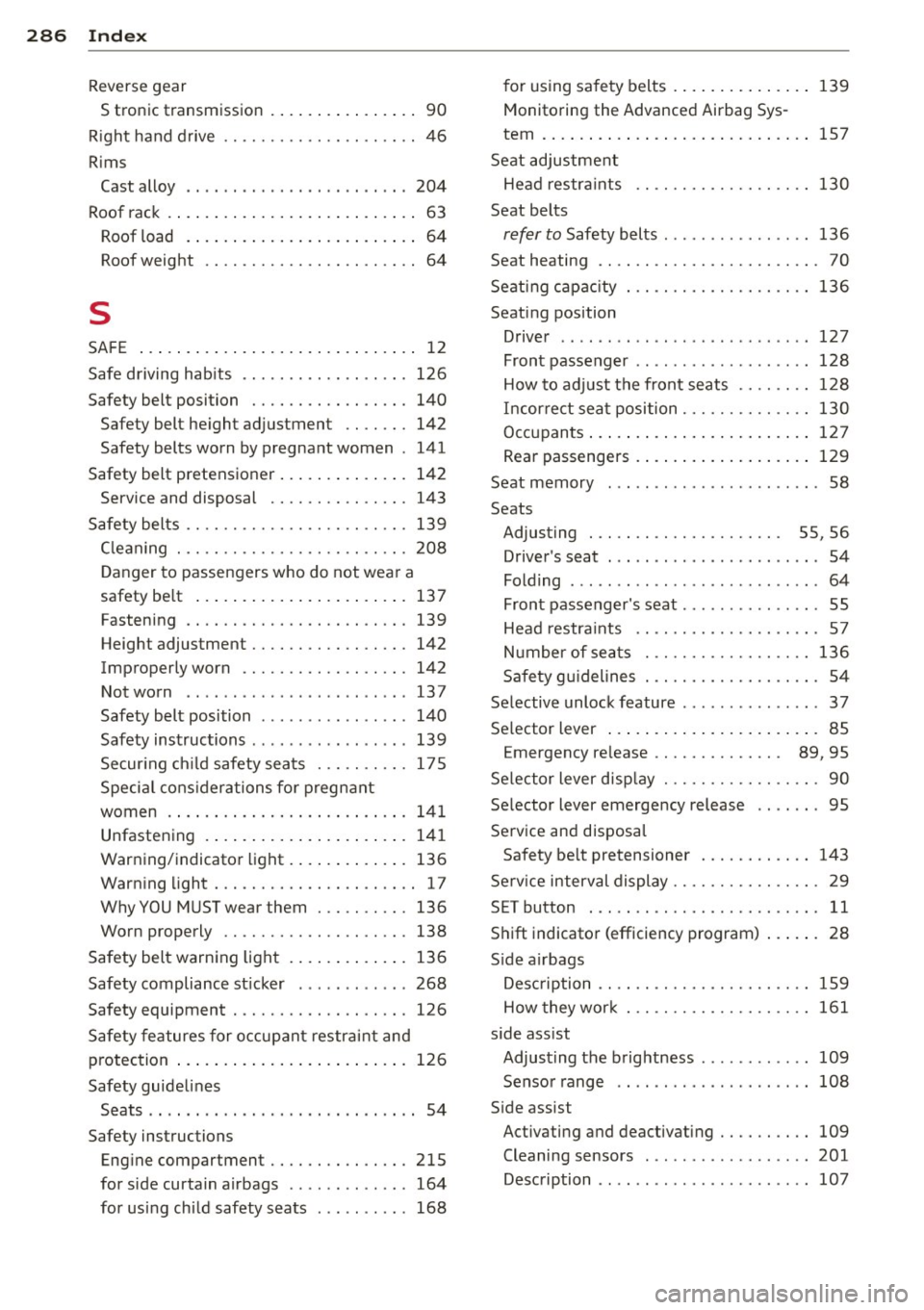
Reverse gear S tronic transmission . ... .. .. ... ... .. 90
R ight hand d rive ........... .... .... .. 46
R ims
Cast alloy .. ... . ...... ... .. .. .. .. . 204
Roof rac k . . . . . . . . . . . . . . . . . . . . . . . . . . . 63
Roof load . . . . . . . . . . . . . . . . . . . . . . . . . 64
Roof weight . . . . . . . . . . . . . . . . . . . . . . . 64
s
SA FE ..... .. ... .. ..... ... .. .. .... .. 12
Safe driving hab its ...... ... .. .. .. .. . 126
Safety belt position . . . . . . . . . . . . . . . . . 140
Safety belt he ight adjustment .. .... . 142
Safety belts worn by pregnant women . 141
Safety belt pretensioner ... .. .. .. .... . 142
Service and disposal . . . . . . . . . . . . . . . 143
Safety belts .... ........... .. .. .... . 139
C leaning . .. ............. .... .. .. . 208
D anger to passengers who do not wea r a
safety be lt . . . . . . . . . . . . . . . . . . . . . . . 13 7
Fastening .... ........... .. .. .... . 139
Height adjustment ........ .. .. .. .. . 142
Improperly worn . . . . . . . . . . . . . . . . . . 142
Not worn .. .................. .... 137
Safety belt position ........ ... .. .. . 140
Safety instructions . . . . . . . . . . . . . . . . . 139
Secur ing c hild safety sea ts . .. .. .. ... 175
Speci al consider ations fo r pregnant
women . ... .. .. ...... ... .. .. .... . 141
Unfasten ing . .. .. ..... ... .. .. .... . 141
Warning/ indicato r light . ... .. .. .. .. . 136
Warn ing light . ........... .. .. .... .. 17
WhyYOU M USTwearthem . .. .. .. ... 136
Worn properly ............. .. .... . 138
Safety belt warning light . ... .. .. .... . 13 6
Safety compliance st icker . ...... .. .. . 268
Safety equipment ............ .. .... . 126
Safety fe atures for o ccup ant restra int and
p rotec tion ... ... .. ..... ... .. .. .... . 12 6
Safety guidel ines
Seats .. .. .. ........ ..... .. ........ S4
Safety instructions Eng ine compartment ...... .. .. .. .. . 215
for side curtain a irbags .. .. .. .. .. .. . 164
for us ing chi ld safety seats ..... .. ... 168 f
o r using sa fe ty belts . .. ..... ... .. .. 139
Monito ring the Advanced Airbag Sys-
tem . ... .. .. .. .. .. ... .. ..... ... .. 157
Seat adjustment He ad restra ints .. ............. .... 130
Seat belts
refer to Safety belts ............... . 136
Seat heating ...... ............. .... . 70
Se ating c apac ity . .. ... .......... .. .. 136
Seating pos ition
D rive r ... ... .. .. .. ... ... ... .. .. .. 127
Front passeng er .. .......... ...... . 128
How to ad just the fron t seats .. .. .. .. 1 28
Incor re ct sea t position .......... .. .. 130
Occ upan ts ..... .. ... .. ..... ... .. .. 12 7
Rear passengers . .... .. ..... .... . .. 129
Seat memory . . . . . . . . . . . . . . . . . . . . . . . 58
Seats Adjusting . . . . . . . . . . . . . . . . . . . . . 5S, 56
Driver's seat . . . . . . . . . . . . . . . . . . . . . . . 54
Folding ....... .. .. ... ....... ... .. . 64
Front passenger's seat . . . . . . . . . . . . . . . 5S
Head restra ints .. ... .......... .. .. . 57
N umber of sea ts . ............. .. .. 136
Sa fe ty g uid elines ................ .. . 54
Se lective unlock feature . . . . . . . . . . . . . . . 3 7
Se lector lever ..... .. ... ..... ... .. .. . 8S
Emergency re lease . . . . . . . . . . . . . . 89, 9S
Se lector lever d isp lay . ........... .. .. . 90
Se lector lever emergency release ...... . 9S
Se rvice and disposa l
Safety be lt pretensioner . . . . . . . . . . . . 143
Se rv ice interv al d is play . . . . . . . . . . . . . . . . 29
SET button . . . . . . . . . . . . . . . . . . . . . . . . . 11
S hi ft indicato r (efficiency program) ... .. . 28
S ide a irbags
Des cription ...... ............. .... 159
How they wor k ... ............. .... 161
s ide ass ist
Adjus ting the b rightness . ........... 109
Senso r range .. .. ................ . 108
S ide assist
Activati ng and deactivating .... .. .. .. 109
Cleaning sensors .... .. .. ... ..... .. 201
Desc ription .. .. .. .......... ... ... . 107