hood AUDI A4 SEDAN 2013 User Guide
[x] Cancel search | Manufacturer: AUDI, Model Year: 2013, Model line: A4 SEDAN, Model: AUDI A4 SEDAN 2013Pages: 294, PDF Size: 73.71 MB
Page 87 of 294
necessary to keep the vehicle from
rolling.
- If the selector lever is unintentionally
moved into N while you are driving, take
your foot
off the accelerator pedal and
wait for the engine to return to idle
speed before selecting a driving position .
- Never shift into R or P when the vehicle is
in motion .
- Never get out of the driver's seat when
the engine is running.
- If you must get out of the vehicle, move
the selector lever securely into the P po
sit ion and apply the parking brake firmly.
- If the engine must remain running, never
have any driving position engaged when
checking under the hood . Make sure the
selector lever has securely engaged and
is locked in P with the parking brake
firmly set ¢
page 208, Engine compart
ment.
Otherwise, any increase in engine
speed may set the vehicle in motion,
even with the parking brake applied.
(D Tips
For safety reasons, the parking brake is re
leased automatically only when the driv
er 's safety belt is engaged in the buckle.
Selector lever positions
Applies to vehicles: with multit ronic or tiptronic
This section describes the selector lever posi
tions and driving ranges .
2
Radio WXRK
9:30-
12/5/2 011
121 19 .0mpg
1992 mi 40 .4
~= ~p +7 2~
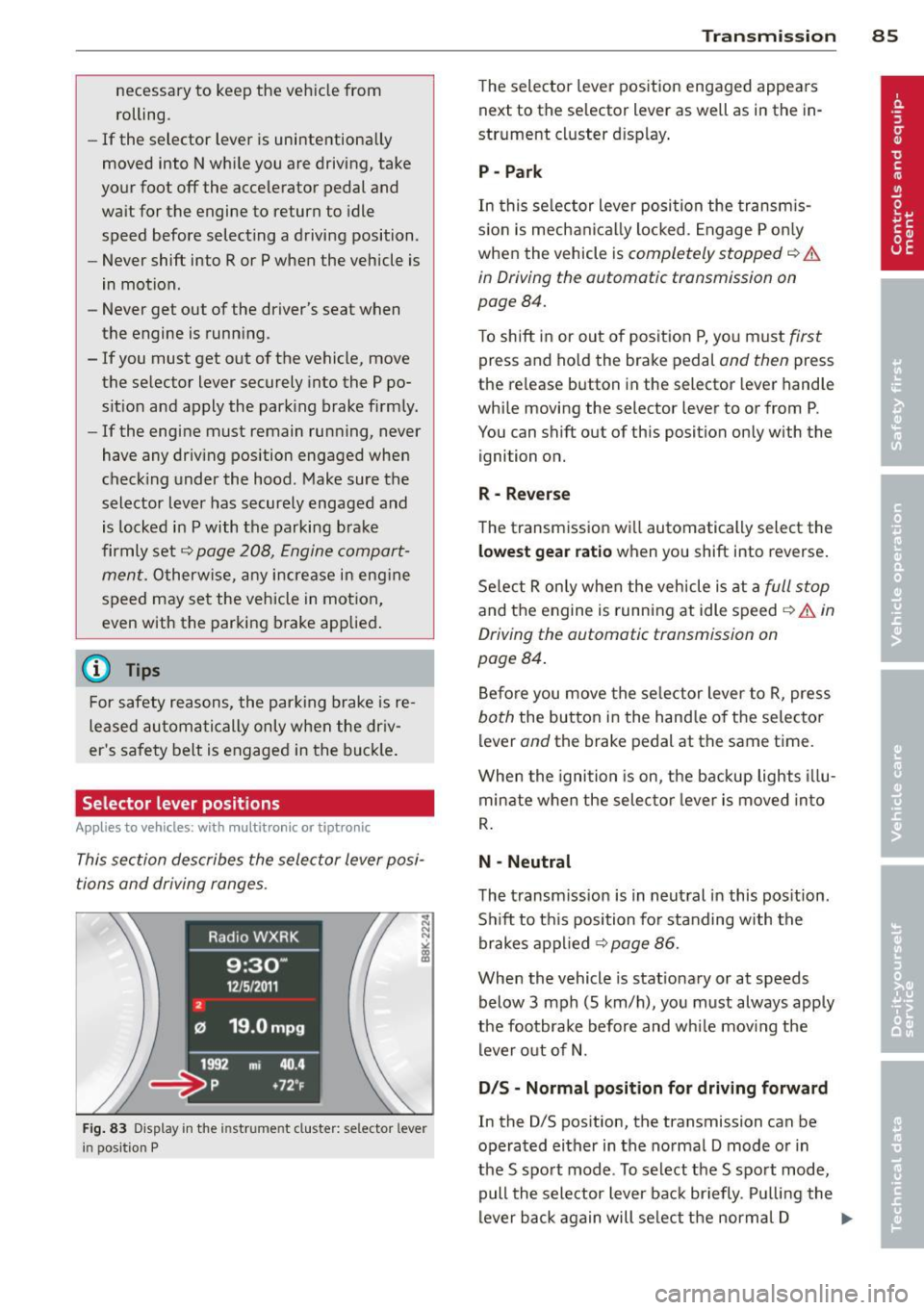
Fig. 83 Display in the in str um ent cluste r: selecto r leve r
i n positi on P
Transmission 85
The selector lever position engaged appears
next to the selector lever as well as in the in
strument cluster display .
P -Park
In this selector lever position the transmis
s ion is mechanically locked. Engage P only
when the vehicle is
completely stopped ¢ &
in Driving the automatic transmission on
page 84.
T o shift in or out of position P, you must first
press and hold the brake pedal and then press
the re lease button in the selector lever handle
while moving the selecto r lever to or from P.
You can shift out of this position only with the
ignition on.
R- Reverse
The transmission will automatically select the
lowest gear ratio when you shift into reverse.
Select R only when the vehicle is at a
full stop
and the engine is running at idle speed ¢ & in
Driving the automatic transmission on
page 84.
Before you move the selector lever to R, press
both the button in the handle of the selector
lever
and the brake pedal at the same time .
When the ignition is on, the backup lights illu
minate when the selector lever is moved into
R.
N -Neutral
The transmission is in neutral in this position.
Shift to th is position for standing with the
brakes applied ¢
page 86.
When the vehicle is stationary or at speeds
below 3 mph (S km/h), you must always apply
the footbrake before and while mov ing the
lever out of N.
D /S -Normal position for driving forward
In the D/S pos ition, the transmission can be
operated either in the normal D mode or in
the S sport mode . To select the S sport mode,
pull the selector lever back briefly . Pulling the
lever back again will se lect the normal D ...,
Page 92 of 294
90 Transmi ssion
You can a lso shift the gears manually using
tiptron ic, if you like ¢page 93.
Selector lever positions
Appl ies to vehicles: with S tro nic t ransmission
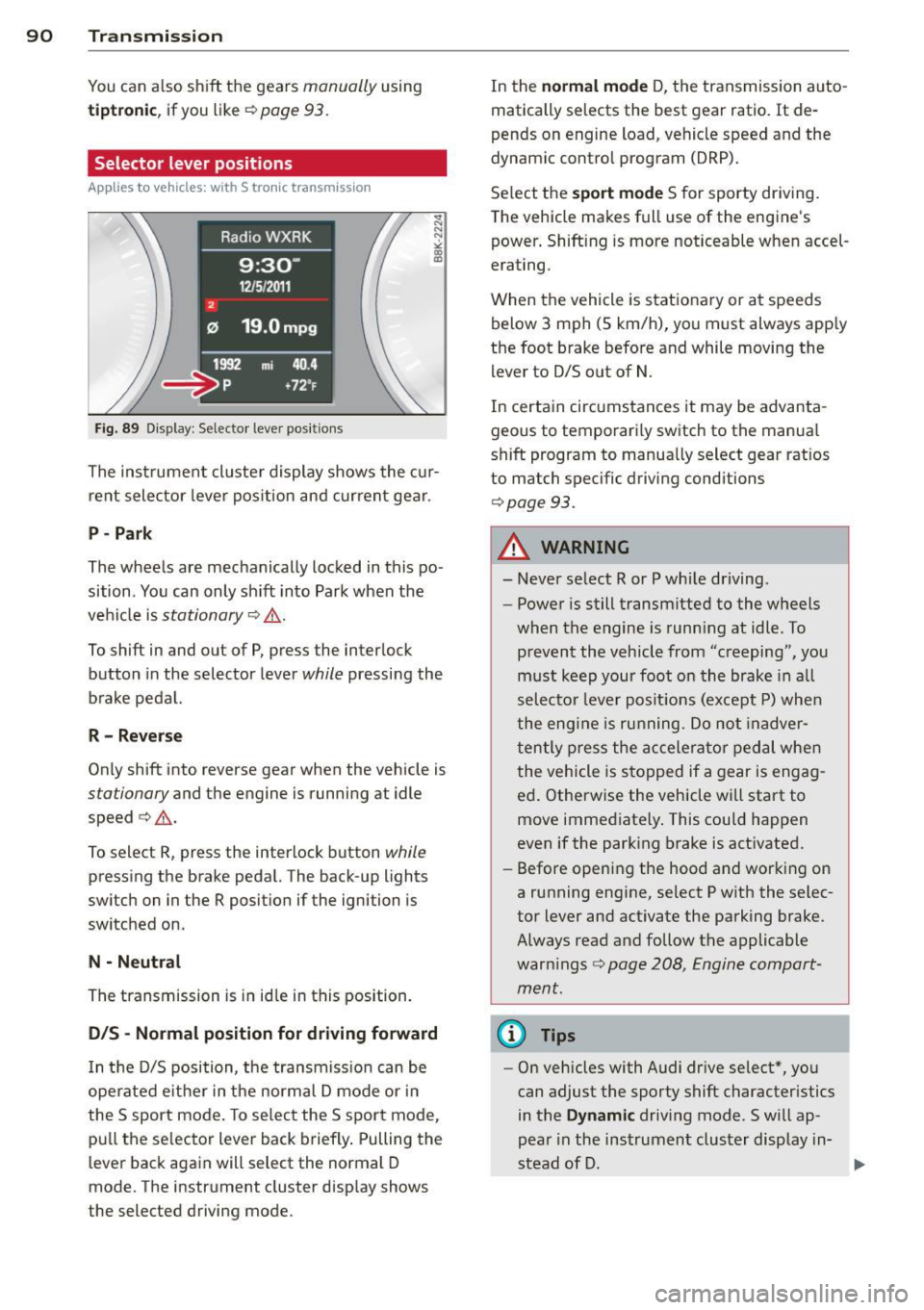
F ig . 89 Display : Selector lever posit io ns
The inst rument cluster display shows the cur
rent selector lever position and current gear .
P-Park
The wheels are mechanically locked in this po
sition . You can only sh ift into Park when the
vehicle is
stationary ¢,&. .
To shift in and out of P, press the inter lock
button in the selector lever
while pressing the
brake pedal.
R - Re verse
Only shift into reverse gear when the vehicle is
stationary and the engine is running at idle
speed ¢.&. .
To select R, press the interlock button
while
pressing the brake pedal. The back-up lights
switch on in the R posit ion if the ignition is
switched on.
N -N eutral
The transmission is in id le in this position.
0 /5 -Normal position for driving forward
In t he D/S position, the transmiss io n can be
ope rated e ither in the normal D mode or i n
the S sport mode . To select the S sport mode,
pu ll the se lector lever back brief ly . Pulling the
l ever back again will select the normal D
mode. The instrument cluster disp lay shows
the selected driving mode. In the
n
o rmal mode D, the transmission auto
matically selects the best gear ratio.
It de
pends on engine load, vehicle speed and the
dynamic contro l program (DRP).
Se lect the
s port m ode S for sporty driving.
T he vehicle makes full use of the engine's
power . Shift ing is more noticeable when accel
erating.
When the vehicle is stationary or at speeds below 3 mph (5 km/h), you must always app ly
the foot brake before and while moving the l ever to D/S out of N.
In certain circumstances it may be advanta
geous to temporari ly switch to the manua l
shift program to manua lly select gear ratios
to match specific driving conditions
¢ page 93.
A WARNING
-- Never select R or P whi le driving .
- Power is still transmitted to the wheels
when the engine is runn ing at idle . To
prevent the vehicle from "creeping", you
m ust keep your foot on the brake in a ll
selecto r lever posit ions (except P) whe n
the eng ine is ru nning. Do not inadver
t en tly press the a ccelera tor pedal when
the vehicle is s topped if a gear is engag
ed . Otherwise the vehicle will start to
move immediate ly . This could happen
even if the park ing brake is act ivated.
- Before opening the hood and working on
a running engine, select P w ith the selec
tor lever and activate the parking brake. Always read and follow the applicable
war nings
c>page 208, Engine compart
ment.
@ Tips
- On vehicles with Audi dr ive select* , yo u
can adjust the sporty shift character istics
in the
Dynami c driving mode.Swill ap-
pear in the ins trument cluster display in-
stead of D. ..,.
Page 155 of 294
BAG OFF light comes on and stays on to tell
you when the front Advanced Airbag on the
passenger side has been turned
off
c:> page 145, Child restraints on the front seat
- some important things to know.
A WARNING
To reduce the risk of injury whe n an airbag
inflates, always wear safety belts properly .
- If you are unrestrained, lean ing forward,
sitting sideways or out of position in any
way, your risk of injury is much highe r.
- You w ill also receive serious injuries and
could even be killed if you are up against
the a irbag or too close to it when it in
flates -even with an Advanced Airbag
c:> page 144.
More important things to know about
front airbags
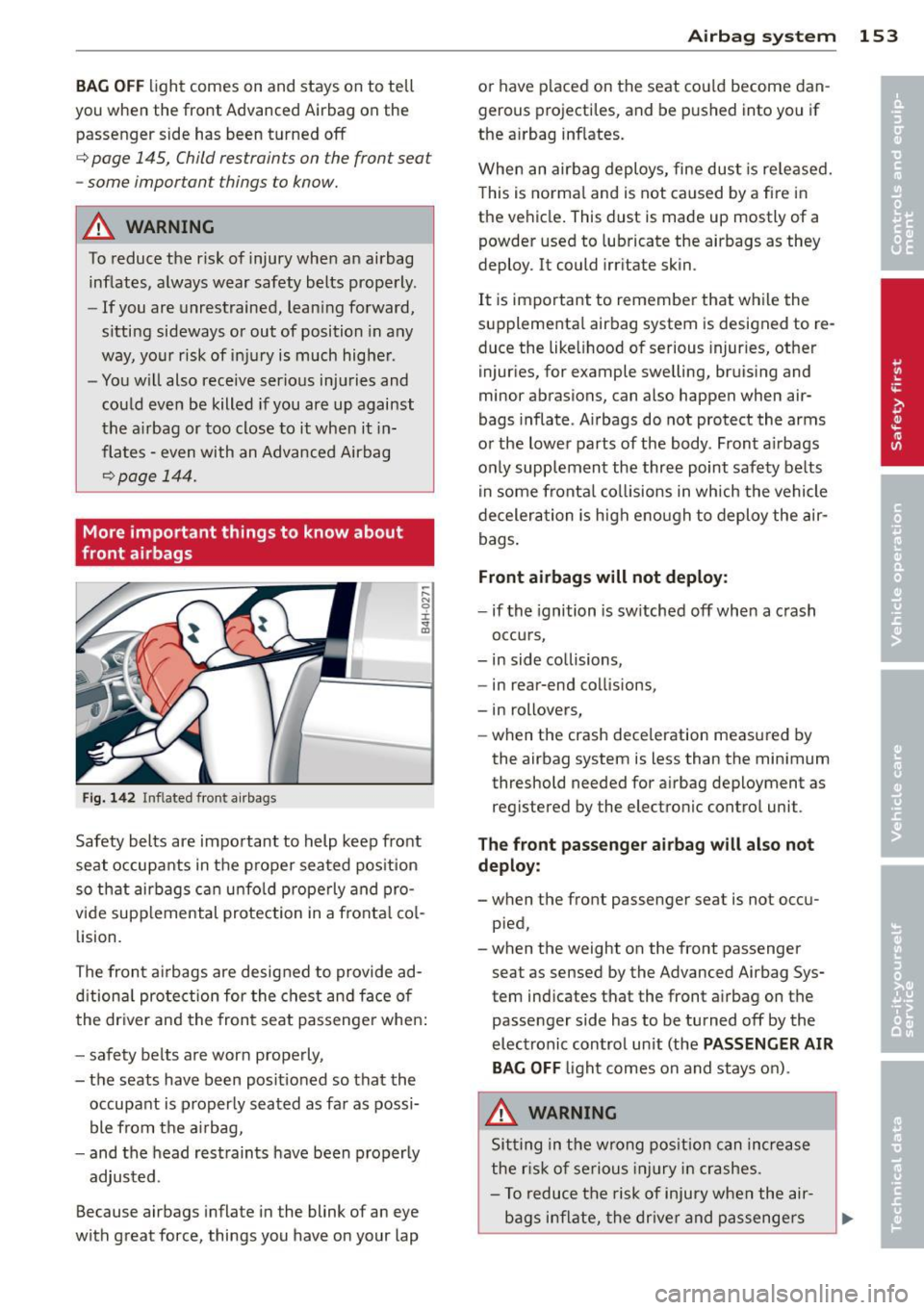
Fi g. 1 42 Inflated front a irbags
Safety belts are important to help keep front
seat occupants in the proper sea ted pos ition
so that airbags c an u nfo ld properly and pro
vide supp lemental protection in a fronta l co l
lision.
The front a irbags are designed to provide ad
d itiona l protection for the chest and face of
the dr iver and the front seat passenge r when:
- safety belts are worn properly,
- the seats have been posit io ned so that the
occupant is p roperly seated as far as possi
ble from the a irbag,
- and the head restraints have been properly
adjusted.
Because airbags inflate in the blink of an eye
with great force, things you have on your lap
A irba g sy stem 153
or have p laced on the seat co uld become dan
gerous projectiles, and be p ushed into you if
the a irbag inf lates.
When an airbag deploys, fine dust is re leased.
T his is norma l and is not caused by a fi re in
the ve hicle . This dust is made up mostly of a
powder used to lubricate the airbags as they
deploy. It could irr itate skin .
It is important to remembe r that wh ile the
supplementa l airbag system is designed to re
duce the like lihood of serious injur ies, other
injuries, for example swelling, bruis ing and
minor abrasions, can also happen when air
bags inflate . A irbags do not protect the arms
o r the lower parts of the body. Front a irbags
on ly supp lement the three point safety belts
in some fronta l co llisions in which the vehicle
decelera tion is high e no ugh to deploy the air
bags .
Front airbags will not deploy :
-if the ignition is sw itched off when a crash
occu rs,
- in side collisions,
- in rear-end collisions,
- in rollovers,
- when the crash deceleration measured by
the airbag system is less than the minimum
threshold needed for a irbag deployment as
reg istered by the electronic control unit .
The front pa sse n ger ai rbag will also not
deplo y:
- when the front passenger seat is not occu
pied,
- when the weight on the front passenger seat as sensed by the Advanced Airbag Sys
tem ind icates that the front airbag on the
passe nger side has to be turned off by the
electronic control unit (the
PAS SENGER A IR
BAG OFF
light comes on and stays on) .
A WARNING
Sitting in the wrong position can increase
the r is k of se rious inj ury in crashes.
- To reduce the risk of injury when the air
bags inflate, the drive r and passenge rs
Page 162 of 294
160 Airbag sys te m
at all times . Each time you turn on the igni
tion, the airbag system indicato r light will
c o me on for a few seconds (self diagnostics).
T he s ide airbag sys tem supp lemen ts the safe
ty belts and can help to reduce the risk of in
jury to the driver's and front passenger's up per torso on the side of the vehicle that is
struck in a side col lision. The airbag deploys
only in s ide impacts and only when the veh icle
acceleration registered by the control un it is
h igh enough .
If this rate is below the refer
ence va lue programmed i nto the control u nit,
the side airbags will not be t riggered, even
though the car may be badly damaged as a re
sult of the collision . It is not possible to de
fine an a irbag tr iggering range that will cover
every possible angle of impact, since the cir
cumstances wi ll vary considerably between
one co llision and another. Important factors
include, for examp le, the nature (hard or soft)
of the impacting object, the ang le of impact,
ve hicle speed, etc. ¢
page 161, Important
safety instructions on the side airbag system.
Aside from the ir normal safety function, safe
ty belts work to he lp keep the driver or front
passenger in posit ion in the event of a side
coll is io n so that the side a irbags can provide
p rotection.
The airbag system is
not a substitute for your
safety bel t. Rathe r, it is pa rt of the overall oc
cupa nt restraint system in your ve hicle. Al
ways remember tha t the side airbag system
can only help to protect yo u if you are wear ing
your safety be lt and wear ing it prope rly. This
is another reason w hy you sho uld always wear
your safety be lts, not just beca use the law re
q ui res you to do so¢
page 136, General
notes.
It is important to remember that whi le the
supp lemental side airbag system is designed
to reduce the like lihood of serious injur ies,
other inj uries, for example, swell ing, bruising,
and minor abras ions can also be associated
with deployed s ide a irbags . Remember too,
side a irbags w ill deploy on ly once and on ly in
certain kinds of accidents -your safety belts
a re a lways there to offer pro tec tion. Vehicle damage,
repair costs o r even the lack
of ve hicle damage are not necessarily a n in di
cation o f ove r-sensitive or failed airbag act iva
t ion. In some coll is ions, both front and side
airbags may inflate. Remember too, that air
bags will deploy only once a nd only in ce rtain
k inds of col lisions -you r sa fety belts are al
ways there to offe r protection in those acc i
den ts in which a irbags a re not supposed to
deploy or when they have a lready deployed .
The side airbag system will not deploy:
- when the ignit io n is t urned off
- in side co llisions when the acceleration
measured by the sensor is too low
- in front-end collisions
- in rear-end co llisions
- in rollove rs .
In some types of accidents t he fro nt airbags,
s ide cu rtain air bags and s ide a irb ags may be
t rigge red togethe r.
A WARNING ~
- Safety belts an d the air bag system will
only provide protection when occupants
are in the proper seating position
¢page 161.
-If the ai rbag ind icator light ¢ page 20
comes when the veh icle is being used,
have the system inspected immediately
by your authorized A udi dealer. It is pos
sible that the airbag will inflate when it
is not suppos ed to, or will not infla te
when it should.
Page 165 of 294
in a side collision. The side curtain a irbag in
f lates in side impacts and on ly when the vehi
cle acce lerat ion reg istered by the contro l unit
is high enough. If this rate is be low the refer
ence value programmed into the control un it,
the side airbags will not be triggered, even
though the car may be badly damaged as a re sult of the collision . It is not possible to de
f ine an a irbag tr igger ing range that will cover
every possible angle of impac t, since the ci r
cumstances wi ll vary conside rably between
one co llision and another . Important factors
include, for examp le, the nat ure ( hard o r soft)
of the impacting object, the ang le of impact,
veh icle speed, etc.
c:> page 163, How side cur
tain airbags work.
Aside from thei r normal safety function, safe
ty belts work to he lp keep the driver or front
passenger in position in the event of a co lli
sion so that the side curtain airbags can pro
vide protection.
The airbag system is not a s ubst itute for your
safety belt. Rather, it is part of the overall oc
cupant restraint system in your veh icle. Al
ways remember that the airbag system can
only help to protect yo u if you are wea ring
your safety belt and wear ing it prope rly. This
i s ano ther reason w hy you sho uld a lways wear
your safety bel ts, not jus t be ca u se the law re
qu ires you to do soc:>
page 136, General
notes.
It
is impor tant to remember tha t while the
side curt ain airbag sys tem is designed to he lp
red uce the likelihood o f serious injuries, othe r
i nj uries, for example, swell ing, bruising, and
minor abrasions can a lso be associated wit h
these airbags. Remember too, these a irbags
will deploy only once and only in certain kinds
of accidents - your safety belts are always
there to offer protection .
The side curtain airbag system basically
consists of:
- The electronic control modu le and externa l
s ide impact sensors
- The side curtai n airbags above the front and
rear side w indows
A irba g system 163
- The a irbag indicator light in the instrument
panel
T he airbag syste m is mon itored e lec troni cally
to make ce rtain i t is func tioning prope rly at all
times . Each time you turn on the ignit ion, the
airbag system indicator light will come on for
a few seconds (sel f diagnostics).
The side curtain airbag is not activated :
-if the ignition is tur ned off,
- in side co llisions whe n the accele ration
meas ured by the sensor is too low,
- in rea r-end collisions,
- in rollovers.
A WARNING
- Safety belts and the airbag system will
only provide protection w hen occupants
a re in the proper seating position
c:> page 54, Seats and s torage.
- I f the air bag ind icator lig ht c:> page 20
comes w hen the veh icle is being used,
have the system ins pect ed imme diately
by your authorized A udi dealer.
It is pos
sible that the air bag will inflate when it
is not supposed to, or will not inflate
when it should .
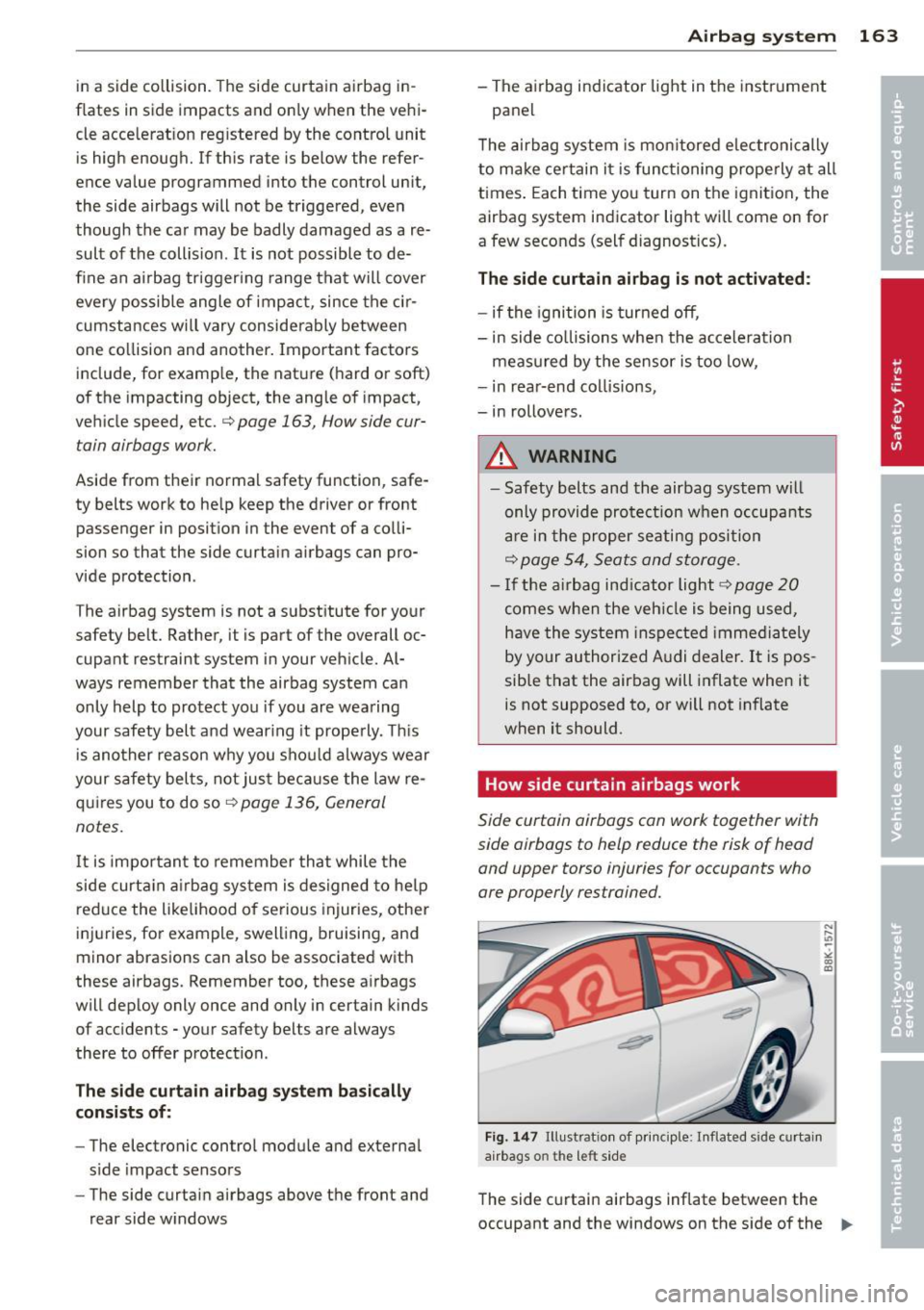
How side curtain airbags work
Side curtain airbags c an work together with
side airbags to help reduce the risk of head
and upper torso injuries for occupants who
are properly restrained.
Fi g. 147 Illustrat io n o f pri nc iple: I nflated s ide curtai n
a irbags on the left sid e
The side c urtai n airbags inflate betwee n the
occupant and the windows on the s ide of the ..,.
Page 203 of 294
@ For the sake of the environment
In the interest of the environment, the ve
hicle should only be washed in special
wash bays.
Washing your vehicle with a power
washer
Cleaning the ex terior of your car wi th a high
pressure power washer is safe as long as you
observe a few simple rules .
11-Before using the power washer, make su re
you have read and understood the WARN
INGS
c:::> A in General information on
page 199 .
11-Always fo llow the operating instructions for
the power washer .
11-Make sure that the jet on the spray hose
produces a "fan shaped spray".
11-Do not ho ld the spray nozzle too close to
soft materia ls.
When cleaning the vehicle with a power wash
er
always fo llow the operating instructions .
This applies particularly to the
operati ng
p re ssu re
and the s p ra yin g distance . Maintain
a sufficient d istance to soft mater ials such as
rubber hoses and sound/vibra tion deadening
materials (particularly on the underside of the
engine hood) . Do not use a jet wh ich sprays
water in a
direct stream or one that has a ro·
tat in g
jet.
Water temperature should not exceed 140 °F
(60 °() .
A WARNING
Never wash tires w it h a jet that sprays wa
t er in a direc t stream. This cou ld cause in
visib le damage to t he tires and weake n
them, even if the spray is from a relatively
long distance and for a short time . Dam
aged and weakened t ires can fai l and cause
accidents and persona l injury.
(D Note
To avo id damag ing your vehicle, always
make sure t hat there is sufficient distance
Cleaning and protec tion 20 1
between the spray head and soft materia ls
like rubber hoses, plastic parts and sound
deaden ing mater ia ls. Never aim the spray
head at the same point for a long time.
This also applies to cleaning headlights
and painted bumpers . Remember: the
closer the nozzle is to the surface of the
mater ia l, the greater the st ress on the ma
terial.
Sensors and camera lenses
- Remove snow w ith a hand br ush and remove
ice with a de -icing sp ray that does not con
tain so lvents.
- Clean the senso rs (adap tive c ruise co ntrol *,
parking system *) with a cleaning so lution
that does not contain so lvents and a soft
cloth.
(D Note
- If you wash your vehicle with a pressure
washer,
- make sure there is enough distance to
sensors i n the rear bumper.
- do not clean the camera lenses and the
area a ro und them with the press ure
washer.
- Never use warm or hot water to remove
snow o r ice from the camera lens . This
cou ld caus e the lens to crack .
- Never clean the camera lens with abra
sive products .
Waxing and Polishing
Waxing
A good wax coating protects the vehicle paint
t o a la rge extent agains t the envi ronmental
f actors lis ted under
c:::> page 199, Washing and
even against s light scra tches .
You can use a liquid car wax to protect yo ur
paint as soon as one wee k afte r you r vehicle
has been delivered.
Even if you regularly use a
wa xing process in
automat ic car washes, we recommend that
you manually apply a coat of wax to g ive the .,.
•
•
Page 204 of 294
202 Cleaning and protec tio n
paint extra p rotection, particularly if water no
longer beads on the clean paint.
P rotec t plastic body parts with ca r wax in the
same way as the vehicle body.
During warm weather dead insects tend to
collect on the front bumper and on the for
ward area of the hood. They are much easier
to remove from paint that is waxed
often.
Poli shing
Polish your vehicle only if the paint has lost its
shine and the gloss cannot be brought back
with wax.
If the polish used does not contain preserva
tive compounds, the paint must be waxed af
terwards.
.8, WARNING
Always read and heed a ll WARNINGS and
other information ¢
page 199.
(D Note
Do not use car wax on
- matte or anod ized metal trim
- rubber or rubber-like tr im.
Trim strips
Metal trim needs special care.
F or environmenta l reasons, Audi fabricates
the bright trim strips and trim pieces from pure chromium-free a luminum .
Dirt and marks on the trim str ips should be
removed with a
pH-bal anc ed cleaning agent
(do not use a chrome cleaner) . Authorized
Audi dealers carry cleaning products which have been tested for use on your vehicle and
are not harmful to the environment.
To avoid corrosion on the exterior trim strips,
only a pH-balanced solution should be used
for the windshield washer.
.8, WARNING
Always read and heed all WARNINGS and other information ¢
page 199.
Plastic and vinyl
Plastic needs special care.
Use a clean, damp cloth or sponge to remove
dust and light surface dirt. For other soil, use
a lukewarm all-purpose cleaning solution or a
mild saddle soap for v inyl tr im . Remove water
spots and traces of soap with a clean, damp
cloth o r sponge. Use a clean, soft cloth to rub
dry.
Grease, tar or oil stains can be removed with a
clean cloth or sponge soaked with all-purpose
cleaner or with a solvent designed espec ially
to clean v inyl.
Occas ionally apply a colorless vinyl or leather
preservative to retain the material's luster
and pliability .
.8, WARNING
Always read and heed all WARNINGS and
other information¢
page 199.
Aluminum trim
Use only neutral-pH products to remove spots
and deposits from a luminum surfaces .
Chrome care products and alkaline cleaners
will attack a luminum surfaces and can dam
age them over time.
.8, WARNING
Always read and heed all WARNINGS and
other information¢
page 199.
Touch-up paint
Minor paint damages should be touched up
immediately.
.,. Use either a touch-up paint stick or spray
paint to cover minor scratches and nicks.
Your authorized Audi dea ler has touch-up
paint for minor scratches and stone chips.
Scratches should be touched up soon after
they occur to prevent corrosion .
Page 210 of 294
208 Cleaning and protection
-Never use chemical solvents (e.g . lighter
fluid, turpentine), waxes, shoe polish or
similar products on the leather surfaces
in your Audi.
- To avoid damage, have stubborn stains removed by a commerc ial cleaning spe
cialist.
Cleaning Alcantara ® (synthetic suede)
App lies to vehicles: with A lcantara® up holstery
Removing dust and dirt
,. Moisten a cloth,
squeeze out excess water
and wipe down the seat surfaces .
Removing stains
,. Moisten a cloth with lukewarm water or
with diluted
ethyl (rubbing) alcohol.
,. Dab at the stain. Start at the outside and
work inwards .
,. Once the stain is no longer visible, use a
soft dry cloth or tissue to soak up the mois
ture.
Do not use leather cleaning products on Al
cantara ®.
You may use a suitable shampoo for removing
dust and dirt.
Dust and grit in the pores and seams can
scratch and damage the surface. If the car is
left standing in the sun for long periods, the
Alcantara ® should be protected against direct
sunlight to prevent it from fading . Slight color
variations will develop in normal use and are
not an indication of material deterioration .
IQ) Note
- Never use chemical solvents (e.g . lighter
fluid, turpentine), waxes, shoe polish or
s imilar products on Alcantara ® surfaces .
- To avoid damage, have stubborn stains
removed by a commerc ial cleaning spe
cialist.
- Do not use brushes, st iff sponges or sim
i larly abrasive cleaning aids . Safety belts
Only well-maintained safety belts work relia
bly when needed
.
,. Keep belts clean.
,. For cleaning, use a mild soap and water sol
ution. Let belts dry thorough ly and away
from d irect sunlight.
,. Do not allow inertia reel safety belts to re
tract before they are completely dry.
,. Check the condition of your safety be lts
reg
ularly.
Heavily soiled safety belts may not retract
properly.
A WARNING
-
Damaged safety belts can break in a crash .
- Anyth ing that might damage your safety
be lts could mean that you and your pas
sengers would not be adequate ly pro
tected in an accident.
- Safety belt performance depends on cor
rect installation. Never remove belts
from the vehicle to clean them.
- Do not use chemical cleaning agents,
bleach or dyes. They have corrosive prop
erties which weaken the webbing.
- When cleaning your safety be lts, inspect
them for damage . If you discover dam
age, see your authorized Audi dealer.
- Always read and heed all WARNINGS and
other information ¢
page 199.
Engine compartment
Be especially careful when cleaning the en
gine compartment.
Always switch off the ignition before clean
ing the engine
c.? .&, .
Plenum panel
Remove leaves from the plenum panel in front
of the windshield under the engine hood. This
prevents the water drai n holes from becoming
blocked, and it prevents debris from entering
the vehicle interior through the heating and
ventilat ion ducts .
Page 217 of 294
Checking and filling Engine hood
Releasing the engine hood
The engine hood is released from inside the
vehicle .
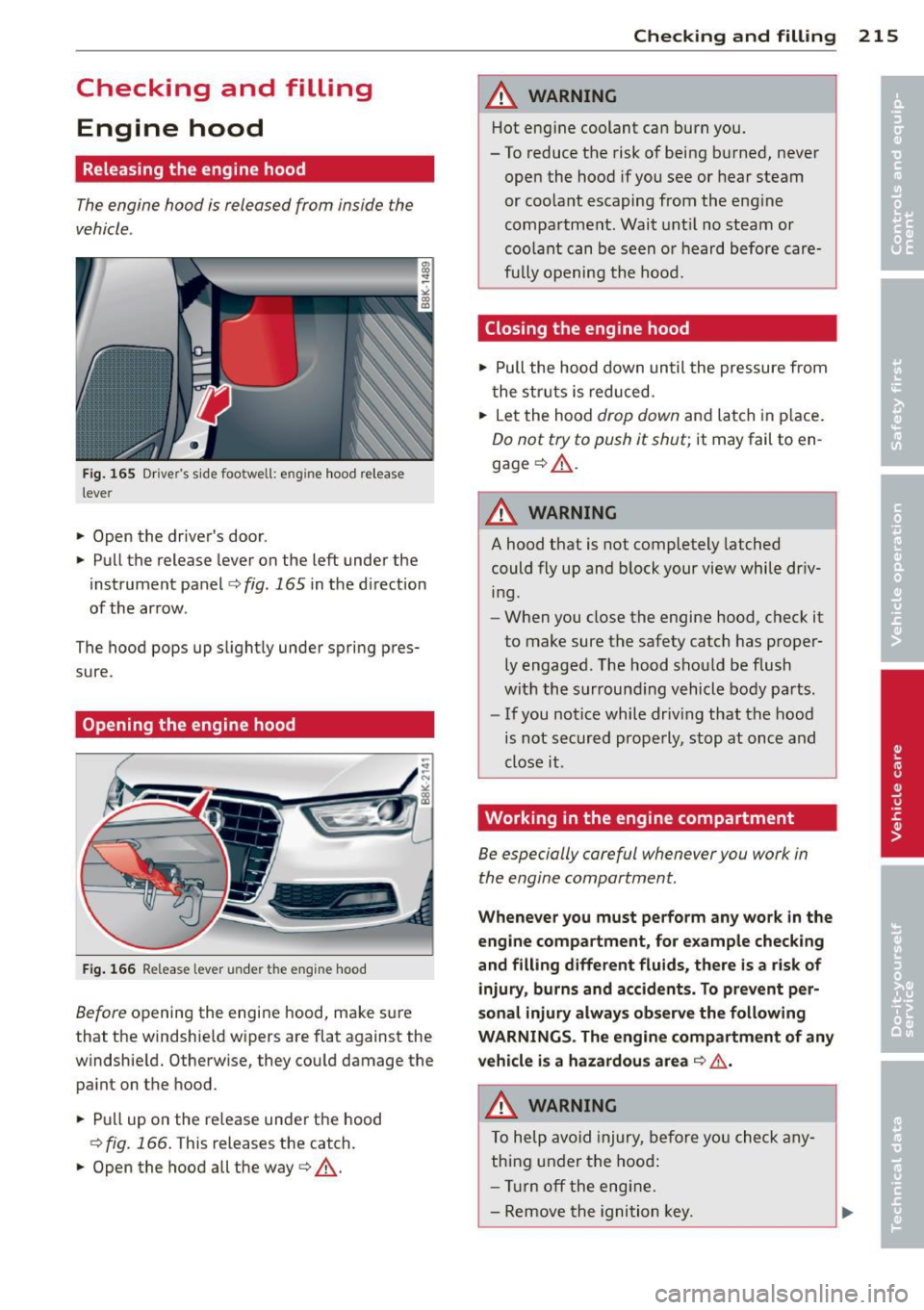
Fig. 165 Dr iver's s ide footwell: engine hood release
lever
"' Open the driver's door .
"' Pull the release lever on the left under the
instrument panel
r=> fig. 165 in the d irection
of the arrow.
The hood pops up slight ly under spring pres
sure.
Opening the engine hood
.... ~- ---=-
Fig . 166 Re lease lever under the engine hood
Before opening the engine hood, make sure
that the windshie ld wipers are flat against the
windshie ld. Otherwise, they could damage the
paint on the hood.
"' Pull up on the release under the hood
r::!> fig. 166 . This releases the catch.
"' Open the hood all the way
c::> &,.
Checkin g and fillin g 215
A WARNING
Hot engine coolant can burn you.
- To reduce the risk of being burned, never
open the hood if you see or hear steam
or coo lant escaping from the eng ine
compartment. Wait unt il no steam or
coolant can be seen or heard before care
fu lly opening the hood.
Closing the engine hood
"' Pull the hood down un til the pressure from
the struts is reduced.
"' Let the hood
drop down and latch in p lace .
Do not try to push it shut; it may fail to en
gage
c;, &, .
A WARNING
--
A hood that is not completely latched
could fly up and b lock your view while dr iv
ing.
- When you close the engine hood, check it
to make sure the safety catch has p roper
ly engaged. The hood should be flush
with the surround ing vehicle body parts.
- If you notice while driv ing that the hood
is not secured prope rly, stop at once and
close it .
Working in the engine compartment
Be especially careful whenever you work in
the engine compartment.
Whene ver you must perform any wo rk in the
eng ine compartment, for e xample checking
and filling different fluids, th ere is a risk of
injury, burns and accident s. To pr event per
sonal injury always observe the following
WARNINGS . The engine compartment of an y
vehicle i s a hazardou s area
c;, Lh, .
A WARNING ~
To help avoid injury, befo re yo u check any
thing under the hood:
- Tu rn off the engi ne.
- Remove the ignition key.
Page 218 of 294
216 Checking and filling
-Apply the parking brake.
- Move selector lever of automatic trans- mission to "P" (Park); put manual trans
mission in Neutral.
- Always let the engine cool down. Hot
components will burn skin on contact.
- To reduce the risk of being burned, never
open the hood if you see or hear steam
or coolant escaping from the engine
compartment . Wait until no steam or
coolant can be seen or heard before care
fully opening the hood .
- Keep children away from the engine com
partment .
- Never spill fluids on hot engine compo
nents. They can cause a fire.
- Never touch the radiator fan. The auxili ary electric fan is temperature controlled
and can switch on suddenly.
- Never open the coolant reservoir cap when the engine is still warm. The cool
ant system is pressurized and hot cool
ant could spray out .
-Protect your face, hands and arm from
steam or hot engine coolant by placing a
thick rag over the cap when you open the coolant reservoir .
- Do not remove the engine cover under
any circumstances. This increases the
risk of burns.
- If work on the fuel system or the electri
cal system is necessary:
- Always disconnect the battery .
- Never smoke or work near heaters or
open flames. Fluids in the engine com
partment could start a fire.
- Keep an approved fire extinguisher im
mediately available.
- To avoid electrical shock and personal in
jury while the engine is running or being
started, never touch:
- Ignition cables
- Other components of the high voltage
electronic ignition system.
- If you must perform a check or repair with the engine running: -
First, fully apply the parking brake,
move selector lever of automatic trans
mission to "P" (Park); put manual
transmission in Neutral.
- Always use extreme caution to prevent
clothing, jewelry, or long hair from get
ting caught in the radiator fan, V-belts
or other moving parts, or from contact ing hot parts. Tie back hair before
starting, and do not wear clothing that
will hang or droop into the engine.
- Minimize exposure to emission and
chemical hazards~&, .
.&_ WARNING
California Proposition 65 Warning:
- Engine exhaust, some of its constituents,
and certain vehicle components contain
or emit chemicals known to the State of
California to cause cancer and birth de
fects and reproductive harm. In addition, certain fluids contained in vehicles and
certain products of component wear con
tain or emit chemicals known to the
State of California to cause cancer and
birth defects or other reproductive harm.
- Battery posts, terminals and related ac
cessories contain lead and lead com
pounds, chemicals known to the State of
California to cause cancer and reproduc
tive harms. Wash hands after handling.
(D Note
When adding fluids, always make sure that
they are poured into the proper container
or filler opening, otherwise serious dam
age to vehicle systems will occur.
@ For the sake of the environment
To detect leaks in time, inspect the vehicle
floor pan from underneath regularly . If
you see spots from oil or other vehicle flu ids, have your vehicle inspected by an au
thorized Audi dealer.