instrument panel AUDI A4 SEDAN 2013 Owner's Manual
[x] Cancel search | Manufacturer: AUDI, Model Year: 2013, Model line: A4 SEDAN, Model: AUDI A4 SEDAN 2013Pages: 294, PDF Size: 73.71 MB
Page 165 of 294
in a side collision. The side curtain a irbag in
f lates in side impacts and on ly when the vehi
cle acce lerat ion reg istered by the contro l unit
is high enough. If this rate is be low the refer
ence value programmed into the control un it,
the side airbags will not be triggered, even
though the car may be badly damaged as a re sult of the collision . It is not possible to de
f ine an a irbag tr igger ing range that will cover
every possible angle of impac t, since the ci r
cumstances wi ll vary conside rably between
one co llision and another . Important factors
include, for examp le, the nat ure ( hard o r soft)
of the impacting object, the ang le of impact,
veh icle speed, etc.
c:> page 163, How side cur
tain airbags work.
Aside from thei r normal safety function, safe
ty belts work to he lp keep the driver or front
passenger in position in the event of a co lli
sion so that the side curtain airbags can pro
vide protection.
The airbag system is not a s ubst itute for your
safety belt. Rather, it is part of the overall oc
cupant restraint system in your veh icle. Al
ways remember that the airbag system can
only help to protect yo u if you are wea ring
your safety belt and wear ing it prope rly. This
i s ano ther reason w hy you sho uld a lways wear
your safety bel ts, not jus t be ca u se the law re
qu ires you to do soc:>
page 136, General
notes.
It
is impor tant to remember tha t while the
side curt ain airbag sys tem is designed to he lp
red uce the likelihood o f serious injuries, othe r
i nj uries, for example, swell ing, bruising, and
minor abrasions can a lso be associated wit h
these airbags. Remember too, these a irbags
will deploy only once and only in certain kinds
of accidents - your safety belts are always
there to offer protection .
The side curtain airbag system basically
consists of:
- The electronic control modu le and externa l
s ide impact sensors
- The side curtai n airbags above the front and
rear side w indows
A irba g system 163
- The a irbag indicator light in the instrument
panel
T he airbag syste m is mon itored e lec troni cally
to make ce rtain i t is func tioning prope rly at all
times . Each time you turn on the ignit ion, the
airbag system indicator light will come on for
a few seconds (sel f diagnostics).
The side curtain airbag is not activated :
-if the ignition is tur ned off,
- in side co llisions whe n the accele ration
meas ured by the sensor is too low,
- in rea r-end collisions,
- in rollovers.
A WARNING
- Safety belts and the airbag system will
only provide protection w hen occupants
a re in the proper seating position
c:> page 54, Seats and s torage.
- I f the air bag ind icator lig ht c:> page 20
comes w hen the veh icle is being used,
have the system ins pect ed imme diately
by your authorized A udi dealer.
It is pos
sible that the air bag will inflate when it
is not supposed to, or will not inflate
when it should .
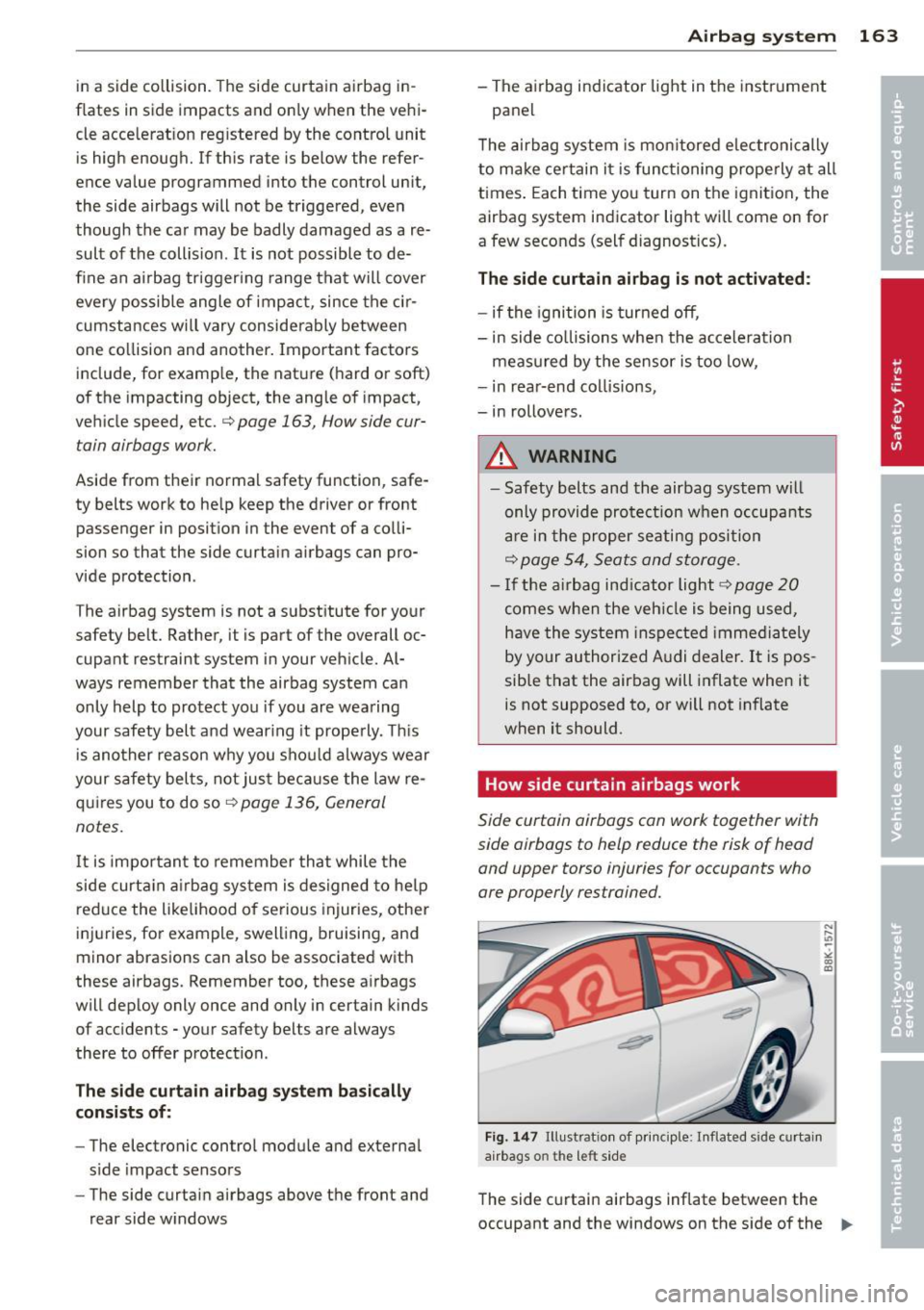
How side curtain airbags work
Side curtain airbags c an work together with
side airbags to help reduce the risk of head
and upper torso injuries for occupants who
are properly restrained.
Fi g. 147 Illustrat io n o f pri nc iple: I nflated s ide curtai n
a irbags on the left sid e
The side c urtai n airbags inflate betwee n the
occupant and the windows on the s ide of the ..,.
Page 168 of 294
166 Child Safety
-If you must install a rearward facing
child safety seat on the front passenger
seat in exceptional circumstances and
the
PASSENGER AIR BAG OFF light does
not come on and stay on, immediately
install the rearward-facing child safety
seat in a rear seating position and have
the airbag system inspected immediately
by your authorized Audi dealer.
.&, WARNING
If, in exceptional circumstances, you must
install a forward-facing child restraint on
the front passenger's seat:
- Always make sure the forward-facing
seat has been designed and certified by
its manufacturer for use on a front seat
with a passenger front and side airbag.
- Always follow the manufacturer's in
structions provided with the child safety
seat or carrier.
- Always move the passenger seat into its
rearmost position in the seat's fore and
aft adjustment range, as far away from
the airbag as possible before installing
the child restraint. The backrest must be adjusted to an upright position .
- Always make sure that the
PASSENGER
AIR BAG OFF
light comes on and stays
on all the time whenever the ignition is
switched on.
(D Tips
Always replace child restraints that were
installed in a vehicle during a crash. Dam
age to a child restraint that is not visible
could cause it to fail in another collision
situation.
Advanced front airbag system and children
Your vehicle is equipped with a front "Ad
vanced Airbag System" in compliance with
United States Federal Motor Vehicle Safety
Standard (FMVSS) 208 as applicable at the
time your vehicle was manufactured . The
Advanced Airbag system in your vehicle
has been certified to meet the "low-risk" re
quirements for 3- and 6-year old children on
the passenger side and small adults on the driver side. The low risk deployment criteria
are intended to reduce the risk of injury
through interaction with the airbag that can
occur, for example, by being too close to the
steering wheel and instrument panel when
the airbag inflates . In addition, the system
has been certified to comply with the "sup
pression" requirements of the Safety Stand
ard, to turn off the front airbag for infants up
to 12 months who are restrained on the front
passenger seat in child restraints that are list
ed in the Standard.
Even though your vehicle is equipped with an
Advanced Airbag system, all children, espe
cially those 12 years and younger, should al
ways ride in the back seat properly restrained
for their age and size. The airbag on the pas
senger side makes the front seat a potentially
dangerous place for a child to ride . The front
seat is not the safest place for a child in a for
ward-facing child safety seat.
It can be a very
dangerous place for an infant or a larger child
in a rearward-facing seat.
Advanced Airbags and the weight
sensing mat in the front seat
The Advanced Airbag System in your vehicle detects the presence of an infant or child in a
child restraint on the front passenger seat us
ing the weight-sensing mat in the seat cush
ion and the sensor below the safety belt latch
on the front passenger seat that measures the
tension on the safety belt.
The weight-sensing mat measures total
weight of the child and the child safety seat
and a child blanket on the front passenger
seat. The weight on the front passenger seat
is related to the design of the child restraint
and its "footprint", the size and shape of the
bottom of the child restraint as it sits on the
seat. The weight of a child restraint and its "footprint" vary for different kinds of child re -
straints and for the different models of the .,.
Page 190 of 294
188 Intelligent technology
200 kilometers) of normal city driving.
You can compensate for this by pressing
the brake pedal more firmly. This also applies later when new pads are instal
led .
- You should perform braking maneuvers
for the purpose of cleaning the brake
system only if road conditions permit.
Other road users must not be put at risk -
you may cause an acc ident!
- Before descending a steep grade, reduce
speed and shift transmission into a lower
gear or lowe r driving range. Do not ride
the brakes or hold the pedal down too
long or too often. This could cause the
brakes to get hot and diminish braking
efficiency.
- Do not "ride the brakes" by resting your
foot on the pedal when you do not intend
to brake . This may cause the brakes to
overheat, premature wear and increased
stopping distance.
- Under certain climatic and operating
conditions such as passing through wa
ter, driving in heavy rain or after washing
the vehicle, the effectiveness of the
brakes can be reduced. In winter, ice can
accumulate on the brake pads, linings,
discs and drums. Carefully apply brakes
for a test. Brakes will dry and ice coat
ings will be cleaned off after a few care
ful brake applications.
- Driving for an extended period of time on
salt-covered roads without using your
brakes can also affect braking efficiency.
Clean off accumulated salt coating from
brake discs and pads with a few careful
brake applications.
- If you damage the front spoiler, or if you
install a different spoiler, be sure the air
flow to the front brakes is not obstruct
ed . Otherwise the brake system could
overheat reducing the effectiveness of
the entire brake system.
- Failure of one brake c ircuit will impair
the braking capability resulting in an in
creased stopping distance. Avoid driv ing
the vehicle and have it towed to the near- est authorized Audi dealer or
qualified
workshop.
- Never let the vehicle roll to a stop with
the engine shut off.
- If the brake booster is not working, for
example when towing your vehicle, or
because the brake booster has somehow
been damaged, the brake pedal must be
pressed considerably harder to make up
for the lack of booster assistance.
Electro-mechanical
power assist, dynamic
steering
The electro-mechanical power assist helps
the driver when steering.
Power steering adapts electronically based on
the vehicle speed .
Indicator lights and messages
• Steering defective! Do not drive vehicle!
If this indicator light turns on and stays on
and this message appears, the power steering
may have failed.
Do
not continue driving . See your authorized
Audi dealer or other qualified repair facility
for assistance.
E!"4 Dynamic steering: System fault! You can
continue driving
If the indicator light turns on and the mes
sage appears, the steering may be more diffi
cult to move or more sensitive than usual. The
steering wheel may also be at an angle when
driving straight .
Drive slowly to your authorized Audi dealer or
qualified workshop to have the malfunction
corrected .
ls!'fl Dynamic steering: initializing
If this driver message appears and the indica
tor light is flashing on the instrument panel,
dynamic steering* is being reinitialized. Once
you start the engine after this is finished, the ..,..
Page 208 of 294
206 Cleaning and protec tio n
Open Velcro fasteners on your clothing can
damage the seat cover. Please make sure
that Velcro fasteners are closed.
Plastic parts and instrument panel
Always use a clean cloth moistened in clear
water to clean these areas . For pers istent dirt
use an Audi approved
so lv ent-fr ee plastic
cleaner/protectant.
_& WARNING
So lvents can change the propert ies of
some plastics and make it harder for the
airbag to dep loy.
-
- Never clean the instr ument pane l or the
surface of airbag modules with cleaning
products that contain solvents.
- Products containing solvents w ill make
the surface o f this part porous.
- Serious injur ies can result if plastic pa rts
come loose when the airbag is deployed .
- Always read and heed all WARN INGS and
other information
¢page 199.
(D Note
Cleaning agents contain ing solvents will
attac k the mater ial and can change the
way it behaves.
Natural leather
Appl ies to vehicles: with natural leather
Audi makes great efforts to maintain the
properties, natural look and feel of interior
leather.
General
We offer many different types of leather on
our veh icles . Most are differe nt types of nappa
l eather, which has a smooth surface and
comes in var ious co lors .
The intensity of the color determines the v isu
al character istics and appearance .
If the sur
face of the leather has a typical natural look,
the n the leather is a nappa leat her that has been left in a relative
ly natura l condition . This
leather offers particularly good comfort and
breathes we ll. Fine veins, closed grains, insect
bites, skin fo lds, and s ubt le variations in color
rema in v is ible. These character istics demon
strate that the material is natural.
Natura l nappa leather is not covered by a co l
or finish. It is therefore more sensit ive to soil
ing and wear, which is someth ing you need to
consider if children, animals or other factors
mig ht prove to be part icularly hard o n the
l eather .
By contrast, leather types that are covered by
a colored finish layer are more durable. This has a positive effect on the leather's resist
ance to wear and soiling in da ily use . On the
othe r hand, the typica l charac teristics of natu
ral le a the r are barely o r not appa rent. Howev
er, th is does not mean that the leather itse lf
is of inferior quality.
Care and handling
Because of the exclusive nature of the types of
leather that Aud i uses and their uniq ue p rop
erties (such as sens itivity to oils, grease, soil
ing, etc.), yo u w ill need to be somewhat ca re
ful with these leathers, and a certain type of care is requi red . For example, dark clothing
mater ials can disco lor leather seats (especia l
ly if such clothing is damp and was not dyed
correct ly). Dust and dirt particles in pores,
folds, and seams can have an abrasive effect
and can damage the leather surface as well as
wea ken seams .
The leather should be cleaned regularly as needed . After hav ing been used for a relat ively
long time, your leather seats will acq uire a
rich aged fi nish. This is a character istic of nat
ur al leathe r and a s ign of true quality.
In order to maintain the value of this natural
product over the life of your veh icle, you
shou ld follow t he recomme ndat io ns be low: ..,.
Page 217 of 294
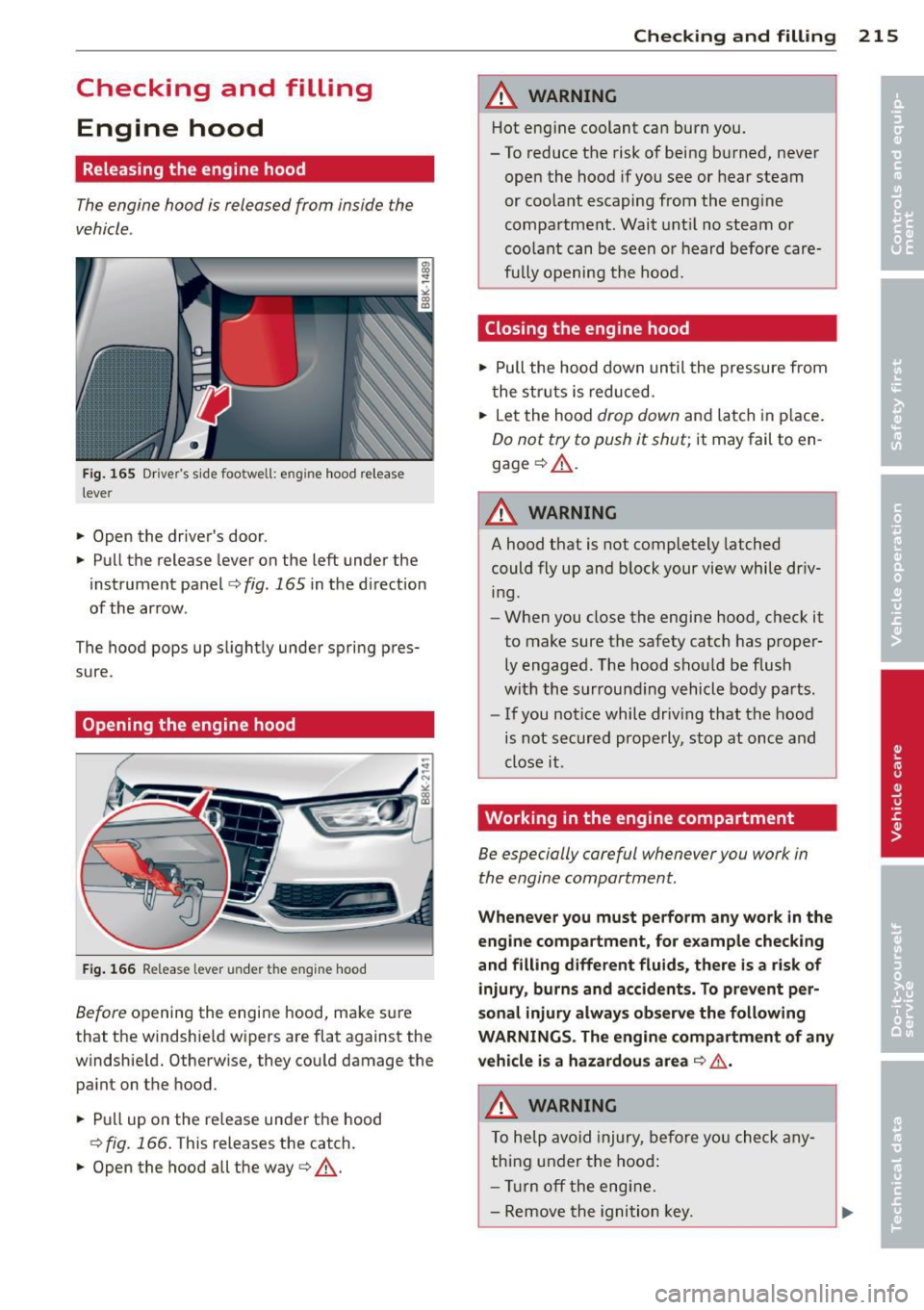
Checking and filling Engine hood
Releasing the engine hood
The engine hood is released from inside the
vehicle .
Fig. 165 Dr iver's s ide footwell: engine hood release
lever
"' Open the driver's door .
"' Pull the release lever on the left under the
instrument panel
r=> fig. 165 in the d irection
of the arrow.
The hood pops up slight ly under spring pres
sure.
Opening the engine hood
.... ~- ---=-
Fig . 166 Re lease lever under the engine hood
Before opening the engine hood, make sure
that the windshie ld wipers are flat against the
windshie ld. Otherwise, they could damage the
paint on the hood.
"' Pull up on the release under the hood
r::!> fig. 166 . This releases the catch.
"' Open the hood all the way
c::> &,.
Checkin g and fillin g 215
A WARNING
Hot engine coolant can burn you.
- To reduce the risk of being burned, never
open the hood if you see or hear steam
or coo lant escaping from the eng ine
compartment. Wait unt il no steam or
coolant can be seen or heard before care
fu lly opening the hood.
Closing the engine hood
"' Pull the hood down un til the pressure from
the struts is reduced.
"' Let the hood
drop down and latch in p lace .
Do not try to push it shut; it may fail to en
gage
c;, &, .
A WARNING
--
A hood that is not completely latched
could fly up and b lock your view while dr iv
ing.
- When you close the engine hood, check it
to make sure the safety catch has p roper
ly engaged. The hood should be flush
with the surround ing vehicle body parts.
- If you notice while driv ing that the hood
is not secured prope rly, stop at once and
close it .
Working in the engine compartment
Be especially careful whenever you work in
the engine compartment.
Whene ver you must perform any wo rk in the
eng ine compartment, for e xample checking
and filling different fluids, th ere is a risk of
injury, burns and accident s. To pr event per
sonal injury always observe the following
WARNINGS . The engine compartment of an y
vehicle i s a hazardou s area
c;, Lh, .
A WARNING ~
To help avoid injury, befo re yo u check any
thing under the hood:
- Tu rn off the engi ne.
- Remove the ignition key.
Page 261 of 294
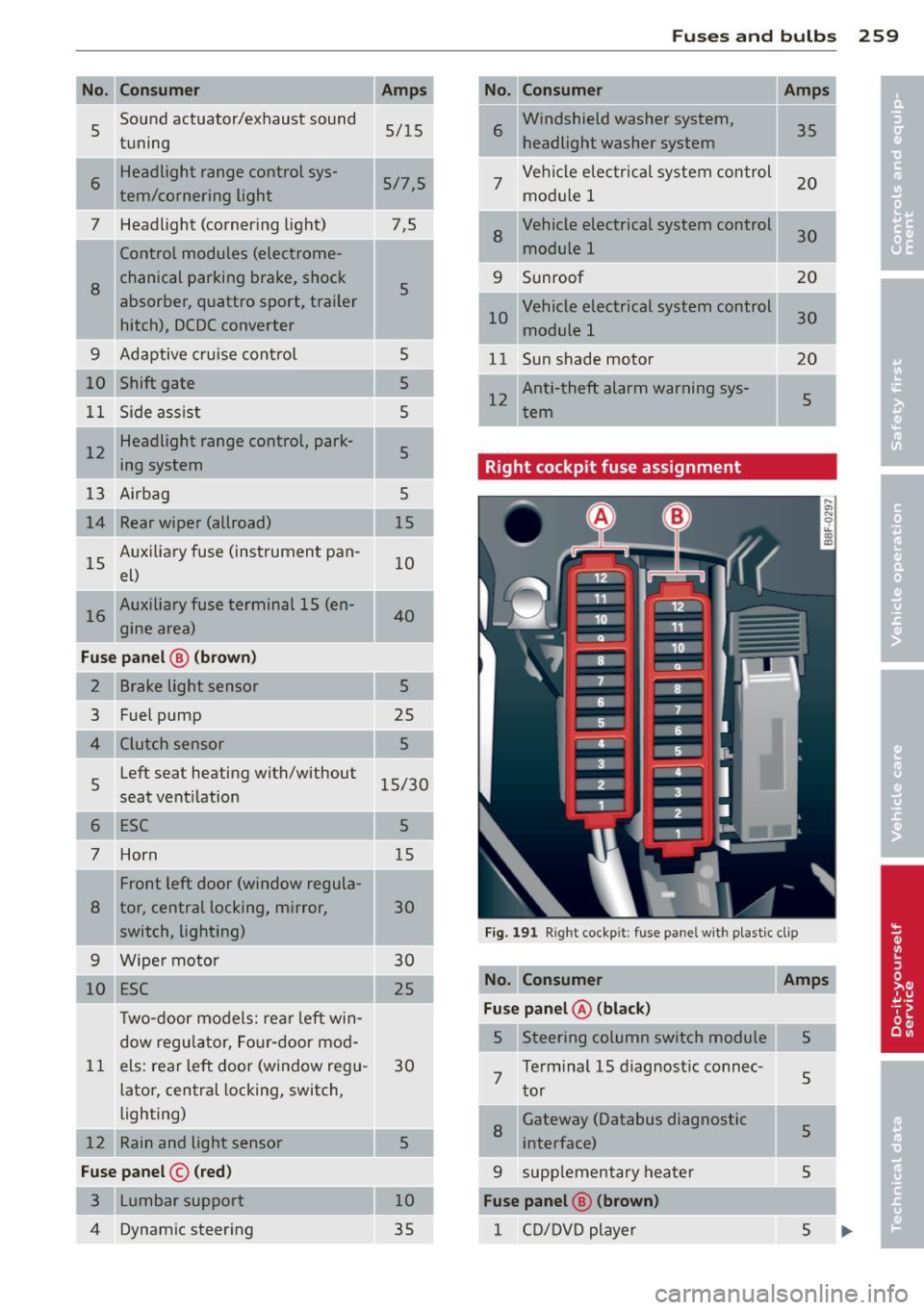
Fuses and bulbs 259
-No. No. Consumer Amps
5 Sound
actuato r/exhaust sound
5/15
tuning 6
Windshield washer system,
35
headlight washer system
.
6 Headlight range control sys-
5/7,5
tern/cornering light 7 Vehicle electrical system control
20
module 1
7 Headlight (cornering light) 7,5
Control modules (electrome-
8
Vehicle electrical system control
30
module 1
'
8
chanical parking brake, shock
5
absorber, quattro sport, trailer
hitch), DCDC converter 9 Sunroof 20
10 Vehicle electrical system control
30
module
1
9 Adaptive cruise control 5
11 Sun shade motor 20
10 Shift gate
5
11 Side assist 5 12 Anti-theft alarm
warning sys-
5
tern
I 12 Headlight range control, park-
5
ing system
Right cockpit fuse assignment
13 Airbag 5
14 Rear wiper (allroad) 15
15 Auxiliary fuse (instrument pan-
10
el)
I 16 Auxiliary fuse terminal 15 (en-
40
gine area)
Fuse panel @ (brown)
2 Brake light sensor 5
3 Fuel pump
25
4
5 Left seat
heating with/without
15/30
seat ventilation
6
7 Horn Front left door (window regula-
8 tor, central locking, mirror, 30
switch, lighting)
Fig. 191 Right cockpit : fuse panel with plastic cl ip
9 Wiper motor 30
10 ESC 25
No. Consumer Amps
Two-door models: rear left win-Fuse panel @ (black)
dow regulator, Four-door mod- 5 Steering column switch module 5
11
els:
rear left door (window regu-
30
lator, central locking, switch, 7 Terminal 15 diagnostic connec-
5
tor
lighting)
12 Rain and light sensor 5
8
Gateway (Databus diagnostic
5
interface)
-..
Fuse panel © (red) 9 supplementary heater 5
3
Fuse panel @ (brown)
4 Dynamic steering
1 CD/DVD player 5
Page 262 of 294
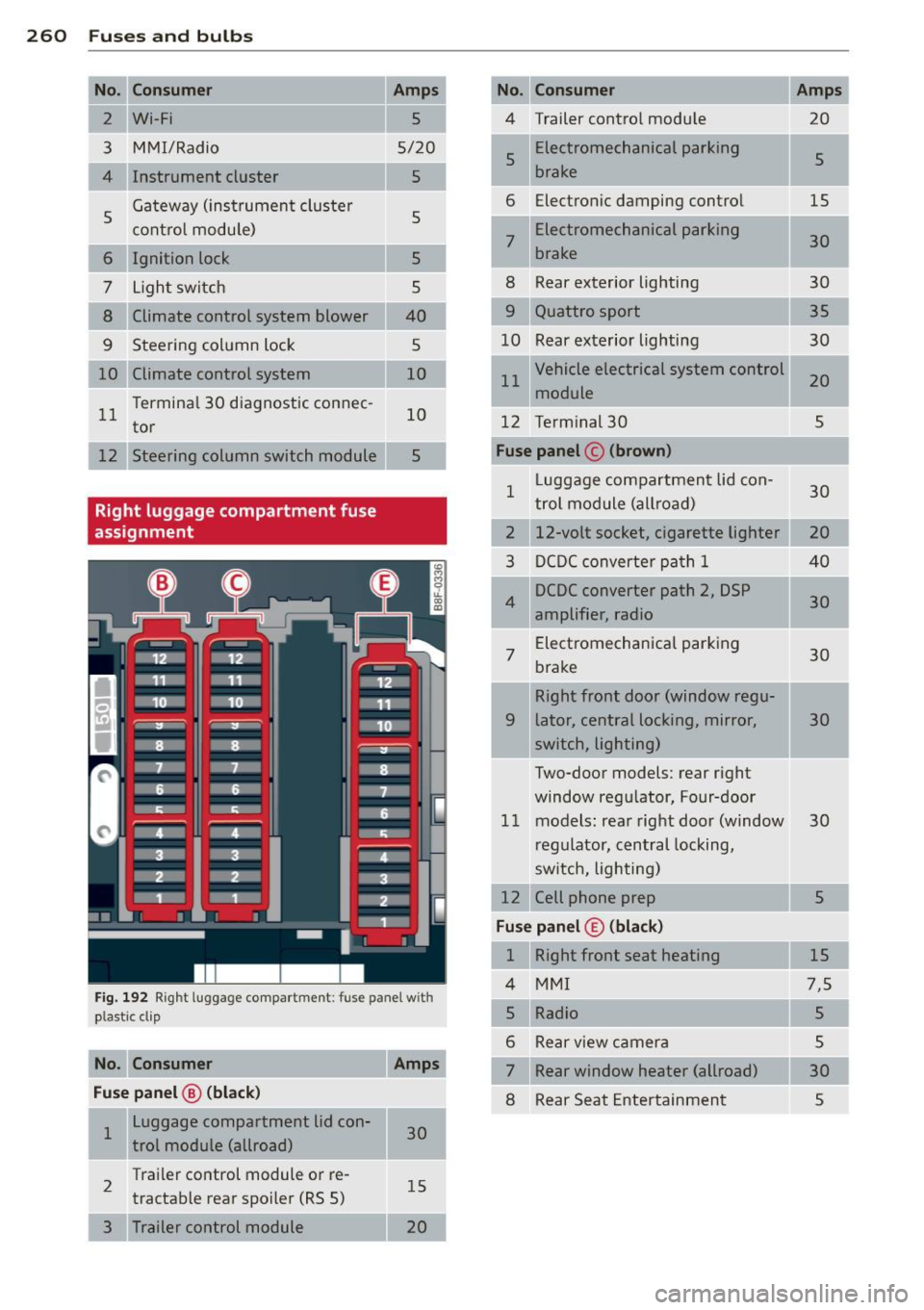
260 Fuses a nd bulb s
I
-No. Consumer
2 Wi-Fi
3 MMI/Radio
4 Instrument cluster
5 Ga
teway (instrument cluster
control module)
6 Ignition lock
7 L igh t switch
8 Climate control system blower
9 Steer ing column lock
10 Climate control system
11 Termina
l 30 diagnostic connec-
tor
12 Steering column switch module
Right luggage compartment fuse
assignment
Amps
5
5/20
5
5 5
5
40 5
10
10
5
Fig. 192 R ig ht l uggag e compar tmen t: fu se pan el w ith
plas tic cl ip
No. Con sumer Amps
Fu se pan el
@ (bl ack )
1 Luggage compartment lid con-
30
trol module (allroad)
2 Trail
er control module or re-
15
tractable rear spoiler (RS 5)
3 Trailer control module
20
No . Consumer
4 Trailer contro l modu le
5 Electromechanical parking
5
brake
6 Elec tronic damping control
15
--
7 Electromechanical parking
30
brake
8 Rear exterior lighting 30
9 Quattro sport
10 Rear exterior lighting
11 Vehicle electrical system control
20
module
12 Te rminal 30 5
Fuse panel© (brown )
1 L
uggage compartment lid con-
30
trol module (all road)
2 12-volt socket, cigarette lighter
20
3 DCDC converter pa th 1 40
4 DCDC converter path 2, DSP
30
amplifier , radio
7 Electromechanical parking
30
b rake
Right front door (window regu-
9 lator, central locking, mirror, 30
switch, lighting)
Two-door models : rear righ t
window regu lator, Four-door
11 models : rear right door (window
30
regulator, central locking,
switch, lighting)
Cell phone prep 5
Fuse panel © (blac k)
1 Right front seat heating
15
4 MMI 7,5
5 Radio 5
6 Rear view camera 5
7 Rear window heater (allroad)
30
8 Rear Seat Entertainment 5