ECU AUDI A4 SEDAN 2013 Owner's Guide
[x] Cancel search | Manufacturer: AUDI, Model Year: 2013, Model line: A4 SEDAN, Model: AUDI A4 SEDAN 2013Pages: 294, PDF Size: 73.71 MB
Page 182 of 294
180 Child Safet y
Description
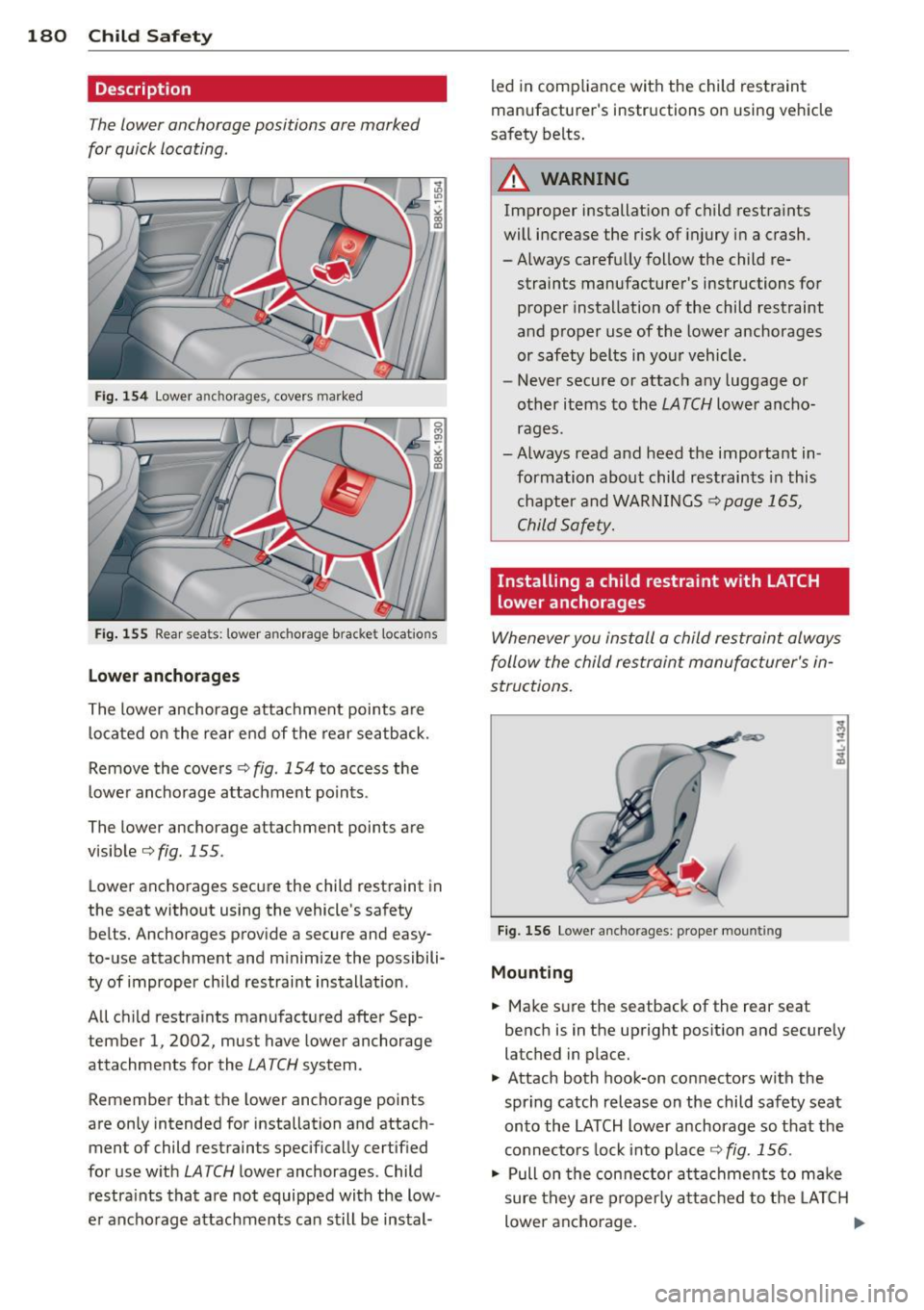
The lower anchorage positions are marked
for quick locating .
Fig. 154 Lower a nch orages, covers marke d
Fig. 155 Rear sea ts: towe r an ch orage b racke t locat io n s
Lowe r ancho rages
The lower anchorage atta chment points are
located on the rear end of the rear seatback.
Remove the covers¢
fig. 154 to access the
lower anchorage attachment points .
The lower anchorage attachment points are
visible ¢
fig. 155 .
Lower anchorages secure the child restraint in
the seat without using the vehicle 's safety
belts. Anchorages provide a secure and easy
to-use attachment and m inim ize the possibili
ty of improper child restraint installation .
All chi ld restraints manufactured after Sep
tember 1 , 2002, must have lower anchorage
attachments for the
LATCH system .
Remember that the lower anchorage points
are only intended for installation and attach ment of child restraints specifically certified
for use w ith
LATCH lower anchorages. Child
restra ints that are not equipped with the low
e r ancho rage attachments can still be instal- led in compliance with the child restraint
manufacturer's instructions on using vehicle
safety belts
.
A WARNING
-Improper installat ion of child restra ints
will increase the risk of injury in a crash .
-A lways carefu lly follow the child re -
straints manufacturer's instructions for proper installation of the child restraint
and proper use of the lower anchorages
or safety belts in your vehicle .
- Never secure or attach any luggage or
other items to the
LATCH lower ancho
rages.
- Always read and heed the important in formation about child restraints in this
chapter and WARN INGS
¢ page 165,
Child Safety.
Installing a child restraint with LATCH
lower anchorages -
Whenever you install a child restraint always
follow the child restraint manufacturer's in
structions.
F ig. 156 Lower a ncho rages : proper mount ing
Mounting
.. Make s ure the seatback of the rear seat
bench is in the upright posit ion and securely
latched in place.
.,. Attach both hook-on connectors with the
spring catch release on the child safety seat
onto the LATCH lower anchorage so that the
connecto rs lock i nto pla ce ¢
fig. 156.
.. Pull on the con nector attachments to make
sure they are properly a ttached to the LA T CH
lower ancho rage . ..,.
Page 183 of 294
.. Pull straps tight following the child re
straint manufacturer's instructions.
Releasing
.. Loosen the tension on the straps following
the ch ild restraint manufacturer's instr uc
tions .
.. Depress the spring catches to re lease the
anchorage hooks from the lower anchorag
es.
Remember: Use tether straps to help keep the
child restraint firmly in p lace.
A WARNING
Improper use of the LATCH system can in
crease the risk of ser ious personal injury
and death in an acc ident.
- These anchors were developed only for
child safety seats us ing the "LATCH" sys
tem.
- Never attach other child safety seats,
belts or other objects to these anchors.
- Always make sure that you hear a click
when latching the seat in place. If you do
not hear a click the seat is not secure and
cou ld fly forward and h it the interior of
the vehicle, or be ejected from the vehi cle.
A WARNING
Imprope r installation of ch ild restrai nts
w ill increase the risk of injury in an acc i
de nt.
- Always fo llow the child rest raint system
m anufactu rer's ins tru ctions for proper
ins tallation of the child res traint system
and proper use of tether straps as we ll as
the lower anchorages or safety belts in
your vehicle.
- Always read and heed the important in
format ion and WARNINGS about child
safety and the installation of child re
straint systems
Q page 165, Child Safe
ty.
-
Child S afety 181
Tether anchors and tether straps
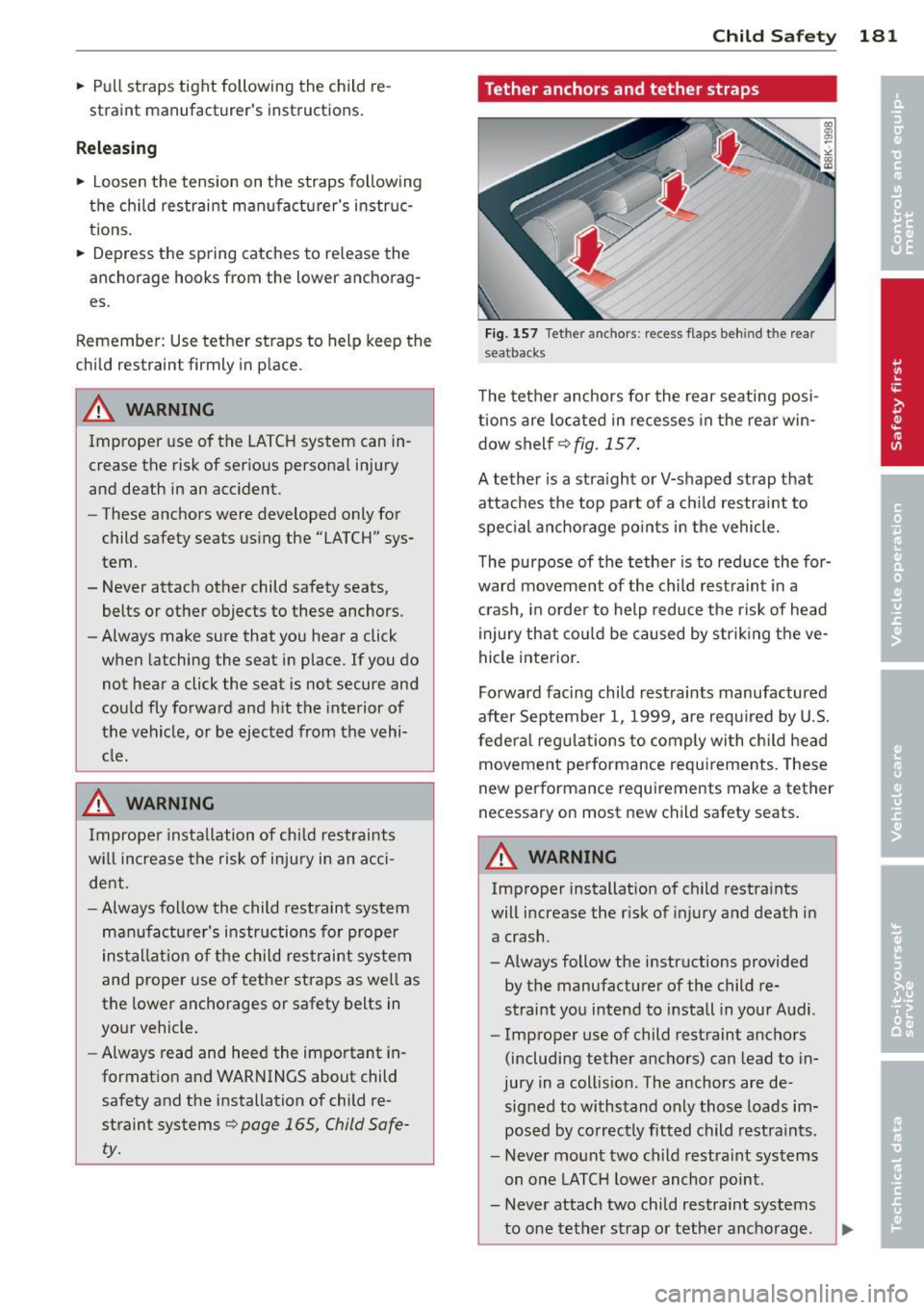
Fig. 157 Tet her anchors: recess flaps behind th e rear
seatbacks
T he te ther anchors for the rear seating posi
tions are located in recesses in the rear win
dow shelf¢
fig. 15 7.
A tether is a stra ight or V-s haped st rap that
attaches the top par t of a ch ild restrai nt to
spe cial a nchorage po ints in the vehicle.
T he purpose of the tether is to reduce the for
ward movement of the child rest raint in a
c rash, i n orde r to help reduce the risk of head
i njury that cou ld be caused by str ik ing the ve
hicle inte rior .
Fo rward facing child rest raints manufactured
after September 1, 1999, are requ ired by U.S.
federa l reg ulations to comply wi th ch ild head
movement pe rformance requ irements. These
new performance requirements make a tether
necessary on most new child safety seats .
A WARNING
Improper installat ion of child restra ints
will increase the r isk of injury and death in
a crash.
-Always follow the instr uctions provided
by the manufacturer of the child re
straint you intend to install in your Audi.
- Improper use of child restraint anchors
(including tether anchors) can lead to in
jury in a coll ision. The anchors are de
signed to withstand only those loads im
posed by co rrectly fitt ed child restraints.
- Neve r mo unt two child rest ra int systems
on one LATC H lower anchor point.
- Never attach two child restraint systems
-
to one tether strap o r tethe r ancho rage . ~
Page 184 of 294
182 Child Safet y
-Never attac h a tether strap to a tie-down
hook in the luggage compartment .
- Never use c hild restraint tether ancho
rages to secure safety belts or other
kinds of occupant restra ints .
- Never secure or attach any l uggage or
other items to the LATCH lower ancho
rages or to the tether anchors.
- If a tether or other strap is used to at
tac h a child restraint to the front passen
ger seat, make sure that it is not so
t ight, that it causes the weight -sensing
mat to measu re more weight than is ac
tua lly on the seat.
- The heav ier weight reg istered can make
the Advanced Airbag System wo rk as
though an adult we re on the seat and de
ploy the Advanced A irbag when it m ust
be s uppressed causing ser ious or even
fatal inj ury to the child.
- If you mus t install a rearward f acing
child safety seat on the front passenger
seat because of exceptional circ umstan
ces and the
PASSENGER AIR BAG OFF
light does not come on and stay on, im
mediately install the rear-facing child
safety seat in a rear seating position a nd
have the a irbag system inspected by you r
Audi dealer.
Installing the upper tether strap on the
anchorage
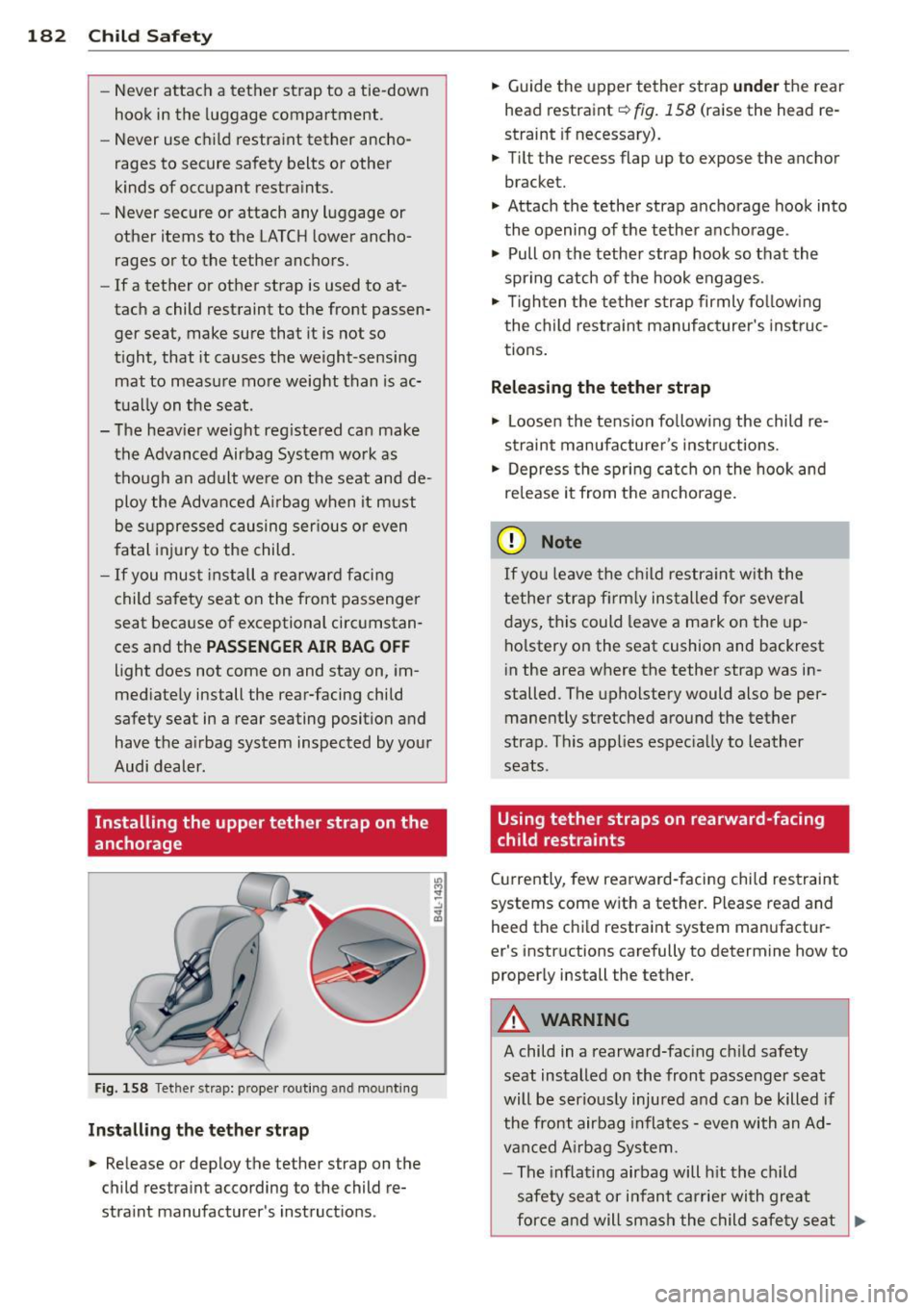
F ig . 1 58 Tethe r strap: prope r rou ting and mounting
Installing the tether strap
.,. Release or deploy the tether strap on the
child restra int acco rding to the child re
straint manufacturer's instruct ions . .,.
Guide the upper tether strap
under the rear
head restraint co
fig. 158 (raise the head re
straint if necessary).
.,. Tilt the recess flap up to expose the anchor
bracket.
.,. Attach the tether strap anchorage hook into
the opening of t he tether anchorage.
.,. Pull on the tethe r strap hook so that the
spri ng catch of the hook engages .
.,. Tight en t he te ther s tra p firmly fo llow ing
the child restraint manufac turer's instruc
tions .
Releasing the tether strap
.,. Loosen the tens ion fo llowing the child re
s traint manufa cture r's instr uctions.
.,. Depress the spring c atc h o n the hook and
release it from the ancho rage.
(D Note
If yo u leave the child restr aint w ith the
tethe r strap firm ly ins talled for several
days, this could leave a ma rk on the up
ho lstery on the seat cushion and backrest
i n the area where the tether strap was in
stalled. The upholstery would also be per
manently stretched around the tether
strap . This applies espec ia lly to leather
seats .
Using tether straps on rearward-facing
child restraints
Currently, few rearward-facing child res traint
systems come w ith a tether. Please read and
heed the c hild restra int system man ufactur
er 's instr uctions carefully to determine how to
properly install the tether .
A WARNING
-
-
A child in a rearward-fac ing ch ild safety
seat installed on the front passeng er seat
will be s erious ly inju re d and ca n be killed if
the fr ont air bag infla tes -even with an Ad
va nced A irbag Sys tem .
- Th e inflating airbag will h it th e chi ld
safety sea t or infant c arrie r wi th gre at
for ce and will sma sh the child s afety seat
~
Page 198 of 294
196 Trailer towing
Trailer towing Driving with a trailer
General information
Your Audi was designed primarily for passen
ger transportation .
If you plan to tow a trai ler, p lease remember
that the additional load will affect durability,
economy and performance .
Trailer towing not on ly places more stress on
the vehicle, it also calls for more concentra
tion from the driver.
For this reason, always fo llow the operating
and driving instructions provided and use
common sense.
Technical requirements
Trailer hitch Use a weight-carrying hitch conforming to the
gross trailer weight. The hitch must be suita
ble for your vehicle and trailer and must be
mounted securely on the veh icle's chassis at a
technically sound location. Use only a trailer
hitch with a removable ball mount. Always
check with the trailer hitch manufacturer to
make sure that you are using the correct
hitch.
Do not use a bumper hitch.
The hitch must be installed in such a way that
it does not interfere with the impact-absorb
ing bumper system . No modifications should
be made to the vehicle exhaust and brake sys
tems . From time to time, check that all hitch
mounting bolts remain securely fastened.
When you are not towing a trailer, remove the
trailer hitch ball mount. This prevents the
hitch from causing damage should your vehi
cle be struck from behind
¢ A.
Trailer brakes
If your tra iler is equipped with a braking sys
tem, check to be sure that it conforms to a ll
regulations . The trailer
hydraulic brake system must not be
direct ly connected to the vehicle's hydraulic
brake system
~ A.
Safety chains
Always use safety chains between your vehicle
and the trai le r.
Trailer lights
T railer lights must meet all regulations. Be
sure to check w ith your authorized Audi dealer
for correct wiring, sw itches, and relays.
Mirrors
If you are unable to see the traffic behind you
using the regular outside mirrors, then you
must install extended mirrors . It is important
that you
always have clear vis io n to the rear.
,8. WARNING
- If a trailer has electrical brakes please
note that these brakes are not activated
by the factory-fitted control unit -risk of
accident!
- Afte r removing the trailer hitch, do not
store it in your vehicle. In case of sudden
braking, the hitch could fly forward and
injure you or your passengers.
Operating instructions
Maximum trailer weight
-
A trailer for your vehicle is limited to a typical
class 1 or class 2 tra iler.
Trailer load distribution Be sure the load in the trailer is held secure ly
in place to prevent it from shifting forward,
backward or sideways.
Never allow a passenger to ride in a trailer
¢ A in Driving instructions on page 197.
Engine cooling system
T owing a trailer makes the engine work hard
er. It is important that the cooling system's
performance is up to the additional load.
Make sure that the cooling system has enough
fluid . .,..
Page 217 of 294
Checking and filling Engine hood
Releasing the engine hood
The engine hood is released from inside the
vehicle .
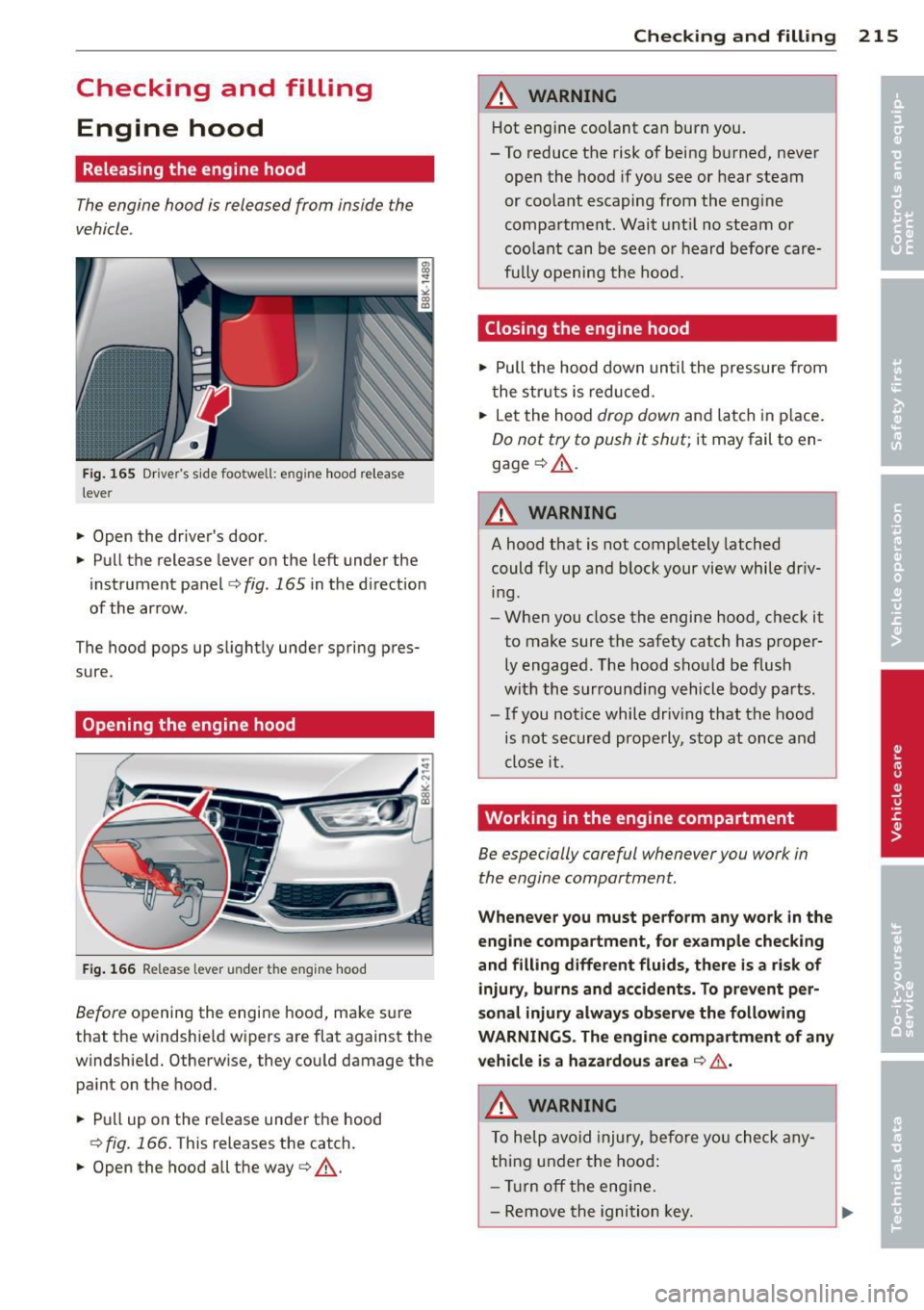
Fig. 165 Dr iver's s ide footwell: engine hood release
lever
"' Open the driver's door .
"' Pull the release lever on the left under the
instrument panel
r=> fig. 165 in the d irection
of the arrow.
The hood pops up slight ly under spring pres
sure.
Opening the engine hood
.... ~- ---=-
Fig . 166 Re lease lever under the engine hood
Before opening the engine hood, make sure
that the windshie ld wipers are flat against the
windshie ld. Otherwise, they could damage the
paint on the hood.
"' Pull up on the release under the hood
r::!> fig. 166 . This releases the catch.
"' Open the hood all the way
c::> &,.
Checkin g and fillin g 215
A WARNING
Hot engine coolant can burn you.
- To reduce the risk of being burned, never
open the hood if you see or hear steam
or coo lant escaping from the eng ine
compartment. Wait unt il no steam or
coolant can be seen or heard before care
fu lly opening the hood.
Closing the engine hood
"' Pull the hood down un til the pressure from
the struts is reduced.
"' Let the hood
drop down and latch in p lace .
Do not try to push it shut; it may fail to en
gage
c;, &, .
A WARNING
--
A hood that is not completely latched
could fly up and b lock your view while dr iv
ing.
- When you close the engine hood, check it
to make sure the safety catch has p roper
ly engaged. The hood should be flush
with the surround ing vehicle body parts.
- If you notice while driv ing that the hood
is not secured prope rly, stop at once and
close it .
Working in the engine compartment
Be especially careful whenever you work in
the engine compartment.
Whene ver you must perform any wo rk in the
eng ine compartment, for e xample checking
and filling different fluids, th ere is a risk of
injury, burns and accident s. To pr event per
sonal injury always observe the following
WARNINGS . The engine compartment of an y
vehicle i s a hazardou s area
c;, Lh, .
A WARNING ~
To help avoid injury, befo re yo u check any
thing under the hood:
- Tu rn off the engi ne.
- Remove the ignition key.
Page 240 of 294
238 Tires and wheels
-If the tire pressure is too low or too high,
the tires will wear prematurely and the
vehicle will not handle well.
- If the tire is not flat and you do not have
to change a wheel immediately, drive at
reduced speed to the nearest service sta
t ion to check the tire pressure and add
air as required.
(D Note
Driving without valve stem caps can cause
damage to the tire va lves. To prevent this,
always make sure that facto ry installed
valve stem caps on all wheels are securely mounted on the valve.
@ For the sake of the environment
Underinflated tires will also increase the
fuel consumption .
Tires and vehicle load limits
There are limits to the amount of load or
weight that any vehicle and any tire can carry.
A vehicle that is overloaded w ill not handle
well and is more difficult to stop. Overloading
can not only lead to loss of vehicle control,
but can a lso damage important parts of the
vehicle and can lead to sudden tire failure, in
cluding a blowout and sudden deflation that
can cause the vehicle to crash .
Your safety and that of your passengers a lso
depends on making sure that load limits are
not exceeded. Vehicle load includes everybody
and everything in and on the vehicle . These
load limits are techn ically referred to as the
vehicle's
Gross Vehicle Weight Rating
("GVWR").
The "GVWR" includes the weight of the basic
vehicle, all factory installed accessories , a full
tank of fuel , oi l, coolant and other fluids plus
maximum load. The maximum load includes
the number of passengers that the vehicle is
intended to carry ("seating capacity") with an
assumed weight of 150 lbs . (68 kg) for each
passenger at a designated seating position
and the tota l weight of any luggage in the ve- hide.
If you tow a trai ler, the weight of the
trailer hitch and the tongue weight of the loaded trailer must be included as part of the
vehicle load.
T he
Gross Axle Weight Rating ("GAWR") is
the maximum load that can be applied at each
of the vehicle's two axles .
T he Gross Vehicle Weight Rating and the
Gross Axle Weight Rating are listed on the
safety compliance sticker label located on the
driver's side B-pillar.Your Audi has 5 seating
positions, 2 in the front and 3 in the rear for
total seating capacity of 5. Each seating posi
tion has a seat belt <=>
page 136, Safety belts .
The fact that there is an upper limit to yo ur
vehicle's Gross Vehicle Weight Rating means
that the to tal weight of wha tever is being car
ried in the vehicle ( including the weight of a
tra iler hitch and the tongue weight of the
loaded trailer) is lim ited. The more passen
gers in the vehicle or passengers who are
heavier than the standard we ights assumed
mean that less we ight can be carried as lug
gage.
T he tire pressure label on your Audi also lists
the maximum combined weight of all of the
occupants and luggage or other cargo that
the vehicle can carry. For the location of the
label <=>page234 , fig.174.
A WARNING
-Overloading a vehicle can cause loss of ve-
hicle control, a crash or other accident, se
rious personal injury, and even death.
- Carrying more we ight than your vehicle
was des igned to carry will prevent the
veh icle from handling properly and in
crease the risk of the loss of vehicle con
trol.
- The brakes on a vehicle that has been
overloaded may not be able to stop the
veh icle with in a safe distance .
- Tires on a vehicle that has been overload
ed can fail suddenly, incl uding a blowout
and sudden deflation, causing loss of
con trol and a crash .
Page 249 of 294
driving a few yards and correct if neces
sary . Follow the instructions from the
snow cha in manufacturer when doing so.
(D Tips
Where snow chains are mandatory oncer
tain roads, this norma lly also applies to
veh icles with all wheel drive.
Wheel bolts
Wheel bolts must always be tightened to the
correct torque.
The design o f whee l bolts is matched to the
factory insta lled r ims . If different rims are fit
ted, the correct wheel bo lts wit h the right
l ength and correctly shaped bolt heads must
be used. This ensures that wheels are f itted
securely and that the brake system functions
correctly .
In certain circumstances, you may not use
wheel bo lts from a different vehicle -even if it
is the same model
<=> page 274.
A WARNING
Improperly tightened or maintained wheel
bolts can become loose caus ing loss of
cont ro l, a co llision and serious persona l in
Jury .
- Always keep the w heel bolts and the
threads in the wheel hubs clea n so the
w hee l bolts can t urn easily and be p rop
erly t igh tened.
- Never grease or oil the wheel bolts and
the threads in the wheel h ubs. They can
become loose wh ile d riving if greased or
oiled, even if tightened to the specified
torq ue.
- Only use whee l bo lts that belong to the
rim being installed .
- Never use different whee ls bolts on your
vehicle.
- Alw ays m ain ta in the co rrec t tig hten ing
torq ue fo r the wheel bo lts to reduce the
risk of a wheel loss . If the tightening tor
que of the wheel bo lts is too low, they
can loosen and come out when the vehi-
Tire s an d wheel s 24 7
cle is mov ing. If the tightening torq ue is
too high, the wheel bolts and threads
can be damaged and the whee l can be
come loose.
@ Note
The specified torque for the whee l bolts is
90 ft lbs . (120 Nm) w ith a tolerance of
± 7,4 ft lbs. (± 10 Nm). Torque whee l bolts
diagonally . After changi ng a wheel, the
torque m ust be checked as soon as poss i
ble with a to rque wrench -preferably by an
a uthorized Aud i dea le r or qualified wor k
shop.
Low aspect ratio tires
Your A udi is fac tory -eq uipped w ith low aspect
ratio tires . These tires have been tho ro ughly
tested and been se lected specifically for your
model for their superb performance, road fee l
and handling under a variety of driving condi
tions . Ask your authorized Aud i dealer for
more details.
The low aspect ratio of these t ires is ind icated
by a numeral of
55 or less in the tire's size
designation. The numera l represents the ratio
of the tire's sidewa ll height in relation to its
tread width exp ressed in percentage. Conven
tiona l tires have a he ight/w idth ratio of 60 or
more.
The performance of low-a spect-r atio tire s is
particularly sensit ive to improper inflation
pre ssure. It is therefor e important that low
a spect ratio tire s are inflated to the specified
pres sure and that th e inflation pr essure i s
regularly checked and maintained. Tire pre s
sure s should be chec ked at lea st once a
month and always before a long trip
<=> page 236, Checking tire pressure.
What you can do to avo id tire and rim
damage
Low aspect ratio tires can be damaged mo re
easily by impact w ith potholes, curbs, gull ies
or ridges on the road, particularly if the tire is
under inflated . ..,.
•
•
Page 253 of 294
What do I do now?
Vehicle tool kit
The tools ore stored underneath the floor
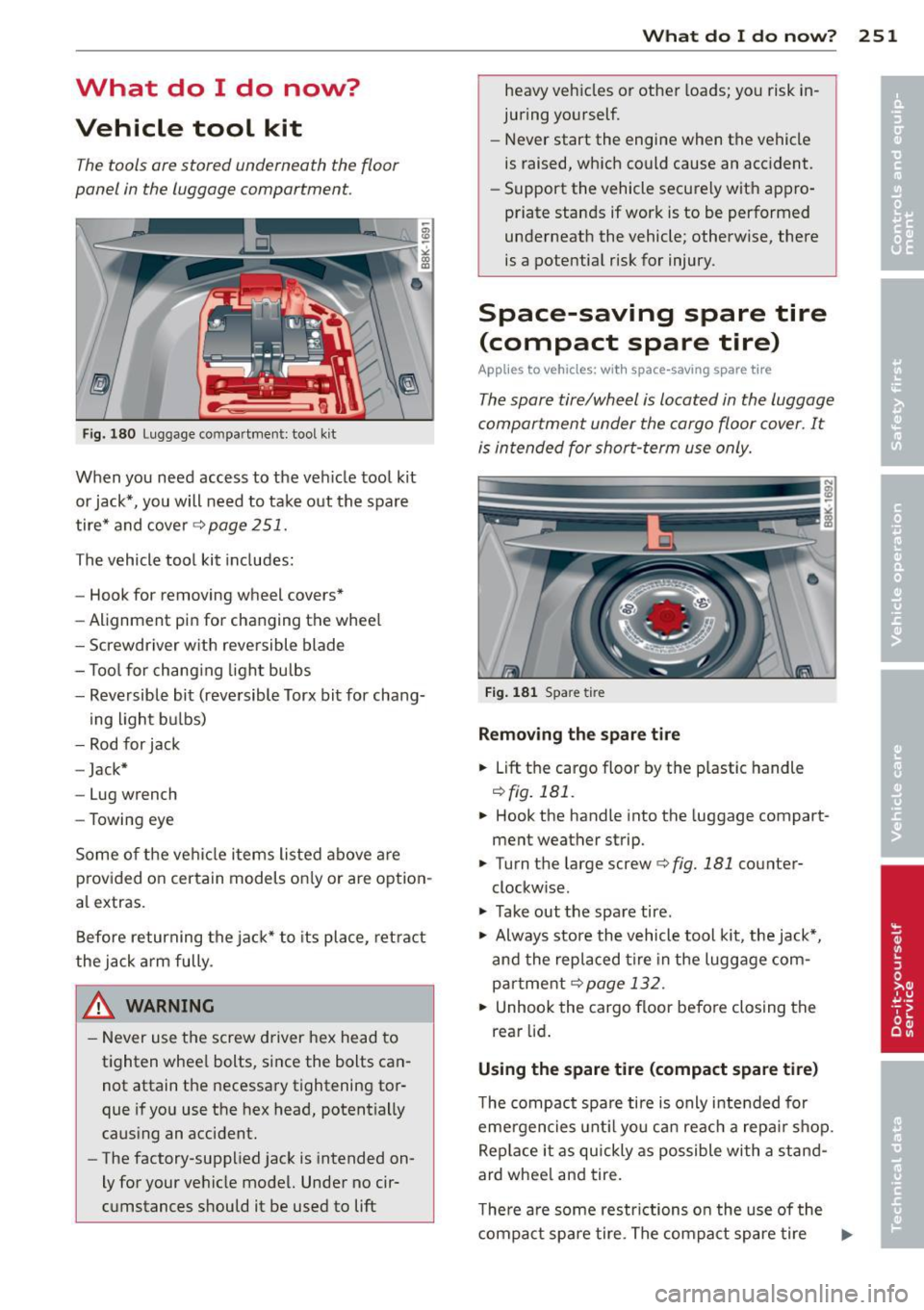
panel in the luggage comportment.
F ig . 180 Luggage compartment: tool kit
When you need access to the veh icle tool kit
or jack*, you will need to take o ut the spare
tire* and cover¢
page 251.
The vehicle tool kit includes:
- Hook for removing wheel covers*
- Alignment pin for changing the whee l
- Screwdriver w ith reversible blade
- T ool for chang ing light bulbs
- Reversible bit (reve rsible Torx bit for chang-
ing light b ulbs)
- Rod for jack
- Jack*
- Lug wrench
- Towing eye
Some o f the ve hicle items listed above are
p rov ided o n certain models on ly or are opt ion
a l extras.
Before returning the ja ck* to its place, ret ra ct
the jack a rm fully.
& WARNING
- Never use t he screw driver hex head to
tighten whee l bolts, since the bolts can
not attain the necessary tightening tor
que if yo u use the hex head, potentially
caus ing an accident.
- The factory-supplied jack is intended on
ly for your ve hicle model. Unde r no cir
c u mstances should it be used to
lift
What do I d o now ? 251
heavy ve hicles o r other loads; yo u risk in
juring yo urself.
- Never start the engi ne when the vehicle
is raised, which could cause an acc ident.
- Support the vehicle secu re ly wit h app ro
priate stands if wor k is to be performed
underneath the vehicle; otherwise, there
is a pote ntia l risk for injury.
Space-saving spare tire
(compact spare tire)
App lies to vehicles: wi th space -saving spare tir e
The spore tire/wheel is located in the luggage
comportment under the cargo floor cover. It
is in tended for shor t-term use only.
Fig. 181 Spare tire
Removing the spare ti re
.. Lift
th e ca rgo floo r by the p lastic handle
r:!) fig. 1 Bl.
.. Hook the handle into the luggage compart
ment weather strip.
.. Turn t he large screw ¢
fig. 181 counter
clockw ise.
.. Take out the spa re tire .
.. Always store the vehicle tool kit, the jack*,
an d the replaced tir e in the luggage com
par tme nt
¢page 132.
.. Unhook the cargo floor befo re closing the
rear lid .
Using the spare tire (compact spare tire)
The compact spa re ti re is only intended for
eme rgencies unt il yo u ca n reac h a repa ir sh op.
Rep lace i t as quickly as possible with a stan d
ard whee l and tire.
T he re a re some restr ictions o n the use of the
compact sp are tire. The compa ct spare tire
IJ>
Page 255 of 294
-To he lp prevent the vehicle from moving
sudden ly and possibly slipping off the
jack, always fully set the parking brake and block the whee l diagona lly opposite
the wheel being cha nged with the fold
ing chocks o r othe r objects. When one
front whee l is lifted off the g ro und, plac
ing the A utomat ic Transm iss ion in "P"
(Park) wi ll
not prevent the vehi cle from
moving .
- Before you change a wheel, be su re the
ground is level and f irm . If necessa ry,
use a sturdy board under the jack.
- After installing the spare tire, make s ure
that you replace the flat ti re/wheel in its
storage area proper ly and tighten the
knur led retain ing screw securely .
Q;) Note
If you are changing the wheel on a steep
incline, use a rock or similar object to
block the opposite wheel to prevent the
veh icle from mov ing.
Obey all laws .
Changing a wheel
When you change a wheel, follow the se
quence described below step -by-step and in
exactly that order.
1. Remove the d ec orative wheel c ove r* or
the
wheel bolt cap s*. Fo r more de tails see
a lso
¢ page 2 54, Decorative wheel cov
ers
or ¢ page 2 54, Wheels with wheel
bolt caps.
2 . Loosen the wheel bolts ¢ page 254.
3. Locate the proper mount ing po int for the
jack and align the jack below that point
¢ page 255.
4. Lift the car with the jack ¢ page 2 55.
S. Remove the wh eel with th e flat tire and
then install the
s pare tire¢ page 256.
6. Tighten all wheel bo lts light ly .
7.
Lower the vehicle with the jac k.
What do I do now? 253
8. U se the wheel bolt w rench and firmly
tighten a ll wheel bolts in a crisscross pat
te rn ¢
page 254.
9. Replace the decorati ve wheel co ver* or
the
wheel bolt caps* .
A WARNING
Always read and fo llow all WARNINGS and
info rmat ion¢
A in Raising the vehicle on
page 255
and ¢ page 257.
After changing a wheel
A wheel change is not complete without the
doing the following.
.,. Always store the vehicle tool kit, the jack*,
and the replaced tire in the luggage com
partme nt
¢ page 132.
.,. Check the tire pr essure of the spare ti re as
soon as possible.
.,. As soon as possib le, have the
ti ght ening
torque s
on all wheel bolts chec ked w ith a
torque wrench . The correct tightening tor
que
i s 90 ft l bs. (120 Nm) .
.,. Have the flat tire replaced as soon as possi
ble .
(D Tips
-If you notice that the wheel bo lts a re
corroded and difficult to turn while
chang ing a tire, they should be replaced
before you check the tightening torque.
- Dr ive at reduced speed until you have the
tightening torques checked. •
•
Page 257 of 294
@ Tips
-Never use the hexagonal socket in the
handle of the screwdriver to loosen or
tighten the wheel bolts.
- If a whee l bolt is very tight, you may find
it easier to loosen by carefully pushing
down on the end of the wheel bolt
wrench w ith
one foot only. As you do so,
hold on to the car to keep your ba lance
and take ca re not to slip.
Raising the vehicle
The vehicle must be li~ed with the jack first
before the wheel can be removed .
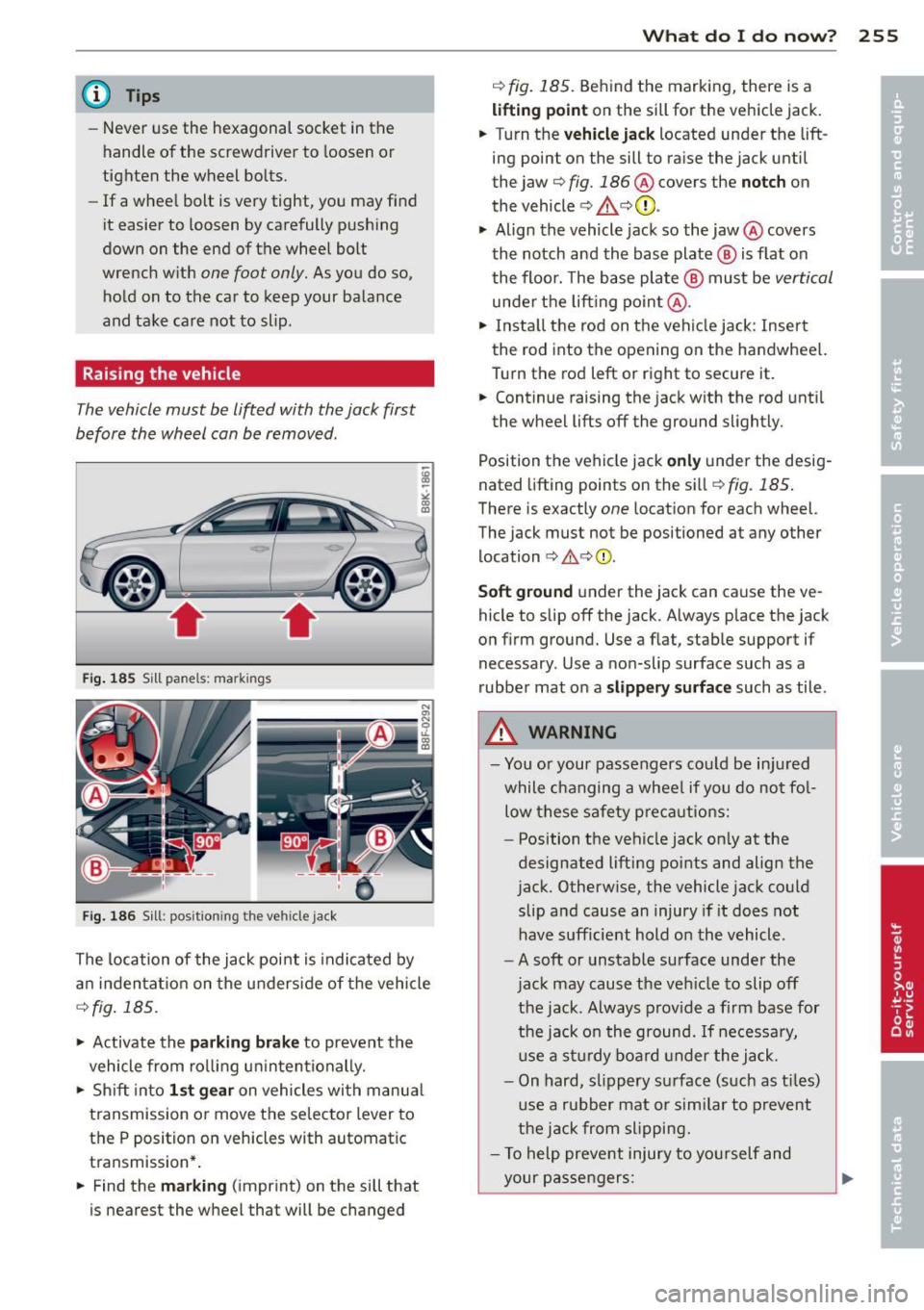
Fig. 1 85 Sill pane ls: ma rki ngs
Fi g. 186 Sill: posit ion ing the ve hicle jack
The location of the jack point is indica ted by
a n in den ta ti on on the underside of the vehicle
Q fig . 185.
"' Activate the parking brake to prevent the
vehicle from ro lling u ninten tionally.
"' Sh ift into
1 st gear on vehicles with m anua l
transmission or move the se lector lever to
the P position on vehicles with automatic
transmission* .
"' Find the
mark ing (imprint) on the sill that
is nearest the wheel that will be changed
What do I d o now ? 255
¢ fig. 185. Behind the marking, there is a
lifting point on the sill for the vehicle jack.
"' Turn the
vehicle jack located under the lift
ing point on the sill to ra ise the jack until
the jaw ¢
fig. 186 @ covers the notch on
the vehicle
¢ & ¢ (D .
"' Align the vehicle jack so the jaw@ covers
th e notch and the base plate @ is flat on
the floor. The base plate @ must be
vertical
unde r th e lift ing po in t @ .
"' Insta ll the rod on the vehi cle jack: Insert
the rod into the opening on the handwheel.
Turn the rod left or right to secure it.
"' Cont inue raising the jack w ith the rod unt il
the wheel lifts off the ground slightly.
Position the veh icle jack
only under the desig
nated lifting points on the sill ¢
fig. 185 .
There is exactly one location for each wheel.
The jack must not be positioned at any other location
¢ ,&. ¢(I) .
Soft ground under the jack can cause the ve
hicle to slip off the jack. Always place the jack
on f irm ground. Use a f lat, stab le support if
necessary . Use a non-slip surface such as a
rubber mat on a
s lipp ery surface such as tile .
A WARNING
-You or your passengers co uld be in ju red
while c hanging a whee l if you do no t fo l
low these safety p re ca utions:
- Position t he veh icle jack on ly at the
designated lifting poi nts and align the
jack. Otherw ise, the vehicle jack could
slip a nd cause an injury if it does not
have sufficie nt hold o n the vehicle.
- A soft or unstable surface under the
jac k may cause the ve hicle to slip off
the jack . A lways prov ide a fi rm base for
the jack o n the ground. If necessa ry,
u se a st ur dy boa rd under the jack .
- On hard, sl ippery su rface (such as t iles)
u se a rubber mat or simi lar to prevent
the j ack from slipping.
- T o help preve nt injury to yo urself and
your pas sengers: