instrument panel AUDI A5 2015 Owner´s Manual
[x] Cancel search | Manufacturer: AUDI, Model Year: 2015, Model line: A5, Model: AUDI A5 2015Pages: 264, PDF Size: 66.83 MB
Page 143 of 264
M N
i? co ,...., \!) 1.1'1
N 1.1'1 ,....,
his or her back up against the backrest and the
backrest is not reclined
~ page 113, Correct
passenger seating positions,
- the ad ult is not taking weight off the seat by
holding on to the passenger assist handle
above the front passenger door or supporting
their weight on the armrest,
- the safety be lt is being proper ly worn and that
there is not a lot of slack in the safety be lt web
bing,
- accessory seat covers or cushions or other
th ings that may cause an incorrect read ing or
impression on the weig ht-sens ing mat under
the upholstery of the seat have been removed
from the front passenger seat,
- a safety be lt extender has not been left in the
safety belt latch for the front passenger seat .
In addition to the
PA SSENGER AIR BAG OFF
light in t he center of the instrument panel, the
message
PASS ENG ER AIR BAG OFF or PAS SEN
GER AIR BAG ON
will br iefly appear in the instru
ment cluster display . Th is is to inform the driver
of the current front passenger ai rbag status.
Important safety instructions on
monitoring the Advanced Airbag System
A WARNING
An airbag system that is not funct ioning prop
erly cannot provide supplementa l protect ion
in a frontal crash.
- If the airbag indicato r light ~ page 19
comes when the vehicle is be ing used, have
the system inspected immed iate ly by your
authorized Audi dealer . It is possible that
the a irbag will inflate when it is not s up
posed to, or wi ll not inflate when it should.
A WARNING
If the front airbag inflates, a ch ild without a
child restraint, in a rearward-facing child safe
ty seat or in a forward-facing child restraint that has not been proper ly installed will be
ser iously injured and can be killed.
- Even though your veh icle is equipped with
an Advanced Airbag System, make certa in
that all ch ild ren, especially 12 years and
Airbag syste m
younger, a lways ride on the back seat prop
erly restra ined for their age and size.
- Always install forward o r rear-facing child
safety seats on the rear seat -even with an
Advanced Airbag System.
- If you must install a rearward-facing child
safety seat on the front passenger seat be
cause of except iona l circumstances and the
PASSENGER AIR BAG OFF light does not
appear and stay on, immediately install the
rea r-facing chi ld safety seat in a rear seating
position and have the airbag system inspect
ed by your authori zed Audi dealer .
- A tight tether or o ther s trap on a rea rward
facing ch ild restraint attached to the front
p assenger seat can put too much pressure
on the weight-sens ing mat in the seat and
register more weight than is actually on the
seat. The heavier weight registe red can
make the system work as though an adult
were on the seat and deploy the Advanced
Airbag when it must be suppressed causing
serio us or even fatal injury to the child.
- If, in exceptiona l circumstances, you must
install a forward-facing child restraint on
the front passenger seat, always move the seat into its rearmost pos ition in the seat's
fore and aft ad justmen t range, as fa r away
from the airbag as possib le. The b ackrest
m ust be adjus ted to an upr ight position.
Make sure that the
PASSENGER AIR BAG
OFF
li ght comes on and stays on all the time
whenever the ignit ion is switched on.
A WARNING
--
- If the PASSENGER AIR BAG OFF light does
not go out when an adult is s itting on the
front passenger seat after tak ing the steps
described above, make sure the adult is
p roperly seated and restrained at one of the
rea r seat ing pos itions.
- Have the airbag system inspected by your
author ized Audi dealer befo re transpo rting
anyone on the front passenger seat.
141
Page 144 of 264
Airbag syste m
(D Tips
If the weight-sensing mat in the front passen
ger seat detects an empty seat, the front air
bag on the passenger side will be turned off,
and
PASS ENGE R AIR BAG OFF will stay on.
Repair, care and disposal of the airbags
Parts of the a irbag system are installed at many
d ifferent places on your Audi . Install ing , remov
ing, servicing or repa iring a part in an area of the
veh icle can damage a part of a n airbag system
and p revent that system from working properly
in a co llision.
There are some important things you have to know to make sure that the effect iveness of the
sys tem w ill not be impaired and that d iscarded
components do not cause injury or pollute the
environment.
A WARNING
-
Improper care, servicing and repair proce
dures can increase the risk of personal injury
and death by preventing an airbag from de
ploying when needed or deploying an airbag
unexpectedly :
- Never cover, obstruct, or change the steer
ing wheel horn pad or a irbag cover or the in
strument panel or modify them in any way .
- Never attach any objects such as cupholders
or telephone mountings to the surfaces cov
ering the airbag units.
- For cleaning the horn pad or instrument panel, use only a soft, dry cloth or one mois
tened with plain water. So lvents or cleaners
could damage the a irbag cover or change
the stiffness o r strength of the mater ial so
that the airbag cannot dep loy and protect
properly .
- Never repa ir, adjust, or change any parts of
the airbag system.
- All work on the steering wheel, inst rument
panel, front seats or electrical system (in
cluding the installation of audio equipment,
cellular telephones and CB radios, etc.)
must be performed by a qualified technician
142 who has the training and special equipment
necessary.
- For any work on the airbag system, we
strongly recommend that yo u see your au
thorized Audi dealer or qualified workshop.
- Never modify the front bumper or parts of
the vehicle body.
- Always make sure that the side airbag can
inflate w ithout interference :
- Never install seat covers or rep lacement
upholstery over the front seatbacks that
have not been specifically approved by
A udi .
- Never use additional seat cushions that
cover the areas where the side a irbags in
flate.
- Damage to the orig inal seat cove rs or to
the seam in the are a of the side ai rbag
module must a lways be repaired immedi
ate ly by an authorized Aud i dealer.
- The a irb ag sys tem can be activated only
once . After an airbag has inflated, it mus t
be rep laced by an authorized Audi dealer or
qualif ied technic ian who has the technical
information, training and specia l equipment
necessary.
- The a irbag system can be deployed only
once . After an airbag has been deployed, it
must be replaced with new replacement parts des igned and approved espec ially for
your Aud i model version. Replacement of
comp lete airbag systems or airbag compo
nents must be perfo rmed by qualified work
shops only. Ma ke s ure tha t any airbag serv
ice action is entered in yo ur Audi Warranty
&
Maintenance booklet under AIRBAG RE
PLACEMENT RECORD.
- In accidents when an airbag is deployed, the
vehicle battery separates the alternator and
the starter from the vehicle electrical sys
tem for safety reasons with a pyrotechn ic
circuit interrupter .
- Work on the pyrotechnic c ircuit inte rrupt
er must on ly be performed by a qua lified
dealer -risk of an acc iden t!
- If the vehicle or the circuit interr upter is
scrapped, all app licable safety precautions
must be followed .
~
Page 145 of 264
M N
0 loo
rl I.O
"' N
"' rl
@ For the sake of the environment
Undep loyed airbag modu les and pretension
ers might be classified as Perchlorate Mater ial
-special handling may apply, see
www.dtsc.ca.gov/hazardouswaste/perchlo rate. When the vehicle or parts of the re
straint system includ ing a irbag modules safe
ty belts with pretensioners are scrapped, a ll
app licable laws and regu lations must be ob
served. Your author ized Audi dealer is fam iliar
w ith these requirements and we recommend
that you have your dealer perform this service
for you.
Other things that can affect Advanced
Airbag performance
Changing the vehicle's suspension system can
change the way that the Advanced A irbag System
performs in a crash. For example, using t ire-rim
comb inat ions not approved by Audi, lowering the
vehicle, chang ing the stiffness of the s uspension,
including the springs, suspension struts, shock
absorbers etc . can change the forces that are
measured by the airbag sensors and sent to the
e lectronic control un it. Some suspension changes
can, for example, increase the force levels meas
ured by the sensors and make the airbag system
deploy in crashes in which it wou ld not deploy if
the changes had not been made . Other kinds of
changes may reduce the force levels measured by
the sensors and prevent the airbag from deploy ing when it should.
A WARNING
Changing the vehicle 's s uspension including
use of unapproved tire-rim combinations can
change Advanced Airbag performance and in
crease the risk of ser ious personal injury in a
crash.
- Never install suspens ion components that
do not have the same performance charac
teristics as the components or iginally instal
led on your veh icle.
- Never use tire-rim combinations that have
not been approved by Audi.
Ai rb ag system
A WARNING
-Items stored between the safety be lt buckle
and the center console can cause the sensors i n the buckle to send the w rong informat ion
to the electronic control module and prevent
the Advanced A irbag System from wor king
properly.
- Always ma ke sure that nothing can interfere
wit h the safety belt buckles a nd that they
are not obstr ucted.
Knee airbags
Description of knee airbags
Appl ies to vehicles: wit h knee airbags
The knee airbag system can provide supplemen
tal protection to properly restrained front seat
occupants.
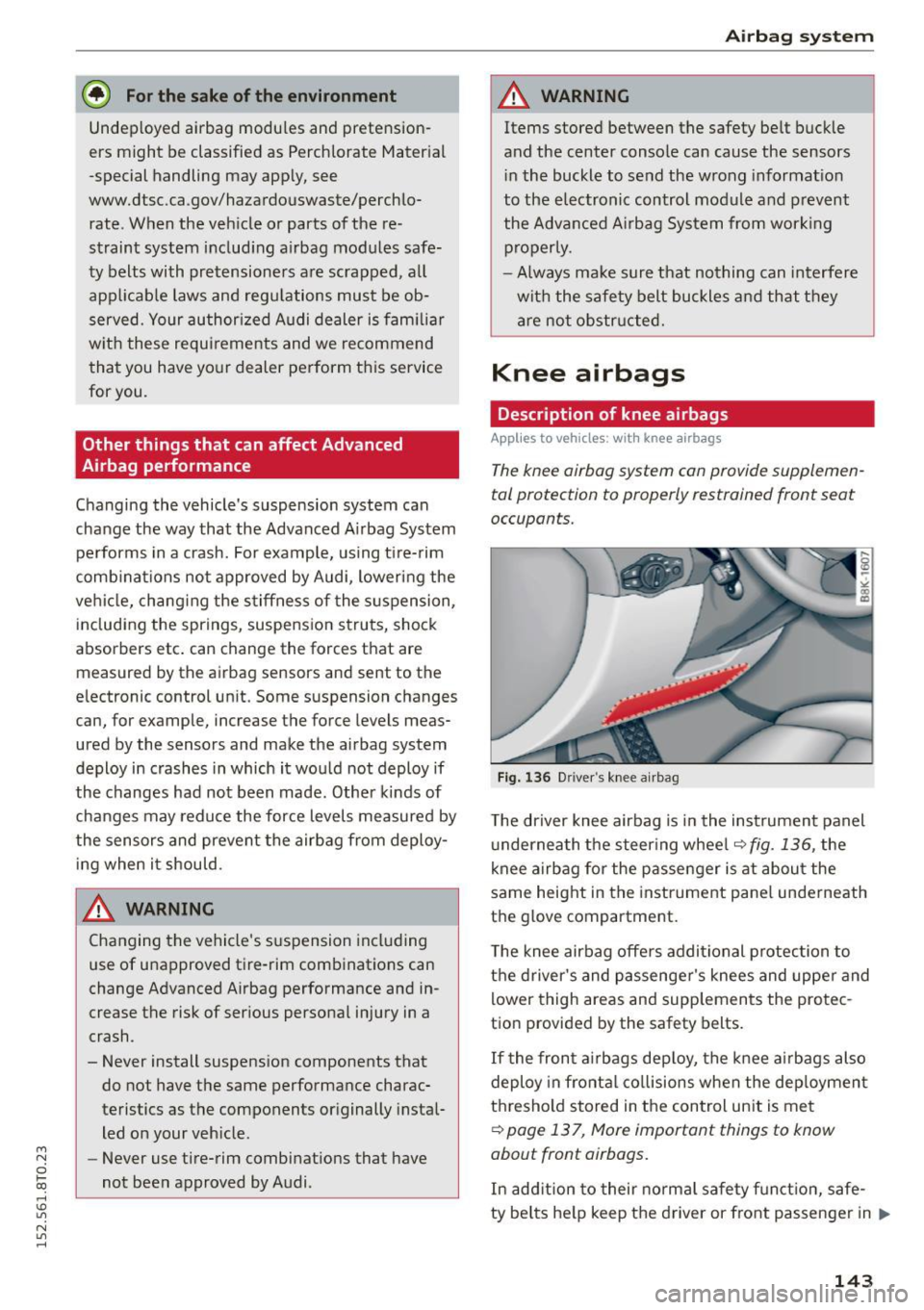
Fig. 136 Dr iver 's knee ai rbag
T he driver knee airbag is in the instrument panel
u nderneath the steer ing whee l~
fig. 136, the
knee airbag for the passenger is at abou t the
same height in the instrument pane l underneath
the g love compartment.
T he knee airbag offe rs additional p rotection to
the driver's and passenge r's knees and uppe r and
lower thigh areas and supp lements the protec
tion provided by the safety belts.
If the front a irbags dep loy, the knee a irbags also
deploy in fronta l co llisions when the dep loyment
th resho ld stored in the control unit is met
~ page 13 7, More important things to know
about front airbags.
In add ition to their normal sa fety f unct ion, safe-
ty be lts he lp keep the driver or fro nt passenger in .,.
143
Page 146 of 264
Airb ag syst em
position in a frontal collision so that the airbags
can provide supp lemental protection.
The airba g system is not a s ubstitute for yo ur
safety belt. Rathe r, it is part of the overall occ u
pant restraint system in your vehicle. Always re
member that the airbag system can only help to
protect you if you are wearing your safety be lt
and wear ing it properly. This is why you should al
ways wear your safety belt, not just because the
law requ ires you to do so
¢page 121, General in
formation .
Remember too, airbags will deploy only once and
only in certain kinds of accidents -your safety
belts are always there to offer protection in those
accide nts in which airbags are not supposed to
deploy or when they have already deployed, for
examp le when your vehicle str ikes o r is s truck by
another after the first collision .
This is just one of the reasons why a n airbag is
not a substitute for the safety belt. The airbag
system works most effectively when used with
the safety belts . T he refore, always wear your
safety belts correctly.
It is important to remember that while the sup
p lemental knee airbag system is des igned to re
duce the likelihood of serio us inj uries , other inju
ries, for examp le, swelling, bruising, and mi nor
abrasions and friction burns can a lso occur when
an airbag inflates .
The kn ee airbag system basically consists of:
- T he electronic con tro l module
- Two inflatab le airbags (airbag and gas genera-
tor), one for the drive r and one fo r the front
passenger
- T he airbag indicator light in the instrument
pane l
The knee airbag system will not deploy:
-whe n the ignition is turned off
- in fronta l coll isions when the dece leration
measured by the control unit is too low
- in side collisions
- in rear-end collisions
- in ro llovers
144
- in the event of a system malfunction (warning/
indicator light is on)
r::;, page 19.
A WARNING
-Safety belts and the airbag system can only
provide protection whe n occupants are in
the proper seating position
r::;, page 137.
- If the airbag indicator light r::;, page 19
comes when the vehicle is being used, have
the system inspected immediately by your
author ized Audi dealer .
It is possible that
the airbag will i nflate when it is not sup
posed to, o r will not inflate when it should.
How knee airbags work
App lies to vehicles: with knee airbags
The risk of injury to the leg area can be reduced
by fully deployed knee airbags.
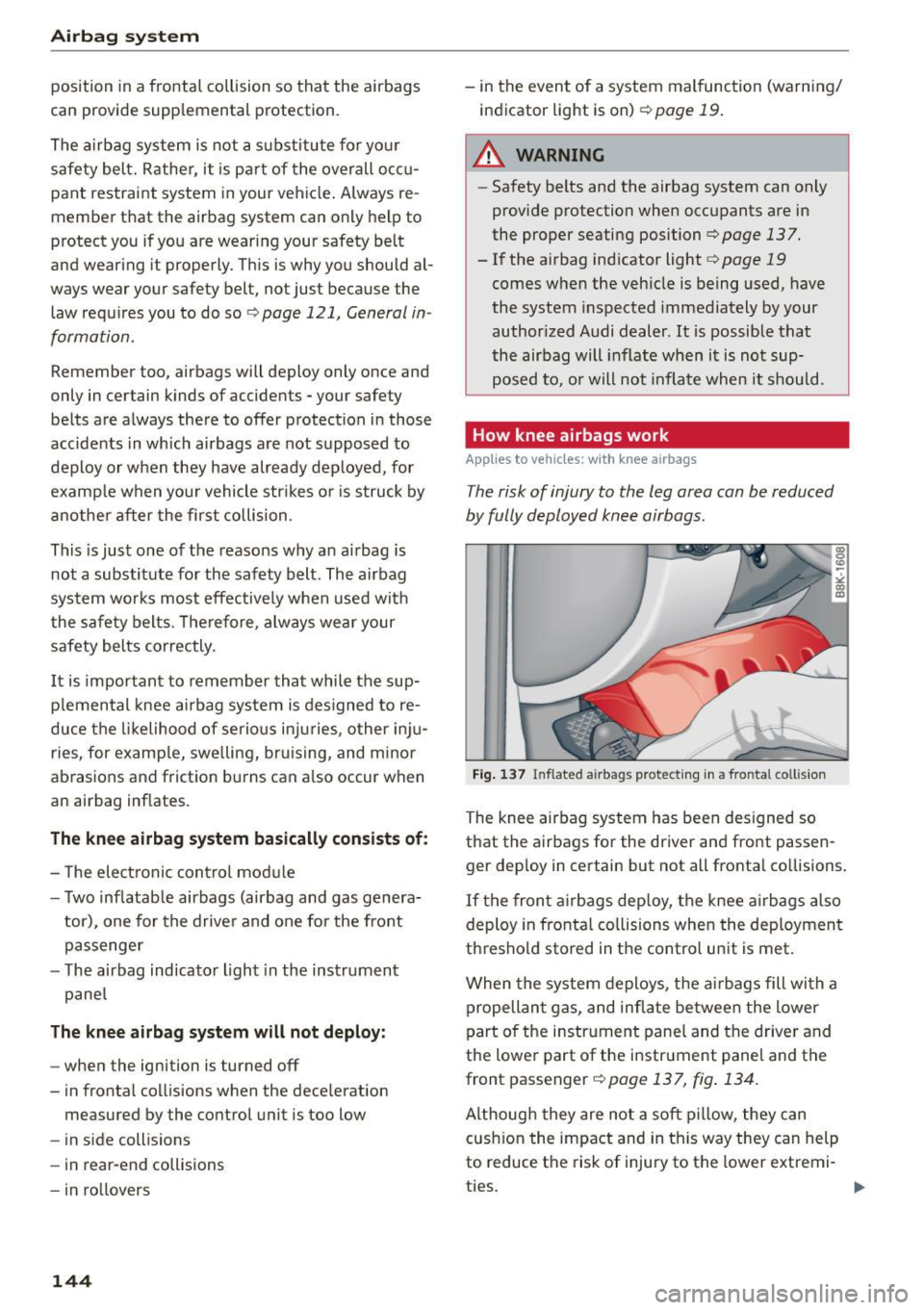
Fig . 13 7 Inflated airbags protect ing in a fro nta l collis ion
The knee airbag system has been des igned so
that the airbags for the driver and front passen
ger dep loy in certain but not all fronta l co llisions.
If t he fron t air bags dep loy, the knee a irbags also
deploy in fro nta l collisions whe n the dep loyment
thresho ld stored in the contro l unit is met .
When the system deploys, the ai rbags fill with a
propellan t gas, and inflate be tween the lower
part o f the instr ument panel and the d rive r and
the lowe r part of the instrument panel and the
front passenger
¢ page 137, fig . 134 .
Although they are not a soft p illow, they can
cush io n the impact and in this way they can help
to reduce the risk of injury to the lower extremi
ties .
Page 151 of 264
M N
i? co
the circumst ances wi ll vary considerably between
one co llision and another . Important facto rs in
clude, for example, t he nature (hard or soft) of
the impacting object, the angle of impact, vehicle
speed, etc .
¢ page 149, How side curtain air
bags work .
Aside from the ir norma l safety func tion, safety
be lts work to help keep the dr iver or front pas
senger in posit ion in the event of a collision so
that the side curta in a irbags can provide protec
tion .
The airbag system is not a subst itute for your
safety belt. Rather, it is part of the overall occu
pant restraint system in your vehicle . Always re
member that the airbag system can only help to
p rotect you if you are wear ing your safety be lt
and wear ing it prope rly. This is another reason
why you should a lways we ar your safety belts,
not just because the law req uires you to do so
¢ page 121, General information.
It is impor tant to remember that whi le the side
cur tain a irbag sys tem is designed to he lp redu ce
the like lihood o f serious injuries, other injur ies,
for example, swe lling, bruising, and minor abra
sions can a lso be associated with these airbags .
Remember too, these airbags wi ll dep loy only
once and only in certain k inds of accidents -yo ur
safety belts are always there to offer protect ion.
The side curt ain airbag sy stem basically
con sists of :
-The electronic control mod ule and externa l side
impact sensors
- The side curtain airbags above the front and
rear side w indows
- The airbag indicator light in the instrument
panel
The airbag system is monitored elect ronica lly to
make certain it is f unctioning proper ly at a ll
times. Eac h time you turn on the ign ition, the a ir
bag system ind icator light will come on for a few
seconds (self diagnostics).
The side curt ain airbag is not activated:
- if the ignitio n is turned off,
~ - in s ide coll isions when the acce leration meas-.,.,
~ u red by the sensor is too low, ,....,
Airbag syste m
- in rear -end co llisions,
- in rollove rs.
A WARNING
-
- Safety belts and the airbag system will only
p rovi de p rotection when occ upants are in
the proper seating position
¢ page 54,
Seats and storage.
- If the ai rbag indicator light ¢ page 19
comes when the veh icle is being used, have
the system inspected immediately by your
author ized Audi dealer. It is possib le that
the airbag will inflate when it is not sup
posed to, or will not infla te when it s hould.
How side curtain airbags work
Side curtain airbags can work together with side
airbags to help reduce the risk of head and upper
torso injuries for occupants who are properly re
strained .
E
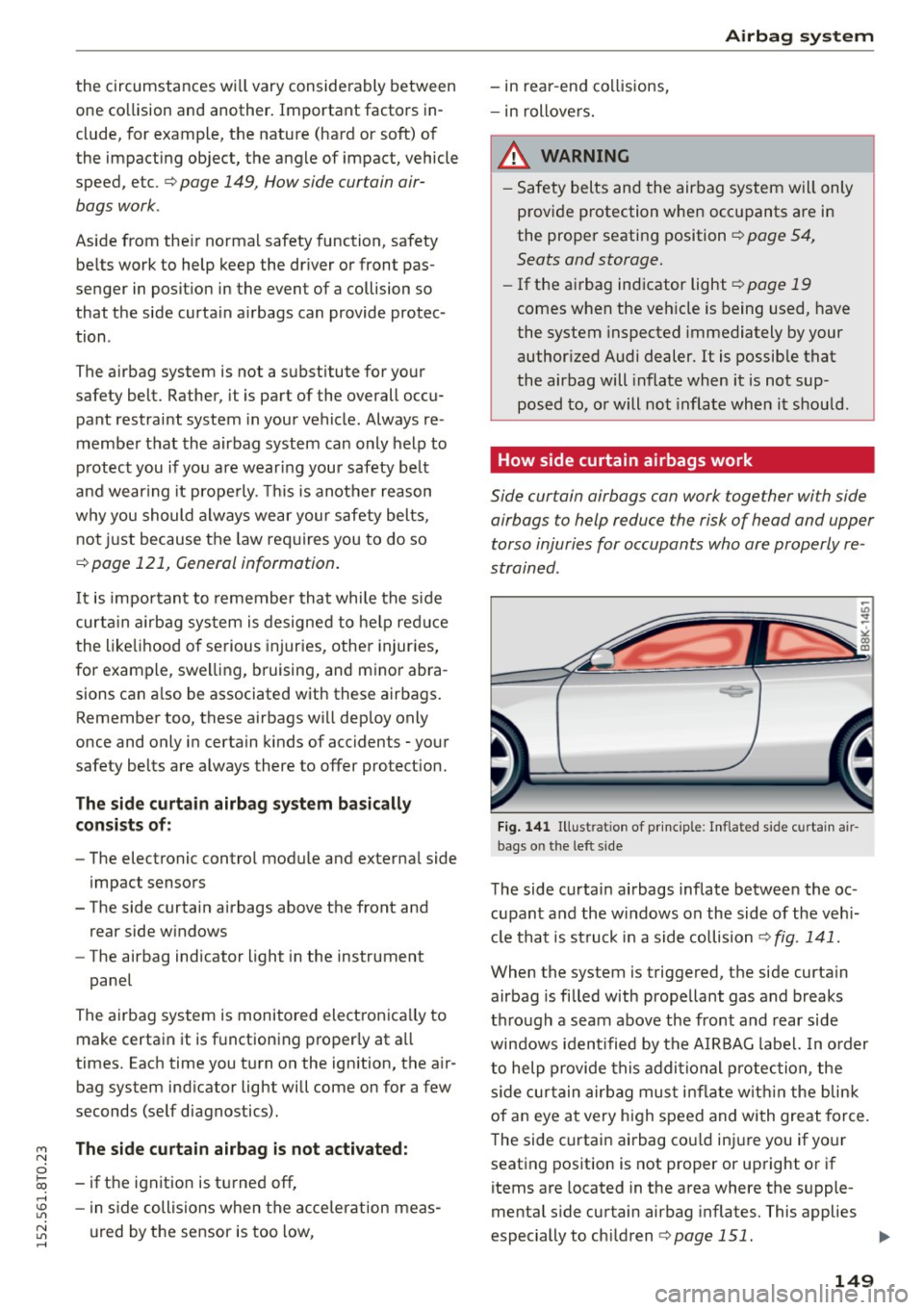
Fig. 14 1 Illus trati on of pr inc ip le : Inf lat ed s ide curtain a ir
bags o n the left s ide
The side curtai n airbags inflate betwee n the oc
cupant a nd the w indows on the side of the ve hi
cl e that is st ruck in a side collision
¢ fig. 141.
When the system is triggered, the side curta in
airbag is filled with prope llant gas and breaks
t hr ough a seam above the front and rear side
windows ident ified by the AIR BAG label. In o rder
to help provide this addi tional p rotec tion , the
s ide cu rtain airbag mus t in flate w it hi n the blin k
of an eye at very high speed and wi th great force.
The side c urtain airbag co uld inj ure you if yo ur
seating position is not proper or upright or if
items are located in the area where the s upple
mental s ide curtain airbag inflates. This applies
especially to ch ildren
¢ page lSl. .,..
149
Page 154 of 264

Child safety
exceptional circumstances and the PASSEN
GER AIR BAG OFF
light does not come on
and stay on, immediately install the rear
ward-facing child safety seat in a rear seat
ing position and have the airbag system in
spected immediately by your authorized
Audi dealer.
_& WARNING
If, in exceptional circumstances, you must in
stall a forward-facing child restraint on the
front passenger's seat:
- Always make sure the forward-facing seat
has been designed and certified by its man
ufacturer for use on a front seat with a pas
senger front and side airbag.
- Always follow the manufacturer's instruc
tions provided with the child safety seat or
carrier.
- Always move the passenger seat into its
rearmost position in the seat's fore and aft
adjustment range, as far away from the air
bag as possible before installing the child
restraint. The backrest must be adjusted to
an upright position.
- Always make sure that the
PASSENGER AIR
BAG OFF
light comes on and stays on all the
time whenever the ignition is switched on.
(D Tips
Always replace child restraints that were in
stalled in a vehicle during a crash. Damage to
a child restraint that is not visible could cause
it to fail in another collision situation.
Advanced front airbag system and children
Your vehicle is equipped with a front "Advanced
Airbag System" in compliance with United States
Federal Motor Vehicle Safety Standard (FMVSS)
208 as applicable at the time your vehicle was
manufactured.
The Advanced Airbag system in your vehicle has
been certified to meet the "low-risk" require
ments for 3- and 6-year old children on the pas
senger side and small adults on the driver side.
The low risk deployment criteria are intended to
152
reduce the risk of injury through interaction with
the airbag that can occur, for example, by being
too close to the steering wheel and instrument panel when the airbag inflates. In addition, the
system has been certified to comply with the
"suppression" requirements of the Safety Stand
ard, to turn off the front airbag for infants up to
12 months who are restrained on the front pas
senger seat in child restraints that are listed in
the Standard.
Even though your vehicle is equipped with an Ad
vanced Airbag system, all children, especially
those 12 years and younger, should always ride in
the back seat properly restrained for their age
and size. The airbag on the passenger side makes
the front seat a potentially dangerous place for a
child to ride. The front seat is not the safest place
for a child in a forward-facing child safety seat. It
can be a very dangerous place for an infant or a
larger child in a rearward-facing seat.
· Advanced Airbags and the weight-sensing
mat in the front seat
The Advanced Airbag System in your vehicle de
tects the presence of an infant or child in a child
restraint on the front passenger seat using the
weight-sensing mat in the seat cushion and the sensor below the safety belt latch on the front
passenger seat that measures the tension on the
safety belt .
The weight-sensing mat measures total weight of
the child and the child safety seat and a child blanket on the front passenger seat. The weight
on the front passenger seat is related to the de
sign of the child restraint and its "footprint", the
size and shape of the bottom of the child re
straint as it sits on the seat . The weight of a child
restraint and its "footprint" vary for different
kinds of child restraints and for the different
models of the same kind of child restraint offered
by child restraint manufacturers.
The weight ranges for the individual types, makes
and models of child restraints that the NHTSA
has specified in the Safety Standard together
with the weight ranges of typical infants and typ-
ical 1 year-old child have been stored in the .,..
Page 193 of 264
M N
0 loo
rl I.O
"' N
"' rl
Checking and Filling Hood
Releasing and opening the engine hood
The engine hood is released from inside the vehi
cle.
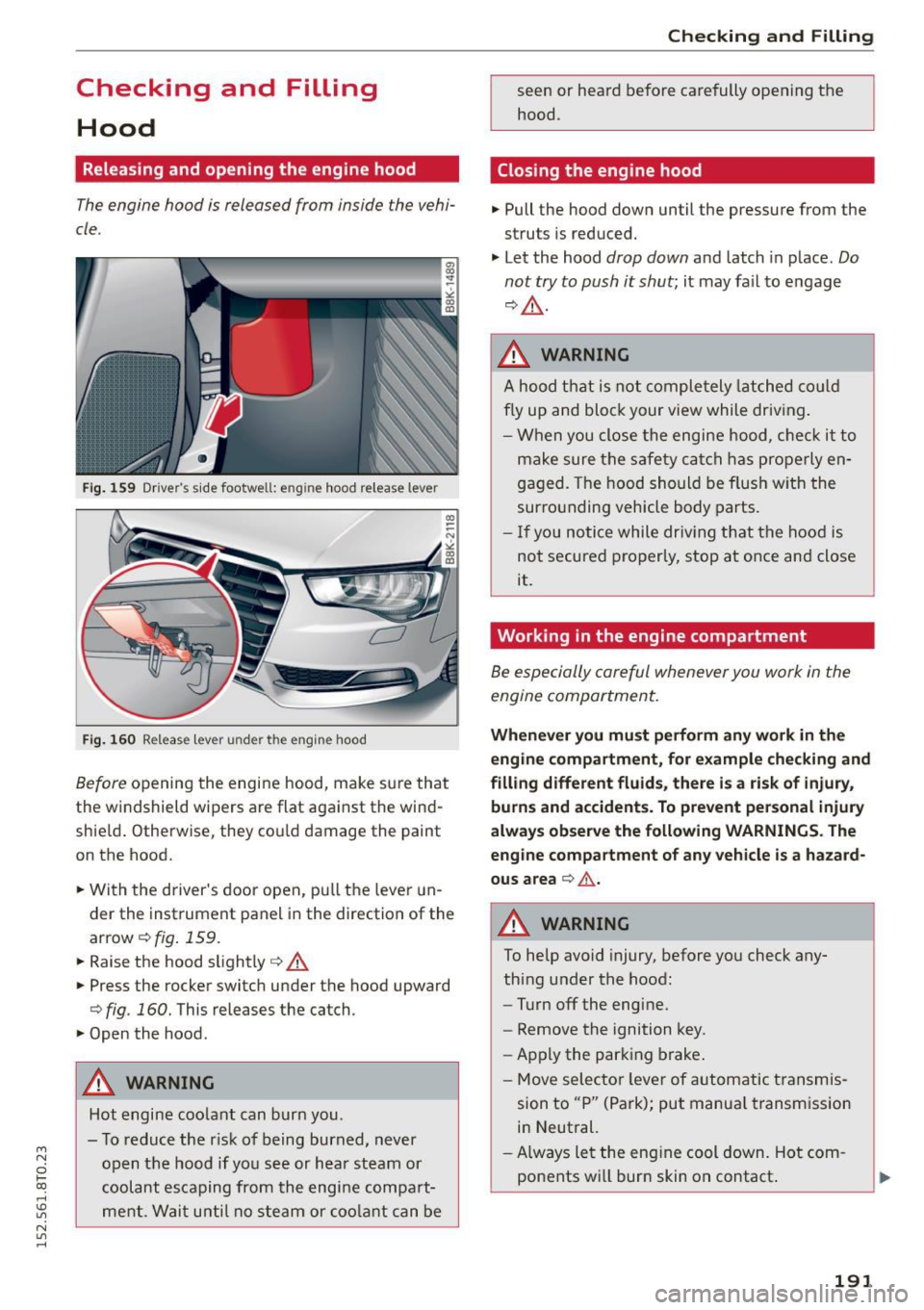
Fig. 159 Driver's side footwell: e ng in e hood release lever
Fig. 160 Releas e lev er un der t he e ngin e hood
Before opening the engine hood, make sure that
the windshield wipers are flat against the wind
shield . Otherwise, they could damage the paint
on the hood.
.. With the driver's door open, pu ll the lever un
der the instrument panel in the direction of the
arrow
c::> fig . 159.
.. Ra ise the hood slightly c::> &.
.. Press the rocker switch under the hood upward
c::> fig . 160. This releases the catch .
.. Open the hood.
A WARNING
Hot engine coolant can burn you.
- To reduce the r isk of being burned, never
open the hood if you see or hear steam or
coolant escaping from the engine compa rt
ment. Wait until no steam or coolant can be
Checking and Filling
seen or heard before carefully opening the
hood .
Closing the engine hood
.. Pull the hood down until the pressure from the
struts is reduced.
"' Let the hood
drop down and latch in place. Do
not try to push it shut;
it may fa il to engage
c::> &. -
A WARNING
A hood that is not comp letely latched could
fly up and block your view while driving.
- When you close the engine hood, check it to
make sure the safety catch has properly en
gaged . The hood should be flush with the
surrounding vehicle body parts.
- If you notice while driv ing that the hood is
not secured properly, stop at once and close
it.
Working in the engine compartment
Be especially careful whenever you work in the
engine compartment.
-
Whenever you must perform any work in the
engine compartment, for example checking and
filling different fluids , there i s a risk of injury ,
burns and accidents. To prevent personal injury
always observe the following WARNINGS . The
engine compartment of any vehicle is a hazard
ous area
c:> .&. .
A WARNING
-
To help avoid injury, before you check any-
thing under the hood:
- Turn off the engine.
- Remove the ignition key .
- Apply the parking brake.
- Move selector lever of automatic transmis-
sion to "P" (Park); put manua l transmission
in Neutral.
-Always let the engine cool down. Hot com
ponents wi ll burn skin on contact .
191
Page 235 of 264
M N
0 loo
rl I.O
"' N
"' rl
Fu se pa nel @ (black )
No. Consumer
1 Dynamic steering
2 Electron ic Stabilization Control (module)
A/C system pressure sensor, electrome-
chanical parking brake, HomeLink, auto-
3 mat
ic dimming interior rear view mirror,
air quality/outside air sensor, Electron ic
Stabilization Control (button)
s Sound actuator
6 Headlight range control/headl
ight (corner-
ing light)
7 Headlight (cornering light)
Control modu les (electromechanical park-
8 ing brake, shock absorber, q uattro sport),
DCDC converte r
9 Adaptive
cruise control
10 Shift gate/clutch sensor
11 Side assist
1 2 Headlight range cont ro l, parking system
13 Airbag
14 Rear
wiper (a llroad)
15 Auxiliary fuse (instrument panel)
16 Auxiliary
fuse termina l 15 (engine area)
Fuse p anel @ (brown )
No. C onsumer
2 Brake light sensor
3 Fuel pump
4 Clutch sensor
5
Left seat heating with/without seat venti-
lation
6 Electronic Stabilization Control (electric)
7 Ho rn
8
Front left door (window regulator, central
locking, mirror, switch, lighting)
9 Windshield wiper motor
10 Electronic Stabilization Control (valves) Fu
ses a nd bulb s
No. Consumer
Two-door mode ls: rear left window regula-
11 tor; Four-door
models: rear left door (win-
dow regulator, central locking, switch,
light ing)
12 Rain and l
ight sensor
Fuse panel © (r e d )
No . Con sumer
3 Lumbar support
4 Dynamic steering
5 Inter
ior l ight ing (Cabriolet)
6 Windshie
ld washer system, headlight
washer system
7 Vehicle electrica l system control module 1
8 Vehicle electr ica l system control module 1
9 Left rear
window regulator motor (Ca brio-
let)/su nroof
10 Vehicle electr ica l system co ntrol module 1
11 Right rear
window regulator (Cabriolet)/
sun shade motor
12 Anti-theft
alarm warning system
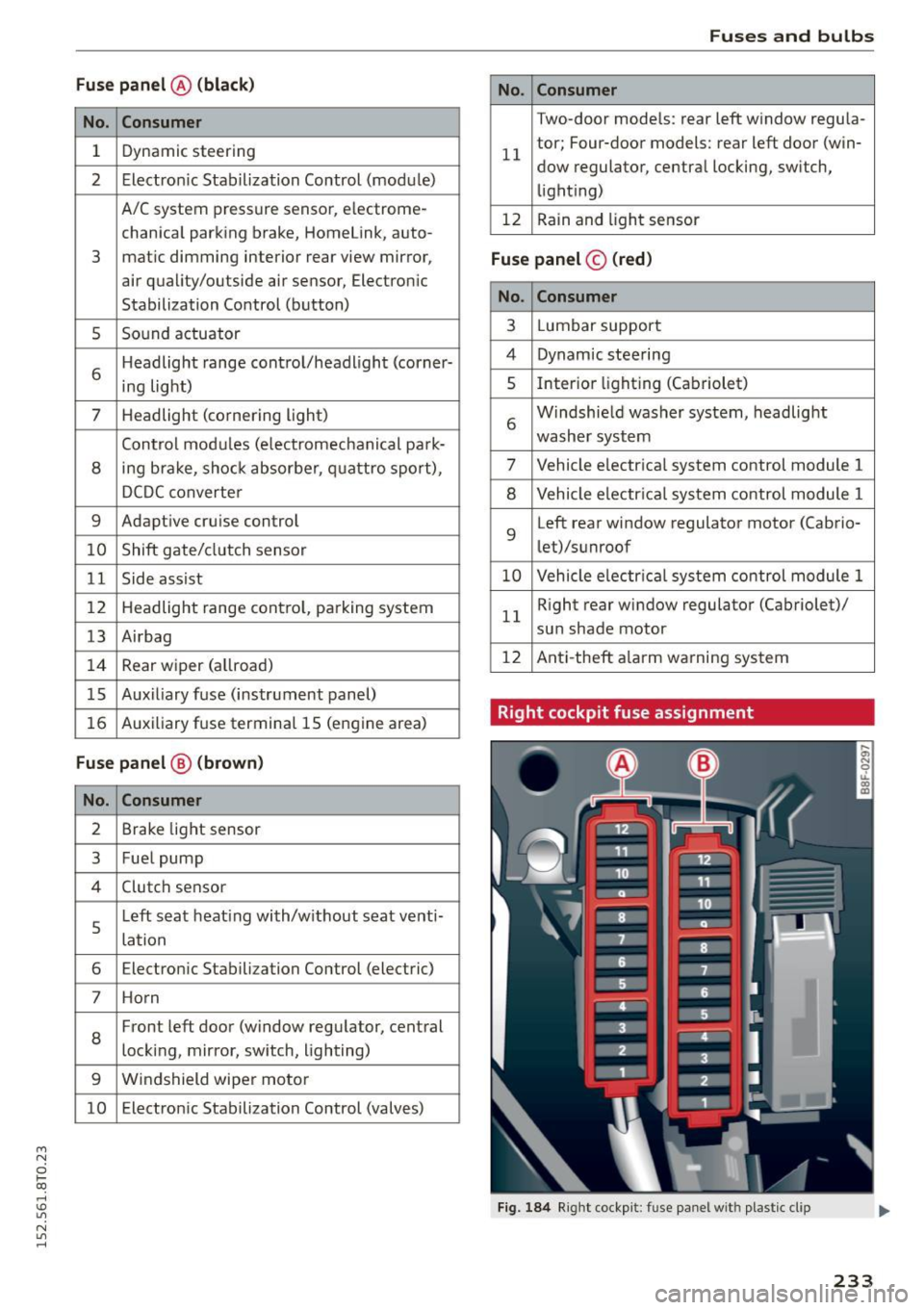
Right cockpit fuse assignment
Fig. 184 Right cockpit: fu se panel with plastic cl ip
233
Page 236 of 264
Fuses and bulbs
Fuse panel @ (black )
No. Consumer
5 Steering col
umn switch module
7 Term inal 15 d iagnost ic connector
8 Gateway (Databus diagnostic interface)
9 Supplementary heater
Fuse panel@ (brown )
No. Consumer
1 CD/ DVD p laye r
2 Wi-Fi
3 M
MI/Radio
4 Instrument cluster
5
Gateway (ins trument cluster co ntrol mod-
ule)
6 Ignition lock
7 Ligh t swi tch
8 Climate control system blower
9 Steering col umn lock
10 Climate contro l system
1 1 Te
rm inal 30 d iagnost ic connector
12 Steer ing column sw itch module
234
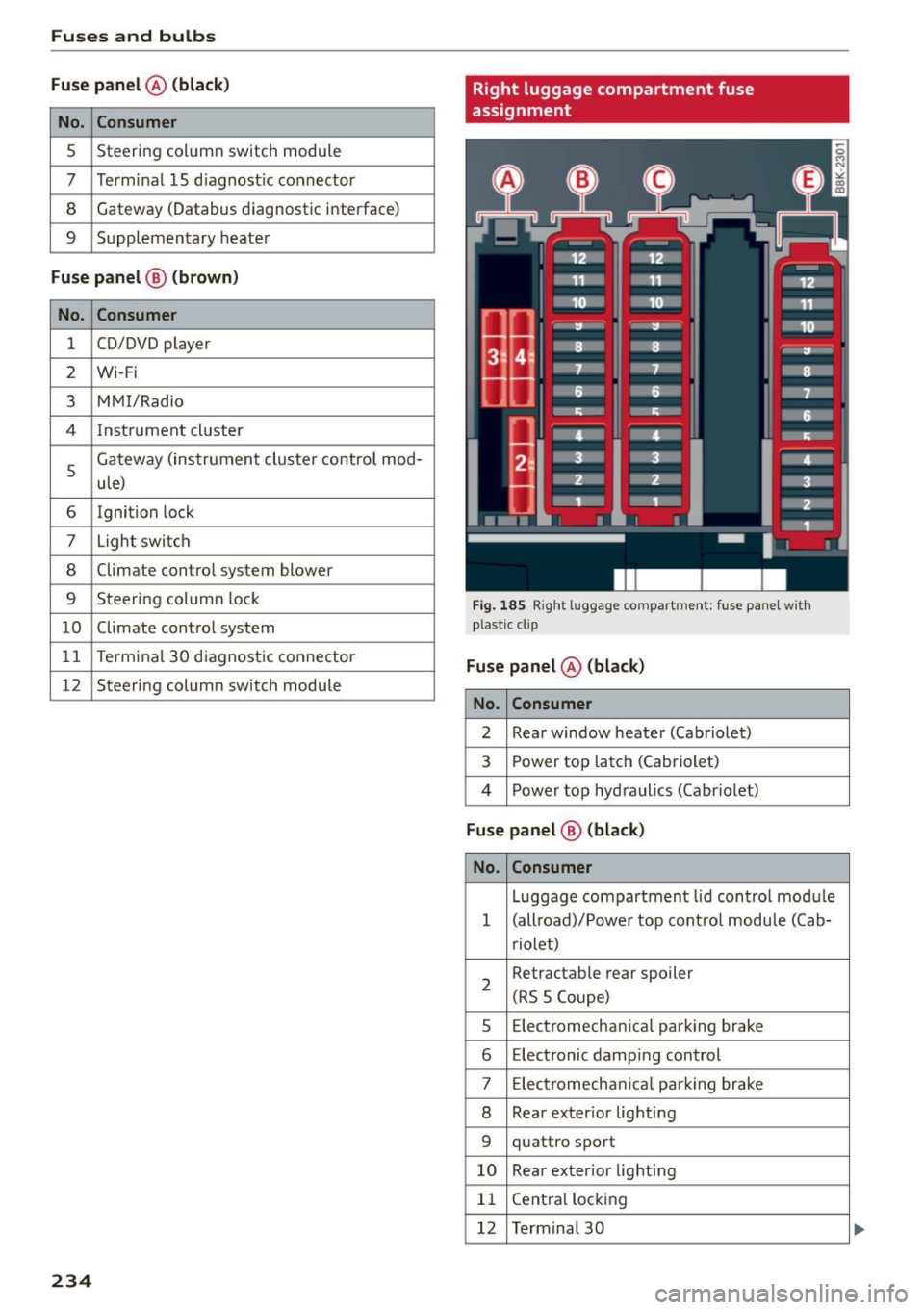
Right luggage compartment fuse
assignment
Fig. 185 Right lu ggage compartment: f use pane l w it h
plast ic clip
Fuse panel @ (black )
No . Consumer
2 Rea r window heater (Cabriole t)
3 Power top latch (Cabriolet)
4 Power top hyd raulics (Cabr io let)
Fuse panel @ (black)
No . Consumer
Luggage compartment lid con trol mo dule
1 (all road)/Powe r top cont ro l modu le (Cab-
r iolet)
2 Retractable rear
spoiler
(RS 5 Coupe)
5 Elec tromechan ica l pa rking brake
6 Electronic damping control
7 Elec tromech anica l par king brake
8 Rear exterior lig hti ng
9 qu attro sport
10 Rear exter ior lighting
1 1 Cent
ral locking
12 Term inal 30