door lock AUDI A5 2015 Owner´s Manual
[x] Cancel search | Manufacturer: AUDI, Model Year: 2015, Model line: A5, Model: AUDI A5 2015Pages: 264, PDF Size: 66.83 MB
Page 79 of 264
M N
0 loo
engine can only be sta rted w ith the selector in
these positions.
!!I Is the k ey in the vehi cle?
This message appea rs if the maste r key is re
moved from t he vehicle w ith the eng ine running.
If the maste r key is no longer in the vehicle, you
c a nnot swi tch on the ignition after s topping the
e ngine and yo u also cannot start the engine
again. Mo reover, yo u cannot lock the vehicle from
the outside with the key.
Shift to P otherwi se vehicle can roll aw ay. Doors
do not lo ck if lever i s not in P .
This message appears for safety reasons a long
w ith a warn ing signal. It appears if the se lector
l eve r fo r the autom atic transmis sion is not in the
P posi tion when switching off the ign ition. Move
the selector leve r to the P posit ion, otherwise the
ve hicle is not secured against ro lling away. You
a lso cannot lock the vehicle using the locking
button* on the door handle or using the remote
key .
Convenience key defective! Use ignition lock
This mes sage appea rs if the eng ine mus t be
started or s topped using the igni tion key and no t
the
! START ENGINE STOPI b utton.
Electromechanical
parking brake
Operation
The electromechanical parking brake replaces
the hand brake.
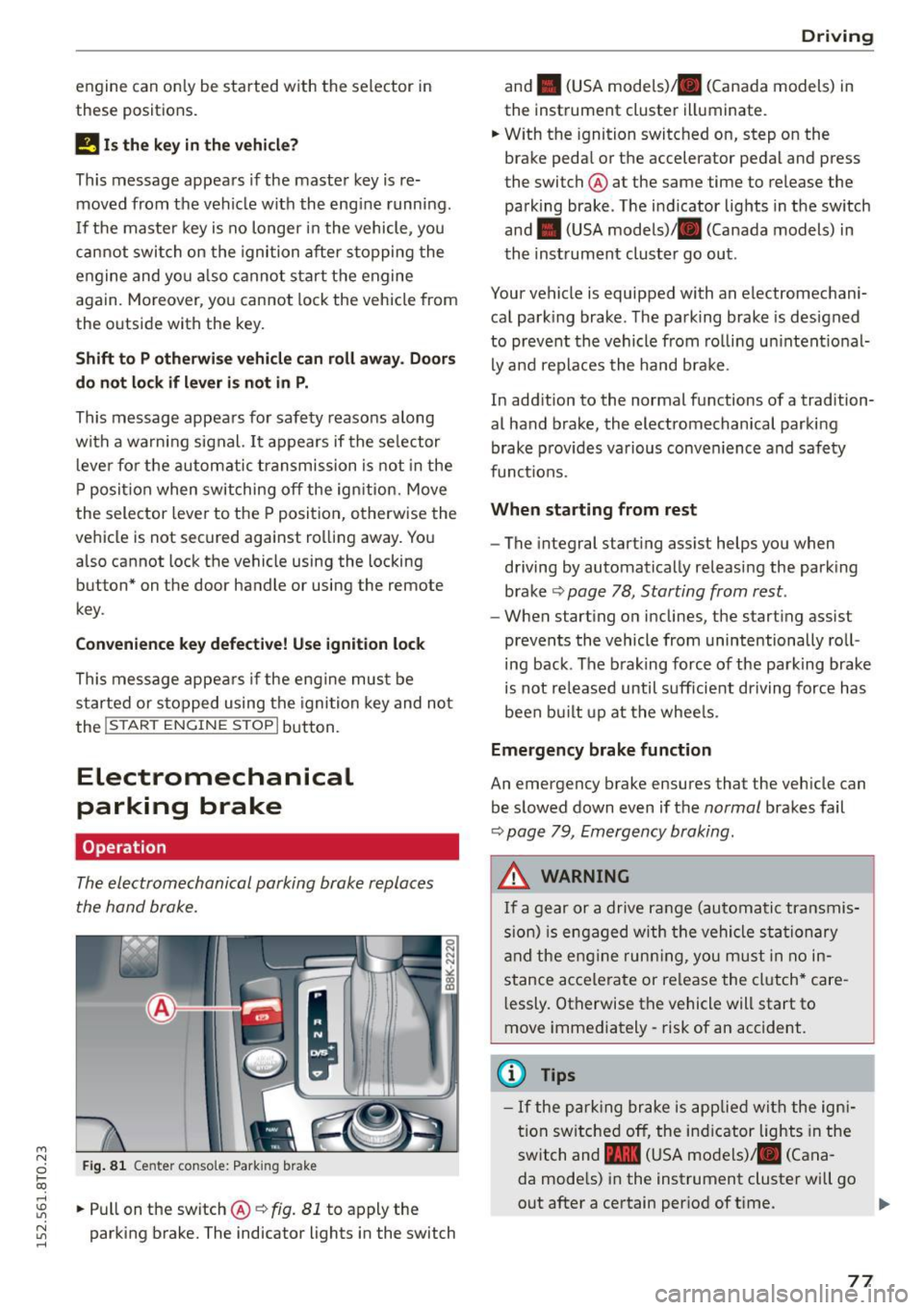
Fig. 81 Ce nter conso le : Park ing bra ke
rl
:5: .. Pull on t he sw itch @¢ fig. 81 to apply the
~ parking b rake. The indicator lights in the switch rl
Driv ing
and . (USA mode ls) . (Canada models) in
the instrument cluste r illuminate.
.. W ith the ignition switched on, step o n the
brake peda l or the accelerator pedal and press
the switch @ at the same time to release the
pa rking brake . The i ndicator lig hts in the sw itch
and . (USA models) . (Canada models) in
th e inst rument cluster go out .
Your vehicle is equipped with an electromechani
ca l park ing brake . T he pa rking brake is designed
to preve nt the vehicle from ro ll in g u nintent ional
ly and replaces the hand brake .
In add ition to the normal functions of a tradition
al hand brake, the electromechanical parki ng
brake p rov ides va rious conve nience and saf ety
funct ions.
When starting from rest
- The integral start ing ass ist helps you when
driving by automatically releasing the park ing
brake
¢ page 78, Starting from rest .
-When starting o n inclines, the starting assist
prevents the vehicle from unintentionally ro ll
ing back . The b rak ing force of the parking brake
i s not re leased until s ufficie nt driving force has
been built up at t he whee ls.
Emergency brake function
An emergency brake ensures that the vehicle can
be s lowed down even if t he
normal brakes fail
¢ page 79, Emergency braking .
A WARNING
If a gear or a drive ra nge (au tomati c tr an smis
s ion) is engaged w ith the vehi cle sta tion ary
a nd the e ng in e runn ing, you m ust in no in
stance ac ce lerate or re lease the cl utch* care
l essly. Otherwise the vehicle will start to
move immediately - risk of an accident.
(1) Tips
- If the p arking br ake is app lied wi th the ign i
tion sw itche d off, the ind icator lights in the
swit ch and -(USA mo dels)/ . (Cana
da mode ls) i n the instrument cluster will go
out after a certain per iod of t i me.
77
Page 80 of 264
Driving
-Oc ca siona l noises when the parking brake is
applied and released are normal and are not
a cause for conce rn.
- When the vehicle is parked, the parking
brake goes thro ugh a se lf-test cycle at regu
l ar inte rvals . Any associated noises are nor
mal.
Parking
.,. Press the brake pedal to stop the vehicle .
.,. Pull the switch@¢
page 77, fig. 81 to set the
parking b rake.
.,. Automat ic transm iss ion: Move the se lector lev-
er to P.
.. Turn the eng ine off ¢,&. .
.. Manua l transmission: Shift in to 1st gea r.
.. When on inclines or declines, tu rn the steering
whee l so that the vehicle w ill roll into the curb
if it beg ins to move.
A WARNING
- When you leave your veh icle -even if only
br iefly -always remove the ignition key . This
applies part icu larly when children remain in
t h e ve hicl e. Otherwise the childre n could
s tar t the engine, release the p arking br ake
or opera te e lectr ica l equi pment (e.g . power
win dows) . There is the ris k of an acci den t.
- When the vehicle is lo cked, no one -particu
larly not children should rema in in the vehi
cl e. Locked doors make it more difficult for
emergency wor kers to get into the vehicle -
putt ing lives at risk.
Starting from rest
The starting assist function ensures that the
parking brake is released automatically upon
starting .
Stopping and applying parking brake
.. Pu ll t he swi tch @ ¢ page 77, fig. 81 to app ly
t h e parking brake.
78
-
Starting and automatically releasing the
park ing brake
.. When you sta rt to drive as usual, the parking
bra ke is automatically released and yo ur vehicle
beg ins to move.
When stop ping at a traffic signal or stopping in
c ity t raffic on vehicles with an a utomat ic t rans
mission, the parking brake can be app lied. The
vehicle does not have to be he ld with the foot
brake. The pa rking brake eliminates the tendency
to c reep with a d rive ra nge engaged. As soon as
yo u drive off as usua l, the park ing b rake is re
l eased a utomat ica lly and the vehi cle starts to
m ove .
Starting on slopes
When sta rting on inclines, the starting assist pre
ven ts the vehicle from unintentionally ro lling
bac k. The braking force of the parking b rake is
n ot released until suff icient dr iving force has
been built up at the wheels.
(D Tips
For safety reasons, the pa rking bra ke is re
l eased a utoma tically on ly w hen t he d river's
s a fety be lt is en gaged in t he b uckle.
Starting off with a trailer
To prevent rolling back unin tentionally on an in
cline, do the f ollowing:
.. Keep the sw itch @¢ page 77, fig . 81 pulled
and dep ress the accelera to r. T he pa rking brake
s t ays app lied and p revents the veh icle from
roll ing ba ckw ard .
.. Yo u can re lease the swi tch @ once you are s ure
that you are deve loping enough d riving force at
the whee ls by depressing the accelerato r.
Depend ing on the weight of the rig (vehi cle an d
t ra ile r) and the seve rity of the incline, yo u may
r o ll backwards as yo u start. You can p revent roll
i ng backwards by holding the parking brake
switch @pulled o ut and acce lerating -just as
you would when starting on a hill wi th a conven
tiona l hand b rake .
Page 87 of 264
M N
i? co ,...., \!) 1.1'1
N 1.1'1 ,....,
~ Wait briefly until the transmission has shifted (you will feel a slight movement) .
~ Remove your foot from the brake pedal and ac
celerate.
Stopp ing tempo raril y
~ Keep the vehicle stationary using the b raking
pedal, for examp le at traffic lights.
~ Do not press the accelerator pedal when doing
this .
~ To prevent the vehicle from rolling when you
start driving , se t the parking brake when stop
ping on steep inclines¢&,. .
~ The parking brake will release automatically
and the vehicle will start moving once you press
the accelerator pedal.
Stopp ing /p ar kin g
If the selector lever is not in the P position when
you open the driver 's door, the veh icle could roll.
The message
Tr ansmi ssion : Car m ay roll ! Shift
t o park!
appears .
~ Press and hold the brake pedal until the vehicle
has come to a complete stop .
~ Apply the parking brake¢ page 78, Parking.
~ Select the P selector lever pos ition ¢ .&_.
Stopp ing on an incline
~ Always press the brake pedal to hold the vehi
cle in place and prevent it from "rolling back"
¢ &,. . Do
not try to prevent the vehicle from
"rolling back" when a gear is engaged by in
creasing the engine speed ¢0 .
Startin g on an incline
~ Activate the parking br ake.
~ With the driving gear selected, press the accel
erator pedal carefully . The parking brake will re
lease automat ically if you r seat belt is fastened.
Under certain circumstances, such as driv ing in
the mountains, it may be useful to switch tempo
rarily to the manual shift program in orde r to ad
just the gears to the d riving conditions by hand
¢ page 86.
On slopes, activate the parking brake first and
then move the selector lever to the P posit ion.
Aut omatic transm issio n
This prevents too much stress from being placed
on the locking mechanism .
A WARNING ,-
-The vehicle can also roll when the engine is
stopped.
- Unintended vehicle movement can cause se
rio us injury.
- Never leave your vehicle with the engine
running while in gear . If you must leave your
veh icle when the engine is running, activate
the park ing brake and move the selector lev
er to P .
- Power is still transmitted to the wheels
when the engine is runn ing at idle . To pre
vent the vehicle from "creep ing", you must
keep your foot on the brake when the eng ine
is running and the se lector lever is in D/S or
R or "tiptronic" mode is selected.
- Do not press the accelerator pedal when
changing the se lector lever position while
the vehicle is stationary and the eng ine is
r u nning .
- Never sh ift into R or P while driving ,
- Before driving down a steep s lope, reduce
your speed and sh ift into a lower gear with
" t ipt ronic ".
- Do not ride the brakes or press the brake pedal too ofte n or too long whe n driving
down a hi ll. Constant brak ing causes the
b rakes to overhea t and substantially re
duces braking performance, increases brak ing distance or causes comp lete fai lure of
the brake system.
- To prevent the vehicle from ro lling back
when stopping on inclines, always ho ld it in
p lace with the brake pedal or parking brake.
- Never hold the vehicle on an incline with a
slipping clutch. The clutch opens automati
cally when it becomes too hot from the
overload. An ind icator lamp@] illuminates
and a driver message appears¢
page 87
when the clutch is overloaded .
-If the engine must remain running, never
have any dr iving posit ion engaged when
checking under the hood . Make sure these
lecto r lever has secu rely engaged and is
locked in P with the parking brake set
85
Page 159 of 264
M N
0 loo
rl I.O
"' N
"' rl
The airbag on the passenger side makes the front
seat a potentially dangerous place for a chi ld to
ride . The front seat is not the safest place for a
chi ld in a forward-facing child seat. It is a very
dangerous place for an infant or a large r child in
a rearward -facing seat .
& WARNING
Not using a ch ild safety seat, using the w rong
child saf ety seat or improperly installing a
child rest raint in cr eases the r is k of serious
pe rsonal in jury and death in a crash.
- Never install rea rward-faci ng ch ild safety
seats or infant car riers on the front passe n
ger seat -even wit h an Adv anced A irbag Sys
tem . A child w ill be seriously injured and can
be k illed when the inflat ing airbag hits the
child safety seat or infant carr ier with great
force and smashes the child safety seat and
child against the backrest, center armrest,
door or roof¢
page 130, Child restraints on
the front seat -some important things to
know .
- Always install rearward -facing child safety
seats or infant car riers on the rear seat .
- Never install a rearward-facing child re
straint in the forward -fac ing direct ion . Such
rest raints a re des igned for the special needs
of infants and very sma ll childre n and can
not p rotect them p roperly if the seat is fo r
w ard-fac ing .
-If you must install a rea rward faci ng chi ld
s afety sea t on t he front passenger sea t be
ca use of exceptional ci rcumstances and the
PASSENGER AIR BAG OFF light does not
come on and stay on, immediately install
the rearward-fac ing ch ild safety seat in a
rear seating position and have the airbag
system inspected by your author ized Audi
dealer .
- Always read and heed all WARNINGS w hen
ever using a child restra ined in a vehicle is
being used¢
page 121, Safety belts,
¢ page 129, Airbag system and
¢ page 151, Important information.
Child sa fe ty
Convertible child safety seats
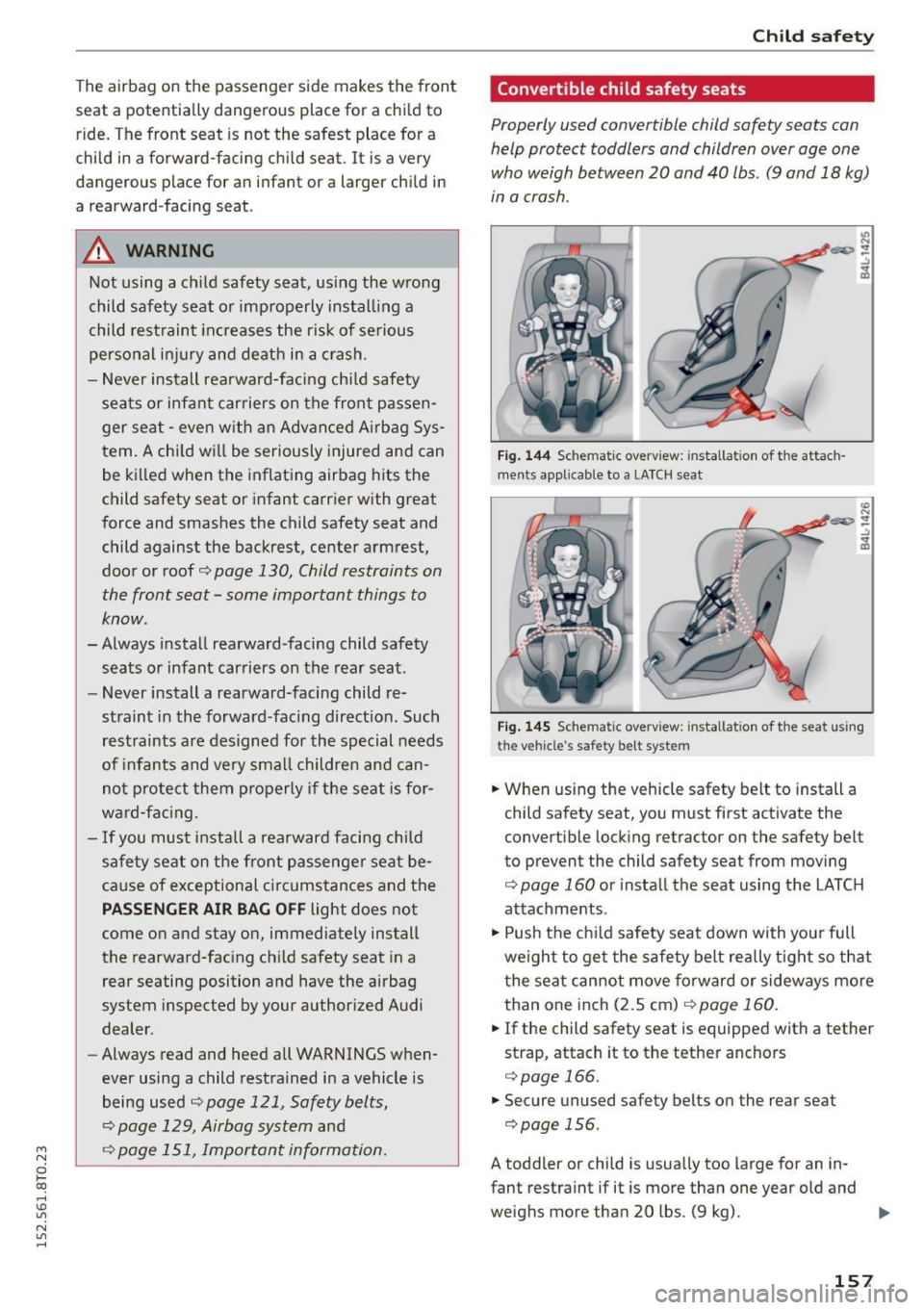
Properly used convertible child safety seats con
help protect toddlers and children over age one who weigh between 20 and 40 lbs. (9 and 18 kg)
in a crash.
F ig . 144 Sc hemat ic ove rv iew: installat io n of t he attach
me nts applicable to a LATCH seat
F ig . 14 S Schemat ic ove rv iew: insta llat io n of th e sea t usi ng
t he ve hicle's sa fety be lt system
.,. W hen us ing the vehicle safety belt to install a
child safety seat, you must first activate the
convert ible lock ing retractor on the safety be lt
t o prevent the child safety seat from mov ing
¢
page 160 or insta ll the seat using the LATC H
attachments .
.,. Push the ch ild safety seat down with you r full
we ight to ge t the safety belt re ally tigh t so that
t he seat can not move forward or sideways mo re
than one inch (2.5 cm)¢
page 160.
.,. If the child safety seat is equ ipped with a tether
strap, attach it to the tether anchors
¢ page 166.
.,. Secure unused safety belts on the rear seat
¢page 156.
A todd ler or child is usua lly too large for an in
fant restraint if it is more than one year old and
weighs more than 20 lbs. (9 kg).
IIJ,,,
157
Page 163 of 264
M N
i? co ,...., \!) 1.1'1
N 1.1'1 ,....,
A WARNING ,~ -
Improperly installed child safety seats in
crease the risk of serious personal injury and
death in a collision.
- Always make sure that the safety belt re
tractor is locked when installing a child safe
ty seat . An unlocked safety belt retractor
cannot hold the child safety seat in place
during normal driving or in a crash.
- Always buckle the child safety seat firmly in
place even if a child is not sitting in it. A
loose child safety seat can fly around during
a sudden stop or in a collision.
- If the backrest is not securely latched, the
child and the child restraint will be thrown
forward together with the backrest and will
strike parts of the vehicle interior. The child
can be seriously injured or killed.
- Never install rearward-facing child safety seats or infant carriers on the front passen
ger seat . A child will be seriously injured and
can be killed when the passenger airbag in
flates.
- The inflating airbag will hit the child safety seat or infant carrier with great force and
will smash the child safety seat and child
against the backrest, center armrest, door
or roof.
- Always install rearward-facing child safety
seats or infant carriers on the rear seat.
- Forward-facing child safety seats or infant
carriers installed on the front passenger's
seat may interfere with the deployment of
the airbag and cause serious injury to the
child.
- It is safer to install a forward-facing child
safety seat on the rear seat.
- Always read and heed all WARNINGS when
ever using a child restrained in a vehicle is
being used
r=;, page 151 . Special precautions
apply when installing a child safety seat on
the front passenger seat
¢ page 130, Child
restraints on the front seat -some impor
tant things to know.
Child safety
A WARNING
Always take special precautions if you must
install a forward or rearward-facing child re
straint on the front passenger's seat in excep
tional situations:
- Whenever a forward or rearward -facing
child restraint is installed on the front pas
senger seat, the
PASSENGER AIR BAG OFF
light must come on and stay on whenever
the ignition is switched on.
- If the PASSENGER AIR BAG OFF light does
not come on and stay on, perform the
checks described
r=;, page 139, Monitoring
the Advanced Airbag System.
- Take the child restraint off the front passen
ger seat and install it properly at one of the
rear seat positions if the
PASSENGER AIR
BAG OFF
light does not stay on whenever
the ignition is switched on.
- Improper installation of child restraints can
reduce their effectiveness or even prevent
them from providing any protection.
- An improperly installed child restraint can
interfere with the airbag as it deploys and
seriously injure or even kill the child .
- Always carefully follow the manufacturer's
instructions provided with the child safety
seat or carrier.
- Never place additional items on the seat
that can increase the total weight registered
by the weight-sensing mat and can cause in
jury in a crash .
A WARNING
-Forward-facing child restraints:
- Always make sure the forward-facing seat
has been designed and certified by its man
ufacturer for use on a front seat with a pas
senger front and side airbag.
- Never put the forward-facing child restraint up, against or very near the instrument pan
el.
-Always move the passenger seat into its
rearmost position in the seat's fore and aft
-
161
Page 164 of 264
Child safet y
adjustment range, as far away from the air
bag as possib le before installing the for
ward-fac ing ch ild restraint. The backrest
must be adjusted to an upright posit ion.
- Make sure that the
PASSENGER AIR BAG
OFF
light comes on and stays on all the t ime
whenever the ignition is switched on.
A WARNING
Rearward-fac ing ch ild restra ints:
- A ch ild in a rearward-facing child safety seat
installed on the front passenger seat will be
seriously injured and can be k illed if the
front a irbag inflates - even with an Ad
vanced Airbag System.
- The inflating a irbag w ill hit the child safety
seat or infant car rier with great force and
will smash the chi ld safety seat and child
against the bac krest, center armrest, door
or roof .
- Always be espe cially caref ul if you must in
sta ll a rearward facing chi ld safety seat on
the front passenger seat in exceptiona l cir
cumstances .
- A tight tether strap on a rearward-facing
child restraint attached to the front passen
ger seat can put too much pressure on the
weight-mat in the seat and register a heavi er we ight in the Advanced Airbag System.
The heav ier weight reg istered can make the
system work as though an adult were on the
seat and deploy the Advanced Airbag when it m ust be s uppressed causing ser ious o r
even fatal injury to the child.
- Make sure that the
PASSENGER AIR BAG
OFF
light comes on and s tays on all the t ime
whenever the ignition is switched on.
- If the PASSENGER AIR BAG OFF light does
not come on and stay on, immed iate ly in
sta ll the rearward-fac ing ch ild safety sea t in
a rear seating posit ion and have the airbag
system inspected by your authorized Audi
dealer .
162
· Activating the convertible locking retractor
Use the convertible locking retractor to secure a
child restraint.
Always heed the child safety seat manufacturer's
i nstruct ions when installing a child restraint in
your vehicle . T o activate the convert ible locking
retractor:
.. Place the child restraint on a seat, preferably on
the rear seat .
.. Slowly pull the belt
all th e wa y out .
.. Route it around or through the child restraint
belt pat h
c::> _&..
.. Push the ch ild safety seat down with your full
weigh t to get the sa fety belt really tight.
.. Insert the belt tongue into the b uckle for that
seating position .
.. Guide the safety be lt back into the retractor un
til the belt lies flat and snug on the ch ild safety
seat.
.. You should hear a "clicking" noise as the belt
w inds back into the inertia reel. Test the con
vert ible lock ing retractor by pu lling on the belt .
You should no longer be able to pull the belt
out of the ret ractor. The conve rtible locking re
tractor is now ac tivated .
.. Make s ure that the red release button is fac ing
away from the child restraint so that it can be
unbuckled quickly .
.. Pull on the belt to make sure the safety be lt is
properly tight and fastened so that the seat
cannot move forward or s ideways more than
one inch (2 .5 cm).
A WARNING
Using the wrong child restraint or an improp
e rly installed child restraint can cause serious
personal injury or death in a crash.
- Always ma ke sure that the safe ty be lt re
tracto r is loc ked when insta lling a child sa fe
ty seat. An unlocked sa fety belt retractor
cannot ho ld the child safety seat in place
during normal driving or in a crash.
- Always buckle the child safety seat firmly in place even if a chi ld is not sitting in it. A
loose child safety seat can fly around d uring
a sudden stop or in a crash.
.
Page 191 of 264
M N
i? co ,...., \!) 1.1'1
N 1.1'1 ,....,
When activating the central locking, the fuel fi ll
er flap is automatically un locked or locked . Re
fue l the vehicle with the ignit ion turned
off.
Tak ing th e fu el cap off
.,. Turn off the ignit ion.
.,. Press the left side o f the fue l filler flap to open
it
r=;, fig . 155 -arrow -.
.,. Unscrew fuel cap counter-clockwise and hang it
on the fue l filler flap
c> fig. 156.
R efuellin g proc edu re
.,. Inse rt the fue l nozz le from the gasol ine p ump
into the fuel filler neck as far as it will go .
.,. Se lect a medium refuelling rate so that the
nozzle switches off automatica lly when the
tank is full.
P utting the fuel cap back on
.,. After fi lling your tank, tw ist the fuel cap clock-
wise as far as it wi ll go.
.,. Close the fuel filler flap .
To avo id f uel spi lling or evaporating from the fue l
tank always close fuel cap properly and com
p letely.
A WARNING
Improper refueling or handling of fue l can
cause fire, exp losion and severe burns.
-
- Fuel is highly flammable and can cause se
vere burns and other injuries.
- Failure to shut the engine off whi le refuel
ing and/or to insert the pump nozzle fu lly
into the fuel filler neck could cause fue l to
spray out of f iller neck or to overflow. Fuel
spray and overflow ing fuel can cause a fire.
- Never use a cellular telephone wh ile refuel
ing. The electromagnetic radiation can
cause sparks that can ignite fuel vapors and
cause a fire.
- Never get back into your vehicle while refu
eling. If in exceptional c ircumstances you
must get back in your vehicle while refuel
ing, make certain that you close the door
and touch meta l to discharge static e lectric
ity before touching the filler nozzle again.
Fu el and R efu elin g
Static electricity can cause sparks that can
ignite fuel vapors released during refue ling.
- Never smoke or have an open f lame any
where in or near your vehicle when refueling or filling a portable fuel conta iner .
- For your safety, we strongly recommend
that you do not travel with a portable f uel
container in your veh icle. The container, full
or empty may leak and cou ld cause a fire,
especially in a crash .
- If, under exceptional c ircumstances, you
must transport a portab le fuel container,
please observe the following:
- Never fill a portable fuel container while it
is anywhere in or on the vehicle (for exam
ple, in the l uggage compartment, or on
the trunk). Static e lectric ity can build up
while filling and can ignite fuel vapors
caus ing a fire .
-Always place a portab le fue l conta iner on
the ground before fill ing .
- Always keep the filler nozzle completely
inside the portable container before and
during f il li ng.
- If filling a portab le container made of
metal, the f iller nozzle must always be in
contact with the container. This will help prevent static electricity from d ischarging
and cause a fi re.
- Never spill fuel inside the vehicle or lug
gage compartment. Fuel vapors are highly
flammable.
- Always observe local and state/provincial
laws regarding the use, storage and trans
po rtation of fue l conta iners.
- Make certain the fuel conta iner meets in
dustry standards (ANSI/ AS TM F852 -86).
(D Note
If any fuel has sp illed onto the car, it should
be removed immediately to prevent damage
to the pa int.
@) For the sake of the environment
As soon as the correct ly operated nozzle
switches off automat ically for the first time,
189
Page 192 of 264
Fuel and Refueling
the tank is full. Do not try to add more fuel
because fuel may spill out. In addition, the
expansion space in the fuel tank will be filled -
causing the fuel to overflow when it becomes
warm and pollute the environment.
(D Tips
- Running your engine while refuelling may
cause vapors to escape or even cause fuel to
spill out of the tank. This would then shut
off the fuel nozzle before the tank is full.
- Do not refuel your vehicle with the ignition
turned on. The fuel gauge may otherwise
not indicate the correct fuel level after refu
elling.
- The fuel filler flap of your vehicle is not
locked when you lock the vehicle from the
inside .
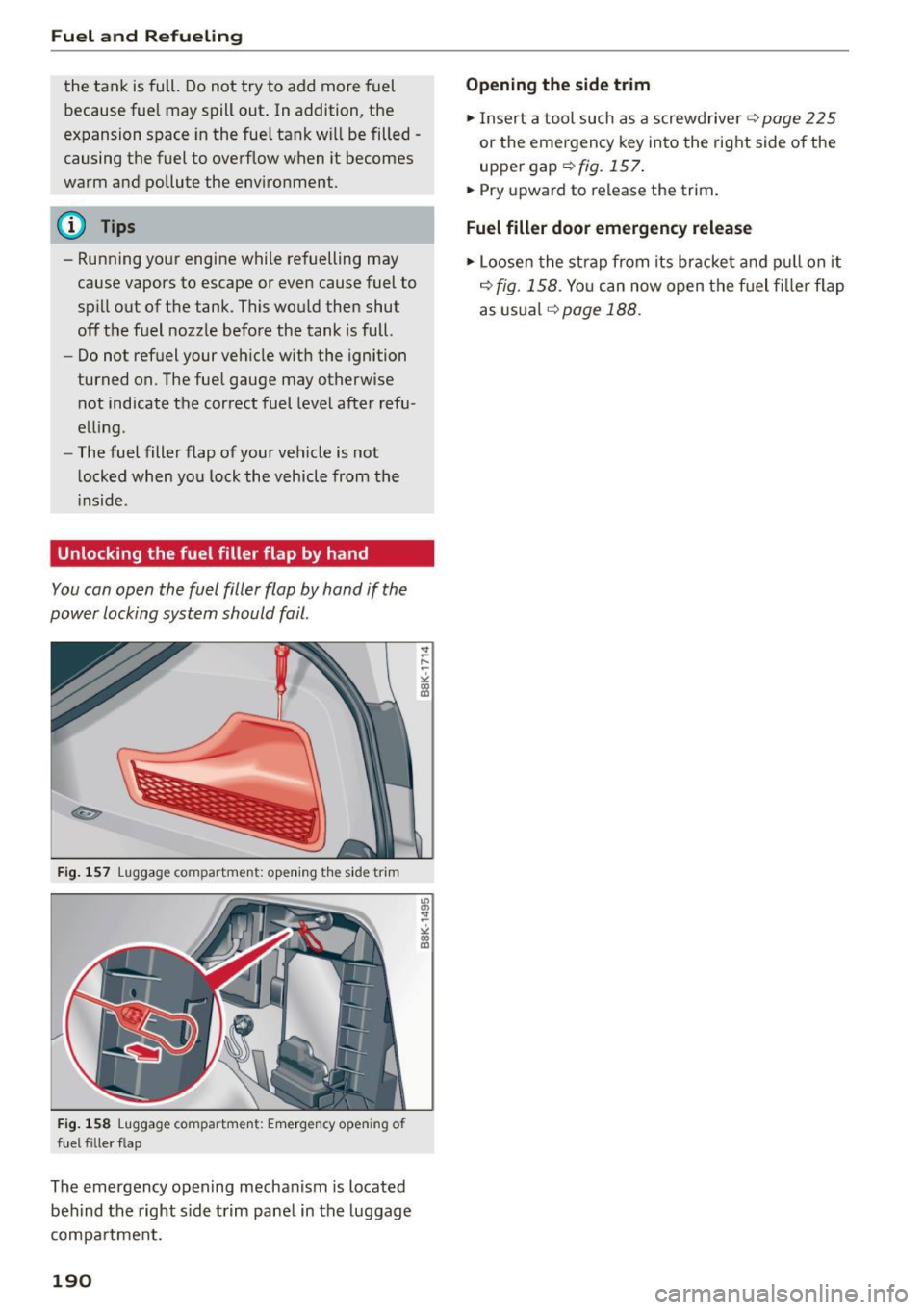
Unlocking the fuel filler flap by hand
You can open the fuel filler flap by hand if the
power locking system should fail.
F ig. 157 Luggag e compartment: open ing the sid e trim
Fig. 158 Luggag e compart ment: Emergency open ing of
fuel filler flap
The emergency opening mechanism is located
behind the right side trim panel in the luggage
compartment.
190
"' a, st
-
" co
"'
Opening the side trim
.. Insert a tool such as a screwdrive r c:> page 225
or the emergency key into the right side of the
upper gap
¢fig. 157.
.. Pry upward to release the trim .
Fuel filler door emergency release
.. Loosen the strap from its bracket and pu ll on it
¢ fig. 158. You can now open the fu el filler flap
as usual
¢page 188.
Page 193 of 264
M N
0 loo
rl I.O
"' N
"' rl
Checking and Filling Hood
Releasing and opening the engine hood
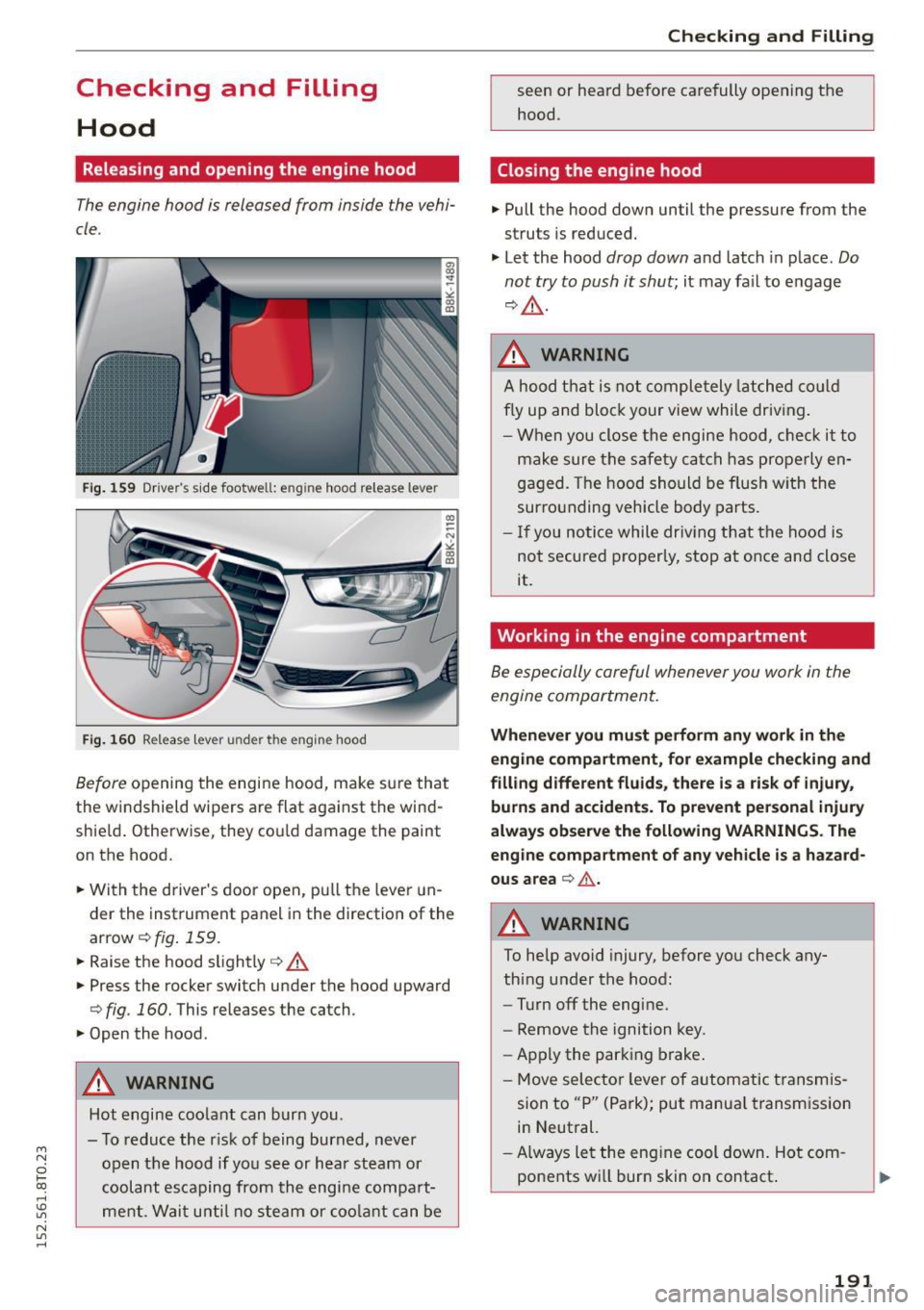
The engine hood is released from inside the vehi
cle.
Fig. 159 Driver's side footwell: e ng in e hood release lever
Fig. 160 Releas e lev er un der t he e ngin e hood
Before opening the engine hood, make sure that
the windshield wipers are flat against the wind
shield . Otherwise, they could damage the paint
on the hood.
.. With the driver's door open, pu ll the lever un
der the instrument panel in the direction of the
arrow
c::> fig . 159.
.. Ra ise the hood slightly c::> &.
.. Press the rocker switch under the hood upward
c::> fig . 160. This releases the catch .
.. Open the hood.
A WARNING
Hot engine coolant can burn you.
- To reduce the r isk of being burned, never
open the hood if you see or hear steam or
coolant escaping from the engine compa rt
ment. Wait until no steam or coolant can be
Checking and Filling
seen or heard before carefully opening the
hood .
Closing the engine hood
.. Pull the hood down until the pressure from the
struts is reduced.
"' Let the hood
drop down and latch in place. Do
not try to push it shut;
it may fa il to engage
c::> &. -
A WARNING
A hood that is not comp letely latched could
fly up and block your view while driving.
- When you close the engine hood, check it to
make sure the safety catch has properly en
gaged . The hood should be flush with the
surrounding vehicle body parts.
- If you notice while driv ing that the hood is
not secured properly, stop at once and close
it.
Working in the engine compartment
Be especially careful whenever you work in the
engine compartment.
-
Whenever you must perform any work in the
engine compartment, for example checking and
filling different fluids , there i s a risk of injury ,
burns and accidents. To prevent personal injury
always observe the following WARNINGS . The
engine compartment of any vehicle is a hazard
ous area
c:> .&. .
A WARNING
-
To help avoid injury, before you check any-
thing under the hood:
- Turn off the engine.
- Remove the ignition key .
- Apply the parking brake.
- Move selector lever of automatic transmis-
sion to "P" (Park); put manua l transmission
in Neutral.
-Always let the engine cool down. Hot com
ponents wi ll burn skin on contact .
191
Page 235 of 264
M N
0 loo
rl I.O
"' N
"' rl
Fu se pa nel @ (black )
No. Consumer
1 Dynamic steering
2 Electron ic Stabilization Control (module)
A/C system pressure sensor, electrome-
chanical parking brake, HomeLink, auto-
3 mat
ic dimming interior rear view mirror,
air quality/outside air sensor, Electron ic
Stabilization Control (button)
s Sound actuator
6 Headlight range control/headl
ight (corner-
ing light)
7 Headlight (cornering light)
Control modu les (electromechanical park-
8 ing brake, shock absorber, q uattro sport),
DCDC converte r
9 Adaptive
cruise control
10 Shift gate/clutch sensor
11 Side assist
1 2 Headlight range cont ro l, parking system
13 Airbag
14 Rear
wiper (a llroad)
15 Auxiliary fuse (instrument panel)
16 Auxiliary
fuse termina l 15 (engine area)
Fuse p anel @ (brown )
No. C onsumer
2 Brake light sensor
3 Fuel pump
4 Clutch sensor
5
Left seat heating with/without seat venti-
lation
6 Electronic Stabilization Control (electric)
7 Ho rn
8
Front left door (window regulator, central
locking, mirror, switch, lighting)
9 Windshield wiper motor
10 Electronic Stabilization Control (valves) Fu
ses a nd bulb s
No. Consumer
Two-door mode ls: rear left window regula-
11 tor; Four-door
models: rear left door (win-
dow regulator, central locking, switch,
light ing)
12 Rain and l
ight sensor
Fuse panel © (r e d )
No . Con sumer
3 Lumbar support
4 Dynamic steering
5 Inter
ior l ight ing (Cabriolet)
6 Windshie
ld washer system, headlight
washer system
7 Vehicle electrica l system control module 1
8 Vehicle electr ica l system control module 1
9 Left rear
window regulator motor (Ca brio-
let)/su nroof
10 Vehicle electr ica l system co ntrol module 1
11 Right rear
window regulator (Cabriolet)/
sun shade motor
12 Anti-theft
alarm warning system
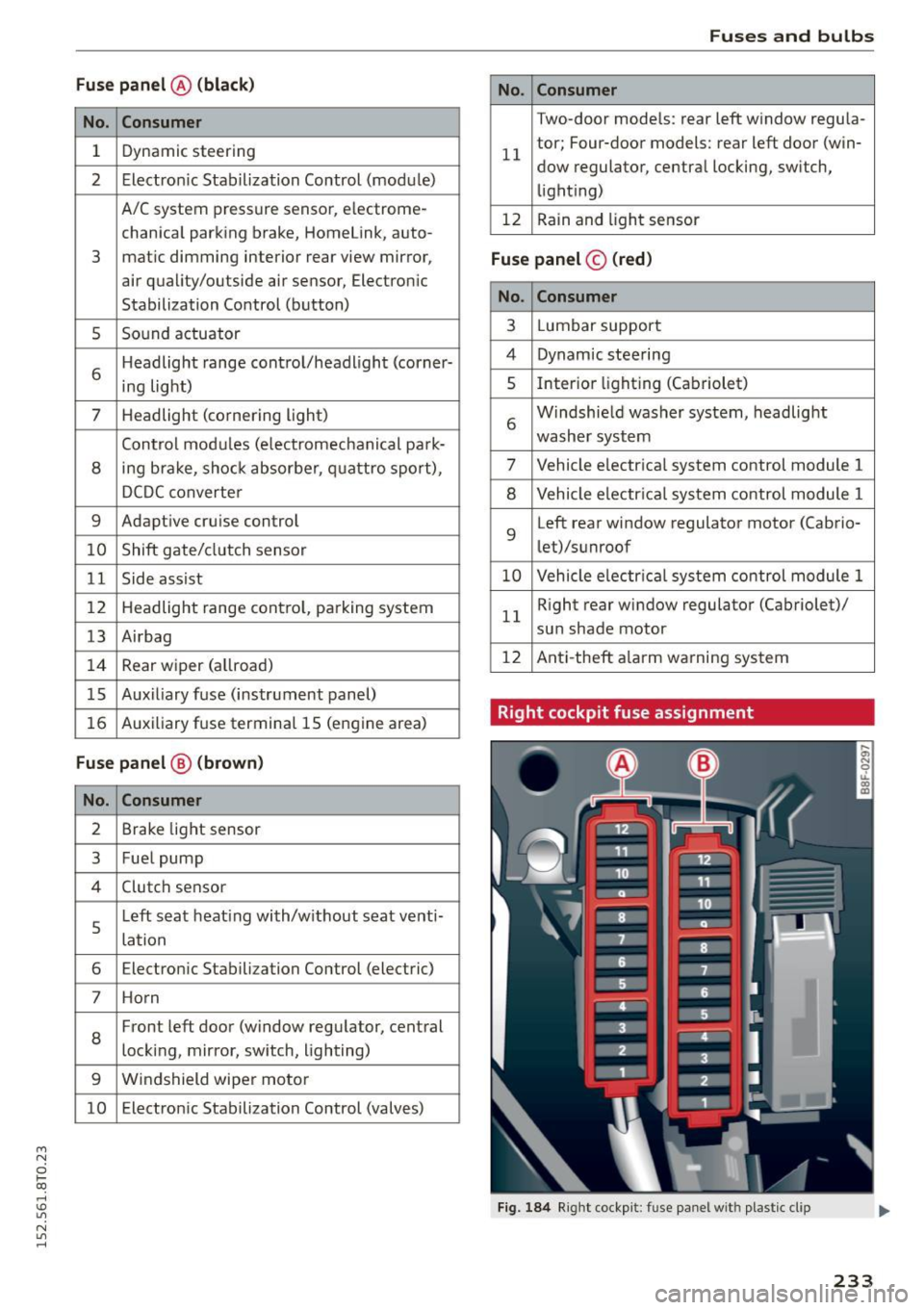
Right cockpit fuse assignment
Fig. 184 Right cockpit: fu se panel with plastic cl ip
233