warning light AUDI A5 2015 Owner´s Manual
[x] Cancel search | Manufacturer: AUDI, Model Year: 2015, Model line: A5, Model: AUDI A5 2015Pages: 264, PDF Size: 66.83 MB
Page 156 of 264
Child safety
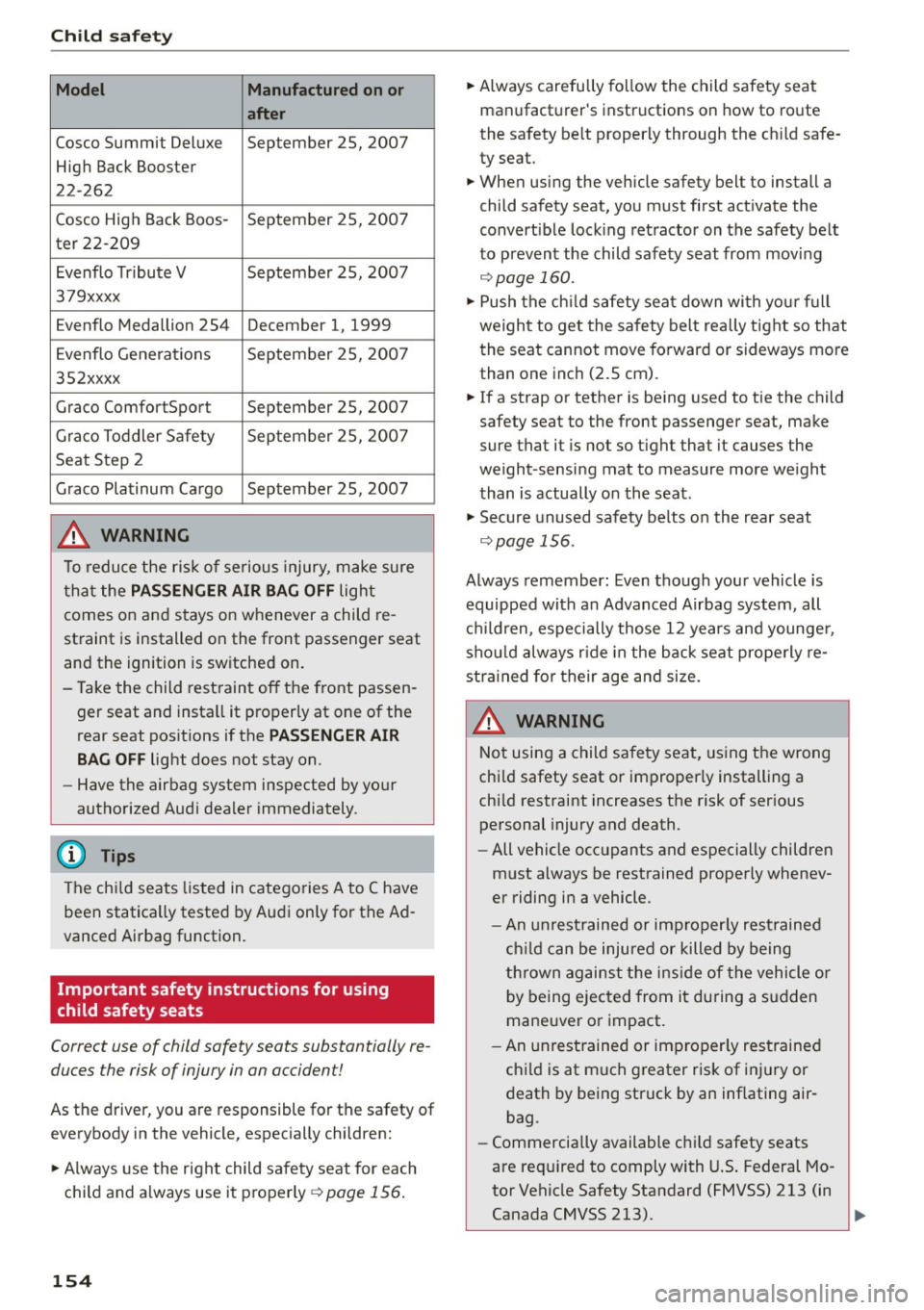
Model Manufactured on or
after
Cosco Summit Deluxe September 25, 2007
High Back Booster
22-262
Cosco High Back Boos -September 25, 200 7
ter 22-209
Evenflo Tr ibute V September 25, 2007
379xxxx
Evenflo Medallion 254 December 1, 1999
E venflo Generations September 25, 2007
352xxxx
Grace ComfortSport September 25, 2007
Grace To ddler Sa fe ty Sep
tember 25, 200 7
Seat Step 2
G race Platinum Cargo September 25, 2007
.&_ WARNING
To reduce the ris k of serious injury, make sure
t ha t the
PASSENGER AIR BAG OFF light
comes on and stays on whenever a child re
st raint is installed on the front passenger seat
and the ignition is switched on.
- Take the child rest raint off the front passen
ger seat and insta ll it properly at one of the
rear seat pos itions if the
PASSENGER AIR
BAG OFF
light does not stay on.
- Have the airbag system inspected by yo ur
autho rized Audi dealer immediately.
(D Tips
The ch ild sea ts listed in catego ries A to C have
been statica lly tested by Audi only for the Ad
vanced Airbag function.
Important safety instructions for using
child safety seats
Correct use of child safety seats substantially re
duces the risk of injury in on occident!
As the driver, you are responsible for the safety of
everybody in the vehicle, espec ially children:
... Always use the right child sa fety seat for each
c h ild and a lways use it properly
¢ page 156.
154 ...
Always carefully fo llow the child safety seat
manufact urer's instructions on how to ro ute
the sa fety belt proper ly through the c hild safe
ty seat.
... When using the vehicle safety belt to install a
child safety seat, you must first act ivate the
convert ible lock ing ret ractor on the safety belt
to prevent the child safety seat from moving
¢ page 160.
... Push the ch ild safety sea t down wi th yo ur fu ll
weigh t to get the safety belt really tight so that
the seat cannot move forward or sideways more
than one inch (2.5 cm).
... If a strap or tether is be ing used to tie the child
safety seat to the front passenger seat, make
sure that it is not so tight that it causes the
weight-sensi ng mat to measure more we ight
than is actually o n the seat .
... Secu re unused safety belts on the r ear seat
¢ page 156.
Always remember : Even tho ugh you r vehicle is
equipped with an Advanced Airbag system, all
c hi ld ren, espe cially those 12 years and younge r,
shou ld always r ide in the back seat prope rly re
stra ine d f or t heir age an d size.
.&_ WARNING
-
N ot using a child safe ty seat, using t he wrong
chi ld safety seat or improper ly installing a
chi ld restraint increases the risk of ser ious
personal injury and death.
- All vehicle occ upants and especially children
m ust always be restrained properly whenev
er riding in a vehicle.
- An un rest rained or imp rope rly res trained
chi ld ca n be inju red or killed by being
t h rown ag ains t the i nsid e of the vehicle or
b y being ejected from it du ring a s udden
mane uver o r impact.
- An unrestrained or im properly res trained
ch ild is at much greater risk of i nju ry or
death by being struck by an inflating air
bag.
- Commercially available ch ild safety seats
are req uired to comply with U.S. Federal Mo
tor Vehicle Safety Standard (FMVSS) 213 (in
Canada CMVSS 213). .,_
Page 157 of 264
M N
i? co ,...., \!) 1.1'1
N 1.1'1 ,....,
-When buying a child restraint, select one
that fits your child and the vehicle.
- Only use child restraint systems that fully
contact the flat portion of the seat cush
ion. The child restraint must not tip or
lean to either side. Audi does not recom
mend using child safety seats that rest on
legs or tube-like frames. They do not pro
vide adequate contact with the seat.
- Always heed all legal requirements per
taining to the installation and use of child
safety seats and carefully follow the in
structions provided by the manufacturer
of the seat you are using.
- Never allow children under 57 inches
(1.45 meters) to wear a normal safety belt.
They must always be restrained by a proper
child restraint system. Otherwise, they
could sustain injuries to the abdomen and
neck areas during sudden braking maneu
vers or accidents.
- Never let more than one child occupy a child
safety seat.
- Never let babies or older children ride in a
vehicle while sitting on the lap of another
passenger.
- Holding a child in your arms is never a sub
stitute for a child restraint system.
- The strongest person could not hold the
child with the forces that exist in an acci
dent. The child will strike the interior of
the vehicle and can also be struck by the
passenger.
- The child and the passenger can also in
jure each other in an accident.
- Never install rearward-facing child safety
seats or infant carriers on the front passen
ger seat. A child will be seriously injured and
can be killed when the passenger airbag in
flates -even with an Advanced Airbag Sys
tem.
- The inflating airbag will hit the child safe
ty seat or infant carrier with great force
and will smash the child safety seat and
child against the backrest, center arm
rest, door or roof.
-Always install rearward-facing child safety
seats or infant carriers on the rear seat.
Child safety
-Forward-facing child safety seats installed
on the front passenger's seat can interfere
with the airbag when it inflates and cause serious injury to the child . Always install for
ward-facing child safety seats on the rear seat .
- If exceptional circumstances require the use of a forward-facing child restraint on the
front passenger's seat, the child's safety
and well-being require that the following
special precautions be taken :
- Make sure the forward-facing seat has
been designed and certified by its manu
facturer for use on a front seat with a pas
senger front and side airbag .
- Always carefully follow the manufacturer's
instructions provided with the child safety
seat or carrier .
- Always move the front passenger seat into
the rearmost position of the passenger
seat's fore and aft adjustment range, and
as far away from the airbag as possible be
fore installing the child restraint.
-Always make sure that nothing prevents
the front passenger's seat from being
moved to the rearmost position in its fore
and aft adjustment range.
- Always make sure that the backrest is in
the upright position.
- Always buckle the child safety seat firmly in
place even if a child is not sitting in it. A
loose child safety seat can fly around during
a sudden stop or in a collision.
- Always read and heed all WARNINGS when
ever using a child restrained in a vehicle is
being used
¢page 121, Safety belts,
¢ page 129, Airbag system and
¢ page 151, Child safety.
A WARNING
-To reduce the risk of serious injury, make sure
that the
PASSENGER AIR BAG OFF light
comes on and stays on whenever a child re
straint is installed on the front passenger seat
and the ignition is switched on.
liJ,,
155
Page 158 of 264
Child safety
-Take the child restraint off the front passen
ger seat and install it properly at one of the
rear seat positions if the
PASSENGER AIR
BAG OFF
light does not stay on .
- Have the airbag system inspected by your
authorized Audi dealer immediately .
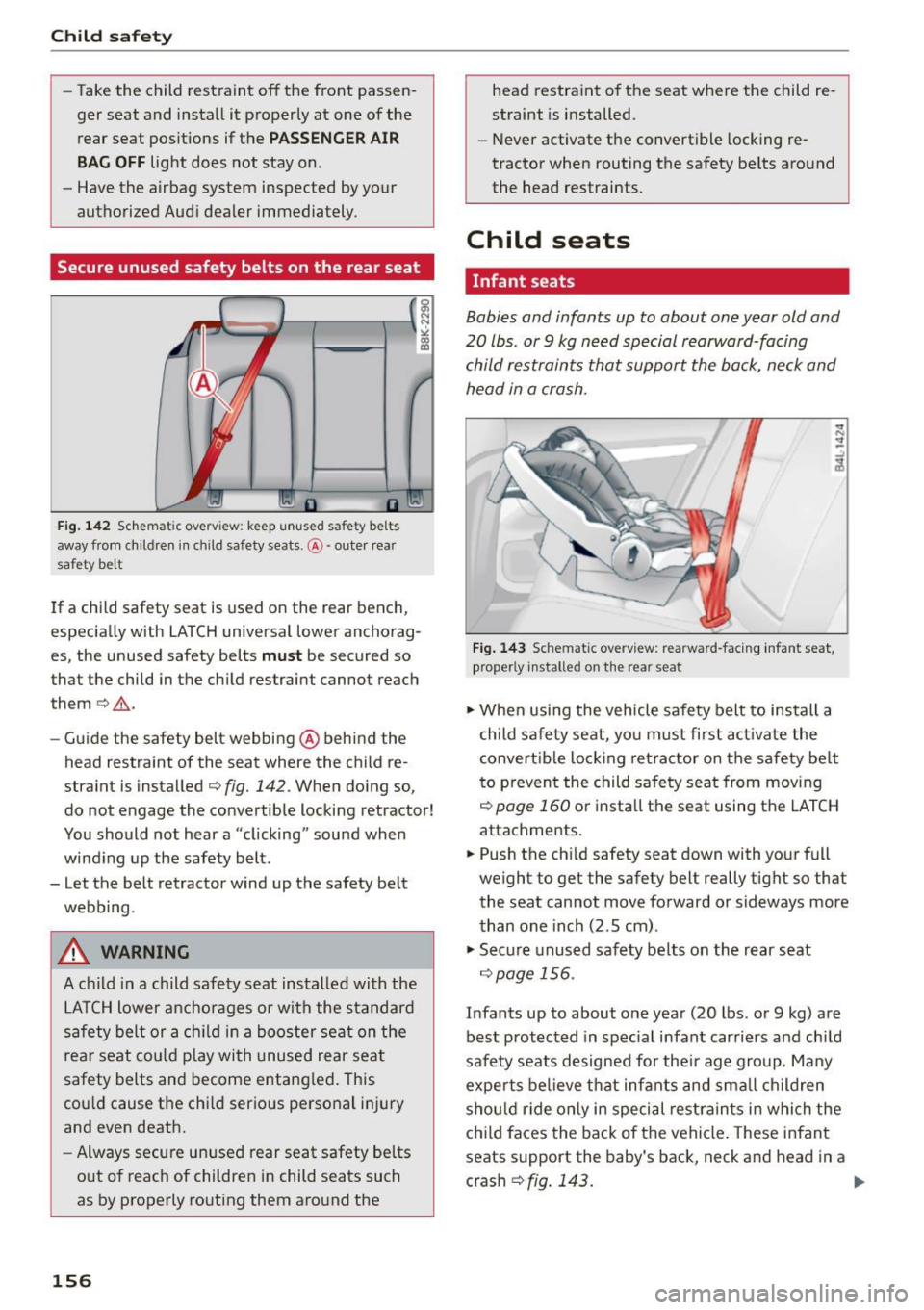
Secure unused safety belts on the rear seat
Fig. 142 Schemat ic overview : keep unus ed sa fety belt s
away from chil dren in chil d safety seats .@ · outer rea r
sa fety belt
If a child safety seat is used on the rear bench,
especially with LATCH universal lower anchorag
es, the unused safety belts
must be secured so
that the child in the child restraint cannot reach
them ¢,& .
- Guide the safety belt webbing @ behind the
head restraint of the seat where the child re
straint is installed
¢fig. 142. When doing so,
do not engage the convertible locking retractor!
You should not hear a "clicking" sound when
winding up the safety belt .
- Let the belt retractor wind up the safety belt webbing .
.,&. WARNING
A child in a child safety seat installed with the
LATCH lower anchorages or with the standard
safety belt or a child in a booster seat on the
rear seat could play with unused rear seat
safety belts and become entangled. This
could cause the child serious personal injury
and even death.
- Always secure unused rear seat safety belts
out of reach of children in child seats such
as by properly routing them around the
156
head restraint of the seat where the child re
straint is installed.
- Never activate the convertible locking re
tractor when routing the safety belts around
the head restraints.
Child seats
Infant seats
Babies and infants up to about one year old and
20 lbs . or
9 kg need special rearward-facing
child restraints that support the back, neck and
head in a crash.
Fig. 143 Sc hem atic ove rview: rearward-facing infant seat,
prope rly installe d on the rea r seat
.,. When using the vehicle safety belt to install a
child safety seat, you must first activate the
convertible locking retractor on the safety belt
to prevent the child safety seat from moving
¢
page 160 or install the seat using the LATCH
attachments.
.,. Push the child safety seat down with your full
weight to get the safety belt really tight so that
the seat cannot move forward or sideways more than one inch (2.5 cm) .
.,. Secure unused safety belts on the rear seat
¢page 156.
Infants up to about one year (20 lbs. or 9 kg) are
best protected in special infant carriers and child
safety seats designed for their age group. Many experts believe that infants and small children
should ride only in special restraints in which the
child faces the back of the vehicle. These infant
seats support the baby's back, neck and head in a
crash
¢ fig. 143. .,.
Page 159 of 264
M N
0 loo
rl I.O
"' N
"' rl
The airbag on the passenger side makes the front
seat a potentially dangerous place for a chi ld to
ride . The front seat is not the safest place for a
chi ld in a forward-facing child seat. It is a very
dangerous place for an infant or a large r child in
a rearward -facing seat .
& WARNING
Not using a ch ild safety seat, using the w rong
child saf ety seat or improperly installing a
child rest raint in cr eases the r is k of serious
pe rsonal in jury and death in a crash.
- Never install rea rward-faci ng ch ild safety
seats or infant car riers on the front passe n
ger seat -even wit h an Adv anced A irbag Sys
tem . A child w ill be seriously injured and can
be k illed when the inflat ing airbag hits the
child safety seat or infant carr ier with great
force and smashes the child safety seat and
child against the backrest, center armrest,
door or roof¢
page 130, Child restraints on
the front seat -some important things to
know .
- Always install rearward -facing child safety
seats or infant car riers on the rear seat .
- Never install a rearward-facing child re
straint in the forward -fac ing direct ion . Such
rest raints a re des igned for the special needs
of infants and very sma ll childre n and can
not p rotect them p roperly if the seat is fo r
w ard-fac ing .
-If you must install a rea rward faci ng chi ld
s afety sea t on t he front passenger sea t be
ca use of exceptional ci rcumstances and the
PASSENGER AIR BAG OFF light does not
come on and stay on, immediately install
the rearward-fac ing ch ild safety seat in a
rear seating position and have the airbag
system inspected by your author ized Audi
dealer .
- Always read and heed all WARNINGS w hen
ever using a child restra ined in a vehicle is
being used¢
page 121, Safety belts,
¢ page 129, Airbag system and
¢ page 151, Important information.
Child sa fe ty
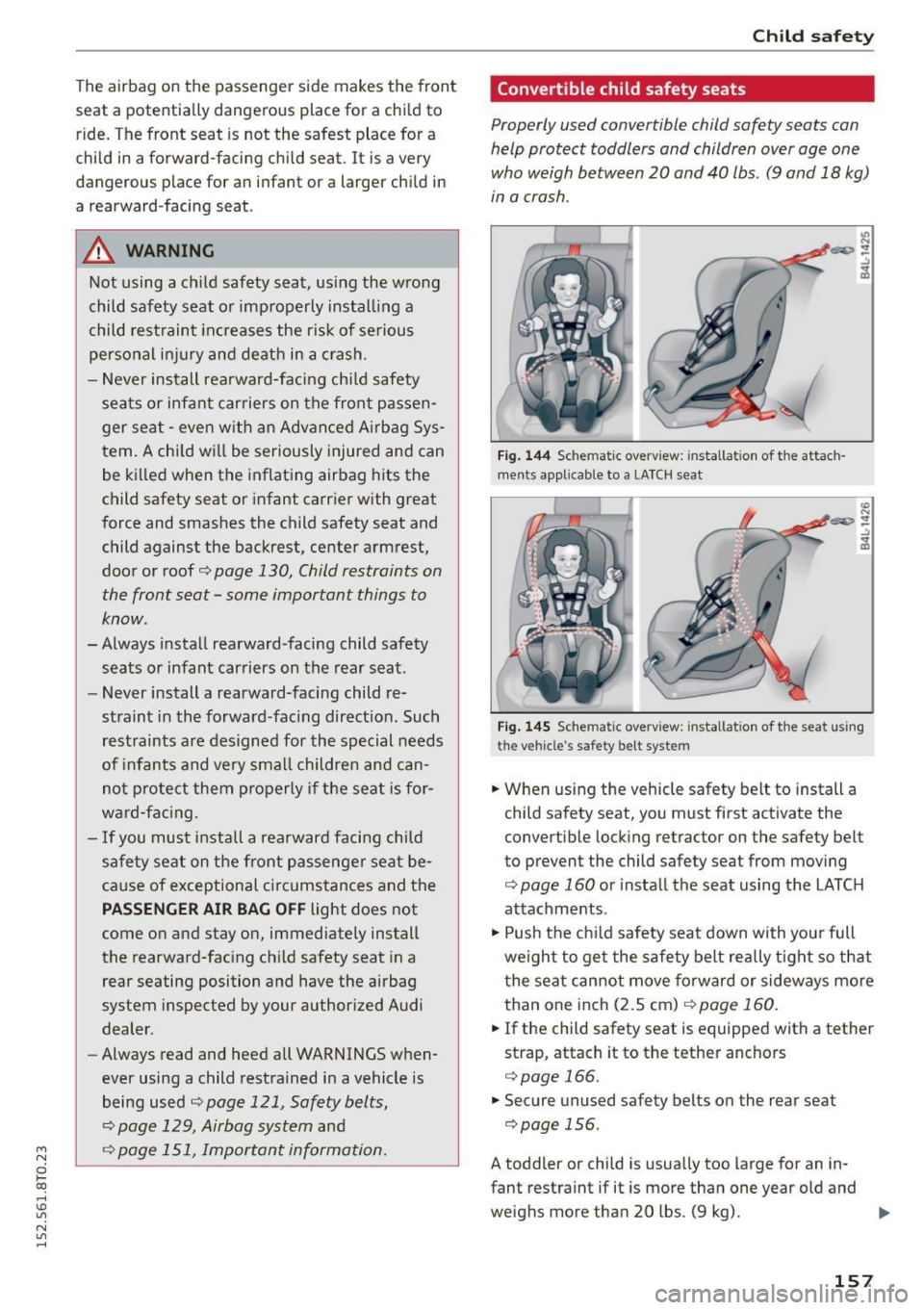
Convertible child safety seats
Properly used convertible child safety seats con
help protect toddlers and children over age one who weigh between 20 and 40 lbs. (9 and 18 kg)
in a crash.
F ig . 144 Sc hemat ic ove rv iew: installat io n of t he attach
me nts applicable to a LATCH seat
F ig . 14 S Schemat ic ove rv iew: insta llat io n of th e sea t usi ng
t he ve hicle's sa fety be lt system
.,. W hen us ing the vehicle safety belt to install a
child safety seat, you must first activate the
convert ible lock ing retractor on the safety be lt
t o prevent the child safety seat from mov ing
¢
page 160 or insta ll the seat using the LATC H
attachments .
.,. Push the ch ild safety seat down with you r full
we ight to ge t the safety belt re ally tigh t so that
t he seat can not move forward or sideways mo re
than one inch (2.5 cm)¢
page 160.
.,. If the child safety seat is equ ipped with a tether
strap, attach it to the tether anchors
¢ page 166.
.,. Secure unused safety belts on the rear seat
¢page 156.
A todd ler or child is usua lly too large for an in
fant restraint if it is more than one year old and
weighs more than 20 lbs. (9 kg).
IIJ,,,
157
Page 160 of 264
Child safety
Toddlers and children who are older than one
year up to about 4 years old and weigh more than
20 lbs. (9 kg) up to 40 lbs. (18 kg) must always
be properly restrained in a child safety seat certi
fied for their size and weight¢
fig. 144 and
¢ fig. 145.
The airbag on the passenger side makes the front
seat a potentially dangerous place for a child to
ride. The front seat is not the safest place for a
child in a forward -facing child safety seat .
It is a
very dangerous place for an infant or a larger
child in a rearward-facing seat .
A WARNING
Not using a child safety seat, using the wrong
child safety seat or improperly installing a
child restraint increases the risk of serious
personal injury and death in a collision or oth
er emergency situation.
- Children on the front seat of any car, even with Advanced Airbags, can be seriously in
jured or even killed when an airbag inflates. A child in a rearward-facing child safety seat
installed on the front passenger seat will be
seriously injured and can be killed if the
front airbag inflates -even with an Ad
vanced Airbag System .
- The inflating airbag will hit the child safety seat or infant carrier with great force and
will smash the child safety seat and child against the backrest, center armrest, door
or roof.
- Always install rearward-facing child safety
seats on the rear seat.
- If you must install a rearward facing child
safety seat on the front passenger seat be
cause of exceptional circumstances and the
PASSENGER AIR BAG OFF light does not
come on and stay on, immediately install
the rearward-facing child safety seat in a rear seating position and have the airbag
system inspected by your authorized Audi
dealer.
- The rear side of the child safety seat should be positioned as close as possible to the
backrest on the vehicle seat . Adjust or re
move the rear seat head restraint if it is dif-
158
ficult to install the child seat with the head
restraint in place¢
page 58. Install the
head restraint again immediately once the
child seat is removed . Driving without head
restraints or with head restraints that are
not properly adjusted increases the risk of
serious or fatal neck injury dramatically.
- Always read and heed all WARNINGS when
ever using a child restrained in a vehicle is
being used
¢page 121, Safety belts,
¢page 129, Airbag system
and
¢ page 151, Important information.
A WARNING
If exceptional circumstances require the use
of a forward-facing child restraint on the front
passenger's seat, the child's safety and well
being require that the following special pre
cautions be taken :
- Make sure the forward-facing seat has been
designed and certified by its manufacturer
for use on a front seat with a passenger
front and side airbag .
-Always follow the manufacturer's instruc
tions provided with the child safety seat or
infant carrier.
- Always move the front passenger seat into
the rearmost position of the passenger
seat's fore and aft adjustment range, and as
far away from the airbag as possible before
installing the child restraint.
- Always make sure that nothing prevents the
front passenger's seat from being moved to
the rearmost position in its fore and aft ad
justment range.
- Always make sure the backrest is in an up
right position .
- Make sure that the
PASSENGER AIR BAG
OFF
light comes on and stays on all the time
whenever the ignition is switched on.
- If the light does not stay on, perform the
checks ¢
page 139, Monitoring the Ad
vanced Airbag System.
- Take the child restraint off the front passen
ger seat and install it properly at one of the
rear seat positions if the
PASSENGER AIR ~
Page 162 of 264
Child safety
body and the front of the passenger compart
ment, the airbag can inflate completely and pro
vide supplemental protection in certain frontal
collisions .
.,&. WARNING
Not using a booster seat, using the booster
seat improperly, incorrectly installing a boos
ter seat or using the vehicle safety belt im
properly increases the risk of serious personal
injury and death in a collision or other emer
gency situation. To help reduce the risk of se
rious personal injury and/or death:
- The shoulder belt must lie as close to the
center of the child's collar bone as possible
and must lie flat and snug on the upper
body. It must never lie across the throat or
neck. The lap belt must lie across the pelvis
and never across the stomach or abdomen.
Make sure the belt lies flat and snug. Pull on
the belt to tighten if necessary.
- Failure to properly route safety belts over a
child's body will cause severe injuries in an
accident or other emergency situation
c::> page 121 .
-The rear side of the child safety seat should
be positioned as close as possible to the
backrest on the vehicle seat . Adjust or re
move the rear seat head restraint if it is dif
ficult to install the child seat with the head
restraint in place
c::>page 58. Install the
head restraint again immediately once the
child seat is removed. Driving without head
restraints or with head restraints that are
not properly adjusted increases the risk of
serious or fatal neck injury dramatically .
- Children on the front seat of any car, even
with Advanced Airbags, can be seriously in
jured or even killed when an airbag inflates.
- Never let a child stand or kneel on any seat.
- Never let a child ride in the cargo area of
your vehicle.
- Always remember that a child leaning for
ward, sitting sideways or out of position in
any way during an accident can be struck by
a deploying airbag. This will result in serious
personal injury or death .
160
-If you must install a booster seat on the
front passenger seat because of exceptional
circumstances the
PASSENGER AIR BAG
OFF
light must come on and stay on, when
ever the ignition is switched on .
- If the
PASSENGER AIR BAG OFF light does
not come on and stay on, perform the
checks described
c::, page 139, Monitoring
the Advanced Airbag System.
- Take the child restraint off the front passen
ger seat and install it properly at one of the rear seat positions if the
PASSENGER AIR
BAG OFF
light does not stay on whenever
the ignition is switched on.
- Always read and heed all WARNINGS when
ever using a child restrained in a vehicle is
being used
<=> page 121, Safety belts,
<=>page 129, Airbag system
and
c::> page 151, Important information.
Securing child seats
' Securing a child safety seat using a safety
I _!>elt
Safety belts for the rear seats and the front pas
senger's seat con be locked with the convertible
locking retractor to properly secure child safety
seats.
The safety belts emergency locking retractors for
the rear seats safety belts and for the front pas
senger's seat safety belt have a convertible lock
ing retractor for child restraints. The safety belt
must be locked so that belt webbing cannot un
reel. The retractor can be activated to lock the
safety belt and prevent the safety belt webbing
from loosening up during normal driving. A child
safety seat can only be properly installed when
the safety belt is locked so that the child and child safety seat will stay in place.
Always remember: Even though your vehicle is equipped with an Advanced Airbag system, all
children, especially those 12 years and younger,
should always ride in the back seat properly re-
strained for their age and weight . ..,_
Page 163 of 264
M N
i? co ,...., \!) 1.1'1
N 1.1'1 ,....,
A WARNING ,~ -
Improperly installed child safety seats in
crease the risk of serious personal injury and
death in a collision.
- Always make sure that the safety belt re
tractor is locked when installing a child safe
ty seat . An unlocked safety belt retractor
cannot hold the child safety seat in place
during normal driving or in a crash.
- Always buckle the child safety seat firmly in
place even if a child is not sitting in it. A
loose child safety seat can fly around during
a sudden stop or in a collision.
- If the backrest is not securely latched, the
child and the child restraint will be thrown
forward together with the backrest and will
strike parts of the vehicle interior. The child
can be seriously injured or killed.
- Never install rearward-facing child safety seats or infant carriers on the front passen
ger seat . A child will be seriously injured and
can be killed when the passenger airbag in
flates.
- The inflating airbag will hit the child safety seat or infant carrier with great force and
will smash the child safety seat and child
against the backrest, center armrest, door
or roof.
- Always install rearward-facing child safety
seats or infant carriers on the rear seat.
- Forward-facing child safety seats or infant
carriers installed on the front passenger's
seat may interfere with the deployment of
the airbag and cause serious injury to the
child.
- It is safer to install a forward-facing child
safety seat on the rear seat.
- Always read and heed all WARNINGS when
ever using a child restrained in a vehicle is
being used
r=;, page 151 . Special precautions
apply when installing a child safety seat on
the front passenger seat
¢ page 130, Child
restraints on the front seat -some impor
tant things to know.
Child safety
A WARNING
Always take special precautions if you must
install a forward or rearward-facing child re
straint on the front passenger's seat in excep
tional situations:
- Whenever a forward or rearward -facing
child restraint is installed on the front pas
senger seat, the
PASSENGER AIR BAG OFF
light must come on and stay on whenever
the ignition is switched on.
- If the PASSENGER AIR BAG OFF light does
not come on and stay on, perform the
checks described
r=;, page 139, Monitoring
the Advanced Airbag System.
- Take the child restraint off the front passen
ger seat and install it properly at one of the
rear seat positions if the
PASSENGER AIR
BAG OFF
light does not stay on whenever
the ignition is switched on.
- Improper installation of child restraints can
reduce their effectiveness or even prevent
them from providing any protection.
- An improperly installed child restraint can
interfere with the airbag as it deploys and
seriously injure or even kill the child .
- Always carefully follow the manufacturer's
instructions provided with the child safety
seat or carrier.
- Never place additional items on the seat
that can increase the total weight registered
by the weight-sensing mat and can cause in
jury in a crash .
A WARNING
-Forward-facing child restraints:
- Always make sure the forward-facing seat
has been designed and certified by its man
ufacturer for use on a front seat with a pas
senger front and side airbag.
- Never put the forward-facing child restraint up, against or very near the instrument pan
el.
-Always move the passenger seat into its
rearmost position in the seat's fore and aft
-
161
Page 164 of 264
Child safet y
adjustment range, as far away from the air
bag as possib le before installing the for
ward-fac ing ch ild restraint. The backrest
must be adjusted to an upright posit ion.
- Make sure that the
PASSENGER AIR BAG
OFF
light comes on and stays on all the t ime
whenever the ignition is switched on.
A WARNING
Rearward-fac ing ch ild restra ints:
- A ch ild in a rearward-facing child safety seat
installed on the front passenger seat will be
seriously injured and can be k illed if the
front a irbag inflates - even with an Ad
vanced Airbag System.
- The inflating a irbag w ill hit the child safety
seat or infant car rier with great force and
will smash the chi ld safety seat and child
against the bac krest, center armrest, door
or roof .
- Always be espe cially caref ul if you must in
sta ll a rearward facing chi ld safety seat on
the front passenger seat in exceptiona l cir
cumstances .
- A tight tether strap on a rearward-facing
child restraint attached to the front passen
ger seat can put too much pressure on the
weight-mat in the seat and register a heavi er we ight in the Advanced Airbag System.
The heav ier weight reg istered can make the
system work as though an adult were on the
seat and deploy the Advanced Airbag when it m ust be s uppressed causing ser ious o r
even fatal injury to the child.
- Make sure that the
PASSENGER AIR BAG
OFF
light comes on and s tays on all the t ime
whenever the ignition is switched on.
- If the PASSENGER AIR BAG OFF light does
not come on and stay on, immed iate ly in
sta ll the rearward-fac ing ch ild safety sea t in
a rear seating posit ion and have the airbag
system inspected by your authorized Audi
dealer .
162
· Activating the convertible locking retractor
Use the convertible locking retractor to secure a
child restraint.
Always heed the child safety seat manufacturer's
i nstruct ions when installing a child restraint in
your vehicle . T o activate the convert ible locking
retractor:
.. Place the child restraint on a seat, preferably on
the rear seat .
.. Slowly pull the belt
all th e wa y out .
.. Route it around or through the child restraint
belt pat h
c::> _&..
.. Push the ch ild safety seat down with your full
weigh t to get the sa fety belt really tight.
.. Insert the belt tongue into the b uckle for that
seating position .
.. Guide the safety be lt back into the retractor un
til the belt lies flat and snug on the ch ild safety
seat.
.. You should hear a "clicking" noise as the belt
w inds back into the inertia reel. Test the con
vert ible lock ing retractor by pu lling on the belt .
You should no longer be able to pull the belt
out of the ret ractor. The conve rtible locking re
tractor is now ac tivated .
.. Make s ure that the red release button is fac ing
away from the child restraint so that it can be
unbuckled quickly .
.. Pull on the belt to make sure the safety be lt is
properly tight and fastened so that the seat
cannot move forward or s ideways more than
one inch (2 .5 cm).
A WARNING
Using the wrong child restraint or an improp
e rly installed child restraint can cause serious
personal injury or death in a crash.
- Always ma ke sure that the safe ty be lt re
tracto r is loc ked when insta lling a child sa fe
ty seat. An unlocked sa fety belt retractor
cannot ho ld the child safety seat in place
during normal driving or in a crash.
- Always buckle the child safety seat firmly in place even if a chi ld is not sitting in it. A
loose child safety seat can fly around d uring
a sudden stop or in a crash.
.
Page 169 of 264
-Never attach a tether strap to a tie-down
hook in the luggage compartment.
- Never use child restraint tether anchorages
to secure safety belts or other kinds of occu
pant restraints.
- Never secure or attach any l uggage or other
items to the LATCH lower anchorages or to
the tether anchors.
- If a tether or other strap is used to attach a
child restraint to the front passenger seat,
make sure that it is not so tight, that it
causes the we ight-sensing mat to measure
more we ight than is actually on the seat .
- The heav ier weight reg istered ca n make the
Advanced Airbag System work as though an
adult were on the seat and deploy the Ad
vanced Airbag whe n it must be supp ressed
ca using se rious or even fatal injur y to the
c h ild.
- If you mu st install a rearwar d faci ng chi ld
sa fety seat on the front passenge r seat be
cause of exceptional c ircums tances and the
PASSENGER AIR BAG OFF light does not
come on and stay on, immediate ly install
the rear-fac ing c hild safety seat in a rear
seating pos ition and have the airbag system
inspected by you r authorized Audi dea ler.
Installing the upper tether strap on the
anchorage
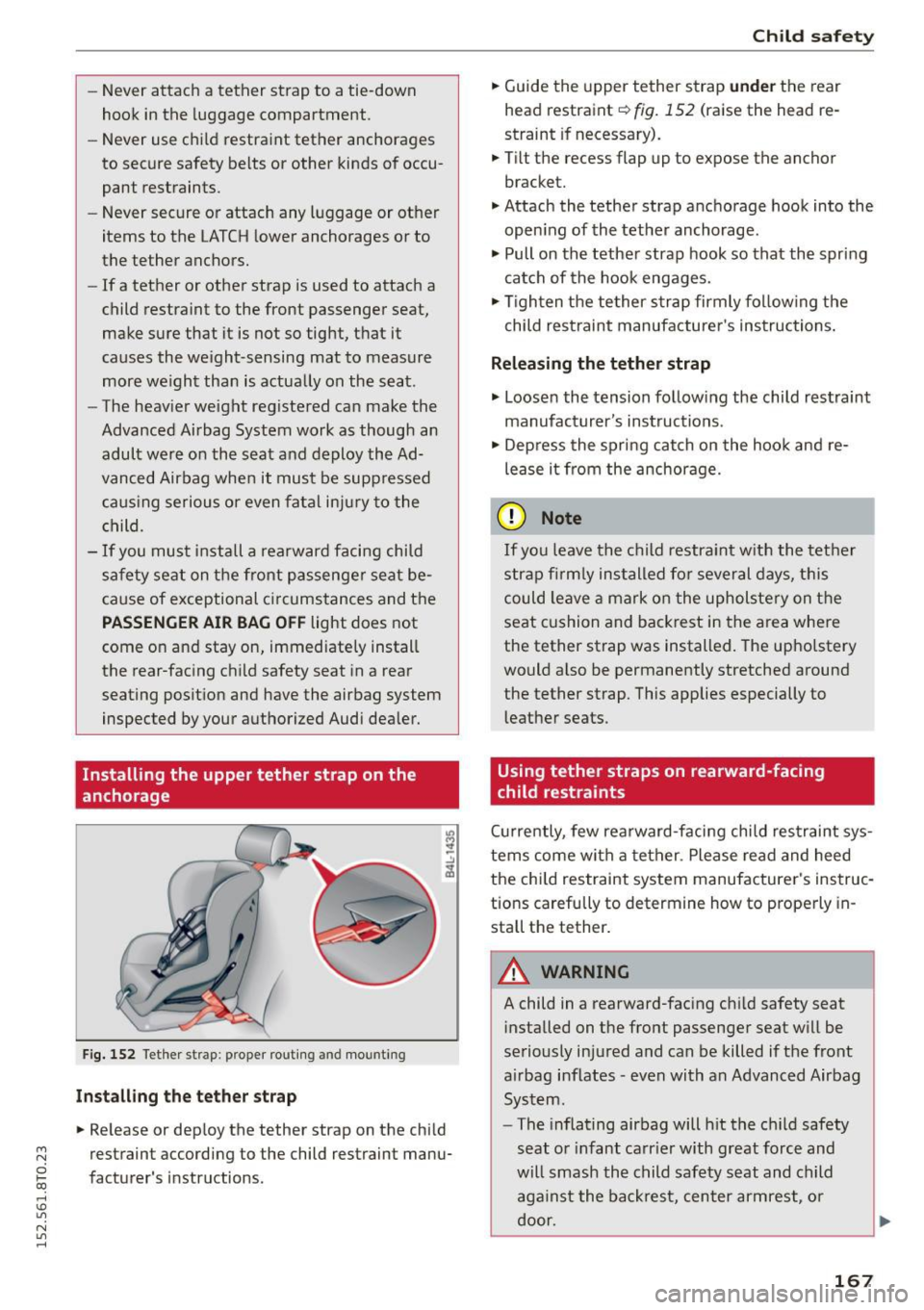
F ig . 1 52 Tether strap : proper ro ut in g a nd mo unting
Installing the tether strap
.,. Re lease or dep loy the tether strap on the chi ld
~ restraint according to the child restraint manu-
o t;o facturer's instructions.
rl I.O
"' N
"' rl
Chil d sa fe ty
.,. Guide the upper tether strap under the rear
head restraint co
fig. 152 (raise the head re
straint if necessary).
.,. Tilt the recess flap up to expose the anchor
bracket.
.,. Attach the tether strap anchorage hook into the
open ing of the tet he r anchorage.
.,. Pull on the tethe r strap hook so that the spri ng
ca tch of the hook engages.
.,. Tigh ten the te ther s trap firmly follow ing the
child res traint manufacture r's instructions .
Releasing the tether strap
.,. Loosen the tension fo llow ing the child restraint
manufac turer's instructions .
.,. Depress the spri ng catch o n the hoo k and re
lease it from the anchor age.
(D Note
If you leave the child restra int w it h the tet her
s trap firm ly ins talled fo r sever al days, t his
could leave a mark o n the upholstery on t he
seat cushion and bac krest in the area whe re
the tether strap was installed. The upho lstery
would a lso be permanently stretched around
the tether strap. This applies especially to
l eather seats .
Using tether straps on rearward-facing
child restraints
Cur rently, few rea rward-faci ng chi ld restraint sys
tems come wit h a teth er. Please read and heed
the ch ild restraint system manufacturer's ins truc
tions carefully to determine how to properly in
stall the tether .
A WARNING
A child in a rearward-facing ch ild safety seat
i nsta lled on the front passenger seat will be
se riously in ju red and can be killed if the front
a irbag inflates -even with an Advanced Airbag
System.
- The inflating airbag will hit the c hild safety
seat o r infant ca rr ier w ith great force and
will smash the c hild safety seat and child
aga inst the ba ck rest, center armrest, or
door .
167
Page 174 of 264

Smart Technology
The following situations are exceptions where it
may be usefu l to switch on sport mode to allow
the wheels to spin : -
Rocking the vehicle to free it when it is stuck
- Driv ing in deep snow or on loose ground
- Dr iv ing with snow chains
Sport mode on ESC/ASR off Sport mode off or
ESC /ASRon
Behavior
The ESC and ASR stabiliza- The stabilization funct ion is The full stabilization func-
tion fu nct ions are limited not
available¢ ,&.. ESC and
tion of the ESC and ASR is
¢ ,&. .
ASR are switched
off. available again.
Operation Press the I!> OF F! button Press and hold the I!> OF FI Press the I!> OF F! button
briefly . button longer than 3 sec-again.
onds .
Indicator II turns on. JI and lf'lii•li~ turn on. II turns off or II and
lights lf'lii•l~~ turn off.
Driver mes- Stabilization control (ESC): Stabilization control (ESC): Stabilization control
sages Sport. Warning! Re stricted off. Warning! Restricted (ESC):
On
stability stability
It is only possible to turn off the ASR up to 30
mph (SO km/h) for veh icles wi th front whee l
drive . At about
45 mph (70 km/h) it automatica l
ly turns on again. It is possible to turn
off the
ASR at any speed for vehicles with all whee l
drive.
A WARNING
-
You should only sw itch sport mode on or
switch ESC/ASR
off if your driving ab ilities and
road condit io ns perm it .
- The stabilization function is limited when
sport mode is switched on. The dr iv ing
wheels could spin and the veh icle cou ld
swerve, especially on slick or slippery road
surfaces.
- There is no vehicle stabilization when ESC/
ASR are switched
off.
(D Tips
ESC/ASR cannot be switched off or sport
mode cannot be switched on when cruise con
trol or adaptive cru ise control* is sw itched on .
172
Braking
What affects broking efficiency?
New brake pads
During the first 250 miles (400 km), new brake
pads do not possess their full braking effect, they
have to be "broken in" first¢,&. . You can com
pensate for this slightly reduced braking power
by pushing harder on the brake pedal. Avoid
heavy braking loads during the break-in period.
Operating conditions and driving habits
The brakes on today's automobiles are still sub
ject to wear, depending largely on operating con
ditions and driving habits~,&. . On vehicles that
are either driven most ly in stop-and -go city traf
fic or are driven hard, the brake pads should be
checked by your authorized Audi dealer more of
ten than specified in the
Warranty & Mainte
nance booklet .
Failure to have your brake pads
i nspected can result in reduced brake perform
ance .
On steep slopes, you should use the braking ef
fect of the engine . This way, you prevent unnec
essary wear on the brake system. If you must use
your brakes, do not hold the brakes down contin
uously. Pump the brakes at intervals.