air condition AUDI A5 CABRIOLET 2010 User Guide
[x] Cancel search | Manufacturer: AUDI, Model Year: 2010, Model line: A5 CABRIOLET, Model: AUDI A5 CABRIOLET 2010Pages: 364, PDF Size: 86.51 MB
Page 167 of 364

______________________________________________________ P_a _ r_ k_ a_ s _ s_is _ t _ __.fflll
& WARNING
• You should a lways adju st the volum e and fr equency of the
c hime s so that you can ea sily hear the ac oustic di stance warning
even if the rad io is playing, the air-conditioner blowe r is on High
or there is a high level of outside noise.
- Check the setting s whenever anyone els e ha s dri ven the
vehicle before you. •
Parking system (rear, with rear
view camera)
App lies to vehicl es: w ith par king system (rear) and rear -view camera
Introduction
Contro ls a nd e quip
m en t
0 ~ 9
" co m
Fig . 167 Parking
mode 1 : rever se
parking
Vehicle OP-eration
Fig. 168 Pa rkin g
mode 2: p ara llel
p ark in g
Vehicles with the park ing system are equ ipped with a rear-view
camera in additio n to the aco ust ic and visual pa rking system .
You ca n choose between two modes to ass ist yo u w ith pa rk ing . Fo r
example, you can use "parking model" when parking in a parking
sp ace or garage ~ fig . 167. When you wan t to p ark paralle l to the
edge of the street, select "park ing mode 2"
~ fig. 168.
& WARNING
• The rear-view camera has blind spots, in which objects cannot
be detected. Be especially careful to check for small children and
animals before backing up. Small ch ildren and animals will not
alway s be detected by the sen sors. •
Vehicle care Do-it-yourselt service iTechnical data
Page 179 of 364

Driving Safely ---------------------"~'----
Important things to do before driving
Safety is everybody's job! Vehicle and occupant safety
always depends on the informed and careful driver.
For your safety and the safety of your passengers, before
driving always:
- Make sure that all lights and signals are operating
correctly.
- Make sure that the tire pressure is correct.
- Make sure that all windows are clean and afford good visi-
bility to the outside.
- Secure all luggage and other items carefully::::>
page 86.
-Make sure that nothing can interfere with the pedals.
- Adjust front seat, head restraint and mirrors correctly for your height .
- Instruct passengers to adjust the head restraints according to their height.
- Make sure to use the right child restraint correctly to
protect children ::::,
page 222, "Child Safety".
- Sit properly in your seat and make sure that your passen gers do the same::::,
page 77, "General recommenda
tions".
- Fasten your safety belt and wear it properly. Also instruct
your passengers to fasten their safety belts properly
=:> page 190. •
Controls and equip
ment Safety first Vehicle operation
What impairs driving safety?
Safe driving is directly related to the condition of the
vehicle, the driver as well as the driver's ability to concen
trate on the road without being distracted .
The driver is responsible for the safety of the vehicle and all
of its occupants. If your ability to drive is impaired, safety
risks for everybody in the vehicle increase and you also
become a hazard to everyone else on the road::::,,& . There
fore:
Do not let yourself be distracted by passengers or by using
a cellular telephone.
NEVER drive when your driving ability is impaired (by
medications, alcohol, drugs, etc.).
- Observe all traffic laws, rules of the road and speed limits
and plain common sense .
- ALWAYS adjust your speed to road, traffic and weather
conditions.
- Take frequent breaks on long trips. Do not drive for more than two hours at a stretch.
- Do NOT drive when you are tired, under pressure or when
you are stressed .
& WARNING
Impaired driving safety increases the risk of serious personal
injury and death whenever a vehicle is being used.•
Vehicle care Do-it-yourself service Technical data
Page 187 of 364

________________________________________________ D_ r_ i_ v _i_n _,,,g "-- S_a_ f_ e_ l _,,y'-- __
& WA RNING (continued)
to get out . Being trapped in a vehicle can lead to serious personal
injury .
• Never let children play in or around the vehicle.
• Never l et passengers ride in the luggage compartment. Vehicl e
occupants must alwa ys be p roperl y res trained in one of the
vehicle 's seat ing posi tions.
(I) Tips
• Air circula tion helps to reduce window fogging. Sta le air escapes
to the outside thro ugh vents in the tr im panel. Be sure to keep these
slots free and ope n.
• Th e tire p ressure m ust co rrespon d to the load . The tire pressure is
show n on the tire p ressu re label. O n USA v ehicles, the tire p ress ure
label is located on the driver's side 8-p illar. On Canada veh icles, the
ti re pressu re lab el is locat ed either on the driver' s sid e B-pillar or
inside the fuel fi lle r flap . The t ire pressure labe l lists the recom
mended co ld tire in flati on press ures f or th e ve hicle at its max imum
capacity weight and the tires that were on yo ur vehicle at the time it
w as m anuf acture d. F or re co m mended ti re p res sur es for normal loa d
conditions, p lease see chapter=>
page 300 . •
Tie-downs
T he l uggage c omp artm ent is equipped with fo ur tie
d ow ns to sec ure l ug gag e a nd oth er ite ms.
Use the t ie-downs to secu re yo ur cargo properly => page 183,
"Lo ading the lugg age comp artmen t" .
I n a co llision, t he laws of physics mean that ev en sma ller items that
are loose i n the vehicle will become heavy missiles t hat can cause
serious injury. Items in the vehicle possess e nergy wh ich vary w ith
vehicle speed and the we ight of the item. Vehicle spee d is t he most
signifi cant factor.
Controls and equip
ment Safety first Vehicle operation
For example,
in a frontal collis io n at a speed of 30 mph (48 km/ h),
t he forces a ctin g o n a 1 0-lb (4 .5 kg) objec t are ab out 20 times the
normal weight of the item . T his means that the weight of the item
wou ld s udden ly be abo ut 200 lbs . (90 kg). You can imagine the inju
ries that a 200 lbs . (90 kg) item fly ing freely through the passenger
compartment could cause in a collision like this .
& WARNING
Weak, damaged or improper straps used to secure item s to tie
downs can fail during hard braking or in a collision and cause
serious personal injury.
• Always use suitable mounting straps and properly secure items
to the tie -downs in the luggage compartment to help prevent
items from shifting or flying forward as dangerous missiles.
• When the rear seat backrest is folded down, always us e suit
able mounting straps and properly secure items to the tie-downs
in the luggage compartment to help prevent items from flying
forward as dangerous missiles into the passenger compartment .
• Never attach a child safety seat tether strap to a tie-down .•
Reporting Safety Defects
Applicable to U.S.A.
If you believe that your vehi cle has a defect
whi ch could cause a crash or could cau se injury
or death, you should immediately inform the
National Highway Traffic Safety Administration
(NHTSA) in addition to notifying Audi of
Ameri ca, Inc. -.
Vehicle care Do-it-yourself service Technical data
Page 204 of 364
........ _A_ i_rb _ a_,g,:;._ s_, y'- s_ t_e _m ________________________________________________ _
Child restraints on the front seat - some
important things to know
- Be sure to read the important information and head the WARNINGS for important detai ls about children and
Advanced Airbags =:>
page 22 2.
Even though your veh icle is eq uipped with an Advanced Airbag
System, make certain that all ch ildren, especially those 12 years and
younger, a lways r ide in the back seat properly rest rained for the ir age
and size . The airbag on the passenger side makes the front seat a
poten tially dangerous place fo r a child to r ide. The front seat is not
the safest place for a child in a forward-facing c hild safety seat. It can
be a ve ry dange rous place fo r an infant or a child in a rearward-fac ing
seat.
T he Advanced Airbag System in your vehicle has been cert ified to
comply with the Req uirements of United States Federa l Moto r
Vehicle Safety Standard 208 as applicable at the time your vehicle
was ma nufactu red .
The Standard requires the front airbag on the passenger side to be tu rned off ("supp ressed") if a c hild up to abo ut one year o f age
restra ined in one of the rear -facing or forward -fac ing infant
restrain ts listed in Federa l Moto r Vehicle Safety Sta ndard 208 with
w hich the Advanced Airbag System in your veh icle was certified has
been installed on the front passenger seat. For a listing of the chi ld
restra ints that were used to cert ify complia nce w ith the US Safety
Standard
=> page 224.
T he PASSENGER AIR BAG OFF ligh t in t he inst rumen t panel tells you
when the front Advanced Airbag on the passenger s ide has been
tu rn ed off by the electronic con tro l u nit.
Eac h time you turn on the ign ition, the
PASSENGER AIR BAG OFF
light will come on for a few seconds and:
• will stay on if th e fron t passenger seat is no t occupied, •
will stay on if there is a small ch ild or child restra int on the front
p assenge r seat,
• will go off if the front passenger seat is occup ied by an adult as
reg iste red by the weight-sens ing mat =:>
page 211, "Monitori ng the
Adva nced Airbag System" .
Th e
PASSENGER AIR BAG OFF light comes on when the control unit
detects a tota l we ight on the front passenger seat t hat req uires the
front airbag to be t urned off.
If the tota l we ight on the front passenger sea t is more than th at of a
typical 1 year-old child but less than the weight of a small adu lt, the
front airbag on t he p assenger s ide c an dep loy (the
PASSENGER AIR
BAG OFF
li g ht does not come on) . If the PASSENGER AIR BAG OFF
light does not come on, the front airbag on the passenger side has
not been tu rned off by the e lectron ic control u nit and can deploy if
the contro l unit senses an impact that meets the conditions stored in
its memory.
For e xample , the a irbag may deploy if:
• a small chi ld that is heavier than a typical 1 year -old child is on the
front passenge r seat (regardless of whether the child is in one of the
child safety seats listed =>
page 224), or
• a chi ld who has outgrown ch ild restra ints is on the front passenger
seat.
If the front passenger a irbag is turned off, the
PASSENGER AIR BAG
OFF
light comes on in the instrument cluster an d stays o n.
Th e front airbag on the passenger side may
not dep loy (t he
PASSENGER AIR BAG OFF light does not illum inate and stay lit) even
if a small adult or teenage r, or a passenger who is no t si tting upright
w ith the ir back against a non-recli ned backrest w it h their feet on the
vehicle floor in front of the seat is on the front passenger seat
=:>
page 178, " P rope r seat ing pos ition for the dr ive r" .
If the front passenger airbag deploys, the Federal Standard requ ires
th e airb ag to meet the "low risk" deployment criteria to red uce the
r is k of injury through interaction with the airbag. "Low risk" deploy
ment occurs in those crashes t hat ta ke place a t lower decelerations as .,.
Page 207 of 364

_______________________________________________ A_ ir_ b_ a_,,,g ~ s,,._y _s _t_ e _ m ___ _
& WARNING (co ntinued )
• Even when they deploy, airbags provide only supplemental
prot ection .
• Airbag work most effectively when u sed with p roperly worn
safety belts .
• Therefore, always wear your safety belts and make sure that
everybody in your veh icle is properly restrained.
& WARNING
A person on the front passenger seat , especially infants and small
c hildren, will re ceive serious injuries and can even be killed by
being too close to the airbag when it inflates.
• Although the Advanced Airbag System in your v ehicle is
designed to turn off the front passenger ai rbag if an infant or a
s mall child i s on the front passenger seat, nobody can ab solutely
guar antee that deployment under these special conditions is
impossible in all conceivable situations that may happen during
the useful life of your veh icle.
• The Advanced Airbag System can deploy in accordance with the
" low risk" option unde r the U .S . Federal Standard if a child that is
heavier than the typical one-year old child is on the front
passenge r seat and the other conditions for airbag deployment
are met.
• Accident statistics have shown that children are generally safer
in the rear seat area than in the front seating position.
• For their own safety, all children, especially 12 years and
younger, should alway s rid e in the back properly re strained for
their age and size. •
Controls and equip ment Safety first Vehicle operation
Advanced front airbag system
Your vehicle
is equipped with a front Advanced Airbag System in
co mpliance wit h United St ates Feder al Motor Vehicle S afety St andar d
208 as applicab le at the time your vehicle was manufactured .
Th e front A dvanced A irbag System supp lements the safety be lts to
prov ide addit ional protection for the dr iver's and front passenge r's
heads and upper bodies in frontal crashes. The airbags inflate o nly in
frontal i mpacts w he n t he vehicle de ce le ra ti on is high enoug h.
The front Advanced Airbag System for the front seat occupants is not
a s ubstitu te for your s afety be lts. R at he r, it is p art o f the ove rall occu
pant restrai nt system in your ve hicle. Always remembe r that the
air bag sys tem can on ly help to protect you, if yo u are s itting upr ight,
wearing your safety be lt and wear ing it properly . This is why you and
your passengers must always be p roper ly restra ined, not just beca use
the law requires you to be .
The Advanced Airbag System in your vehicle has been cert ified to
meet the " low r is k " requi remen ts for 3 and 6 ye ar-old childr en on the
passenger side and very sma ll adults on the driver side. The low risk
deployme nt criter ia a re in tended to he lp red uce the risk o f inju ry
throug h interaction with the fro nt a irbag tha t can occur, for examp le ,
by being too close to the stee ring wheel an d instr ument panel whe n
t he a irba g inflates.
In addit ion, the system has bee n certified to comply with the
"supp ression " requireme nts of the Safety Sta ndard, to turn off th e
front airbag for infants 12 mo nths old and you nger who are
re strai ned o n the fron t pa ssenge r sea t in child res tra ints that are
listed in the Standard=>
page 224, "Chil d restraints and Advanced
Air bag s".
" Supp ression" requ ires the front a irbag on the passenger side to be
turne d off if:
• a child up to a bout one year o f age is re stra ined on the fron t
passenger seat in one of the rear-facing or forward-fac ing infant
restr aints liste d in F ed er al M oto r Ve hicl e Sa fety S tandard 208 with
w hich the Advanced A irbag System in yo ur ve hicle was certified. For a ...
Vehicle care Do-it-yourself service Technical data
Page 208 of 364
ffl..,___A_ i_rb _ a_,g,:;._ s_, y'- s_ t_e _m ________________________________________________ _
listing of the child res traints that were used to certify your vehicle's
compliance with the US Safety Standard
~ page 224,
• weight less than a thresho ld level stored in the contro l unit is
detected on the front passenger seat.
When a perso n is detected on the front passenger seat, weigh ing
more than the tota l weight of a child that is about 1 year old
restra ined in one of the rear-facing or forward-fac ing infant
restraints (listed in Federal Motor Vehicle Safety Standard
208 with
w hich the Advanced Ai rbag System in you r ve hicle was cert ified), the
front airbag on the passenger s ide may or may not dep loy .
T he
PA SSEN GER AIR BAG OFF light comes on when the elect ronic
control un it detects a total weight on the front passenger seat that
requires the front airbag to be turned off. If the
PAS SENGER AIR
BAG OFF
light does not come on, the front a irbag on the passenger
side has not been turned off by the control unit and can deploy if the
cont rol unit senses an impact that meets the conditions stored in its
memory .
If the total weight o n the fron t passenge r seat is more than that of a
typical
1 year-old, but less than the weight of a small adult, the fron t
airbag on the passenge r side may deploy (the
PASSENGER AIR BAG
OFF
light does not come on).
F o r example , the ai rbag may deploy if:
• a small chi ld tha t is heavie r th an a typ ica l 1 year-o ld child is on the
front passenger seat (regard less of whether the chi ld is in one of the
child safety seats listed ~
page 224),
• a child who has outgrown child restraints is on the front passenge r
seat.
If the front passenger a irbag is turned off, the
PASSENG ER AIR BAG
OFF
light in the center of the instrument panel wi ll come on and stay
on .
The front a irbag on the passenger side may
not deploy (the
PASSENGER AIR BAG OFF l ight does no t ill um inate and s tay lit) if:
• a small adu lt or teenager is on the front passenger seat •
a passenger who is not sitting upr ight w ith their back against a
non-recli ned backrest w ith their fee t on the vehi cle floor in front of
the seat is on the front passe nger seat.
If the front passenger airbag deploys, the Federal Standard requires
the airbag to meet the "low risk" deployment criter ia to help reduce
the risk of inj ury through interaction with the a irbag. "Low r isk"
dep loymen t oc cur s in those crashes t hat take pl ace at lower de celer
ations as defined in the electronic contro l unit.~
page 211
Alway s remember: Even though your ve hicle is eq uipped with
Adva nced A irbags, the safest place for children is properly restra ined
on the back seat. Please be sure to read the important information in
the sections that follow and be sure to heed all of the WAR NINGS.
& WARNING
To reduc e the risk of injur y when an airbag inflates , alwa ys wear
s a fet y belt s properl y.
• If you are un restrained, leaning forward, s itting sideways or
ou t o f po sit ion in any way , your r isk of injury i s much higher .
• You will also receive seriou s injuries and could e ven be killed if
you are up against the airbag or too close to it when it inflate s -
even with an Advanced Airbag
~ p age 200.
& WARNING
A child in a rearward-facing ch ild safety seat installed on the front
pa ssenger seat will be seriou sly injured and can be killed if the
front airbag inflate s -even with an Ad vanced Airbag S ystem .
• Although the Advanced Airbag System in your vehicle is
designed to turn off the front airbag when a rearward-facing child
restraint has been installed on the front p asseng er seat , nobody
can absolutely gua rantee th at deployment i s imposs ible in all
con ceivabl e situation s that may happen during the u seful life of
your vehicle . .,_
Page 213 of 364

Airbag system -----------------=--=---
& WARNING (co ntinued )
airbag during braking or in a sudden maneuver. Objects near the
airbags can b ecome projectiles and cause injury , particularly when
the seat is reclined.
& WARNING
The fine dust created when airbags deploy can c ause breathing
problems
for people with a history of asthma or other breathing
conditions.
• To
reduce the risk of breathing probl ems, those with asthma or
other respiratory conditions should get fresh air right away by
getting out of the vehicle or opening windows or doors.
• If you are in a colli sion in which airbags deploy, wash your
hands and face with
mild soap and water before eating .
• Be careful
not to get the dust into your eyes, or into any cuts or
scratches.
• If the residue should get into your eyes, flush them with
water. •
Monitoring the Advanced Airbag
System
Airbag monitoring indicator Light~~
Two sep ara te i ndic a to rs mo nit o r the func tio n of the
A dvan ced Ai rb ag Sy stem: th e airbag mo nito ring i ndic ator
lig ht and th e
PASSENGER AIR BAG OFF light.
The A dvanced A irbag System ( includ ing the elect ronic contro l unit,
senso r circu it s and system wir ing) is mon it or ed co ntinuous ly to make
sure that it is function ing p roperly whenever the ignition is on. Eac h
tim e you turn on the igni tion, the airba g mo nitoring indicat or ligh t
t:.
will come o n for a few seconds (se lf diagnostics) .
Controls and equip
ment Safety first Vehicle operation
The system must be inspected when the indicator
light ~:
• does not come o n when the ignit io n i s switched on,
• does not go o ut a few se conds a fter you h ave switche d on t he ig ni
tion, or
• co mes on whil e dr iving.
If a n airbag system malfunction is detected, the ind icator light will
fi rst start flashing to catc h the dr iver 's attention and t hen stay on
cont inuo usly to s erve as a constan t rem inder to have the system
inspected immediately .
If a ma lf u ncti on oc curs that tur ns th e fron t air bag on the passe nger
side off, the
PASSENGER AIR BAG OFF light will come on and stay on
w henever the ignition is on.
& WARNING
An airbag system that is not functioning properly cannot provide
supplemental p rotect ion in a frontal crash .
• If the airbag indicator light comes on, it means that there may
be something wrong with the Advanced Airbag System. It is
possible that the airbag will inflate when it is not supposed to, or
will not inflate when it should .
• Have the airbag system inspected immediately by your autho
rized Audi dealer. •
Vehicle care Do-it-yourself service Technical data
Page 224 of 364
-Child Safety P:llf..,____ ______________ _
Child Safety
Important things to know
Introduction
The rear seat is generally the safest place in a collision.
The physi cal pr in ci ples of wha t happe ns when yo ur vehicl e is in a cras h
apply a lso to chi ldren=>
page 192, "What happens to occupants not
wearing safety belts?" . B ut unlike a dults and teenage rs, their
muscles and bones are not fully deve loped. In many respects c hildren
are at greater risk of ser io us injury in c rashes than adults.
Beca use child ren's bodies are not fu lly d ev el op ed, they requ ire
restra int systems especially designed fo r their size, weight, and body
st ruct ure. M any count ries a nd a ll states of t he Uni ted St ates and
prov inces of Canada have laws requ iring the use of approved c hild
restrain t sys tems for infants and sm all chi ldr en .
In a frontal crash at a speed o f 20-35 mph (30-56 km/ h) the forces
act ing on a 13-poun d (6 kg) infant w ill be more than 20 times t he
we ight of the c hild . This means t he weigh t of the child would
sudden ly be more than 260 po unds (120 kg). Under these conditions,
only a n app ropr iate child restra int properly use d can red uce t he risk
of serious in jury. Child restra ints must be used properly to be effec
t ive. Use d im properly, they c an increase the risk of ser io u s injury in an
acc ident.
Consult the c hild safety sea t manufac ture r's ins truc tion s in order to
be sure the seat is right for your c hild's size=>
page 225, "Im por tan t
safety instructions fo r using chi ld safety seats". P lease be s ure to
read and heed all of t he impo rtant informa tion and WAR NINGS
about ch ild safety, Advanced Airba gs, and the installation of c hild
restrain ts i n t his chapte r.
The re is a lot you need to know about the Advanced Airbags in your
veh icle and how t hey wo rk when inf ants and childre n in child
restra in ts are o n the front passenger seat . Beca use of the la rge amount of importan
t informat ion, we can not rep eat i t all he re . We
urge you to read the detai led information in this owner's manual
abou t ai rb ags a nd th e Adva nced Airbag Syste m in your vehicle an d the
very important information abo ut transporting children on the front
pa ssen ger s eat. P lease be sure to heed the W ARN IN GS -th ey are
extremely important fo r your safety a nd the sa fety of your passe n
g ers , especially infants and small childre n.
& WARNING
• Accident statistics have shown that children are generally safer
in the rear seat area than in the front seating position. Always
restrain any child age 12 and under in the rear.
• All vehicle occupants and especially children must be
restrained properly whenever riding in a vehicle. An unrestrained
or improperly restrained child could be inju red by striking the
interior or by being ejected from the vehicle during a sudden
maneuver or impact. An unrestrained or improperly restrained
child is also at greater risk of injury or death through contact with
an inflating airbag.
• A suitable child re straint properly installed and used at one of
the rear seating posit ions provides the highest degree of protec
tion for infants and small children in most accident situations .
& WARNING
Children on the front seat of any car even with Advanced Airbags
can be seriously injured or even killed when an airbag inflates. A
child in a rearward -facing child safety seat installed on the front
passenger seat will be seriously injured and can be killed if the
front airbag inflates .
• The inflating airbag will hit the child safety seat or infant
carrier with great for ce and will sma sh the child safety seat and
child against the backrest, or door.
IJll,
Page 242 of 364
Intelligent technology
~----------------------------------------------
Intelligent technology
Notice about data recorded by
vehicle control modu Les
Your vehicle is not equipped with an Event Data Recorder (EDR),
installed by some manufacturers for the express purpose of
capturing data for retrieval after an accident or crash event. EDR's are
sometimes called "crash recorders".
Some state laws restrict the retrieval or downloading of data stored
by ED R's that were installed in a vehicle for the express purpose of
retrieving data after an accident or crash event without the owner's
consent.
Although your vehicle is not equipped with an EDR, it is equipped with
a number of e lectronic control modules for various vehicle systems
such as, for example, eng ine function, emission control, as well as for
the airbags and safety belts.
These electronic control modules also record vehicle-related data
during normal vehicle operation for diagnostic and repair purposes .
The recording capacity of the electronic control modu les is limited to
data (no sound is recorded) and only a sma ll amount of data is actu
ally recorded over a very limited period of time and stored when a
system fault or other condition is sensed by a control unit. Some of
the data then stored may relate to vehicle speed, direction, braking
as well as restraint system use and performance in the event of a
crash or other condition. Stored data can only be read and down
loaded with special equipment .•
Electronic Stabilization Program
(ESP}
Ce-ieral lnforrrc:t~on
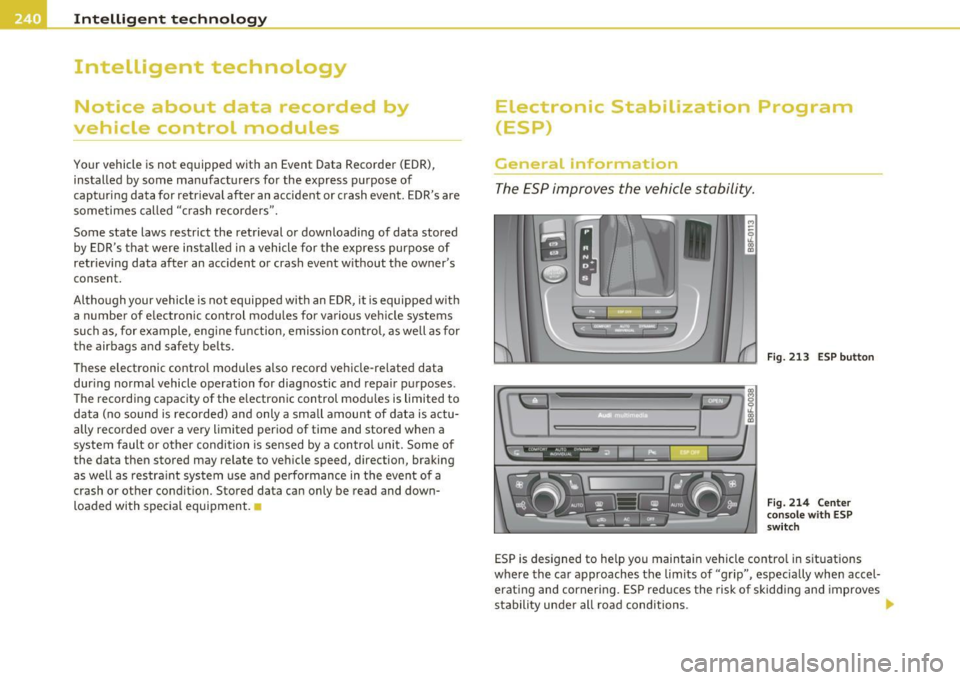
The ESP improves the vehicle stability.
Fig. 213 ESP button
Fig. 214 Center
console with ESP
switch
ESP is designed to he lp you maintain vehicle control in situations
where the car approaches the limits of "grip", especially when accel
erating and cornering. ESP reduces the risk of skidding and improves
stability under all road conditions.
Page 246 of 364
Intelligent technology
'-------------------------------------------------
Corrosion
T he re may be a te ndency fo r d irt to build u p on the bra ke pads and
co rrosion to form on the d iscs if the car is not dr iven reg ularly o r only
for short trips with litt le use of the bra kes .
If the brakes a re not used freq uen tly, or if co rrosion has formed o n
the discs, it is advisable to clean off the pads and discs by braking
fir mly a few times from a mode rat ely h igh spee d~ & .
Faults in the brake system
If yo u sh ou ld noti ce a sudden increase in b rake peda l trave l, then one
of the two brake circu its may have failed~& .
Low brake fluid level
Ma lfunctions can occ ur in t he brake system if the brake fluid level is
t oo low. The bra ke f lu id level is moni tore d elec tron ically.
Brake lin ing wear status
Brake lin ing wear may be checked by v isua l inspect ion of the condi
tion of the brake pads throu gh the open ings in the whee l.
If neces
sary, the whe el may be removed fo r thi s insp ection~
page 320,
"Changing a w hee l".
& WARNING
• You should perform braking maneuvers for the purpose of
cleaning the brake system only if road conditions permit. Other
road users must not be put at risk - you may cau se an accident!
• Before descending a steep grade, reduce speed and shift trans
mission into a lower gear or lower driving range. Do not ride the
brakes or hold the pedal down too long or too often . This could
cause the brakes to get hot and diminish braking efficiency.
• Do not "ride the brakes " by resting your foot on the pedal when
you do not intend to brake . This may cause the brakes to overheat ,
premature wear and increased stopping distance.
• Under certain climatic and operating condition s such as
passing through water , driving in heavy rain or after washing the
& WARNING (co ntinued )
vehicle, the effectiveness of the brakes can be reduced . In winter,
ice can ac cumulate on the brake pads, linings, dis cs and drums.
Carefully apply brakes for a test. Brakes will dry and ice coatings
will be cleaned off after a few careful brake appli cations.
• Driving for an extended period of time on salt-covered roads
without u sing your brakes can also affect braking efficiency . Clean
off accumulated salt coating from b rake discs and pads with a few
careful brake applic ations.
• If you damage the front spoiler, or if you install a different
spoiler, be sure the air flow to the front brakes i s not obstructed .
Otherwise the brake system could overheat reducing the effective
ness of the entire brake system.
• Failure of one brake circuit will impair the braking capability
resulting in an increased stopping di stance. Avoid driving the
vehicle and have it towed to the nearest authorized Audi dealer or
qualified workshop.
n
Brake booster
The b roke boost er odds extra broking po wer.
The bra ke boos ter wor ks wi th v acuum pressure whi ch is crea ted o nly
when the eng ine is ru nning~ &.
& WARNING
• Never let the vehicle roll to a stop with the engine shut off.
• If the brake booster is not working, for example when towing
your vehicle , or because the brake booster has somehow been
damaged, the brake pedal mu st be pressed considerably harder to
make up for the lack of booster assistance. •