ECU AUDI A5 CABRIOLET 2010 Owner's Manual
[x] Cancel search | Manufacturer: AUDI, Model Year: 2010, Model line: A5 CABRIOLET, Model: AUDI A5 CABRIOLET 2010Pages: 364, PDF Size: 86.51 MB
Page 187 of 364

________________________________________________ D_ r_ i_ v _i_n _,,,g "-- S_a_ f_ e_ l _,,y'-- __
& WA RNING (continued)
to get out . Being trapped in a vehicle can lead to serious personal
injury .
• Never let children play in or around the vehicle.
• Never l et passengers ride in the luggage compartment. Vehicl e
occupants must alwa ys be p roperl y res trained in one of the
vehicle 's seat ing posi tions.
(I) Tips
• Air circula tion helps to reduce window fogging. Sta le air escapes
to the outside thro ugh vents in the tr im panel. Be sure to keep these
slots free and ope n.
• Th e tire p ressure m ust co rrespon d to the load . The tire pressure is
show n on the tire p ressu re label. O n USA v ehicles, the tire p ress ure
label is located on the driver's side 8-p illar. On Canada veh icles, the
ti re pressu re lab el is locat ed either on the driver' s sid e B-pillar or
inside the fuel fi lle r flap . The t ire pressure labe l lists the recom
mended co ld tire in flati on press ures f or th e ve hicle at its max imum
capacity weight and the tires that were on yo ur vehicle at the time it
w as m anuf acture d. F or re co m mended ti re p res sur es for normal loa d
conditions, p lease see chapter=>
page 300 . •
Tie-downs
T he l uggage c omp artm ent is equipped with fo ur tie
d ow ns to sec ure l ug gag e a nd oth er ite ms.
Use the t ie-downs to secu re yo ur cargo properly => page 183,
"Lo ading the lugg age comp artmen t" .
I n a co llision, t he laws of physics mean that ev en sma ller items that
are loose i n the vehicle will become heavy missiles t hat can cause
serious injury. Items in the vehicle possess e nergy wh ich vary w ith
vehicle speed and the we ight of the item. Vehicle spee d is t he most
signifi cant factor.
Controls and equip
ment Safety first Vehicle operation
For example,
in a frontal collis io n at a speed of 30 mph (48 km/ h),
t he forces a ctin g o n a 1 0-lb (4 .5 kg) objec t are ab out 20 times the
normal weight of the item . T his means that the weight of the item
wou ld s udden ly be abo ut 200 lbs . (90 kg). You can imagine the inju
ries that a 200 lbs . (90 kg) item fly ing freely through the passenger
compartment could cause in a collision like this .
& WARNING
Weak, damaged or improper straps used to secure item s to tie
downs can fail during hard braking or in a collision and cause
serious personal injury.
• Always use suitable mounting straps and properly secure items
to the tie -downs in the luggage compartment to help prevent
items from shifting or flying forward as dangerous missiles.
• When the rear seat backrest is folded down, always us e suit
able mounting straps and properly secure items to the tie-downs
in the luggage compartment to help prevent items from flying
forward as dangerous missiles into the passenger compartment .
• Never attach a child safety seat tether strap to a tie-down .•
Reporting Safety Defects
Applicable to U.S.A.
If you believe that your vehi cle has a defect
whi ch could cause a crash or could cau se injury
or death, you should immediately inform the
National Highway Traffic Safety Administration
(NHTSA) in addition to notifying Audi of
Ameri ca, Inc. -.
Vehicle care Do-it-yourself service Technical data
Page 190 of 364
___ D_ r_ i_v _i_n -=g "-- S_ a_ f_ e--= Ly,__ _____________________________________________ _
Retracting rollover protection
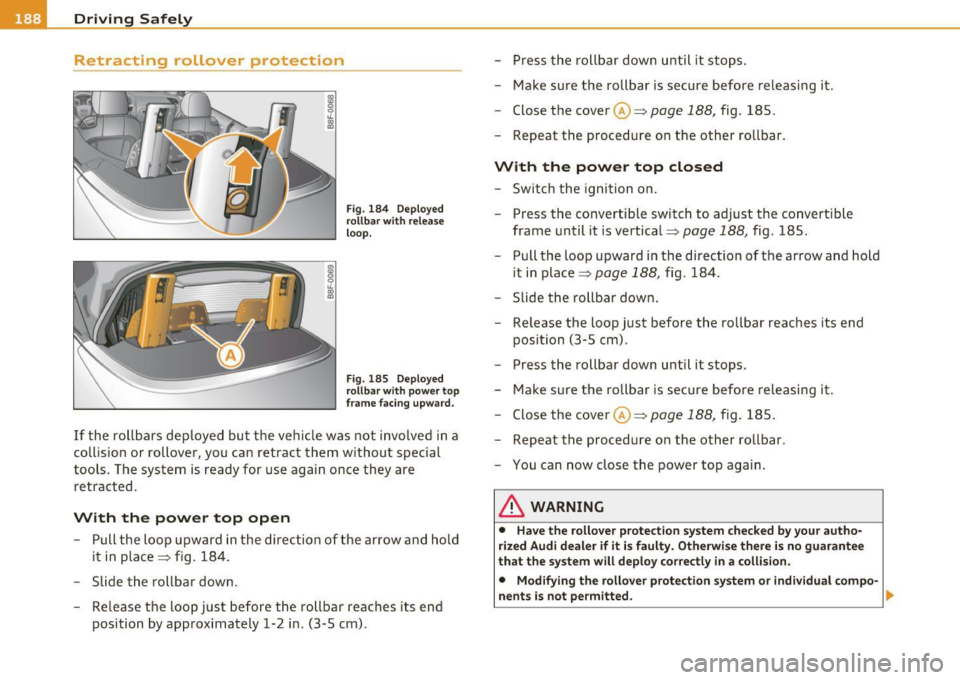
Fig. 184 Deployed
roll bar w it h r ele ase
loop.
F ig . 18 5 Deployed
rollbar w ith po wer top
frame facing upwar d.
If the rollbars deployed but the vehicle was not involved in a
collision or rollover, you can retract them without special
tools . The system is ready for use again once they are
retracted.
W ith th e power top open
- Pull the loop upward in the direction of the arrow and hold
it in place => fig. 184 .
- Slide the rollbar down .
- Release the loop just before the rollbar reaches its end position by approximately 1-2 in . (3 -5 cm). -
Press the rollbar down until it stops .
- Make sure the rollbar is secure before releasing it.
Close the cover@=>
page 188, fig. 185 .
- Repeat the procedure on the other rollbar.
With the power top closed
- Switch the ignition on .
- Press the convertible switch to adjust the convert ible
frame until it is vertical=>
page 188, fig. 185 .
- Pull the loop upward in the direction of the arrow and hold
it in place=>
page 188, fig. 184.
- Slide the rollbar down.
- Release the loop just before the rollbar reaches its end
position (3-5 cm).
- Press the rollbar down until it stops.
- Make sure the rollbar is secure before releasing it .
- Close the cover@=>
page 188, fig. 185 .
- Repeat the procedure on the other rollbar .
- You can now close the power top again .
& WARNING
• Have the roll over prot ectio n syst em ch ec ked b y your aut ho
rize d Audi d ealer if it i s fault y. Oth erwise th ere is no gua rante e
th at the s yste m wi ll dep loy correctl y in a c ollision.
• Mod ifying th e ro llo ver prote cti on sys te m or indi vid u al compo -
ne nts is no t permit ted.
~
Page 196 of 364
___ s_a_ f_ e_ t_y _ b_e _l_t _s ___________________________________________ _
& WARNING (continued)
• Never let any person ride with their feet on the instrument
panel or sticking out the window or on the seat .
• Never remove a safety belt while the vehicle is moving . Doing
so will increase your risk of being injured or killed .
• Never wear belt s twisted.
• Never wear belts over rig id or breakable objects in or on your
clothing, such as eye glasses, pen s, keys, etc ., a s these may cause
injury.
• Never allow safety belt s to become damaged by being caught
in door or seat hardware .
• Do not wear the shoulder part of the belt under your arm or
otherwise out of position.
• Several layers of h eavy clothing may interfere with correct
positioning of belts and reduce the overall effectiveness of the
sy stem.
• Always keep belt buckles free of anything that may prevent the
bu ckle from latching securely.
• Never u se comfort clips or devices that create slack in the
shoulder belt. However, special clips may be required for the
proper use of some child restraint systems.
• Torn or frayed safety belts can tear , and damaged belt hard
ware can break in an accident. Inspect belts regularly . If webbing,
bindings, buckles , or retractors are damaged, hav e belts replaced
by an authorized Audi dealer or qualified workshop.
• Safety be lts that have been worn and loaded in an accident
must be repla ced with the correct replacement safety belt by an
authorized Audi dealer. Replacement may be necessary even if
damage cannot be clearly seen. Anchorages that were loaded
must also be inspected.
• Never remove, modify , disas semble, or try to repair the safety
belts yourself .
& WARNING (co ntinued )
• Always keep the belts clean. Dirty belts may not work properly
and can impair the function of the inertia reel ::::>
page 272,
"Safety belts". •
Safety belts
Belt positioner
Th e driver and fr ont passenger se ats are e qui pp ed with
b elt pos itione rs.
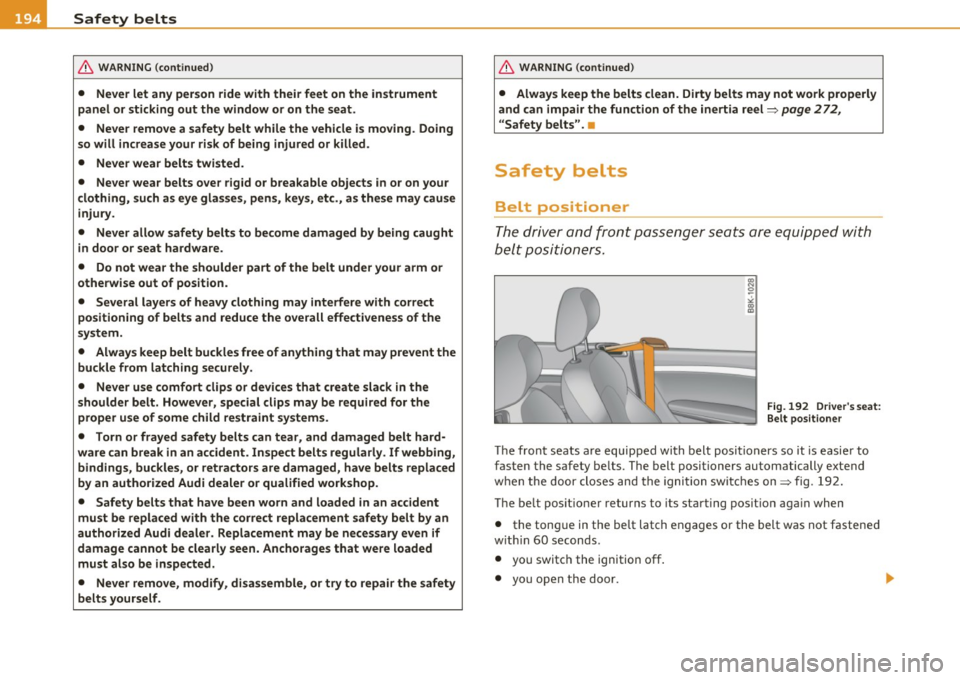
Fig. 192 Driver 's seat:
Be lt positioner
Th e fron t seats a re equipped with belt posi tioners so it is easie r to
fasten the safety be lts. The belt posit ioners automatically extend
w hen the door closes and the igni tion swi tch es on=> fig. 192.
T he be lt pos it io ner returns to its starting posit ion aga in when
• the tong ue in the be lt latch engages or the belt was not fastene d
w it hi n 60 s eco nds .
• you switc h the ignition off .
• you open the door.
Page 197 of 364

_____________________________________________ S_a _f _e _t _y_b _e_lt _ s __ _
& WARNING
• Only your authorized Audi dea ler should work on the system or
remove and in stalling system component s when performing other
work .
• The belt positioners could cause injury or damage if they pin ch
people or obj ects when extending or retracting .•
Fastening safety belts
Sea t fir st -everybod y buckle u p!
Fig. 19 3 Belt buc kle
and ton gue on t he
dr iv er's seat
To prov ide maxim um protection, sa fe ty be lts must a lways be
pos it io ned cor rect ly on t he wear er's bo dy.
- Ad just the front seat and head rest ra int p roper ly
=> page 77, "General recom mendatio ns" .
- Make sure the seat b ack of the rear sea t ben ch is in a n
u pright pos it ion and secu rely latche d in place before us ing
the belt=> &.
- Ho ld the belt by the to ngu e and pu ll it eve nly acros s the
ches t and pelvis=> &.
Controls and equip
ment Safety first Vehicle operation
- Ins
ert t he tong ue into the co rrect b uck le of your seat until
yo u h ear it latch securely=> fig. 193 .
- Pull o n th e be lt to make su re th at it is sec urel y la tched in
th e bu ckle.
Automatic safety belt retractors
Eve ry safety be lt is equipped w ith an automatic belt retracto r o n the
shoulder be lt. T his fea ture loc ks th e be lt when the bel t is pulled out
fast, during hard bra king and in an acc ident. The belt may also lock
w hen you dr ive up or down a steep hill or through a sharp curve.
During norma l dr iv ing the belt lets you move freely.
Safety belt pretensioners
The safety belts are eq uipp ed with a belt pretens ioner that he lps to
ti gh ten the safe ty bel t and r emove slack whe n the preten sio ner i s
act ivated . T he function of the pretensioner is monitored by a war ning
ligh t~
page 14 .
Switchable locking feature
Eve ry sa fety belt except t he one o n the driver sea t is eq uipp ed with a
switchab le locking feat ure that
must be used when t he safety be lt is
used to att ach a child sa fe ty seat . Be s ure to re ad th e im port ant inf or
mation about th is feature~
page 232.
& WARNING
Improperly positioned safety belts can cause serious injury in an
accident ~
page 196, "Safety belt position ".
• Safety belts offer optimum protection only when the seat back
is upright and belts are properly positioned on the body.
• Never attach the safety belt to the buckle for another seat.
Attaching the belt to the wrong buckle will reduce safety belt
effectiveness and can cause serious personal injury.
• A passenger who is not properly restrained can be seriously
injured by the safety belt itself when it move s from the stronger
parts of the body into critical areas like the abdomen . .,
Vehicle care Do-it-yourself service Technical data
Page 198 of 364
.. Safety belts PJWI _______________ _
& WARNING (continued)
• Always lock the convertible locking retractor when you are
securing a child safety seat in the vehicle=>
page 234. •
Safety belt position
Correct belt position is the key to getting maximum
protection from safety belts.
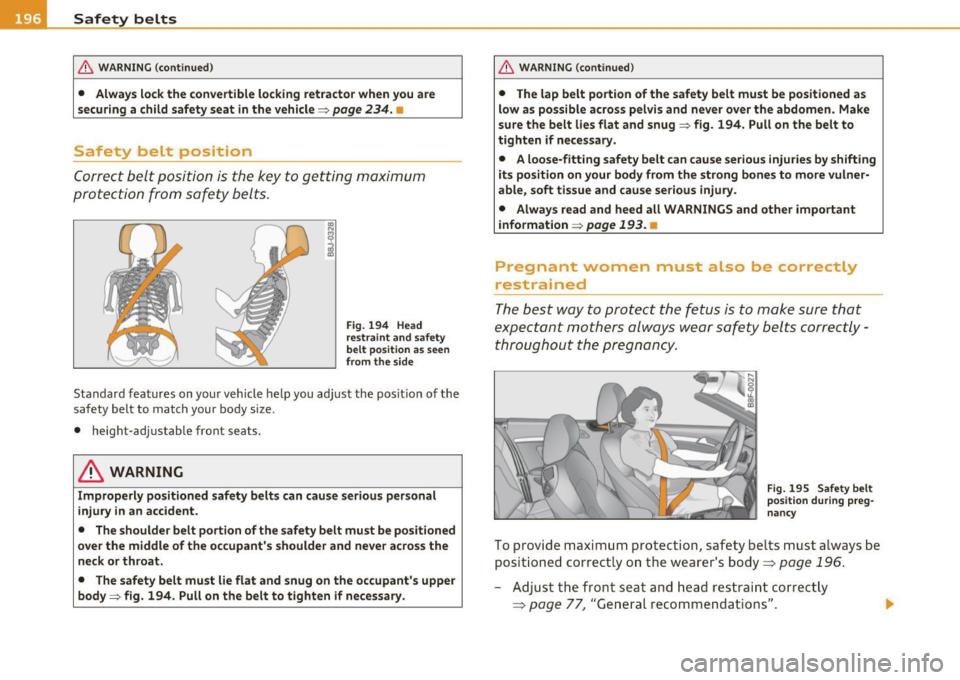
Fig. 194 Head
restraint and safety
belt position as seen
from the side
Standard features on your vehicle help you adjust the position of the
safety belt to match your body size.
• height-adjustable front seats.
& WARNING
Improperly positioned safety belts can cause serious personal
injury in an accident.
• The shoulder belt portion of the safety belt must be positioned
over the middle of the occupant's shoulder and never across the
neck or throat.
• The safety belt must lie flat and snug on the occupant's upper
body=> fig. 194. Pull on the belt to tighten if necessary.
& WARNING (continued)
• The lap belt portion of the safety belt must be positioned as
low as possible across pelvis and never over the abdomen. Make
sure the belt lies flat and snug => fig. 194. Pull on the belt to
tighten if necessary.
• A loose-fitting safety belt can cause serious injuries by shifting
its position on your body from the strong bones to more vulner
able, soft tissue and cause serious injury.
• Always read and heed all WARNINGS and other important
information =>
page 193. •
Pregnant women must also be correctly
restrained
The best way to protect the fetus is to make sure that
expectant mothers always wear safety belts correctly -
throughout the pregnancy.
Fig. 195 Safety belt
position during preg
nancy
To provide maximum protection, safety belts must always be
positioned correctly on the wearer's body=>
page 196.
-Adjust the front seat and head restraint correctly
=>
page 77, "General recommendations".
Page 199 of 364

-Make sure the seat back of the rear seat bench is in an
upright position and securely latched in place before using
the belt.
- Hold the belt by the tongue and pull it evenly across the
chest and pelvis=> fig. 195, =>
&.
- Insert the tongue into the correct buckle of your seat until
you hear it latch securely=>
page 195, fig. 193.
- Pull on the belt to make sure that it is securely latched in
the buckle.
& WARNING
Improperly positioned safety belts can cause serious personal
injury in an accident.
• Expectant mothers must always wear the lap portion of the
safety belt as low as possible across the pelvis and below the
rounding of the abdomen.
• Always read and heed all WARNINGS and other important
information =>
& in "Fastening safety belts" on page 195. •
Safety first Vehicle OP-eration
Safety belts
Unfastening safety belts
Unbuckle the safety belt with the red release button only
after the vehicle has stopped.
Fig . 196 Releasing
the tongue from the
buckle
- Push the red release button on the buckle=> fig. 196. The
belt tongue will spring out of the buckle =>& .
- Let the belt wind up on the retractor as you guide the belt
tongue to its stowed position .
& WARNING
Never unfasten safety belt while the vehicle is moving. Doing so
will increase your risk of being injured or killed. •
Improperly worn safety belts
Incorrectly positioned safety belts can cause severe inju
ries.
Wearing safety belts improperly can cause serious injury or
death . Safety belts can only work when they are correctly
positioned on the body. Improper seating positions reduce
the effectiveness of safety belts and will even increase the
risk of injury and death by moving the safety belt to critical •
Vehicle care Do-it-yourselt service iTechnical data
Page 234 of 364
lffllL___:C:..:h..:.. i:..: l .=d ~S=-= a..:..f .= e ~ty ~ --------------------------------------------
& WA RNING (conti nued)
• Never let a child stand or kneel on an y seat, for example the
front seat.
• Never let a child ride in the cargo area of your vehicle.
• Alwa ys remember that a child leaning forward , sitting s ide·
ways or out of po sition in an y way during an accident can be struck
by a deploying airbag. Th is will result in serious personal injury or
death.
• If you must install a booster seat on the front passenger seat
because of e xceptional circumstance s the PASSENGER AIR BAG
OFF light must come on and stay on, whenever the ignit ion is
switched on.
• If the PASSENGER AIR BAG OFF light does not come on and
s tay on, perform the checks described =>
page 211, "Monitoring
the Advanced Airbag System ".
• Take the child re straint off the front pa ssenger seat and install
it prope rly at one of the rear seat positions if the PASSENGER AIR
BAG OFF light does not stay on whenever the ignition i s swit ched
on.
• Always read and heed all WARNINGS whenever u sing a child
restrained in a vehicle is being used=>
page 190, "Safety belts ",
=> page 200, "Airbag system " and => page 222, "Impo rtant
th ings to know ". •
Installing a child safety seat
Securing a child safety seat using a safety
belt
S afet y belts for the re ar seats a nd the front passenger's
seat c an be locked with the c onvertible locking retract or
to pro perly secure child safety seats.
T he safety belts emergency loc king retractors for the rear seats
saf ety belts and fo r the front passe nger's seat safety be lt have a
convertib le locking retractor for child restraints. The safety be lt m ust
be loc ked so that belt webbing ca n not u nreel. The re tractor can be
activated to lock the safety belt and prevent the safety belt webbing
from loosening up d uring norm al driving. A chi ld safety seat can only
be properly installed when the safety belt is locked so that the child
and child safe ty seat will stay in p lace .
Always remembe r: Even though your vehicle is equipped with an
Advanced Airbag system, all chi ld ren, especially those 12 yea rs and
younger, should always ride in th e bac k seat p roperly restra ined for
their age and size.
& WARNING
Improperl y in stalled child safety se ats increase the risk of serious
per sonal injury and death in a collision.
• Always make sure that the safety belt retractor is locked when
i nstalling a child safety seat . An unlocked safety belt retractor
cannot hold the child safety seat in place during normal driving or
in a crash.
• Always buckle the child safety seat firmly in place even if a
child is not s itting in it. A loose child safety seat can fly around
during a sudden stop or in a collision.
• If the back rest is not securely latched , the child and the child
restraint will be thrown forward together with the backre st and ._
Page 236 of 364
ffl.___C_ h_ il_d _ S_a _ f_ e _ t--= y '------------------------------------------------
& WARNING (continued)
• A child in a rearward-facing child safety seat installed on the
front passenger seat will be seriously injured and can be killed if
the front airbag inflates -even with an Advanced Airbag System.
• The inflating airbag will hit the child safety seat or infant
carrier with great force and will smash the child safety seat and
child against the backrest, center arm rest, door or roof.
• Always be especially careful if you must install a rearward
facing child safety seat on the front passenger seat in exceptional
circumstances.
• A tight tether strap on a rearward-facing child restraint
attached to the front passenger seat can put too much pressure on
the weight-mat in the seat and register a heavier weight in the
Advanced Airbag System. The heavier weight registered can make
the system work as though an adult were on the seat and deploy the Advanced Airbag when it must be suppressed causing serious
or even fatal injury to the child.
• Make sure that the PASSENGER AIR BAG OFF light comes on
and stays on all the time whenever the ignition is switched on.
• If the PASSENGER AIR BAG OFF light does not come on and
stay on, immediately install the rearward-facing child safety seat
in a rear seating position and have the airbag system inspected by
your authorized Audi dealer. •
Activating the convertible locking retractor
Use the convertible locking retractor to secure a child
restraint.
Always heed the child safety seat manufacturer's instruc
tions when installing a child restraint in your vehicle. To acti
vate the convertible locking retractor:
- Place the child restraint on a seat, preferably on the rear
seat. -
Slowly pull the belt
all the way out.
- Route it around or through the child restraint belt path
=>& .
- Push the child safety seat down with your full weight to
get the safety belt really tight.
- Insert the belt tongue into the buckle for that seating
position.
- Guide the safety belt back into the retractor until the belt
lies flat and snug on the child safety seat.
- You should hear a "clicking" noise as the belt winds back
into the inertia reel. Test the convertible locking retractor
by pulling on the belt. You should no longer be able to pull
the belt out of the retractor. The convertible locking
retractor is now activated.
- Make sure that the red release button is facing away from
the child restraint so that it can be unbuckled quickly.
- Pull on the belt to make sure the safety belt is properly
tight and fastened so that the seat cannot move forward
or sideways more than one inch (2.5 cm).
& WARNING
Using the wrong child restraint or an improperly installed child
restraint can cause serious personal injury or death in a crash.
• Always make sure that the safety belt retractor is locked when
installing a child safety seat. An unlocked safety belt retractor
cannot hold the child safety seat in place during normal driving or
in a crash.
• Always buckle the child safety seat firmly in place even if a
child is not sitting in it. A loose child safety seat can fly around
during a sudden stop or in a crash.
Page 237 of 364

Child Safety ------------------------"'--l'ff'II
& WARNING (c on tinued )
• Always make sure the seat backrest to which the child re stra int
is installed is in an upright position and securely latched into place
and cannot fold forward . Otherwise , the seat back with the child
safety seat atta ched to it could fly forward in the e vent of an acci
dent or other emergency situation.
• Always read and heed all WARNINGS whenever u sing a child
restrained in a vehicle is being used~
page 222. Special precau
tions apply when installing a child safety seat on the front passenger seat~
page 202, "Child restra ints on the front seat -
s ome important things to know ".•
Deactivating the convertible locking
retractor
The convert ible locking retractor for child restraints will
be dea ctivat ed aut om at ic ally when the belt i s woun d all
th e way bac k in to t he retr actor .
- Press the re d but to n o n th e sa fety belt buckle. T he b elt
to ng ue wi ll pop out of th e buckle .
- Guide the safety belt all t he way back in to its stowed posi-
tion.
Always le t the safety bel t retract completely into i ts stowe d position .
Th e safety belt can now be used as an ord inary safe ty be lt withou t the
convertible locking ret ractor fo r ch ild rest raints .
If the convertib le locking retractor should be activated inadvertently,
t he s afety bel t m ust be unfastened and guide d com plete ly b ack i nto
its stowed position to deactivate this feature. If the convertible
lo ck ing r etr acto r is no t deact ivated, the sa fe ty belt w ill gradu ally
become t ighter and uncomfo rtable to wear .
Controls and equip
ment Safety first Vehicle operation
& WARNING
Improperly installed child safety seats increase the risk of serious
personal injury and death in a colli
sion.
• Never unfasten the safety belt to deactivate the convertible
locking retractor for child restraints while the vehicle i s moving.
You would not be restrained and could be seriously injured in an
accident.
• Always read and heed all WARNINGS whenever using a child
re strained in a vehicle i s being used~
page 222. Special precau
tions apply when installing a child safety seat on the front
pas senger seat~
page 202, "Child restraints on the front seat -
some important things to know ".•
LATCH Lower anchorages and
tethers for children
Child Restraint System anchors and how
are they related to child safety
To provide a simp le r and more practicable way to attac h the child
restra int on the ve hicle sea t, Fe d era l regu lations require spec ia l
lower anchorages in veh icles and devices on new child restra ints to
attach to t he vehicle anc ho rages.
Th e combin ation of the te ther anchorages and t he lower an chorages
is now generally called the
LATCH system for " Lower Anchorages and
T ether s fo r Chi ldren. "
Forward-fac ing ch ild restra ints manufactured after September 1,
1 999, are required by U .S . federa l reg ulations to comp ly with new
child head movement per formanc e requi reme nts . These new perfor
mance requirements ma ke a tether necessary on most new child
sea ts.
Vehicle care Do-it-yourself service Technical data
Page 238 of 364
lffll,___C_ h_ il_d _ S_a _ f_ e _ t-= y ;....._ ____________________________________________ _
Installing a child restraint that requires a top tether w ithout one can
ser iously impair the pe rformance of the ch ild res tra in t and i ts abili ty
to protect the c hild in a collision . Instal ling a child restra int that
requires a top tether w ithout t he top tether may be a violation of
state law.
Chi ld restraint manufacturers o ffer LATCH lower anchorages on their
c hild se ats with hoo k-on or push-on connectors att ache d to ad ju st
able straps.
In ad dit ion to the LA TCH lowe r anchorages, these ch ild restra int
systems usually require the use o f tether st raps to help keep the chi ld
restra int fi rm ly in place.
Tether anchorages
Yo ur Audi Cabr io le t is not equippe d w it h a LA TCH sys tem . It is not
equipped with top tether anchorages. It is equ ipped w ith lower
anchora ges on ly .
Yo ur Cabr iolet is eq uipped w ith the A ctive Rollove r Pro te ct io n
System, which is integ rated into the back rest of the rear seat. The
Ac tive Rollover Prote ction Sy st em dep loy s upward s to hel p pr ovide
add itiona l protection in certa in coll is ions and crash sit uat ions. For
t his re a son, you r ve hicl e is
not equipped wi th top te ther an chor ages
for use with forward-fac ing ch ild restraints .
In Canada, provincial law requires that fo rwa rd -facing child
restra ints use bot h top tethe r anc horages and lower a ncho rages;
therefore, it is
not possible to install a forwar d-fac ing child rest raint
in thi s ve hicle.
In the United States , child restraint installation must co nform with
t he ch ild rest rain t manufactu rer's instr uctions. Chec k the inst ru c
tions that come with the c hild restraint or contact the manufacturer
to dete rmine if the c hild rest raint may be insta lled facing fo rwa rd
without secu ring the top tether st rap .
& WARNING
Improper installation of child restraints will increase the risk of
injury and death in a cra sh .
• Always follow the instructions pro vided by the manufacturer
of the child restraint you intend to install in your vehicle.
• Improper use of child restraint LATCH lower anchorage points
c an lead to injury in a colli sion . The LATCH lower anchorage point s
are designed to withstand only those loads imposed by correctly
fitted child restraints .
• Never mount two child restraint systems on one LATCH lower
anchorage point .
• Never secure or attach any luggage or other item to the LATCH
lower anchorages.
[]] Tips
In other countries, the term "IS O FIX " is used to descr ibe the lower
anchorages. •
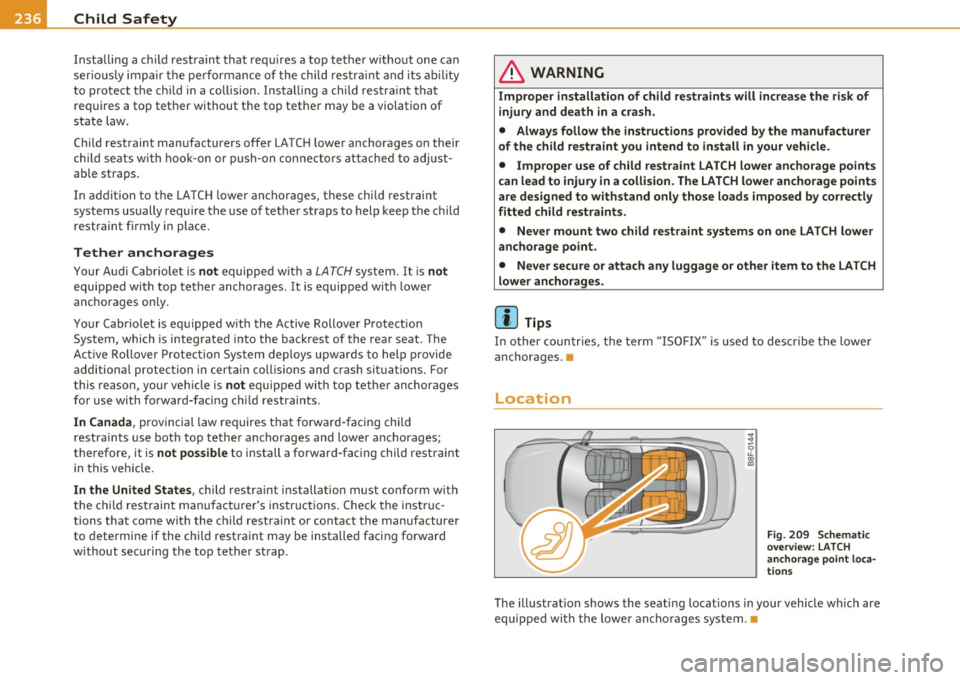
Location
Fig. 209 Schemati c
overv iew : LATCH
an chorage p oint loca
tions
T he ill ustrat ion shows the seati ng locat ions in your vehicle wh ich are
equi pped wi th the lowe r anchora ges sys te m .•