child restraint AUDI A5 CABRIOLET 2010 Owner's Manual
[x] Cancel search | Manufacturer: AUDI, Model Year: 2010, Model line: A5 CABRIOLET, Model: AUDI A5 CABRIOLET 2010Pages: 364, PDF Size: 86.51 MB
Page 215 of 364

Airbag system Ill
----------------=--=---
the weight-sensing mat to measure more weight t han is act ua lly on
t he sea t.
If the PASSENGER AIR BAG OFF light still does not come on and
does not stay on cont in uou sly (when the ignition is sw itched on),
• t ake the child re st raint o ff the fr ont pa ssenge r seat and in stall it
prope rly at one of t he rear seat pos itions. Have t he a irbag system
i n sp ec ted by y ou r au thorized A udi dea ler im medi ately.
• move the child to a rear seat posit io n and make sure that the child
i s prop erly re stra ined in a chi ld restr aint t hat is a ppr opr iate for i ts
size and age.
Th e
PASSENGER AIR BAG OFF light sho uld NOT come on when t he
ign ition is on and an adult is si tting in a proper seating pos it io n on the
front passenge r seat. If the
PASSENGER AIR BAG OFF light comes on
and st ays o n or flashes for abou t 5 seco nds w hile drivi ng, under these
circumstances, make sure that:
• t he adult on t he fr on t p asse nger sea t is pro pe rly se ate d on the
center of the seat cushion with his or her back up against the backrest
and the bac kres t is not recli ned => page 178, "Proper occ upant
seating posit ions",
• t he adult is n ot tak ing weig ht off t he se at by h olding on to t he
passenger assist handle above the fro nt passenger doo r or
s up po rting their weight on the armrest,
• the safety belt is be ing properly worn and th at there is not a lot of
s la ck in t he safe ty be lt webb in g,
• accessory seat cove rs or cushions o r othe r th ings that may cause
an in cor rect readin g or i mpress io n o n the weight -sen sing m at under
the upholstery of the seat have been removed from the front
pas senge r sea t,
• a safety be lt extender has not been left in the safety belt latch fo r
t he fr ont p asse n ge r se at.
In addition to the
PASSENGER AIR BAG OFF light in t he center of the
instrument pa nel, the message
PASSENGER AIR BAG OFF or
PASSENGER AIR BAG ON w ill b riefly appear in th e inst rume nt clus ter
Controls and equip
ment Safety first Vehicle operation
display.
This is to inform the dr iver of the current front passenger
a ir bag s tatus. •
Important safety instructions on
monitoring the Advanced Airbag System
& WARNING
An airbag system that is not functioning properly cannot provide
supplemental protection in a frontal crash.
• If the airbag indicator light comes on, it means that there may
be something wrong with the Advanced Airbag System. It is possible that the airbag will inflate when it is not supposed to, or
will not inflate when it should .
• Have the airbag system inspected immediately by your autho
rized Audi dealer.
& WARNING
If the front airbag inflates, a child without a child restraint, in a
rearward-facing child safety seat or in a forward-facing child
restraint that has not been properly installed will be seriously
injured and can be killed .
• Even though your vehicle is equipped with an Advanced Airbag
System, make certain that all children, especially 12 years and
younger , always ride on the back seat properly restrained for their
age and size .
• Always install forward or rear-facing child safety seats on the
rear seat -even with an Advanced Airbag System.
• If you must install a rearward-facing child safety seat on the
front passenger seat because of e xceptional circumstances and
the PASSENGER AIR BAG OFF light does not appear and stay on, immediately install the rear-facing child safety seat in a rear ..,
Vehicle care Do-it-yourself service Technical data
Page 216 of 364
........ _A_ i_rb _ a_,g,:;._ s_, y'- s_ t_e _m ________________________________________________ _
& WARNING (conti nued)
seating position and have the airbag system inspected by your
authorized Audi dealer .
• A tight tether or othe r strap on a rearward-facing child
restraint attached to the front passenger seat can put too much
pressure on the weight-sensing mat in the seat and register more
weight than i s actually on the seat. The heav ier weight registered
can make the system work as though an adult were on the seat
and deploy the Advanced Airbag when it must be suppressed
causing serious or even fatal injury to the child .
• If, in ex ceptional circumstances, you must install a forward·
facing child restraint on the front passenger seat, always move
the seat into i ts rearmo st po sition in the seat's fore and aft adjust ·
ment range, as far away from the airbag as possible . The backrest
must be adjusted to an upright position. Make sure that the
PASSENGER AIR BAG OFF light comes on and stays on all the time
whenever the ignition is switched on.
& WARNING
• If the PASSENGER AIR BAG OFF light do es not go out when an
adult is sitting on the front passenger seat after taking the steps
de scribed above, make sure the adult i s properly seated and
restrained at one of the rear seating positions.
• Have the airbag system inspected by your authorized Audi
dealer before transporting anyone on the front passenger seat.
[ i ] Tips
If the we ight-sens ing mat in the front passenger seat detects an
empty seat, the front a irbag on the passenger side w ill be t urne d off,
and PASS ENGER AIR BAG OFF will stay on.•
Repair, care and disposal of the airbags
Parts of the a irbag system a re installed at many different p laces on
your Audi. Inst all in g, remov ing, servic ing or repa iring a part in an
area of the ve hicle can damage a part of an airbag system and preve nt
t ha t system from working pro perl y in a coll is ion.
T here are some important thi ngs you have to know to make sure that
the effectiveness of the system will not be impa ired an d that
discarded components do no t cause injury or poll ute the enviro n
ment .
& WARNING
Improper care , servicing and repair procedures can increase the
risk of personal injury and death by preventing an airbag from
deploying when needed or deploying an airbag unexpectedly:
• Never cover, obstruct , or change the steering wheel horn pad or
airbag cover or the instrument panel or modify them in any way.
• Never attach any objects such as cupholders or telephone
mountings to the surfaces covering the airbag unit s.
• For cleaning the horn pad or instrument panel, use only a soft,
dry cloth or one moistened with plain water. Solvent s or cleaners
could damage the airbag cover or change the stiffness or strength
of the material so that the airbag cannot deploy and protect prop·
erly .
• Never repair, adjust, or change any part s of the airbag system .
• All work on the steering wheel, instrument panel , front seats
or electrical sy stem (including the installation of audio equip·
ment , cellular telephones and CB radios, etc .) must be performed
by a qualified technician who ha s the training and special equip ·
ment necessary .
• For any work on the airbag system, we strongly re commend
that you see your autho rized Audi dealer or qualified workshop.
• Never modify the front bumper or parts of the vehicle body.
liJ,,
Page 220 of 364
........ _A_ ir_ b_ a-=g ,__ s,,.,y _s _t _e_ m _______________________________________________ _
If the front airbags deploy, the knee airbags also deploy in frontal
collisions above a certain severity.
When the system is deployed, the a irbags start to fill with a prope l
lant gas , and inflate between the lower part of the instrument panel
and the driver and the lower part of the instrument panel and the
front passenger =>
page 209, fig. 199.
Altho ugh they are not a soft pillow, they can cushion the impact and
in this way they can help to reduce the risk of injury to the lower
extremities.
All this takes place instantaneously, so fast that many people don't
even realize that the airbags have deployed. The airbags also inflate
w ith a great deal of force and it is important fo r occupant safety that
nothing should be in their way when they deploy.
Fully inflated airbags in combination with properly worn safety belts
slow down and limit the occupant's forward movement and help to
red uce the risk.•
Applies to ve hicle s: wit h Knee ai rbag s
Important safety instructions on the knee
airbag system
Airbags are only supplemental restraints. Always wear
safety belts correctly and ride in a proper seating posi
tion.
Th ere is a lot that yo u and your passengers must know and do to help
the safety belts and a irbags to prov ide supp lemental protection.
& WARNING
An inflating knee airbag can cause serious injury. Wearing safety
belts incorrectly and improper seating positions increase the risk
of serious personal injury and death whenever a vehicle is being
used.
& WARNING (continued)
• The airbag system cannot protect you properly if you are seated
too close to any of the airbag locations. When adjusting their seat
positions, it is important that both the driver and the front
passenger keep their upper bodies and knees at the following
minimum safe distances:
- 10 inches (25 cm) between the chest and the steering
wheel/instrument panel.
- 4 inches (10 cm) between the knees and the lower part of
the instrument panel.
• The risk of personal injury increases if you lean forward or to
the side, or if the seat is improperly positioned and you are not
wearing your safety belt. The risk increases even more should the
airbag deploy.
• Always make sure that the knee airbag can inflate without
interference. Objects between yourself and the airbag can increase
the risk of injury in an accident by interfering with the way the
airbag deploys or by being pushed into you as the airbag deploys.
- No persons (children) or animals should ride in the footwell
in front of the passenger seat. If the airbag deploys, this can
result in serious or fatal injuries.
- No objects of any kind should be carried in the footwell area
in front of the driver's or passenger's seat. Bulky objects (shop
ping bags, for example) can hamper or prevent proper deploy
ment of the airbag. Small objects can be thrown through the
vehicle if the airbag deploys and injure you or your passengers.
• Make sure there are no cracks, deep scratches or other damage
in the area of the instrument panel where the knee airbags are
located.
• If children are incorrectly seated, their risk of injury increases
in the case of an accident =>
page 222, "Child Safety". •
Page 222 of 364
Ill Airbag system
----=------------------------------
• in rear-end collisions
• in rollovers.
In some types of accidents the front a irbags a nd side a irbags may be
t riggered together.
& WARNING
• Safety belt s and the airbag sy stem will only provide prote ction
when occupants are in the proper seating position=>
page 220.
• If the airbag indicator l ight comes on when the vehicle is being
used , have the system inspected immediately by your authorized
Audi dealer. The airbag may not work properly when the vehicl e
accele ration in a side collision is h igh enough to activate the
airbag .•
How supplemental side airbags work
Side airbags deploy instantly and con help reduce the risk
of upper torso injuries for occupants who ore properly
restrained.
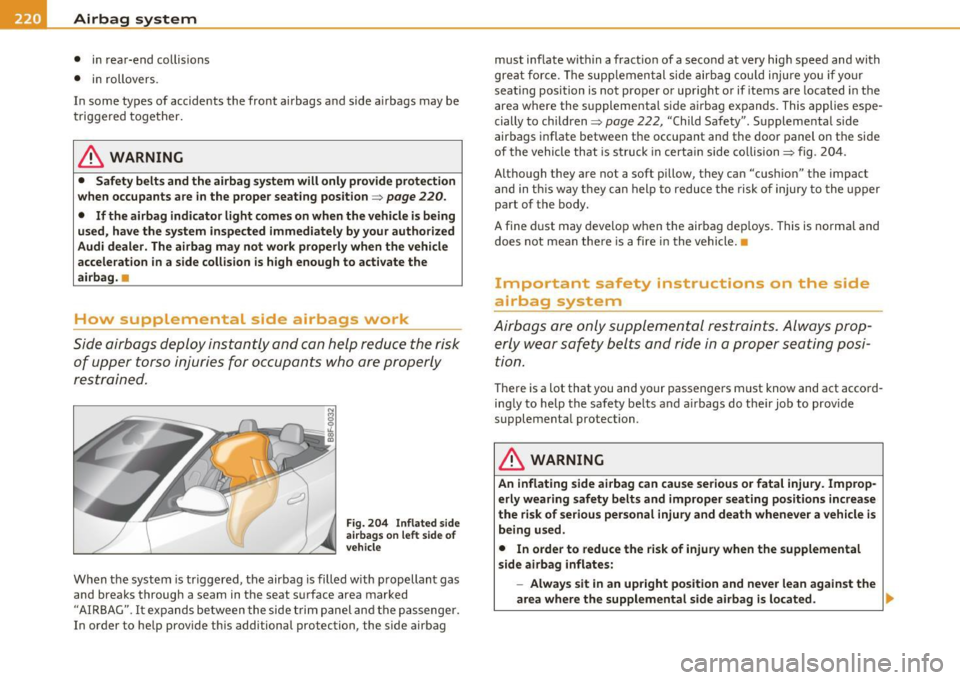
F ig. 2 04 Inflated side
ai rbag s on left s ide o f
veh icle
When the system is triggered, the airbag is filled with p ropellant gas
and breaks through a seam in the seat surface area marked
"AIRBAG". I t expands between the side t rim panel and the passenger.
In order to he lp provide this additional protection, the side airbag must inflate within a fraction of a second at very hig
h speed and with
great force. The supp lemen tal side airbag cou ld inju re you if yo ur
seat ing position is not proper or upr ight or if items are located in the
area where the s upplemental s ide a irbag expands. This applies espe
cially to children=>
page 222 , "Child Safety". Suppleme nta l s ide
airbags inflate between the occupant and the door panel on the side
of the vehicle that is s truck in certa in side collision=> fig. 204.
Although they are not a soft pi llow, they can "cush ion" the impact
and in t his way t hey can help to reduce the risk of injury to the upper
part of the body.
A fine dust may develop w hen the airbag dep loys. This is norma l and
does not mean the re is a fire i n the vehicle. •
Important safety instructions on the side
airbag system
Airba gs are only supplemental restraints. Always prop
erly wear safety belts and ride in a proper sea ting posi
tion .
There is a lot that you and your passengers m ust know and act acco rd
ing ly to he lp the safety be lts and a irbags do the ir job to prov ide
supplementa l protection .
& WARNING
An inflating side airbag can caus e serious or fatal inju ry. Improp
erly wearing safety belts and improper seating po sition s increa se
the risk of serious personal injury and death whenever a vehicle is
being used .
• In order to reduce the risk of injury when the supplemental
side airbag inflates:
-Alway s sit in an upright position and never lean against the
area where the supplement al side airbag is located . _,
Page 225 of 364

__________________________________________ ___:C~ h~il ~d ~ S~a ~f ~e ~t ¥_Y __ _
& WARNING (c on tinued )
• Always install rearward-facing child safety seat s on the rear
seat .
• If you must install a rearward facing child safety seat on the
front passenger seat in e xceptional circumstance s and the
PASSENGER AIR BAG OFF light does not come on and sta y on,
immediately install the rearward-facing child safety seat in a rear
seating position and have the airbag system inspected immedi ·
ately by your authorized Audi dealer .
_& WARNING
If, in exceptional circumstances, you must install a forward-facing
child restraint on the front passenger' s seat:
• Always make sure the forward -facing seat has been designed
and certified by its manufacturer for use on a front seat with a
passenger front and side airbag.
• Always follow the manufacturer's instructions provided with
the child safety seat or carrier.
• Always move the passenger seat into its rearmost position in
the seat's fore and aft adjustment range , as far away from the
airbag as po ssible before in stalling the child restraint. The back
rest must be adjusted to an upright position.
• Alway s make sure that the PASSENGER AIR BAG OFF light
comes on and stays on all the time whenever the ign ition is
switched on .•
Advanced front airbag system and children
Your vehicle is equipped wi th a fron t "Adva nced Airbag Syste m" in
compliance with United States Federal Motor Vehicle Safety Standard
(FMVSS) 20 8 as app licable at t he time your ve hicle w as m anufa c
tured.
Controls and equip ment Safety first Vehicle operation
T
he Advanced A irbag system in your veh icle has been ce rtified to
meet the "low-r isk" re quiremen ts fo r 3-and 6-ye ar old c hildre n on
t he passenger side and small ad ults o n the dr ive r side . The low r isk
deployme nt c riteria are intende d to reduce the risk of injury t hrough
in teraction with the airbag that can occ ur, for example, by being too
close to the steering w heel and i nstr ument panel when the ai rbag
inflates . In addi tion, the system has bee n certified to comp ly with the
"suppression" requirements of the Safety Sta ndard, to turn
off the
fr ont ai rbag for infan ts up to 12 month s w ho are rest rai ned on the
front passenger seat in child restraints t hat are listed in the Stan
d ard .
Even thoug h your veh icle is eq uipped with an Advanced Airbag
system, a ll child ren, es pecially those 12 years and yo unger, should
always ride in the back seat pro perly r estra ined for the ir age and s ize.
T he airbag on the passenger si de makes the fro nt seat a potentially
dange rous place fo r a child to ride. The front seat is not the s afest
place for a c hild in a forward-facing c hild safety seat. It can be a very
dange rous place for a n infant or a larger ch ild in a rearward-fa cing
seat. •
Advanced Airbags and the weight-sensing
mat in the front seat
Th e Advance d Airbag System i n your vehicle detects the p resence o f
an in fant o r chil d in a c hild rest raint o n the front passenger seat using
the weight-sens ing mat in the seat cushion and the sensor be low the
safety belt latc h on t he fro nt passeng er seat that meas ures t he
tension on the sa fety belt.
Th e weigh t-sens ing m at me asures to tal weight of the ch il d and t he
child saf ety seat a nd a child blanket on the front passenge r seat . T he
we ight on t he front passenger seat is re lated to t he desi gn of the
child res traint and i ts "foot print", the size and shape of the bo ttom
of the chi ld restraint as it sits on the seat . The weight of a child
restra int a nd its " foo tprint" va ry for diffe re nt k inds of child res tra ints
~
Vehicle care Do-it-yourself service Technical data
Page 226 of 364
-Child Safety ---- ~---------------------------
and for the different models of the same kind of child restraint
offered by child restraint manufactu rers .
The weight ranges for the individual types, makes and models of ch ild
restraints that the NHTSA has specified in the Safety Standard
together with the weight ranges of typica l infants and typical 1 year
old child have been stored in the control unit of the Advanced Airbag
System. When a child restraint is being used on the front passenger
seat with a typical 1 year-old chi ld, the Advanced Airbag System
compares the weight measured by the weight sens ing mat with the
information stored in the electronic control unit .
T he electronic control unit also registers the tension on the front
passenger safety be lt . The tension on the safety belt fo r the front
passenger seat will be different for an adult who is properly using the
safety belt as compared to the tension on the be lt when it is used to
attach a child restraint to the seat. The sensor below the latch for the
safety belt for the front seat passenger measures the tension on the
belt. The input from this sensor is then used with the we ight to
"decide", whether there is a child restraint with a typical 1 yea r-old
child on the front passenger seat and whether or not the airbag must
be turned off.•
Child restraints and Advanced Airbags
Regardless of the child restraint that you use, make sure that it has
been certified to meet United States Federal Motor Vehicle Safety
Standards and has been certified by its manufacturer for use with an
airbag . Always be sure that the child restraint is properly installed at
one of the rear seating positions. If in exceptional circumstances you
must use it on the front passenger seat, carefully read all of the infor
mation on chi ld safety and Advanced Airbags and heed a ll of the
applicable WARNINGS. Make certain that the child restraint is
correctly recognized by the weight-sensing mat inside the front
passenger seat, that the front passenger airbag is turned off and that
the airbag status is always correctly signaled by the
PASSENGER AIR
BAG OFF
light. Many
types and models of child restra ints have been available over
the years, new mode ls are introduced regularly incorporating new
and improved designs and older models are taken out of production .
Chi ld restraints are not standardized. Child restraints of the same
type typically have different weights and sizes and different 'foot
prints,' the size and shape of the bottom of the chi ld restraint that
sits on the seat, whe n they are installed on a vehicle seat. These
differences make it virtually impossible to certify compliance with
the requirements for advanced airbags with each and every child
restraint that has ever been sold in the past or w ill be sold over the
course of the useful lif e of yo ur vehicle.
For this reason, the United States National H ighway Traffic Safety
Administration has published a list of specific type, makes and
mode ls of child restraints that must be used to cert ify comp liance of
the Advanced Airbag System in your vehicle with the suppression
requirements of Fede ral Motor Vehicle Safety Standa rd 208. These
child restraints are:
A. Car beds, manufactured on or after September 1,
2004:
• Cosco Dream Ride 02-719
B. Rearward facing child restraint systems,
manufactured on or after September 1, 2004:
(When the restraint system comes equipped with a removable base,
compliance has to be certified w ith or w ithout the base).
• Britax Handle with Care 191
• Century Assura 4553
• Century Smart Fit 4543
• Cosco Arriva 02727
• Evenflo Discovery Adjust Right 212
• Evenflo First Choice 204
• Graco Infant 8457
Page 227 of 364

Child Safety Ill
-------------------"'---
C. Forward-facing convertible child restraint
systems, manufactured on or after September 1,
2004:
• Britax Roundabout 161
• Century Encore 4612
• Century STE 1000 4416
• Cosco Olympian 02803
• Cosco Touriva 02519
• Evenflo Horizon V 425
• Evenflo Medallion 254
• Safety First Comfort Ride 22-400
& WARNING
To reduce the risk of serious injury, make sure that the
PASSENGER AIR BAG OFF light comes on and stays on whenever a
child restraint is installed on the front passenger seat and the
ignition is switched on.
• Take the child restraint off the front passenger seat and install
it properly at one of the rear seat positions if the PASSENGER AIR
BAG OFF light does not stay on.
• Have the airbag system inspected by your authorized Audi
dealer immediately.
(I} Tips
The child seats listed in categories A to C have been tested by Audi
only for the Advanced Airbag function. •
Controls and equip
ment Safety first Vehicle operation
Important safety instructions for using
child safety seats
Correct use of child safety seats substantially reduces the
risk of injury in an accident!
As the driver, you are responsible for the safety of everybody
in the vehicle, especially children:
- Always use the right child safety seat for each child and
always use it properly::::>
page 227.
- Always carefully follow the child safety seat manufac
turer's instructions on how to route the safety belt prop
erly through the child safety seat.
- When using the vehicle safety belt to install a child safety
seat, you must first activate the convertible locking
retractor on the safety belt to prevent the child safety seat
from moving ::::>
page 232.
-Push the child safety seat down with your full weight to
get the safety belt really tight so that the seat cannot
move forward or sideways more than one inch (2.5 cm).
- If a strap or tether is being used to tie the child safety seat
to the front passenger seat, make sure that it is not so
tight that it causes the weight-sensing mat to measure more weight than is actually on the seat.
Always remember: Even though your vehicle is equipped with an
Advanced Airbag system, all children, especially those 12 years and
younger, should always ride in the back seat properly restrained for
their age and size . ..,
Vehicle care Do-it-yourself service Technical data
Page 228 of 364
111,___C_ h_ il_d _ S_a _ f_ e _ t-= y ;....._ ____________________________________________ _
in. WARNING
Not using a child safety seat, using the wrong child safety seat or
improperly installing a child restraint increases the risk of serious
personal injury and death.
• All vehicle occupants and especially children must always be
restrained properly whenever riding in a vehicle .
- An unrestrained or improperly restrained child can be injured or killed by being thrown against the inside of the
vehicle or by being ejected from it during a sudden maneuver or impact.
- An unrestrained or improperly restrained child is at much greater risk of injury or death by being struck by an inflating
airbag.
• Commercially available child safety seats are required to
comply with U.S. Federal Motor Vehicle Safety Standard (FMVSS)
213 (in Canada CMVSS 213).
- When buying a child restraint, select one that fits your child and the vehicle.
- Only use child restraint systems that fully contact the flat portion of the seat cushion. The child restraint must not tip or
lean to either side. Audi does not recommend using child
safety seats that rest on legs or tube-like frames . They do not
provide adequate contact with the seat .
- Always heed all legal requirements pertaining to the instal
lation and use of child safety seats and carefully follow the instructions provided by the manufacturer of the seat you are
using.
• Never allow children under 57 inches (1.5 meters) to wear a
normal safety belt . They must always be restrained by a proper
child restraint system. Otherwise, they could sustain injuries to
the abdomen and neck areas during sudden braking maneuvers or accidents.
• Never let more than one child occupy a child safety seat.
& WARNING (co ntinued )
• Never let babies or older children ride in a vehicle while sitting
on the lap of another passenger .
- Holding a child in your arms is never a substitute for a child
restraint system.
- The strongest person could not hold the child with the forces
that exist in an accident. The child will strike the interior of the
vehicle and can also be struck by the passenger.
- The child and the passenger can also injure each other in an
accident .
• Never install rear-facing child safety seats or infant carriers on
the front passenger seat. A child will be seriously injured and can be killed when the passenger airbag inflates -even with an
Advanced Airbag System.
• The inflating airbag will hit the child safety seat or infant
carrier with great force and will smash the child safety seat and
child against the backrest, center arm rest, door or roof.
• Always install rear-facing child safety seats or infant carriers
on the rear seat.
• Forward-facing child safety seats installed on the front
passenger 's seat can interfere with the airbag when it inflates and
cause serious injury to the child . Always install forward-facing
child safety seats on the rear seat.
• If exceptional circumstances require the use of a forward·
facing child restraint on the front passenger's seat , the child's
safety and well-being require that the following special precau
tions be taken:
- Make sure the forward-facing seat has been designed and certified by its manufacturer for use on a front seat with a
passenger front and side airbag .
- Always carefully follow the manufacturer's instructions
provided with the child safety seat or carrier.
Page 229 of 364

& WARNING (continued)
-Always move the front passenger seat into the rearmost
position of the passenger seat's fore and aft adjustment range,
and as far away from the airbag as possible before installing
the child restraint.
- Always make sure that nothing prevents the front
passenger's seat from being moved to the rearmost position in
its fore and aft adjustment range.
- Always make sure that the backrest is in the upright posi
tion.
• Always buckle the child safety seat firmly in place even if a
child is not sitting in it. A loose child safety seat can fly around
during a sudden stop or in a collision.
• Always read and heed all WARNINGS whenever using a child
restrained in a vehicle is being used=>
page 190, "Safety belts",
~ page 200, "Airbag system" and~ page 222, "Child Safety".
& WARNING
To reduce the risk of serious injury, make sure that the
PASSENGER AIR BAG
OFF light comes on and stays on whenever a
child restraint is installed on the front passenger seat and the
ignit ion is switched on.
• Take the child restrain t off the front passenger seat and install
it properly at one of the rear seat positions if the PASSENGER AIR
BAG
OFF light does not stay on.
• Have the airbag system inspected by your authorized Audi
dealer immediately.
& WARNING
A child in a child restraint installed with the LATCH lower anchor
ages or with the standard safety belt on the rear seat may play
Safety first Vehicle OP-eration
Child Safety
& WARNING (continued)
with unused rear seat safety belts and become entangled
resulting in serious personal injury and even death.
• Always buckle unused rear seat safety belts out of reach of chil
dren in child seats and properly activate the convertible locking
retractor so that the child cannot unreel the safety belt from the
retractor .•
Child safety seats
Infant seats
Babies and infants up to about one year old and 20 lbs. or
9 kg need special rearward-facing child restraints that
support the back, neck and head in a crash .
Fig. 205 Schematic
overview: rearward
facing infant seat, properly installed on
the rear
seat
- When using the vehicle safety belt to install a child safety
seat, you must first activate the convertible locking
retractor on the safety belt to prevent the child safety seat
from moving =>
page 232 or install the seat using the
LATCH attachments. •
Vehicle care Do-it-yourselt service Technical data
Page 230 of 364
___ C_h _i_ld _ S_ a_ f_ e_ t_,, y'-----------------------------------------------
- Push the child safety seat down with your full weight to
get the safety belt really tight so that the seat cannot
move forward or sideways more than one inch (2.5 cm).
Infants up to about one year (20 lbs. or 9 kg) a re best protected in
special infant carriers and child safety seats designed for the ir age
group . Many exp erts believe that infants and small children should
r ide only in spec ial restraints in which the child faces the back of the
vehicle. These infant seats suppo rt the baby's back, neck and head in
a crash=> fig. 205.
The airbag on the passenge r side makes the front seat a potentially
dangerous place for a chi ld to ride. The front seat is not the safest
place for a ch ild in a forward-facing child seat. It is a very dangerous
place for an infant or a large r child in a rearward -fac ing seat.
& WARNING
Not using a child safety seat, using the wrong child safety seat or
improperly installing a
child restraint increases the risk of serious
personal injury and death
in a crash.
• Never install rear-facing child safety seats
or infant carriers on
the front passenger seat -even with an Advanced Airbag System.
A child will be seriously injured and can be killed when the
inflating airbag hits the child safety seat or infant carrier with
great force and smashes the
child safety seat and child against the
backrest, center arm rest,
door or roof => page 202, "Child
restraints on the front seat- some important things to know".
• Always install rearward-facing child safety seats
or infant
carriers on the rear seat.
• Never install a rearward-facing child restraint in the forward
facing direction. Such restraints are designed for the special needs
of infants and very small children and cannot protect them
prop·
erly if the seat is forward-facing.
• If you must install a rearward facing child safety seat on the
front passenger seat because of exceptional circumstances and
the PASSENGER AIR BAG OFF light does not come on and stay on,
& WARNING (continued)
immediately install the rearward-facing child safety seat in a rear
seating position and have the airbag system inspected by your
authorized Audi dealer.
• Always read and heed all WARNINGS whenever using a child
restrained
in a vehicle is being used => page 190, "Safety belts",
=> page 200, "Airbag system" and => page 222, "Important
things to know" .•
Convertib le child safety seats
Properly used convertible child safety seats can help
protect toddlers and children over age one who weigh between 20 and 40 lbs. (9 and 18 kg) in a crash .
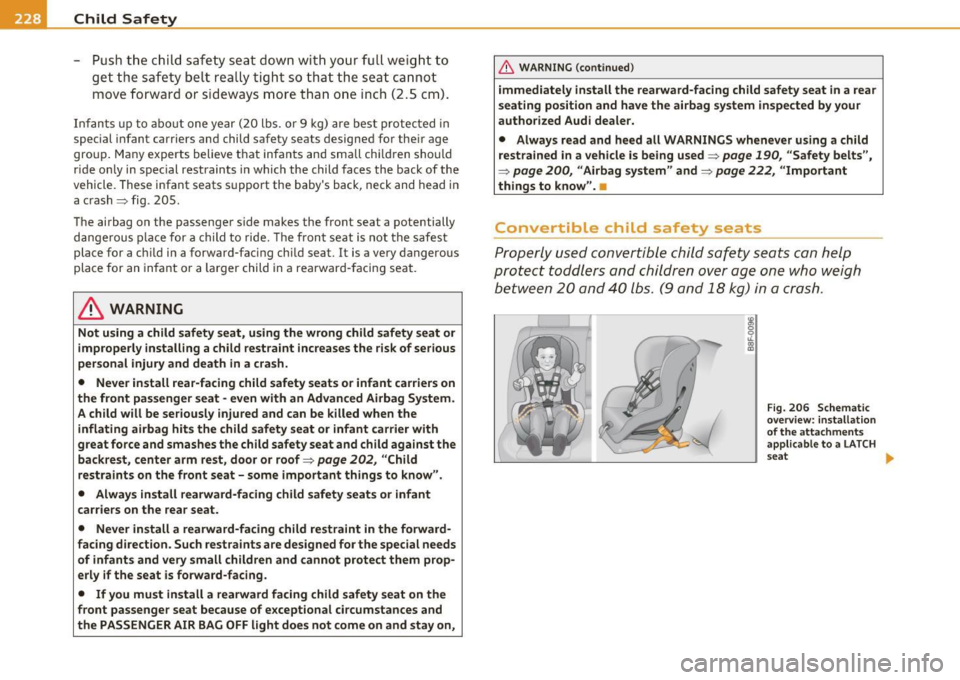
Fig. 206 Schematic
overview: installation
of the attachments
applicable to a LATC H
seat ...