transmission AUDI A5 CABRIOLET 2010 Owner's Manual
[x] Cancel search | Manufacturer: AUDI, Model Year: 2010, Model line: A5 CABRIOLET, Model: AUDI A5 CABRIOLET 2010Pages: 364, PDF Size: 86.51 MB
Page 163 of 364

______________________________________________________ T_ r_a _n_ s_m _ i_ s _s_ i_ o_ n _ __.1111
App lies to vehicles : w ith mu lt itron ic® Continuous ly Variab le Transm ission (CVT)
Automatic transmission malfunction )
In the event of a system malfu nction, the automatic transmission
swi tches to emergency opera tion mode.
Gearbox malfunction: you can continue driving
You can continue to drive the vehicle . See an authorized Aud i dea ler
or other qualified workshop at the next opportunity .
Gearbox malfunction: you can continue driving (limited
functionality)
There is a serious system malfunct ion :
• Th e program sh ifts only into certain gea rs.
• The engin e may s tall.
• It is not poss ible to restart the engine if it has been sw itched off.
• Continuing to drive could result in subsequent damage .
0 Note
If the transmission switches to fail-safe mode , you should take the
vehicle to an authorized Aud i dealership as soon as poss ible to have
the condition corrected .•
Con tro ls a nd e quip
m en t Vehicle
OP-eration
Applies to vehicles : w ith mu ltitron ic® Cont inuous ly Va riab le Transm ission (CVT)
Emergency release for selector lever
If the vehicle's power supply fails, the selector lever can
be released in an emergency .
Fig. 1 65 Removing
ashtray inse rt
Fig. 166 Emergency
release for selector
l ever
- To access the emergency release mechanism, remove the
ashtray insert ® using the release switch@=> fig . 165.
- Loosen and remove the cap in the ashtray mount .
- You now have access to a pin . Using a screwdrive r or
similar object , press the pin down and hold it in that posi-
tion => fig . 166. ._
Vehicle care Do-it-yourselt service iTechnical data
Page 282 of 364
-Checking and filling
-------=------=---------------------------------------------------
Closing the engine hood
-Pull the hood down until the pressure from the struts is
reduced.
- Let the hood
drop down and latch in place . Do not try to
push it shut;
it may fail to engage=> &.
& WARNING
A hood that is not completely latched could fly up and block your
view while driving.
• When you close the engine hood, check it to make sure the
safety catch has properly engaged. The hood should be flush with
the surrounding vehicle body parts.
• If you notice while driving that the hood is not secured prop
erly, stop at once and close it. •
Working in the engine compartment
Be especially careful whenever you work in the engine
compartment.
Whenever you must perform any work in the engine compartment,
for example checking and filling different fluids, there is a risk of
injury, burns and accidents. To prevent personal injury always
observe the following WARNINGS. The engine compartment of any
vehicle is a hazardous area
=> & .
& WARNING
To help avoid injury, before you check anything under the hood :
• Turn off the engine.
• Remove the ignition key.
• Apply the parking brake.
& WARNING (continued)
• Move selector lever of automatic transmission to "P" (Park).
• Always let the engine cool down. Hot components will burn
skin on contact.
• To reduce the risk of being burned, never open the hood if you
see or hear steam or coolant escaping from the engine compart
ment. Wait until no steam or coolant can be seen or heard before
carefully opening the hood.
• Keep children away from the engine compartment.
• Never spill fluids on hot engine components. They can cause a
fire.
• Never touch the radiator fan. The auxiliary electric fan is
temperature controlled and can switch on suddenly.
• Never open the coolant reservoir cap when the engine is still
warm. The coolant system is pressurized and hot coolant could
spray out.
• Protect your face, hands and arm from steam or hot engine
coolant by placing a thick rag over the cap when you open the
coolant reservoir.
• If work on the fuel system or the electrical system is necessary:
-Always disconnect the battery.
- Never smoke or work near heaters or open flames. Fluids in
the engine compartment could start a fire.
- Keep an approved fire extinguisher immediately available.
• To avoid electrical shock and personal injury while the engine is
running or being started, never touch: -Ignition cables
- Other components of the high voltage electronic ignition system.
• If you must perform a check or repair with the engine running: -First, fully apply the parking brake, move selector lever of
automatic transmission to "P" (Park). ..,
Page 299 of 364

________________________________________________ T_i_re _ s_ a _ n_d_ w_ h_ e_ e_l_s __ l!'II
& WARNING (co ntinued )
• Tires age even if they are not be ing used and can fail suddenly ,
e specially at high speeds . Tires that are more than 6 year s old can
only be used in an emergency and then with special care and at low
s peed .
Glossary of tire and loading terminology
Accessory weight
means the combined weigh t (in excess of those sta ndard items wh ich
may be replaced) of automatic transmission, power steer ing, power
bra kes, powe r win dows, power sea ts, radio, and heate r, to the exte nt
that these items are available as factory-insta lled equipment
(whet her i ns ta lled or no t).
Aspect ratio
means the r atio of t he he ight to t he widt h of the t ire in percent.
N umbers of 55 or lower indicate a low sidewa ll for improved steer ing
res ponse and bet ter over all h andling on dry p avemen t.
Bead
means the part of the t ire that is made of stee l wi res, w rapped or
re in forced by ply cords and that is shaped to fit the rim.
Bead separation
means a brea kdown of the bond between components in the bead.
Cord
means the st rands forming the plies in the ti re.
Safety first
& W ARNING (co ntinued )
• Never mount u sed tires on your vehicle if you are not sure of
their "previous history ." Old u sed tires may have been damaged
eventhoughthedamagecannotbeseenthatcanleadtosudden
tire failure and loss of vehicle control.
• If you notice unusual vibr ation or if the vehicle pulls to one side
when driving, always stop as soon as it is safe to do so and check
the wheels and tires for damage. •
Cold tire inflation pressure
means the t ire pressu re recom mended by the vehicle manufa ctu rer
for a tire of a desig nate d size that has not been driven for more than
a couple of m iles ( kilomete rs) a t low speeds in the t hree hour per io d
before the tire pressu re is measured or adjusted.
Curb weight
means the weight of a moto r vehicle wit h standard equipment
incl uding the max imum ca pac it y of fue l, o il, and coo lan t, air condi
tioning and additiona l weig ht of optional eq uipment.
Extra load tire
means a tire design to operate at higher loads and at higher inflat ion
pressures than t he co rresponding sta ndard t ire. Extra load tires may
be identif ied as "XL", "xl", "EXTRA LOAD", or "RF" on the sidewa ll.
Gross Axle Weight Rating ( "GAWR ")
means the loa d-carrying capac ity of a sing le ax le system, measure d at
the t ire-grou nd interfaces.
Gross Vehicle Weight Rating ("GVWR")
mea ns the maximum tota l loaded we ig ht of the vehicle .
Vehicle care Technical data
Page 323 of 364
What do I do now? Ill ____________ ______;_ __ _
& WARNING (continued)
the ground, placing the Automatic Transmission in "P" (Park) will
not prevent the vehicle from moving.
• Before you change a wheel, be sure the ground is level and
firm. If necessary, use a sturdy board under the jack.
• After installing the inflatable spare tire, make sure that you
replace the flat tire/wheel in its storage area properly and tighten
the knurled retaining screw securely.
0 Note
If you are changing the wheel on a steep incline, use a rock or simi lar
object to block the opposite wheel to prevent the vehicle from
moving.
[I] Tips
Obey all laws. •
Changing a wheel
When you change a wheel, follow the sequence described
below step-by-step and in exactly that order.
1. Remove the decorative wheel cover*. For more details see
also =>
page 322, "Decorative wheel covers" .
2. Loosen the
wheel bolts=> page 323.
3. Locate the proper mounting point for the jack and align
the jack below that point=>
page 323.
4. Lift the car with the jack=> page 323.
5. Remove the wheel with the flat tire and then install the
spare tire=> page 325.
Safety first
6. Tighten all wheel bolts lightly.
7. Lower the vehicle with the jack .
8. Use the wheel bolt wrench and firmly tighten all wheel
bolts in a crisscross pattern=>
page 323.
9. Replace the decorative wheel cover*.
& WARNING
Always read and follow all WARNINGS and information~ & in
" Raising the vehicle" on
page 323 and ~ page 326. •
After changing a wheel
A wheel change is not complete without the doing the
following.
- Store and secure the wheel you replaced in the spare
wheel well.
- Replace the tools and the jack in their proper location.
- Check the
tire pressure of the spare tire as soon as
possible.
- As soon as possible, have the
tightening torques on all
wheel bolts checked with a torque wrench. The correct
tightening torque is 90 ft lb (120 Nm).
- Have the flat tire
replaced as soon as possible.
[ i] Tips
• If you notice that the wheel bolts are corroded and difficu lt to turn
while changing a tire, they should be replaced before you check the
tightening torque. .,_
Vehicle care Do-it-yourself service Technical data
Page 338 of 364
lffll.,___E_ m_ e_r-=g :.. e_ n_c -=y '-- s_i_t _u _a _ t_ i_ o _ n_ s ____________________________________________ _
battery that is being charged does not vent to the outside, escaping
battery gas could ignite and explode! •
Emergency towing with
commercial tow truck
General hints
Your Audi requires special handling for towing.
The following information is to be used by commercial tow truck
operators who know how to operate their equipment safely.
• Never tow your Audi, towing will cause damage to the engine
and transmission.
• Never wrap the safety chains or winch cables around the brake
lines.
• To prevent unnecessary damage, your Audi must be transported
with a flat bed truck.
• To load the vehicle on to the flat bed, use the towing loop found
in the vehicle tools and attach to the front or rear anchorage
~ page 336 and ~ page 33 7.
& WARNING
A vehicle being towed is not safe for passengers. Never allow
anyone to ride in a vehicle being towed, for any reason. •
Front towing loop
Do not install the front towing loop until it is needed.
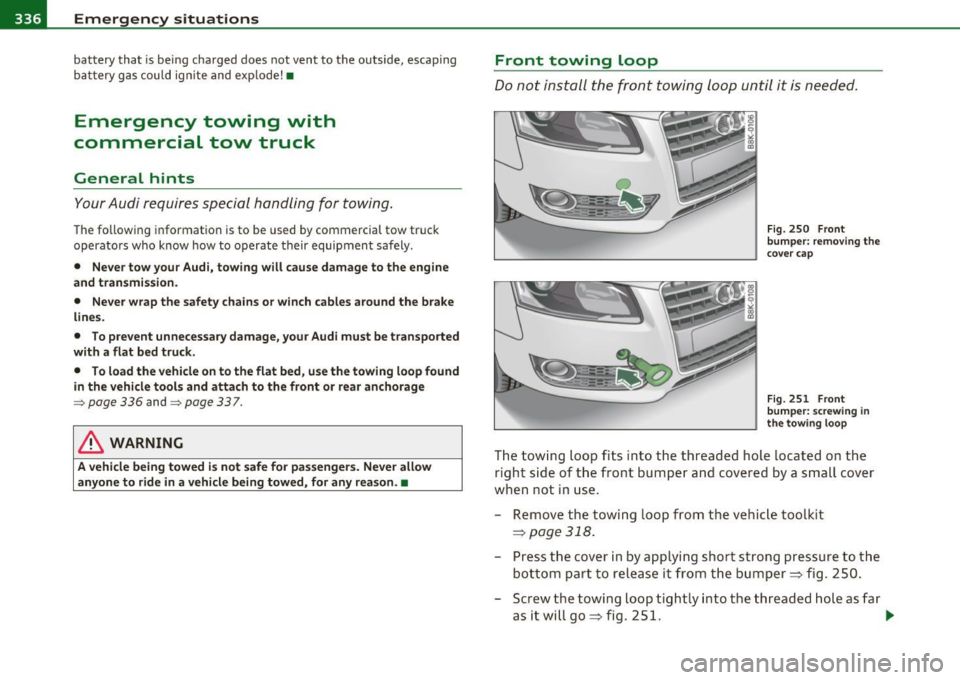
Fig. 250 Front
bumper: removing the
cover cap
Fig. 251 Front
bumper: screwing in
the towing loop
The towing loop fits into the threaded hole located on the
right side of the front bumper and covered by a small cover
when not in use.
- Remove the towing loop from the vehicle toolkit
~page 318.
- Press the cover in by applying short strong pressure to the
bottom part to release it from the bumper~ fig. 250.
- Screw the towing loop tightly into the threaded hole as far
asitwillgo~fig. 251. ..,
Page 341 of 364

_____________________________________________ E_ m_ e_r-= g ::.. e_ n_c-= y'- s_ i_t _u _a_ t_ i_ o _ n_ s __ _
& WARNING
• To reduce the risk of serious injury and vehicle damage.
-Always lift the vehicle only at the special workshop hoist and
floor jack lift points illustrated=>
page 338, fig. 254 and
=> page 338, fig. 255.
- Failure to lift the vehicle at these points could cause the
vehicle to tilt or fall from a lift if there is a change in vehicle
weight distribution and balance. This might happen, for
example, when heavy components such as the engine block or
transmission are removed .
• When removing heavy components like these, anchor vehicle
to hoist or add corresponding weights to maintain the center of
gravity. Otherwise , the vehicle might tilt or slip off the hoist ,
causing serious personal injury.
0 Note
• B e aw are of the following poi nts b efo re li fting the ve hicl e:
- The vehicle should never be lifted or jacked up from under
neath the engine oil pan, the transmission housing , the front or
rear axle or the body side members . This could lead to serious
damage.
- To avoid damage to the underbody or chassis frame, a rubber
pad must be inserted between the floor jack and the lift points.
- Before driving over a workshop hoist, check that the vehicle
weight does not exceed the permissible lifting capacity of the hoist.
- Before driving over a workshop hoist, ensure that there is
sufficient clearance between the hoist and low parts of the
vehicle. •
Safety first Vehicle care Do-it-yourself service Technical data
Page 342 of 364

___ G_ e_n_ e_r _a _ l_ in_ f_o _r_ m_ a_ t_io _ n _______________________________________________ _
General information
Explanation of technical data
Some of the technical data listed in this manual requires
further explanation.
The technical data for your vehicle is listed in the charts starting on
~ page 342 . This sect ion prov ides genera l information, notes and
restrictions which app ly to this data .•
Veh icle identification
The key data is given on the vehicle identification number
(VIN) plate and the vehicle data sticker.
F ig. 256 V ehicle I den
t ifi ca tion Nu mbe r
(V IN ) pl ate: locat io n
o n d river's s id e d ash
p an el Fi
g. 257 The vehi cle
i d enti ficati on l abel -
in side the l ugga ge
co mpa rtme nt
The Vehicle Id ent ifi cat ion Number (VlN )
is located on the driver's s ide so that it is visible from the outside
throug h the windsh ield ~ fig . 256 . You can also d isp lay the Vehicle
Identification Number of your vehicle in the radio or in the MMI*.
Select function button [ CAR
l Veh icle ID numb er (VIN) .
The vehicle identifica tion label
is located in the luggage compartment near the battery .
The label~ fig . 257 shows the following vehicle data:
© Production control No.
@ Vehicle identification No.
® Type code n umber
@ Type designat io n/eng ine output in Kilow atts
© Engine and transmission code letter
© Paint No./Interior
(j) Optional equipment No.'s
Vehicle data 2 to 7 are also found in your Warranty
& Maintenance
booklet . .,,
Page 351 of 364
___________________________________________ A_ l::.. p _h _a_ b_ e_t _ic _a_ l_ in_ d _ e_x __ _
Auto Lock .. .. ... ..... ... ... ... .. .. .. 41
Auto Safety Hotline ... ... ... . .. ..... 185
Auto-Check Control .. ..... ... .... ... .. 26
Automatic belt retractor .......... ... 195
Automatic car wash See Washing ......... .... .. .... . 261
Automatic climate control . . . . . . . . . 88, 9S
Automatic driving light control ......... 62
Automatic power top ..... .. .. .. .... .. SO
Automatic Shift Lock (ASL) ... .. .. 150, 158
Automatic transmission 6-speed automatic transmission ... . 148
Automatic Shift Lock (ASL) .... 150, 158
Driving ...... ...... .. .. .. .. .. .. . 148
Dynamic shift program ... .... .. ... 151
Emergency release ............. .. . 154
Emergency release for selector lever
(mu ltitron ic®) ............... .. . 161
Fail-safe mode .............. 153, 161
Kick-down ...................... 151
Manual shift program ............. 152
multitronic ® ..................... 155
Selector lever ........... .. .. 149, 157
Shift buttons ....... .. .. .... 153, 160
Steering wheel with tiptronic ® . 153, 160
Automatic wipe/wash system .......... 69
Average speed .. ....... .... .. .. .. .. .. 22
Avoid damaging the vehicle .. .. .. .. .. . 251
Controls and equip
ment Safety first
B
Battery
... .. ... ... ................. 291
Charging . .. .. .. .... .. .. ... ... .. . 293
Important warnings when work ing on the
battery ..... ........... ...... .. 292
Jump starting . ........... ........ 333
Low ... .. .. .. .... .... .. ......... 247
Replacing the battery .. .. .. .... ... 294
State of charge ..... .. ... ...... .. 247
Winter operation ..... ..... ....... 291
Working on the battery .... .... .... 292
Battery voltage .. ........... ...... .. . 34
Before driving .. ... .... .. .. .. .. ..... 177
Belt positioner .. .. .... .. ... ... ..... 194
Blended gasoline ................ ... 27 4
Body cavity sealing . ................. 267
Booster seats ... .. ...... .. ......... 230
Brake assist ..................... ... 245
Brake booster . ........ ... .......... 244
Brake fluid
Changing the brake fluid ........... 290
Checking the brake fluid level ..... .. 290
Reservoir .. .. .. .... .... ......... 290
What is the correct brake fluid level? . 290
What should I do if the brake fluid warning light comes on? . ... ... .......... 290
Brake system .. .. .. ..... .... ........ 290
Anti-lock brake system . .. .......... 16
Brake fluid ... .... ............... 290
Brake fluid specifications for refill and
replacement ................... 290
Brake light defective ....... .... ... . 34 Brake pads
.. .. .... ..... .... .... . 251
Electromechanical parking brake .... 110
General information .............. 243
How does moisture or road salt affect the
brakes? ... .... .............. .. 243
Malfunction .............. .... .. .. 28
Warning/indicator lights ....... .. .. 17
Worn brake pads symbol ........... 33
Braking guard
See Audi braking guard ............ 129
Break-in period ... .. .. .............. 250
Brake pads .. ...... ........... .. . 251
Tir es ... .. .. ................. .. . 250
Bulbs ................ .. .... .... .. . 331
C
California Proposition 65 Warning .. ... 281
Battery specific .................. 293
Capacities ......................... 342
Car care .. .... .............. ...... . 260
Interior ............ .. .. .. .. .. .. . 268
Plastic and vinyl .... ............. . 264
Weatherstrips ............ .. .. .. . 266
Care of exterior ... .... .. . .. .. .. .. .. . 260
Cargo area
See Loading the luggage compartment ..
183
Catalytic converter .. ..... ........... 251
Certification ......... .............. 346
Changing a flat tire .. ................ 320
Changing a wheel ...... ...... .... .. . 320
Changing engine oil ... .. .. ......... . 285
Vehicle operation Vehicle care Do-it-yourself service Technical data
Page 352 of 364

___ A_ l_. p_ h _ a_b_ e_ t_ic _a_ l_ in_ d_e _ x ____________________________________________ _
Chassis
Undercoating . ...... ...... ... . .. . 267
Checking Engine coolant level .............. 287
Checking tire pressure ............... 302
Child restraint system anchors . ... .... 235
Child restra ints
Danger of using child restraints in the front
seat ........ ..... .. .... ... .. .. 202
Where can I get add itional information
about chi ld restraints and their use? ...
239
Child safety ................ .. .... .. 222
Convertible locking retractor ..... .. 232
Important safety instructions for using
child safety seats ............ ... 225
Important things to know when driving w ith children ................. .. 222
Insta lling a child restraint using the LATCH
system ....................... 238
Mounting and releasing the anchorage hook ............ ...... ... .. .. 238
Child safety seats ... ........ .... .. .. 227
Booster seats ............. ... ... 230
Convertible child seats ............ 228
Convert ible locking retractor ....... 232
Danger of using child restraints in the front
seat ........ ...... ...... .. .. .. 202
How do I properly install a child safety seat in my vehicle? .................. 225
Infant seats .................. ... 227
Installing .. .. .. ........ ......... 232
LATCH system ................. .. 238
Safety instructions ............. .. 225 Child seats
Lower anchorages ............... . 237
Cigarette lighter ............. .. .... .. 85
Cleaning Alcantara (synthet ic suede) . .. .. .. . 271
Engine compartment ........ .. .. . 272
Exhaust tail pipes ......... .. .. .. . 267
Fabrics and fabric coverings ........ 268
Instrument panel ................ 269
Interior ........ ... .. .... ....... 268
Leather ............ ... .. .. .... . 270
MMI control console ............. . 268
MMI display . .. .. ............... . 268
Plastic and vinyl ................ . 264
Plastic parts .. ... ... ... .. .. .. .. . 269
Safety belts ........... ... ... .... 2 72
Trim strips .......... ... ... ...... 264
trim str ips .. .. ........... .. .. .. . 265
Cleaning and protection ...... .. ..... 260
Clock .............................. 10
Cold tire inflation pressure ........ .. . 300
Compact spare tire ........... .. .... . 319
See also Spare tire ........ .. .. .. . 319
Compass mirror ......... .. .. .. ...... 75
Compliance ............. ........ ... 346
Consumer Information .......... 185, 343
Contacting NHTSA ... ........ .. .... . 185
Continuously Variable Transmission (CV T)
See multitronic ® ................. 155
Conven ience key ........ ...... ..... .. 43
Locking and unlocking vehicle ....... 43
S TART ENGINE ST OP button ... 108, 109
Starting engine ...... ... .. .. .... . 108 Switching engine off .
..... .. .. .. .. 109
Switching on ignition ........ ... .. 108
Convenience opening/closing .......... 48
Convert ible chi ld safety seats ......... 228
Convertible locking retractor Activating ...... .......... .. . ... 234
Deactivating . .. ... ............. . 235
Using to secure a child safety seat . . 232,
234
Cooling System Expansion tank ...... .... .. .. .. .. 287
Cooling system .. ............. .... .. 286
Cornering light ...... .. .... .......... 66
Cru ise control
Changing speed .. .. ............. 114
Preselect speed . . . . . . . . . . . . . . . . . . 114
Switching off . . . . . . . . . . . . . . . . . . . . 114
Switching on ... .. .. ............. 113
Wa rning/indicator lights ... ........ 15
Cruising range .. .. .. ..... ........... 22
Cup holders ................ ... ... .. 84
D
Data 342
Data recorde r ... ............... .... 240
Date display . . . . . . . . . . . . . . . . . . . . . . . . 10
Daytime running lights ............... 64
Declaration of compliance Adaptive Cruise Control ........... 346
Audi side ass ist ...... .. .... .... .. 346
Cell phone package .. ........... .. 346
Conven ience key .. .. .... ......... 346
Page 360 of 364

___ A_ l_. p_ h _ a_b_ e_ t_ic _a_ l_ in_ d_e _ x ____________________________________________ _
Storage .. .. .. .. .. .. .. .. ....... ..... 86 Tires ...... ........ ... ... .. .. .. .. . 296 TPMS
Front seats ...................... 87 Service life .................. ... . 306 Tire pressure monitoring system .... 315
Glove compartment ............... 87 speed rating letter code ........... 309
Trailer towing ... .... .. ............. 255
Sun visors .. .................... .... 69 Tire manufacturing date
........... 309
Operating instructions ........... . 255
Switches Tir
e spec ifications ................ 308
Technica l requirements ....... 255, 256
Eme rgency flashers ............... 66 Tread
depth ... ........... ...... . 306
Trailer towing tips .... .. ......... 257
Symbols Red . ................. ... ........ 27 Uniform t
ire quality grading ....... 311
Winter tires ..................... 311 Transmission
automatic transmission® .......... 148
Yellow ......... ............ .. .. . 31 Tires
and vehicle load limits .......... 304
multitronic® ... ................ . 155
Tires and wheels
Transport Canada ................... 186
T Checking tire pressure ............ 302
Tread Wear Indicator (TWI) .......... 306
Tachometer .................... ..... 9
Technica l modifications ............ .. 346
The first 1,000 miles (1,SOO km) and
afterwards .................. .. 2SO
Tie-downs .................. ... . 83, 185
tiptron ic® ...................... ... 148
Automatic Sh ift Lock (ASL) ......... 150
Driving ......................... 148
Dynamic shift program . .. ......... 151
Fail -safe mode ... .. ............. 153
Kick-down ..... .... ............. 151 Cold tire
inflation pressure ......... 300
Dimensions ... .................. 307
General notes ............ .. ..... 296
Glossary of tire and loading terminology .
297
N ew tires and wheels ............. 307
Replacing ................ .. ..... 308
Snow chains .................... 312
Tires and vehicle load limits . .. .... . 304
Wheel bolts ................... .. 313
Winter tires ..................... 311
Tires/Whe els Trip
computer
Fuel consumption . .. .............. 22
Mileage ............ ...... .. .. .. . 22
Single -trip memory ........ ... ... .. 23
Total-trip memory .. .............. 23
Tr ip odometer .. .. .... .............. 11
Trunk
See Rear lid .. .. .................. 46
Trunk escape handle ... ............. 318
T urn s ignals ................... .... . 67
Warning/indicator lights . .......... 15
Manual shift program . ............ 152 Low aspect ratio tires . .... . .. .. ... 314
Selector lever ...... ..... .... . ... 149 Tire pressure monitoring system . 14, 314
u
Tire pressure .... .......... ......... 302 Tool kit .................... .. .. .. . 318
T ire pressure monitoring system ....... 314 Torn or frayed safety belts ............ 193
Loss of air pressure ............ 14, 315 Touch-up paint ... .................. 265 Undercoating .
.. .. .. .. ............. 267
Unfastening safety belts ........... .. 197
Unidirect ional tires .. .. .. .. .. ....... 296
Malfunction ..................... 315 Towing
Resetting tire pressures ...... .. ... 316 Front eyelet ..................... 336
T ire service life .. .. ............... .. 306 Rear eyelet .................... . 337
T ow truck procedures .... .. .. .. ... 336 Uniform t
ire quality grading ... .... ... 311
Unlocking Power locking switch .............. 45
Rear lid/trunk lid . .. .... .......... 46