tires AUDI A5 CABRIOLET 2010 Owner's Guide
[x] Cancel search | Manufacturer: AUDI, Model Year: 2010, Model line: A5 CABRIOLET, Model: AUDI A5 CABRIOLET 2010Pages: 364, PDF Size: 86.51 MB
Page 316 of 364
___ T_ ir_e_ s _ a_ n _ d_ w_ h_e_ e_ ls _______________________________________________ _
After changing a wheel, the torque must be checked as soon as
possible with a torque wrench -preferably by an authorized Audi
dealer or qualified workshop. •
Low aspect ratio tires
Your Audi is factory-equipped with low aspect ratio tires. These tires
have been thoroughly tested and been selected specifically for your
model for their superb performance, road feel and handling under a
variety of driving conditions. Ask your authorized Audi dealer for
more details.
The low aspect ratio of these tires is indicated by a numeral of
55 or
less
in the tire's size designation. The numeral represents the ratio of
the tire's sidewall height in relation to its tread width expressed in
percentage. Conventional tires have a height/width ratio of 60 or
more.
The performance of low-aspect-ratio tires is particularly sensitive to
improper inflation pressure. It is therefore important that low
aspect ratio tires are inflated to the specified pressure and that the
inflation pressure is regularly checked and maintained. Tire pres
sures should be checked at least once a month and always before a
long trip=>
page 302, "Checking tire pressure" .
What you can do to avoid tire and rim damage
Low aspect ratio tires can be damaged more easily by impact with
potholes, curbs, gullies or ridges on the road, particularly if the tire is
underinflated.
In order to minimize the occurrence of impact damage to the tires of
your vehicle, we recommend that you observe the following precau
tions:
• Always maintain recommended inflation pressures. Check your
tire pressure every 2,000 miles (3,000 km) and add air if necessary.
• Drive carefully on roads with potholes, deep gullies or ridges. The
impact from driving through or over such obstacles can damage your
tires. Impact with a curb may also cause damage to your tires. •
After any impact, immediately inspect your tires or have them
inspected by the nearest authorized Audi dealer. Replace a damaged
tire as soon as possible.
• Inspect your tires every 2,000 miles (3,000 km) for damage and
wear . Damage is not always easy to see. Damage can lead to loss of
air and underinflation, which could eventually cause tire failure. If
you believe that a tire may have been damaged, replace the tire as
soon as possible.
• These tires may wear more quickly than others.
• Please also remember that, while these tires deliver responsive
handling, they may ride less comfortably and make more noise than
other choices.
Reduced performance in winter/cold season
conditions
All tires are designed for certain purposes. The low aspect ratio, ultra
high performance tires originally installed on your vehicle are
intended for maximum dry and wet road performance and handling.
They are not suitable for cold, snowy or icy weather conditions. If you
drive under those circumstances, you should equip your vehicle with
all-season or winter tires, which offer better traction under those
conditions. We suggest you use the recommended snow or all-season
tires specified for your vehicle, or their equivalent.
Refer to=>
page 311 for more detailed information regarding winter
tires. •
Tire pressure monitoring system
Applies to veh icles: w ith tire pressure monitoring system
General notes '
Each tire, including the spare (if provided), should be checked
monthly when cold and inflated to the inflation pressure recom
mended by the vehicle manufacturer on the vehicle placard or tire
inflation pressure label. (If your vehicle has tires of a different size .,
Page 317 of 364

Tires and wheels Ill _______________ _____.
than the size indicated on the vehicle placard or tire inflation pressure
label , you sho uld determine the proper tire infla tion pressure fo r
those tires.)
As an added safety feature, your vehicle has been equipped with a tire pressu re monitoring sys tem (TPMS) that illuminates a low tire pres
sure telltale when one o r more of your t ires is s ignificantly under
inflated. Accord ingly, when the low tire pressure tellta le illumi nates,
you should stop and check your tires as soon as possib le, and inflate
them to the proper p ress ure. D riving on a sign ificantly under-inflated
tire causes the tire to overheat and can lead to tire fa ilure . Under
inflation also reduces f uel efficiency and tire tread life, and may
affect the vehicle's handling and stopping ability .
Please note that the TPMS is not a substitute for proper tire mainte
nance, and it is the d river's responsibility to mainta in correct tire
pressure, even if under-inflation has not reached the level to trigger
ill umination of the TPMS low tire press ure te lltale.
Your vehicle has also been equipped w ith a TPMS malfunction indi
cato r to indica te when the system is not operating properly . The
TP MS ma lf u nction indicator is combined with the low tire p ress ure
telltale. When the system detects a malfunct ion, the telltale will
fl ash for approximate ly one minute and then rema in continuously
illuminated. This sequence will continue upon subsequent vehicle
sta rt-ups as long as the malfunction exists.
When the ma lfunction indicator is illum inated, the system may not
be able to de tect or signa l low ti re pressure as intended . TPMS
ma lfunctions may occur fo r a var iety of reaso ns, includ ing the instal
lation of replacement o r alternate tires or wheels on the vehi cle that
prevent the T PMS from functioning properly . Always check the TPMS
ma lfunction tellta le after replacing one or more tires or whee ls on
yo ur vehicle to ensure that the replacement o r alte rnate t ires and
wheels allow the TPMS to continue to funct ion proper ly .•
Vehicle OP-eration
App lies to vehicles : wi th t ire p ressu re mon it ori ng system
Tire pressure indicator appears
The tire pressure indicator in the instrument cluster
informs you if the tire pressure is too low or if there is a
system malfunction.
M
"'
j
Fi g. 23 2 Dis pl ay:
un der infl ation
wa rning
Fi g. 23 3 Dis play :
Sys tem malfun ction
Us ing the ABS sensors, the tire pressure monitor ing system compares
the t ire tread c ircumference and vibration characteristics of the ind i
vidual tires .
If the pressure decreases in one or more tires, this is indi -
cated in the instrument cl uster with a warning symbol and a
message ~ fig. 232 . The d river message in the display goes o ut after
5 seconds . The driver message can be displayed again by p ressing the
!SET ] button. If only one tire is affected, the display will indicate its
posit ion. ._
Vehicle care Do-it-yourselt service iTechnical data
Page 318 of 364
IIIIL-_T.:..:..: ir:....:e~ s=---= a~ n:..:..: d:......: w..:....:.. h:....:e~ e= ls=--------------------------------------------------
The tire pressure monitor ing must be reset via rad io or MMI* each
t ime t he press ures are adjusted (e.g. w hen sw itching be tween p artial
and full load pressure) o r after changing or replac ing a tire on yo ur
vehicle => page
316. You ca n find t he recommen ded tire pressures
for your veh icle on the labe l on driver's s ide B-pilla r => page
300.
Tire tread circ umference and vibrat ion characteristics can change and
c a u se a tir e pressure war ning if:
• the t ire pressure in one or more tires is too low,
• t he tire ha s structur al dam age,
• the tire press ure was changed, wheels rotated or rep laced but the
TPM S was no t reset=> page
316.
Warning symbols
1..1' Loss of press ure in at least one tire=> &. Check the tire or tires
and replace or repair if necessary. The indicator light (• in the instru
me nt cluste r a lso illuminates=> page
12. Check/correct the p res
sures o f all four tires and reset TPMS via rad io or MMI *.
rr :; (T ire Pressu re M on itor ing System) Tire pres sure! System
malfunction.
If T ,.;> appears after switching the ignition on or w hile
dr iv ing => page
315, fig. 23 3 and the indica to r lig ht 'in th e instr u
me nt clus ter b links for approx ima tely one m inute and the n stays on,
there is a system ma lf u nct io n. See your authorized Audi dealer as
soon as poss ible.
& WARNING
• If the tir e pres sure indicator appears in the instrument cluster
display, one or more of your tires i s significantly under-inflated.
Reduce your speed immediately and avoid any hard steering or
braking maneuvers. Stop as soon a s possible and check the tires
and their pressures . Inflate the tire pressure to the proper pres
sure as indicated on the vehicle 's tire pressure label=>
page 300.
Driving on a significantly under -inflated tire causes the tire to
overheat and can lead to tire failure. Under -inflation also is likely
to impair the vehicle's handling and stopping ability.
& WARNING (co ntinued )
• The driver is re sponsible for maintaining the correct tire pres
sures . You must check the tire pres sures regularly .
• Under certain conditions (such as a sporty driving style , winter
conditions or unpaved roads) , the pressure monitor indicator may
be delayed.
• Ask your authorized Audi dealer if run-flat tires may be used on
your vehicle . Your vehicle registration becomes invalid if you u se
the se tires when not permitted. Damage to your vehicle or acci
dents could also result.
[ i ] Tips
• T he tire pressure monito ring system stops working when there is
an ES P/ABS malf u nctio n.
• Using snow cha ins may res ult in a system ma lf u n ct ion .
• The tire pressure mon itor ing system on your Au di was calibrated
using t ires with the "AO" or "RO " id ent ificat ion . We re comme nd
using these tires. •
Applies to vehicles: with tire p ressure monito ring sys tem
Reset tire pressure monitoring system
I f the tire pressure is adjus ted, wheels are rotated or
changed, th e TPfvf S must b e re set via radio or fv1fv1 I*.
- Turn on the ign it ion .
- Sele ct: Fu nct ion bu tton
[C AR]> Tire pressure monitoring
> Store now.
[ i ] Tips
Before resett ing the TPMS, the current pressures of all four t ires
mus t co rrespo nd to the specifie d val ues. A djust the tire pre ssure and
~
Page 322 of 364

lffl!I.___W __ h_a_ t_ d_ o_ I_ d_ o_ n_ o_w_ ? _____________________________________________ _
& WARNING (continued)
• The spare tire is intended only for temporary and short-term
use. It should be replaced as soon as possible with the normal
wheel and tire.
• After mounting the compact spare tire, the tire pressure must
be checked as soon as possible. The tire pressure of the compact
spare tire must be 4.2 bar; otherwise, you risk having an accident.
• Do not drive faster than SO mph (80 km/h). You risk having an
accident.
• Avoid full-throttle acceleration, heavy braking, and fast
cornering. You risk having an accident.
• Never drive using more than one spare wheel and tire. You risk
having an accident.
• Normal summer or winter tires must not be mounted on the
compact spare wheel rim.
• For technical reasons, the use of tire chains on the spare tire is
not permitted.
If it is necessary to drive with tire chains, the spare
wheel must be mounted on the front axle in the event of a flat in a rear tire. The newly available front wheel must then be installed
in place of the rear wheel with the flat tire. Installing the tire
chain before mounting the wheel and tire is recommended.
• Loose items in the passenger compartment can cause serious
personal injury during hard braking or in an accident.
- Never store the inflatable spare tire or jack and tools in the passenger compartment.
- Always store all jacking equipment, tools, and the inflatable
spare tire in the luggage compartment.
- Tighten the knurled retaining screw for the inflatable spare
tire securely. •
Changing a wheel
Before changing a wheel
Observe the following precautions for your own and your
passenger's safety when changing a wheel.
-After you experience a tire failure, pull the car well away
from moving traffic and try to reach level ground before
you stop :::> & .
- All passengers should leave the car and move to a safe
location (for instance, behind the guardrail):::>& .
- Engage the parking brake to prevent your vehicle from
rolling unintentionally:::> &.
- Move selector lever to position P :::> & .
- If you are towing a trailer: unhitch the trailer from your
vehicle.
- Take the jack:::>
page 318 and the spare tire :::> page 319
out of the luggage compartment.
& WARNING
You or your passengers could be injured while changing a wheel if
you do not follow these safety precautions:
• If you have a flat tire, move a safe distance off the road. Turn
off the engine, turn the emergency flashers on and use other
warning devices to alert other motorists.
• Make sure that passengers wait in a safe place away from the
vehicle and well away from the road and traffic.
• To help prevent the vehicle from moving suddenly and possibly
slipping off the jack, always fully set the parking brake and block
the wheel diagonally opposite the wheel being changed with the
folding chocks or other objects. When one front wheel is lifted off
~
Page 327 of 364
What do I do now ? -_______________ __.PfWII
Taking the wheel off/installing the spare
tire
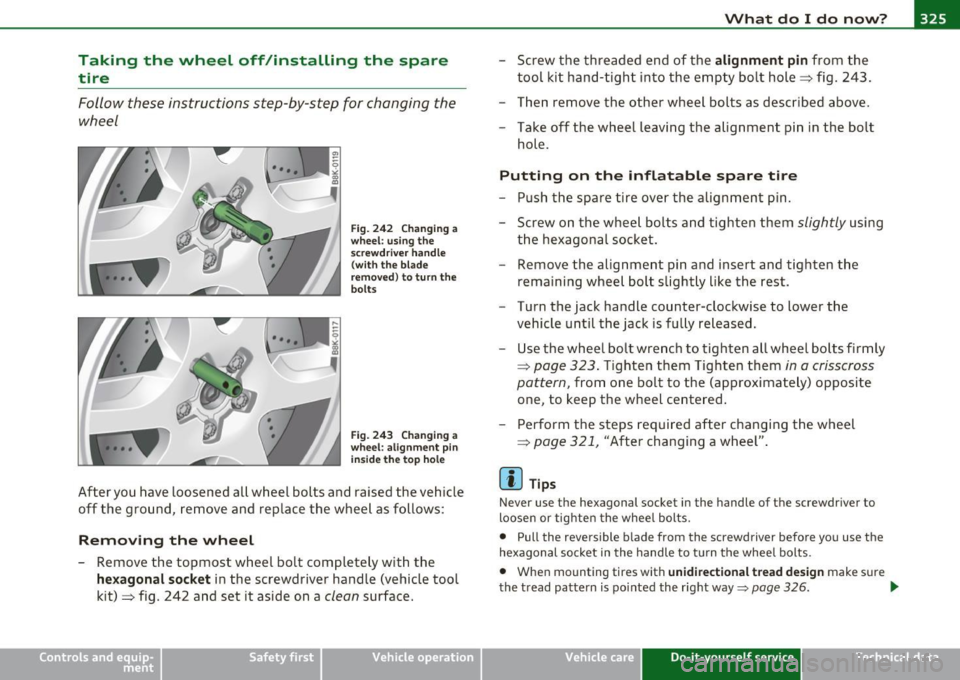
Follow these instructions step-by-step for changing the wheel
F ig. 242 Changing a
wheel: using the
sc rewdriver handle
(w ith the b lade
r emove d) to turn t he
bolts
Fig. 243 Changi ng a
wheel: alignment p in
i nside t he top hole
After you have loosened all wheel bolts and raised the vehicle
off the ground, remove and replace the wheel as follows :
Removing the wheel
- Remove the topmost wheel bolt completely with the
hex agon al sock et in the screwdriver handle (vehicle tool
kit) :=} fig. 242 and set it aside on a
clean surface.
Vehicle OP-eration
-Screw the threaded end of the alignment pin from the
tool kit hand-tight into the empty bolt hole:=} fig. 243.
- Then remove the other wheel bolts as described above .
- Take off the wheel leaving the alignment pin in the bolt
hole.
Putting on the inflatabl e spare tir e
-Push the spare tire over the alignment pin.
- Screw on the wheel bolts and tighten them
slightly using
the hexagonal socket.
- Remove the alignment pin and insert and tighten the
remaining wheel bolt slightly like the rest .
- Turn the jack handle counter-clockwise to lower the
vehicle until the jack is fully released.
- Use the wheel bolt wrench to tighten all wheel bolts firmly :=}
page 323 . Tighten them Tighten them in a crisscross
pattern,
from one bolt to the (approximately) opposite
one, to keep the wheel centered .
- Perform the steps required after changing the wheel :=}
page 321, "After changing a wheel" .
[ i ] Tips
Never use the hexagonal socket in the handle of the screwdriver to
loosen or tighten the wheel bolts.
• Pull the reversible b lade from the screwdrive r before you use the
hexagonal socket in the handle to turn the wheel bolts.
• When mounting tires with
unid irectio nal t rea d design make sure
the tread pattern is pointed the r ight way=>
page 326. _,.
Vehicle care Do-it-yourself service iTechnical data
Page 328 of 364
11ffl1.--....:..:W:...:..; h:..:.:: a:..:t :... d.::..: o:....::. I...;d:.;..:: o....:..: n..:o :...w:..:...:. ? ____________________________________________ _
• The whe el bolts s hou ld b e cl ean a nd easy to tur n. C heck for dirt
and co rros ion on t he matin g su rfac es of bot h th e whee l and th e hub.
Re mov e all d irt fro m these su rfac es before remounti ng the w heel. •
Tires with unidirectional tread design
Tir es with unidirectional tr ead d esign must b e mounted
with the ir tread patt ern pointed in th e right d ir ec tion .
Using a spare tire with a tread pattern intended for
use in a specific direction
W hen using a spare tire w ith a t read patter n inte nded for use i n a
spec ific di rec tion, please no te the fo llow in g :
• Th e directio n of ro ta ti on is mark ed by an
arrow on the side of the
tire .
• If th e spa re tir e has to be install ed in t he in cor rec t dire ction, use
the s pare t ire only tem porar ily since t he tire w ill not be a ble to
a chi eve it s opti mum perf o rma nce ch aract erist ic s wi th re gar d to
aquap lan ing, no ise and wea r.
• We re co mmen d t hat you pay part icular atten tion to t his fact
dur ing wet weather a nd that you adjust yo ur speed to match road
co ndi tions.
• Rep lace the f lat ti re with a new one and have it insta lled on your
v eh icle as so on as possible to r estor e t he hand ling advantag es o f a
unid irect ional tire .•
Notes on wheel changing
Please read the in formation => page 307, "N ew t ires and rep lacing
t ir es and w heels" if yo u are going to us e a spa re tire which is differ ent
from t he tires on yo ur vehicle .
A ft er y o u change a tir e:
• Check the tire pressure on the spare immediately after installa
tion . •
Have the wheel bolt tightening torque checked with a torque
wrench as soon as possible by your authorized Audi dealer or a qual
ified workshop.
• With steel and alloy wheel rims, the wheel bolts are correctly
tightened at a torque of 90 ft lb (120 Nm ).
• If you notice that the wheel bolts are corroded and difficult to
turn while changing a tire, they should be replaced befo re you check
the tightening torque.
• Replace the flat tire with a new one and have it installed on your
vehicle a s soon as possible. Remount the wheel cover.
Until then, dr ive with extra care and at reduced speeds .
& WARNING
• If you are going to equip your vehicle with tires or rims which
differ from those which were factory installed, then be sure to
read the information =>
page 307, "New tires and replacing tires
and wheels".
• Always make sure the damaged wheel or even a flat tire and
the jack and tool kit are properly secured in the luggage compart ment and are not loose in the passenger compartment.
• In an accident or sudden maneuver they could fly forward,
injuring anyone in the vehicle.
• Always store damaged wheel, jack and tools securely in the
luggage compartment. Otherwise, in an accident or sudden
maneuver they could fly forward, causing injury to passengers in
the vehicle. •
Page 350 of 364

___ A_ l_. p_ h _ a_b_ e_ t_ic _a_ l_ in_ d_e _ x ____________________________________________ _
A
A/C mode ...................... 93, 100
Accessories ..... .................. . 345
Active rollover protection system ... ... 187
Retracting rollover protection . ..... 188
Adaptive cruise control ............ .. 116
Chang ing speed .................. 119
Dr iver information ............... 122
Driver intervention prompt ........ 126
Driving in traffic ................. 117
Driving program .. .. ............. 127
Error messages . .. ...... .... ..... 125
Open road ...................... 117
Override ................ ...... .. 117
Request for driver to assume control 117
Save speed . . . . . . . . . . . . . . . . . . . . . . 119
Setting distance ................. 121
Setting time interval . ............. 121
Sett ings ... ..................... 127
Special driving situations ........ .. 127
Status messages ........ ......... 125
Switching on and off .............. 118
System limits ................ ... 127
T emporarily turning off ........... 120
warning/indicator lights ........... 123
Adaptive light ... ...... .............. 66
defect ive .. .. .. .. .. .............. 35
Adding Engine coolant .................. 288
Engine oil .. ...... ....... ..... ... 285
Windshield washer flu id ........ ... 295 Additional accessories
............... 345 Side airbags .. .. .. .. .. .. ......... 219
Additives We
ight-sensing mat .............. 223
Engine oil ........ .... .. .. .. .. ... 285 When must
the system be inspected? 211
Adjusting All wheel drive
.. .. .. .. .. ...... ... .. 246
Steering column .......... .. .. .. . 105 Winter tires
.. .. ................. 311
Adjusting front seats .......... ...... . 77 Alloy wheels
........... .. .... .... .. 266
Airbag Warning/indicator lights ... .. .. .. .. 14
Airbag system .................. 200, 220 Advanced Airbag System .......... 204
Advanced Airbag System components 207 Care .................... .. .... . 214
Child restraints .................. 224
Children ........................ 223
Components (front airbags) ... .. .. . 207
Danger of fitting a child safety seat on the
front passenger seat ............ 202
Disposal ........ .... ..... .. .... . 214
Front airbags .............. .. 204, 205
How do the front airbags work? ..... 209
How many airbags does my vehicle have? .
207
How the Advanced Airbag System compo- nents work together ........... . 208
Important safety instructions on the knee airbag system ............ ... .. . 218
Important things to know .. .. .. .. . 200
Indicator light ........ .. .. .. .... . 211
Knee airbags .................... 216
Monitoring . .. ............... ... 211
PASSENGER AIR BAG OFF light ..... 212
Repairs .. ........ ... ... .. .. .. .. . 214
Safety instructions ............. .. 213 Alternator
Malfunct ion .... .. .. .............. 28
Anti-freeze
See Eng ine cooling system ......... 286
Anti-glare inside day-night mirror ..... .. 72
Anti -lock brake system
How the ABS system works . . . . . . . . 245
Wa rning/indicator lights . .......... 16
Anti-Slip Regulation System (ASR) How the system works ..... ... .. .. 242
Anti-theft systems Electronic immobilizer ............. 40
Ashtray ............................ 85
Asterisk What does it mean when something is
marked with an asterisk? . . . . . . . . . . . 5
Audi brak ing guard .................. 129
Error messages . . . . . . . . . . . . . . . . . . 131
Settings ........................ 131
Status messages ................. 131
Switching on and off ....... ... .. .. 131
Audi drive select Description ..................... 145
Setting the driving mode .......... 146
Audi Service Repair Manuals and Literature ..
343
Page 358 of 364

ffl Alphabetical index ------',.__ ___________________________________ _
Power top . . . . . . . . . . . . . . . . . . . . . . . . . . SO
Care and clean ing .... ......... ... 263
Clos ing .................. .... .... 52
Convenience ope ning/closing .. ... ... 53
Emergency operation .. .. .... ...... 56
E rro r message . . . . . . . . . . . . . . . . . . . . 51
General informat io n ...... ...... .. . SO
Indica to r li gh t ... .... ..... ... . ... . 51
Ma lf u nct io n . . . . . . . . . . . . . . . . . . . . . . 51
Opening ... .. ...... .. .. .. ... . ... . 52
Var iab le power top storage bay . .. .. . 54
Wind deflector . .. .. .. .. .... ...... 54
Power window reg ulato rs
Convenien ce ope ning/closing .. ...... 48
Ma lf u nct ions ... .. ... ..... ... . ... . 49
Power window sw itches . .............. 47
Pregnan t women
Special considerat ions when wearing a
safety be lt .. ........... .. .. .. .. 196
Programming the Homelink ® universa l re -
mote control ... .... ..... .... . .. 17 2
Prope r occupant seat ing pos it ions . .. .. 1 78
Proper safety belt position .... .... . .. 1 96
Prope r seat ing pos ition
Front passenger .. .. .. .. .... ..... 179
O cc upan ts . ................... .. 178
Re ar passengers 180
Q
Quartz clo ck . ..... .. .. .. .. ..... ..... 10 Question
What happens to u nbelted occupants? .. .
19 2
Why safety belts? .... .. .. ... .. .. . 190
R
Radiator fan ....... ... .. .. . ... .... . 289
Rain sensor ............. .... .. .... .. 69
Rain sensor defect ive .... ... .......... 33
Read ing lights . .. .... ............. .. 68
Rea r ... .. .. .. .. .... ... . ... .... .. 68
Rear fog lights . .. ................ ... 63
Rear lid Escape handle .... .... ...... ..... 318
Ope ning and closingi ........... .. .. 46
Rear lig ht Remote rear lid release
... ... .... . ... . 46
Repa ir manua ls ... .. .. ...... ... . ... 34 3
Repairs Airbag system ............... ... . 214
Replacing a fuse . ............. .. .. .. 327
Rep lacing bulbs . .. .. .. .... ......... 331
Replacing tires and wheels . ... ... ... . 308
Reporting Safety Defects ... .. .. .. 185 , 186
Reset b utton . . . . . . . . . . . . . . . . . . . . . . . . 11
Retractor .. ........... ...... .... .. 195
Rims Cast a lloy .... .. ...... .. ... .. .. .. 266
Rollbar
See Active rollove r protect ion system 187
s
Defective . . . . . . . . . . . . . . . . . . . . . . . . 34
Rear window defogger ........ .. .. 92, 100 SAF E · · · · · · · · · · · · · · · · · · · · · · · · · · · · · · 1
1
Safe dr iv ing habits ............ .. .. .. 176
Rear-v iew camera
Park ing mode 2 ....... .. .. .. .. .. .
Park ing mode 1 ........... .. .... .
Rearview m irror 169
168
S
ee M irrors ... ... .... ..... ... .. .. 72
Recircu lation mode . .............. 91, 99
Red symbols ...... ...... ...... ...... 27
Refi ll engi ne oil ... .. .. .. .... .. .. .... 30
Refuelling ............... .. . ... ... . 276
Release lever for hood . .. ... .. .. .... . 279
Remote cont rol ga rage door opener
(Homelink ®) ........ .... .. ..... 172
Remote cont rol key
Unloc king and lock ing .. ........... 42 Sa
fety belt posi tion . ... ...... ... . ... 196
Sa fety belts wo rn by pregnant women .. .
196
Safety belt pretensioner . . . . . . . . . . . . . 198
Service and disposal . ....... .... .. 198
Sa fety belt w arning light . .. .. .. .. . 15, 190
Safety belts ..... .. .. .. .. .. ........ 194
Belt positioner .... ....... ... .. .. 194
cleaning ................. ... ... . 272
Dange r to passengers who do not wear a
sa fety belt ........ ...... .. .. .. 192
Fastening ... ....... ...... ...... 195
Improperly wor n ................. 197
Not worn .. .. ... ..... .. ... .. .. .. 192
Page 360 of 364

___ A_ l_. p_ h _ a_b_ e_ t_ic _a_ l_ in_ d_e _ x ____________________________________________ _
Storage .. .. .. .. .. .. .. .. ....... ..... 86 Tires ...... ........ ... ... .. .. .. .. . 296 TPMS
Front seats ...................... 87 Service life .................. ... . 306 Tire pressure monitoring system .... 315
Glove compartment ............... 87 speed rating letter code ........... 309
Trailer towing ... .... .. ............. 255
Sun visors .. .................... .... 69 Tire manufacturing date
........... 309
Operating instructions ........... . 255
Switches Tir
e spec ifications ................ 308
Technica l requirements ....... 255, 256
Eme rgency flashers ............... 66 Tread
depth ... ........... ...... . 306
Trailer towing tips .... .. ......... 257
Symbols Red . ................. ... ........ 27 Uniform t
ire quality grading ....... 311
Winter tires ..................... 311 Transmission
automatic transmission® .......... 148
Yellow ......... ............ .. .. . 31 Tires
and vehicle load limits .......... 304
multitronic® ... ................ . 155
Tires and wheels
Transport Canada ................... 186
T Checking tire pressure ............ 302
Tread Wear Indicator (TWI) .......... 306
Tachometer .................... ..... 9
Technica l modifications ............ .. 346
The first 1,000 miles (1,SOO km) and
afterwards .................. .. 2SO
Tie-downs .................. ... . 83, 185
tiptron ic® ...................... ... 148
Automatic Sh ift Lock (ASL) ......... 150
Driving ......................... 148
Dynamic shift program . .. ......... 151
Fail -safe mode ... .. ............. 153
Kick-down ..... .... ............. 151 Cold tire
inflation pressure ......... 300
Dimensions ... .................. 307
General notes ............ .. ..... 296
Glossary of tire and loading terminology .
297
N ew tires and wheels ............. 307
Replacing ................ .. ..... 308
Snow chains .................... 312
Tires and vehicle load limits . .. .... . 304
Wheel bolts ................... .. 313
Winter tires ..................... 311
Tires/Whe els Trip
computer
Fuel consumption . .. .............. 22
Mileage ............ ...... .. .. .. . 22
Single -trip memory ........ ... ... .. 23
Total-trip memory .. .............. 23
Tr ip odometer .. .. .... .............. 11
Trunk
See Rear lid .. .. .................. 46
Trunk escape handle ... ............. 318
T urn s ignals ................... .... . 67
Warning/indicator lights . .......... 15
Manual shift program . ............ 152 Low aspect ratio tires . .... . .. .. ... 314
Selector lever ...... ..... .... . ... 149 Tire pressure monitoring system . 14, 314
u
Tire pressure .... .......... ......... 302 Tool kit .................... .. .. .. . 318
T ire pressure monitoring system ....... 314 Torn or frayed safety belts ............ 193
Loss of air pressure ............ 14, 315 Touch-up paint ... .................. 265 Undercoating .
.. .. .. .. ............. 267
Unfastening safety belts ........... .. 197
Unidirect ional tires .. .. .. .. .. ....... 296
Malfunction ..................... 315 Towing
Resetting tire pressures ...... .. ... 316 Front eyelet ..................... 336
T ire service life .. .. ............... .. 306 Rear eyelet .................... . 337
T ow truck procedures .... .. .. .. ... 336 Uniform t
ire quality grading ... .... ... 311
Unlocking Power locking switch .............. 45
Rear lid/trunk lid . .. .... .......... 46
Page 361 of 364
Alphabetical index IIJ!II ___________________________________ ____._ _______ _
Remote control key .. . .... ... ... ... 42 Washer reservoir .... ... ...... .... ... 295
Us ing the mechanical key ........... 44
Washing ... .................... ... 260
Upper cabin heating ... ... .. .. .. ..... 104 Automatic car wash .. ............. 261
Use of jumper cables ................ 334 by hand
...................... ... 261
General information .............. 260
V Power top cleaning ............... 263
with a power washer .............. 262
Valet parking ... .. ... .... ... .. .. ..... 49
Waxing .. .. .. .. ... ... ............. 263
Vanity mirror .............. .. .... .. .. 69
Wear indicator .. .. .... ...... .... ... 306
Vehicle Identificat ion Number (VIN) ... . 340
Weatherstrips ....... .. .. .. .. ....... 266
Vehicle jack .................... ... . 323
Weights .. .. .. .. .. .... .. .. ... ...... 341
Vehicle lite ratur e ................ .. ... 4 What happens if you wear your safety belt too
Vehicle tool kit ..................... 318 loose? ...................... .. 196 When should
I adjust the tire pressures? 303
When should I check the tire pressures? . 303
Where are lower anchorages located? ... 237
Where can I find the tire pressures for my car?
302
Why safety belts? . . . . . . . . . . . . . . 190, 191
Wind deflector ..... .. ............... 54
Cleaning ............ .... ..... ... 263
Window regulators
Malfunctions ..................... 49
Power locks .... ... ............... 48
Windows Cleaning .......... ........ ... ... 265
Vehicle-care products ................ 260 What happens to unbelted occupants? .. 192 Windshield defogging/defrosting . . 92, 100
Ventilat ion . . . . . . . . . . . . . . . . . . . . . 91, 98 What impairs driving safety? .......... 177 Windshield washer fluid
Warning/indicator lights ..... ......... 12
adaptive cruise control ..... .. .. .. . 123
Airbag system ............... ... .. 14
Anti -lock brake system (ABS) ........ 16
Brake system ..................... 17
Cruise control ........... ...... .. .. 15
Electromechanical parking brake ..... 16
Electronic power control . .... .. ... .. 13
Electronic stabilization program (ESP) . 14
High beam ....................... 15
Ma lfunction Indicator Lamp (MIL) .... 15
Safety belt ............. .. .. .. .. .. 15
Tir e pressure monitoring system . .. .. 14
T urn signals .............. .. .. .. .. 15
Warranty coverages .............. .. . 343
Controls and equip
ment Safety first
What should
I do after changing a wheel? . .
303
What should I do after replacing wheels? .. .
303
Whee l bolts
To rque . ..................... ... 313
Wheels .. .... .. .. ................. 296
Cast alloy ....................... 266
Check ing tire pressure ............ . 302
Cold tire inflation pressure ......... 300
General notes ................ .. . 296
Glossary of tire and loading terminology .
297
New tires and wheels ......... .. .. 307
T ir es and vehicle load l imits . .. ..... 304
When must a safety belt be replaced? .. 193
When must the airbag system be inspected?
211 Low
level ... .... .. ..... ........ .. 34
Windshield wipers ................... 69
Faulty ........ .......... ... .. .. .. 36
Installing new wiper blades ........ . 71
Service position ................... 70
Washer reservoir ... .............. 295
Winter operation
Battery ......................... 291
Coolant system .................. 286
Defrosting windows . . . . . . . . . . . 92, 99
Rear seat heating ................ 103
Seat heating ......... ..... ... ... . 103
Tir es . ......................... . 246
Windows . .. ...... ...... ....... . 26S
Winter tires ........................ 311
All wheel drive .............. .. ... 311
Vehicle operation Vehicle care Do-it-yourself service Technical data