seats AUDI A5 CABRIOLET 2011 User Guide
[x] Cancel search | Manufacturer: AUDI, Model Year: 2011, Model line: A5 CABRIOLET, Model: AUDI A5 CABRIOLET 2011Pages: 364, PDF Size: 86.48 MB
Page 88 of 364
Seats and storage Removing ashtray insert
- Release the ashtray inse rt by sliding the switch @
~ page 85, fig. 92 to the right.
- Remove the as htray insert @~
page 85, fig. 92.
Reinstalling ashtray insert
- Press th e asht ray ins ert i nto its ho ld er.
& WARNING
Never put wa ste paper in the a shtray . Hot as hes or other hot
objects in the ashtray could set waste paper on fire. •
Cigarette lighter
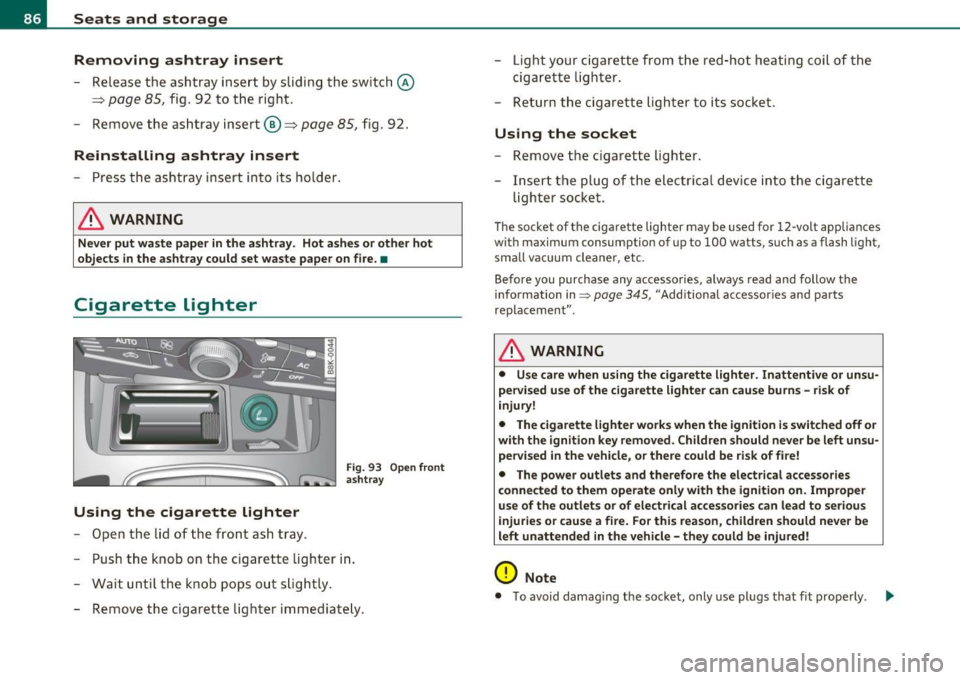
Using the cigarette lighter
-Ope n the lid o f the fro nt ash tray .
Fig. 93 Open fro nt
ashtray
- Push t he knob on the cigarette lighter i n.
- Wait u ntil the knob pops ou t sli ghtly.
- Remove the cigaret te lig hter immed iate ly. -
Light your c igarette from the red-hot heating coil of th e
cigare tte l ighter .
- Return the ciga rette lighte r to its socket.
Using the socket
- Remove the cigarette lighter.
- Insert the plug of the el ectrical device into the cigarette
lighter socke t.
The so cket of the ciga re tte lighter may be used for 12-volt app liances
w ith maximum consumption of up to 100 watts, such as a flash light ,
sm all vacuum cleane r, etc.
Before you purchase any accessor ies, always read and follow the
information in =>
page 345, "Additional accessor ies and parts
replacement" .
& WARNING
• Use care when using the cigarette lighter . Inattentive or unsu
per vis ed u se of the cig arette lighter can cause bu rn s - risk of
injury!
• The cigarette lighter work s when the ignition is switched off or
with the ignition key remo ved . Child ren shou ld never be left unsu
pervised in the vehicle, or there could be ri sk of fire!
• The power outlets and therefore the electrical acce ssories
connected to them operate only with the ignition on . Improper
use of th e outlets or of electri cal accessories can lead to seriou s
i njuries or cause a fire. Fo r thi s reason , children should neve r be
left unattended in th e vehicle -they could be injur ed!
0 Note
• T o avoid damag ing the socket, only use plugs that fit properly . _.,
Page 89 of 364

• Only use the c igarette ligh ter socket as a powe r source for e lec
tr ical a ccesso ries f or short dur ations. Use the socke ts * in the ve hicle
when a powe r so urce is needed fo r lo nger durations.
[I] Tips
When the eng ine is of f and accessories ar e st ill plugged in and are on,
the ve hicl e battery can sti ll be draine d.•
Storage
General overview
There are num er ous pla ce s to stor e item s in your v eh ic le .
Glove com par tm en t =>page 87
& WARNING
• Always remove objects from the instrument panel. Any items
not put away could slide around inside the vehicle while driving or
when accelerating or when applying the brake s or when driving
around a corner .
• When you are driving make sure that anything you may have
placed in the center console or other sto rage locat ions cannot fall
out into the footwells. In case of sudden braking you would not be
able to brake, depress the clutch or accelerate. •
Controls and equip
ment Safety first
Seats and storage
Glove compartment
Th
e g lov e comp artmen t is i llum inat ed and c an be lo cked.
To open glove compartment
Fig. 94 Glov e
c om partment
- Pull the h andl e i n th e dir e ct ion of t he arro w ~ fig . 9 4 and
swi ng th e co ver d own to o pen.
To close glove compartment
-Push t he gl ove co mpa rtment lid upward u ntil t he lock
engages.
T he re are holders for a pen and a pad of paper in the glove compart
me nt lid.
On t he right s ide in the glove compartment is a holder with the key
body into w hich t he eme rgency key mus t be clip ped to be able to start
the vehicle.
& WARNING
To reduce the risk of personal injury in an accident or sudden stop, always keep the glove compartment closed while driving. •
Vehicle care Technical data
Page 103 of 364
_________________________________________________ W_ a_ r_m _ a_ n_d_ c_ o_ ld _ ___._
App lies to veh icles : with delux e auto matic clim ate contro l p lus
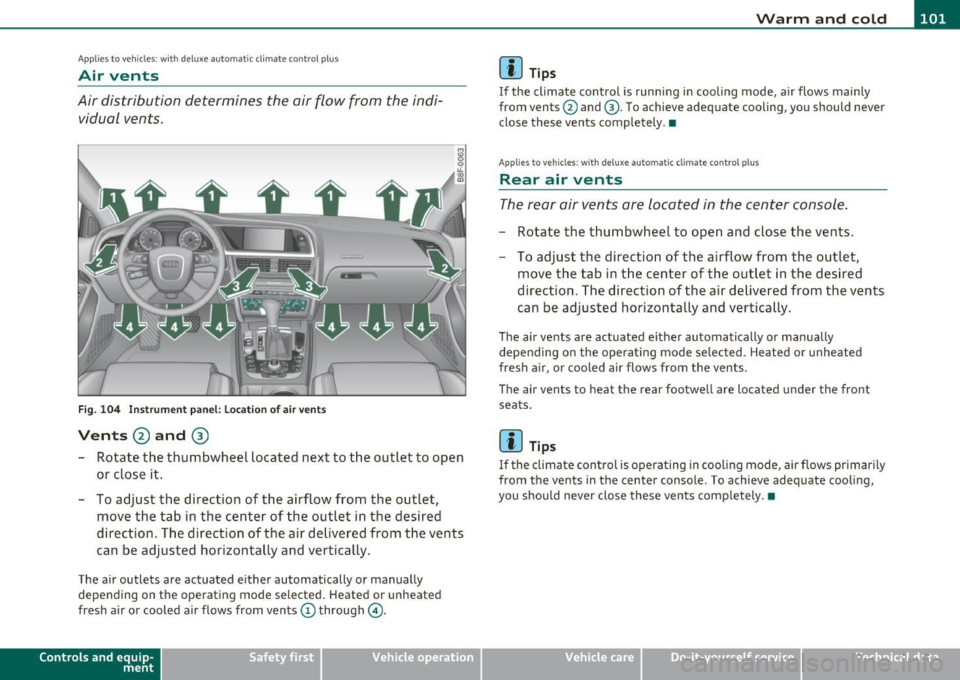
Air vents
Air distribution determines the air flow from the indi
vidual vents .
Fig. 104 Instrument panel: Locat ion of air vents
Vents @and @
-Rotate the thumbwheel located next to the outlet to open
or close it.
- To adjust the direction of the airflow from the outlet,
move the tab in the center of the outlet in the desired
direction . The direction of the air delivered from the vents
can be adjusted horizontally and vertically.
The air outlets are actuated e ither automatically or manually
depending on the operating mode selected. Heated or unheated
fresh air or cooled air flows from vents(!) through @.
Con tro ls a nd e quip
m en t Vehicle
OP-eration
(I) Tips
If the climate control is running in cooling mode, air flows main ly
from ve nts @ and @. To ach ieve adequate cooling, you should never
close these vents completely .•
App lies to vehicles : wit h delu xe aut omatic clim ate co ntro l pl us
Rear air vents
The rear air vents are located in the center console.
Rotate the thumbwheel to open and close the vents .
- To adjust the direction of the airflow from the outlet,
move the tab in the center of the outlet in the desired
direction . The direction of the air delivered from the vents
can be adjusted horizontally and vertically.
The air vents are actuated e ither automatically or manua lly
depending on the operating mode selected . Heated or unheated
fresh a ir, or cooled a ir flows from the vents .
The air ven ts to he at the re ar fo otwell are l ocat ed under the front
seats .
(I) Tips
If the climate control is operating in cooling mode , air flows pr imarily
from the vents in the center console . To achieve adequate cooling,
you should never close these vents comp letely. •
Vehicle care Do-it-yourselt service iTechnical data
Page 105 of 364
_________________________________________________ W_ a_ r_m _ a_ n_d_ c_ o_ ld _ ___.lfll
Seat heating
Ap plies to vehicles: w it h fr ont se at heat in g
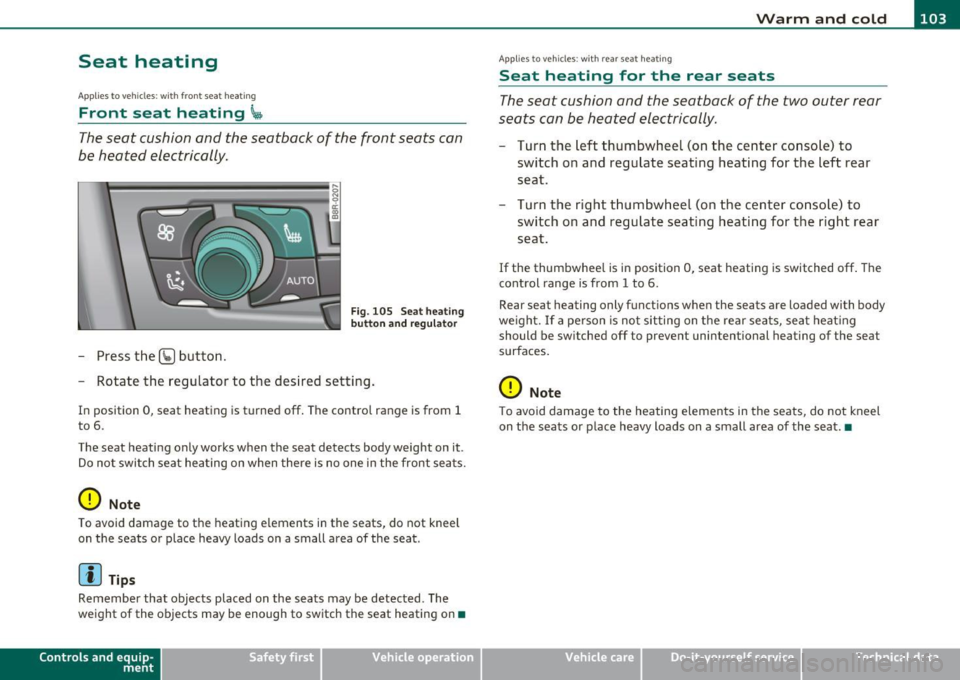
Front seat heating ~
The seat cushion and the seatback of the front seats can
be heated electrically.
- Press the (g button.
s ci: ., m
Fig. 105 Seat heati ng
button and r egul ator
- Rotate the regulator to the des ired setting .
In position 0, seat heating is turned off . The contro l range is from 1
t o 6.
The seat heating only works when the seat detects body weight on it .
Do no t swi tc h s eat he ating on when the re is no one in the front se ats.
0 Note
To avoid damage to t he heat ing e lements in the seats, do not kneel
on t he seats o r place heavy loads on a small area of the seat .
[I) Tips
Remember that objects placed on the seats may be detected . The
we ight of the objects may be enough to switch the seat heating on •
Contro ls a nd e quip
m en t Vehicle
OP-eration
Applies to ve hicles : w ith rea r sea t heat ing
Seat heating for the rear seats
T he seat cushion and the seatback of the two outer rear
seats c an be heated electrically.
- Turn the left thumbwheel (on t he center conso le) to
switch o n and reg ulate seating heat ing fo r the left rear
seat.
Turn t he right t humbwhee l (on the center co nsole) to
switch on and regulate seat ing heating for the r ight rear
seat.
If the thumbwhee l is i n position 0, seat heating is switched off . The
control range is from 1 to 6.
Rear sea t heating only funct ions when the seats are loaded with body
we igh t. If a pe rson is no t sitting on t he rear sea ts, sea t heat ing
should be sw itched off to preve nt unintentional heating of the seat
surfaces.
0 Note
T o avoid damage to the heatin g elements in the seats, do not kneel
on the sea ts or p lace heavy loads on a small area of the seat .•
Vehicle care Do-it-yourselt service iTechnical data
Page 106 of 364
ffl Warm and cold .._ ____ .....;_____,;,;_ _______________________________ _
Applie s to veh icles : wi th upp er cabi n heat in g
Upper cabin heating
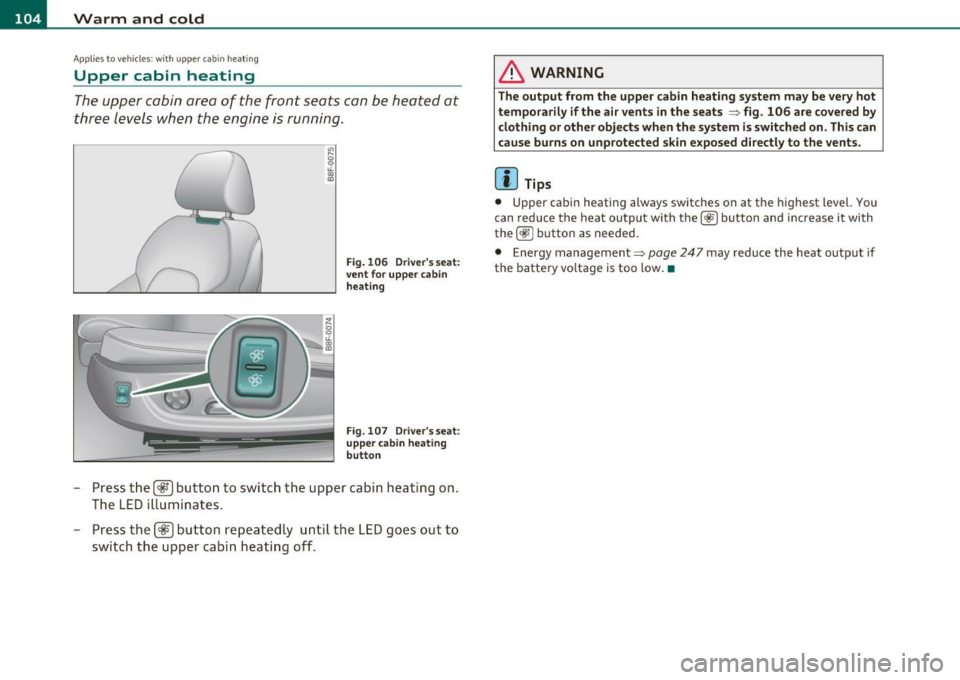
The upper cabin area of the front seats can be heated at
three levels when the engine is running .
Fig. 106 Driver's seat:
vent for upper cabin
heating
Fig . 107 Driver's seat:
upper cabin heating
button
- Press the [~l button to switch the upper cabin heating on.
The LED illuminates.
- Press the
[
& WARNING
The output from the upper cabin heating system may be very hot
temporarily if the air vents in the seats
~ fig. 106 are covered by
clothing or other objects when the system is switched on. This can
cause burns on unprotected skin exposed directly to the vents.
[ i ] Tips
• Upper cabin heating a lways switches on at the highest level. You
can reduce the heat output with the
[cg;) button and increase it with
the[~] button as needed.
• Energy management ~
page 247 may reduce the heat output if
the battery voltage is too low.•
Page 178 of 364
........ _D_ r_iv _i_ n .... g=-- S_ a_f _e _Ly :,.._ ______________________________________________ _
Driving Safely
General notes
Safe driving habits
Please remember -safety first!
Th is chapter contains important information, t ips, instructions and
warnings that you need to read an d observe fo r you r own safe ty, the
safety of you r passengers and others . We have summarized here
w hat you need to know about sa fety belts, airbags, child restra ints as
we ll as child safety . You r safety is for us
priority number 1. Always
observe the information and warnings in this section -for your own
safety as well as t hat of your passengers.
The informat ion in this section applies to all mode l versions of yo ur
veh icle . Some of the fe atures des cribed in this se ctions m ay be st an
dard equ ipment on some models, or may be optional eq uipment on
others. If you a re not sure, ask your a uth o rized Audi dealer.
& WARNING
• Always make sure that you follow the instructions and heed
the WARNINGS in th is Manual. It is in your interest and in the
intere st of your passengers.
• Always keep the complete Owner's Literatu re in your Audi
when you lend or sell your vehicle so that this important informa
tion will always be available to the driver and passengers .
• Always keep the Owner's literature handy so that you can find
it easily if you have questions . •
Safety equipment
The safety features are part of the occupant restraint
s y stem and wor k together to he lp reduce the ris k of injury
in a wide variety of accident situations.
Your sa fety and t he safety o f yo ur passenge rs shou ld no t be left to
chance . Adva nces in technology have made a variety of features avai l
a b le to help re duce the risk of injury in an a cc ident . The fo llow ing is a
list of jus t a few of the safety features in your Audi:
• sophisticated safety belts for driver and a ll passenger seating
p osi tion s,
• belt force limiters for the front seats,
• belt pr etensioners fo r th e sea ts,
• hea d restrain ts f or eac h se ating posi tion,
• front airbags,
• side airbags i n the fro nt s eats,
• special LATCH anchorages fo r chi ld restra in ts,
• adjustable steering co lumn.
T hese individual safety feat ures, can work together as a system to
he lp protect you and yo ur passengers in a wide range of accidents .
T hese feat ures cannot work as a system if they are not a lways
c o rrect ly adjusted and cor rect ly used .
Safety is everybody's responsibility! •
Page 181 of 364
______________________________________________ D_ ri_v _ i_n _,,g ,c.._ S_a_ f_ e_ l..:: y __ _
& WARNING (continued)
• Always sit in an upright position and never lean against or
place any part of your body too close to the area where the airbags
are located.
• Before driving, always adjust the front seats and head
restraints properly and make sure that all passengers are properly
restrained.
• Never adjust the seats while the vehicle is moving. Your seat
may move unexpectedly and you could lose control of the vehicle.
• Never drive with the backrest reclined or tilted far back! The
farther the backrests are tilted back, the greater the risk of injury
due to incorrect positioning of the safety belt and improper
seating position. • Children must always ride in child safety seats~
page 221.
Special precautions apply when installing a child safety seat on
the front passenger seat~
page 199. •
Proper seating position for the front
passenger
The proper front passenger seating position is important
for safe, relaxed driving .
For your own safety and to reduce the risk of injury in the
event of an accident, we recommend that you adjust the seat
for the front passenger to the following position:
- Move the front passenger seat back as far as possible.
There must be a minimum of 10 inches (25 cm) between
the breastbone and the instrument panel=>&.
- Adjust the angle of the seatback so that it is in an upright
position and your back comes in full contact with it when
ever the vehicle is moving.
Controls and equip
ment Safety first Vehicle operation
-
Adjust the head restraint so the upper edge is as even as
possible with the top of your head. If that is not possible,
try to adjust the head restraint so that it is as close to this
position as possible.
- Keep both feet flat on the floor in front of the front
passenger seat .
- Fasten and wear safety belts correctly ::::>
page 193.
For detailed information on how to adjust the front passenger's seat,
see~ page 77.
& WARNING
Front seat passengers who are unbelted, out of position or too
close to the airbag can be seriously injured or killed by the airbag
as it unfolds. To help reduce the risk of serious personal injury:
• Passengers must always sit in an upright position and never
lean against or place any part of their body too close to the area
where the airbags are located.
• Passengers who are unbelted, out of position or too close to
the airbag can be seriously injured by an airbag as it unfolds with
great force in the blink of an eye.
• Always make sure that there are at least 10 inches (25 cm)
between the front passenger's breastbone and the instrument
panel.
• Each passenger must always sit on a seat of their own and
properly fasten and wear the safety belt belonging to that seat.
• Before driving, always adjust the front passenger seat and
head restraint properly.
• Always keep your feet on the floor in front of the seat. Never
rest them on the seat, instrument panel, out of the window, etc.
The airbag system and safety belt will not be able to protect you properly and can even increase the risk of injury in a crash.
II>
Vehicle care Do-it-yourself service Technical data
Page 182 of 364
• ....__D_ r_iv _i_ n_, g=-- S_ a _ f_e _,Ly _ ______________________________________________ _
& WARNING (continued)
• Never drive with the backrest reclined or tilted far back! The
farther the backrests are tilted back, the greater the risk of injury due to incorrect positioning of the safety belt and improper
seating position.
• Children must always ride in child safety seats~
page 221.
Special precautions apply when installing a child safety seat on
the front passenger seat~
page 199. •
Proper seating positions for passengers in
rear seats
Rear seat passengers must sit upright with both feet on
the floor consistent with their physical size and be prop
erly restrained whenever the vehicle is in use.
To reduce the risk of injury caused by an incorrect seating
position in the event of a sudden braking maneuver or an
accident , your passengers on the rear bench seat must
always observe the following :
- Make sure that the seatback is securely latched in the
upright position ~
page 84.
-Keep both feet flat in the footwell in front of the rear seat.
- Fasten and wear safety belts properly~
page 193.
-Make sure that children are always properly restrained in a
child restraint that is appropriate for their size and age
~page 221.
& WARNING
Passengers who are improperly seated on the rear seat can be seri
ously injured in a crash.
& WARNING (continued)
• Each passenger must always sit on a seat of their own and
properly fasten and wear the safety belt belonging to that seat.
• Safety belts only offer maximum protection when the seatback
is securely latched in the upright position and the safety belts are
properly positioned on the body. By not sitting upright, a rear seat
passenger increases the risk of personal injury from improperly
positioned safety belts! •
Applies to veh icles : w ith adjustable head restraints
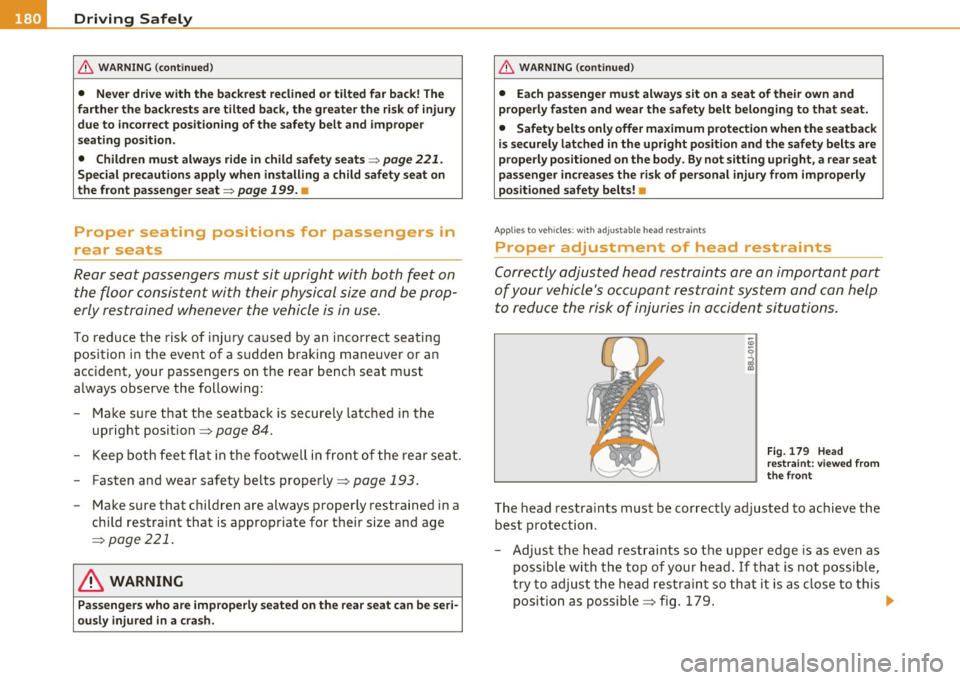
Proper adjustment of head restraints
Correctly adjusted head restraints are an important part
of your vehicle's occupant restraint system and can help
to reduce the risk of injuries in accident situations.
Fig. 179 Head
restraint: viewed from
the front
The head restraints must be correctly adjusted to achieve the
best protection.
- Adjust the head restraints so the upper edge is as even as
possible with the top of your head. If that is not possible,
try to adjust the head restraint so that it is as close to this
position as possible~ fig. 179.
~
Page 183 of 364
________________________________________________ D_ r_ i_ v _i_n ""'g "-- S_a_ f_ e_ l _,,y'-- __
Adjusting head restraints=> page 82.
& WARNING
Driving without head rest raints or with head restraint s that are
not properl y adju sted increa se s the risk of seriou s or fatal neck
injuriy dram atically. To help reduce the risk of injury :
• Always drive w ith the h ead restraints in place and properly
adjusted.
• Every person in the vehicle must have a prope rly adju sted head
restraint.
• Always make sure each person in the vehicle properly ad justs
their head restraint. Adju st the head restraints so the upper edge
i s as even a s pos sible with th e top of your head . If that i s not
possible, try to adjust the head re straint so that it is as close to
this position as po ssible.
• Never attempt to adjust head restraint while driving. If you
have driven off and must adjust the driver headrest for any reason ,
first stop the vehicle safely before attempting to adju st the head
restraint.
• Children must alwa ys be properly restrained in a child re straint
that is appropriate for their age and size
=> page 221 . •
Examples of improper seating positions
The occupant res traint sy stem can o nly redu ce the risk of
injury i f veh icle occup ants are properly sea ted .
Im proper seati ng positio ns can caus e ser ious inju ry o r death .
Safety belts can on ly work w hen t hey are pro perly posi tio ned
on t he body. Impro per sea tin g posit io ns re duce the effect ive
ness of safety belts and w ill even increase the risk of i njury
and deat h by moving the s afety belt to crit ic a l areas of the
body. Imp roper seati ng positions also increase the r is k of
serious injury and death when an airbag deploys and str ikes
Controls and equip
ment Safety first Vehicle operation
an occ
upan t who is not in th e proper s eati ng pos ition . A
d river is respons ib le f or t he safe ty o f all vehic le occu pants
a nd especial ly for children . Therefore:
- Never allow anyone to a ssum e an in correc t sea ting pos i-
t ion whe n the v ehic le is bei ng us ed::::;, &.
The follow ing b ulletins list only some sample positions that will
increase the risk of serious in ju ry and death. O ur hope is that these
examples will ma ke you mo re awa re of seat ing posi tions t hat are
dangero us.
Therefore, whenever the vehicle is moving :
• never stand up in the vehicle
• never stand on the seats
• never knee l on t he se ats
• never ride with the seatback reclined
• never lie down on the rear seat
• never le an up agains t th e ins tru ment panel
• never sit on the edge of the seat
• neve r sit s ideways
• never lean o ut the win dow
• never put your feet out the window
• never p ut yo ur feet on the ins trumen t panel
• never rest your feet on the seat c ush ion or back of the seat
• never ride in the footwell
• never ride in the cargo area
& WARNING
Improper seating position s in crease the ri sk of seriou s personal
injury and death whenever a vehicle is being used. _,.
Vehicle care Do-it-yourself service Technical data
Page 188 of 364
-Driving Safely
NHTSA
1200 New Jersey Avenue, SE
Washington, D.C. 20590
You can also obtain other information about motor vehicle safety from:
http:/ /www.safercar.gov
Applicable to Canada
Canadian customers who wish to report a
safety-related defect to Transport Canada,
Defect Investigations and Recalls, may tele
phone the toll free hotline:
Tel.: 1-800-333-0371 or
Tel.: 1-613-998 -8616 if you are in the Ottawa
area
TTY for hearing impaired: 1-888-675-6863
email comments/questions to: roadsafetyweb [email protected]
or contact Transport Canada by mail at:
Road Safety and Motor Vehicle Regulation
Directorate
Transport Canada
Tower C, Place de Ville, 330 Sparks Street
Ottawa, Ontario KlA ONS For additional road safety information, please
visit the Road Safety website at:
http:/ /www.tc.gc.ca/roadsafety/index.htm •
Active rollover protection system
Function
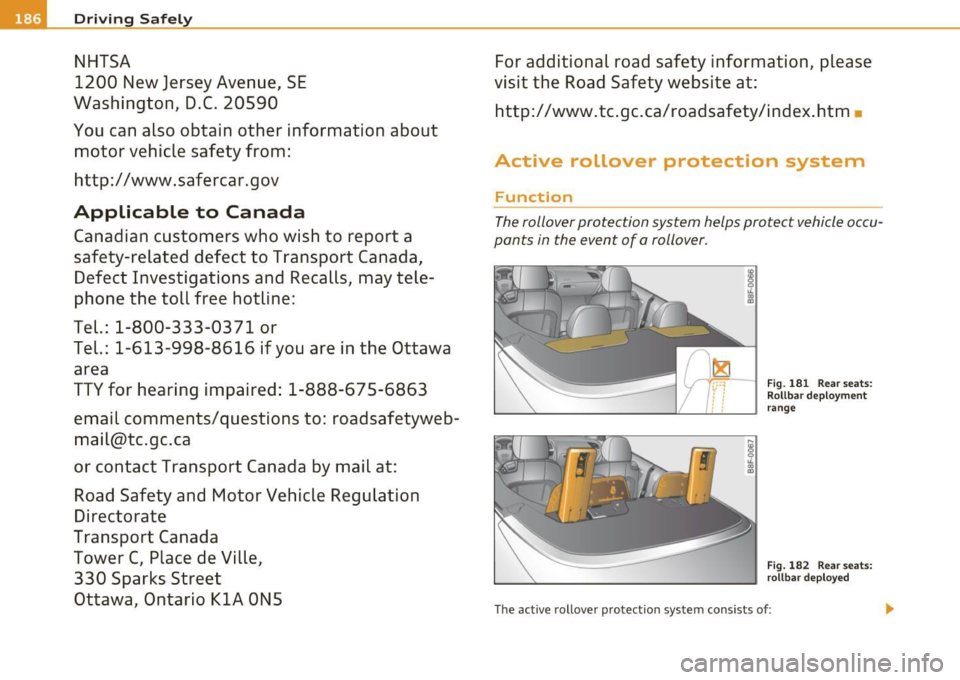
The rollover protection system helps protect vehicle occu
pants in the event of a rollover.
Fig. 181 Rear seats:
Rollbar deployment
i____:.__ ______ &.:....._----'--'-....:...._---' range
i____;.__ _________ ___., Fig. 182 Rear seats:
rollbar deployed
The active rollover protection system consists of : ...