seats AUDI A5 CABRIOLET 2011 Owner's Manual
[x] Cancel search | Manufacturer: AUDI, Model Year: 2011, Model line: A5 CABRIOLET, Model: AUDI A5 CABRIOLET 2011Pages: 364, PDF Size: 86.48 MB
Page 189 of 364
• two rollbars
• the safety belts with belt tensioners
• the windshield frame
• the rollover sensors
The active rollover protection system provides additional safety in the
event of a ro llover. Within milliseconds, sensors deploy two rollbars
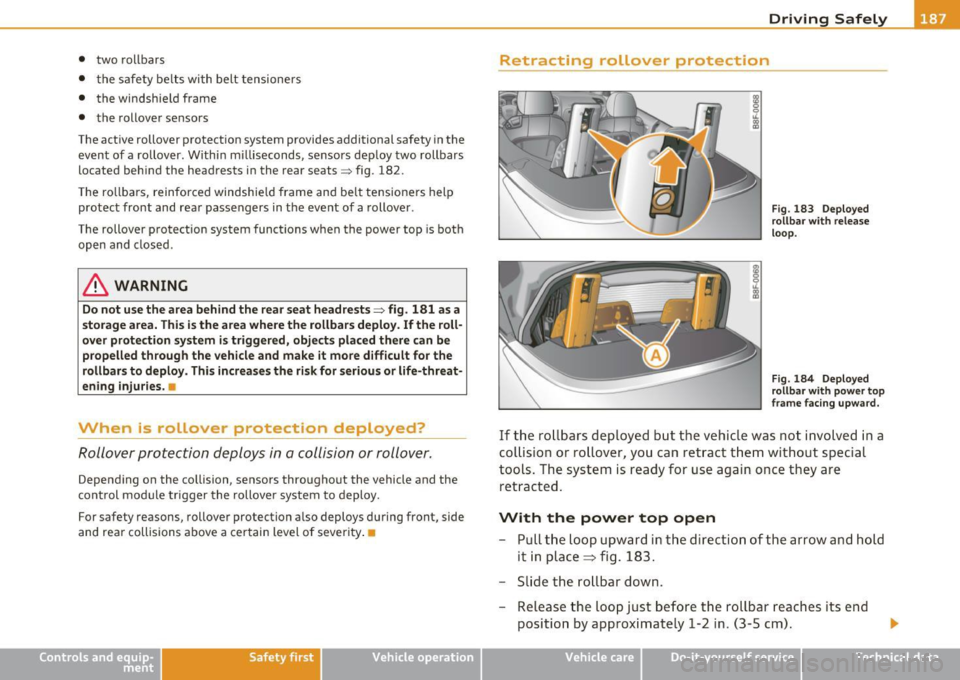
located behind the headrests in the rear seats => fig. 182.
The rollbars, reinforced windshie ld frame and belt tensioners help
protect front and rear passengers in the event of a rollover .
The rollover protection system functions when the power top is both
open and closed.
& WARNING
Do not use the area behind the rear seat headrests=> fig. 181 as a
storage area. This is the area where the rollbars deploy. If the roll
over protection system is triggered, objects placed there can be
propelled through the vehicle and make it more difficult for the
rollbars to deploy . This increases the risk for serious or life-threat
ening injuries . •
When Is rollover protection deployed?
Rollover protection deploys in a collision or rollover.
Depending on the collision, sensors throughout the vehicle and the
control module trigger the rollover system to deploy.
For safety reasons, rollover protection also deploys during front, side
and rea r collisions above a certain level of severity .•
Safety first Vehicle OP-eration
Driving Safely
Retracting rollover protection
Fig. 183 Deployed
rollbar with release
loop.
Fig. 184 Deployed
rollbar w ith power top
frame facing upward.
If the rollbars deployed but the vehicle was not involved in a
collision or rollover, you can retract them without special
tools . The system is ready for use again once they are
retracted.
With the power top open
- Pull the loop upward in the direction of the arrow and hold
it in place=> fig. 183.
- Slide the rollbar down.
- Release the loop just before the rollbar reaches its end
position by approximately 1-2 in. (3-5 cm). •
Vehicle care Do-it-yourselt service Technical data
Page 191 of 364
_____________________________________________ S_a _f _e _t _y _b_ e_lt _ s __ _
Safety belts
General notes
Always wear safety belts!
Wearing safety belts correctly saves lives!
This chapter explains why safety belts are necessary, how
they work and how to adjust and wear them correctly.
- Read all the information that follows and heed all of the
instructions and WARNINGS.
& WARNING
Not wearing safety belts or wearing them improperly increases
the risk of serious personal injury and death.
• Safety belts are the single most effective means available to
reduce the risk of serious injury and death in automobile acci
dents. For your protection and that of your passengers, always
correctly wear safety belts when the vehicle is moving.
• Pregnant women, injured, or physically impaired persons must
also use safety belts. Like all vehicle occupants, they are more
likely to be seriously injured if they do not wear safety belts. The
best way to protect a fetus is to protect the mother -throughout
the entire pregnancy. •
Number of seats
Your Audi has a total of four seating positions: two in the front and
two in the rear . Each seating position has a safety belt .
Controls and equip
ment Safety first Vehicle operation
& WARNING
Not wearing
safety belts or wearing them improperly increases
the risk of serious personal injury and death.
• Never strap more than one person, including small children,
into any belt. It is especially dangerous to place a safety belt over
a child sitting on your lap.
• Never let more people ride
in the vehicle than there are safety
belts available.
• Be sure everyone riding in the vehicle is properly restrained
with a separate safety belt or child restraint. •
Safety belt warning light t
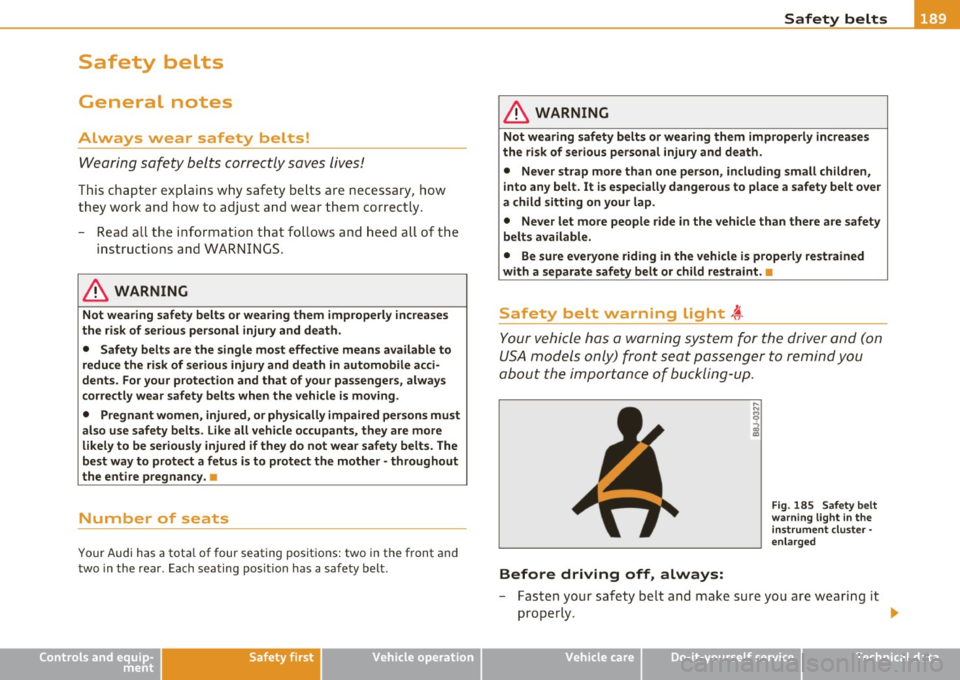
Your vehicle has a warning system for the driver and (on
USA models only) front seat passenger to remind you
about the importance of buckling-up.
Before driving off, always:
Fig. 185 Safety belt
warning light in the
instrument cluster -
enlarged
- Fasten your safety belt and make sure you are wearing it
properly .
IJ,,
Vehicle care Do-it-yourself service Technical data
Page 193 of 364
What happens to occupants not wearing
safety belts?
In crashes unbelted occupants cannot stop themselves from flying forward and being injured or killed. Always
wear your safety belts!
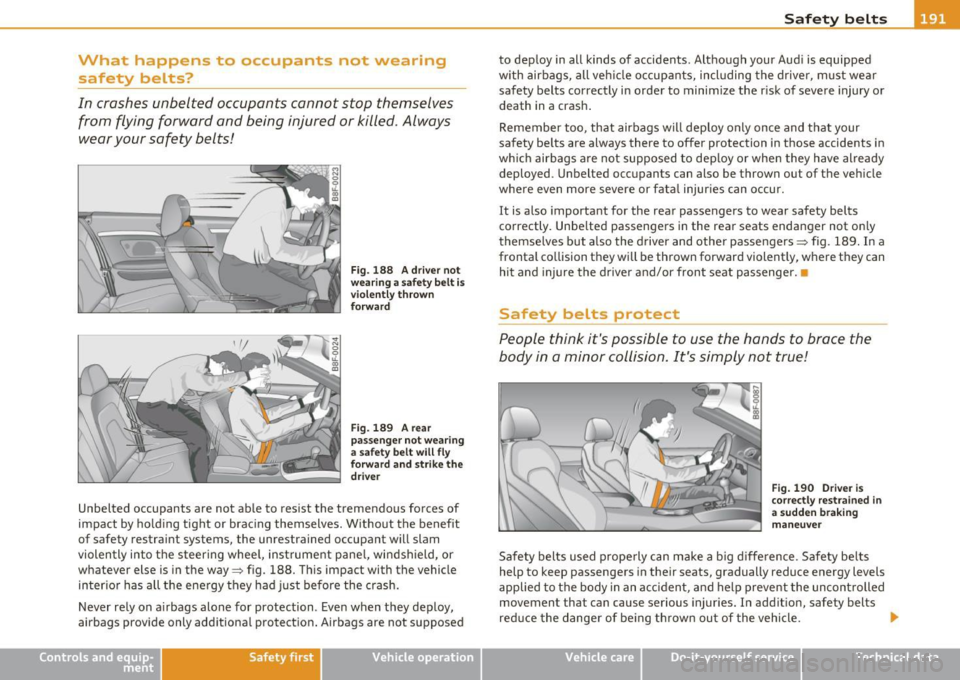
Fig. 188 A driver not
wearing a safety belt is
violently thrown
forward
Fig. 189 A rear
passenger not wearing
a safety belt will fly
forward and strike the
driver
Unbelted occupants are not able to resist the tremendous forces of
impact by holding tight or bracing themselves. Without the benefit
of safety restraint systems, the unrestrained occupant will slam
violently into the steering wheel, instrument panel, windshield, or
whatever else is in the way=:> fig. 188. This impact with the vehicle
interio r has all the energy they had just before the crash.
Never rely on airbags alone for protection . Even when they deploy,
airbags provide only additional protection. Airbags are not supposed
Safety first Vehicle OP-eration
Safety belts
to deploy in all kinds of accidents. Although your Audi is equipped
with airbags, all vehicle occupants, including the driver, must wear
safety belts correctly in order to minimize the risk of severe injury or
death in a crash.
Remember too, that airbags will deploy only once and that your
safety belts are always there to offer protection in those accidents in
which airbags are not supposed to deploy or when they have already
deployed . Unbelted occupants can also be thrown out of the vehicle
where even more severe or fatal injuries can occur.
It is also important for the rear passengers to wear safety belts
correctly. Unbelted passengers in the rear seats endanger not only
themselves but also the driver and other passengers=:> fig . 189. In a
frontal collision they will be thrown forward violently, where they can
hit and injure the driver and/or front seat passenger. •
Safety belts protect
People think it's possible to use the hands to brace the
body in a minor collision. It's simply not true!
Fig. 190 Driver is
correctly restrained in
a sudden braking
maneuver
Safety belts used properly can make a big difference. Safety belts
help to keep passengers in their seats, gradually reduce energy levels
applied to the body in an accident, and help prevent the uncontrolled
movement that can cause serious injuries. In addition, safety belts
reduce the danger of being thrown out of the vehicle. .,.
•
Vehicle care Do-it-yourselt service iTechnical data
Page 195 of 364
& WARNING (continued)
• Never use comfort clips or devices that create slack in the
shoulder belt. However, special clips may be required for the
proper use of some child restraint systems.
• Torn or frayed safety belts can tear, and damaged belt hard
ware can break in an accident. Inspect belts regularly. If webbing,
bindings, buckles, or retractors are damaged, have belts replaced
by an authorized Audi dealer or qualified workshop.
• Safety belts that have been worn and loaded
in an accident
must be replaced with the correct replacement safety belt by an
authorized Audi dealer. Replacement may be necessary even if
damage cannot be clearly seen. Anchorages that were loaded
must also be inspected.
• Never remove, modify , disassemble, or try to repair the safety
belts yourself.
• Always keep the belts clean . Dirty belts may not work properly
and can impair the function of the inertia reel=> page 2 72,
"Safety belts". •
Safety first Vehicle OP-eration
Safety belts
Safety belts
Belt positioner
The driver and front passenger seats are equipped with
belt positioners.
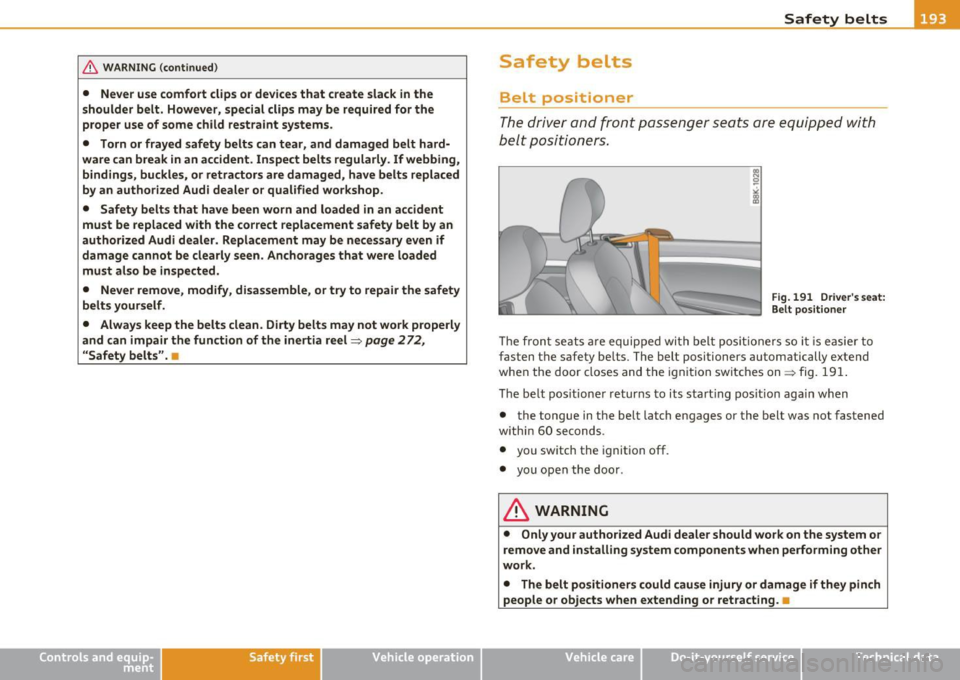
Fig. 191 Driver's seat:
Be lt positioner
Th e front seats are equipped with belt positioners so it i s easier to
fasten the safety belts. The belt positioners automatically extend
when the door closes and the ignition switches on=> fig. 191.
The belt positioner returns to its starting position again when
• the tongue in the belt latch engages or the belt was not fastened
within 60 seconds .
• you switch the ignition off.
• you open the door .
& WARNING
• Only your authorized Audi dealer should work on the system or
remove and installing system components when performing other
work.
• The belt positioners could cause injury or damage if they pinch
people or objects when extending or retracting. •
Vehicle care Do-it-yourselt service iTechnical data
Page 197 of 364
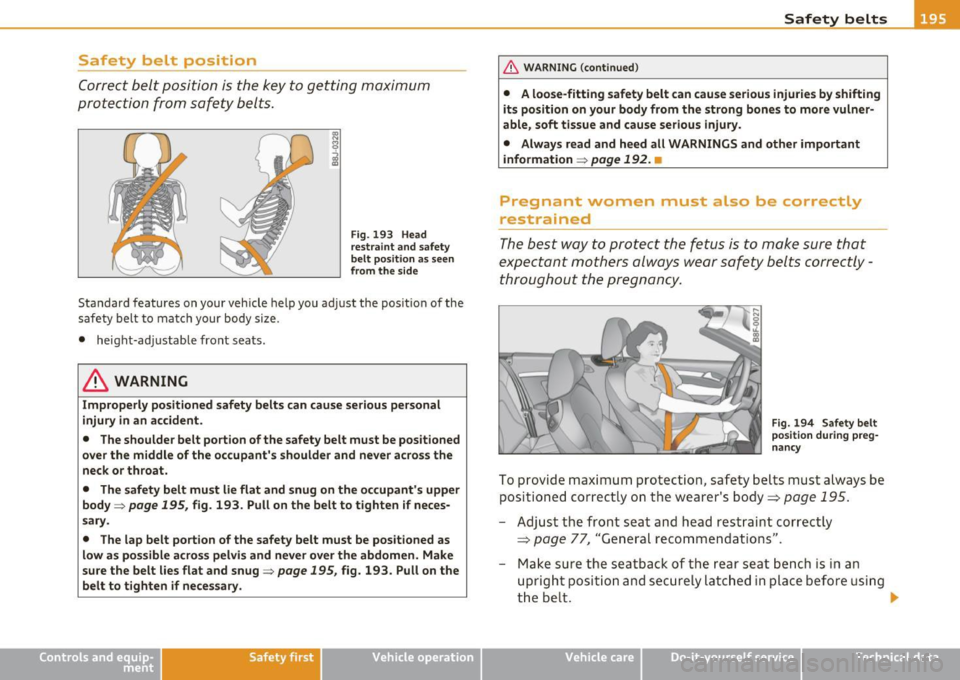
Safety belt position
Correct belt position is the key to getting maximum
protection from safety belts.
Fig. 193 Head
restraint and safety
belt pos ition as seen
from the side
Standard features on your vehicle help you adjust the position of the
safety belt to match your body size.
• height-adjustable front seats.
& WARNING
Improperly positioned safety belts can cause serious personal
injury in an accident.
• The shoulder belt portion of the safety belt must be positioned
over the middle of the occupant's shoulder and never across the
neck or throat.
• The safety belt must lie flat and snug on the occupant's upper
body =>
page 195, fig. 193. Pull on the belt to tighten if neces
sary.
• The lap belt portion of the safety belt must be positioned as
low as possible across pelvis and never over the abdomen. Make
sure the belt lies flat and snug=>
page 195, fig. 193. Pull on the
belt to tighten if necessary.
Safety first Vehicle OP-eration
Safety belts
& WARNING (continued)
• A loose-fitting safety belt can cause serious injuries by shifting
its position on your body from the strong bones to more vulner
able, soft tissue and cause serious injury.
• Always read and heed all WARNINGS and other important
information =>
page 192. •
Pregnant women must also be correctly
restrained
The best way to protect the fetus is to make sure that
expectant mothers always wear safety belts correctly -
throughout the pregnancy.
Fig. 194 Safety belt
position during preg·
nancy
To provide maximum protection, safety belts must always be positioned correctly on the wearer's body ===>
page 195.
- Adjust the front seat and head restraint correctly
===> page 77, "General recommendations".
- Make sure the seatback of the rear seat bench is in an
upright position and securely latched in place before using
the belt. •
I .
Vehicle care Do-it-yourselt service iTechnical data
Page 202 of 364
........ _A_ i_rb _ a_,g,:;._ s_, y'- s_ t_e _m ________________________________________________ _
costs o r ev en t he lack of v ehicle da mage is no t necessar ily an ind ica
t ion of whe the r an a irbag should inflat e or not.
It is not poss ible to defi ne a r ange of v ehicle speeds t hat w ill cove r
every possible k ind and a ngle of impact that will a lways t rigger t he
a ir bags, sin ce the c ircum stanc es will vary consider ably be twee n one
co llision and another. Important factors incl ude, fo r exam ple, the
n at ure (h ard or s oft) of th e obje ct whi ch the c ar hits , the ang le of
impact, vehicle speed, etc. The front airbags will also not inflate in
s ide o r rear coll isions , or in roll-ove rs.
Always remember: Airbags w ill deploy only once, an d on ly in certa in
kinds of co llisio ns. Your safety be lts are a lways there to offer protec
t ion in those s ituatio ns in which airbags ar e no t sup pose d to d eploy,
or w hen they have alrea dy de ploye d; for examp le, when your ve hicl e
st rikes or is st ruc k by ano ther afte r the first collis io n.
T hi s is just one of the reasons w hy an airbag is a s upplementa ry
restra in t a nd is no t a su bst itute for a safe ty bel t. The air bag sy stem
works most effectively when used with the safety be lts. Therefore,
always p rope rly wear y ou r safety belts => page 189 .
& WARNING
Sitting too close to the steering wheel or instrument panel will
decrease the effectiveness of the airbags and will increase the risk
of personal injury in a collision.
• Never sit closer than 10 inches (25 cm) to the steering wheel or
instrument panel.
• If you cannot sit more than 10 inches (25 cm) from the
steering wheel, investigate whether adaptive equipment may be
available to help you reach the pedals and increase your seating
distance from the steering wheel.
• If you are unrestrained, leaning forward, sitting sideways or
out of position in any way , your risk of injury is much higher.
• You will also receive serious injuries and could even be killed if
you are up against the airbag or too close to it when it inflates - even with an Advanced Airbag.
& WARNING (co ntinued )
• To reduce the risk of injury when an airbag inflates, always
wear safety belts properly=>
page 193, "Safety belts ".
• Always make certain that children age 12 or younger always
ride in the rear seat. If children are not properly restrained, they
may be severely injured or killed when an airbag infl ates .
• Never let children ride unrestrained or improperly restrained in
the vehicle. Adjust the front seats properly.
• Never ride with the backrest reclined.
• Always sit as far as possible from the steering wheel or the
instrument panel =>
page 178.
• Always sit upright with your back against the backrest of your
seat.
• Never place your feet on the instrument panel or on the seat.
Always keep both feet on the floor in front of the seat to help
prevent seriou s injuries to the legs and hips if the airbag inflates.
• Never recline the front passenger's seat to transport objects .
Items can also move into the area of the side airbag or the front
airbag during braking or in a sudden maneuver. Objects near the
airbags can become projectiles and cause injury when an airbag inflates .
& WARNING
Airbags that have deployed in a crash must be replaced .
• Use only original equipment airbags approved by Audi and
installed by a trained technician who has the neces sary tools and
diagnostic equipment to properly replace any airbag in your
vehicle and assure system effectiveness in a crash.
• Never permit salvaged or recycled a irbags to be installed in
your vehicle. •
Page 203 of 364
_________________________________________________ A_ ir_ b_ a_,,g :;..__ s-=y '"- s_ t_ e_ m __ _
Child restraints on the front seat - some
important things to know
- Be su re to re ad t he i mpo rt a nt i nfo rmation a nd head the
WA RNINGS fo r i mporta nt details about chil dre n and
Advanced Airbags ~
page 221.
Even t hough your ve hicle is eq uipped with an Advanced Airbag
System, ma ke ce rtain that a ll chi ld ren, especia lly those 12 years an d
younger, always r ide in the back seat prope rly rest rained fo r th eir age
and si ze. The airbag on the passenger side makes the front seat a
po tentially da ngerous place fo r a child to r ide. The fro nt seat is not
the safest place for a ch ild in a forward-facing child safety seat. It can
be a very dange rous place fo r an i nfan t or a child in a rearward-fac ing
seat.
Th e Advanced Ai rbag System in your vehicle has been cer tified to
comply with the Req uirements of Uni ted States Federa l Motor
Vehicle Safety Standard 208 as applicable at the time your veh icle
was ma nufact ured .
The Standard requires the front airbag on the passenger side to be tu rne d off ("s uppressed") if a c hild up to abou t one ye ar of age
restra ined in o ne of the rear -facing or forward -fac ing infant
restra ints listed in Fed era l Moto r Vehicle Safety Standard 208 with
whic h the Advanced Airbag System in yo ur vehicle was cert ified has
been installed on the front passenger seat. For a listing of the ch ild
restra in ts that were used to certify compliance with the US Saf ety
Standard =>
page 223.
The PASSENGER AIR BAG OFF ligh t in th e in st rume nt p anel t ells you
when the front Advanced A irbag on the passenger side has been
tur ned off by the ele ct ronic con trol uni t.
Each time you t urn on the ignition, t he
PASSENGER AIR BAG OFF
light will come on for a few seconds and:
• will stay on if th e front passenger se at is no t oc cupie d,
Controls and equip
ment Safety first
Vehicle operation
• will stay on if there is a small ch ild or child restra int on the front
p assenge r se at,
• will go off if the front passenger seat is occup ied by an adult as
reg iste red by t he weight -sens ing mat =>
page 210, "M oni tor ing t he
Advanced Airbag System" .
T he
PASSENGER AIR BAG OFF light comes o n when t he control unit
de tects a total weight on t he front passenger seat that req uires the
front airbag to be t urned off .
If th e total weight o n the front passenger seat is more than th at of a
typical 1 year-o ld child but less than the weight of a small adult, the
fr on t a ir bag on the passenge r si de c an deploy (t he
PASSENGER AIR
BAG OFF
light does not come on) . If the PASSENGER AIR BAG OFF
light does not come on, the front airbag on the passenger side has
not been turned off by the electronic co ntrol unit and can deploy if
the control unit senses an impact t hat meets the conditions stored in
its memory.
For example, the airbag may deploy if:
• a small child that is heavier than a typical 1 year -old child is on the
front passenger seat (rega rd less of whether the chi ld is in one of the
child safety seats listed =>
page 223), or
• a child who has outgrown child restraints is on the front passenger
sea t.
If the fro nt passenger a irbag is tur ned off, the
PASSENGER AIR BAG
OFF
lig ht comes on in the instr ument cluster an d stays on.
Th e fron t airbag on t he pa sse nger side may
not de ploy ( the
PASSENGER AIR BAG OFF li ght does not illum inate and stay lit) even
if a small a dult or teenager, o r a passenger who is no t sitti ng upright
with their back against a non-reclined backrest w ith the ir feet on the
vehicle floor in front of the seat is on the front passenger seat
=>
page 178, " P roper seat ing pos itio n for the dr iver".
If the front passenger ai rbag dep loys, the Federal Standard requires
t he a irbag to mee t the "low risk" deployme nt cr iter ia to reduce the
risk of inj ury through interaction with the a irbag. "Low r isk" deploy
me nt o ccurs in those cras hes t hat tak e pla ce a t lower decelerat io ns as
I),
Vehicle care Do-it-yourself service Technical data
Page 204 of 364
___ A_ i_r _b _a _, g,:;._ s_, y._ s _ t_e _m ________________________________________________ _
defined in the elect ronic contro l unit~ page 211, "PASSE NGER AIR
BA G OFF l ight ".
Always r emembe r, a c hild safety seat o r infa nt ca rr ie r i nsta lled on th e
fro nt seat may be struc k and k noc ke d out of position by t he ra pidly
i nflat ing pass enge r's air ba g in a fr ontal c oll ision. Th e airba g could
g reat ly re duce the effectiveness o f th e ch ild restraint an d even seri
ousl y injur e th e child d uring inf lation .
For this r easo n, and b eca use the back seat is th e sa fest plac e for chil
dre n -whe n pro per ly restra ined acc ordin g to their age and size -we
s tr ong ly r ecommen d that childr en a lways sit in the back s eat
~ pa ge 22 1, "Child S afety".
& WARNING
A child in a rearward -facing child safety seat installed on the front
passenger seat will be seriously injured and can be killed if the
front airbag inflates - even with an Advanced Airbag System.
• The inflating airbag will hit the child safety seat or infant
carrier with great force and will smash the child safety seat and
child against the backrest, center armrest, door or roof .
• Always install rear-facing child safety seats on the rear seat.
• If you must install a rearward facing child safety seat on the
front passenger seat because of exceptional circumstances and
the PASSENGER AIR BAG OFF light does not come on and stay on,
immediately install the rear-facing child safety seat in a rear
seating position and have the airbag system inspected by your
authorized Audi dealer.
• Forward-facing child safety seats installed on the front
passenger's seat may interfere with the deployment of the airbag
and cause serious personal injury to the child.
& WARNING
If , in exceptional circumstances , you must install a forward-facing
child restraint on the front passenger's seat:
& WARNING (continued)
• Always make sure the forward-facing seat has been designed
and certified by its manufacturer for use on a front seat with a
passenger front and side airbag.
• Never put the forward-facing child restraint up against or very
near the instrument panel.
• Always move the passenger seat into its rearmost position in
the seat's fore and aft adjustment range, as far away from the
airbag as possible before installing the forward-facing child
restraint. The backrest must be adjusted to an upright position.
• Make sure that the PASSENGER AIR BAG OFF light comes on
and stays on all the time whenever the ignition is switched on.
& WARNING
To reduce the risk of serious injury, make sure that the PASSENGER AIR BAG OFF light will be displayed whenever a child
restraint is installed on the front passenger seat and the ignition
is switched on .
• If the PASSENGER AIR BAG OFF light does not stay on, perform
the checks described~
page 210, "Monitoring the Advanced
Airbag System ".
• Take the child restraint off the front passenger seat and install
it properly at one of the rear seat positions if the PASSENGER AIR
BAG OFF light does not stay on .
• Have the airbag system inspected by your authorized Audi
dealer immediately.
• Always carefully follow instructions from child restraint manu
facturers when installing child restraints.
& WARNING
If , in exceptional circumstances , you must install a forward or
rearward-facing child restraint on the front passenger 's seat:
Page 205 of 364
& WARNIN G (con tinued )
• Imprope r in stall ation of child re straints can redu ce their effec·
tiveness or even prevent them from providing any protection.
• An improperl y installed child re straint c an interfere with the
airbag a s it deploy s and seriously injure or even kill the child - even
with an Advanced Airbag Sy stem.
• Always carefully follow the manufacturer 's instruct ions
provided with the child safety seat or carrier.
• Ne ver place additional items on the seat that can increase the
total weight regi stered by the weight-sen sing mat and can cause
injury in a crash .•
Front airbags
Description of front airbags
T he airbag system can p rovide supplemental protection
to properly r estrained front se at oc cupants .
Safety first
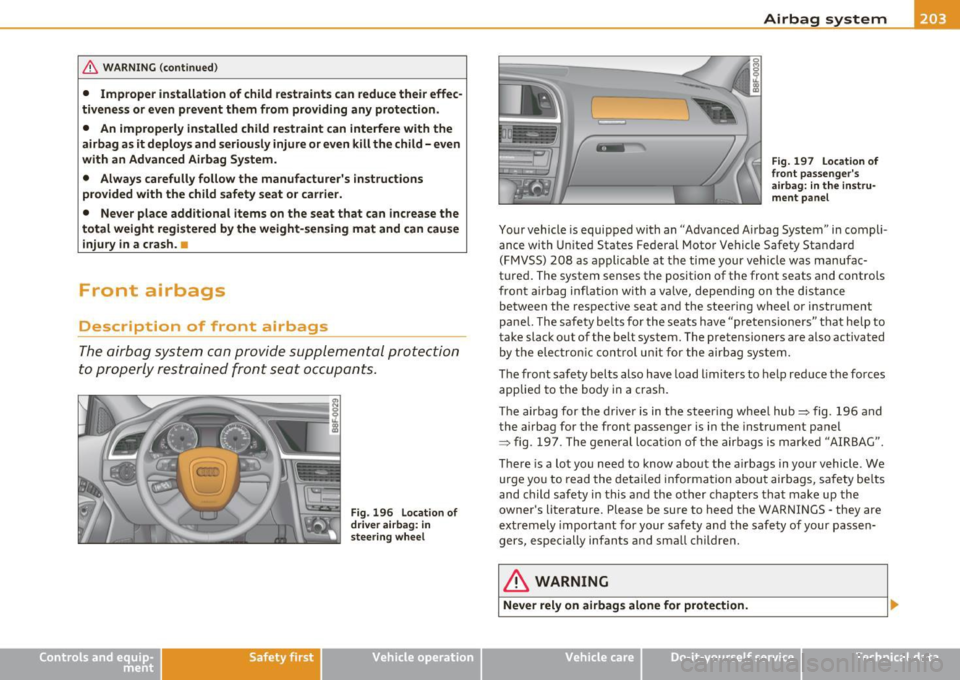
Fig . 19 6 Locatio n of
drive r airb ag : in
s tee ring whee l
Vehicle OP-eration
Airbag system
Fig. 19 7 Locati on of
fr on t pass enge r's
a ir bag: in the instru
me nt pa nel
Yo ur vehicle is equi pped with an "Advanced A irbag Syst em" in compli ·
ance with United States Fe dera l Moto r Vehicle Safety Sta ndard
(FMVSS) 2 08 as a pplicable at t he time your vehi cle was manufac
t u red . The system senses the position of the front seats and controls
front a irbag infl ation w ith a va lv e , dep ending on th e distanc e
between the respective seat and the stee ring wheel or instrument
pane l. The safe ty belts fo r the seats have "prete ns ione rs" t hat he lp to
take slack out of the belt system. The p retensioners are also activated
by the elec tron ic control u nit for the air bag sys tem.
T he front s afe ty belts also have load limiters to help red uce the forces
applied to the body in a cras h.
Th e airbag for the driver is in the stee ring whee l hub::::> fig. 196 and
the ai rbag for the front passenger is in the inst rument panel
::::> fig. 19 7. T he ge neral lo cat io n of the air bags is m ark e d "A IRBAG".
Th ere is a lot you need to know about the a irbags in your vehicle. We
urge yo u to read the det ailed in forma tion abou t air bags, sa fety be lts
and child safety in this and the other chap ters tha t make u p the
owner's literature. Please be sure to heed the WARNINGS -they are
e xtremely importa nt f or your safety and the saf ety of your pas se n
gers, especially infants and sma ll ch ildren.
& WARNING
Never rely on airbags alone for protection.
Vehicle care Do-it-yourselt service iTechnical data
Page 207 of 364
_________________________________________________ A_ ir_ b_ a_,,g :;..__ s-=y '"- s_ t_ e_ m __ _
listing of the child restraints that were used to certify your vehicle's
compliance with the US Safety Standard ~
page 22 3,
• weight less than a threshold level sto red in the contro l unit is
de tected o n the front p assenge r seat.
When a person is detected on t he front passenger seat, weigh ing
more tha n the tota l we ight of a child that is about 1 year old
restra ined in one of the rear-facing or forward-fac ing infant
restraints (listed in Federal Motor Ve hicle Safety Standard
208 with
w hich t he Advan ced Ai rbag System in your veh icle was cert ified), the
front airbag on the passenger s ide may or may not dep loy.
T he
PASSENGER AIR BAG OFF ligh t comes on when the elect ronic
control u nit detects a tota l weig ht on the front passenger seat that
req uires the front airbag to be turned off . If the
PASSENGER AIR
BAG OF F
light does not come on, the front airbag on the passenger
side has not been turned off by the control unit and can deploy if the
cont rol un it senses an impact that meets the conditions stored in its
memory.
If the tota l we ight on the fro nt passenger sea t is more than th at of a
typical
1 year-o ld, but less than the weight of a small adult, the front
airbag on the passenger side may dep loy (the
PASSENGER AIR BAG
OFF
light does not come on) .
For example, the airb ag may deploy if:
• a small child that is heav ie r than a typical 1 year-old child is on the
front passenger seat (regard less of whether the ch ild is in one of the
child safety seats listed ~
page 223),
• a child who has outgrown child restra ints is on the front passenger
sea t.
If the front passenger a irbag is turned off, the
PASSENGER AIR BAG
OFF
light in the center of the instr ument panel will come on and stay
on .
The front airbag on the passenger side may
not dep loy (the
PASSENGER AIR BAG OFF li ght does not i llumi nate and s tay lit) if:
• a small adult or teenager is on the front passenger seat
Controls and equip
ment Safety first Vehicle operation
•
a passenger w ho is not sitt ing uprig ht with their back against a
non-recline d backrest wi th t he ir feet on the veh icle floor in fro nt o f
the seat is o n the fro nt passenger seat.
If the front passenger airbag dep loys, the Federa l Standard requires
t he a irbag to mee t the " low ris k" deployment c riter ia to help reduce
the risk of injury through interaction with the a irbag. "Low risk"
dep loyment oc curs in those c rashes that ta ke p lace at lowe r de cele r
ations as defined in the electronic contro l unit.~
page 210
Alw ays remember: Even tho ugh your vehicle is eq uipped with
Advanced A irbags, the safest place for children is properly restrained
on the back seat. Please be sure to read the important information in
the sections t hat follow and be su re to heed all of the WAR NINGS.
& WARNING
To reduc e the ri sk of injury w hen an airbag inflate s, alwa ys w ear
safet y belt s properly .
• If you are unrestrained, leaning forward , sitting sidewa ys or
out of po sition in any way , your ri sk of injury i s much high er.
• You will also recei ve serious injurie s and could even be killed if
you are up again st the airbag or too close to it wh en it inflates -
e ven with an Ad vanced Airbag ~
page 199.
& WARNING
A child in a rearward-facing child safety seat installed on the front
pa ssenger seat will be seriou sly injured and can be killed if the
front a irbag inflates · even with an Advanced Airbag System .
• Although the Ad vanced Airb ag System in your v ehicle is
designed to turn off the front airbag when a rearward-facing child
re straint has been installed on the front pas senger seat , nobody
c an absolut ely guarantee th at deployment is impo ssible in all
c onceivable situation s that may happen during the u seful life of
your vehicle. _,.
Vehicle care Do-it-yourself service Technical data