steering wheel AUDI A5 CABRIOLET 2011 User Guide
[x] Cancel search | Manufacturer: AUDI, Model Year: 2011, Model line: A5 CABRIOLET, Model: AUDI A5 CABRIOLET 2011Pages: 364, PDF Size: 86.48 MB
Page 169 of 364

___________________________________________________ P_ a_ r_k _ a _ s_s _ i_s _t _ __.fflll
If the warning message appears in the display but not the rear-view
camera picture, read and confi rm the warn ing message . The aco ustic
distance signal is always act ive.
If you press a function button on the MMI control console, the rear
view camera picture disappears. The rear-view camera picture reap
pears the next time you park .
Further information on the wa rning message and the MMI contro l
console can be found in the MMI instruct io n booklet.
(I] Tips
• The rear-view camera picture is ava ilable as soon as the MMI
Display or the MMI is .switched on, or the start-up phase is completed.
• Keep the sensors in the rear bumper and the rear-view camera lens
clean and free of snow and ice, so that the parking system can work
properly . Please follow the additional notes on=>
page 170. •
App lies to veh icles : w ith parking system (r ear) and rear-view camera
Reverse Parking
Parking mode 1 can be used when parking in a garage or
parking space.
Con tro ls a nd e quip
m en t
Fig. 17 1 MMI D ispla y:
Aim ing at a par king
sp ot
Vehicle OP-eration
Fig.172 MMI D ispl ay:
A lig ning the vehicl e
-Switch th e MMI on and select the reverse gea r.
- Turn the steering wheel until the orange orientation lines
(D appear in the parking spot=> fig. 171. Use the mark
ings @to help you es timate the distance from an
obstacle. Each marking co rres ponds to 3 ft (1 m). The
blue area repr esen ts an ext ension of the vehicle 's outline
by approximately 16 ft (S m) to the rear .
- While driving in reverse gear, adjust the steering wheel
angle to fit the parking space wi th the aid of the orange
orienta tion lines=>
0. ® marks th e re ar bumper . You
should sto p driving in reverse as soon as and no later than
when the red orientation line © abuts an object=> &!
& WARNING
• The re ar- vie w came ra doe s not sh ow th e entire are a behind the
veh icl e=>
pag e 165, fig. 169. Watch out espe ciall y for small chil
dr en and anim als. Th e rear-view cam era cannot alwa ys dete ct
th em, posing ri sk of an a ccident!
• Plea se note that objec ts not tou ching th e ground can appear to
be furthe r awa y than the y reall y are ( for e xample , th e bump er of
a p arked vehi cle, a trailer hitch , or the rear of a truck ). In thi s ca se, .,_
Vehicle care Do-it-yourselt service iTechnical data
Page 170 of 364
ffl Park assist .._ _____________________________________ _
& WARNING (continued)
you should not use the help lines to help with parking, which
poses danger of an accident!
0 Note
• Low obstacles already signaled by a warning can disappear from
the system's detection range as they are approached and will not
continue to be signaled. Objects such as barrier chains, trailer draw
bars, thin painted vertical poles or fences may not be detected by the
system, posing risk of damage.
• In the MMI display, the direction of travel of the vehicle rear is
represented depending on the steering wheel angle. The vehicle front
swings out more than the vehicle rear . Maintain plenty of distance
from an obstacle so that your outside mirror or a corner of your
vehicle does not collide with any obstacles -danger of accident! •
Applies to vehicles: w ith park ing system (rea r) and rear-view camera
Parallel Parking
Use parking mode 2 to help you park on the edge of a
street.
Fig.173 MMI Display:
blue surface In the
parking slot Fig.174 MMIDisplay:
Blue
curve on th curb
The following steps apply only when there is no obstacle
(such as a wall) near the parking spot. Otherwise, please read
the "Tips on Parking Next to Obstacles".
- Activate the turn signal.
- Switch the MMI on and select the reverse gear. The
parking aid turns on and parking mode 1 appears on the
display.
- Position your vehicle parallel to the edge of the street,
approximately 1 meter from a parked vehicle.
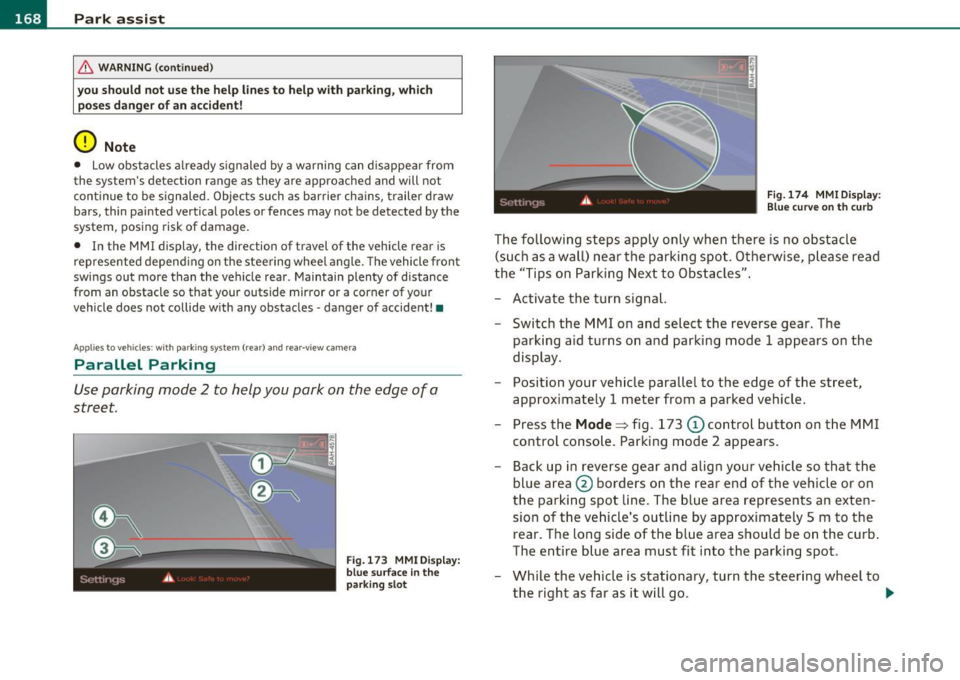
- Press the
Mode => fig. 173 © control button on the MMI
control console. Parking mode 2 appears.
- Back up in reverse gear and align your vehicle so that the
blue area
0 borders on the rear end of the vehicle or on
the parking spot line. The blue area represents an exten
sion of the vehicle's outline by approximately 5 m to the rear. The long side of the blue area should be on the curb.
The entire blue area must fit into the parking spot.
- While the vehicle is stationary, turn the steering wheel to
the right as far as it will go.
~
Page 171 of 364
_________________________________________________ P_ a_ r_k _a_ s_s _is _ t __ _
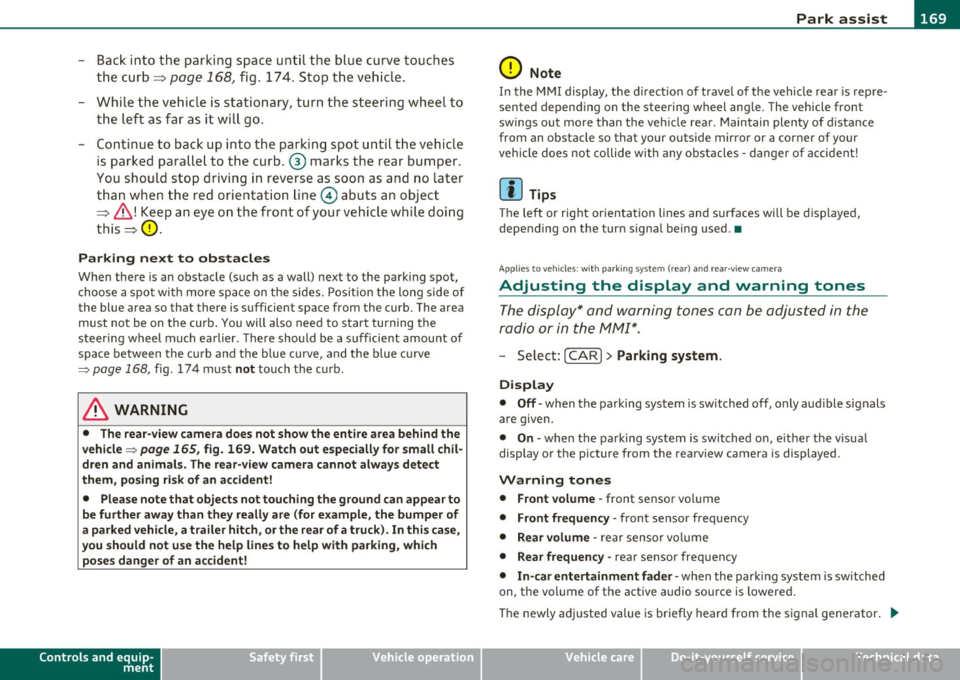
- Bac k into the parking space un til the bl ue curve touches
the curb =:>
page 168, fig. 17 4. Stop the vehicle .
- While th e ve hicle is statio nary, turn the steering wheel to
the left as far as i t wil l go .
- Continue to back up into the parking spot until the vehicle
is parked paralle l to the curb. @ mar ks the rear bumper .
You should stop driving in reverse as soon as and no late r
than when the red orie ntatio n line
0 abuts an object
:::::, & ! Keep an eye on the f ront of you r ve hi cle while doi ng
this =:>
0.
Parking next to obstacles
When there is an obstacle (such as a wall) next to the park ing spot,
choose a spo t w ith more space on the s ides. Pos ition the long side of
the blue area so that there is sufficient space from the curb. The area
must not be on the curb . You will also need to star t turning the
steeri ng wheel much earlier. There sho uld be a suff icie nt amount of
space between the cu rb and t he b lue c urve, and the blue c urve
=> page 168, fig . 1 74 must not touch the curb .
& WARNING
• The rea r-view camera does not show the entire a rea behind the
vehicle =>
page 165, fig. 169. Watch out e speciall y for small chil·
dren and animals . The rear-view camer a cannot always dete ct
them , posing ri sk of an accident!
• Please note th at objects not touching the ground can appear to
be further away than they really are (for example, the bumper of
a park ed vehicle, a trailer hit ch, or the r ear of a truck). In this ca se,
you should not u se the help line s to help with pa rking , which
po se s danger of an accident!
Controls and equip
ment Safety first
0 Note
I n the MMI display, the d irect io n of travel of t he vehicle rear is rep re
sented depending on the steering wheel ang le. The vehicle front
sw ings ou t mo re than t he veh icle rea r. M ain tain plenty of d ista nce
from an obstacle so that your outside mirror or a corner of your
vehicle does not collide w ith any obstacles -dange r of a ccident!
[ i ] Tips
Th e left or r ight or ien tat ion lines and s urf aces will be d isp laye d,
depending on the turn signal being used .•
A pp lies to veh icles : w ith par king system (rea r) and rea r-vi ew camera
Adjusting the display and warning tones
The display* and warning tones can be adjusted in the
radio or in the /11/111* .
- Select: [C A R]> Parking sy stem.
Display
• Off -when the parking system is switched off, only aud ible signals
are given.
• On -when the pa rking system is switched on, e ithe r the v isua l
display or the picture from the rearv iew camera is displayed .
Warning tones
• Front volume -front sensor vo lume
• Front frequ ency -front sensor frequency
• Rear volume -rear sensor vol ume
• Rear frequency -rear sensor freq uency
• In-car entertainm ent f ader · when the parking system is switched
on, the volume of the active a udio source is lowered .
Th e newly ad justed v alue is briefly hear d from the s ignal ge nerator.
~
Vehicle care Technical data
Page 180 of 364
• ....__D_ r_iv _i_ n_, g=-- S_ a _ f_e _,Ly _ ______________________________________________ _
Proper occupant seating positions
Proper seating position for the driver
The proper driver seating position is important for safe,
relaxed driving.
Fig. 178 Correct
seating position
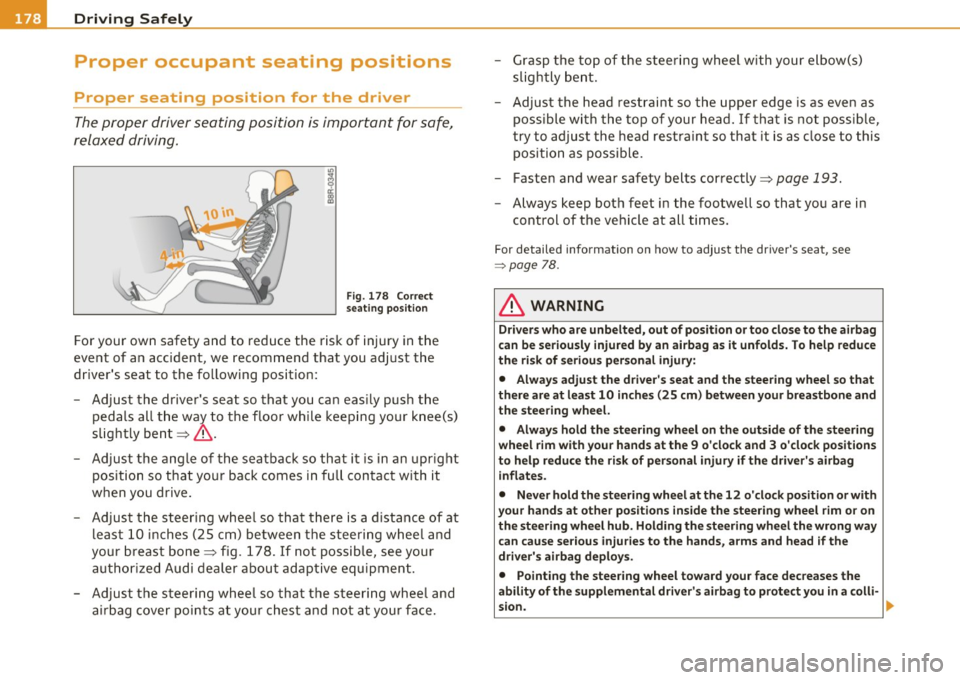
For your own safety and to reduce the risk of injury in the
event of an accident, we recommend that you adjust the
driver's seat to the following position:
- Adjust the driver's seat so that you can easily push the
pedals all the way to the floor while keeping your knee(s)
slightly bent~& .
- Adjust the angle of the seatback so that it is in an upright
pos ition so that your back comes in full contact with it
when you drive.
- Adjust the steering wheel so that there is a distance of at least 10 inches (25 cm) between the steering wheel and
your breast bone~ fig . 178. If not possible, see your
authorized Audi dealer about adaptive equipment.
- Adjust the steering wheel so that the steering wheel and airbag cover points at your chest and not at your face. -
Grasp the top of the steering wheel with your elbow(s)
slightly bent.
- Adjust the head restraint so the upper edge is as even as
possible with the top of your head. If that is not possible,
try to adjust the head restraint so that it is as close to this
position as possible.
- Fasten and wear safety belts correctly~
page 193.
-Always keep both feet in the footwell so that you are in
control of the vehicle at all t imes.
F o r deta iled informat ion on how to adjust the d river 's seat, see
=:> page 78.
& WARNING
Drivers who are unbelted, out of position or too close to the airbag
can be seriously injured by an airbag as it unfolds. To help reduce
the risk of serious personal injury:
• Always adjust the driver's seat and the steering wheel so that
there are at least 10 inches (25 cm) between your breastbone and
the steering wheel.
• Always hold the steering wheel on the outside of the steering
wheel rim with your hands at the 9 o'clock and 3 o'clock positions
to help reduce the risk of personal injury if the driver's airbag
inflates.
• Never hold the steering wheel at the 12 o'clock position or with
your hands at other positions inside the steering wheel rim or on
the steering wheel hub. Holding the steering wheel the wrong way
can cause serious injuries to the hands, arms and head if the
driver's airbag deploys.
• Pointing the steering wheel toward your face decreases the
ability of the supplemental driver's airbag to protect you in a colli-
sion.
~
Page 193 of 364
What happens to occupants not wearing
safety belts?
In crashes unbelted occupants cannot stop themselves from flying forward and being injured or killed. Always
wear your safety belts!
Fig. 188 A driver not
wearing a safety belt is
violently thrown
forward
Fig. 189 A rear
passenger not wearing
a safety belt will fly
forward and strike the
driver
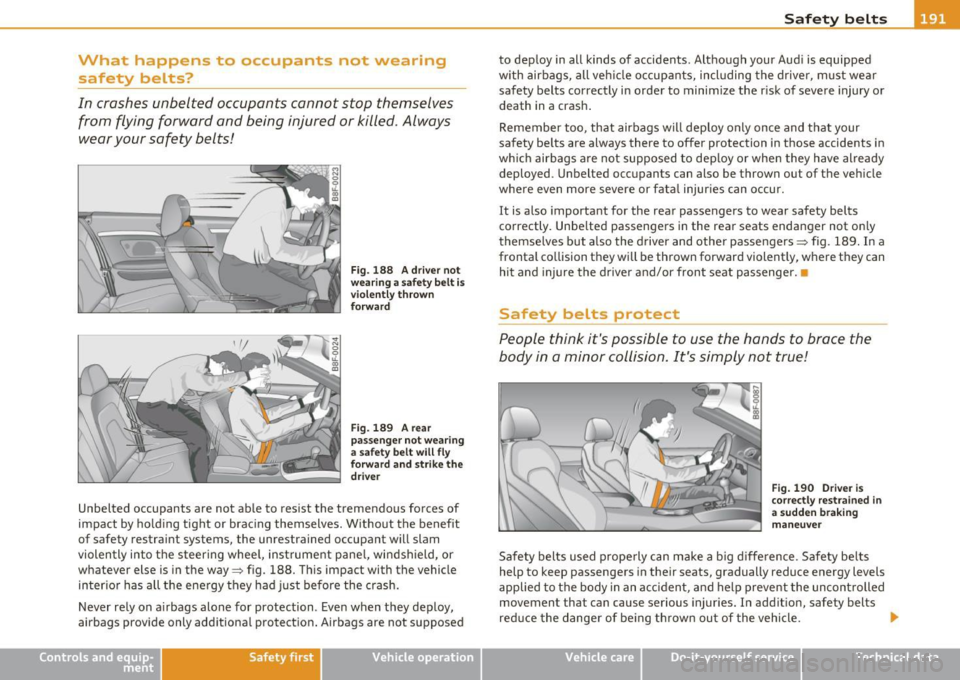
Unbelted occupants are not able to resist the tremendous forces of
impact by holding tight or bracing themselves. Without the benefit
of safety restraint systems, the unrestrained occupant will slam
violently into the steering wheel, instrument panel, windshield, or
whatever else is in the way=:> fig. 188. This impact with the vehicle
interio r has all the energy they had just before the crash.
Never rely on airbags alone for protection . Even when they deploy,
airbags provide only additional protection. Airbags are not supposed
Safety first Vehicle OP-eration
Safety belts
to deploy in all kinds of accidents. Although your Audi is equipped
with airbags, all vehicle occupants, including the driver, must wear
safety belts correctly in order to minimize the risk of severe injury or
death in a crash.
Remember too, that airbags will deploy only once and that your
safety belts are always there to offer protection in those accidents in
which airbags are not supposed to deploy or when they have already
deployed . Unbelted occupants can also be thrown out of the vehicle
where even more severe or fatal injuries can occur.
It is also important for the rear passengers to wear safety belts
correctly. Unbelted passengers in the rear seats endanger not only
themselves but also the driver and other passengers=:> fig . 189. In a
frontal collision they will be thrown forward violently, where they can
hit and injure the driver and/or front seat passenger. •
Safety belts protect
People think it's possible to use the hands to brace the
body in a minor collision. It's simply not true!
Fig. 190 Driver is
correctly restrained in
a sudden braking
maneuver
Safety belts used properly can make a big difference. Safety belts
help to keep passengers in their seats, gradually reduce energy levels
applied to the body in an accident, and help prevent the uncontrolled
movement that can cause serious injuries. In addition, safety belts
reduce the danger of being thrown out of the vehicle. .,.
•
Vehicle care Do-it-yourselt service iTechnical data
Page 201 of 364
_______________________________________________ A_ ir_ b_ a_,,,g '--- s.:.y _s _t_ e _ m ___ _
Airbag system
Important things to know
Importance of wearing safety belts and
sitting properly
Airbags are only supplemental restraints. For airbags to
do their job, occupants must always properly wear their
safety belts and be in a proper seating position.
For your safety and the safety of your passengers, before
driving off, always:
- Adjust the driver's seat and steering wheel properly
=>
page 178,
- Adjust the front passenger's seat properly=> page 78,
-Wear safety belts properly=> page 192,
-Always properly use the proper child restraint to protect
children=>
page 221.
In a collision airbags must inflate within the blink of an eye and with
considerable force. The supplemental airbags can cause injuries if the
driver or the front seat passenger is not seated properly. Therefore in
order to help the airbag to do its job, it is important, both as a driver
and as a passenger to sit properly at all times.
By keeping room between your body and the steering wheel and the
front of the passenger compartment, the airbag can inflate fully and
completely and provide supplemental protection in certain frontal
collisions =:,
page 178, "Proper occupant seating positions" . For
details on the operation of the seat adjustment controls=>
page 78.
It's especially important that children are properly restrained
=:,
page 221.
Controls and equip ment Safety first Vehicle operation
There
is a lot that the driver and the passengers can and must do to
help the individual safety features installed in your Audi work
together as a system .
Proper seating position is important so that the front airbag on the
driver side can do its job. If you have a physical impairment or condi
tion that prevents you from sitting properly on the driver seat with
the safety belt properly fastened and reaching the pedals, special
modifications to your vehicle may be necessary .
Contact your authorized Audi dealer, or call Audi Customer Relations
at 1-800-822-2834.
When the airbag system deploys, a gas generator will fill the airbags, break open the padded covers, and inflate between the steering
wheel and the driver and between the instrument panel and the front
passenger. The airbags will deflate immediately after deployment so
that the front occupants can see through the windshield again
without interruption.
All of this takes place in the blink of an eye, so fast that many people
don 't even realize that the airbags have deployed . The airbags also
inflate with a great deal of force and nothing should be in their way
when they deploy . Front airbags in combination with properly worn
safety belts slow down and limit the occupant's forward movement.
Together they help to prevent the driver and front seat passenger
from hitting parts of the inside the vehicle while reducing the forces
acting on the occupant during the crash. In this way they help to
reduce the risk of injury to the head and upper body in the crash.
Airbags do not protect the arms or the lower parts of the body.
Both front airbags will not inflate in all frontal collisions . The trig
gering of the airbag system depends on the vehicle deceleration rate
caused by the collision and registered by the electronic control unit.
If this rate is below the reference value programmed into the control
unit , the airbags will not be triggered, even though the car may be
badly damaged as a result of the collision. Vehicle damage , repair .._
Vehicle care Do-it-yourself service Technical data
Page 202 of 364
........ _A_ i_rb _ a_,g,:;._ s_, y'- s_ t_e _m ________________________________________________ _
costs o r ev en t he lack of v ehicle da mage is no t necessar ily an ind ica
t ion of whe the r an a irbag should inflat e or not.
It is not poss ible to defi ne a r ange of v ehicle speeds t hat w ill cove r
every possible k ind and a ngle of impact that will a lways t rigger t he
a ir bags, sin ce the c ircum stanc es will vary consider ably be twee n one
co llision and another. Important factors incl ude, fo r exam ple, the
n at ure (h ard or s oft) of th e obje ct whi ch the c ar hits , the ang le of
impact, vehicle speed, etc. The front airbags will also not inflate in
s ide o r rear coll isions , or in roll-ove rs.
Always remember: Airbags w ill deploy only once, an d on ly in certa in
kinds of co llisio ns. Your safety be lts are a lways there to offer protec
t ion in those s ituatio ns in which airbags ar e no t sup pose d to d eploy,
or w hen they have alrea dy de ploye d; for examp le, when your ve hicl e
st rikes or is st ruc k by ano ther afte r the first collis io n.
T hi s is just one of the reasons w hy an airbag is a s upplementa ry
restra in t a nd is no t a su bst itute for a safe ty bel t. The air bag sy stem
works most effectively when used with the safety be lts. Therefore,
always p rope rly wear y ou r safety belts => page 189 .
& WARNING
Sitting too close to the steering wheel or instrument panel will
decrease the effectiveness of the airbags and will increase the risk
of personal injury in a collision.
• Never sit closer than 10 inches (25 cm) to the steering wheel or
instrument panel.
• If you cannot sit more than 10 inches (25 cm) from the
steering wheel, investigate whether adaptive equipment may be
available to help you reach the pedals and increase your seating
distance from the steering wheel.
• If you are unrestrained, leaning forward, sitting sideways or
out of position in any way , your risk of injury is much higher.
• You will also receive serious injuries and could even be killed if
you are up against the airbag or too close to it when it inflates - even with an Advanced Airbag.
& WARNING (co ntinued )
• To reduce the risk of injury when an airbag inflates, always
wear safety belts properly=>
page 193, "Safety belts ".
• Always make certain that children age 12 or younger always
ride in the rear seat. If children are not properly restrained, they
may be severely injured or killed when an airbag infl ates .
• Never let children ride unrestrained or improperly restrained in
the vehicle. Adjust the front seats properly.
• Never ride with the backrest reclined.
• Always sit as far as possible from the steering wheel or the
instrument panel =>
page 178.
• Always sit upright with your back against the backrest of your
seat.
• Never place your feet on the instrument panel or on the seat.
Always keep both feet on the floor in front of the seat to help
prevent seriou s injuries to the legs and hips if the airbag inflates.
• Never recline the front passenger's seat to transport objects .
Items can also move into the area of the side airbag or the front
airbag during braking or in a sudden maneuver. Objects near the
airbags can become projectiles and cause injury when an airbag inflates .
& WARNING
Airbags that have deployed in a crash must be replaced .
• Use only original equipment airbags approved by Audi and
installed by a trained technician who has the neces sary tools and
diagnostic equipment to properly replace any airbag in your
vehicle and assure system effectiveness in a crash.
• Never permit salvaged or recycled a irbags to be installed in
your vehicle. •
Page 206 of 364
111,___A_ i_rb _ a_,g=-- s_, y:;.. s_ t_e _m ________________________________________________ _
& WARNING (conti nued)
• Even when they deploy, airbags provide only supplemental
protection.
• Airbag work most effectivel y when used with properly worn
safety belts .
• Therefore, always wear your safety belts and make sure that
everybody in your vehicle is properly restrained.
& WARNING
A person on the front passenger seat , especially infants and small
c hildren, will receive serious injuries and can even be killed by
being too close to the a irbag when it inflates .
• Although the Advanced Airbag System in your vehicle is
designed to turn off the front passenger airbag if an infant or a
small child i s on the front pa ssenger seat, nobody can absolutely
guarantee that deployment under these spec ial conditions is
impos sible in all conceivable situations that may happen during
the useful life of your vehicle .
• The Advanced Airbag System can deploy in a ccordance with the
" low risk" option under the U.S . Federal Standard if a child that is
heavier than the typical one-year old child is on the front
passenger seat and the other conditions for airbag deployment
are met.
• Accident statistics have shown that children are generally safer
in the rear seat area than in the front seating po sition .
• For their own safety , all children , especially 12 years and
younger, should alway s ride in the back properly re strained for
the ir age and size. •
Advanced front airbag system
Your vehicle is equipped with a front Advanced A irbag System in
comp li a nce wi th Unit ed State s F edera l Motor Vehicle Sa fety Sta ndar d
208 as applicable at t he time your veh icle was manufactured.
Th e front A dvanced A irbag System s upplements the safety belts to
prov ide addit ional p rotect ion fo r the driver's a nd front passenger's
hea ds and uppe r bodies in fronta l crashes . The airbags inflate only in
fronta l impa cts when the vehicle dece leration is high enoug h.
T he front Advanced Airbag System for the front seat occupants is not
a subs titu te for your s afe ty be lts. R athe r, it is part o f the ove rall occu
pant restra int system in your ve hicle. Always remember t hat the
airbag sys tem ca n on ly hel p to protect you, if yo u are sitting upr igh t,
wearing your safety be lt and wear ing it prope rly . T his is why you and
your passengers must always be p roperly restra ined, not just beca use
t he law requires you to be .
The Advanced A irbag System in your veh icle has been cert ified to
meet the " low r isk " req uirem ents fo r 3 a nd 6 year-old childre n on the
passenger s ide and very small adu lts on the driver s ide. T he low r isk
dep loyme nt crite ria are in tende d to hel p r educe t he ris k of injury
throug h interaction with the front airbag that can occur, for example,
by being too close to the steering wheel and instr ume nt pane l whe n
t he airbag i nflates.
In addit ion, the system has been cert ified to comply with t he
"supp ression" requirements of the Safety Stand ard, to turn off the
front airbag for infants 12 mont hs old and younger who are
res trained on the fron t passenger sea t in child re strai nts th at ar e
listed in the Standard~
page 223, "Child restraints and Advanced
Air bags".
" Sup pression" requ ires the front a irbag on the passenger side to be
turned off if:
• a chi ld up to about one year o f age is restra ined on the fron t
passenge r seat in one of t he rear-faci ng or forward-facing infant
res train ts lis ted in F eder al Motor Vehicle S afety Stand ard 208 wit h
w hich the Advanced A irbag System in yo ur vehicle was ce rtified . Fo r a .,_
Page 208 of 364
ffl..,___A_ i_rb _ a_,g,:;._ s_, y'- s_ t_e _m ________________________________________________ _
& WARNING (conti nued)
• The inflating ai rbag will hit the child safety seat or infant
carrier with gr eat force and will sma sh the child safety seat and
c hild again st the backrest , center armrest , door , or roof.
• Alway s install rearward-facing child restraints in the back seat.
• If you must install a rearward facing child safety seat on the
front passenger seat because of e xceptional circumstances and
the PASSENGER AIR BAG OFF light does not come on and stay on ,
immediately install the rear-facing child safety seat in a rear
s eating po sition and have the airbag system inspected by your
authorized Audi dealer .
& WARNING
If, in except ional circumstances, you must install a forward-facing
child restraint on the front pas senger' s seat:
• Always make sure the forward-fac ing se at has been designed
and certified by its manufacturer for u se on a front seat with a
passenger front and side airbag.
• Never put the forward -facing child restraint up against or very
near the instrument panel.
• Alway s move the passenger seat into it s rearmost position
in
the seat 's fore and aft adjustment range, as far away from the
airbag a s possible, before in stalling the forward -facing child
restraint. The back rest must be adjusted to an upright position.
• Make sure that the PASSENGER AIR BAG OFF light comes on
and stays on all the t ime whenever the ignition is switched on .•
Advanced Airbag System components
Th e front passenger seat in your veh icle has a lot of very important
parts of t he A dvanced A irbag System in it. These parts incl ude t he
we ight-sens ing mat, sensors, wiring, brackets, and more. The func- tion of the system
in the front passenger seat is checked by the elec
t ronic c ontro l unit w hen the ignitio n is o n. The contr ol unit mon itors
t he Advanced Airbag System and tu rns the airbag indicato r light o n
w hen a malfunction in t he system components is detected. The func
t ion of the a irbag indicator light is descr ibed in greater deta il below .
Because the front passenge r seat co nta ins impo rtant parts of t he
Adva nced Ai rbag System, you must ta ke care to p reve nt i t from be ing
damaged. Damage to the seat may p revent the A dvanced A irbag for
t he fro nt passenge r se at from do ing its job in a crash.
The front Advanced Airbag System consists of the
following:
• Cras h sensors in the front of t he vehicle that measu re vehicle
a cc ele ration/de ce le ra tion to provi de i nfo rm ation to the Advanced
Airbag System about the severity of the crash .
• An e lec tron ic contro l unit, w it h i ntegrated crash sensors fo r front
and side impacts. The contro l unit "dec ides" w het her to fire the front
a irbag s based o n the inform ation receive d fro m t he c rash se nso rs.
The contro l unit also "decides" whether the safety be lt pretens ioners
shoul d be activ at ed .
• An Advanced Air bag with gas generator and control va lve for the
dr ive r in side t he steering wheel hub.
• An Advanced Air bag with gas generator and control va lve inside
t he inst rument pa ne l for the fron t passenge r.
• A weight-sensi ng mat unde r th e up ho ls tery pad ding of the front
passenger s eat cushion that measures the tota l we igh t on the seat .
Th e informat io n registered is sent continuous ly to the elect ronic
con trol unit to regulate deployment of t he front Advanced A irbag o n
the passenger side.
• An airbag mon itoring system a nd ind icator light in the ins trument
cl uster => page
210 .
• A senso r in each front seat reg isters the distance between the
res pective sea t and t he steeri ng whee l o r i nst rument p ane l. T he
info rmation reg iste red is sent co ntin uously to the e lectronic con trol
uni t to reg ulate dep loyment of the front Advanced Air bags . ..,
Page 210 of 364
___ A_ ir_b_ a --= ge....- s.:y _s_ t_ e_ m ________________________________________________ _
situat ions . Be sure to read the important i nformat ion about safety
a nd hee d the WAR NIN GS i n t his ch apte r.
Deployment of the Advanced A irbag System and the act ivat ion of the
safety belt pretensioners depend on the deceleration measured by
t he crash senso rs an d regis tered by the e lectroni c con trol u nit. The
amount of inflation of the front airbags can a lso be adapted to the
front seat pos it ion, depending on t he d istance be tween the respec
tive front seat and the steering wheel or instrument panel as reg is
t ere d by sensors in the seats. Crash seve rity depends on speed and
deceleration as well as the mass and stiffness of the vehicle or object
involved in the crash .
On the passenger side, rega rd less of safety be lt use, the a irbag will
be t urned off if the we ight on the passenger seat is less tha n the
amount prog rammed in the e lec tronic contro l uni t. The fro nt airbag
on the passenger side will a lso be turned off if one of the chi ld safety
sea ts tha t has been cert ified under Federa l Mo to r Vehicle Safety
Standard 208 has been recognized on the seat . The
PASSENGER AIR
BAG OFF
lig ht comes on and stays on to tell you w hen the fron t
Advanced Airbag on the passenger side has been turned off
=> page 201, "C hild restraints o n the front sea t - some impo rtant
things to know ".
& WARNING
To reduce the risk of inju ry when an a irbag inflates, always wear
safety belt s properly.
• If you are un rest rained, leaning forward, sitting sideways or
out of posit ion in any way , your risk of injury is much higher .
• You will also receive serious injuries and could even be killed if
you are up again st the airbag or too clo se t o it wh en it inflates ·
even with an Advanced Airbag=>
page 199. •
More important things to know about front
airbags
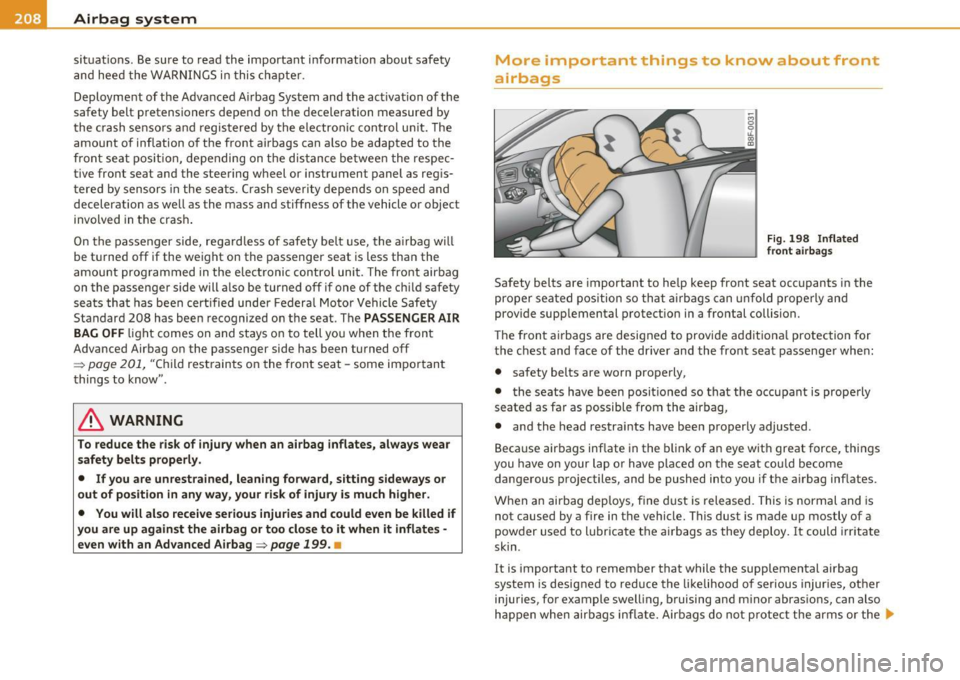
Fi g. 1 98 I nfl ate d
front a irb ags
Safety belts are important to he lp keep front seat occupants in the
pro per seated pos ition so that a irbags can unfold prope rly and
prov ide supp lemental protect ion in a frontal collision.
Th e front airbags are designed to provide add itio na l protec tion for
the c hest and face of the driver and the front sea t passenge r when:
• safety belts are worn properly ,
• t he seats have been posit ioned so that the occupant is prope rly
seated as far as possible from the airbag,
• and the head restraints have been properly adjusted .
Because air bags inflate in the b link of a n eye w it h great force, things
you have on your lap o r have place d on the seat cou ld become
dangerous projectiles, and be pushed into you if the a irbag inf lates .
When a n airbag dep loys, fine dust is released. This is normal and is
not caused by a fire in the vehicle. This dust is made up mostly of a
powder used to l ubricate the ai rbags as they deploy.
It could irritate
skin .
I t is important to remember that while the supp lemental airbag
system is desig ned to reduce the li ke lihood of serious injur ies, other
injuries, for example swelling , b ruising and m inor abras ions, can also
happen when airbags infl ate. Airbags do not p rotect the arms or the ..,_