steering wheel AUDI A5 CABRIOLET 2011 Owner's Manual
[x] Cancel search | Manufacturer: AUDI, Model Year: 2011, Model line: A5 CABRIOLET, Model: AUDI A5 CABRIOLET 2011Pages: 364, PDF Size: 86.48 MB
Page 211 of 364
Airbag system --------------------------------------------- -=---=----
lowe r pa rts of the body . Front a irbags only supp lemen t th e t hree
po int saf ety b elt s in som e frontal col lisions in which t he vehicl e decel
erat io n is high en ough to d ep loy the a irbags.
Front airbags will not deploy:
• if the ignition is switched off w hen a cras h occ urs ,
• in side co llisions,
• in re ar- end collisions,
• in rollove rs,
• when t he cra sh d ecelera tion m easur ed by the airbag sys te m is le ss
than the min imum threshold needed fo r airbag deployme nt as reg is
t ere d by t he e lectr onic c ontrol u nit.
The front passenger airbag will also not deploy:
• when t he fro nt p ass eng er s eat i s not o ccupi ed,
• when the weight on the front passenge r seat as sense d by the
A dvanc ed Airba g Sy stem indicat es that t he front a irbag o n the
passenge r s id e has to be turned off by the e lectro nic con trol unit (the
PASSENGER AIR BAG OFF lig ht c om es on an d sta ys on).
& WARNING
Sitting in the wrong position can increase the risk of serious injury
in crashes.
• To reduce the risk of injury when the airbags inflate, the driver
and passengers must always sit in an upright position , must not
lean against or place any part of their body too close to the area
where the airbags are located.
• Occupants who are unbelted, out of position or too close to the
airbag can be seriously injured by an airbag as it unfolds with
great force in the blink of an eye=>
page 201.
Controls and equip
ment Safety first Vehicle operation
& WARNING
A child in a rearward-facing child safety seat installed on the front
passenger seat will be seriously injured and can be killed if the
front airbag inflates - even with an Advanced Airbag System.
• The inflating airbag will hit the child safety seat or infant
carrier with great force and will smash the child safety seat and
child against the backrest, center armrest, door or roof.
• Always install rear-facing child safety seats on the rear seat.
• If you must install a rearward facing child safety seat on the
front passenger seat because of exceptional circumstances and
the PASSENGER AIR BAG OFF light does not come on and stay on,
immediately install the rear-facing child safety seat in a rear
seating position and have the airbag system inspected by your
authorized Audi dealer.
& WARNING
Objects between you and the airbag will increase the risk of injury
in a cra sh by interfering with the way the airbag unfolds or by
being pushed into you as the airbag inflates.
• Never hold things in your hands or on your lap when the vehicle
is in use.
• Never transport items on or in the area of the front passenger
seat. Objects could move into the area of the front airbags during
braking or other sudden maneuver and become dangerous projec
tiles that can cause serious personal injury if the airbags inflate .
• Never place or attach accessories or other objects (such as
cupholders, telephone brackets, large , heavy or bulky objects) on
the doors, over or near the area marked "AIRBAG " on the steering
wheel , instrument panel, seat backrests or between those areas
and yourself. These objects could cause injury in a crash, especially
when the airbags inflate .
• Never recline the front passenger's seat to transport objects .
Items can also move into the area of the side airbag or the front
IIJ,,
Vehicle care Do-it-yourself service Technical data
Page 215 of 364
Airbag system Ill
----------------=--=---
& WARNING (co ntinued )
seating position and have the airbag system inspected by your
authorized Audi dealer.
• A tight tether o r other strap on a rearward -facing child
restraint attached to the front pa ssenger seat can put too much
pressure on the weight -sensing mat in the seat and register more
weight than i s actually on the seat . The heavier weight regi stered
can make the system work as though an adult were on the seat
and deploy the Advan ced Airbag when it mu st be suppre ssed
causing serious or even fatal injury to the child .
• If , in exceptional circumstanc es, you must install a forward
facing child restraint on the front passenger seat, always move
the seat into its rearmost po sition in the seat' s fore and aft adjust
ment range, as far away from the airbag as possible . The backrest
must be adjusted to an upright position. Make sure that the PASSENGER AIR BAG OFF light comes on and stays on all the time
whenever the ignition is switched on.
& WARNING
• If the PASSENGER AIR BAG OFF light doe s not go out when an
adult is sitting on the front passenger seat after taking the steps
described above, make sure the adult is properly seated and
restrained at one of the rear seating positions.
• Have the airbag system inspected by your authorized Audi
dealer before transporting anyone on the front passenger seat .
[ i ] Tips
If the we ight-sens ing mat in the front passenger seat detects an
em pty seat, the front airbag on the passenge r side will be t urne d off,
and PASSENGER AIR BAG OFF will stay on.•
Controls and equip ment Safety first Vehicle operation
Repair, care and disposal of the airbags
Parts of the airbag system a
re insta lled at many different places on
your Audi. I nstall ing, remov ing, serv icing o r rep airi ng a pa rt in an
area of the vehicle ca n damage a part of a n airbag system and prevent
t ha t sys tem from working prope rly in a coll is io n.
Th ere are some importa nt things you have to know to ma ke sure t hat
the effectiveness of the system will not be impai red and that
dis ca rded compo nents do not cause injury or po llute t he e nvir on
ment .
& WARNING
Improper care , serv icing and repair procedures can increase the
risk of personal injury and death by preventing an airbag from
deploying when needed or deploying an airbag unexpectedly:
• Never cover, obstruct, or change the steering wheel horn pad or
airbag cover or the instrument panel or modify them in any way .
• Never attach any objects such as cupholders or telephone
mountings to the surfaces covering the airbag units .
• For cleaning the horn pad or instrument panel, use only a soft ,
dry cloth or one moistened with plain water . Solvent s or cleaners
could damage the airbag cover or change the stiffness or strength
of the material so that the airbag cannot deploy and protect prop
erly.
• Never repair, adjust, or change any part s of the airbag system .
• All work on the steering wheel, instrument panel , front seats
or electrical sy stem (including the installation of audio equip
ment, cellular telephones and CB radios, etc. ) must be performed
by a qualified technician who has the training and special equip ment necessary .
• For any work on the airbag system, we strongly recommend
that you see your authorized Audi dealer or qualified workshop.
• Never modify the front bumper or parts of the vehicle body . ..,_
Vehicle care Do-it-yourself service Technical data
Page 219 of 364
----------------------------------------------~A....::..:.... ir:....: b.::..:;; a..::g ~ s~y -=s:....: t:...: e:...: m...:....:.. __ lffll
If the front air bags deploy, th e knee a irbags also dep loy i n fronta l
coll is ions ab ove a c ertain s everity.
When the sys tem is d epl oyed , the ai rb a gs s ta rt to fill wi th a propel
lant gas, a nd inflate between the lowe r pa rt of t he instr ument pane l
and th e drive r an d th e l owe r part of the in strum ent pan el a nd t he
front passenger ~
page 208, fig. 198.
Al th ou gh they are no t a soft pil low, they can cus hion th e impact and
in t his way th ey can help to red uce the risk of in jury to t he lower
extremities.
A ll thi s t akes pla ce in stan tan eously , so fas t th at ma ny pe opl e don 't
even rea lize that t he airbags have deployed. The airbags a lso inflate
w ith a g reat d eal o f for ce and it is im portant for o ccupa nt saf ety th at
nothing sh ould be in their way when t hey deploy .
F ully in flated airba gs i n com binatio n with pr ope rly wo rn safety belts
slow dow n and limit the occ upant's forwa rd movement a nd he lp to
re duce the risk. •
Applies to veh icles : w it h Kn ee air ba gs
Important safety instructions on the knee
airbag system
Airbags ar e only supp lem en tal r estra ints . Alw ays wear
s a fe ty be lts cor re ctly and ride in a proper seating pos i
ti on .
Th ere is a lot that you an d yo ur passe ngers m ust know an d do to help
the sa fet y b elts and airbags to p rov id e su pp lemen tal protec tio n.
& WARNING
An inflating knee airbag can cause serious injury. Wearing safety
belts incorrectly and improper seating positions increase the risk
of serious personal injury and death whenever a vehicle is being
used.
Controls and equip ment Safety first Vehicle operation
& WARNING
(cont inued )
• The airbag system cannot protect you properly if you are seated
too close to any of the airbag locations. When adjusting their seat positions, it is important that both the driver and the front
passenger keep their upper bodies and knees at the following
minimum safe distances:
- 10 inches (25 cm) between the chest and the steering
wheel/instrument panel.
-4 inches (10 cm) between the knees and the lower part of
the instrument panel.
• The risk of personal injury increases if you lean forward or to
the side, or if the seat is improperly positioned and you are not
wearing your safety belt. The risk increases even more should the
airbag deploy .
• Always make sure that the knee airbag can inflate without
interference. Objects between yourself and the airbag can increase
the risk of injury in an accident by interfering with the way the
airbag deploys or by being pushed into you as the airbag deploys.
-No persons (children) or animals should ride in the footwell
in front of the passenger seat. If the airbag deploys, this can
result in serious or fatal injuries.
- No objects of any kind should be carried in the footwell area
in front of the driver's or passenger's seat. Bulky objects (shop
ping bags, for example) can hamper or prevent proper deploy
ment of the airbag. Small objects can be thrown through the
vehicle if the airbag deploys and injure you or your passengers.
• Make sure there are no cracks, deep scratches or other damage
in the area of the instrument panel where the knee airbags are
located.
• If children are incorrectly seated, their risk of injury increases
in the case of an accident~
page 221, "Child Safety". •
Vehicle care Do-it-yourself service Technical data
Page 243 of 364

Intelligent technology
--------------------------------------------------' "---.L==--
The system operates across the entire speed range in combination
w ith the ABS sys tem. If the A nti-L o ck Brak e System (A BS) mal fun c
tions, the ESP will also shut down.
How the system works
The Anti-Lock Brake System (ABS), Elect ronic D ifferential Lock (EDL)
and the Anti-Slip Regul ation System (AS R) are in teg rated in the e lec
tronic stab ilizat ion program . In addition to the data prov ided by
th ese fun ctions, the ESP control unit re quires addi tional meas ure
ment data provided by hig h pe rformance senso rs . The ro tat ional
speed of the vehicle about its vertical axis, veh icle acceleration in the
fore-and-a ft and lateral d irect ions, the brake pressure , a nd the
steerin g ang le are all measured .
Th e d irec tion in whi ch the driver w ishes to tra ve l is d ete rm ined wi th
the a id of the steering a ngle and ve hicle speed and is con tinually
c omp ared wi th the a ctu al b ehavior o f the ve hicl e. If t he two do no t
match, for example, when the vehicle starts hydroplani ng on a wet
roa d, E SP w ill automatica lly bra ke the approp riate whee l to correct
the problem.
Th e ve hicle is t hen stab ilized by the fo rces acting on the whee l during
bra king .
If the ve hicl e is oversteering (the vehicle tu rns too s harp ly
and the rear whee ls slide toward the outside of a curve), the brakes
a re mainly a pplied on the whee l tha t is o n the o uts ide of t he curve. In
the case of a vehicle that is
understeering (the vehicle does not turn
shar ply enough and push es out o f a curve), the b rakes are ap plied as
needed on the whee l th at is on the inside of the curve or additionally
on the ot her wheels . An acoustic s ignal indicates w hen ESP bra ke
applica tion cuts in=> &.
T he system operates across the entire speed range in combination
w ith the A BS system =>
page 245. If the A nti-Lo ck Br ake Sys tem
(ABS) ma lfunctions, the ESP w ill be o ut of act ion as we ll.
Activating
When you turn on the engine, ESP wi ll automatica lly be activated and
w ill pe rfor m a self- tes t. As soo n as t he tes t is c om plete d, th e sys tem
is in normal operating mo de.
Controls and equip
ment Safety first Vehicle operation
Yo
u can activate a deactivated ESP or deactivated ESP/ ASR if required
b y pressi ng the =>
page 240, fi g. 2 13 => page 240, fig. 2 12 bu tton.
Wh en they are activated, the message
Stabilisation program on
appears briefly in t he di sp lay .
Deactivating
The ES P shoul d no rma lly be acti va te d a ll the tim e. I f necess ary, y ou
can deact ivate A nti-Slip Reg ulat io n (ASR) or th e Electro nic Sta biliza
t ion Progr am ( ES P) by p ress ing the button =>
page 2 40, fig. 213.
• Deactivating ASR: Tap th e button . In cer tain exceptional s itua
t ions (e.g. driving with tire chains), the Anti -Slip Reg ulation (ASR) can
be dea ct iva te d =>
page 242. The m ess age ASR off Caution! Limited
driving stability
a pp ears in the d isp lay as well.
• Deactivating ESP/ASR Press the but ton for mor e tha n 3 seconds .
With the ESP/ASR deactivated, t he ESP check light comes o n, see
=>
p age 14. The m ess age Warning! Restri cted stability ap pears in
the display as we ll.
& WARNING
The Electronic Stabilization Program is nevertheless subje ct to the
laws of physics . It is particularly important to pay attention to
this fact on wet and slippery roads. It is therefore important that
you always adapt your driving to the condition of the road and
traffic conditions . Do not allow the increased safety provided by
the Electronic Stabilization Program system to lull you into accepting additional safety risks .
u
Vehicle care Do-it-yourself service Technical data
Page 248 of 364

Intelligent t echnology
'-----------------------------------------------
Servotronic® - advanced power
steering system
The power steering systems uses the power of the
running engine to allow precise steering with little effort .
The advanced Servotronic® power steering system senses the road
speed and ele ct ronically adjusts power assistance to provide
comfortable and safe steering response exactly matched to the
veh icle speed.
Power steering will not work if the engine is off. As a resu lt, the
steeri ng wheel will be hard to turn.
T he power steeri ng fluid level is checked du ring the sched uled main
tenance services .
0 Note
If there is an electronic malfunction, servotronic will still function
like a conventional power s teer ing system, provid ing a cons tant
steering support force that is no longer proportionate to the vehicle
speed. This is most noticeable when t urning the s teer ing wheel at low
speeds (for example when park ing), -more effort will be required
than us ua l.
• Be aware of the d ifferent than usual steering response and adjust
your stee ring force accord ingly .
• Have the prob lem checked and set right by an Audi dealer as soon
as possib le.
[ i ] Tips
• When the e ngine is running, neve r hold the stee ring whee l turned
all the way to the right or to the left for longer than 15 seconds. The
powe r steering pump wi ll overheat the hydra ulic fluid if yo u keep
holding the steering wheel turned all the way . This is likely to damage
t he power s teer ing system . •
If the power steering system s hou ld fa il entirely, or if the engine
is no t ru nning (fo r examp le, while be ing towed), you will st ill be able
to steer the vehicle. However,
considerably more effort will be
req uired to do so .
• If the power steering system should have a leak, or is not func
tioning prope rly, con tact your au thor ized A udi dealer immedia tely.
• The power steer ing system requires a specia lly formulated
hyd raulic fluid. The power steer ing rese rvoir is the one loc ated
farthest to the rear on the left s ide of the eng ine compartme nt
=>
page 281. The correct fluid leve l in the reservo ir is im port an t fo r
proper functioning of the power steeri ng .•
Applies to veh icles: with A ll Whee l D rive
Driving with your quattro ®
With all wheel drive, all four wheels are driven.
CieneraL information
Wi th all wheel drive, power is d istribu ted to all fou r whee ls. This
happens automatically depending on your dr iv ing style and the road
condi tions a t the t ime. See also=>
page 242, "Ele ct ronic differen tial
lock (EDL)".
W inter tires
When driving in the winter, your vehicle with a ll whee l dr ive has an
adv anta ge, eve n w it h regula r tir es. In w inte r road co nditio ns i t may
be advisable to mount winter tires (or all-season tires) for improved
dr iveabili ty and b raking: t hese tires m ust be moun ted on all four
wheels . See also=> page 311, "Winter t ires".
Tire chains
Where tire chains are mandatory on certa in roads, th is normally also
app lies to veh icles with a ll w heel d rive =>
page 312, "Snow chains". ~
Page 259 of 364
Observe speed limits. In some areas, speeds for vehicles towing
t railers are lowe r than for regular veh icles.
Always apply brakes early. When dr iv ing downh ill, sh ift in to a lower
gear to use the engine braking effect to slow the vehicle. Use of the
brakes alone can cause them to overheat and fail.
Coolant temperature
The coolant temperature gauge~ page 8 must be observed care
fully. If the needle moves close to the upper end of the scale, reduce
speed immediately and/or turn off the air conditione r.
If the coolant temperature warning light in the instrument cluster
star ts flashing
-t- , pull off the road, stop and let the engine idle for
about two minutes to prevent heat bu ild-up.
& WARNING
Anyone not properly restrained in a moving vehicle is at a much
greater risk in an accident. Never let anyone ride in your car who is
not properly wearing the restraints provided by Audi. u
Trailer towing tips
Important to know
------------
Your vehicle handles differently when tow ing a tra iler because of the
additiona l weight and different weight distribution. Safety, perfor
mance and economy will greatly depend on how carefu lly you load
your trailer and operate your rig .
Before you actua lly tow your trailer, practice turning, stopping and
backing up in an area away from traffic. Keep pract icing until you have
become completely familiar with the way your vehicle-t railer combi
nation behaves and responds.
Controls and equip
ment Safety first Vehicle operation
Backing up
is d iff icult and requ ires practice . Backing up with a trailer
generally requires steering action opposite to that when backing up
your vehicle without a trailer.
Maintain a greater distance between your vehicle and the one in front
of you. You will need more room to stop . To compensate fo r the
trailer, you will need a larger than norma l turning radius.
When passing, remember that you cannot accelerate as fast as you
normally would because of the added load. Make sure you have
enough room to pass. After passing, allow plenty of room for you r
trailer before changing lanes again.
Avoid jerky starts, sharp turns or rapid lane changes .
[I) Tips
• Do not tow a trai ler during the break-in per iod of your vehicle.
• If you tow a tra iler, your Audi may requi re more frequent mainte
nance due to the extra toad~
page 343. •
Parking on a slope
Do not park on a slope with a trailer. If it cannot be
avoided, do so only after doing the following:
When parking:
-Apply the foot brake.
- Have someone place chocks under both the vehicle and the
trailer wheels.
- With chocks in place, slowly release the brakes until the
wheel chocks absorb the load.
- Turn the wheels towards the curb.
- Apply the parking brake .
- Move the se lector lever to
P.
Vehicle care Do-it-yourself service Technical data
Page 318 of 364

IIIIL-_T.:..:..: ir:....:e~ s=---= a~ n:..:..: d:......: w..:....:.. h:....:e~ e= ls=--------------------------------------------------
The tire pressure monitor ing must be reset via rad io or MMI* each
t ime t he press ures are adjusted (e.g. w hen sw itching be tween p artial
and full load pressure) o r after changing or replac ing a tire on yo ur
vehicle => page
316. You ca n find t he recommen ded tire pressures
for your veh icle on the labe l on driver's s ide B-pilla r => page
300.
Tire tread circ umference and vibrat ion characteristics can change and
c a u se a tir e pressure war ning if:
• the t ire pressure in one or more tires is too low,
• t he tire ha s structur al dam age,
• the tire press ure was changed, wheels rotated or rep laced but the
TPM S was no t reset=> page
316.
Warning symbols
1..1' Loss of press ure in at least one tire=> &. Check the tire or tires
and replace or repair if necessary. The indicator light (• in the instru
me nt cluste r a lso illuminates=> page
12. Check/correct the p res
sures o f all four tires and reset TPMS via rad io or MMI *.
rr :; (T ire Pressu re M on itor ing System) Tire pres sure! System
malfunction.
If T ,.;> appears after switching the ignition on or w hile
dr iv ing => page
315, fig. 23 3 and the indica to r lig ht 'in th e instr u
me nt clus ter b links for approx ima tely one m inute and the n stays on,
there is a system ma lf u nct io n. See your authorized Audi dealer as
soon as poss ible.
& WARNING
• If the tir e pres sure indicator appears in the instrument cluster
display, one or more of your tires i s significantly under-inflated.
Reduce your speed immediately and avoid any hard steering or
braking maneuvers. Stop as soon a s possible and check the tires
and their pressures . Inflate the tire pressure to the proper pres
sure as indicated on the vehicle 's tire pressure label=>
page 300.
Driving on a significantly under -inflated tire causes the tire to
overheat and can lead to tire failure. Under -inflation also is likely
to impair the vehicle's handling and stopping ability.
& WARNING (co ntinued )
• The driver is re sponsible for maintaining the correct tire pres
sures . You must check the tire pres sures regularly .
• Under certain conditions (such as a sporty driving style , winter
conditions or unpaved roads) , the pressure monitor indicator may
be delayed.
• Ask your authorized Audi dealer if run-flat tires may be used on
your vehicle . Your vehicle registration becomes invalid if you u se
the se tires when not permitted. Damage to your vehicle or acci
dents could also result.
[ i ] Tips
• T he tire pressure monito ring system stops working when there is
an ES P/ABS malf u nctio n.
• Using snow cha ins may res ult in a system ma lf u n ct ion .
• The tire pressure mon itor ing system on your Au di was calibrated
using t ires with the "AO" or "RO " id ent ificat ion . We re comme nd
using these tires. •
Applies to vehicles: with tire p ressure monito ring sys tem
Reset tire pressure monitoring system
I f the tire pressure is adjus ted, wheels are rotated or
changed, th e TPfvf S must b e re set via radio or fv1fv1 I*.
- Turn on the ign it ion .
- Sele ct: Fu nct ion bu tton
[C AR]> Tire pressure monitoring
> Store now.
[ i ] Tips
Before resett ing the TPMS, the current pressures of all four t ires
mus t co rrespo nd to the specifie d val ues. A djust the tire pre ssure and
~
Page 350 of 364

___ A_ l_. p_ h _ a_b_ e_ t_ic _a_ l_ in_ d_e _ x ____________________________________________ _
A
A/C mode ...................... 93, 100
Accessories ..... .................. . 345
Active rollover protection system ... ... 186
Retracting rollover protection . ..... 187
Adaptive cruise control ............ .. 116
Chang ing speed .................. 119
Dr iver information ............... 122
Driver intervention prompt ........ 126
Driving in traffic ................. 117
Driving program .. .. ............. 127
Error messages . .. ...... .... ..... 125
Open road ...................... 117
Override ................ ...... .. 117
Request for driver to assume control 117
Save speed . . . . . . . . . . . . . . . . . . . . . . 119
Setting distance ................. 121
Setting time interval . ............. 121
Sett ings ... ..................... 127
Special driving situations ........ .. 127
Status messages ........ ......... 125
Switching on and off .............. 118
System limits ................ ... 127
T emporarily turning off ........... 120
warning/indicator lights ........... 123
Adaptive light ... ...... .............. 66
defect ive . . . . . . . . . . . . . . . . . . . . . . . . 3 7
Adding Engine coolant .................. 288
Engine oil .. ...... ....... ..... ... 284
Windshield washer flu id ........ ... 295 Additional accessories
............... 345 Side airbags .. .. .. .. .. .. ......... 218
Additives We
ight-sensing mat .............. 222
Engine oil ........ .... .. .. .. .. ... 284 When must
the system be inspected? 210
Adjusting All wheel drive
.. .. .. .. .. ...... ... .. 246
Steering column .......... .. .. .. . 105 Winter tires
.. .. ................. 311
Adjusting front seats .......... ...... . 77 Alloy wheels
........... .. .... .... .. 266
Airbag Warning/indicator lights ... .. .. .. .. 14
Airbag system .................. 199, 219
Advanced Airbag System .......... 203
Advanced Airbag System components 206 Care .................... .. .... . 213
Child restraints .................. 223
Children ........................ 222
Components (front airbags) ... .. .. . 206
Danger of fitting a child safety seat on the
front passenger seat ............ 201
Disposal ........ .... ..... .. .... . 213
Front airbags .............. .. 203, 204
How do the front airbags work? ..... 208
How many airbags does my vehicle have? .
206
How the Advanced Airbag System compo- nents work together ........... . 207
Important safety instructions on the knee airbag system ............ ... .. . 217
Important things to know .. .. .. .. . 199
Indicator light ........ .. .. .. .... . 210
Knee airbags .................... 215
Monitoring . .. ............... ... 210
PASSENGER AIR BAG OFF light ..... 211
Repairs .. ........ ... ... .. .. .. .. . 213
Safety instructions ............. .. 212 Alternator
Malfunct ion .... .. .. .............. 29
Anti-freeze
See Eng ine cooling system ......... 286
Anti-glare inside day-night mirror ..... .. 72
Anti -lock brake system
How the ABS system works . . . . . . . . 245
Wa rning/indicator lights . .......... 15
Anti-Slip Regulation System (ASR) How the system works ..... ... .. .. 242
Anti-theft systems Electronic immobilizer ............. 41
Ashtray ............................ 85
Asterisk What does it mean when something is
marked with an asterisk? . . . . . . . . . . . 5
Audi brak ing guard .................. 129
Error messages . . . . . . . . . . . . . . . . . . 131
Settings ........................ 131
Status messages ................. 131
Switching on and off ....... ... .. .. 131
Audi drive select Description ..................... 145
Setting the driving mode .......... 146
Audi Service Repair Manuals and Literature ..
343
Page 351 of 364

___________________________________________ A_ l::.. p _h _a_ b_ e_t _ic _a_ l_ in_ d _ e_x __ _
Auto Lock .. .. ... ..... ... ... ... .. .. .. 42 B
Auto Safety Hotline ... ... ... . .. ..... 185
Auto-Check Control .. ..... ... .... ... .. 27
Automatic belt retractor .......... ... 194
Automatic car wash
See Washing ......... .... .. .... . 261
Automatic climate control . . . . . . . . . 88, 9S
Automatic driving light control ......... 63
Automatic power top ..... .. .. .. .... .. 51
Automatic Shift Lock (ASL) ... .. .. 150, 157
Automatic transmission Automatic Shift Lock (ASL) .... 150, 157
automatic transmission ........ ... 148
Driving ...... ...... .. .. .. .. .. .. . 148
Dynamic shift program ... .... .. ... 151
Emergency release ............. .. . 154
Emergency release for selector lever
(mu ltitron ic®) ............... .. . 161
Fail-safe mode .............. 153, 160
Kick-down ...................... 151
Manual shift program ............. 152
multitronic ® ..................... 154
Selector lever ........... .. .. 149, 156
Shift buttons ....... .. .. .... 153, 160
Steering wheel with tiptronic ® . 153, 160
Automatic wipe/wash system .......... 69
Average speed .. ....... .... .. .. .. .. .. 21
Avoid damaging the vehicle .. .. .. .. .. . 251 Battery
... .. ... ... ................. 290
Charging . .. .. .. .... .. .. ... ... .. . 293
Important warnings when work ing on the
battery ..... ........... ...... .. 291
Jump starting . ........... ........ 333
Low ... .. .. .. .... .... .. ......... 247
Replacing the battery .. .. .. .... ... 294
State of charge ..... .. ... ...... .. 247
Winter operation ..... ..... ....... 290
Working on the battery .... .... .... 291
Battery voltage .. ........... ...... .. . 36
Before driving .. ... .... .. .. .. .. ..... 177
Belt positioner .. .. .... .. ... ... ..... 193
Blended gasoline ................ ... 27 4
Body cavity sealing . ................. 267
Booster seats ... .. ...... .. ......... 229
Brake assist ..................... ... 245
Brake booster . ........ ... .......... 244
Brake fluid
Changing the brake fluid ........... 290
Checking the brake fluid level ..... .. 289
Reservoir .. .. .. .... .... ......... 289
What is the correct brake fluid level? . 289
What should I do if the brake fluid warning light comes on? . ... ... .......... 289
Brake system .. .. .. ..... .... ........ 289
Anti-lock brake system . .. .......... 15
Brake fluid ... .... ............... 289
Brake fluid specifications for refill and
replacement ................... 290
Brake light defective ....... .... ... . 35 Brake pads
.. .. .... ..... .... .... . 251
Electromechanical parking brake .... 110
General information .............. 243
How does moisture or road salt affect the
brakes? ... .... .............. .. 243
Malfunction .............. .... .. .. 30
Warning/indicator lights ....... .. .. 17
Worn brake pads symbol ........... 35
Braking guard
See Audi braking guard ............ 129
Break-in period ... .. .. .............. 250
Brake pads .. ...... ........... .. . 251
Tir es ... .. .. ................. .. . 250
Bulbs ................ .. .... .... .. . 332
C
California Proposition 65 Warning .. ... 281
Battery specific .................. 293
Capacities ......................... 342
Car care .. .... .............. ...... . 260
Interior ............ .. .. .. .. .. .. . 268
Plastic and vinyl .... ............. . 264
Weatherstrips ............ .. .. .. . 266
Care of exterior ... .... .. . .. .. .. .. .. . 260
Cargo area
See Loading the luggage compartment ..
183
Catalytic converter .. ..... ........... 251
Certification ......... .............. 346
Changing a flat tire .. ................ 320
Changing a wheel ...... ...... .... .. . 320
Changing engine oil ... .. .. ......... . 285
Controls and equip
ment Safety first Vehicle operation
Vehicle care Do-it-yourself service Technical data
Page 356 of 364
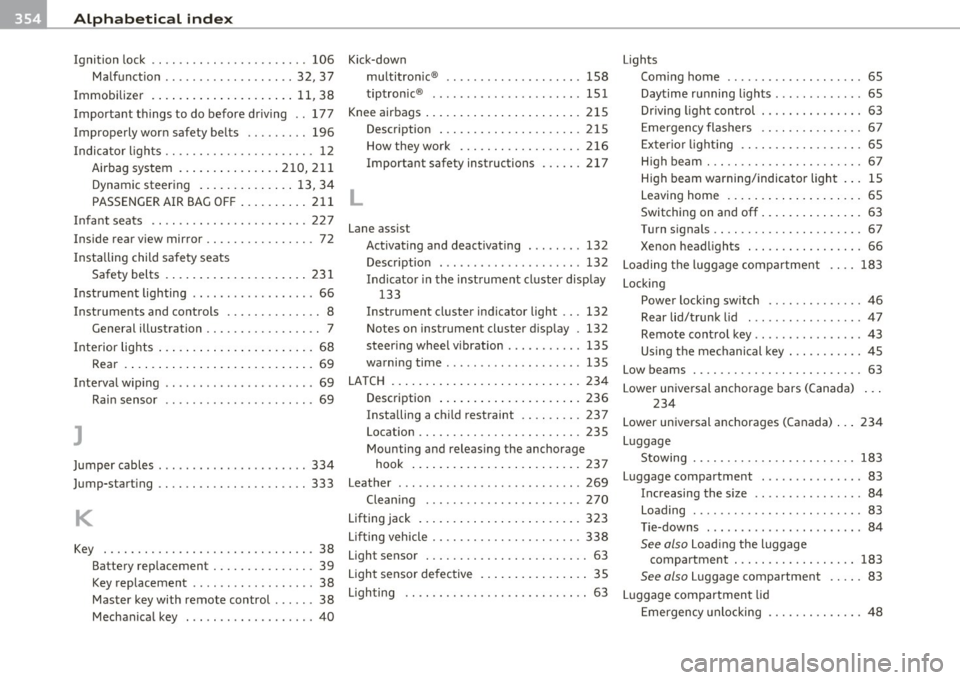
-Alphabetical inde x _ ___,_ ______ .::..:....=.:..:..__ __________________________ _
Ignition lock .. .. .. .. .. .. ... ........ 106
Malfunction .............. ... .. 32, 37
Immobilizer ... ................. . 11, 38
Important things to do before driving .. 177
Improperly worn safety belts ....... .. 196
Indicator lights ............. ...... ... 12
Airbag system ...... ..... .... 210,211
Dynamic steering .............. 13, 34
PASSENGER AIR BAG OFF .......... 211
Infant seats .... .... ...... ......... 227
Inside rear view mirror ................ 72
Insta lling child safety seats
Safety belts .................. ... 231
Instrument lighting .. .. .......... .... 66
Instruments and controls .............. 8 General illustration ............. .. .. 7
Interior lights ... .. .. .. ... ..... ...... 68
Rear .... .. .. .................... 69
Interval wip ing .. ............ ........ 69
Rain sensor ..... ....... ..... .. .. . 69
J
Jumper cables ...................... 334
Jump-starting .... .. .... .. .. .. .. .. .. 333
K
Key . ..................... .. .... .. . 38
Battery replacement ............... 39
Key replacement .... .. .. .. .. .. .. .. 38
Master key with remote control ...... 38
Mechanical key ..... ... ........... 40 Kick-down
multitronic ® ................ ... . 1S8
t.
t . ® rp ronic ................ ... .. . 151
Knee airbags ................ .. .... . 215
Description . .. ................. . 215
How they work ......... .. .. .. .. . 216
Important safety instructions ...... 217
L
Lane assist
Activating and deactivating ........ 132
Description . .................. .. 132
Indicator in the instrument cluster display
133
Instrument cluster indicator light ... 132
Notes on instrumen t cluster display . 132
steering wheel vibration . .......... 135
warning time .. ... ... ... .. .. .. ... 135
LATCH ............ .... ..... .. .... . 234
Description ... ................. . 236
Installing a child restraint .. .. .... . 237
Location ....... ...... .... .. ..... 235
Mounting and releasing the anchorage hook .............. .... ....... 237
Leather . .. .. .. .. ..... ...... .. ... .. 269
Cleaning . .......... ... .. ... ... . 270
Lifting jack ......... .... .... ....... 323
Lifting vehicle .... ........... .. .. .. . 338
Light sensor ............ .... .. ...... 63
Light senso r defective ............. ... 35
Lighting .. .. .. .... ....... .... .... .. 63 Lights
Com ing home .......... .... ...... 65
Daytime running lights ............. 65
Dr iving light control . .......... ... . 63
Emergency flashers .. .. .. .. .. .. .. . 67
Exterior lighting .. .. .... ......... . 65
H igh beam ... .. .. .. .............. 67
High beam warning/indicator light ... 15
Leaving home ........ ... .. .... ... 65
Switching on and off .............. . 63
Turn signals .. .. .... ............. . 67
Xenon headlights . .. ............. . 66
Loading the luggage compartment 183
Locking Power locking switch . . . . . . . . . . . . . . 46
Rear lid/trunk lid ................. 4 7
Remote control key . . . . . . . . . . . . . . . . 43
Us ing the mechanical key . .......... 45
Low beams . . . . . . . . . . . . . . . . . . . . . . . . . 63
Lower unive rsal ancho rage bars (Canada) ...
234
Lower universal anchorages (Canada) . .. 234
Luggage Stowing ............ .. .. .. .... .. 183
Luggage compartment ............... 83
Increasing the s ize .. .......... .... 84
Loading ........... .. . ... ... .. ... 83
Tie-downs . . . . . . . . . . . . . . . . . . . . . . . 84
See also Loading the luggage
compartment . .. .. ......... .... 183
See also Luggage compartment .... . 83
Luggage compartment lid
Emergency unlocking ....... .. .. .. . 48