belt AUDI A5 CABRIOLET 2011 Owner's Manual
[x] Cancel search | Manufacturer: AUDI, Model Year: 2011, Model line: A5 CABRIOLET, Model: AUDI A5 CABRIOLET 2011Pages: 364, PDF Size: 86.48 MB
Page 194 of 364
___ s_a_ f_ e_ t_ y _ b_e _l_t _s ___________________________________________ _
Safety be lts attach passe ngers to t he car an d give th em the benef it of
b ei ng s lo we d d own mor e gentl y or "so ftly" throu gh th e "give" in the
sa fety bel ts, crush z ones a nd oth er safety feat ures engin eered in to
today 's vehicles . By "absor bing" the kinetic e ner gy over a lo ng er
p eriod of time, th e saf ety belts make the forces o n th e body mor e
"to lerable" and less likely to ca use inju ry .
Alt hou gh the se ex amp les a re based on a fr ontal col lis ion, safety bel ts
can a lso s ubstantially red uce the risk of in jur y in other ki nds of
cras hes. So , whe ther you 're o n a long tri p o r ju st go in g to th e co rner
sto re, a lways b uckle up a nd make sure others do, too. Accident statis
t ics s how t hat vehi cle occupan ts properly wea rin g safety belts have a
lower risk of bei ng in jured and a muc h better cha nce of s urvivi ng an
acc ident. Properly usi ng safety belts also greatly increases the ability
of the supp lemental a irbags to do t heir job in a co llisio n. For this
reason, wea ring a safety belt is lega lly re quir ed in most countries
including muc h of th e Uni ted Stat es and Canad a.
Altho ugh your Audi is equipped with a irbags, yo u still have to wear
t he s afety bel ts provi ded. Fr ont airba gs, for ex ample, are activ ated
only in some fro nta l collisions . T he front a irbags are not activated in
all fr ont al collis ions, in side and re ar co llisions, in ro ll overs or in cases
w her e th er e is no t enough d ecelerat io n t hroug h im pac t to th e fron t
o f th e ve hicle. T he same goes for the ot he r air bag sys tems in yo ur
Audi. So, always wear your saf ety be lt and make sure eve rybody in
your vehicle is properly restrai ned! •
Important safety instructions about safety
belts
S afety bel ts m ust alw ays b e co rre ctly po sitio ned a cross
t he str ongest bones o f your bo dy.
- Al ways we ar saf ety be lts as illustra te d an d descri bed i n
this c hapter.
- M ake sure that your s afet y be lts are alw ays re a dy f or use
a nd a re n ot d amaged .
& WARNING
Not wearing safety belts or wearing them improperly increases
the risk of serious personal injury and death. Safety belts can work only when used correctly.
• Always fasten your safety belts correctly before driving off and
make sure all passengers are correctly restrained.
• For maximum protection , safety belts must always be posi
tioned properly on the body.
• Never strap more than one person, including small children,
into any belt.
• Never place a safety belt over a child sitting on your lap.
• Always keep feet in the footwell in front of the seat while the
vehicle is being driven.
• Never let any person ride with their feet on the instrument
panel or sticking out the window or on the seat.
• Never remove a safety belt while the vehicle is moving. Doing
so will increase your risk of being injured or killed.
• Never wear belt s twisted .
• Never wear belts over rigid or breakable objects in or on your
clothing, such as eye glasses, pens, keys, etc., as these may cause
injury .
• Never allow safety belts to become damaged by being caught
in door or seat hardware.
• Do not wear the shoulder part of the belt under your arm or
otherwise out of position.
• Several layers of heavy clothing may interfere with correct
positioning of belts and reduce the overall effectiveness of the
system .
• Always keep belt buckles free of anything that may prevent the
buckle from latching securely . .._
Page 195 of 364
& WARNING (continued)
• Never use comfort clips or devices that create slack in the
shoulder belt. However, special clips may be required for the
proper use of some child restraint systems.
• Torn or frayed safety belts can tear, and damaged belt hard
ware can break in an accident. Inspect belts regularly. If webbing,
bindings, buckles, or retractors are damaged, have belts replaced
by an authorized Audi dealer or qualified workshop.
• Safety belts that have been worn and loaded
in an accident
must be replaced with the correct replacement safety belt by an
authorized Audi dealer. Replacement may be necessary even if
damage cannot be clearly seen. Anchorages that were loaded
must also be inspected.
• Never remove, modify , disassemble, or try to repair the safety
belts yourself.
• Always keep the belts clean . Dirty belts may not work properly
and can impair the function of the inertia reel=> page 2 72,
"Safety belts". •
Safety first Vehicle OP-eration
Safety belts
Safety belts
Belt positioner
The driver and front passenger seats are equipped with
belt positioners.
Fig. 191 Driver's seat:
Be lt positioner
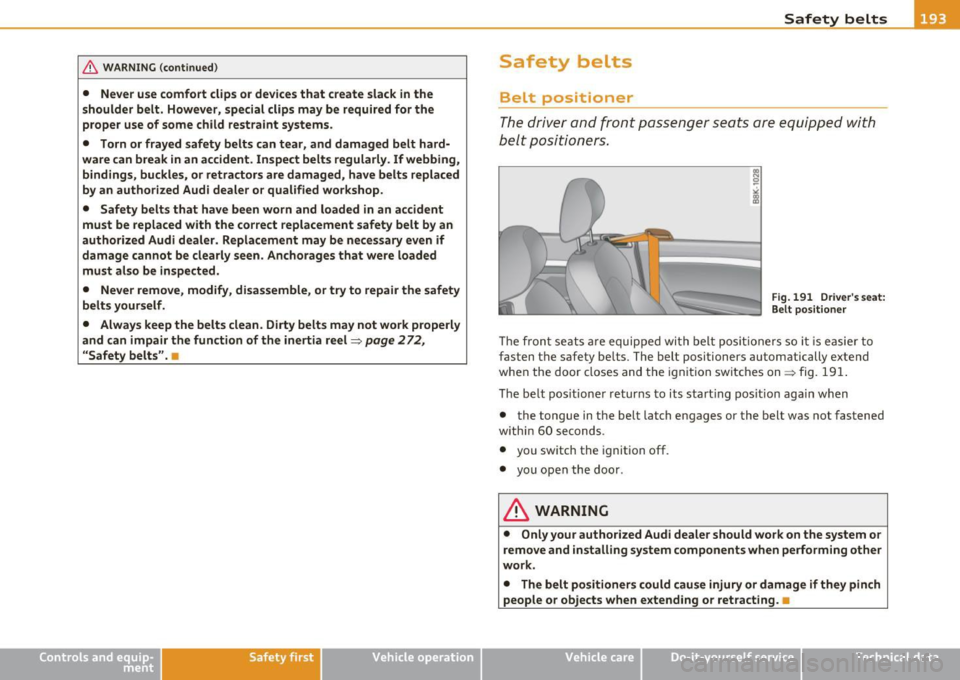
Th e front seats are equipped with belt positioners so it i s easier to
fasten the safety belts. The belt positioners automatically extend
when the door closes and the ignition switches on=> fig. 191.
The belt positioner returns to its starting position again when
• the tongue in the belt latch engages or the belt was not fastened
within 60 seconds .
• you switch the ignition off.
• you open the door .
& WARNING
• Only your authorized Audi dealer should work on the system or
remove and installing system components when performing other
work.
• The belt positioners could cause injury or damage if they pinch
people or objects when extending or retracting. •
Vehicle care Do-it-yourselt service iTechnical data
Page 196 of 364
-Safety belts ----------------
Fastening safety
belts
Seat first -everybody buc kle up!
Fig. 192 Bel t buckl e
a n d ton gue on the
d riv er's se at
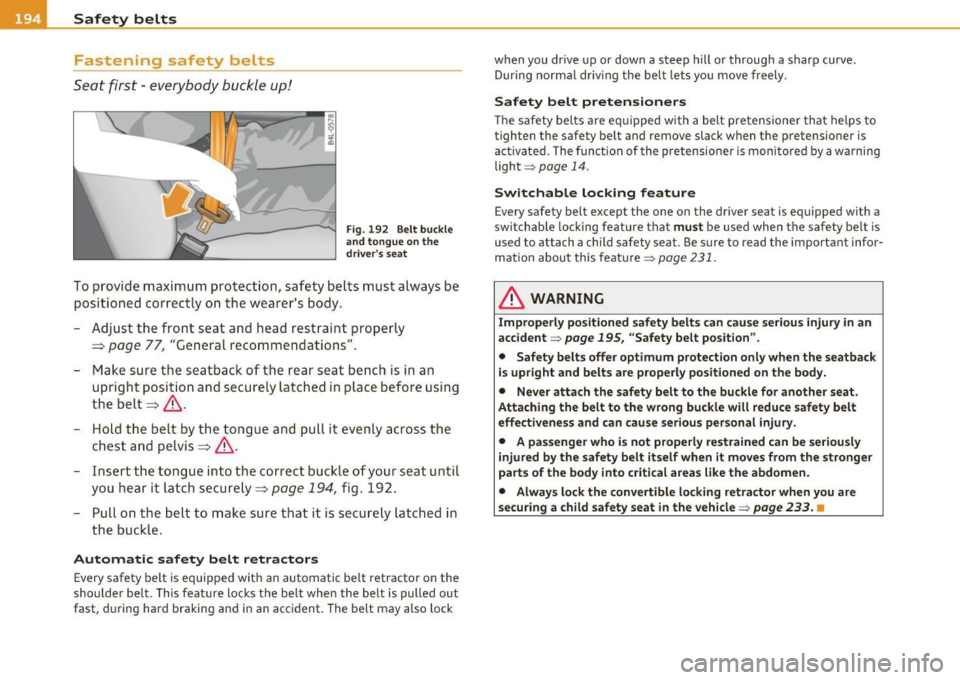
To provide maximum protection, safety belts must always be
posit ioned cor rectly on the wearer's body.
- Adjust the front seat and head restraint properly
=>
page 77, "General recommendat ions" .
- Make sure the seatbac k of the rear seat bench is in a n
upright posit ion and securely latched in place before using
the belt=> &.
- Hold the belt by the to ng ue and pu ll it evenly across t he
chest a nd pe lvis=> &.
- Insert the tongue into the corre ct buckle of your seat until
you hea r it latch secu re ly =>
page 194, fig. 192.
- Pull on the be lt to make sure t hat it is secure ly latched i n
the buckle.
Automatic safety belt retractor s
Every safety belt is equipped with an automatic be lt retractor on the
shoulder be lt . This feat ure locks the be lt when the belt is pulled out
fast, d uring hard braking and in an acc ident. The belt may also lock when you dr
ive up or down a steep hill or throug h a sharp curve .
Dur ing no rma l driv ing the be lt lets you move freely.
Safety belt pretensioners
The safety bel ts are eq uipped with a belt pretensioner tha t he lps to
tighten the safety be lt and remove slack when the pretensioner is
a cti vated. The fun ct ion of the pretensioner is mon itored by a w arning
light=>
page 14 .
Switchable locking feature
Every safety belt except the one on the driver seat is equ ipped with a
switchab le locking feature that
mu st be used when t he safety be lt i s
used to attach a chi ld safety seat. Be sure to read the important infor
mat ion abou t th is feat ure=>
page 231 .
& WARNING
Improperly po sitioned safety belts can cau se seriou s injury in an
accident
=> page 195 , "Safety belt position".
• Safety belts offer optimum protection only when the seatba ck
is upright and belts a re prope rly po sitioned on the body.
• Never attach the safety belt to the buckle f or another seat .
Attach ing the belt to the wrong buckle will reduce safet y belt
effectivenes s and can cau se seriou s personal injury.
• A passenger who i s not p rope rly restrained can be ser iousl y
injured by the safety belt it self wh en it move s from the stronger
parts of the body into critical areas like the abdomen.
• Always lock the convertible locking retractor when you are
s ecuring a child safety seat in the vehicle =>
page 233. •
Page 197 of 364
Safety belt position
Correct belt position is the key to getting maximum
protection from safety belts.
Fig. 193 Head
restraint and safety
belt pos ition as seen
from the side
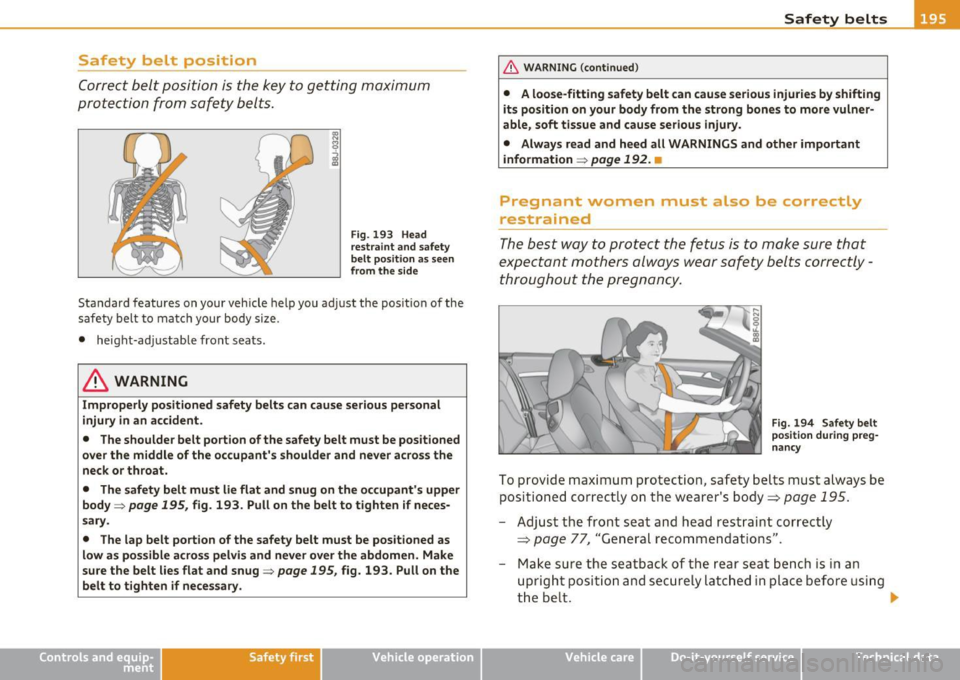
Standard features on your vehicle help you adjust the position of the
safety belt to match your body size.
• height-adjustable front seats.
& WARNING
Improperly positioned safety belts can cause serious personal
injury in an accident.
• The shoulder belt portion of the safety belt must be positioned
over the middle of the occupant's shoulder and never across the
neck or throat.
• The safety belt must lie flat and snug on the occupant's upper
body =>
page 195, fig. 193. Pull on the belt to tighten if neces
sary.
• The lap belt portion of the safety belt must be positioned as
low as possible across pelvis and never over the abdomen. Make
sure the belt lies flat and snug=>
page 195, fig. 193. Pull on the
belt to tighten if necessary.
Safety first Vehicle OP-eration
Safety belts
& WARNING (continued)
• A loose-fitting safety belt can cause serious injuries by shifting
its position on your body from the strong bones to more vulner
able, soft tissue and cause serious injury.
• Always read and heed all WARNINGS and other important
information =>
page 192. •
Pregnant women must also be correctly
restrained
The best way to protect the fetus is to make sure that
expectant mothers always wear safety belts correctly -
throughout the pregnancy.
Fig. 194 Safety belt
position during preg·
nancy
To provide maximum protection, safety belts must always be positioned correctly on the wearer's body ===>
page 195.
- Adjust the front seat and head restraint correctly
===> page 77, "General recommendations".
- Make sure the seatback of the rear seat bench is in an
upright position and securely latched in place before using
the belt. •
I .
Vehicle care Do-it-yourselt service iTechnical data
Page 198 of 364
.. Safety belts PJWI _______________ _
-Hold the belt by the tongue and pull it evenly across the
chest and pelvis=> fig. 194, => & .
- Insert the tongue into the correct buckle of your seat until
you hear it latch securely=>
page 194, fig. 192.
- Pull on the belt to make sure that it is securely latched in
the buckle.
& WARNING
Improperly positioned safety belts can cause serious personal
injury in an accident.
• Expectant mothers must always wear the lap portion of the
safety belt as low as possible across the pelvis and below the
rounding of the abdomen.
• Always read and heed all WARNINGS and other important
information =:-
& in "Fastening safety belts" on page 194. •
Unfastening safety belts
Unbuckle the safety belt with the red release button only
after the vehicle has stopped.
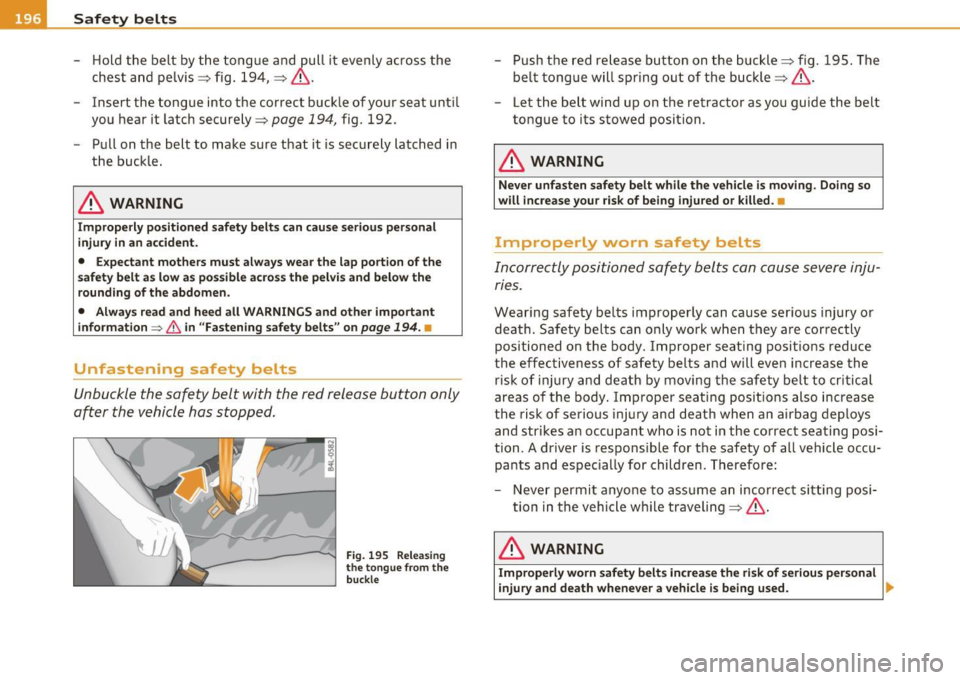
Fig. 195 Releasing
the tongue from the
buckle
-Push the red release button on the buckle=> fig. 195. The
belt tongue will spring out of the buckle=>& .
- Let the belt wind up on the retractor as you guide the belt
tongue to its stowed position .
& WARNING
Never unfasten safety belt while the vehicle is moving. Doing so
will increase your risk of being injured or killed.•
Improperly worn safety belts .
Incorrectly positioned safety belts can cause severe inju
ries.
Wearing safety belts improperly can cause serious injury or
death. Safety belts can only work when they are correctly
positioned on the body. Improper seating positions reduce
the effectiveness of safety belts and w ill even increase the
risk of injury and death by moving the safety belt to critical
areas of the body. Improper seating positions also increase
the risk of serious injury and death when an airbag deploys
and strikes an occupant who is not in the correct seating posi
tion. A driver is responsible for the safety of all vehicle occu
pants and especially for children . Therefore:
- Never permit anyone to assume an incorrect sitting posi
tion in the vehicle while traveling=>,& .
& WARNING
Improperly worn safety belts increase the risk of serious personal
injury and death whenever a vehicle is being used.
IJI,
Page 199 of 364
_____________________________________________ S_a _f _e _t _y _b_ e_lt _ s __ l!'II
& WARNING (co ntinued )
• Always make sure that all vehicle occupants are correctly
restrained and stay in a correct seating position whenever the
vehicle is being used.
• Alway s read and heed all WARNINGS and other important
information =>
page 192. •
Safety belt pretensioners
How safety belt pretensioners work
In front, side and r ear -en d co llisions abov e a p artic ula r
se verity , safe ty belts a re ten sio ned auto mat ically .
The safety belts are equipped w ith safety belt p retensioners . T he
sys tem is activ at ed by sen so rs in fro nt, side and rea r-end co llisi ons of
great severity . T h is tightens t he belt and takes up belt slack=>
& in
" S e rvi ce and dispo sal of sa fe ty be lt pr eten sioner" . Tak ing up t he sl ack
helps to reduce forward occupant movement during a coll is io n.
0 Note
N ever let the belt rema in over a rear seatback that has been folded
forward .
[ i ] Tips
T he safety bel t pretensioner can only be activa ted once .
• In m inor frontal and side co llisions, in rear-end collisions, in a roll
over and in acc iden ts invo lving very li ttle im pact force, the sa fe ty belt
pretensioner are not activated.
• Wh en t he safety belt pre ten sio ner s are activ at ed, a fin e dust is
re leased . T hi s is no rma l and is not caused by a fire in the vehicle.
Controls and equip ment Safety first Vehicle operation •
The relevant safety requ irements must be observed when the
veh icle o r com ponen ts of the system a re scrapped. An aut horiz ed
Audi dealer or qualified workshop is familiar w it h these regu lations
and wi ll be p lease d to pass on t he informat ion to you.
• Be sure to observe all safety, e nvironmental and other regu lations
if the ve hicl e or ind iv idual parts o f the sys tem, p articula rly t he s afety
bel t or a irbag, are to be disposed . We recommend you have your
author ized Au di dea le r p erfo rm this service fo r yo u.•
Service and disposal of safety belt
pretensioner
Th e safety bel t pre ten sio ners are p arts o f the safe ty belt s on y our
Audi. Installing, remov ing, serv ic ing or repair ing of belt preten
sion ers can da mage the s afety belt sys te m and pr event it fr om
wor king cor rectly in a collision .
T he re are some important things you have to know to ma ke sure t hat
t he e ffective ness of t he sys te m will not be impa ired and t hat
discarde d compo nents do not cause injury or poll ute t he env iron
m ent .
_& WARNING
Improper care, servicing and repair procedures can increase the
risk of personal injury and death by preventing a safety belt
pretensioner from activating when needed or activating it unex
pectedly:
• The belt pretensioner system can be activated only once. If belt
pretensioners have been activated , the system must be replaced .
• Never repair, adjust, or change any parts of the safety belt
system.
• Safety belt systems including safety belt pretensioners cannot
be repaired . Special procedure s are required for removal, installa -
tion and d isposal of this system. .,_
Vehicle care Do-it-yourself service Technical data
Page 200 of 364
___ s_a_ f_ e_ t_ y _ b_e _l_t _s ___________________________________________ _
& WARNING (continued)
• For any work on the safety belt system , we strongly recom
mend that you see your authorized Audi dealer or qual ified tech
nician who has an Audi app roved repair manual, training and
s pecial equipment necessary .
W For the sake of the environment
Undeployed ai rbag mod ules and pr etensioners might be class ified a s
Perch lorate Material -special handling may app ly, see
www.dtsc.c a.gov/h azardouswaste/pe rchlor ate. Whe n the ve hicle or
parts of t he restraint system i ncludi ng a irbag modu les safety belts
w ith pretens ioners are s crapped, all appl icable laws and reg ulat io ns
must be observed. You r author ized Aud i dealer is familiar with these
req uirements and we recommend that you have your dealer perfo rm
this service for you. •
Page 201 of 364
_______________________________________________ A_ ir_ b_ a_,,,g '--- s.:.y _s _t_ e _ m ___ _
Airbag system
Important things to know
Importance of wearing safety belts and
sitting properly
Airbags are only supplemental restraints. For airbags to
do their job, occupants must always properly wear their
safety belts and be in a proper seating position.
For your safety and the safety of your passengers, before
driving off, always:
- Adjust the driver's seat and steering wheel properly
=>
page 178,
- Adjust the front passenger's seat properly=> page 78,
-Wear safety belts properly=> page 192,
-Always properly use the proper child restraint to protect
children=>
page 221.
In a collision airbags must inflate within the blink of an eye and with
considerable force. The supplemental airbags can cause injuries if the
driver or the front seat passenger is not seated properly. Therefore in
order to help the airbag to do its job, it is important, both as a driver
and as a passenger to sit properly at all times.
By keeping room between your body and the steering wheel and the
front of the passenger compartment, the airbag can inflate fully and
completely and provide supplemental protection in certain frontal
collisions =:,
page 178, "Proper occupant seating positions" . For
details on the operation of the seat adjustment controls=>
page 78.
It's especially important that children are properly restrained
=:,
page 221.
Controls and equip ment Safety first Vehicle operation
There
is a lot that the driver and the passengers can and must do to
help the individual safety features installed in your Audi work
together as a system .
Proper seating position is important so that the front airbag on the
driver side can do its job. If you have a physical impairment or condi
tion that prevents you from sitting properly on the driver seat with
the safety belt properly fastened and reaching the pedals, special
modifications to your vehicle may be necessary .
Contact your authorized Audi dealer, or call Audi Customer Relations
at 1-800-822-2834.
When the airbag system deploys, a gas generator will fill the airbags, break open the padded covers, and inflate between the steering
wheel and the driver and between the instrument panel and the front
passenger. The airbags will deflate immediately after deployment so
that the front occupants can see through the windshield again
without interruption.
All of this takes place in the blink of an eye, so fast that many people
don 't even realize that the airbags have deployed . The airbags also
inflate with a great deal of force and nothing should be in their way
when they deploy . Front airbags in combination with properly worn
safety belts slow down and limit the occupant's forward movement.
Together they help to prevent the driver and front seat passenger
from hitting parts of the inside the vehicle while reducing the forces
acting on the occupant during the crash. In this way they help to
reduce the risk of injury to the head and upper body in the crash.
Airbags do not protect the arms or the lower parts of the body.
Both front airbags will not inflate in all frontal collisions . The trig
gering of the airbag system depends on the vehicle deceleration rate
caused by the collision and registered by the electronic control unit.
If this rate is below the reference value programmed into the control
unit , the airbags will not be triggered, even though the car may be
badly damaged as a result of the collision. Vehicle damage , repair .._
Vehicle care Do-it-yourself service Technical data
Page 202 of 364
........ _A_ i_rb _ a_,g,:;._ s_, y'- s_ t_e _m ________________________________________________ _
costs o r ev en t he lack of v ehicle da mage is no t necessar ily an ind ica
t ion of whe the r an a irbag should inflat e or not.
It is not poss ible to defi ne a r ange of v ehicle speeds t hat w ill cove r
every possible k ind and a ngle of impact that will a lways t rigger t he
a ir bags, sin ce the c ircum stanc es will vary consider ably be twee n one
co llision and another. Important factors incl ude, fo r exam ple, the
n at ure (h ard or s oft) of th e obje ct whi ch the c ar hits , the ang le of
impact, vehicle speed, etc. The front airbags will also not inflate in
s ide o r rear coll isions , or in roll-ove rs.
Always remember: Airbags w ill deploy only once, an d on ly in certa in
kinds of co llisio ns. Your safety be lts are a lways there to offer protec
t ion in those s ituatio ns in which airbags ar e no t sup pose d to d eploy,
or w hen they have alrea dy de ploye d; for examp le, when your ve hicl e
st rikes or is st ruc k by ano ther afte r the first collis io n.
T hi s is just one of the reasons w hy an airbag is a s upplementa ry
restra in t a nd is no t a su bst itute for a safe ty bel t. The air bag sy stem
works most effectively when used with the safety be lts. Therefore,
always p rope rly wear y ou r safety belts => page 189 .
& WARNING
Sitting too close to the steering wheel or instrument panel will
decrease the effectiveness of the airbags and will increase the risk
of personal injury in a collision.
• Never sit closer than 10 inches (25 cm) to the steering wheel or
instrument panel.
• If you cannot sit more than 10 inches (25 cm) from the
steering wheel, investigate whether adaptive equipment may be
available to help you reach the pedals and increase your seating
distance from the steering wheel.
• If you are unrestrained, leaning forward, sitting sideways or
out of position in any way , your risk of injury is much higher.
• You will also receive serious injuries and could even be killed if
you are up against the airbag or too close to it when it inflates - even with an Advanced Airbag.
& WARNING (co ntinued )
• To reduce the risk of injury when an airbag inflates, always
wear safety belts properly=>
page 193, "Safety belts ".
• Always make certain that children age 12 or younger always
ride in the rear seat. If children are not properly restrained, they
may be severely injured or killed when an airbag infl ates .
• Never let children ride unrestrained or improperly restrained in
the vehicle. Adjust the front seats properly.
• Never ride with the backrest reclined.
• Always sit as far as possible from the steering wheel or the
instrument panel =>
page 178.
• Always sit upright with your back against the backrest of your
seat.
• Never place your feet on the instrument panel or on the seat.
Always keep both feet on the floor in front of the seat to help
prevent seriou s injuries to the legs and hips if the airbag inflates.
• Never recline the front passenger's seat to transport objects .
Items can also move into the area of the side airbag or the front
airbag during braking or in a sudden maneuver. Objects near the
airbags can become projectiles and cause injury when an airbag inflates .
& WARNING
Airbags that have deployed in a crash must be replaced .
• Use only original equipment airbags approved by Audi and
installed by a trained technician who has the neces sary tools and
diagnostic equipment to properly replace any airbag in your
vehicle and assure system effectiveness in a crash.
• Never permit salvaged or recycled a irbags to be installed in
your vehicle. •
Page 205 of 364
& WARNIN G (con tinued )
• Imprope r in stall ation of child re straints can redu ce their effec·
tiveness or even prevent them from providing any protection.
• An improperl y installed child re straint c an interfere with the
airbag a s it deploy s and seriously injure or even kill the child - even
with an Advanced Airbag Sy stem.
• Always carefully follow the manufacturer 's instruct ions
provided with the child safety seat or carrier.
• Ne ver place additional items on the seat that can increase the
total weight regi stered by the weight-sen sing mat and can cause
injury in a crash .•
Front airbags
Description of front airbags
T he airbag system can p rovide supplemental protection
to properly r estrained front se at oc cupants .
Safety first
Fig . 19 6 Locatio n of
drive r airb ag : in
s tee ring whee l
Vehicle OP-eration
Airbag system
Fig. 19 7 Locati on of
fr on t pass enge r's
a ir bag: in the instru
me nt pa nel
Yo ur vehicle is equi pped with an "Advanced A irbag Syst em" in compli ·
ance with United States Fe dera l Moto r Vehicle Safety Sta ndard
(FMVSS) 2 08 as a pplicable at t he time your vehi cle was manufac
t u red . The system senses the position of the front seats and controls
front a irbag infl ation w ith a va lv e , dep ending on th e distanc e
between the respective seat and the stee ring wheel or instrument
pane l. The safe ty belts fo r the seats have "prete ns ione rs" t hat he lp to
take slack out of the belt system. The p retensioners are also activated
by the elec tron ic control u nit for the air bag sys tem.
T he front s afe ty belts also have load limiters to help red uce the forces
applied to the body in a cras h.
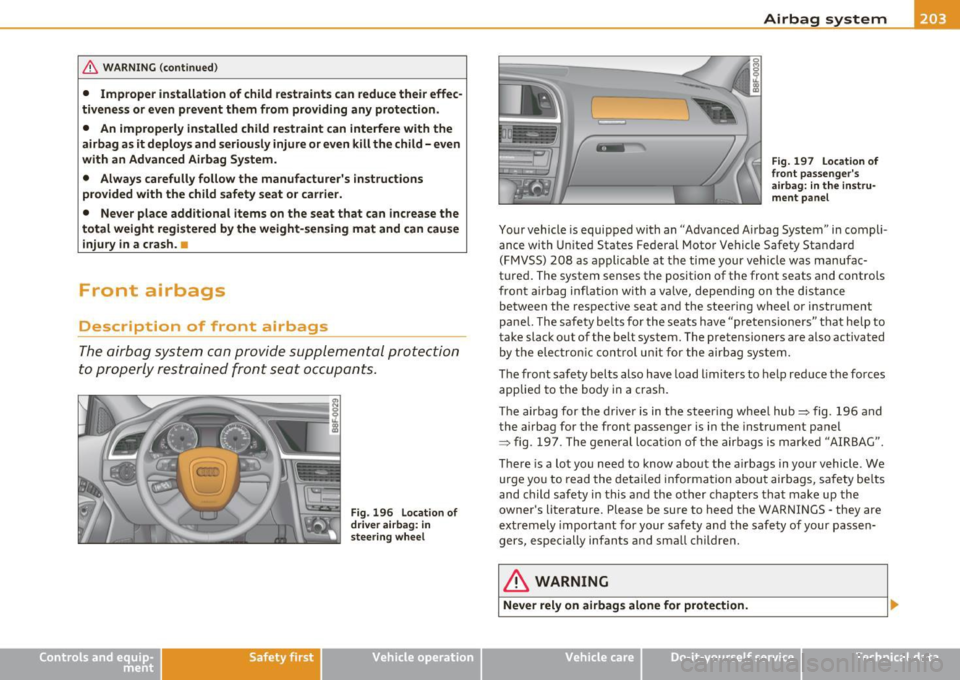
Th e airbag for the driver is in the stee ring whee l hub::::> fig. 196 and
the ai rbag for the front passenger is in the inst rument panel
::::> fig. 19 7. T he ge neral lo cat io n of the air bags is m ark e d "A IRBAG".
Th ere is a lot you need to know about the a irbags in your vehicle. We
urge yo u to read the det ailed in forma tion abou t air bags, sa fety be lts
and child safety in this and the other chap ters tha t make u p the
owner's literature. Please be sure to heed the WARNINGS -they are
e xtremely importa nt f or your safety and the saf ety of your pas se n
gers, especially infants and sma ll ch ildren.
& WARNING
Never rely on airbags alone for protection.
Vehicle care Do-it-yourselt service iTechnical data