fuel AUDI A5 CABRIOLET 2011 Owner's Manual
[x] Cancel search | Manufacturer: AUDI, Model Year: 2011, Model line: A5 CABRIOLET, Model: AUDI A5 CABRIOLET 2011Pages: 364, PDF Size: 86.48 MB
Page 161 of 364
____________________________________________________ T _r_a _n_ s_m _ i_s _s_ i_ o _ n _ ___._
when the driver presses the brake pedal on a downhill gradient . This
makes use of the braking effect of the engine w ithout the need to
shift down manually .
If you are driving in hills and mounta ins, the transmission will contin
uously adjust the gear ratio to the road grade. If you press the brake
pedal when driving downhill, the transmission will downshift auto
matically. This increases the brak ing effect of the engine.
If the cru ise control is on when you are traveling downhill, the trans
mission will automatica lly select a lower gear ratio in order to main
tain the set vehicle speed. Th is will cause the engi ne speed to
increase. •
Applies to vehi cles : wit h mul tit ro nic ® Co nt in uous ly Variabl e Tra ns missi on (CVT )
tiptronic ® manual shift program
Using the manual shi~ program (tiptronic®) you can
manually shift between seven pre-programmed gear
ratios (transmission positions) .
Contro ls a nd e quip
m en t
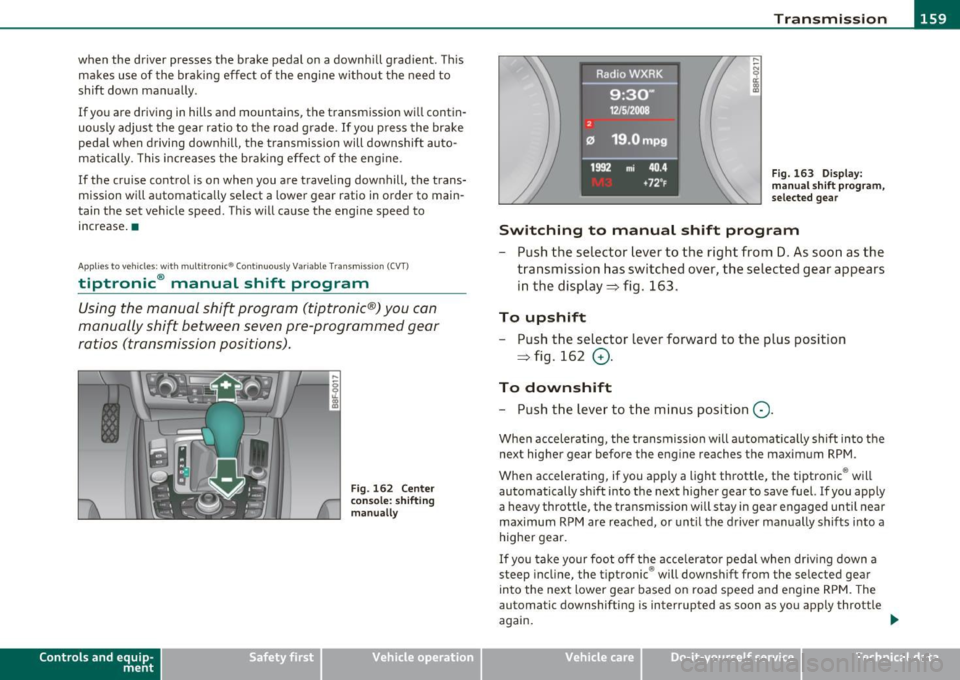
Fig. 162 Center
console: shifting
manually
Vehicle OP-eration
Fig. 163 Di splay:
man ual shift program,
selected gear
Switching to manual shift program
- Push the selector lever to the right from D. As soon as the
transmission has switched over, the selected gear appears
in the display ~ fig . 163.
To upshift
- Push the selector lever forward to the plus position
~ fig . 162
0 -
To downshift
- Push the lev er to the minus position Q.
When accelerating, the transmission will automatically shift into the
next higher gear before the engine reaches the maximum RPM .
When accelerating, if you apply a light throttle, the tiptronic ® will
automatically shift into the next higher gear to save fuel. If you apply
a heavy throttle, the transmiss ion wi ll stay in gear engaged until near
maximum RPM are reached, or until the driver manually shifts into a
higher gear.
If you take your foot off the accelerator pedal when dr iv ing down a
steep incline, the tiptronic ® will downshift from the selected gear
into the next lower gear based on road speed and engine RPM. The
automatic downshifting is interrupted as soon as you apply throttle
again.
Vehicle care Do-it-yourselt service iTechnical data
Page 252 of 364
Driving and environment
Driving and environment
The first 1,000 miles (1,500 km)
and afterwards
New engine
The engine needs to be run-in during the first 1,000 miles
(1,500 km) .
For the first 600 miles (1,000 kilometers):
Do not use full throttle .
- Do not drive at engine speeds that are more than 2/3 of
t h e m aximimum permitted RP M.
- Avoi d high engine speeds .
From 600 to 1,000 miles (1,000 to 1,500
kilometers):
- Spe eds can
gradually be inc reased to th e maximu m
permissib le road o r engin e sp ee d.
During and after break-in period
- Do not rev the engine up to high speeds w hen it is cold.
This applies whet her th e tra nsmission is i n N (N eutral) or
1n gear .
After the break-in period - Do not exceed max imum e ngi ne spee d und er any circu m
s ta nces .
- Upshi ft i nto the next hi gher g ear
befor e reachi ng the red
ar ea at t he end o f th e t achometer scale =>
pag e 8.
Dur ing the first f ew ho urs of d riving, the engine 's interna l frictio n is
higher than later when a ll the mov ing pa rts have been b ro ken in . How
we ll thi s brea k-in p roce ss is do ne depe nds to a considerable exte nt on
the way the veh icle is driven dur ing the first 1,000 m iles ( 1,500 ki lo
me te rs).
0 Note
E xtremely high engine s peeds a re au tom atic ally re duced . H owever,
these rpm limits are program med fo r a n engine we ll run-in, not a new
eng ine .
For the sake of the environment
Do not drive w it h u nnecessari ly h igh eng ine speeds -upsh ifting early
saves fuel, reduces noise and protec ts the env ironment .•
New tires
If y our v ehic le is ru nni ng on new t ires, d rive very ca refu lly for
the firs t 350 miles ( 500 kilome ters) afte r fitt ing .
& WARNING
New tires tend to be slippery and must also be "broken-in ". Be
sure to remember this during the first 350 miles (500 kilome
ters ). Brake gently. Avoid following closely behind other vehicle s
or other situations that might require sudden, hard brak ing. •
Page 253 of 364
Driving and environment
----------------------------------------------'
New brake pads
- -
Remem ber th at new brake pads do not have a full braking
e ffe ct du ring the first 250 mi les (400 ki lo mete rs) afte r they
are in sta lle d .
N ew br ake pads have to be " burnishe d in" before they have op tim al
grab~ &-
Dur ing the break-in period, you sho uld avoid putting severe loads on
the brakes . Severe loads include, for example, sudden ha rd bra king,
in part icu lar at very high s peeds o r, for example, on mountain passes .
& WARNING
New brake pads don't have the best stopping power and must be
" broken-in " during the in itial 100 to 150 miles (150 to 200 kilo
meters) of normal city driving. You can compensate for this by
pressing the brake pedal mor e firmly . This also applies later when
new pads are installed. n
Avoid damaging the vehicle
When yo u are driving on poor roads, or over c urbs, steep ramps, etc.,
ma ke ce rtain that low-lying pa rts su ch as spoilers and exhaust system
parts do not bottom out and get damaged .
This is es peciall y tr ue for veh icle s wi th low-slung chass is (sports
chassis)" and fully loaded vehicles. •
Driving through water on roads
Note the following to avoid vehicle damage w hen drivi ng through
water, fo r examp le on floode d roa ds:
Controls and equip
ment Safety first Vehicle operation
•
The wate r must not be any higher than the bottom of the vehicle
body .
• Do not drive faster than wa lking speed.
& WARNING
After driving through water , mud , slush , etc ., the brakes may be
slow to take effect because of wet brake rotors and pads . Dry the
brakes first by braking carefully to resto re the full braking effect.
0 Note
Vehicle components such as the engine, transmiss ion, suspension or
ele ct ric al sy stem can be severe ly d amaged by driv ing thro ugh wa ter.
[ i ] Tips
• C heck the de pth o f th e wate r before driving thr oug h it.
• Do not stop the vehicle, drive in reverse or switch the engine off
w he n dr iving throug h wate r.
• Keep in m ind that oncoming vehicles may c reate waves t hat raise
t he water leve l and make it too deep fo r yo ur vehicle t o drive thr oug h
safely.
• Avoid drivi ng through sal t wa ter because it can cause corros io n.
Catalytic converter
It is very important th at your emission control s ystem
( c a ta lytic co n verter) is functionin g proper ly to e nsure
th at y our ve hicl e is ru nn in g in an en vir onm entally sound
m ann er.
- Alwa ys use lead- free g asoline=> p ag e 274, "Fuel sup ply".
- Never ru n the tan k down a ll the way to empty . .,
Vehicle care Do-it-yourself service Technical data
Page 254 of 364
Driving and environment
- Never put too much motor oil in your engine=> page 284,
"Adding engine oil~".
- Never try to pus h- or tow-sta rt your vehicle.
The catalytic converter is an efficient "clean-up" dev ice built into the
exhaust system of the vehicle. The catalytic converter burns many of
the pollutants in the exhaust gas before they are released into the
atmosphere.
T he exclusive use of unleaded fuel is c riti cal ly import ant for the life of
the catalytic converter and proper funct io ni ng of the eng ine.
& WARNING
• Do not park or operate the vehicle in areas where the hot
exhaust sy stem may come in conta ct with dry gras s, brush, fuel
spill or other material which can cause a fire.
• Do not apply addit ional undercoat ing or rustproofing on or
near the exhaust manifold , exhau st pipes , catalytic converte r or
heat shield s. During driving, the sub stan ce u sed f or under coating
c ould o ve rheat and cause a fire.
0 Note
• Be aware that just one tank filling with leaded fuel w ill already
ser iously degr ade the performance of the ca talytic co nve rter.
• Do not exceed the correct engine oil level =>
page 284.
• Do not dr ive until the f uel tank becomes com plete ly empty . T he
engine could misfire . Unburned fuel cou ld also get into the ex ha ust
system and t his co ul d cause t he ca talyt ic converter to ove rheat .
• Do not turn off the ignition while the vehicle is moving.
• Do not continue to operate your vehicle u nder these conditions, as
otherwise f uel can reac h the c ata ly tic conve rter. This co uld res ult in
over heat ing of the converter, requir ing its replacement.
• T o ass ure eff icien t operat ion of the Emission Cont rol System: -
Have your vehicle maintained properly and in accordance with
th e se rvice reco mmend ations in your W arran ty
& M ain ten ance
booklet.
- Lack of prope r main ten anc e as well as imp roper use of the
veh icle w ill impair the fu nction of the emission control system and
c o uld l ead to d amage.
~ For the sake of the environment
Even when the Emission Contro l System is operat ing proper ly, the
exhaust gas can have a sulfur-like exhaust gas smell u nder some
operating states. This depends on t he sulfur content of the fue l being
used . Using a different brand of fuel may help , o r fil lin g the tank with
lead-free supe r grade gasoline. •
Operate your vehicle economically
and minimize pollution
General
Yo ur person al sty le of drivi ng will determine the e cono my
of your vehicle, as well as e xhaust and noise levels .
Fuel economy, environmenta l impact, and wear on your engine,
bra kes and tires large ly depe nd on three fa ctors:
• your perso nal driv ing style
• operat ing cond itions
• technical lim itations
If you an ticipa te wh at yo u nee d to do nex t and drive e co nom ically,
you can easily cut your fuel consumption by 10- 15 percent. This
se ct io n w ill give you so me tips on how you ca n he lp the env ironment
and your pocketbook .
9>
Page 255 of 364
Driving and environm ent
------------------------------------------------'
[I) Tip s
The consumption estimates as published by ENV IRONMEN TA L
PROTECTION AGENCY (EPA) and Transport Canada may not corre
spond to your actual consumption on the road, wh ich w ill vary
depending upon vehicle load and speed, road and weather conditions ,
trip length, etc. •
Drive smoothly :1nd keep a Lookout ahead
Vehicles use the most fuel when they are accelerating .
-Avoid unnecessary accelerating and braking.
Vehicles use the most fuel when they a re accelerating. If you antici
pate what is going to happen next, you will need to brake less and,
thus, accelerate less. Let the vehicle coast whenever possible -for
example when you see that the next traffic l ight is red. •
Avoid full throttle
Driving at moderate speeds saves fuel and improves your
mileage.
- Try and keep well below your car's maximum speed .
Accelerating gently reduces fuel consumption, engine wear, and does
not disturb the environment .
Fuel consumption, exhaust emissions and engine noise increase
disproportionately at high speeds . If you drive at approx imately three
quarters of top speed, fuel consumption will be reduced by one half.
Never dr ive faster t han the posted speed limit and weather condi
tions permit. •
Controls and equip
ment Safety first Vehicle operation
Reducing unnecessary idling
Even when your car is just idling it burns up fuel.
-
Shut the engine off when you are not driving the vehicle .
- Do not warm up the veh icle by letting the engine run at
idle.
It makes sense to shut off the engine in traffic jams, when wa iting for
trains to pass at railroad crossings, or at traffic lights that have long
wa its on red . Turn ing the engine off for just 30-40 seco nds saves
mor e fuel than is burned starting the engine again .
It takes a long t ime for the engine to wa rm up fully when it is run ning
at idle. However, wear and noxious emissions are espec ia lly high
when the eng ine is wa rming up. So you should dr ive away as soon as
you start the engine and avoid running at hig h rpms while the engine
is still warm ing up.
0 Note
Do not leave engine idling unattended after starting . If warning
lights should come on to indicate improper operation, they would go
unheeded. Extended idling also produces heat, which could result in
overheat ing or other damage to the vehicle or othe r property.
Regular mai n _t_ e_ n_a_ n_ c_e ___________ _
A badly tuned engine unnecessarily wastes a lot of fuel.
-Have your vehicle serviced at regular intervals .
By having you r vehicle regularly serviced by an authorized Audi dealer
helps to ensure that it runs properly and economically . The condit ion
of your vehicle not only affects its safety and ability to ho ld its val ue,
it also affects
fu el con sumpt ion.
C hec k your oil ea ch tim e you fill you r ta nk .
"1>
Vehicle care Do-it-yourself service Technical data
Page 256 of 364
Driving and environment
The amount of oil used is related to engine load and speed.
It is normal for the oil consumption of a new engine to reach its
lowest value after a certain mileage has been driven.
You must drive your vehicle about 3,000 mi les (S,000 kilometers)
before you can properly assess oil consumption.
Th is also applies to fuel consumption and engine output .
0 Note
• Have your vehicle maintained properly and in accordance with the
service recommendations in your Warranty
& Maintenance booklet.
Lack of proper maintenance as well as improper use of the vehicle w ill
impair the function of the emission control system and could lead to
damage.
• Do not alter or remove any component of the Emission Control
System unless approved by the manufacturer.
• Do not a lter or remove any device, such as heat shields, switches,
ignition wires, valves, which are designed to protect your vehicle's Emission Contro l System and other important vehicle components .•
Fewer short trips
Fuel consumption will always be relatively high on short
trips .
-Try to avoid driving short distances with a cold engine.
The engine and catalytic converter have to reach their optimal oper·
ating temperature
to reduce fuel consumption and noxious emis
sions effectively.
Just after starting, a cold engine in a mid-size car only achieves a fuel
economy of 6-8 m iles per gallon (30-40 l/100 km) . After about a half
a mile, fuel economy climbs to 12 mpg (20 l/100 km). After about
2.5 mi les (4 km), the engine is at its proper operat ing temperature and fuel economy has reached a normal
level. So you can see that you
should avoid short trips whenever possible .
The
outside temperature is also crit ical in this regard . Your car
consumes more fue l in the winter than in the summer. •
Page 258 of 364

Trailer towing
"-------------------------------------------------
Trailer load distribution
Be sure the load in the trailer is held securely in pla ce to prevent it
from shifting forward, backward or s ideways.
Never allow a passenger to ride in a trailer => & in "Driving instruc
tions" on
page 256.
Engine cooling system
Towing a trailer makes the eng ine work harde r. It is important that
the cooling system's performance is up to the additional load. Make
sure that the cooling system has enough fluid.
Tire pressure
When towing a trailer, inflate the tires of your vehicle to the cold tire
pressure listed under "Full load" on the label located either on the
dr iver's side B-pillar (visible when the door is open) or inside the fuel
filler flap . Inflate trailer tires to trailer and tire manufacturers' spec
ifications.
Lights
The headl ight settings should be checked w ith the trailer attached
before driving off. Check to make sure both vehicle and trai ler lights
are working properly.
Safety chains
Be sure trailer safety cha ins are properly connected from the trailer
to the hitch on the vehicle. Leave enough s lack in the chains to permit
turning corners. When you install safety chains, make sure they will
not drag on the road when you are driving.
T he chains should cross under the trailer tongue to p revent it from
dropping in case of separation from the hitch.
Driving instruct!ons
Driving with a trailer always requires extra care and
consideration.
To obtain the best possible handling of vehicle and trailer,
please note the following:
- Do not tow a loaded trailer when your car itself is not
loaded.
- Be especially careful when passing other veh icles .
- Observe speed limits.
- Do not drive at the maximum permissible speed.
- Always apply brakes early.
- Monitor the temperature gauge .
Weight distribution
Towing a loaded trailer w ith an empty car results in a highly unstable
distr ibution of weight. If this cannot be avoided, drive at very low
speeds only to avo id the r isk of losing steer ing control.
A "balanced" rig is easier to operate and control. Th is means that the
tow vehicle should be loaded to the extent possible and permissible,
wh ile keeping the trailer as light as possible under the c ircumstances.
Whenever possible, trans fer some cargo to the luggage compart
ment of the tow vehicle while observing tongue load requirements
and vehicle loading considerations.
Speed
Th e higher the speed, the more difficult it becomes for the driver to
control the r ig . Do not drive at the maximum permiss ible speed.
Reduce your speed even more if load, weather or wind conditions are
unfavorable -part icularly when go ing downhill.
Reduce vehicle speed
immediately i f the trailer shows the slightest
sign of swaying.
Do not try to stop the swaying by accelerating. _,
Page 262 of 364
-~_C_ le_ a_n_ i_ n_ g=- a_ n_d___. p_ ro_ t_e _c_ t_ i_o _n ___________________________________________ _
Cleaning and protection
General information
Regular care preserves vehicl e val ue.
Any automobile is exposed to industria l fumes, co rrosive road salt,
e tc. A well ca red for Audi c an look lik e new many ye ars after pur cha se.
Regu lar and correct care w ill contribute to mai nta in ing t he bea uty
a nd valu e of your Au di.
Furthermore, good care may be a condition for substantiating a
warranty claim should corrosion damage or paint defects occur.
Yo ur au thori zed Audi d eale r h as a var iety of dedicated vehicle-care
products
and can advise w hich ones to use for clea ning the exterior
a n d inter io r of your ve hicle.
W het her you use products recommended by Aud i or other comme r
cia lly availab le cleaning agents , please make sure yo u appl y them
co rrectly .
& WARNING
• Cleaning agents may be poisonous . Keep them out of the reach
of children.
• Heed all caution labels .
• Always read directions on the container before using any
product. Follow the directions carefully.
• Most chemical cleaners are concentrated and have to be
diluted .
• Use spot removing fluids only in well ventilated areas.
• Do not use gasoline, kero sene , diesel fuel , nail polish remover
or other volatile fluids . They may be toxic, flammable or
hazardous in other ways. Do not wash, wax or dry the vehicle with
the ign ition on or the engine running .
& WARNING (continued )
• Do not clean the under sides of chassi s, fenders , wheel covers,
etc. without protecting your hands and arms. You may cut your
self on sharp-edged metal parts.
• Moisture and ice on brakes may impair braking efficiency
~ page 243, "General information ". Test the brakes carefully
each time you wash the vehicle .
'£> For the sake of the environment
Select only envir onmenta lly fr iendly clea ning produc ts . Leftover
cleaning pro ducts sho uld not dis posed of i n the household waste .•
Care of exterior
Washing
F re quent w ashin g protec ts th e vehicle.
T he best protection aga inst env ironmental influences is frequent
w ashi ng and w ax ing. How oft en thi s is requ ired depen ds on :
• How m uch the vehicle is used
• Whe re the ve hicle is parke d (gar age, in the o pen un der tr ees, etc.)
• The seasona l and weather conditions
• Environ mental influences
T he longer bird droppings , insects , tree resin, road and industria l
gr ime, t ar, soo t, road sa lt and o ther ma ter ia ls remain on t he veh icle
body, the more lasti ng their destructive effects w ill be. H igh temper
atu res cause d by ex pos ure to intense s unlight int ensify the co rrosive
effect, part icu larly when humid ity is high as we ll.
~
Page 264 of 364
-~_C_ le_ a_n_ i_ n_ g=- a_ n_d___. p_ ro_ t_e _c_ t_ i_o _n ___________________________________________ _
& WARNING (conti nu ed )
• Alway s read and heed all WARNINGS and other information
~ page 260 .
0 Note
• N ever try to remove dirt, mud o r d ust if the su rface of the vehicle
is dry . Never use a dry cloth or sponge, since this could scratch your
veh icle's pai nt or windows.
• Never was h your car in bright sunlight . D rops of water act as
magni fyi ng lenses and may damage your pa int.
• When you was h yo ur c ar in the winter: i f you rinse your vehicle wit h
a hose, be care ful not to a im the stream of wate r d irectly at locks, or
at door or hatch openings -they can freeze shut.
• Never use sponges des igned to remove insects, or any kitchen
s co ur ing sponges or s imilar pro ducts. They can damage your paint
fin ish ,
• You shou ld remove debris (s uch as inse cts) from the he adlight
lenses on a regu lar bas is, for example when refuelling yo ur vehicle .
• N ever use a d ry cl oth o r sponge to clean t he he adlig hts . Only use
wet cloths or sponges to prevent scratches. It is best to use soapy
wate r.
~ For the sake of the environment
In the in terest o f th e envi ronme nt, the ve hicl e should o nly be washed
in special wash bays. •
Washing your vehicle with a power washer
Clea ning the ex teri or of y our c ar with a high- pre ssu re
po wer washer is safe as long as y ou obser ve a fe w sim ple
rul es.
- Before using the powe r washer, make su re you have read
a nd unders tood the WARN IN GS=>
& in "General info r
ma tio n" on
page 260.
- Alw ays fo llow t he operat ing i nst ructions fo r the powe r
washer.
- Make sure t hat the jet o n the spray hose produces a "fa n
shaped sp ray".
- Do
not ho ld t he spr ay no zz le too close t o sof t ma terials .
Never use a power wa sher to cl ean the powe r to p itself.
When cleaning the vehicle with a powe r washe r
always follow the
operat ing inst ruct ions . T his app lies part icu larly to the
operating
pres sure
and the spraying distance. M ain tain a suff ic ient distance to
soft mater ia ls s uch as rubbe r hoses an d so und/v ibration deaden ing
m ater ials (pa rt icula rly on t he un derside o f th e e ng ine hood). Do not
use a jet which sprays water in a
direct stream or one that has a
rotating j et.
Water temperature s hou ld not exceed 140
°F (60 °().
& WARNING
Never wash tires with a jet that sprays water in a direct stream.
This could cause invisible damage to the tires and weaken them ,
even if the spray is from a relatively long distance and for a short
time . Damaged and weakened tires can fail and cause accident s
and personal injury . .,_
Page 274 of 364
-Cleaning and protection pn, _____________________ _
0 Note
• Never use chemical so lvents (e.g. lig hte r fluid, turpentine), waxes,
shoe po lish or simi lar p roducts on Alca ntara ® surfaces .
• To avo id damage, have stubborn stains removed by a commerc ia l
cleaning specialist .
• Do not use brushes, stiff sponges or sim ila rly abrasive cleaning
aids. •
Safety belts
Only well-maintain ed safety belts work reliably when
needed .
-Keep be lts clea n.
- For cleani ng, use a mi ld soap and wa ter solution. Let be lts
d ry thoroug hly and away fro m dir ect sun light.
- Do not allow in ertia re el s afety b elts to ret ra ct bef ore t hey
are comp le tel y dry .
- C heck the condi tion of y our safety bel ts
regularly .
Heavily soiled safety belts may no t re tract p roper ly .
& WARNING
Damaged safety belts can break in a crash.
• Anything that might damage your safety belts could mean
that you and your passengers would not be adequately protected
in an a ccident.
• Safety belt performance depends on correct installation. Never
remove belts from the vehicle to clean them.
• Do not use chemical cleaning agents , bleach or dyes. They have
corro sive properties which weaken the webbing .
& WARNING (c on tinued )
• When cleaning your safety belts , inspect them for damage. If
you discover damage , see your authorized Audi d ealer .
• Always read and heed all WARNINGS and other info rmation
=:> page 260 . •
Engine compartment
B e especi ally care ful w hen cleaning the engine comp art
men t.
Always switch off the ignition before cleaning the engine=>& .
Plenum panel
Remove leaves from the plenum panel in front of the windsh ield
un der th e eng ine hoo d. This p revents the wate r drain holes from
becom ing b locked, and it prevents debris from entering the ve hicle
inter io r thr ough the heat ing and ventila tion ducts.
Corrosion protection
Th e engine compartment and tran smission have been cor rosion
protected at the factory.
Goo d an ti- cor ros ion treatmen t is very impo rtan t, pa rtic ula rly in the
w inte r. If the vehicle is frequently driven on sa lt treated roads, t he
entire eng ine compa rtment and plenum pane l sho uld be thoroug hly
cleaned at the end of w inter and retreated to prevent sa lt damage . At
the same time, the underside of the vehicle should be washed as we ll.
If the eng ine co m par tment is clea ned at any time wi th grease
removing solutions
2l, or if you have the engine washed, the anti
c o rrosion treatment is a lmost always remove d as we ll.
It is the refore
essential to have a long-last ing corrosion protect io n reapplied to all
s u rfaces, seams, joints and components in the engine compartmen t. ~
2
l Use on ly the co rrect clean ing so lut ions . Neve r use gaso line or d iese l fuel.