ECO mode AUDI A5 CABRIOLET 2011 Owner's Guide
[x] Cancel search | Manufacturer: AUDI, Model Year: 2011, Model line: A5 CABRIOLET, Model: AUDI A5 CABRIOLET 2011Pages: 364, PDF Size: 86.48 MB
Page 216 of 364
-Airbag system ------=-~-----------------------------------
& WARNING (conti nued)
• Always make sure that the side a irbag can inflate without
interference :
- Never in stall seat covers or replacement uphol stery over the
front seatbacks that have not been specifically approved by
Audi .
- Never use addit ional se at cushions that cover the areas
where the side ai rbags inflate.
- Damage to the or iginal seat covers or to the seam in the area
of the side airbag module must always be repaired immedi
ately by an author ized Audi dealer.
• The airbag system can be activated only on ce. After an airbag
has inflated, it must be replaced by an authorized Audi dealer or
qualified technician who has the techni cal information, t raining
and special equipment necessary.
• The airbag sy stem can be deploy ed only once. After an airbag
has been dep loyed , it must be replaced with new replacement
parts designed and approved e specially for your Audi model
version. Replacement of complete airbag systems or a irbag
components must be performed by qualified workshops onl y.
Make sure that any airbag service action is entered in your Audi
Warranty
& Maintenance booklet under AIRBAG REPLACEMENT
RECORD .
• In accidents when an airbag is deployed, the vehicle battery
separates the alternator and the starter from the vehicle electrical
system for safety reason s with a pyrotechnic circuit interrupte r.
- Work on the pyrotechnic circuit interrupter must only be
performed by a qualified dealer -risk of an accident!
- If the vehicle or the circuit interrupter is sc rapped , all appli
cable safety precautions must be followed.
W For the sake of the environment
Un deployed ai rbag modu les and p retensione rs might be class ified as
Perch lorate Materia l -special handling may ap ply, see
www.dts c.ca.gov/ha za rdouswas te/pe rchlorate. When the vehicle or
parts of the restraint system includ ing a irbag modu les safety belts
w it h pretensioners are s crapped, all appli cable laws and regula tions
must be observed. Your author ized Aud i dealer is familiar with these
req uiremen ts and we recommen d that you have your dealer perfo rm
this serv ice for you. •
Other things that can affect Advanced
Airbag performance
Chang ing the vehicle's suspension system can change the way that
t h e Advan ced Airbag System pe rforms in a cr ash . For e xamp le, usi ng
tire-rim combinations not app roved by Audi, lowering the vehicle,
c hang ing the stiffness o f th e suspension, incl uding the sp rings,
suspension struts, shock absorbers etc. can change the forces that
are meas ure d by the a irba g sensors and sent to the ele ct ronic contro l
unit . Some suspension changes can, fo r exam ple, increase the force
levels measured by the senso rs and make the airbag system deploy in
crashes in which i t would not deploy if the changes had no t been
ma de . Other kinds of changes may reduce the force levels meas ured
by the sensors and p revent the airbag from dep loying when it should.
T he sensors in the safety belt b uckle for the drive r and front
p as senge r se at tell the e lectroni c cont rol mo dule if the sa fe ty belt is
latched or not . If the safety belt is being used, t he front a irbag w ill
dep loy a t a s lightly h igher r ate o f vehicle decele ration t han if t he
safety belt is not be ing used . Therefo re, in a par ticular collis io n, it is
possible that an a irba g w ill not dep loy at a seating position where the
safety belt is being used but w ill inflate at the posit ion where the
safety belt is not be ing use d. It is im portant that nothing interfere
w it h t he safety belt bu ckles so that the sensors can se nd the co rrect
info rmation about safety be lt use to the electronic contro l unit.
~
Page 225 of 364
__________________________________________ ___:C~ h~il ~d ~ S~a ~f ~e ~t ¥_Y __ _
and for the different models of the same kind of child restraint
offered by child restraint manufacturers.
The weight ranges for the individual types, makes and models of ch ild
restraints that the NHTSA has specified in the Safety Standard
together with the weight ranges of typical infants and typical 1 year
old child have been stored in the control unit of the Advanced Airbag
System. When a child restraint is being used on the front passenger
seat with a typical 1 year-old chi ld, the Advanced Airbag System
compares the weight meas ured by the weight sensing mat with the
information stored in the electronic control unit .
The electronic contro l unit a lso registers the tension on the front
passenger safety belt. The tension on the safety belt for the front
passenger seat will be different for an adult who is properly using the
safety belt as compared to the tension on the belt when it is used to
attach a child restraint to the seat . The sensor below the latch for the
safety belt for the front seat passenger measures the tension on the
belt. The input from this sensor is then used with the weight to
"decide", whether there is a child restraint with a typical 1 year-old
child on the front passenger seat and whether or not the airbag must
be turned off .•
Child restraints and Advanced Airbags
Regardless of the child restraint that you use, ma ke sure that it has
been certified to meet United States Federal Motor Vehicle Safety
Standards and has been ce rtified by its manufacturer for use with an
airbag . Always be sure that the child restraint is properly installed at
one of the rear seating positions. If in exceptional circumstances you
must use it on the front passenger seat, carefully read all of the infor
mation on ch ild safety and Advanced Airbags and heed all of the
app licab le WARNINGS. Make certain that the child restra int is
correctly recognized by the weight-sensing mat inside the front
passenger seat, that the front passenger airbag is turned off and that
the airbag status is always correctly signaled by the
PASSENGER AIR
BAG OFF
light.
Controls and equip ment Safety first Vehicle operation
Many types and models of child restra
ints have been available over
t he years, new models are introduced reg ularly incorpo rating new
and improved designs and older models are taken out of product ion.
Chi ld restraints are not standardized. Child restraints of the same
type typ ically have d ifferent weights and sizes and differe nt 'foot
prints,' the size and shape of the bottom of the child restraint that
sits on the seat, when they are installed on a vehicle seat . These
differences make it virtually impossib le to certify compliance with
t he requirements for advanced airbags with each and every chil d
restra int that has ever been sold in the past or will be sold over the
course of the useful life of your vehicle.
For this reason, the United States Nationa l Highway Traffic Safety
Administration has published a list of specific type, makes and
mode ls of child restra ints that must be used to cert ify compliance of
the Advanced Airbag System in yo ur vehicle with the suppression
requirements of Federal Motor Veh icle Safety Standard 208. These
child restraints are:
Subpart A - Car bed child restraints
Model
Angel Gua rd Angel Ride
AA2403 FOF
Manufactured on or
after
September 25, 2007
Subpart B -Rear-facing child restraints
Model
Century SmartF it 4543
Cosco Ar riva 22-013PAW and
base 22-999 WHO
Evenflo D iscovery Ad just Right
21 2
Evenflo First Cho ice 204
Manufactured on or
after
December 1, 1999
September 25, 20 07
December 1, 1999
December 1, 1999
Vehicle care Do-it-yourself service Technical data
Page 255 of 364
Driving and environm ent
------------------------------------------------'
[I) Tip s
The consumption estimates as published by ENV IRONMEN TA L
PROTECTION AGENCY (EPA) and Transport Canada may not corre
spond to your actual consumption on the road, wh ich w ill vary
depending upon vehicle load and speed, road and weather conditions ,
trip length, etc. •
Drive smoothly :1nd keep a Lookout ahead
Vehicles use the most fuel when they are accelerating .
-Avoid unnecessary accelerating and braking.
Vehicles use the most fuel when they a re accelerating. If you antici
pate what is going to happen next, you will need to brake less and,
thus, accelerate less. Let the vehicle coast whenever possible -for
example when you see that the next traffic l ight is red. •
Avoid full throttle
Driving at moderate speeds saves fuel and improves your
mileage.
- Try and keep well below your car's maximum speed .
Accelerating gently reduces fuel consumption, engine wear, and does
not disturb the environment .
Fuel consumption, exhaust emissions and engine noise increase
disproportionately at high speeds . If you drive at approx imately three
quarters of top speed, fuel consumption will be reduced by one half.
Never dr ive faster t han the posted speed limit and weather condi
tions permit. •
Controls and equip
ment Safety first Vehicle operation
Reducing unnecessary idling
Even when your car is just idling it burns up fuel.
-
Shut the engine off when you are not driving the vehicle .
- Do not warm up the veh icle by letting the engine run at
idle.
It makes sense to shut off the engine in traffic jams, when wa iting for
trains to pass at railroad crossings, or at traffic lights that have long
wa its on red . Turn ing the engine off for just 30-40 seco nds saves
mor e fuel than is burned starting the engine again .
It takes a long t ime for the engine to wa rm up fully when it is run ning
at idle. However, wear and noxious emissions are espec ia lly high
when the eng ine is wa rming up. So you should dr ive away as soon as
you start the engine and avoid running at hig h rpms while the engine
is still warm ing up.
0 Note
Do not leave engine idling unattended after starting . If warning
lights should come on to indicate improper operation, they would go
unheeded. Extended idling also produces heat, which could result in
overheat ing or other damage to the vehicle or othe r property.
Regular mai n _t_ e_ n_a_ n_ c_e ___________ _
A badly tuned engine unnecessarily wastes a lot of fuel.
-Have your vehicle serviced at regular intervals .
By having you r vehicle regularly serviced by an authorized Audi dealer
helps to ensure that it runs properly and economically . The condit ion
of your vehicle not only affects its safety and ability to ho ld its val ue,
it also affects
fu el con sumpt ion.
C hec k your oil ea ch tim e you fill you r ta nk .
"1>
Vehicle care Do-it-yourself service Technical data
Page 284 of 364

lffl) __ C_ h_ e_c _k _i _ n _g ~ a_n _d_ f_il _l_in _ g _________________________________________ _
in. WARNING
Before you check anything in the engine compartment, always
read and heed all WARNINGS~
& in "Working in the engine
compartment" on
page 280. •
Engine oil
Engine oil specifications
The engine oil used in your Audi needs the right kind of oil.
The engine in your Audi is a sophisticated power plant that was built
to exacting specifications. This engine needs the right kind of engine
oil that meets specifications regarding quality and viscosity so that it
can run smoothly and reliably. Choosing the right oil and changing oil
within the time and mileage intervals printed in your vehicle 's
Warranty
& Maintenance booklet matters a lot more today than it did
years ago. Audi has developed a special quality standard for engine oil
that will help assure that your vehicle 's engine will get the lubrication
it needs for proper operation .
Modern engine lubrication has taken a quantum leap in the last few
years. Many synthetic oils available today provide better engine lubri
cation that can outlast traditional petroleum-based oils, making
them a smart choice for use throughout the life of your Audi.
Whether you use synthetic or petroleum-based engine oil, the oil that
you use must conform to Audi's oil quality standard VW 502 00 to
help keep your vehicle's engine running smoothly and help prevent
the formation of harmful deposits , sometimes called "sludge", that
over time can lead to expensive repairs.
At the time of printing, engine oils available in the U.S. and Canada
that meet the exacting specifications of Audi oil standard VW 502 00
are synthetic engine oils. This does not mean, however, that every
synthetic engine oil will meet Audi oil standard VW 502 00. So always
be sure that you use an approved oil. To help prevent the formation of harmful deposits
use only oil with
the following specifications printed on the oil container:
Audi oil standard VW 502 00
Oil container labels may carry the specification singly or in combina
tion with other designations and oil quality standards.
Viscosity
Engine oils are graded according to their viscosity. The proper
viscosity grade oil for your engine depends on climactic or seasonal
conditions where you drive. You can use oil with a viscosity grade of
SAE 5W40 across all temperature ranges for normal driving condi
tions.
However, if engine oil viscosity grade SAE 5W40 is not available, you
can also use viscosity grade SAE 5W -30 or SAE OW -40 as long as it
meets Audi oil quality standard VW 502 00 specifications.
Because engine oil that meets the Audi oil standard may not be avail
able everywhere when you need it, we strongly recommend that you
always carry with you an extra quart (liter) of oil that expressly
conforms to the VW 502 00 specification, in case you have to top off
the oil while on the road.
Only if the level of the oil is at or below the minimum mark - and no
oil that expressly conforms to Audi oil standard VW 502 00 specifica
tions is available - may you top off with a high quality engine oil, pref
erably synthetic-based, that meets ACEA A3, ACEA AS or ACEA BS or
API SL specifications, but even then, only in viscosity grades SAE 5W-
40, SAE SW-30, or SAE OW-40 . However, during the entire time
between oil change intervals, never top off with more than a total of
0.5 qt/liter engine oil that does not conform to Audi oil specification
vw 502 00.
For more information about engine oil that has been approved for
your vehicle, please contact either your authorized Audi dealer or
Audi Customer Relations at 1 (800) 822-2834 or visit our web site at
www.audiusa.com or www .audicanada.ca. Here you will also find a
current list of oils (manufacturers, brand names etc.) that conform to
Audi oil standard VW 502 00. ._
Page 292 of 364
___ C_ h_ e_c _k _i _ n _g ~ a_n _d_ f_il _l_in _ g _________________________________________ _
The fluid level may drop slightly after some time d ue to the auto
m atic adjus tment o f th e b rake pads. This is no t ca use for alarm.
If the brake flu id level falls considerably below the "MIN" mark, the
brake warning/indicator light ( U.S. models:
BRAKE , Canadian mode ls:
ID ) will come on=> page 17 and=> page 30. Do not contin ue to
operate the vehicle. The complete brake system should be thoro ughly
c he cked by an au thor ized Aud i deale r or q ualified works hop and t he
cause corrected. If the brake fluid level is too low, the brake
w ar ning/ind ic a tor ligh t will illum ina te. Con ta ct a n au thori ze d Audi
dealer
immediately .
rn Tips
The brake fluid reservoir is located underneath t he cover. •
Changing brake fluid
Have the brake fluid cha nged b y an experienced tech ni
c ia n.
Brake fluid absorbs mo isture from the a ir . If the water content in the
bra ke fl uid i s too hig h, cor ros io n in th e bra ke system may res ult afte r
a period of time. The boiling po int of the brake fluid will also decrease
cons iderab ly and decrease brak ing perfo rmance .
Th erefo re, th e brake fl uid must be changed
every two years . Always
use new bra ke fluid w hich conforms to Federal Motor Vehicle Stan
dard "F MVSS 1 16 DO T 4".
The brake flu id reservoir can be diffic ult to reac h, therefore, we
recommend that you have the bra ke fluid c hanged by your author ized
Audi dealer . Your dealer has the correct tools, the right brake flu id
and the know -how to do t his for you .
LJ}. WARNING
• Brake fluid is poisonou s. It mu st be stored only in the closed
original containe r out of the reach of children!
& WARNING (co ntinued )
• Brake failure can result from old or inappropriate brake fluid.
Observe these precaution s:
- Use only brake fluid that meets SAE specification
J 1703 and
conforms to Federal Motor Vehicle Standard 116 . Always check
with your authorized Audi dealer to make sure you are using
the correct brake fluid. The correct type of brake fluid is also indicated on the brake fluid reservo ir.
- The brake flu id must be new . Heavy use of the brakes can
cause a vapor lock if the brake fluid is left in the system too
long. This can seriously affect the efficiency of the brakes as
well as your safety. This could result in an accident.
0 Note
Bra ke fluid will damage the paint of your veh icle.
For the sake of the environment
Because of the prob lem of proper disposal of brake fl uid as well as
t he s pecial tool s required a nd the nece ssary ex pert ise, we recom
mend that you have t he brake f lu id changed by your authorized Audi
de aler. •
Battery
General information
Under normal operat ing con dit ions, the battery in your Aud i does not
need any main tenance . Wit h high outs ide temperatures o r long daily
dr ives we recommend that yo u have the electrolyte level checked by
an a uth orized Audi dealer o r q ua lified wor kshop. The electro lyte lev el
should also be checked each time the battery is charged=> page 293 . .,_
Page 303 of 364
__________________________________________________ T_i_ r _e _s_ a_ n_ d_ w_ h_e_ e _ l_s __ _
If you wish to improve comfort when operating the vehicle at
normal load (up to 3 o ccupant s), you can adjust tire pres sures to
those specified for normal vehicle load . Before operating the
vehicle at maximum lo ad, you must increase the tire p res sures to
those specified for maximum vehicle load=>& .
Bear in mind that the tire press ure monitor ing system* can only
mon itor the t ire pressu re s you h ave sto red . T he sys tem does no t
recogn ize the load cond it ion of your vehicle.
Th e effectiveness of the ti re pressure monitoring system* wi ll be
impa ired if you store normal load pressu res but then operate the
vehicle at its maxim um loa d=> & . See the
illustration=> fig. 227 for the location of the label on driver's
side B- pillar (colo r of the act ual la bel and ex act l ocation on the
vehicle will vary slig htly).
N ote that the fo llow ing tab le is accurate at the time of going to press
and is subjec t to change. I n the even t of discrepancies , the tire pres
sure label is located on the driver 's side B-pillar always takes prece
dence .
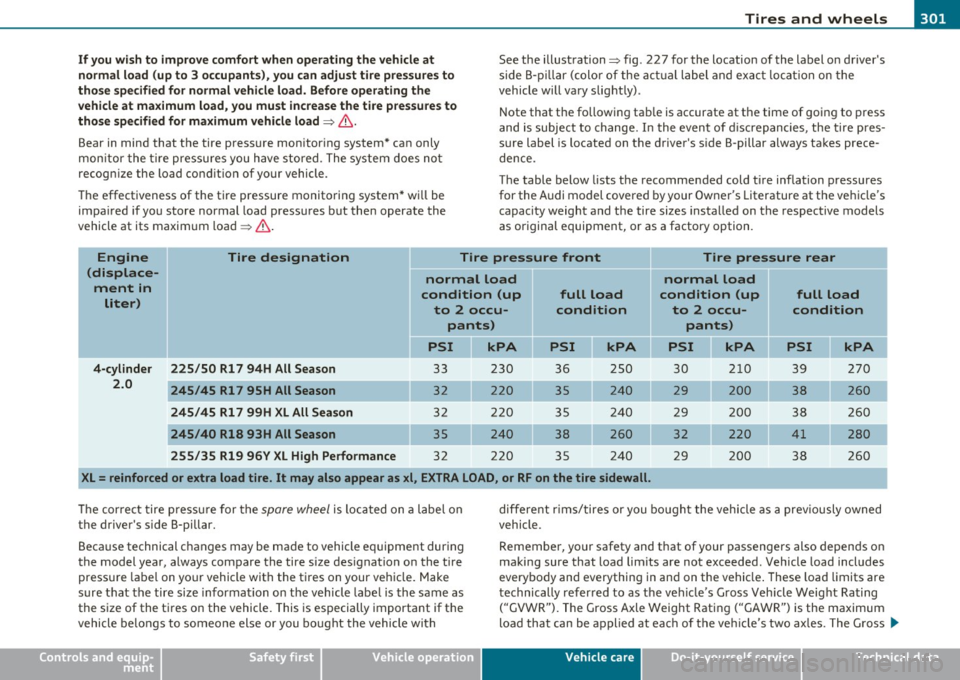
T he table below lists the recommended cold t ire inflation pressures
for the Audi model covered by your Owne r's Literature at t he ve hicle's
capac ity weight and the tire sizes insta lled on the respective models
as original equipment, or as a factory option .
Engine Tire designation Tire pressure front Tire pressure rear
(displace- normal load normal load
ment in
liter) condition (up
full load condition (up
full load
to 2 occu- condition to 2 occu- condition pants) pants)
kPA PSI PSI kPA PSI kPA
4-cylinder 225/50 Rl 7 94H All Season
33 230
36 250
30 2
10 39 270
2.0 245/45
Rl 7 95H All Season 32 220 35 240
29 200 38 260
245/45
Rl 7 99H XL All Season 32 22 0 35 240 2 9 200 3 8 260
245 /40 R18 93H All Sea son 35 240 38 260 32 220 41 280
255/35 R19 96V
XL High Performance 32 220 35 240
29 200 38 260
XL= reinforced or extra load tire . It may also appear as xl , EXTRA LOAD, or RF on the tire sidewall .
The correct tire p ress ure for t he spare wheel is loca ted on a labe l o n
the driver 's s ide B-pillar.
Beca use technical c hanges may be made to vehicle equipment dur ing
the model year, always compare the tire size des ignation on the t ire
pressu re labe l on yo ur vehicle with the t ires on your vehicle. Make
sure that the tire size informat ion on t he v ehicle labe l is the same as
the size of the t ires o n the vehicle. This is especially important if the
vehicle belo ngs to so meone else or you bo ug ht the vehicle with
Safety first
differe nt r im s/ tires or you bo ugh t the vehicle as a prev iously owned
vehicle.
Remember, yo ur safety and t hat of your passengers also depends o n
making sure that load limits are not exceeded. Vehicle load includes
everybody and everything in an d on the vehi cle. These load limits are
t e chnically refer red to as the veh icle's G ross Veh icle Weig ht Rating
("GVW R"). The Gross Axle Weight Rati ng ("GAWR") is the maximum
load tha t can be applied at ea ch of the ve hicle's two ax les . T he G ross ..
Vehicle care Technical data
Page 310 of 364
-~_T_ i_ re _ s_ a_n _ d_ w_ h _e_ e_ ls _________________________________________________ _
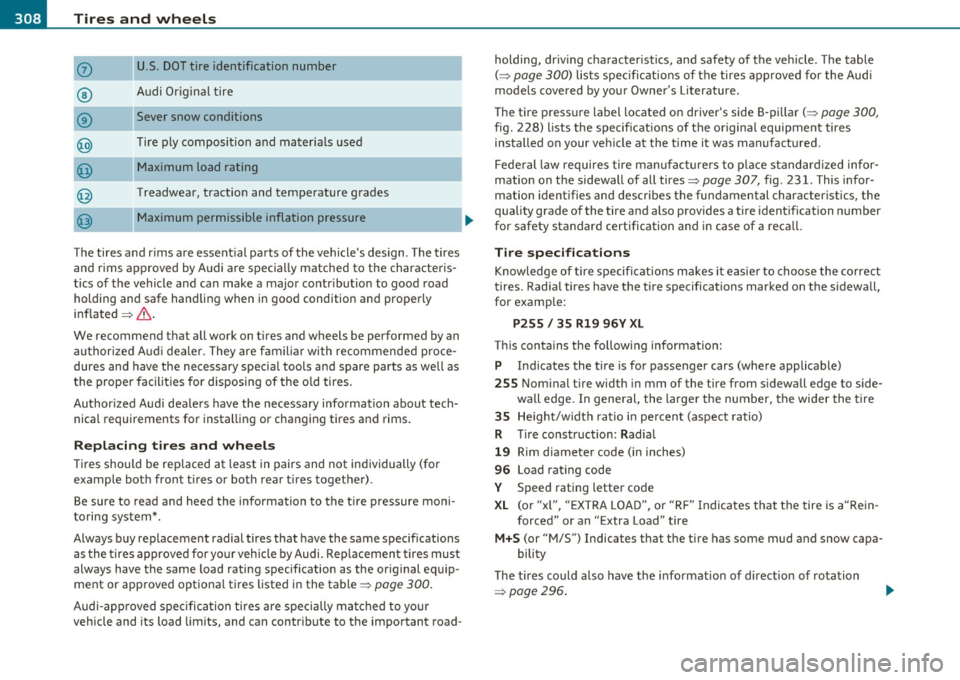
(j)
®
®
@
@
U.S . DOT tire identification number
Audi Original tire
Sever snow conditions
Tire ply composition and materials used Ma ximum load rating
Treadwear, traction and temperature grades M axi mum pe rmissib le inflation pressure
The tires and rims are essential parts of the vehicle's design . The tires
and rims approved by Audi are specially matched to the characteris
tics of the vehicle and can make a major contribution to good road holding and safe handling when in good condition and properly
inflated
~ & .
We recommend that all work on tires and wheels be performed by an
authorized Audi dealer . They are familiar with recommended proce
dures and have the necessary special tools and spare parts as well as
the proper facilities for disposing of the old tires.
Authorized Audi dealers have the necessary information about tech
nical requirements for installing or changing tires and rims.
Replacing tires and wheels
Tires should be replaced at least in pairs and not individually (for
example both front tires or both rear tires together) .
Be sure to read and heed the information to the tire pressure moni
toring system*.
Always buy replacement radial tires that have the same specifications
as the tires approved for your vehicle by Audi. Replacement tires must
always have the same load rating specification as the original equip
ment or approved optional tires listed in the table~
page 300.
Audi-approved specification tires are specially matched to your
vehicle and its load limits, and can contribute to the important road- holding, driving characteristics, and safety of the vehicle
. The table
(~ page 300) lists specifications of the tires approved for the Audi
models covered by your Owner's Literature.
The tire pressure label located on driver's side B-pillar (~
page 300,
fig. 228) lists the specifications of the original equipment tires
installed on your vehicle at the time it was manufactured.
Federal law requires tire manufacturers to place standardized infor
mation on the sidewall of all tires~
page 307, fig. 231. This infor
mation identifies and describes the fundamental characteristics, the
quality grade of the tire and also provides a tire identification number
for safety standard certification and in case of a recall.
Tire specifications
Knowledge of tire specifications makes it easier to choose the correct
tires . Radial tires have the tire specifications marked on the sidewall,
for example:
P255 / 35 R19 96Y XL
This contains the following information:
P Indicates the tire is for passenger cars (where applicable)
255 Nominal tire width in mm of the tire from sidewall edge to side-
wall edge. In general, the larger the number, the wider the tire
35 Height/width ratio in percent (aspect ratio)
R Tire construction : Radial
19 Rim diameter code (in inches)
96 Load rating code
Y Speed rating letter code
XL (or "xl", "EXTRA LOAD", or "RF" Indicates that the tire is a"Rein
forced" or an "Extra Load" tire
M+S (or "M/S") Indicates that the tire has some mud and snow capa
bility
The tires could also have the information of direction of rotation
~page 296.
Page 312 of 364

-~_T_ i_ re _ s_ a_n _ d_ w_ h _e_ e_ ls _________________________________________________ _
& WARNING (conti nu ed )
• Alway s use tire s, rim s and wheel bolts that meet the specifica
tions of original factory-installed tires or other combinat ions that
have been specifically approved by the vehicle manufacturer .
• Tires age even if they are not being used and can fail suddenly,
especially at high speed s. Tires that are more than 6 years old can
only be used in an emergency and then with special care and at
lower speeds.
• Never mount used tir es on your vehicle if you are not sure of
their "previous history. " Old used t ires m ay have been damaged
even though the damage cannot be seen that can lead to sudden
tire failure and loss of vehicle control.
• All four wheels must be fitted with radial tires of the same
type , size (rolling circumference) and the same tread pattern .
Driving with different tire s reduces vehicle handling and can lead
to a loss of control.
• If the spare tire is not the same as the tires that are mounted
on the vehicle - for example w ith winter tires - only use the spare
tire for a short period of time and drive with extra care. Refit the
normal road wheel as soon as safely possible.
• Never drive fa ster than the maximum speed for which the tires
on your vehicle are rated because ti re s that are driven faster than
their rated speed can fail suddenly.
• Overloading tire s cause heat build-up, sudden tire failure,
including a blowout and sudden deflation and loss of control.
• Temperature grades apply to tires that are properl y inflated
and not over or underinflated.
• For technical reasons it is not always possible to u se wheels
from other veh icles- in some cases not even wheels from the same
vehicle model.
• If you install wheel tr im discs on the vehicle wheels , make sure
that the air flow to the brakes i s not blocked . Reduced airflow to
the brakes can them to overheat, increasing stopping distances
and cau sing a collision.
& W ARNING (continued )
• Run flat ti res may only be used on vehicles that were equipped
with them at the factory. The vehicle must have a chassi s designed
fo r run flat tires and a factory-installed tire pressure monitoring
system* that indicates a loss of tire pressure. Incorrect use of run
flat tires can lead to vehicle damage o r accidents. Check with an
authorized Audi dealer or tire speciali st to see if your vehicle can
be equipped w ith run flat tires . If run flat t ires are used , they must
be installed on all four wheels. Mixing tire types is not permitted.
0 Note
• F or tech nical reasons, it is no t gene rally poss ible to use the wheel
r ims from other vehicles . This ca n hold t rue for w heels of the same
veh icle type .
• If the spare tire is different from the tires th at you have mou nted
on yo ur vehi cle (fo r ex am ple w inte r tir es o r wide profile tires), then
use the spa re t ire for a short period of time on ly and d rive with extra
care . Replace t he f lat tire w ith the tire matching the others on your
veh icle as soon as possible.
• N ever dr ive witho ut the valve s te m c ap. The valves coul d get
damaged .
'£> For the sake of the environment
Dispose of old t ires in accordance with the loca l req uirements.
(]] Tips
Tires with t he ident ification "AO" have been specially matched with
your Audi. We recommend us ing only these ti res beca use they meet
t he highest standa rds rega rding saf ety and dr iv ing c ha racteristics
when used correct ly. You r autho rized Audi dealer w ill gladly provide
you with more info rmation. •
Page 315 of 364
Tires and wheels -______________________ Effll
be fitted ove r th e wheel bo lts . These a re available from a uthorized
Au di d eal er s.
& WARNING
Using the wrong snow chains for your vehicle or installing them
incorrectly can increase the risk of loss of control leading to
serious personal injury.
• Snow chains are available in different sizes . Always make sure
to follow the instructions provided by the snow chain manufac
turer.
• When driving with snow chains never drive faster than the
speed permitted for your specific snow chains.
• Always observe local regulations.
0 Note
• Remove snow chains befor e driving on roads not covered w it h
snow to avoid dama gin g tir es and wearing t he snow chai ns dow n
unnece ssaril y.
• Snow chains, which come into direct contact with t he wheel rim,
can scratch o r damag e it. Ther efore, ma ke sure th at th e snow cha ins
are suitably covered. C hec k the pos it io n of the snow cha ins afte r
dr iv in g a few yar ds and correct if ne ce ssa ry . Fo llo w the i nstructions
from t he snow chain ma nufact urer w hen doing so.
[ i ] Tips
W here snow c hains are mandatory on certain roads, this no rmally
a lso a ppl ies to vehicl es wi th a ll w hee l dr ive . •
Safety first
Wheel bolts
Whe el bolts must alway s be tight en ed to th e corre ct
to rqu e.
T he design of wheel bolts is matche d to the fac to ry installed rims. If
differe nt rims ar e fitte d, the cor rec t wheel bolts with the r ight length
and co rrectly s haped bolt hea ds must be used. Th is ensures that
w heel s are fitted s ecur ely and that t he brak e sys te m fun ction s
correctly .
I n certai n circumstances, yo u may not use wheel bolts from a
different veh icle -even if it is th e sam e mode l~
page 345.
& WARNING
Improperly tightened or maintained wheel bolts can become
loose causing loss of control, a collision and serious personal
injury .
• Always keep the wheel bolts and the thread s in the wheel hubs
clean so the wheel bolts can turn easily and be properly tightened.
• Never grease or oil the wheel bolts and the threads in the wheel
hubs. They can become loose while driving if greased or oiled, even
if tightened to the specified torque.
• Only use wheel bolts that belong to the rim being installed.
• Never use different wheels bolts on your vehicle.
• Always maintain the correct tightening torque for the wheel
bolts to reduce the risk of a wheel loss. If the tightening torque of
the wheel bolts is too low , they can loosen and come out when the
vehicle is moving. If the tightening torque is too high, the wheel bolts and threads can be damaged and the wheel can become
loose .
0 Note
The sp eci fied tor qu e for th e wheel bolts i s 90 ft lb ( 120 Nm) wi th a
tole rance of ± 7,4 ft lb( ± 10 Nm). Torque wheel bo lts diagonally. .,_
Vehicle care Technical data
Page 316 of 364
___ T_ ir_e_ s _ a_ n _ d_ w_ h_e_ e_ ls _______________________________________________ _
After changing a wheel, the torque must be checked as soon as
possible with a torque wrench -preferably by an authorized Audi
dealer or qualified workshop. •
Low aspect ratio tires
Your Audi is factory-equipped with low aspect ratio tires. These tires
have been thoroughly tested and been selected specifically for your
model for their superb performance, road feel and handling under a
variety of driving conditions. Ask your authorized Audi dealer for
more details.
The low aspect ratio of these tires is indicated by a numeral of
55 or
less
in the tire's size designation. The numeral represents the ratio of
the tire's sidewall height in relation to its tread width expressed in
percentage. Conventional tires have a height/width ratio of 60 or
more.
The performance of low-aspect-ratio tires is particularly sensitive to
improper inflation pressure. It is therefore important that low
aspect ratio tires are inflated to the specified pressure and that the
inflation pressure is regularly checked and maintained. Tire pres
sures should be checked at least once a month and always before a
long trip=>
page 302, "Checking tire pressure" .
What you can do to avoid tire and rim damage
Low aspect ratio tires can be damaged more easily by impact with
potholes, curbs, gullies or ridges on the road, particularly if the tire is
underinflated.
In order to minimize the occurrence of impact damage to the tires of
your vehicle, we recommend that you observe the following precau
tions:
• Always maintain recommended inflation pressures. Check your
tire pressure every 2,000 miles (3,000 km) and add air if necessary.
• Drive carefully on roads with potholes, deep gullies or ridges. The
impact from driving through or over such obstacles can damage your
tires. Impact with a curb may also cause damage to your tires. •
After any impact, immediately inspect your tires or have them
inspected by the nearest authorized Audi dealer. Replace a damaged
tire as soon as possible.
• Inspect your tires every 2,000 miles (3,000 km) for damage and
wear . Damage is not always easy to see. Damage can lead to loss of
air and underinflation, which could eventually cause tire failure. If
you believe that a tire may have been damaged, replace the tire as
soon as possible.
• These tires may wear more quickly than others.
• Please also remember that, while these tires deliver responsive
handling, they may ride less comfortably and make more noise than
other choices.
Reduced performance in winter/cold season
conditions
All tires are designed for certain purposes. The low aspect ratio, ultra
high performance tires originally installed on your vehicle are
intended for maximum dry and wet road performance and handling.
They are not suitable for cold, snowy or icy weather conditions. If you
drive under those circumstances, you should equip your vehicle with
all-season or winter tires, which offer better traction under those
conditions. We suggest you use the recommended snow or all-season
tires specified for your vehicle, or their equivalent.
Refer to=>
page 311 for more detailed information regarding winter
tires. •
Tire pressure monitoring system
Applies to veh icles: w ith tire pressure monitoring system
General notes '
Each tire, including the spare (if provided), should be checked
monthly when cold and inflated to the inflation pressure recom
mended by the vehicle manufacturer on the vehicle placard or tire
inflation pressure label. (If your vehicle has tires of a different size .,